

Note: This article contains affiliate links. If you click on these links and make a purchase, I may earn a small commission at no extra cost to you. This helps support my research and content. Read my full affiliate disclosure here.
When you are dealing with persistent, established weeds or a site that needs fast, heavy-duty control, choosing the right strength weed killer matters. The wrong formulation can scorch desirable plants, need repeated applications, or simply fail to stop regrowth. This guide examines seven shortlisted heavy-strength options that gardeners commonly consider for aggressive weed problems and hard-to-manage patches. We evaluated each option on how quickly it knocks down vegetation and how long it prevents regrowth, plus application flexibility and safety considerations. Read on to see which formulations match your site conditions and control goals, and to understand the tradeoffs between speed, persistence, and safety.
Top Picks at a Glance
| Best Overall The best all-around choice for most situations | RM43 Concentrated Extended Control Weed Killer, 1 Gallon |  |
| Best Quality Built to a higher standard if you want something more solid | RM43 Total Vegetation Control 43% Glyphosate Plus Weed Preventer, 2.5‑Gallon |  |
| Best Value The sweet spot between price and what you get | Compare-N-Save 1-Gallon Glyphosate Herbicide Concentrate |  |
| Best Budget The cheapest option that still gets the job done reliably | Spectracide Weed & Grass Killer for Driveways & Walkways, 1 Gal |  |
| Highest Rated A top-rated pick with lots of positive feedback | Honcho K6 Glyphosate Herbicide, Concentrated 2.5 Gallon |  |
| Most Popular A crowd favorite that many people choose with confidence | Roundup Weed & Grass Killer4 with Pump 'N Go 2 Sprayer, 1.33 gal. |  |
| Best Seller A high-volume bestseller chosen again and again | Roundup Weed & Grass Killer4 Refill, 1.25 gal. |  |
RM43 Concentrated Extended Control Weed Killer, 1 Gallon

| Unit Count | 128 Fluid Ounces |
|---|---|
| Liquid Volume | 1 gallons |
| Item Form | Spray |
| Coverage | 17297 square feet |
| Active Ingredients | glyphosate |
RM43 is a concentrated, mix-with-water herbicide designed for broad, long-lasting control of unwanted vegetation on non-crop areas such as fence lines, driveways, and around buildings. It combines glyphosate with additional control chemistry and a surfactant so it kills to the root and helps prevent regrowth for up to a year when applied correctly. Typical use is to dilute the concentrate, add to a sprayer, and treat patches or larger sections; one gallon treats a large area when mixed per directions. Notable features include fast rainfastness in about two hours and no re-entry restrictions after the spray dries, which simplifies timing around pets and people. Practical benefits are reliable eradication of persistent weeds and long residual control that reduces repeat treatments. Important limitations are that it is non-selective and must never be applied near desirable plants, and users must follow safety and disposal instructions carefully because it is a powerful herbicide.
Best for: Buyers who want a one-application, long-duration solution for clearing and keeping non-crop areas weed-free and who are willing to follow safety precautions when using concentrated herbicides.
Less Ideal for: Homeowners seeking a selective lawn-safe product or gardeners who need to treat mixed beds with desirable plants should choose a targeted or selective herbicide instead.
- Concentrated formula covers a large area when mixed, reducing how often you need to buy product.
- Kills to the root for thorough control of persistent weeds.
- Provides up to 12 months of prevention in treated non-crop areas.
- Rainfast in about two hours and no entry restrictions after drying make timing easier.
- Non-selective chemistry will damage or kill any desirable plants if contacted.
- Contains strong active ingredients that require careful handling, protective gear, and correct disposal.
Verdict: Choose RM43 when you need a concentrated, long-lasting total vegetation control that kills to the root and reduces the frequency of re-treatment on non-crop areas.
RM43 Total Vegetation Control 43% Glyphosate Plus Weed Preventer, 2.5‑Gallon
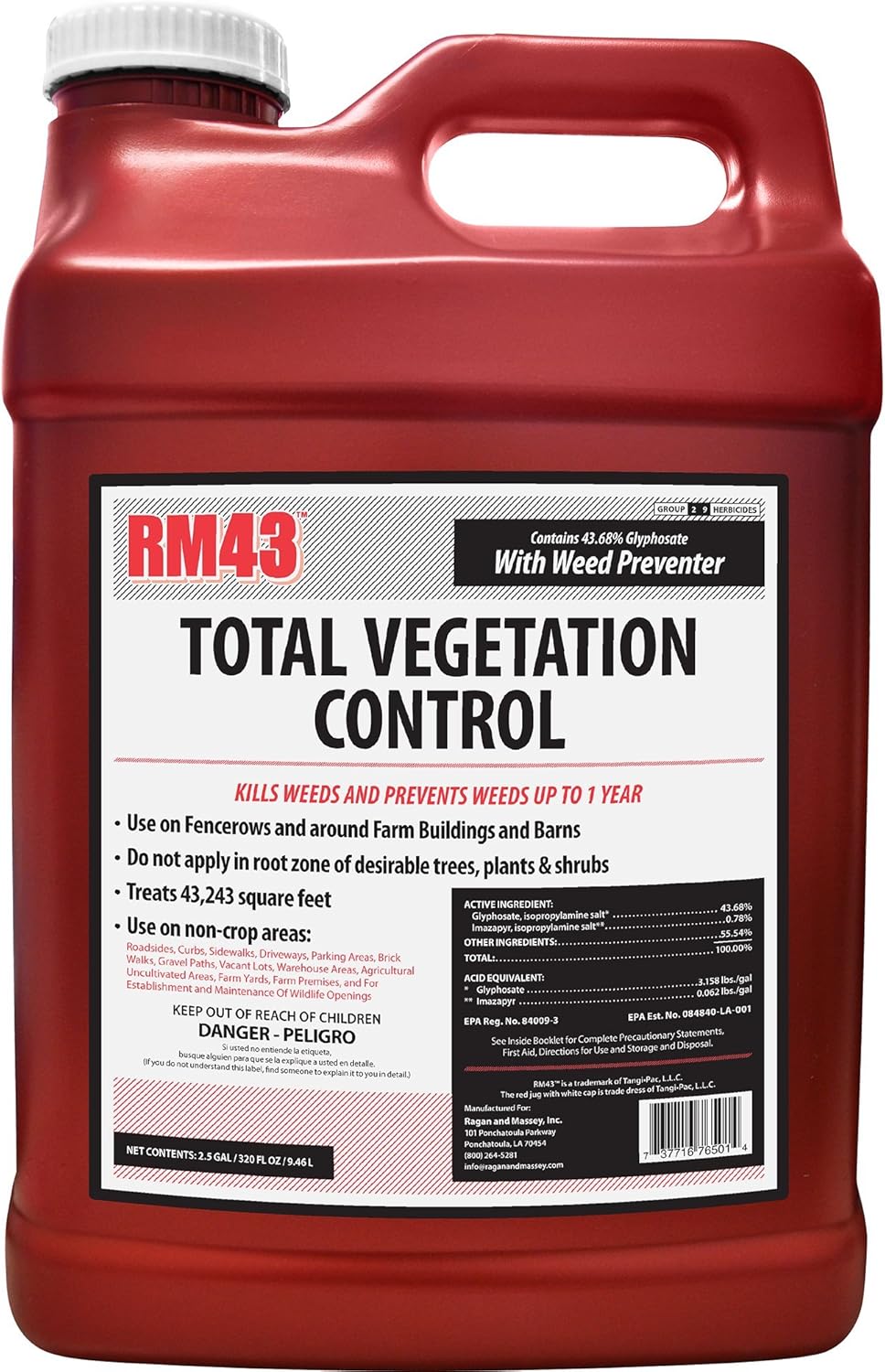
| Unit Count | 320 Fluid Ounces |
|---|---|
| Liquid Volume | 320 fluid ounces |
| Coverage | 243 243 square feet |
| Item Form | Liquid |
| Active Ingredients | Glyphosate isopropylamine salt, Imazapyr isopropylamine salt |
RM43 Total Vegetation Control is a heavy‑duty herbicide concentrate designed for long‑term clearance of unwanted growth on non‑crop areas. Mixed to make spray solution, it is labeled for fence rows, gravel paths, driveways, parking areas and around buildings where you want vegetation eliminated and prevented for up to 12 months. The formula combines glyphosate and imazapyr, so it knocks back grasses, broadleaf weeds, vines, brush and small woody regrowth and becomes rainfast in about two hours. Practical benefits include large coverage from a single 2.5‑gallon container and flexibility for spot treatments or treating bare ground for total vegetation control. Important limitations are that it is for use only where you want no plants to grow and must not be applied over roots of desirable plants since residual activity can affect nearby vegetation; it is not suitable for crop or ornamental areas. Users should follow label directions for mixing, application and safety precautions when handling a concentrated herbicide.
Best for: Buyers who prioritize powerful, lasting weed control on non‑crop land and need a single solution to clear large areas and prevent regrowth for up to a year.
Less Ideal for: Home gardeners who need selective treatments near flowers, lawns, edible plants, or anyone looking for a temporary or non‑residual weed control solution.
- Concentrated formula covers large areas from one container
- Combines glyphosate and imazapyr for control of weeds, brush and small trees
- Rainfast in about two hours, reducing loss from unexpected wet weather
- Suitable for both spot treatments and total vegetation control on bare ground
- Not selective and will damage any desirable plants if drifted or applied over roots
- Intended only for non‑crop areas so not appropriate for lawns, gardens or around ornamentals
Verdict: Choose RM43 when you need a professional‑strength, long‑lasting herbicide to clear and prevent vegetation across large non‑crop areas.
Compare-N-Save 1-Gallon Glyphosate Herbicide Concentrate

| Active Ingredients | glyphosate |
|---|---|
| Liquid Volume | 1 gallons |
| Item Form | Spray |
| Coverage | 25000 square_feet |
This 1-gallon Compare-N-Save concentrate delivers a high-percentage glyphosate solution for killing established annuals, perennials, and grasses. You mix the concentrate with water (recommended 1.5 oz per gallon for general weeds, up to 2.5 oz for tough perennials) to make ready-to-use spray that is applied directly to foliage. It works systemically so the herbicide is absorbed through leaves and translocated to roots, producing visible decline in 2 to 4 days and rainproofing in about two hours. The bottle covers a large area and can make up to 85 gallons of spray, making it efficient for treating driveways, walkways, fence lines, garden renovation and spot removal. Important practical limits are that it will kill any green plant it contacts so careful spraying and protective gear are required, and it offers no residual control so repeat treatments or follow-up maintenance are necessary. Follow label directions for safe use around edible gardens and during windy conditions to avoid drift.
Best for: Buyers who want a cost-effective, high-strength herbicide to remove established weeds and restore or prepare large outdoor areas with minimal mixing and repeat trips.
Less Ideal for: Homeowners who need a selective lawn-safe product or who prefer a residual pre-emergent solution should consider alternatives.
- Concentrated glyphosate formula makes large volumes of spray from one bottle
- Systemic action kills to the root for durable removal of treated plants
- Fast-acting with visible results in 2 to 4 days and rainproof in about 2 hours
- Versatile for driveways, walkways, fence lines, garden prep and stump or brush treatment
- Non-selective and will kill any green plant it touches requiring careful application
- Contains glyphosate which requires protective equipment and adherence to safety directions
Verdict: A concentrated, workhorse glyphosate concentrate for anyone needing an economical, fast-acting solution to kill established weeds and grasses.
Spectracide Weed & Grass Killer for Driveways & Walkways, 1 Gal

| Unit Count | 128 Fluid Ounces |
|---|---|
| Coverage | 6,400 square feet |
| Item Form | Spray |
| Active Ingredients | Diquat Dibromide 0.12%, Fluazifop-P-Butyl 0.06%, Dicamba, Dimethylamine Salt |
Spectracide Weed & Grass Killer is a one-gallon, ready-to-use spray designed for spot treating unwanted weeds and grasses on hard surfaces and around planting areas. It is intended to be used with the AccuShot sprayer cap for continuous spraying and an extendable wand to improve accuracy and reduce hand fatigue. The formula claims visible results in about three hours and becomes rainproof in 15 minutes, so light rain shortly after application should not reduce effectiveness. It kills down to the root and allows replanting of flowers, trees, or shrubs after one day. Practical benefits include wide coverage per bottle and an easy-to-operate sprayer system for directed applications near desirable plants. Important limitations are that it must be applied carefully to avoid drift onto desirable vegetation and that it is formulated for spot treatments rather than broadcast lawn use. Follow safety directions closely to protect people, pets, and nearby plants.
Best for: Buyers wanting an affordable, no-mix solution to remove weeds from driveways, walkways, and around beds who prioritize straightforward, targeted treatments over lawn-wide programs.
Less Ideal for: Those looking for a lawn-safe, broadcast weed control for large turf areas or users who prefer organic or non-chemical weed management methods.
- Ready-to-use pre-mixed formula requires no measuring or mixing
- Works on both broadleaf weeds and grasses and claims root-killing action
- Rainproof in 15 minutes so light rain shortly after application will not wash it away
- Designed for use with AccuShot sprayer and extendable wand for targeted application
- Not suitable for broadcast lawn treatments since it is intended for spot and hard-surface use
- Contains strong active ingredients so careful application and protective measures are required
Verdict: A budget-friendly, ready-to-use spot treatment that delivers fast, rainproof control of weeds and grasses on driveways and walkways.
Honcho K6 Glyphosate Herbicide, Concentrated 2.5 Gallon

| Active Ingredients | Glyphosate potassium salt 48.7% |
|---|---|
| Item Form | Liquid |
| Unit Count | 320 Fluid Ounces |
| Included Components | (1) 2.5 Gallon Jug of Honcho K6 |
Honcho K6 is a high-load potassium glyphosate concentrate designed for post-emergent, systemic control of a wide range of weeds, brush, vines, and woody plants. It is applied by mixing with water or other carriers and using field or industrial sprayers to deliver foliar coverage; the built-in surfactant helps the solution spread and be absorbed into plant tissue so the herbicide translocates to roots. Because it is non-selective and leaves no soil residual, it is useful for fence rows, farmsteads, shrub bed cleanups, turf renovation when replanting, and large-area spot treatments. The large 2.5 gallon size supplies multiple applications for property-scale needs and reduces the frequency of repurchase. Important limitations are that it will damage or kill desirable plants if contacted and that label restrictions prohibit use in some states, so careful handling, personal protective equipment, and strict adherence to label directions are required.
Best for: Buyers who prioritize dependable, broad-spectrum weed control for large yards, farmsteads, or commercial properties and want a concentrated product that handles multiple applications between purchases.
Less Ideal for: People seeking a selective or soil-residual herbicide for delicate beds or homeowners who need spot treatments near desirable plants should consider more targeted options.
- High-concentration glyphosate formula for reliable translocation and control of top growth and roots
- Built-in surfactant improves leaf coverage and uptake for more consistent results
- Large 2.5 gallon container supplies multiple applications for property or farm use
- No soil residual activity, allowing replanting without long-term soil persistence
- Non-selective and will harm desirable plants on contact
- Label restrictions prevent use in some states and require strict safety measures
Verdict: Choose Honcho K6 when you need a concentrated, reliably systemic glyphosate solution for large-scale, post-emergent weed and brush control.
Roundup Weed & Grass Killer4 with Pump 'N Go 2 Sprayer, 1.33 gal.

| Unit Count | 170 Fluid Ounces |
|---|---|
| Item Form | Spray |
| Coverage | 300 Square_Feet |
| Active Ingredients | Triclopyr; Fluazifop-P-Butyl; Diquat Dibromide |
This Roundup kit combines a pre-mixed 1.33 gallon herbicide with a Pump 'N Go 2 sprayer for spot treatment around beds, driveways, and foundations. It is formulated to kill common tough weeds and grasses down to the root and lists active ingredients that target both broadleaf weeds and grasses. The pump sprayer gives up to about 10 minutes of continuous spray and an extendable wand for more accurate application without bending over. In practice you can treat cracks, edging, and landscape beds and expect visible dieback in hours and rainproof protection in roughly 30 minutes, with planting guidance provided on the label. Important limitations are standard for concentrated herbicides: it is toxic to desirable plants and requires careful application, protective clothing, and keeping people and pets away until the spray dries. It also contains multiple active ingredients which some buyers may prefer to avoid if they want a single-ingredient option or an organic approach.
Best for: Buyers who want a fast, effective, easy-to-use herbicide system for targeted weed control and value social proof that it performs on common tough weeds.
Less Ideal for: Gardeners who prioritize organic or single-ingredient products or who need a nonselective option safe for use near desirable plants and high-traffic areas with pets and children.
- Ready-to-use system with built-in Pump 'N Go 2 sprayer for immediate application
- Kills a wide range of broadleaf weeds and grasses to the root
- Visible results in hours and becomes rainproof in about 30 minutes
- Extendable wand and continuous spray capability improve accuracy and reduce bending
- Must be kept off desirable plants and requires careful, protective handling
- Contains multiple synthetic active ingredients which some users may want to avoid
Verdict: A convenient, ready-to-use herbicide kit with a built-in pump sprayer that delivers fast, reliable control of common tough weeds and grasses.
Roundup Weed & Grass Killer4 Refill, 1.25 gal.

| Unit Count | 160 Fluid Ounces |
|---|---|
| Item Form | Spray |
| Coverage | 375 square feet |
| Active Ingredients | Triclopyr, Fluazifop P-Butyl, Diquat Dibromide |
This 1.25 gallon Roundup Weed & Grass Killer4 refill is made to top up a compatible spray container and tackle stubborn broadleaf weeds and grasses around yards and hardscapes. You pour the concentrate into an empty applicator (do not dilute), then spray where needed—flower bed edges, driveways, walkways, mulch and around trees and shrubs. The formula lists multiple active ingredients and claims visible effects within hours and rainproofing in about 30 minutes, which helps minimize reapplication after unexpected showers. Coverage is stated at about 375 sq ft, so one refill is suitable for small to medium targeted jobs. Important limitations are safety and timing: treated areas must stay clear until the spray dries and the label gives specific replanting windows of 1 to 30 days depending on use. Because it is a concentrated herbicide with multiple actives, careful application is required to avoid drift onto desirable plants and to follow all safety directions on the label.
Best for: Buyers who prioritize predictable, proven weed control and want a refillable, fast-acting product for targeted spots and edges around a typical lawn or garden.
Less Ideal for: Gardeners who need a ready-to-use spray out of the bottle or who plan to treat large acreage in a single pass should consider alternatives.
- Concentrated refill covers up to about 375 sq ft for targeted weed control
- Fast-acting formula with visible results in hours and rainproofing in as little as 30 minutes
- Multiple active ingredients target both broadleaf weeds and grassy weeds
- Designed to refill an existing applicator for quick, familiar use
- Requires careful handling and strict adherence to label directions for safety and replanting timing
- Not a ready-to-use spray so an appropriate applicator is required
Verdict: Choose this refill if you want a fast, concentrated weed killer for reliable spot and edge control with quick rain resistance.
Choosing the Right Strength Weed Killer: Key Factors to Consider
Knockdown Speed and Visible Results
How quickly a product wilts or browns target weeds matters when you need an immediate reduction in competition. Fast-acting chemistries show visible symptoms within hours to days, which helps when you are clearing a planting area or treating an unsightly patch. However, rapid visual control does not always equal long-term suppression; some fast-acting products require follow-up to prevent regrowth.
Assess knockdown speed against your tolerance for repeat treatments. If you need quick removal for a prep job such as renovating a bed, prioritize faster-acting formulations. For maintenance where immediate aesthetics are less important, slower systemic action that moves into roots can provide more lasting control.
Residual Activity and Regrowth Prevention
Residual activity refers to how long a product continues to prevent new weeds from emerging after application. Some strong formulations include residual soil activity that suppresses germinating seeds for weeks, which reduces the need for frequent retreatment in bare soil areas or pathways. Other options are non-residual and only kill established foliage, requiring repeat applications or integrated cultural controls to stop reinfestation.
Consider residual activity when treating seedbanks or when treating edges and hardscapes where new seedlings are likely to appear. Be aware that residual chemicals near vegetable beds or ornamentals can create crop safety concerns, so choose accordingly and follow label buffers.
Selectivity and Risk to Desirable Plants
Stronger weed killers vary in their selectivity. Some are non-selective and will damage any green plant contacted, while others are selective for grassy or broadleaf species. Non-selective, high-strength products are useful for spot treatments on driveways, patios, and cleared beds but are risky near desirable plants. Selective options let you treat weeds in lawns or certain landscapes with less collateral damage.
Match selectivity to the treatment area. When working near ornamentals, use targeted applications or a selective chemistry. When clearing a plot for renovation, non-selective options provide reliable control but require careful application technique to avoid drift or overspray.
Application Method and Coverage
How you apply a Strength Weed Killer affects effectiveness and safety. Ready-to-use sprays, concentrates mixed in a pump sprayer, and spot-gel applicators each offer different control patterns. Broad broadcast sprays cover large areas quickly but increase the risk of off-target exposure. Spot treatments conserve product and reduce drift but are labor intensive for large infestations.
Choose an application method that suits the size of the problem and your comfort with spray equipment. For edges and cracks, a targeted liquid or gel reduces waste. For large, dense stands of weeds, a sprayer with good nozzle control gives more uniform coverage.
Safety, Handling, and Environmental Considerations
Stronger chemistries often require stricter personal protective equipment, careful mixing, and attention to weather conditions to avoid drift or runoff. Read label directions for required gloves, eye protection, and re-entry intervals. Consider nearby water features, pollinator habitat, and soil health when selecting a product; some formulations carry restrictions around waterways and flowering plants.
Plan applications for calm, dry weather and keep treated areas away from irrigation until the product has settled or as the label directs. Safe storage and disposal of unused concentrate and application rinse water are also important to protect people and the environment.
Contact Versus Systemic Action
Contact weed killers damage the parts of the plant they touch and are best for annuals and green foliage, but they often leave the root system intact. Systemic products travel into roots and storage organs, offering better control of perennials and underground structures. In heavy infestations of perennial species, systemic action increases the likelihood of lasting control.
Decide whether you need immediate topgrowth removal or deeper rootkill. For established perennial weeds, prioritize systemic formulations and expect slower visible symptoms. For quick cleanup of seedlings and shallow-rooted weeds, contact herbicides can be effective and faster acting.
Matching Strength to Site Situation
Assess the treatment site before picking a formulation. Hard surfaces, gravel paths, and heavily infested fallow beds tolerate non-selective heavy-strength control, while mixed planting beds and near ornamentals require more selective approaches or physical removal.
When working near desirable plants, protect them with shields, avoid broadcast sprays, and consider spot applications or wicking methods. For large, open areas with dense weed cover, choose a method that balances coverage rate with minimizing drift.
- Use non-selective products on patios, driveways, and cleared plots.
- Prefer selective or targeted applications in mixed plantings.
- Consider pre-treating barriers or mulches where chemical control is unsuitable.
Timing Treatments for Best Results
Timing affects how well a herbicide moves into a plant. Many systemic products work best when applied to actively growing weeds before they set seed. Late-summer and early-fall applications can be effective because plants translocate resources to roots as growth slows, carrying systemic actives downward.
Avoid treating during drought stress or immediately after heavy rain. Calm, dry weather promotes better uptake and reduces off-target movement.
- Target young, actively growing weeds for quicker uptake.
- Avoid applications during drought or extreme heat.
- Allow time between treatment and irrigation as directed on the label.
Application Techniques That Reduce Risk
Use low-drift nozzles, shielded wands, or foam/gel applicators to limit contact with desirable plants and reduce drift. Spot-spraying and wiping cut down on the amount of product used and the chance of runoff.
Calibrate sprayers for the correct output and maintain equipment to prevent leaks. Follow mixing instructions exactly and triple-rinse sprayer tanks after use when label guidance requires it.
- Calibrate sprayer output before treating large areas.
- Use shields or hand-held shields when spraying near ornamentals.
- Consider non-spray applicators for tight spaces and cracks.
Dealing with Tough Perennials and Regrowth
Persistent perennials often need repeated treatments and integrated management. Combine systemic applications with mechanical removal of crown and root fragments where feasible. When roots are extensive, plan for follow-up treatments timed to when regrowth is most vulnerable.
Be realistic about timelines. Eliminating deep-rooted species can take months and more than one season of targeted applications combined with cultural controls like mulching and solarization.
- Expect multiple treatments for deeply rooted perennials.
- Use systemic actives and follow-up mechanical control for best results.
- Restore treated areas with mulch or desirable plantings to reduce reinfestation.
Minimizing Environmental Impact
Protect water features, pollinators, and beneficial plants by following label buffers and avoiding applications during bloom when foraging insects are present. Use the lowest effective rate and avoid broadcast treatments near sensitive zones.
Dispose of rinse water and unused product according to local regulations and label instructions. When possible, combine chemical control with cultural practices like improved edging, mulching, and targeted cultivation to lower overall chemical use.
- Never apply near standing water unless the product is labeled for it.
- Avoid treating flowering plants and areas with high pollinator activity.
- Follow local disposal rules for leftover concentrate and rinsate.
How We Chose the Best Strength Weed Killer
We shortlisted products that are formulated and labeled for heavy-duty weed control and that offer clear application guidance for garden and landscape use. Selection focused on four to six concrete performance and usability dimensions that matter in real gardens: initial kill speed, residual activity against regrowth, selectivity and risk to nearby plants, application options and ease of use, and safety/handling requirements for homeowners. We also looked for products with practical label instructions for common garden scenarios such as spot treatments, broad-area broadcast, and use near hardscapes. Excluded from the list were products intended only for turf, aquatic use, or industrial vegetation control where homeowner application is restricted. We also excluded specialty formulations that target only a narrow set of species if they lacked broader efficacy claims. The final picks represent a range of application methods and active-ingredient profiles so gardeners can match strength and persistence to the infestation size and proximity to desirable plants.
FAQ
How soon will I see weeds die after applying a strong weed killer?
Visible wilting or browning can appear within hours to a few days for contact chemistries, while systemic products may take one to three weeks to show full effects as the herbicide moves into the root system.
Can I use a high-strength product in my vegetable garden?
Using strong, non-selective formulations in vegetable beds is generally not recommended because they can leave residues or harm crops. If you must treat nearby areas, choose a selective product, apply carefully, and follow label re-entry and planting interval guidance.
How many applications are usually needed to control perennial weeds?
Control of deep-rooted perennials often requires multiple treatments. Expect at least two applications spaced according to label guidance, combined with mechanical removal or solarization for better long-term control.
Is it safe to apply strong weed killers when pollinators are active?
It is safer to avoid applications during bloom or times when pollinators are foraging. Many labels advise avoiding applications to flowering plants and recommend timing treatments for early morning or late evening when insect activity is lower.
Can I water or mow immediately after treatment?
You should follow label instructions because watering or mowing too soon can reduce effectiveness. Some products need a dry window to be absorbed, while others tolerate limited irrigation after a certain period.
How do I protect nearby shrubs and lawns during a heavy-duty treatment?
Use physical shields, spot-apply with wands or gel applicators, and avoid broadcast spray patterns near desirable plants. Keep a buffer zone and consider selective chemistries when treating close to ornamentals or turf.
Final Verdict
Choosing the right Strength Weed Killer requires balancing rapid knockdown with the level of residual control you need and the risk to nearby plants. Prioritize systemic actives for stubborn perennials and consider contact options for quick cleanup of seedlings or green foliage. Match application method and timing to the site to reduce drift and environmental risk. Make decisions based on the infestation size, proximity to desirable plants, and how quickly you need visible results. With careful application and follow-up, you can bring heavy weed problems under control while protecting the rest of your garden.
