

Note: This article contains affiliate links. If you click on these links and make a purchase, I may earn a small commission at no extra cost to you. This helps support my research and content. Read my full affiliate disclosure here.
Floratam is a widely planted warm-season turf that tolerates heat and traffic but reacts differently to herbicides than other St. Augustine varieties. Choosing the right weed killer matters because an incompatible active ingredient can scorch or thin this grass, leaving bare patches and inviting more weeds. This guide looks at five top picks chosen for their balance of broadleaf control and Floratam safety, plus settings where spot treatment or lawn-wide application is appropriate. We summarize the factors that affect results in the real yard, such as timing, application method, and recovery time. Below you will find the shortlisted products and the criteria used to evaluate them, followed by practical advice for application, timing, and managing treated turf.
Top Picks at a Glance
| Best Overall The best all-around choice for most situations | Ortho Weed B Gon Ready-To-Spray for St. Augustinegrass (32 oz) |  |
| Best Quality Built to a higher standard if you want something more solid | Southern Ag Atrazine St. Augustine Weed Killer, 32 oz |  |
| Best Budget The cheapest option that still gets the job done reliably | Image Weed Killer for Southern Lawns Ready-to-Spray, 32 fl oz |  |
| Highest Rated A top-rated pick with lots of positive feedback | Image Herbicides Liquid Weed Killer Concentrate for Southern Lawns, 32 oz |  |
| Most Popular A crowd favorite that many people choose with confidence | BioAdvanced Season Long Lawn Weed Killer + Preventer for Southern Lawns, 10 lb |  |
Ortho Weed B Gon Ready-To-Spray for St. Augustinegrass (32 oz)

| Unit Count | 32 Ounce |
|---|---|
| Item Form | Spray |
| Coverage | 2500 sq ft |
| Liquid Volume | 32 fluid ounces |
This ready-to-use Ortho Weed B Gon is formulated specifically for St. Augustinegrass and designed to kill more than 250 listed weeds without harming the turf when used as directed. It comes as a 32-ounce spray bottle with an easy-grip control for broadcast applications, so you can walk and spray rather than mixing chemicals. The label notes it becomes rain-proof in about an hour and covers roughly 2,500 square feet, which makes it convenient for small to medium lawns. Practical benefits include targeted weed control for Floratam lawns and the convenience of a pre-mixed spray that removes measuring and dilution steps. Important limitations are that it is labeled only for St. Augustinegrass (sold in select southern states), so it should not be used on other turf types, and users must follow safety directions to avoid contact with skin, eyes, and pets. Expect reliable spot and broadcast control on listed weeds but restrict use to the grass types specified on the label to avoid damage.
Best for: Homeowners with St. Augustine or Floratam lawns who want a convenient, ready-to-use product for routine weed control and easy broadcast application.
Less Ideal for: People with different turf varieties, large acreage lawns, or those seeking an all-purpose, nonselective herbicide should consider other products.
- Ready-to-spray bottle eliminates mixing and measuring
- Formulated specifically for St. Augustinegrass including Floratam
- Covers up to 2,500 sq ft for small to medium lawns
- Rain-proof in about 1 hour for quicker weather windows
- Labeled only for St. Augustinegrass so not suitable for other turf types
- Contains chemicals that require careful handling and keeping away from children and pets
Verdict: A convenient ready-to-spray herbicide that delivers targeted weed control for Floratam and other St. Augustinegrass lawns.
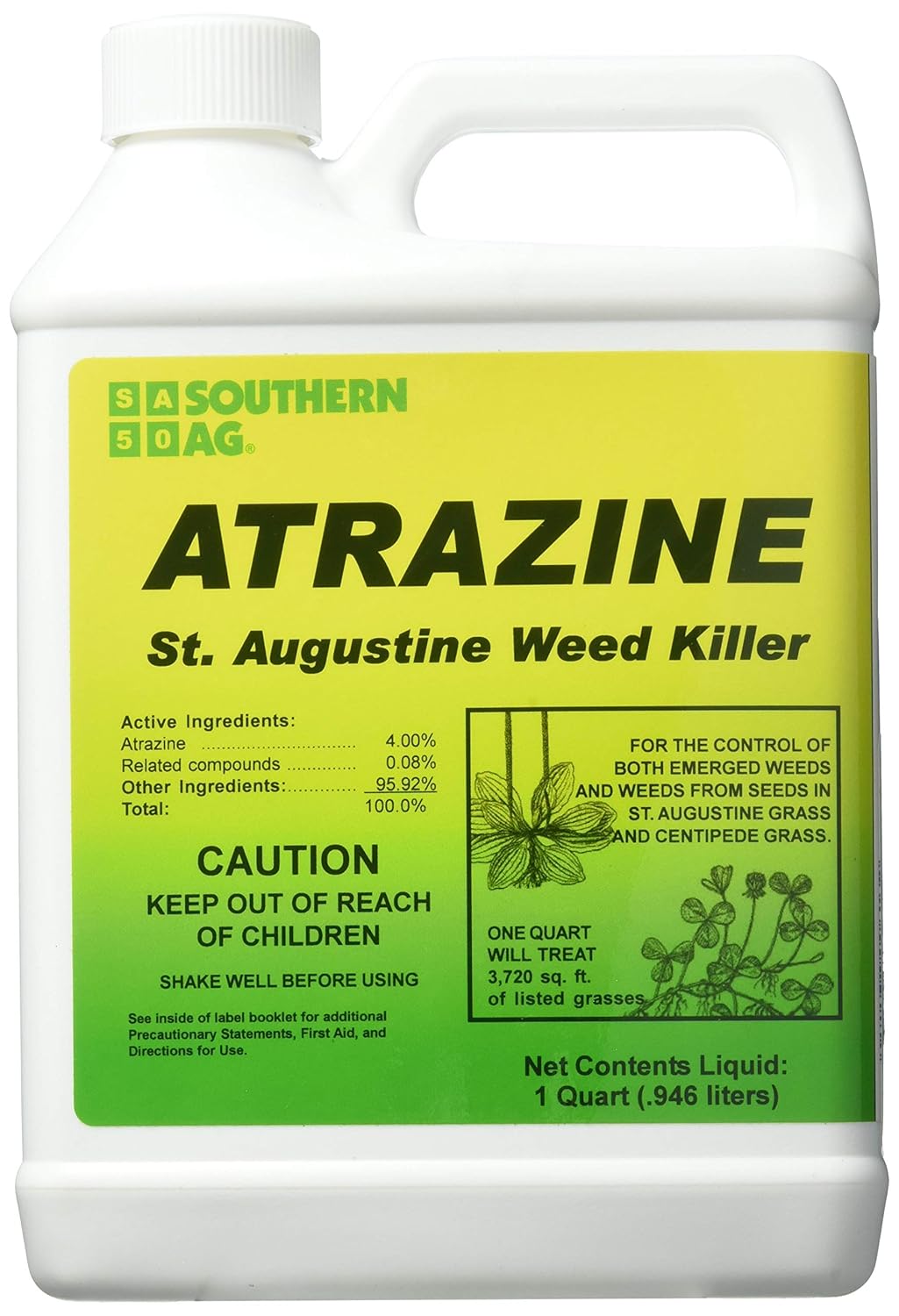
Southern Ag Atrazine St. Augustine Weed Killer, 32 oz
| Unit Count | 32 Fluid Ounces |
|---|---|
| Item Form | Spray |
| Coverage | 3,720 square_feet |
| Item Type Name | Specialty Herbicide |
Southern Ag Atrazine is a concentrated liquid herbicide made specifically for St. Augustine and centipede grasses. It is mixed into spray and applied across the lawn to suppress crabgrass and remove many common broadleaf and grassy weeds; one quart claims coverage of roughly 3,720 square feet when diluted at the recommended rate. The product is intended for targeted seasonal use, with best results from early spring applications and careful, overlap-free spraying. Practical benefits include a focused label for the two grass types and a coverage rate that stretches a single bottle across a medium-sized yard, which helps keep costs down. Important limitations are that it is a chemical herbicide requiring careful handling and strict label following, it is not recommended for hose-end sprayers, and it is not a fertilizer so it will not improve turf nutrition or overall lawn health by itself. Use protective gear and avoid off-target drift to protect desirable plants.
Best for: Buyers who need an affordable, targeted weed control for St. Augustine or centipede lawns and want a product that covers a medium-sized yard without repeated purchases.
Less Ideal for: Homeowners seeking an all-in-one lawn treatment for nutrition or for use on other grass types should choose a different product or combine this with appropriate fertilization.
- Formulated specifically for St. Augustine and centipede lawns for targeted control
- Concentrated formula with coverage up to about 3,720 sq ft per quart
- Controls a range of broadleaf and some grassy weeds including suppression of crabgrass
- Practical application instructions for spot or broadcast spray use in early spring
- Chemical herbicide that requires protective handling and careful application
- Not a fertilizer so it does not provide nutrients or improve turf vigor
Verdict: A cost-effective, concentrated herbicide for homeowners who need focused weed control on St. Augustine or centipede lawns.
Image Weed Killer for Southern Lawns Ready-to-Spray, 32 fl oz

| Item Form | Liquid |
|---|---|
| Coverage | 5,000 sq. ft |
| Unit Count | 32 Fluid Ounces |
| Active Ingredients | Penoxsulam & Sulfentrazone |
This ready-to-spray Image weed killer connects to a garden hose for quick coverage of a typical yard and is formulated specifically for southern lawns, including Zoysia. It targets broadleaf weeds such as dandelion, chickweed, and clover and starts showing results within hours while being labeled as safe for southern turf when used as directed. The 32-ounce bottle covers up to 5,000 square feet, making it convenient for homeowners who want a single-step spray solution instead of mixing concentrates. Practical benefits include easy hose-end application, a fast-acting formula, and active ingredients designed to control tough weeds down to the root. Limitations are that it is a broadleaf herbicide, so it will not control grassy weeds and requires following temperature and safety instructions exactly to avoid turf damage or contact with people and pets. For spot treatments or small lawns the hose connection may waste product compared with a targeted sprayer, and repeat applications may be necessary for persistent infestations.
Best for: Homeowners with southern lawns who want a low-effort, budget-friendly way to knock back broadleaf weeds across medium to large yards and prefer a hose-end product over mixing concentrates.
Less Ideal for: Gardeners needing selective control of grassy weeds, those with very small lawns who want to minimize product use, or users who prefer spot treatment with a hand sprayer.
- Ready-to-spray hose-end design for fast, no-mixing application
- Formulated for southern turf including Zoysia, Bermudagrass, St. Augustine, and Centipedegrass
- Covers up to 5,000 sq. ft. from a single bottle
- Fast-acting formula that visibly reduces broadleaf weeds within hours
- Does not control grassy weeds or grassy weed species
- Requires careful application and adherence to temperature and safety directions to avoid damage or exposure
Verdict: A convenient, ready-to-spray herbicide designed to quickly reduce broadleaf weeds in Zoysia and other southern lawns with minimal fuss.
Image Herbicides Liquid Weed Killer Concentrate for Southern Lawns, 32 oz

| Item Form | Liquid |
|---|---|
| Coverage | 5000 square_feet |
| Unit Count | 32 Fluid Ounces |
| Active Ingredients | Penoxsulam |
This Image Herbicides concentrate is a post-emergent liquid designed specifically for southern turfgrasses like St. Augustine, Floratam, Bermuda, centipede and zoysia. You mix the measured amount into a sprayer, apply evenly across the lawn and should see effects within hours on common broadleaf weeds such as dandelion, clover and chickweed. The product uses penoxsulam as the active ingredient and advertises coverage up to 5,000 square feet from the package volume. Practical benefits include a formulation tuned for warm-season grasses that claims to be safe when applied as directed and a fast-acting result on roots as well as foliage. Important limitations are that it is intended for use in spring or summer when temperatures are between about 45 and 90 F and it targets broadleaf weeds rather than grasses or all weed types. Like all concentrated herbicides it requires careful measuring and proper sprayer application to avoid off-target damage to desirable plants.
Best for: Homeowners with warm-season southern lawns who want a targeted, fast-acting solution for broadleaf weeds and prefer a concentrated product to treat multiple areas.
Less Ideal for: Gardeners needing a non-selective or grass-targeting herbicide or those with cool-season lawns should look for products formulated for their turf type or broader weed control needs.
- Formulated specifically for warm-season southern turfgrasses so less risk to those lawns when used correctly
- Fast-acting on broadleaf weeds with root-killing activity
- Concentrate format treats a large area from one bottle (coverage listed as 5000 sq ft)
- Not a non-selective or grass weed killer so it will not control grassy weeds
- Use window limited to warmer seasons and specific temperature range
- Requires accurate mixing and sprayer application to avoid harming nearby plants
Verdict: A concentrated, fast-acting broadleaf herbicide made for warm-season southern lawns that treats large areas when applied correctly.
BioAdvanced Season Long Lawn Weed Killer + Preventer for Southern Lawns, 10 lb

| Item Form | Granule |
|---|---|
| Coverage | 4000 square feet |
| Unit Count | 160 Ounce |
| Active ingredients | Dicamba acid 0.088% / Penoxsulam 0.041% / Indaziflam 0.027% |
This granular formula is designed to give season-long control on southern warm-season lawns, including Floratam and St. Augustine varieties. You apply it with a rotary or drop spreader to an established, dry lawn, water after application to activate the ingredients, then avoid mowing for 48 hours. The product combines multiple actives to kill common broadleaf weeds such as dandelion, clover, and dollarweed and includes a residual herbicide to help prevent crabgrass and other listed grassy weeds for up to six months. It treats up to 4,000 sq ft from the 10 lb bag, so a single application covers a typical yard of that size. Important practical points are that it is specifically labeled for southern turfs and requires following label directions closely to avoid off-target damage; it is not legal for sale in many states and the label lists supported grass types. Also take standard safety precautions around children and pets. For someone with Floratam grass looking for a single-season preventive approach, this product simplifies scheduling and reduces the need for repeated spot treatments.
Best for: Homeowners with Floratam or other established southern warm-season lawns who want a straightforward, season-long granular treatment to reduce repeat spot-treating and simplify lawn care.
Less Ideal for: Gardeners with cool-season lawns, small patches under 4,000 sq ft who prefer liquid spot treatments, or anyone in a state where the product is not permitted should look for alternatives.
- Formulated for southern warm-season lawns including Floratam and St. Augustine
- Provides up to six months of control and prevention for listed broadleaf and grassy weeds
- Covers up to 4,000 square feet from a single 10 lb bag
- Granule form spreads easily with a rotary or drop spreader and activates with watering
- Not approved for sale or use in many states, so availability and legal use are restricted
- Contains multiple active herbicides so label directions and safety precautions must be followed to avoid lawn or landscape damage
Verdict: If you have Floratam or another southern warm-season lawn and want a one-application granular product that controls listed weeds and prevents crabgrass for up to six months, this is a practical choice.
Choosing the Right Weed Killer for Floratam Grass: Key Factors to Consider
Herbicide Chemistry and Target Spectrum
Different weed killers use different active ingredients that work against distinct groups of weeds. Some are selective broadleaf herbicides that spare grassy turf, while others are nonselective and will harm any green plant they contact. Knowing whether the product targets broadleaf weeds, grassy weeds, or both is essential because Floratam lawns most often need broadleaf control without injuring turf blades.
Active ingredient choice also affects timing and repeated use. Some chemistries require treatment when weeds are small and actively growing to achieve good control, while others can suppress larger, established weeds. Read label directions about weed stage and regrowth expectations to match the product to the typical weeds in your lawn.
Floratam Compatibility and Turf Safety
Floratam can be more sensitive to certain herbicides than other St. Augustine varieties. Turf safety is determined by both the chemistry and the labeled turf species. Always confirm that a product explicitly lists St. Augustine or Floratam compatibility; absence of that listing increases the risk of turf injury.
Beyond label listing, consider local conditions that affect uptake and stress. Applying herbicide to Floratam during drought, high heat, or immediately after heavy fertilization raises the chance of scorch or thinning. Timing applications for moderate temperatures and when the turf is actively growing helps the grass tolerate treatment better.
Application Method and Coverage
How you apply a weed killer affects both efficacy and turf impact. Spot treatments limit product contact to visible weeds and reduce overall chemical exposure to the lawn, which is useful for limited infestations. Broadcast treatments are efficient for widespread weed pressure but require careful calibration of sprayers and even coverage to avoid streaking or overapplication.
Nozzle selection, water volume, and spray speed change droplet size and coverage. Coarser droplets reduce drift but can give uneven coverage on small weeds; finer droplets improve coverage but increase drift risk. Follow the label for recommended water rates and nozzles to ensure consistent results and minimize harm to Floratam.
Timing and Turf Growth Cycle
Floratam is a warm-season grass that grows most actively in late spring through summer. Applying selective broadleaf herbicides while the turf and weeds are actively growing improves herbicide uptake and control. Avoid spraying during dormancy periods or when the grass is under heat or drought stress, because stressed turf is less able to metabolize herbicides and heal from incidental injury.
Also consider season-specific weed populations. Some winter annuals are best controlled with fall or late-winter applications, while perennial broadleaf weeds often respond to treatments during spring growth. Matching the calendar to the dominant weeds in your yard increases success and reduces the need for repeat treatments.
Residual Activity and Repeat Treatments
Some weed killers have residual soil activity that prevents new weeds for weeks to months, while others provide only contact control and require follow-up applications. Residual products can reduce future weed pressure but may also limit overseeding or interfere with desirable plants in adjacent beds. When planning a treatment schedule, weigh the benefit of longer control against restrictions on replanting or seeding.
If repeat treatments are necessary, check label limits on the number of applications per year and minimum intervals. Repeated use of the same active ingredient can encourage tolerant weed strains, so rotating chemistries or integrating cultural controls helps sustain control over time.
Environmental Conditions and Safety Measures
Weather affects both efficacy and safety. Wind increases drift risk and can deposit herbicide onto flowers, vegetables, or sensitive ornamentals. Rain soon after application can wash product off leaves and reduce control, while very dry conditions may limit weed uptake. Choose calm, mild weather for applications and follow label timing for rainfastness.
Also plan for buffer zones near water bodies, pollinator plantings, and edible gardens. Even turf-safe herbicides can harm non-target plants if they move off-site. Use personal protective equipment recommended on the label to protect yourself during mixing and application.
When To Use Spot Treatment Versus Broadcast Application
Spot treatment is generally the safest first option for Floratam lawns with isolated weeds because it limits chemical exposure to healthy turf. Use a targeted wand or small pump sprayer to apply only to the weed foliage and avoid foliage of surrounding grass and ornamentals.
Broadcast application is appropriate when weeds are numerous or evenly distributed across the lawn. Before broadcasting, calibrate your sprayer, check nozzle type, and choose a labeled rate for Floratam. Consider splitting larger lawns into smaller passes to maintain consistent speed and coverage.
- Spot treat small, scattered patches to minimize turf stress
- Broadcast for wide infestations with careful calibration
- Avoid broadcast when turf is heat-stressed or drought-affected
Mowing, Irrigation, and Post-Application Care
Adjust mowing and irrigation to support recovery after treatment. Most labels recommend delaying mowing for a short period before and after application to allow thorough herbicide contact with weed foliage. Mowing too soon can remove treated leaf tissue and reduce effectiveness.
Irrigation timing matters: do not irrigate immediately after foliar applications unless the label permits. For products with soil activity, light irrigation after a specified drying period can help move ingredients into the root zone, but follow label guidance carefully. Monitor the lawn for signs of scorch or thinning and water appropriately to reduce heat stress while the turf recovers.
- Hold mowing for the interval specified on the label
- Avoid watering right after foliar sprays unless directed
- Watch treated areas for discoloration and adjust care
Managing Sensitive Areas and Nearby Plants
Floratam is often planted near flower beds, shrubs, and vegetable gardens. Protect non-target plants by using shields, increasing nozzle height to reduce drift, or applying with a hand sprayer for spot treatments. Be especially careful around young ornamentals and recently planted beds, which are more vulnerable to herbicide exposure.
If a sensitive plant is accidentally exposed, rinse foliage with water as quickly as possible and monitor for injury. When planning treatments, map out buffer zones and consider physical barriers or turf-safe alternatives for areas with high-value ornamentals or pollinator plantings.
- Use shields and low-drift nozzles near beds
- Employ spot treatments next to sensitive plants
- Rinse exposed foliage promptly if accidental contact occurs
Integrating Cultural Controls With Chemical Treatment
Long-term weed control in Floratam lawns is rarely achieved by herbicides alone. Cultural practices such as proper mowing height, regular fertilization timed to warm-season growth, and adequate irrigation promote dense turf that competes effectively with weeds. Thicker turf reduces the window for weed establishment and decreases reliance on chemical controls.
Aeration and targeted overseeding in thin spots help close gaps where weeds take hold. Address underlying causes of weed invasion such as compaction, poor drainage, or soil nutrient imbalances to reduce repeat outbreaks and improve the overall resilience of the lawn.
- Maintain recommended mowing height for Floratam to shade out weeds
- Fertilize in the growing season to strengthen turf
- Aerate compacted areas and repair bare patches promptly
Handling Common Problem Weeds in Floratam Lawns
Identify whether the dominant weeds are broadleaf species, grassy weeds, or sedges because each group responds to different chemistries and approaches. Broadleaf weeds like clover and dandelion are commonly controlled with selective broadleaf herbicides, while grassy weeds may need products labeled for grassy weed control in warm-season turf.
Sedges and nutsedge often require specialized actives and repeated treatment for control. Nonchemical tactics such as improving drainage and reducing overwatering can help make the environment less favorable for sedges and reduce the need for repeated herbicide applications.
- Match the herbicide type to the weed group for best results
- Consider cultural fixes for perennial or environmental weed problems
- Expect multi-season strategies for persistent sedges and perennial weeds
How We Chose the Best Weed Killer for Floratam Grass
We shortlisted weed-control options that are commonly recommended for warm-season, coarse-bladed turfs and then applied a consistent editorial filter to identify trustworthy choices. Selection started with products that list warm-season turf compatibility and have clear labeling about St. Augustine or similar grasses. We prioritized herbicide active ingredients known to target broadleaf weeds while minimizing turf injury when used according to label directions. Evaluation criteria focused on herbicide chemistry and spectrum of control, turf safety specifically for Floratam and related St. Augustine grasses, application flexibility (spot treatment versus broadcast use), and documented re-entry and mowing intervals that affect real garden workflows. We also considered formulation stability and ease of mixing in typical homeowner sprayers. Exclusions included products without explicit warm-season turf guidance, experimental mixes lacking label support, and herbicides requiring specialized commercial applicator certification. The resulting selections reflect options that balance effective weed control with conservative turf safety when used as directed.
FAQ
Can I use the same weed killer on Floratam as on other St. Augustine grasses?
Often the same products are labeled for several St. Augustine varieties, but Floratam can be more sensitive to some chemistries. Always check the label to confirm Floratam or St. Augustine compatibility and follow temperature and timing recommendations to minimize risk.
How soon after applying a Floratam-safe weed killer can I mow?
Mowing intervals vary by product. Many labels recommend waiting 24 to 48 hours after foliar application, but some suggest longer waits. Follow the product label for the exact mowing and re-entry intervals to ensure maximum effectiveness.
Will a spot treatment prevent weeds from returning?
Spot treatments remove visible weeds but do not provide soil residual control in most cases, so new seedlings can emerge later. Combine spot treatments with cultural practices like overseeding and improved fertility to reduce future weed pressure.
Are there restrictions for using weed killers near water or pollinator plants?
Yes, many herbicides have buffer recommendations or restrictions near water bodies and flowering plants. Choose low-drift application methods, avoid spraying during bloom times, and follow label instructions for buffer zones and pollinator safety.
How do environmental conditions affect treatment success on Floratam?
Weather strongly influences efficacy and safety. Avoid applications during drought, extreme heat, or windy conditions. Moderate temperatures and active weed growth typically yield the best uptake and control while reducing the chance of turf injury.
Final Verdict
When choosing a weed killer for Floratam grass, prioritize active ingredients and labeled turf safety first, then consider application method, timing, and residual needs. Balance the desire for quick control with the risk of turf injury by favoring spot treatments for isolated weeds and calibrated broadcast applications for widespread problems. Complement chemical control with cultural practices to reduce future weed pressure and preserve a dense, healthy Floratam lawn. Aim for products and schedules that align with your lawn conditions and the label directions. That approach will give you effective weed control without compromising Floratam turf health.
