

Note: This article contains affiliate links. If you click on these links and make a purchase, I may earn a small commission at no extra cost to you. This helps support my research and content. Read my full affiliate disclosure here.
On a farm, the wrong weed control approach can cost yield, increase labor, or damage crops. You need treatments that remove established weeds, suppress new flushes, and fit into your crop rotation and spray schedule. This guide looks at shortlisted options suited for farm-scale use and compares how they perform across application safety, residual control, and compatibility with common tillage and planting practices. Below we summarize the key performance tradeoffs and evaluation criteria so you can match a weed control choice to your operation and growing system.
Top Picks at a Glance
| Best Overall The best all-around choice for most situations | Roundup Pro Concentrate Herbicide (2.5 gal) |  |
| Best Quality Built to a higher standard if you want something more solid | RM43 Concentrated Extended Control Weed Killer (1 gallon) |  |
| Best Value The sweet spot between price and what you get | Compare-N-Save Glyphosate Concentrate Grass & Weed Killer, 2.5-Gallon |  |
| Best Budget The cheapest option that still gets the job done reliably | Southern Ag Amine 2,4-D Liquid Weed Killer, 32 oz |  |
| Highest Rated A top-rated pick with lots of positive feedback | Corteva Agriscience Remedy Herbicide |  |
Roundup Pro Concentrate Herbicide (2.5 gal)

| Unit Count | 300 Fluid Ounces |
|---|---|
| Liquid Volume | 2.5 gallons |
| Coverage | Up to 435,600 sq. ft |
| Item Form | Liquid |
Roundup Pro Concentrate is a liquid herbicide intended for mixing in sprayers to treat large lawns, fields, and commercial areas. The 2.5 gallon jug is a concentrate that dilutes at rates from about 1 to 10.5 ounces per gallon of water, letting you cover up to the manufacturer-stated area without frequent refills. It is formulated to be rainfast in roughly an hour and is best applied when weeds are actively growing and temperatures are above 60°F. Practical benefits include high coverage per container and compatibility with stainless steel or plastic sprayers for standard application workflows. Important limitations are the need for careful dilution and protective handling, strict restrictions around water and runoff, and regulatory or local sale limitations in some states. Users should follow label directions for safety, keep people and pets away until spray dries, and expect that effective use requires proper equipment and basic pesticide handling practices.
Best for: Buyers who need a high‑coverage, performance-oriented herbicide for treating large yards, fields, or commercial properties and who are comfortable following pesticide mixing and safety instructions.
Less Ideal for: Casual gardeners with small beds or people unwilling to handle concentrated pesticides should choose ready-to-use alternatives or nonchemical methods.
- Concentrated formula covers very large areas from a single container
- Rainfast within about one hour which reduces loss from light rain
- Compatible with standard stainless steel or plastic sprayers for easy mixing and application
- Requires precise dilution and proper protective equipment during mixing and application
- Not for use near water or where runoff may occur and restricted in some jurisdictions
Verdict: Choose this concentrate when you need a professional-strength herbicide that treats very large areas with fewer refills.
RM43 Concentrated Extended Control Weed Killer (1 gallon)

| Unit Count | 128 Fluid Ounces |
|---|---|
| Item Form | Spray |
| Coverage | 17297 square feet |
| Active Ingredients | glyphosate |
RM43 is a concentrated glyphosate‑based weed killer blended for broad, long‑lasting vegetation control on noncrop areas. You mix it with water and apply through a sprayer to drive down perennial weeds, fence lines, gravel areas, and other places where you want no plant growth. The formula pairs glyphosate with a second herbicide and a surfactant so it kills to the root and claims prevention of new growth for up to a year while becoming rainfast in about two hours. A single gallon treats a large area, making it suitable for larger properties or professional use. Important practical limits are safety and site restrictions: it must not be used near desirable plants or crops and requires cautious handling to avoid drift and contact with skin and eyes. For routine spot treatments it is concentrated enough that careful measuring is needed, and it is intended only for areas where total vegetation removal is acceptable.
Best for: Buyers who need a powerful, long‑lasting solution for clearing and keeping large nonplant areas free of vegetation, including property managers and professional landscapers focused on durable results.
Less Ideal for: Gardeners who need selective weed control around ornamentals or vegetable beds or those who want an organic or low‑toxicity option should choose a different product.
- Concentrated one‑gallon formula treats large areas, reducing trips to refill
- Combination of glyphosate and a second herbicide for deeper, longer control
- Rainfast in about two hours so results are less affected by light rainfall
- Designed for total vegetation control and claims up to 12 months of prevention
- Not selective so will kill desirable plants and must be applied only to noncrop areas
- Requires careful mixing and handling because of strong active ingredients
Verdict: Choose RM43 when you need a concentrated, professional‑strength herbicide that kills to the root and provides long‑term vegetation control on noncrop areas.
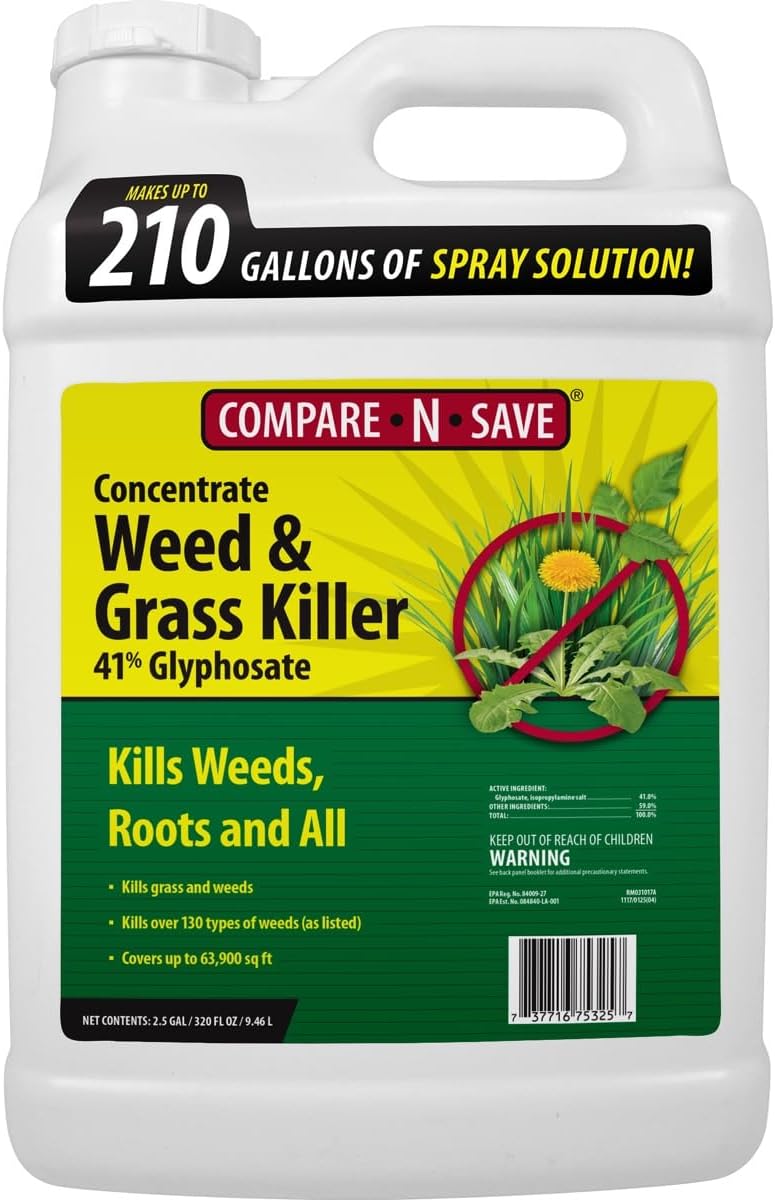
Compare-N-Save Glyphosate Concentrate Grass & Weed Killer, 2.5-Gallon
| Active Ingredients | glyphosate |
|---|---|
| Liquid Volume | 2.5 gallons |
| Item Form | Spray |
| Coverage | 630000 square feet |
This 2.5-gallon Compare-N-Save concentrate delivers a high-strength glyphosate formula for killing established grasses and most perennial and annual weeds. It is mixed with water to make ready-to-use spray and is typically applied to driveways, fence lines, garden plots, and areas targeted for lawn renovation or site preparation. Notable features include a 41% glyphosate concentration, fast visible results in 2 to 4 days, and the ability to make up to 210 gallons of spray to cover extensive acreage. In practice the product is effective at translocating to roots so treated plants die rather than just brown temporarily. Important limitations are safety and selectivity: it will kill any green plant it contacts, so careful mixing, targeted spraying, and protective gear are required, and it offers no residual pre-emergent control. For farm-scale or large-property use it is economical because one concentrate container treats large areas, but users must follow label directions closely for timing, replanting intervals around edibles, and environmental precautions to avoid off-target damage.
Best for: Buyers managing large properties or farms who prioritize efficient, economical weed and grass removal for site preparation, renovation, and broad-area cleanup.
Less Ideal for: Home gardeners seeking a selective or residual weed control solution or anyone who needs an organic or non-glyphosate option should consider alternatives.
- High glyphosate concentration for effective root-killing control
- Large 2.5-gallon bottle yields a large volume of ready-to-use spray for wide coverage
- Visible results in 2 to 4 days for quick follow-up work
- Mixes with water for adjustable application rates depending on weed toughness
- Non-selective and will damage or kill any contacted green plants, requiring careful application
- Contains glyphosate so users must follow safety and replanting guidance and avoid drift to sensitive areas
Verdict: Choose this concentrate when you need an economical, high-strength glyphosate solution to clear large areas of unwanted grasses and weeds quickly.
Southern Ag Amine 2,4-D Liquid Weed Killer, 32 oz

| Item Form | Liquid |
|---|---|
| Coverage | 5000 Square Feet |
| Liquid Volume | 32 quarts |
| Active Ingredients | Dimethylamine salt of 2,4-D-Dichlorophenoxyacetic acid |
Southern Ag Amine 2,4-D is a concentrated liquid herbicide formulated to control many broadleaf weeds and woody plants in lawns, pastures, rangeland, ditch banks, fences, and similar non-crop sites. It is mixed with water at modest rates (manufacturer guidance suggests roughly 2 to 3 tablespoons per 1,000 sq ft in typical small-spray mixes) and applied as a coarse, low-pressure spray to reduce drift. The active ingredient is the dimethylamine salt of 2,4-D, a well-established selective herbicide for broadleaf control. Practical benefits are its economical use rate, broad application range, and compatibility with common spray equipment. Limitations include the need to take drift precautions around desirable plants, the potential for injury to broadleaf ornamentals or sensitive crops, and the requirement to follow safety and local use restrictions for synthetic herbicides. This product is a straightforward choice when you need a proven, cost-effective tool to reduce broadleaf weed pressure over larger turf or non-crop areas, provided you apply it carefully and observe label safety directions.
Best for: Gardeners and land managers who prioritize effective, economical broadleaf weed control over larger turf or non-crop areas and who are comfortable following label mixing and application steps.
Less Ideal for: Homeowners with small, diverse ornamental beds or vegetable gardens near the treatment area should avoid this product and consider more targeted or non-chemical options.
- Proven active ingredient for broadleaf weed control
- Concentrated liquid with low recommended use rates for economical coverage
- Suitable for a wide range of non-crop and turf sites
- Designed for coarse, low-pressure spray to limit drift when applied correctly
- Can damage desirable broadleaf plants if spray drifts or is applied incorrectly
- Not suitable for use where 2,4-D-sensitive crops or ornamentals are nearby
- Requires careful handling and adherence to safety directions due to being a synthetic herbicide
Verdict: A concentrated, cost-effective 2,4-D amine concentrate for gardeners and land managers who need reliable broadleaf weed control across turf and non-crop areas.
Corteva Agriscience Remedy Herbicide

| Manufacturer | Corteva Agriscience |
|---|---|
| Part Number | Remedy |
| Coverage | 1 acre |
Corteva Remedy is a targeted herbicide designed for controlling woody plants and broadleaf weeds on rangeland, permanent grass pastures, CRP acres, fence rows, and non-irrigation ditch banks. It is typically mixed and applied with standard ground equipment by land managers, ranchers, or contractors to treat large areas up to the labeled coverage. Notable features include professional-grade formulation and one-acre coverage per unit as stated by the manufacturer, plus labeled directions for specific noncropland uses. In practice Remedy delivers effective broadleaf and woody plant control when applied according to label directions, and the product's concentrated form reduces the number of trips required to treat a field. Important limitations are that it is intended for noncropland settings only and requires protective equipment during application, so it is not suitable for casual home-garden use and needs someone comfortable with herbicide handling and compliance with label restrictions.
Best for: Buyers who need a reliable, professional herbicide for managing weeds and woody plants across pasture, rangeland, or conservation acres and who follow labeled application practices.
Less Ideal for: Casual gardeners, homeowners, or anyone seeking a multipurpose home garden weed killer or a product for irrigated turf should look for consumer-labeled alternatives.
- Professional-strength formulation for woody plant and broadleaf weed control
- Labeled for large-area uses such as rangeland, pastures, and CRP acres
- Concentrated product covers one acre per unit as indicated by manufacturer
- Clear label directions for the specified noncropland applications
- Not formulated or labeled for general home or ornamental garden use
- Requires use of protective equipment and familiarity with herbicide handling
Verdict: Choose Remedy when you need a dependable, professional-strength herbicide for managing woody plants and broadleaf weeds on pasture and rangeland.
Choosing the Right Weed Killer for Farms: Key Factors to Consider
Control Spectrum and Target Weeds
Knowing which weeds are most problematic on your farm matters because herbicides vary widely in which species they control. Some products are strong on broadleaf weeds but offer limited grassy-weed control, while others target grassy species and do little to suppress perennial broadleaves.
Match a product's labeled spectrum to the actual weed species in your fields. If you have a mix of annual grasses and established perennials, you may need a combination approach or a product with both contact and systemic activity to prevent regrowth.
Residual Activity and Soil Persistence
Residual duration affects how long the product suppresses new weed emergence and influences planting windows for rotational crops. Short-residual treatments allow quicker replanting but may require additional passes, whereas longer-residual chemistries can reduce follow-up passes but may impose crop rotation restrictions.
Soil type, organic matter, and rainfall patterns change how long a herbicide remains active. Sandy soils often reduce persistence, while heavier soils with more organic matter can hold active ingredients longer. Consider your soil profile and upcoming rotations when selecting a product.
Crop Safety and Rotation Restrictions
Labels list sensitive crops and required rotation intervals; ignoring these can lead to stand injury or poor emergence. Some herbicides have long plant-back intervals for certain vegetables, small grains, or legumes.
Plan your weed-control program around those restrictions so you do not limit future planting options. If you run a diverse rotation, favor products with shorter, well-documented replant intervals or use targeted applications confined to fields where the rotation is compatible.
Application Method and Drift Management
How you apply a herbicide on a farm affects efficacy and safety. Boom sprayers, air-assist rigs, and high-clearance sprayers each produce different droplet patterns and drift potential. Nozzle selection, spray pressure, and ground speed influence droplet size and deposition.
High wind, temperature inversions, and small droplet sizes increase off-target movement risk. Choose products and adjuvants that reduce volatility and drift, and follow label guidance on spray conditions and nozzle recommendations to protect neighboring crops and sensitive areas.
Tank-Mix Flexibility and Sequence Planning
Farmers frequently tank-mix herbicides to broaden control or add residuals. Not all products are compatible, and antagonism or reduced efficacy can occur when incompatible chemistries are combined.
Check label compatibility and perform jar tests when trying new mixes. Also plan chemical sequences across the season so that residuals and modes of action rotate to reduce the risk of resistance development in weed populations.
Environmental Impact and Stewardship
Consider effects on non-target organisms, buffer zones, and waterway protection. Runoff or leaching potential is influenced by product solubility, persistence, and application timing relative to heavy rains.
Adopt best-management practices such as buffer strips, reduced tillage where appropriate, and careful calibration of equipment to minimize environmental risk. Stewardship preserves long-term product utility and protects soil and water resources on the farm.
Matching Herbicide Mode of Action to Resistance Management
Repeated reliance on a single mode of action drives resistance in weed populations. On farms with a history of hard-to-control species, align your seasonal program to rotate modes of action and combine residual and post-emergence tools where labels allow.
- Map resistant patches and prioritize alternate modes of action in those fields.
- Use integrated tactics such as mechanical control or targeted cultivation to reduce seed return when resistance is suspected.
- Keep records of active ingredients used year to year to avoid unintentional repetition.
Spot Treatment Versus Whole-Field Applications
Spot treatments save product and reduce selection pressure when weed outbreaks are localized. For widely infested fields, whole-field applications are often more economical and reduce the risk of spread during harvest and tillage.
- Evaluate infestation patterns before deciding scale of treatment.
- Combine spot treatment with follow-up monitoring to catch escapes early.
- Consider targeted application technology to improve accuracy in irregular fields.
Calibration and Application Best Practices for Farm Sprayers
Accurate calibration ensures you apply the labeled rate for the intended coverage and efficacy. Calibrate for your typical forward speed and nozzle selection, and re-check after changing tires or sprayer settings.
- Measure output per nozzle and calculate ground speed to set correct spray volume.
- Choose nozzle types that produce coarser droplets to reduce drift when appropriate.
- Regularly inspect and replace worn nozzle tips to maintain uniform application.
Timing and Integration With Cultural Practices
Timing applications to crop and weed growth stage maximizes effectiveness. Many products work best when weeds are young and actively growing; perennial control often requires timing to target carbohydrate translocation to roots.
- Coordinate herbicide timing with tillage and planting operations to avoid disrupting efficacy.
- Use cover crops or stale seedbeds to reduce flushes and lower chemical needs.
- Monitor weather forecasts to avoid applications ahead of heavy rain that could reduce residual activity.
Recordkeeping and Field-Level Trials
Keeping detailed spray logs helps identify what worked and what did not in different fields and soil types. Small on-farm trials across strips or paddocks can reveal which approaches fit your operation without committing the whole acreage.
- Track active ingredients, rates, adjuvants, and environmental conditions at time of application.
- Rotate trial plots among fields to see results under varying soil and weed pressures.
- Use yield maps and scouting notes to correlate control programs with outcomes.
How We Chose the Best Weed Killer for Farms
We focused on products and formulations that are appropriate for farm-scale applications and that address the most common agronomic concerns. Our selection criteria prioritized proven weed control spectrum, documented residual activity, and labels that support typical farm application rates and equipment. We evaluated efficacy against both annual grassy weeds and perennial broadleaf species, persistence in different soil types, and the likelihood of crop injury or volunteer crop effects. Spray drift risk and compatibility with common sprayer setups and nozzles were major filters because off-target movement is a frequent farm concern. We also considered tank-mix flexibility and any documented rotation intervals or planting restrictions. Excluded from the shortlist were products intended solely for home garden use, spot-treatment-only formulations not practical at field scale, and chemistries with label restrictions that make them impractical for most crop rotations. The editorial choices reflect agronomic utility: control spectrum, residual behavior, application safety, tank-mix versatility, and label-supported use patterns.
FAQ
How do I choose a herbicide if my fields have both grasses and broadleaves?
Often you need a combination approach: either a product labeled for both groups or a planned tank-mix/sequential program that targets each group at the correct growth stage. Always check label compatibility and follow timing guidance for the most vulnerable weed stages.
Will residual herbicides prevent me from planting certain crops?
Residual products can have plant-back intervals that restrict when sensitive crops may be planted. Those intervals depend on the active ingredient, the rate used, and soil conditions. Consult label rotation guidance and factor in your planned rotations before applying long-residual chemistries.
What steps reduce spray drift when applying on windy days?
Avoid spraying in windy conditions and during temperature inversions. Use larger droplet-producing nozzles, lower boom height, and drift-reducing adjuvants when compatible. Follow label wind speed limits and observe buffer recommendations for sensitive areas.
Can I tank-mix herbicides to broaden control?
Tank-mixing is common but requires label checks for compatibility and potential antagonism. Perform a jar test before full-scale mixing, and follow label guidance for order of addition and recommended adjuvants to maintain efficacy.
How should I manage weeds that regrow after a treatment?
First, confirm whether regrowth is from surviving plants, new flushes, or resistant biotypes. Repeat applications may be needed for new flushes; perennial regrowth may require systemic herbicides timed for translocation. Integrate mechanical removal and sanitation to reduce seed return.
Final Verdict
On-farm weed control is a balance between broad, dependable control and protecting future planting options. Prioritize products that match your dominant weed spectrum, have manageable residual profiles for your rotation, and minimize drift and off-target risk with correct application methods. Make decisions based on your crop sequence, soil conditions, and resistance-management plan. When you align application timing, equipment calibration, and stewardship practices with the label guidance, you can control weeds effectively while preserving productive fields for future seasons.
