

Note: This article contains affiliate links. If you click on these links and make a purchase, I may earn a small commission at no extra cost to you. This helps support my research and content. Read my full affiliate disclosure here.
If you keep gravel, river rock, or crushed stone paths and planting areas tidy, the right weed killer for stone beds makes maintenance far easier. Stone beds pose specific challenges: soil pockets under rocks, heat reflection from stones, and visible dead foliage that can look worse than living weeds. Choosing products designed to work in that setting preserves appearance and reduces how often you need to treat. This guide covers seven shortlisted options suited to stone-bed conditions and explains the practical tradeoffs gardeners face. We evaluate contact speed, residual activity, application control, and safety considerations to help you pick the type of treatment that fits your maintenance rhythm and site conditions.
Top Picks at a Glance
| Best Overall The best all-around choice for most situations | Roundup Dual Action 365 Weed & Grass Killer Plus 12 Month Preventer, 1 gal. |  |
| Best Quality Built to a higher standard if you want something more solid | Ortho GroundClear Year Long Vegetation Killer with Comfort Wand, 1.33 gal |  |
| Best Value The sweet spot between price and what you get | Ortho GroundClear Weed & Grass Killer with Comfort Wand, 1 gal. |  |
| Best Budget The cheapest option that still gets the job done reliably | Spectracide Weed & Grass Killer Concentrate, 16 fl oz |  |
| Highest Rated A top-rated pick with lots of positive feedback | RM43 Total Vegetation Control 43% Glyphosate Plus Weed Preventer, 2.5-Gallon |  |
| Most Popular A crowd favorite that many people choose with confidence | Spectracide Weed & Grass Killer with AccuShot Power Sprayer, 1.33 Gal |  |
| Best Seller A high-volume bestseller chosen again and again | Roundup Weed & Grass Killer4 with Pump 'N Go 2 Sprayer, 1.33 gal |  |
Roundup Dual Action 365 Weed & Grass Killer Plus 12 Month Preventer, 1 gal.

| Unit Count | 128 Fluid Ounces |
|---|---|
| Item Form | Spray |
| Coverage | 300 square feet |
| Active Ingredients | Triclopyr; Fluazifop-P-Butyl; Imazapic; Diquat Dibromide |
This one-gallon Roundup Dual Action 365 combines fast-acting contact herbicides with a longer-lasting residual to both kill visible weeds and prevent new growth for up to a year when applied correctly. It is intended for non-lawn areas such as cracks in driveways, sidewalks, patios, gravel and under decks. The Comfort Wand one-touch continuous spray makes treating a contiguous area less fatiguing and helps deliver an even application. Visible wilting can appear within hours and treated areas become rainproof in roughly 30 minutes. The label stresses spraying the entire target area, not just individual plants, because the preventer works by creating an invisible soil barrier. Practical limits include use only on non-lawn surfaces and adherence to label rates and reapplication intervals; it is not suitable for spot-spraying near desirable plants or for use on turf you want to keep. If you need a fast, long-lasting solution for clearing and keeping paved and gravel areas weed-free, this product streamlines both tasks in a single application.
Best for: Buyers who want a straightforward, long-lasting solution to clear and keep paved, gravel, and other non-lawn areas weed-free with minimal repeated effort.
Less Ideal for: Gardeners who need selective control inside lawns, around flower beds, or who prefer an organic or nonchemical approach should consider other products or methods.
- Kills existing broadleaf and grassy weeds and many tough species.
- Provides up to 12 months of prevention when the entire area is treated.
- Comfort Wand with one-touch continuous spray reduces hand fatigue and promotes even coverage.
- Fast visible results in hours and becomes rainproof in about 30 minutes.
- Formulated only for non-lawn areas so it will damage desirable turf and plants if misapplied.
- Requires treating the entire area to establish the preventive barrier rather than only spot-treating visible weeds.
Verdict: If you need a single product that quickly kills weeds and then prevents new growth for up to a year in non-lawn areas, this is a convenient, long-lasting option.
Ortho GroundClear Year Long Vegetation Killer with Comfort Wand, 1.33 gal

| Unit Count | 170.24 Fluid Ounces |
|---|---|
| Coverage | 400 square feet |
| Item Form | Spray |
| Liquid Volume | 1.33 gallons |
| Active Ingredients | Imazapyr, Isopropylamine salt 0.09% Pelargonic Acid and related fatty acids |
Ortho GroundClear Year Long is a ready-to-use vegetation killer designed for spot treatment of driveways, sidewalks, gravel and other areas where you do not want any plants. The bottle includes a comfort wand for targeted spraying and the fast-acting formula begins to show visible results within an hour. It is rainproof in one hour and the manufacturer claims up to 12 months of vegetation prevention from a single application when used as directed. Active ingredients include imazapyr and pelargonic acid, which provide both quick contact action and longer-term root control. The product covers about 400 square feet and is best applied on sunny days when weeds are actively growing. Important limitations are that it is intended only for areas where no vegetation is wanted and should not be used near desirable plants or lawns, and users must follow safety directions to avoid skin or eye contact. For a buyer wanting a straightforward, no-mix sprayer for hardscape weed control, this is a practical, low-effort option.
Best for: Homeowners who need a simple, no-mix solution to clear and keep hardscape, gravel, and unplanted areas weed-free with minimal effort and follow-up.
Less Ideal for: Gardens, lawns, or anyone who needs selective weed control near desirable plants should avoid this product and choose a more targeted herbicide or spot-treat method.
- Ready-to-use spray with attached comfort wand for precise application
- Fast-acting formula with visible results in about an hour
- Rainproof after one hour so light rain is less likely to wash it away
- Claims up to one year prevention of regrowth from a single application
- Treats approximately 400 square feet per bottle
- Not selective and will kill any vegetation it touches, so careful targeting is required
- Formulation contains persistent active ingredient (imazapyr) that restricts use around desirable plants
Verdict: A convenient, no-mix wand sprayer that quickly kills weeds on hardscapes and prevents regrowth for up to a year, ideal for hands-off hardscape weed control.
Ortho GroundClear Weed & Grass Killer with Comfort Wand, 1 gal.

| Item Form | Spray |
|---|---|
| Coverage | 5120 square feet |
| Unit Count | 128 Fluid Ounces |
| Active Ingredients | Ammonium Nonanoate |
Ortho GroundClear is a one-gallon ready-to-use weed and grass spray designed for spot and surface treatment on driveways, walkways, patios, and landscape beds. The formula absorbs on contact and shows visible browning in about 15 minutes, becoming rainproof roughly two hours after drying, which helps when weather is unpredictable. The included Comfort Wand makes it easy to aim at weeds growing between gravel and pavers without soaking surrounding surfaces. It is OMRI Listed, so it can fit into some organic-minded maintenance routines. Coverage is large for a single container, and the product lists ammonium nonanoate as the active ingredient, which works by contact so small or actively growing weeds are best treated. Because it is a contact herbicide, perennial or well-established weeds may need repeat applications or mechanical removal for full control, and care is required to avoid spray drift onto desirable plants. Follow safety directions and keep pets and children away until treated areas are dry.
Best for: Homeowners who want a practical, hands-on solution to remove weeds from gravel driveways and hardscapes and who prioritize quick, targeted results with minimal setup.
Less Ideal for: People seeking a long-term systemic control for deep-rooted perennial weeds or a total lawn herbicide should consider systemic products or integrated mechanical removal instead.
- Fast visible results on contact, often browning in about 15 minutes.
- Comfort Wand enables precise targeting in gravel joints and along edges.
- Becomes rainproof in approximately 2 hours, reducing loss from unexpected rain.
- OMRI Listed, compatible with some organic production standards.
- Contact-only action means deeper or perennial roots may require multiple applications.
- Spray can damage nearby desired plants if not applied carefully.
Verdict: A fast, ready-to-use contact spray with a comfort wand that makes quick, precise weed control on gravel driveways simple and practical.
Spectracide Weed & Grass Killer Concentrate, 16 fl oz
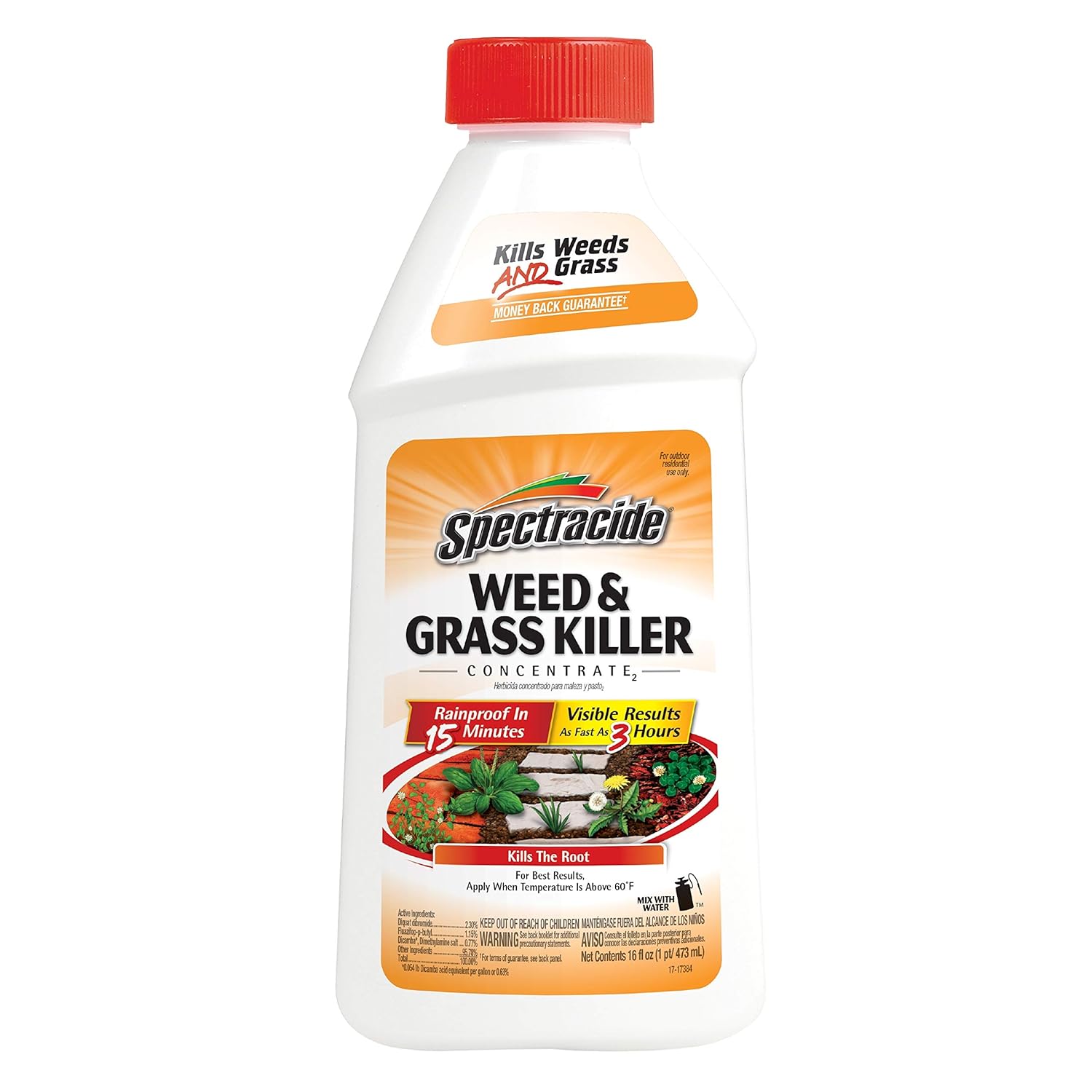
| Unit Count | 16 Fluid Ounces |
|---|---|
| Item Form | Spray |
| Coverage | 7 fl oz per gallon covers up to 300 sq ft |
| Rainproof time | 15 minutes |
| Visible results | As fast as 3 hours |
This Spectracide concentrate is a practical, fast-acting option for clearing unwanted weeds and grasses from hard surfaces and around garden beds. You mix the 16 fl oz bottle with water and apply with a tank sprayer for spot treatments; the label rate (7 fl oz per gallon) covers roughly 300 sq ft per treatment. The formula is rainproof after 15 minutes and can show visible dieback in as little as three hours, letting you replant in treated areas after about a day. It is nonselective, so it kills foliage down to the root and requires care to avoid desirable plants. Because it is a concentrate, small bottles treat a larger area than ready-to-use sprays, which is useful for recurring patch treatments while keeping storage space low. Important limits are the usual safety precautions for herbicides and the need to shield nearby plants and follow temperature guidance for best results. For someone wanting a straightforward, effective knockdown of pavement and edge weeds, this performs reliably when used as directed.
Best for: Buyers who want a cost-effective, no-nonsense herbicide to tackle spot infestations on driveways, walkways and edges and who are comfortable mixing and applying a concentrate.
Less Ideal for: Customers who need a gentle or selective lawn-safe product or who prefer ready-to-use sprays with no mixing should look elsewhere.
- Concentrated formula covers a larger area per ounce than ready-to-use products
- Fast visible results in as little as 3 hours and rainproof after 15 minutes
- Kills weeds and grasses down to the root for longer-lasting control
- Nonselective formula can damage desirable plants if oversprayed
- Requires mixing and a separate tank sprayer rather than a ready-to-use bottle
Verdict: A concentrated, fast-acting spot herbicide that delivers economical, root-killing weed control for paved areas and edges.
RM43 Total Vegetation Control 43% Glyphosate Plus Weed Preventer, 2.5-Gallon
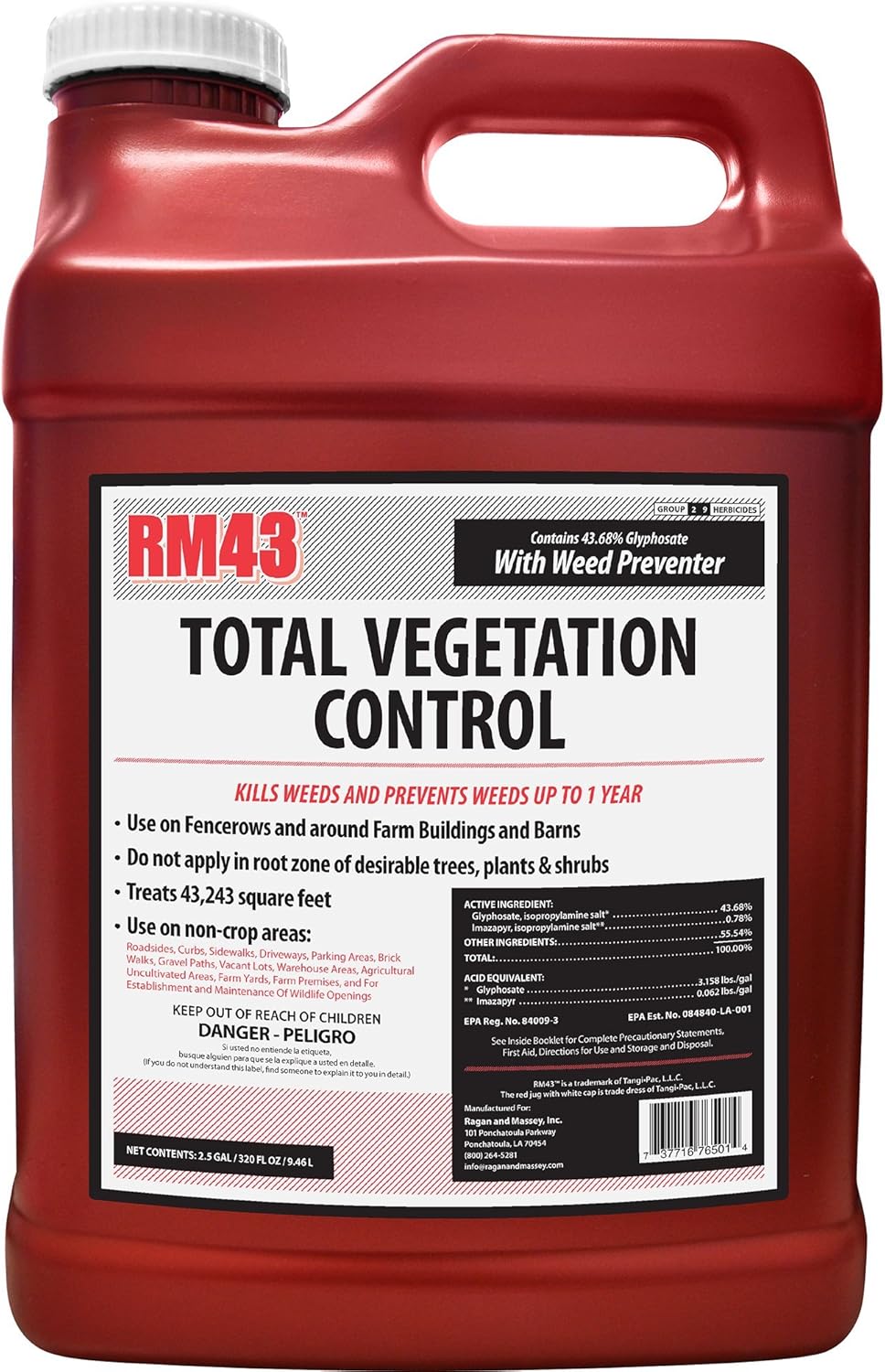
| Unit Count | 320 Fluid Ounces |
|---|---|
| Liquid Volume | 320 fluid ounces |
| Coverage | 243 243 square feet |
| Active Ingredients | Glyphosate isopropylamine salt, Imazapyr isopropylamine salt |
RM43 Total Vegetation Control is a concentrated 2.5‑gallon herbicide intended for killing existing growth and preventing regrowth for up to a year on areas where no vegetation is desired. You mix it into spray solution and apply to hardscape edges, gravel driveways, fence rows, and around buildings as either spot treatments or blanket applications on bare ground. The formula pairs glyphosate and imazapyr with a surfactant so it kills grasses, broadleaf weeds, vines, brush and some woody growth and becomes rainfast in about two hours. Practical benefits for driveway use include long residual control that reduces repeat spraying and a large coverage rate that treats many square feet from one container. Important limitations are that it is for non‑crop areas only and will damage desirable plants if sprayed over roots or drift occurs, and the active ingredient blend makes it persistent so care is required where you may later want vegetation to return. Follow label directions for mixing, application timing and safety precautions when using near soil that will be planted later.
Best for: Gardeners, property owners, and maintenance crews who prioritize strong, long‑lasting weed eradication on gravel driveways and other non‑crop hardscape areas and want to minimize repeat applications.
Less Ideal for: Homeowners planning to replant treated areas soon or those needing selective weed control near desirable plants should choose a less persistent or more targeted product.
- Combination of glyphosate and imazapyr for both knockdown and long residual control
- Concentrated 2.5‑gallon container covers large areas without frequent refills
- Rainfast in about two hours so light rain soon after application is less likely to reduce effectiveness
- Suitable for total vegetation control on gravel driveways, fence rows and other non‑crop areas
- Persistent active ingredients that can prevent desirable vegetation from reestablishing for an extended period
- Not safe for use where desirable plant roots may be exposed or where drift could contact nearby plants
Verdict: Choose RM43 when you need a single, heavy‑duty application that delivers broad spectrum kill and up to a year of weed prevention on gravel driveways and other non‑crop surfaces.
Spectracide Weed & Grass Killer with AccuShot Power Sprayer, 1.33 Gal

| Unit Count | 170 Fluid Ounces |
|---|---|
| Item Form | Spray |
| Coverage | 1 gallon |
| Active Ingredients | Diquat Dibromide 0.12%, Fluazifop-p-butyl 0.06%, Dicamba 0.04% |
Spectracide Weed & Grass Killer pairs a concentrated non-selective formula with a battery-powered AccuShot sprayer to clear weeds from driveway cracks, patios and around foundations. The product is used by aiming and spraying foliage until leaves are covered; the active ingredients move through the leaf to the root and can show visible die-back in as little as three hours. The AccuShot wand is extendable and provides continuous spray without manual pumping, which improves accuracy for narrow cracks and reduces hand fatigue during larger jobs. It is rainproof within 15 minutes, so treated areas are protected quickly. Practical benefits include fast results that let you replant or resume use of the area within a day and a reusable sprayer for follow-up applications. Important limitations are that the herbicide is non-selective so it will kill any plant it contacts, it requires careful handling and PPE to avoid skin or eye exposure, and the sprayer runs on four AA batteries that must be replaced periodically. Follow label directions to avoid runoff into water.
Best for: Buyers who want a fast, no-nonsense solution for weeds growing in driveways and hard surfaces and who prioritize tools with clear user feedback and proven results.
Less Ideal for: Gardeners who need a selective lawn-safe treatment, people unwilling to follow pesticide safety precautions, or those treating areas adjacent to water features.
- AccuShot battery-powered wand gives continuous spray for accurate application in tight cracks
- Formula moves through foliage to kill weeds down to the root with visible results in about three hours
- Rainproof after 15 minutes so treatments are not easily washed away by brief showers
- Covers approximately 300 square feet per gallon, suitable for multiple crack-treatment sessions
- Non-selective herbicide will damage any desirable plants it contacts
- Sprayer requires four AA batteries and occasional replacement to maintain function
- Product is toxic to aquatic life and must not be used near water or allowed to run off
Verdict: A fast-acting, easy-to-aim non-selective herbicide with a battery-powered wand that is well suited to reliably clear weeds from driveway cracks and other hard surfaces.
Roundup Weed & Grass Killer4 with Pump 'N Go 2 Sprayer, 1.33 gal

| Unit Count | 170 Fluid Ounces |
|---|---|
| Item Form | Spray |
| Coverage | 300 Square_Feet |
| Active Ingredients | Triclopyr, Triethylamine Salt, Fluazifop-P-Butyl, Diquat Dibromide |
This Roundup Weed & Grass Killer4 comes in a 1.33 gallon container with an integrated Pump 'N Go 2 sprayer that lets you apply a continuous stream for up to 10 minutes without mixing. It is formulated to kill a wide range of broadleaf weeds and grasses down to the root and advertises visible browning in hours and rainproof protection in about 30 minutes, so treated areas can be replanted in 1 to 30 days depending on instructions. The extendable wand improves accuracy for edging around flower beds, foundations, and hard surfaces so you can target unwanted plants without bending over. Practical benefits include straightforward one-hand spraying, coverage suitable for small- to medium-scale cleanup, and a clear safety section that emphasizes protective clothing and keeping people and pets away until the spray dries. Important limitations are that it is a chemical herbicide with active ingredients buyers should review for toxicity and environmental impact, and it requires careful application to avoid drift onto desirable plants. The sprayer is convenient but adds weight as you carry and handle the full container.
Best for: Gardeners who want a ready-to-use, targeted herbicide to quickly clear weeds around beds and hardscapes and who prioritize easy application and fast visible results guided by other buyers' experience.
Less Ideal for: Organic gardeners or those who prefer nonchemical methods should look for mechanical or organic alternatives, and users who need very large-area broadcast control may prefer concentrate products or professional services.
- Built-in Pump 'N Go 2 sprayer with extendable wand for up to 10 minutes of continuous spray
- Produces visible results in hours and becomes rainproof in about 30 minutes
- Designed for use around flower beds, hardscapes, mulch and foundations for targeted spot treatment
- Covers a useful area from a single bottle suitable for small to medium beds
- Contains synthetic active ingredients that require careful handling and distancing of people and pets until dry
- Risk of harming nearby desirable plants if not applied precisely
Verdict: If you want a convenient, ready-to-use sprayer that gives fast, targeted weed control around garden beds and hardscapes, this package is a practical pick.
Choosing the Right Weed Killer for Stone Beds: Key Factors to Consider
Contact Kill Speed
How quickly a product browns and collapses visible weed foliage matters in stone beds because dead, ragged weeds are immediately noticeable against rock. Faster contact action gives immediate cosmetic results and reduces the time weeds have to set seed. However, rapid foliar wilting does not guarantee root death, so consider whether you need quick visual control or longer-term suppression.
Also factor in the species you most commonly face. Annual grasses and broadleaf weeds often respond faster than perennial roots, which may require repeat applications or formulations with systemic activity.
Residual Suppression
Residual activity describes how long treated areas resist new germination after application. In a stone bed, where soil pockets and windblown seed collect, some level of residual control can meaningfully cut down on repeat treatments. Products range from little to no residual action to several weeks or months of suppression.
Think about nearby seed sources and how often you can reapply. Longer residuals reduce trips with the sprayer but may affect desirable seedlings you want to establish later.
Application Precision
Stone beds are often adjacent to ornaments, pavers, or planted borders, so being able to target weeds without contact to desirable plants is essential. Look for formulations compatible with handheld sprayers, trigger-actuated foamers, or wicking applicators that let you deliver product directly to foliage or cracks. Narrow-spray nozzles and non-drifting formulations protect nearby plantings and reduce waste.
Operator technique matters too. A product that allows spot treatment rather than blanket spraying will give you finer control and safer outcomes around mixed landscapes.
Surface Compatibility
Some chemistries can stain or discolor certain stones or hardscape materials, especially porous natural rock and lighter-colored aggregate. Consider how visible residues or dead plant matter will look against your stone finish and whether the label warns about surface effects. Water run-off patterns and sun exposure also influence how a product behaves on stones versus bare soil.
If hardscape aesthetics are a priority, choose a product with minimal residue and follow rinse or wipe recommendations where appropriate.
Safety Around Plants and Pets
Gardeners frequently need weed control near ornamental plantings and areas used by pets or children. Review how long a treated area requires restriction from foot traffic, whether runoff may affect nearby beds, and whether the formulation requires protective equipment during mixing and application. Products that bind quickly to foliage or have low vapor drift reduce incidental exposure risk.
Also consider timing and buffer zones. Some treatments are safe once dried; others require longer setbacks before allowing pets or people back onto the stones.
Ease of Use and Reapplication
Practical maintenance depends on how easy the product is to mix, apply, and reapply. Pre-mixed trigger bottles and foam applicators simplify spot work, while concentrates require measuring and a sprayer. For large stone beds, look for products that work with standard garden sprayers and have clear dilution rates.
Directions for reapplication vary by active ingredient and target weed. Choose a product whose label gives straightforward intervals and that matches how frequently you are willing to maintain the area.
When to Use Contact Treatments Vs Systemic Options
Contact treatments scorch and desiccate foliage quickly, which is useful for visible cleanup along walkways and high-visibility areas. They are best for annual weeds and small seedlings that you want removed immediately.
Systemic options move into the plant and weaken or kill roots over time, making them more effective on established perennials and deep-rooted grasses. For stone beds with persistent perennial pockets, systemic treatments often reduce regrowth frequency even though they take longer to show results.
- Use contact treatments for fast cosmetic cleanup and seedling control.
- Choose systemic options for long-term control of perennial weeds.
- Combine approaches for mixed infestations: spot-systemic on stubborn plants, contact on surface growth.
Application Timing and Weather Considerations
Apply treatments on calm, dry days to minimize drift and improve uptake. Morning applications after dew dries but before high heat reduce stress on desirable plants and help contact materials stick to foliage.
Avoid treating during heavy rain or when significant runoff is expected, since rain can wash away products and reduce residual performance. Follow label guidance about how long to wait after rainfall before reapplying.
- Pick low-wind windows to prevent overspray on borders.
- Avoid peak heat to reduce volatilization and plant stress.
- Allow treated foliage to dry according to directions before irrigation or rain events.
Spot Treatment Techniques for Crevices and Tight Areas
Stone beds often have narrow cracks and pockets where weeds are protected. Use low-volume, direct-application tools like hand pump sprayers with a narrow nozzle, wick applicators, or a paintbrush to apply product directly to foliage. This reduces waste and preserves nearby plantings.
For dense mats, remove loose debris first so the product contacts live tissue. Repeat applications at recommended intervals will help exhaust seed banks in deeper pockets.
- Remove loose plant material before treating for better contact.
- Consider mechanical removal for large perennial clumps before applying systemic control.
- Use protective gloves and avoid skin contact during spot work.
Managing Seed Banks and Long-Term Maintenance
Stone beds accumulate windblown seed in the gaps between stones. Even with effective treatments, a persistent seed bank will produce new seedlings each season. Combine targeted herbicide use with cultural practices that reduce seed capture, such as topping with a finer gravel layer or installing landscape fabric where appropriate.
Regular inspection and quick spot treatments prevent small seedlings from setting seed. Over time, a strategy of occasional residual application and mechanical cleanup will reduce the overall workload.
- Inspect beds regularly, especially after windy periods.
- Use mulches or infill to limit seed lodging in crevices.
- Address perennial roots mechanically before using a systemic product for better long-term results.
Safety Precautions for Hardscape Areas
Avoid applying products where runoff can enter storm drains, ornamental water features, or nearby planted beds unless the label allows it. Use targeted applications to minimize movement and follow local regulations for disposal of leftover mix.
When treating near patios or seating areas, give treated surfaces time to dry and air out before allowing regular foot traffic. Store concentrates securely out of reach of children and pets and rinse equipment thoroughly after use.
- Prevent overspray with shields or low-pressure nozzles.
- Keep pets off treated areas until product is dry or as directed.
- Rinse sprayers on bare soil away from desired plants.
How We Chose the Best Weed Killer for Stone Beds
We selected products that perform well in stone-bed environments where weeds grow in crevices, soil pockets, and among decorative rock. Editorial filters focused on four to six measurable traits that matter to gardeners: how quickly foliage dies after application, how long the product suppresses new growth on exposed substrates, the precision of application to avoid overspray on desirable plants, and the compatibility with common stone-bed setups like gravel paths and rock mulch. We also considered safety guidance for use around hardscape and near ornamental plantings and how straightforward the label instructions are for repeat treatments. Excluded items included broad claims without clear instructions for stone or gravel beds, products labeled only for turf or agricultural row crops, and formulations that require specialized equipment beyond standard garden sprayers or hand tools. The final picks balance immediate control and realistic residual protection while prioritizing applicator control and site safety.
FAQ
Can I use general garden weed killers on stone beds?
Often you can, but check the label for guidance about stone or gravel areas. Choose formulations that allow precise application and note any warnings about runoff, staining, or restrictions near ornamental plantings.
How soon will weeds die after application in a stone bed?
It depends on the active ingredient. Contact products can brown foliage within hours to a few days, while systemic treatments may take several days to a few weeks to show full effect on roots and top growth.
Will leftover product stain or discolor my stones?
Some formulations or dead plant residues can temporarily darken porous rocks. Rinse instructions or limiting application to foliage can reduce surface effects. Test a small, inconspicuous area if you are unsure.
How often should I reapply to control persistent perennial weeds?
Reapplication intervals vary by product and weed type. For stubborn perennials, plan on multiple treatments several weeks apart, or combine spot mechanical removal with a systemic product for more durable control.
Is it safe to treat stone beds near planted borders and pavers?
Yes if you use application methods that prevent drift and follow label buffer recommendations. Use narrow-spray nozzles, shields, or wick applicators to protect adjacent plants and hardscape finishes.
Can I water or hose treated stone beds after application?
Do not water immediately after applying unless the label permits it. Many products require a dry period to adhere and perform. Follow the specific drying or rain-free window stated in the instructions.
Final Verdict
Choosing the right weed killer for stone beds is about matching speed of control, residual needs, and how precisely you can apply the product. Fast-contact options give quick cosmetic results while systemic treatments reduce regrowth from roots. Prioritize application precision and surface compatibility when stones and adjacent plantings are important to appearance. Balance how often you want to treat against the level of suppression you need. With targeted application technique and a clear maintenance plan, you can keep stone beds tidy while minimizing repeated work and protecting nearby plants.
