

Note: This article contains affiliate links. If you click on these links and make a purchase, I may earn a small commission at no extra cost to you. This helps support my research and content. Read my full affiliate disclosure here.
Choosing a combined weed killer and lawn fertilizer matters because you want to remove unwanted plants without weakening the grass you are trying to protect. The right product knocks back broadleaf weeds and crabgrass while delivering nutrients that promote thicker, more resilient turf. In this guide we shortlisted six top-rated weed killer lawn fertilizers suited to common home lawns and maintenance schedules. We evaluated products for how effectively they kill target weeds, how safe they are for established grass, and how they affect turf health and maintenance. Read on to compare the main tradeoffs so you can pick the best option for your yard and mowing routine.
Top Picks at a Glance
| Best Quality Built to a higher standard if you want something more solid | The Andersons Surge Weed and Feed 16-0-9 Fertilizer (40 lb) |  |
| Best Value The sweet spot between price and what you get | BioAdvanced 5-in-1 Weed and Feed Granules (9.6 lb) |  |
| Best Budget The cheapest option that still gets the job done reliably | Spectracide Weed Stop for Lawns Concentrate Ready-to-Spray, 32 oz |  |
| Highest Rated A top-rated pick with lots of positive feedback | Scotts Turf Builder WinterGuard Fall Weed & Feed, 11.43 lb |  |
| Most Popular A crowd favorite that many people choose with confidence | Scotts Turf Builder Weed & Feed, 14.29 lb |  |
| Best Seller A high-volume bestseller chosen again and again | Scotts Turf Builder Weed & Feed5 Lawn Fertilizer and Weed Killer, 33.95 lb. |  |
The Andersons Surge Weed and Feed 16-0-9 Fertilizer (40 lb)

| Item Form | Granule |
|---|---|
| Coverage | 16000 square_feet |
| Unit Count | 640 Ounce |
| Active Ingredients | Herbicide |
The Andersons Surge is a 40 lb granular weed-and-feed formulated to control broadleaf weeds while supplying nitrogen and potassium to promote thicker turf. It is applied with a broadcast spreader to established lawns when weeds are actively growing; the manufacturer recommends mowing one to two days before and applying to a damp lawn so granules adhere to weed foliage, then keeping the lawn dry for at least 24 hours. Notable features include a four-way herbicide mix that targets more than 250 common weeds and small particle granules for greater coverage per square inch. In practice this product delivers broad-season control and visible weed decline in a week to two weeks on susceptible species while also supplying nutrients for greener growth. Limitations are that it is not for newly seeded turf or certain turf types such as Floratam St. Augustine and creeping bentgrass, and it requires careful timing around irrigation and rainfall to avoid wash-off. For larger lawns the 16,000 sq ft coverage per bag reduces reapplication frequency but you must follow label restrictions for sensitive grass varieties.
Best for: Buyers who prioritize season-long weed control and stronger turf appearance for medium to large established lawns and want a single product that both kills common broadleaf weeds and feeds the grass.
Less Ideal for: Homeowners establishing new seed or sod, or those with the excluded grass varieties mentioned on the label, should choose a product formulated for delicate or newly planted turf.
- Professional four-way herbicide that controls over 250 common broadleaf weeds
- Granular formulation with small particles for wider coverage per application
- Feeds lawn with a 16-0-9 nutrient ratio to promote thicker, greener turf
- Large 40 lb bag formulated to cover up to 16,000 sq ft which reduces application frequency
- Not safe for certain turf types and must be avoided on newly seeded lawns
- Needs dry weather after application and can be less effective if washed off by rain or irrigation
Verdict: Choose this if you want a single professional-strength granular product that both controls a wide range of broadleaf weeds and feeds an established, larger lawn.
BioAdvanced 5-in-1 Weed and Feed Granules (9.6 lb)

| Item Form | Granule |
|---|---|
| Coverage | 4000 square_feet |
| Active Ingredients | Dicamba, Quinclorac |
This BioAdvanced 5-in-1 Weed and Feed is a granular lawn treatment that combines fertilizer with multiple herbicides to kill existing broadleaf weeds and crabgrass while helping prevent new weeds for up to six months. You apply it with a broadcast or drop spreader to an established, dry lawn, then water it in and avoid mowing for at least a day. The formula lists active ingredients dicamba and quinclorac and is intended to both remove tough weeds like dandelions and clover and feed turf for up to three months to encourage thicker growth. Practical benefits include one-step coverage across a large area and the convenience of a long-lasting barrier that reduces repeat treatments. Important limitations are standard safety precautions for herbicides, such as keeping children and pets off treated areas until dry and avoiding use in restricted states; it is not suitable for spot-treating small patches without risk to nearby desirable plants. For best results follow label directions and calibrate your spreader for even coverage.
Best for: Homeowners who want a single-product solution to reduce repeat lawn treatments and maintain a greener, thicker lawn across a midsize yard.
Less Ideal for: Gardeners who need spot treatments near flowers, vegetables, or delicate ornamentals or those seeking an organic or non-chemical solution should look elsewhere.
- Combines weed control and fertilizer in one application for convenience
- Controls over 200 listed broadleaf weeds and large crabgrass, addressing both prevention and active infestations
- Coverage up to 4,000 sq ft from one bag reduces frequency of purchase and application
- Fertilizer component greens and thickens turf for up to three months after application
- Contains herbicides that require safety precautions and careful application to avoid harming non-target plants
- Not available for sale in certain states and territories which limits where it can be used
Verdict: Best for practical homeowners who want one granular product to both kill a wide range of lawn weeds and feed turf across a midsize lawn.
Spectracide Weed Stop for Lawns Concentrate Ready-to-Spray, 32 oz

| Unit Count | 32 Ounce |
|---|---|
| Item Form | Liquid |
| Coverage | 8,000 square feet |
| Active Ingredients | 2,4-D, Mecoprop-P, Dicamba, Sulfentrazone |
Spectracide Weed Stop For Lawns Concentrate is a hose-attach, ready-to-spray lawn weed killer designed to control broadleaf weeds across common turf types. You connect the QuickFlip sprayer to a garden hose and spray treated areas until wet; the formula claims visible browning of weeds in roughly three hours and works down to the root on many listed species. It is intended for use on bluegrass, fescue, Bermuda, perennial ryegrass and established zoysia (avoid zoysia just coming out of dormancy) and is rainproof after one hour. Practical benefits include fast knockdown of dandelions, clover and chickweed without special mixing and coverage rated for thousands of square feet from a single bottle. Follow label directions for temperature windows and re-seeding wait times and keep people and pets off treated turf until it is dry. Limitations are the need to avoid application above 90 degrees and the general precautions around post-application re-seeding and safety for children and pets until dry.
Best for: Buyers who want an inexpensive, easy-to-use spot and area treatment for common lawn weeds and prefer a hose-ready product that works quickly without measuring or mixing.
Less Ideal for: Homeowners planning immediate overseeding or those needing a product safe to use in high-temperature conditions or on newly emerged zoysiagrass.
- QuickFlip sprayer attaches to hose for fast, no-mix application
- Claims visible weed control in about three hours
- Controls a wide list of broadleaf weeds including dandelion, clover and chickweed
- Rainproof within one hour after application
- Should not be applied when daytime temperatures exceed 90 degrees to avoid lawn injury
- Requires waiting 3 to 4 weeks before reseeding treated areas
Verdict: A budget-friendly, hose‑attach concentrate that delivers fast, wide‑spectrum broadleaf weed control without mixing.
Scotts Turf Builder WinterGuard Fall Weed & Feed, 11.43 lb

| Item Form | Granule |
|---|---|
| Coverage | 4000 square feet |
| Item Highlight | Kills over 50 listed lawn weeds, including clover and dandelion |
| Unit Count | 1 Count |
Scotts Turf Builder WinterGuard Fall Weed & Feed is a granular combination product intended for a single fall application to both reduce common broadleaf weeds and feed cool- and warm-season grasses. You apply it with a broadcast or drop spreader on a calm day when weeds are actively growing and temperatures are between 60°F and 90°F, and the label recommends moist grass for best adhesion and waiting 24 hours before watering. The bag covers about 4,000 sq. ft. and lists control for more than 50 weeds including dandelion and clover, while delivering nutrients designed to help lawns recover from summer stress and build stronger roots for winter. Practical benefits include straightforward application with a spreader, combined weed control and fertilization in one step, and clear grass-type guidance on where to use it. Limitations are that it is labeled only for specific grass types and must not be used on several turf species, and it requires following precise timing and moisture conditions to work well. For reliability-minded users it performs as intended when the label directions are followed.
Best for: Homeowners who prioritize a dependable, no-frills fall treatment to both reduce broadleaf weeds and strengthen lawn roots for winter and who will follow label timing and spreader instructions.
Less Ideal for: People with excluded turf species such as St. Augustinegrass or those who need an all-season or spot-only solution should look elsewhere.
- Controls over 50 listed broadleaf lawn weeds including dandelion and clover
- Combines weed control and fall fertilizer in a single application
- Covers approximately 4,000 square feet per 11.43 lb. bag
- Clear application guidance for use with broadcast or drop spreaders
- Not suitable for all turf types and specifically must not be applied to St. Augustinegrass and several other species
- Effectiveness depends on applying under specific temperature and moisture conditions and waiting 24 hours before watering
Verdict: A reliable single-step fall treatment that kills common broadleaf weeds and feeds your lawn to help produce a stronger, healthier turf next spring.
Scotts Turf Builder Weed & Feed, 14.29 lb

| Item Form | Granule |
|---|---|
| Coverage | 5000 square_feet |
| Active Ingredients | 2,4-D 1.220%, Mecoprop 0.081% |
Scotts Turf Builder Weed & Feed is a granular lawn product that kills common broadleaf weeds while feeding grass to encourage thicker growth. You apply it with a broadcast or drop spreader when weeds are actively growing and temperatures are between 60 and 90°F, ideally on a dewy or recently watered lawn so granules stick to weed leaves. The formula uses WeedGrip technology and lists active ingredients 2,4-D and mecoprop for control of dandelion, clover and other broadleaf species, and one 14.29 lb bag covers about 5,000 sq. ft. Practical benefits include simultaneous weed control and fertilization, which can save an extra lawn-care pass, and clear directions for spreader settings. Important limitations are that it cannot be used on several grass types including St. Augustine and bentgrass, it requires no rain for 24 hours after application, and it is intended for use only when weeds are actively growing so timing matters. For homeowners looking to reduce visible weeds while feeding established turf, it is a straightforward, proven option; those with sensitive grass species or small targeted-spot treatments should consider alternatives.
Best for: Homeowners who want a single, reliable product to reduce broadleaf weeds while feeding an established lawn and who prefer proven, widely used solutions.
Less Ideal for: Gardeners with lawns composed of excluded grass species, small patch spot-treatment needs, or those seeking organic or nonchemical weed controls.
- Combines broadleaf weed control and fertilizer in a single application
- WeedGrip technology helps granules stick to leaves for better control
- Covers up to 5,000 sq. ft. per 14.29 lb bag, suitable for average yards
- Clear application guidance with recommended spreader settings
- Not safe for several common grass types including St. Augustine and bentgrass
- Requires specific temperature range and dry window after application
- Contains synthetic herbicides so not suitable for organic lawns
Verdict: A convenient, proven weed-and-feed that controls broadleaf weeds while feeding established lawns across a typical yard.
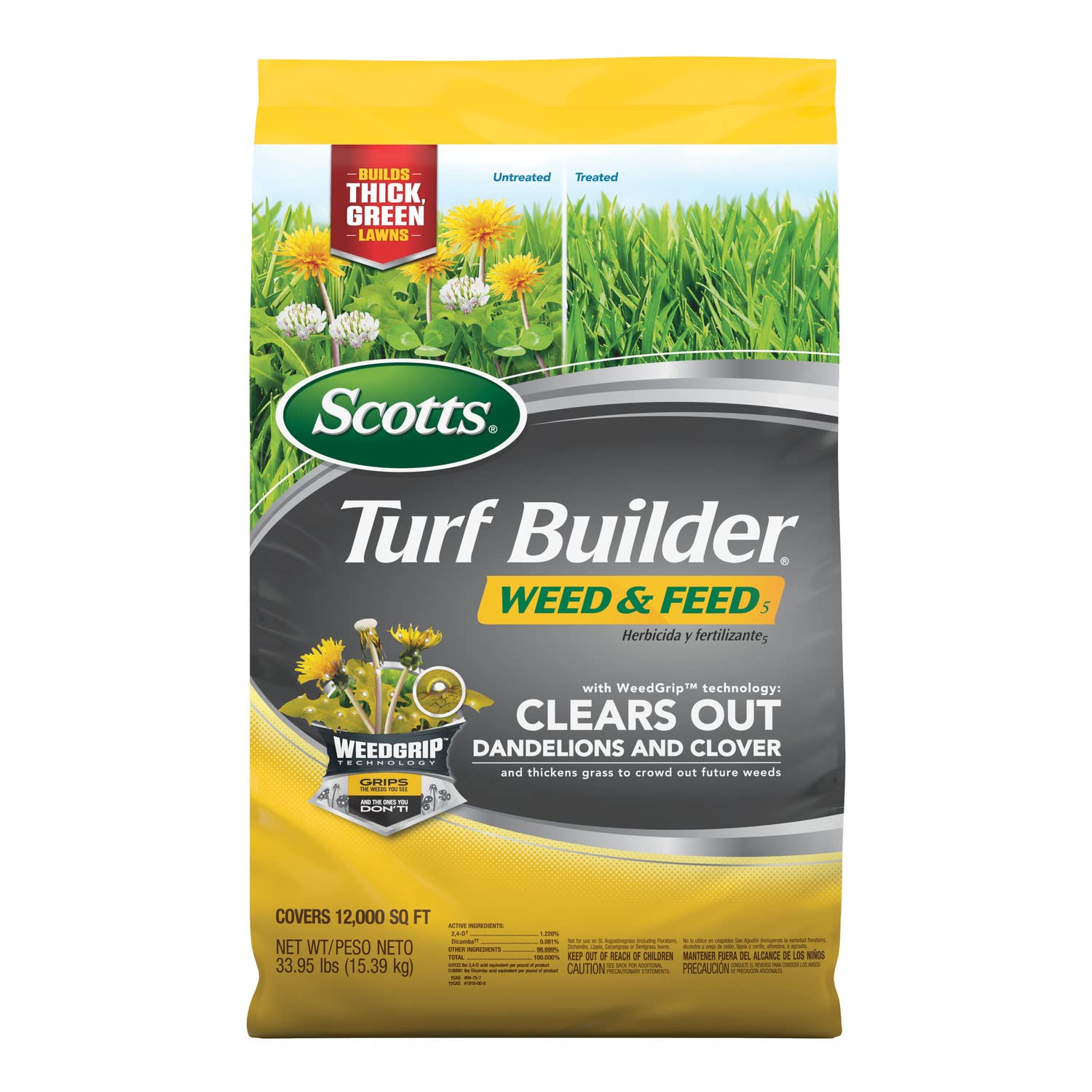
Scotts Turf Builder Weed & Feed5 Lawn Fertilizer and Weed Killer, 33.95 lb.
| Item Form | Granule |
|---|---|
| Coverage | 12000 square feet |
| Active Ingredients | 2.4-D, Dicamba |
Scotts Turf Builder Weed & Feed5 combines selective broadleaf weed control with a lawn fertilizer in a single granular product intended for use in late spring when weeds are actively growing. You apply it with a broadcast, drop, or handheld spreader (Scotts gives specific spreader settings) to a wet lawn and avoid watering for 24 hours to let granules stick and work. The formula targets more than 50 listed weeds such as clover and dandelion while delivering nitrogen and potassium to thicken grass and help it crowd out future weeds. Practical benefits include coverage for up to 12,000 square feet from one bag and WeedGrip Technology that helps granules adhere to leaves for better control. Important limitations: it is a selective herbicide so it must not be used on several grass types (for example St. Augustine and bentgrass), it requires timing when daytime temps are 60 to 90°F, and you must keep people and pets off the treated area until dust settles. Follow label directions closely for safe and effective results.
Best for: A homeowner who wants a straightforward, single-step product to reduce broadleaf weeds while feeding a common cool- or warm-season lawn and prefers clear, proven instructions to minimize mistakes.
Less Ideal for: Owners of St. Augustine, bentgrass, carpetgrass, dichondra, or other excluded turf types and people who need a product that can be applied year-round or during cooler/hotter conditions.
- Combines weed control and fertilizer in one application to simplify lawn care
- Large coverage so one bag treats up to 12,000 sq. ft.
- WeedGrip Technology helps granules stick to weed leaves for improved efficacy
- Clear application guidance with recommended spreader settings for even coverage
- Not safe for use on several turf types such as St. Augustine and creeping bentgrass
- Must be applied only when temperatures and lawn moisture meet the label conditions and cannot be watered for 24 hours after application
Verdict: Use this if you want a trusted, all-in-one granular product to kill common broadleaf weeds and feed an eligible lawn in a single late-spring application.
Choosing the Right Weed Killer Lawn Fertilizer: Key Factors to Consider
Weed Control Spectrum and Target Weeds
Different products target different weeds. Some formulas are broadleaf-focused, dealing with dandelions, clover, and plantain, while others include active ingredients for grassy weeds like crabgrass or annual bluegrass.
Understanding the spectrum matters because a product that excels against broadleaf weeds may do little to suppress grassy invaders. Match the label to the weeds present in your lawn and time applications for when those weeds are most vulnerable, typically during active growth phases.
Turf Safety and Grass Type Compatibility
Herbicide ingredients and application timing affect how safe a product is for your turf species. Warm-season grasses and cool-season grasses differ in tolerance to certain chemicals and to application during heat or cold stress.
Check that the formula is labeled for your grass type and avoid treating lawns under heat stress, drought, or immediately after overseeding unless the product specifically permits it. Safer choices reduce the risk of browning, thinning, or delayed recovery after treatment.
Nutrient Balance and Release Profile
Fertilizers supply macro- and micronutrients that feed grass and influence recovery after weed control. Fast-release formulations give a quick green-up but can burn tender turf if applied incorrectly. Controlled-release granules feed over weeks to months and reduce growth flushes.
Consider your mowing frequency and seasonal needs. A balanced N-P-K ratio with some slow-release nitrogen is often preferable for steady growth and reduced mowing after treatment.
Application Method and Equipment Needs
Some weed killer fertilizers are dry granules meant for spreaders, others are concentrates for spray application, and a few are ready-to-use liquid mixes. The chosen method affects accuracy, coverage, and the chance of overapplication.
Think about the equipment you own, whether you need a broadcast spreader calibration, or if you prefer spot-spraying. Ease of mixing, clear dosing instructions, and compatibility with common spreaders or tank sprayers make routine treatments simpler and safer.
Timing and Seasonal Fit
When you apply matters as much as what you apply. Preemergent herbicides must go down before weed seeds germinate, while postemergent products work best when weeds are actively growing and not dormant.
Align treatments with local seasons and mowing schedules. Avoid applying during extreme temperatures or drought, and observe reapplication intervals on the label to avoid stressing turf with repeated treatments.
Environmental Considerations and Runoff Risk
Herbicides and fertilizers can move offsite with rainfall or irrigation, affecting waterways and nearby plants. Some formulations are designed to reduce runoff risk or use less volatile actives.
Choose products with clear environmental use instructions, follow buffer zone guidance near water or flower beds, and avoid application before heavy rain. Proper calibration and conservative dosing lower the chance of unintended impacts.
When to Use a Combined Weed Killer and Fertilizer
Combining weed control with fertilizer is often efficient when weeds are actively growing and the lawn can benefit from a nutrient boost. Postemergent treatments paired with a balanced fertilizer help grass outcompete returning weeds after they have been suppressed.
Avoid combined treatments when the lawn is stressed from drought, heat, or recent overseeding. In those situations, treat problems separately or wait until the turf has regained vigor so the grass can respond positively to both the herbicide and the nutrients.
- Best during active growth in spring or early fall for many regions
- Not recommended immediately after seeding unless product label allows it
- Avoid application before heavy rain to reduce runoff
Application Tips for Uniform Coverage
Calibrating your spreader or sprayer is essential to ensure even distribution and avoid hotspots that can burn grass. Follow the label's suggested settings but test on a small area to confirm coverage.
Overlap passes slightly with a spreader to prevent streaking, and keep walking speed consistent. For sprays, use a coarse nozzle when applying fertilizer-containing mixes to reduce drift and improve droplet retention on foliage.
- Measure lawn area to calculate correct product amount
- Apply on a calm day with temperatures below midday extremes
- Water lightly only if the label specifies incorporating nutrients into the soil
Caring for Lawn After Treatment
After application, monitor the lawn for weed decline and any signs of turf stress. Avoid heavy foot traffic for a few days if the product label suggests limited reentry.
Maintain proper mowing heights and regular watering patterns to support recovery. If you used a slow-release fertilizer, expect gradual improvement in color and density rather than an immediate surge.
- Wait the recommended reentry interval listed on the product label
- Mow at the correct height for your grass and avoid scalping
- Resume regular fertilization schedule only after assessing turf response
Special Situations: Overseeding and Renovation
If you plan to overseed or renovate, most combined weed killer fertilizers are not appropriate because herbicides can damage new seedlings. Schedule herbicide-containing treatments several weeks before seeding or choose non-herbicidal fertilizer until new grass is established.
For patch repair, treat weeds in adjacent areas carefully to protect seedbed zones and follow label guidance for timing between herbicide use and seeding.
- Delay overseeding according to the label after herbicide application
- Use mechanical weed removal or targeted spot treatments in seedbeds
Organic and Reduced-Risk Alternatives
Many gardeners prefer reduced-risk or organic fertilizer and weed control strategies. These often rely on mechanical weeding, corn gluten meal as a preemergent option, or iron-based spot treatments for broadleaf weeds.
Organic approaches usually require more frequent effort and close monitoring but reduce chemical exposure and runoff risk. They can be integrated with conventional tactics for a hybrid management plan.
- Organic preemergents like corn gluten meal need precise timing to be effective
- Iron-based spot treatments are useful for small infestations of broadleaf weeds
How We Chose the Best Weed Killer Lawn Fertilizer
We focused on practical performance for typical home lawns and only included products that combine herbicide action with balanced fertilizer. Selection prioritized materials formulated for common turfgrasses and labeled for residential use rather than commercial or agricultural-only treatments. We required clear directions for application and reentry intervals, plus compatibility with standard mower and irrigation schedules. Evaluation emphasized measurable, gardener-relevant criteria: weed control spectrum and speed, fertilizer nutrient balance and release profile, turf safety across common grass types, and ease of application with typical spreaders or sprayers. We excluded products intended solely for spot treatment, non-labeled experimental blends, or formulas requiring specialized licensing to apply. The final list favors options that balance quick weed decline with long-term turf health and practical useability for homeowners.
FAQ
Can I apply a weed killer fertilizer right after overseeding?
Usually you should not. Most herbicides included in combined products will harm seedlings. Wait the interval specified on the product label or apply fertilizer without herbicide until seedlings are established.
How soon will I see weeds die after applying a combined product?
It often depends on the weed and active ingredient. Many broadleaf weeds show browning within a few days to two weeks, while grassy weeds can take longer. Weather and weed growth stage also affect speed.
Is it safe to apply these products during hot, dry weather?
Applying during extreme heat or drought increases the risk of turf stress. It is usually better to treat when grass is actively growing and soil moisture is adequate. Follow label warnings about temperature restrictions.
Will a combined product prevent future weed germination?
Most combined weed killer fertilizers are postemergent and control existing weeds rather than acting as a preemergent barrier. If you need prevention, look for products labeled specifically as preemergent or plan a separate preemergent application.
How should I water after application?
Watering instructions vary. Some granular formulas require light irrigation to move nutrients into the root zone, while many herbicides perform best when not immediately washed off. Follow the product label for timing and irrigation amounts.
Can I use a combined product on all lawn grass types?
Not all products are safe on every grass species. Check the label for compatibility with cool-season and warm-season grasses and avoid applying products that are not listed for your turf type.
Final Verdict
When choosing a weed killer lawn fertilizer, prioritize matching the product to the weeds you face and the type of grass you grow. Balance quick weed suppression with a fertilizer formulation that supports steady turf recovery and minimizes stress. Consider timing, application method, and environmental precautions as part of your decision. Focus on labeled compatibility, a suitable nutrient release profile, and practical ease of application to choose the best option for your lawn maintenance plan.
