

Note: This article contains affiliate links. If you click on these links and make a purchase, I may earn a small commission at no extra cost to you. This helps support my research and content. Read my full affiliate disclosure here.
When you want a thicker, greener lawn and fewer broadleaf weeds in a single treatment, a lawn fertilizer with weed killer can save time and reduce repeat applications. Choosing the right combined product matters because nutrient ratios, weed active ingredients, and application timing all affect how your turf responds and whether nearby landscape plants are safe. This guide covers six shortlisted options selected for common lawn types and seasonal needs. We evaluate each pick on nutrient balance, weed control spectrum, application ease, and turf safety so you can match a product to your yard and maintenance plan.
Top Picks at a Glance
| Best Overall The best all-around choice for most situations | Scotts Turf Builder Triple Action Granular Lawn Food (14.1 lb) |  |
| Best Quality Built to a higher standard if you want something more solid | Scotts Turf Builder Triple Action 3-in-1 Lawn Fertilizer and Weed Control, 33.94 lb |  |
| Best Value The sweet spot between price and what you get | BioAdvanced 5-in-1 Weed and Feed Granules (9.6 lb) |  |
| Best Budget The cheapest option that still gets the job done reliably | GreenView Weed & Feed Lawn Fertilizer, 13 lb Bag |  |
| Highest Rated A top-rated pick with lots of positive feedback | Scotts Turf Builder Halts Crabgrass Preventer with Lawn Food (covers 5,000 sq. ft.) |  |
| Most Popular A crowd favorite that many people choose with confidence | Scotts Liquid Turf Builder Plus 2 Weed Control, 32 fl. oz. |  |
Scotts Turf Builder Triple Action Granular Lawn Food (14.1 lb)

| Item Form | Granule |
|---|---|
| Coverage | 5,000 sq. ft. |
| Active Ingredients | Pendimethalin 1.22%, 2,4-D 1.22%, Dicamba 0.081% |
Scotts Turf Builder Triple Action combines fertilizer with selective weed control and crabgrass prevention in one granular formula intended for spring lawn care. You apply it with a broadcast spreader to a wet lawn when broadleaf weeds like dandelions are actively growing, then water after 24 hours to activate the crabgrass preemergent. The bag covers about 5,000 square feet and lists active ingredients (pendimethalin, 2,4-D, dicamba) that target both existing broadleaf weeds and prevent many grassy weeds. In practice this reduces the number of separate treatments you need and simplifies seasonal maintenance for common cool- and warm-season grasses. Important limitations are that it will not kill established crabgrass and it contains herbicides that require waiting for dust to settle and keeping people and pets out of the area until safe. Also follow label directions on timing and application frequency since the product should be used sparingly and no more than twice a year.
Best for: Homeowners who want a straightforward, low-effort spring treatment that reduces separate weed and feed steps and maintains a thicker, greener lawn across common grass types.
Less Ideal for: People with small ornamental lawns, vegetable gardens, or those who prefer organic-only products should consider alternatives; do not use where runoff could reach ponds or streams.
- Three-in-one formula combines weed killer, crabgrass prevention, and fertilizer for fewer separate applications
- Covers approximately 5,000 sq. ft. per 14.1 lb. bag, convenient for medium lawns
- Works with standard broadcast spreaders and activates after watering to prevent grassy weed germination
- Contains herbicides that require careful handling and re-entry precautions around people, pets, and water
- Does not kill existing crabgrass, only prevents future germination
Verdict: A convenient all-in-one spring treatment for homeowners who want weed control, crabgrass prevention, and fertilization in a single application.
Scotts Turf Builder Triple Action 3-in-1 Lawn Fertilizer and Weed Control, 33.94 lb

| Item Form | Granule |
|---|---|
| Coverage | All-purpose |
| Active Ingredients | Pendimethalin, 2,4-D, Dicamba |
| Unit Count | 543.04 Ounce |
Scotts Turf Builder Triple Action combines weed control, crabgrass prevention, and fertilizer into one granular product aimed at simplifying spring lawn care. You apply it with a broadcast spreader to a wet lawn when broadleaf weeds like dandelions are actively growing, let the granules settle for 24 hours, then water to activate the pre-emergent layer that blocks crabgrass germination. The formula contains pendimethalin plus 2,4-D and dicamba to target a broad list of lawn weeds while providing nutrients to strengthen turf. Its main benefits are convenience and broad coverage — one 33.94 lb bag treats about 12,000 sq ft — and it works on most common turf species. Important limitations to note are safety and timing: active ingredients require care around children and pets until dusts settle, it will not kill established crabgrass, and correct application timing and watering are essential for prevention to work. For best results use a calibrated spreader and follow label directions for temperature and grass type compatibility.
Best for: Buyers who prioritize measurable lawn performance and want a single product to reduce steps in spring lawn care, particularly homeowners managing medium to large cool- or warm-season lawns.
Less Ideal for: Those who need a solution for existing crabgrass patches, have very small decorative turf areas, or prefer organic-only products should consider alternative targeted treatments.
- Three functions in one bag: fertilizer, broadleaf weed killer, and crabgrass pre-emergent
- Large coverage per bag suitable for medium to large lawns (up to 12,000 sq ft)
- Granular form works with standard broadcast spreaders for even application
- Contains multiple active ingredients for control of a wide range of listed weeds
- Instructions and recommended use timing are provided to optimize performance
- Does not control existing crabgrass since pre-emergent only prevents germination
- Contains herbicides that require keeping people and pets off treated area until granules settle
- Effectiveness depends on correct timing, watering, and spreader calibration
Verdict: Choose this if you want a performance-focused, all-in-one granular treatment that feeds turf while preventing crabgrass and controlling common broadleaf weeds.
BioAdvanced 5-in-1 Weed and Feed Granules (9.6 lb)

| Item Form | Granule |
|---|---|
| Coverage | 4000 square_feet |
| Active Ingredients | Dicamba, Quinclorac |
BioAdvanced 5-in-1 Weed and Feed is a granular lawn treatment that combines multiple herbicides with fertilizer so you can kill existing weeds and feed turf in a single application. You apply it with a broadcast or drop spreader to an established, dry lawn, then water in and avoid mowing for at least a day. The formula targets over 200 broadleaf weeds and large crabgrass and creates a soil barrier that helps prevent new listed weeds for up to six months while feeding and greening the lawn for about three months. Practical features include granular form for easy even coverage and instructions for follow-up watering and safety precautions. Important limitations are usual for combined herbicide-fertilizers: it is intended for established turf rather than newly seeded lawns, and precautions are needed around children, pets, and windy applications. It is not labeled for sale in all states and requires following label directions closely for best results.
Best for: Homeowners who want a low-effort, maintenance-friendly product to reduce separate purchases and applications and keep an established lawn greener while controlling common weeds.
Less Ideal for: People establishing a new lawn from seed, managing sensitive ornamentals near turf, or those who prefer non-chemical weed control methods.
- Combines weed control and fertilizer in one application for convenience
- Controls both broadleaf weeds and large crabgrass and helps prevent new weeds for up to six months
- Granular formula spreads evenly with a broadcast or drop spreader for uniform coverage
- Feeds and greens turf for up to three months after application
- Not suitable for newly seeded or delicate lawns where herbicides can inhibit germination
- Requires careful handling and exclusion of children and pets until treated areas are dry
Verdict: Use this product when you want one granular application to both kill common and crabgrass weeds and feed an established lawn for months of reduced maintenance.
GreenView Weed & Feed Lawn Fertilizer, 13 lb Bag

| NPK | 27-0-4 |
|---|---|
| Form | Granule |
| Coverage | 5000 square_feet |
| Active ingredient | Nitrogen |
GreenView Weed & Feed is a combined granular fertilizer and selective herbicide designed to feed established turf while controlling broadleaf weeds. You apply it to a dry, established lawn when weeds are actively growing, then water to activate the product and avoid mowing for two days. It uses a controlled-release nitrogen formulation to deliver steady feeding for up to eight weeks, which helps green-up without pushing surge growth and supports deeper roots for better drought tolerance. The herbicide component targets more than 250 common lawn weeds such as dandelion, clover, and plantain, so one application handles both nutrition and weed pressure across many cool- and warm-season grasses. Practical benefits include long feeding duration, wide weed control, and coverage suitable for medium to large yards. Important limitations are that it is for established turf only, it can damage certain grasses like St. Augustine (in Florida), dichondra, and carpetgrass, and timing matters because weeds must be actively growing for best control.
Best for: Homeowners who want a single, budget-friendly product to both feed and reduce broadleaf weeds on established lawns and prefer less frequent applications over the season.
Less Ideal for: Gardeners establishing new turf, owners of sensitive or excluded grass types, or those seeking an organic or granular fertilizer without herbicide.
- Controlled-release nitrogen feeds lawns for up to eight weeks, reducing the need for frequent applications
- Provides selective control of over 250 broadleaf weeds alongside fertilization
- Covers approximately 5,000 square feet from a single 13 lb bag, suitable for medium to large yards
- Zero phosphate formulation to reduce risk of waterway runoff
- Not safe for certain turf types such as St. Augustine in Florida, dichondra, and carpetgrass
- Requires correct timing and watering after application for effective weed control
- Intended only for established lawns and can harm seedlings or sensitive grasses
Verdict: A cost-effective all-in-one weed-and-feed that delivers eight weeks of controlled-release nitrogen while knocking back a wide range of common broadleaf weeds.
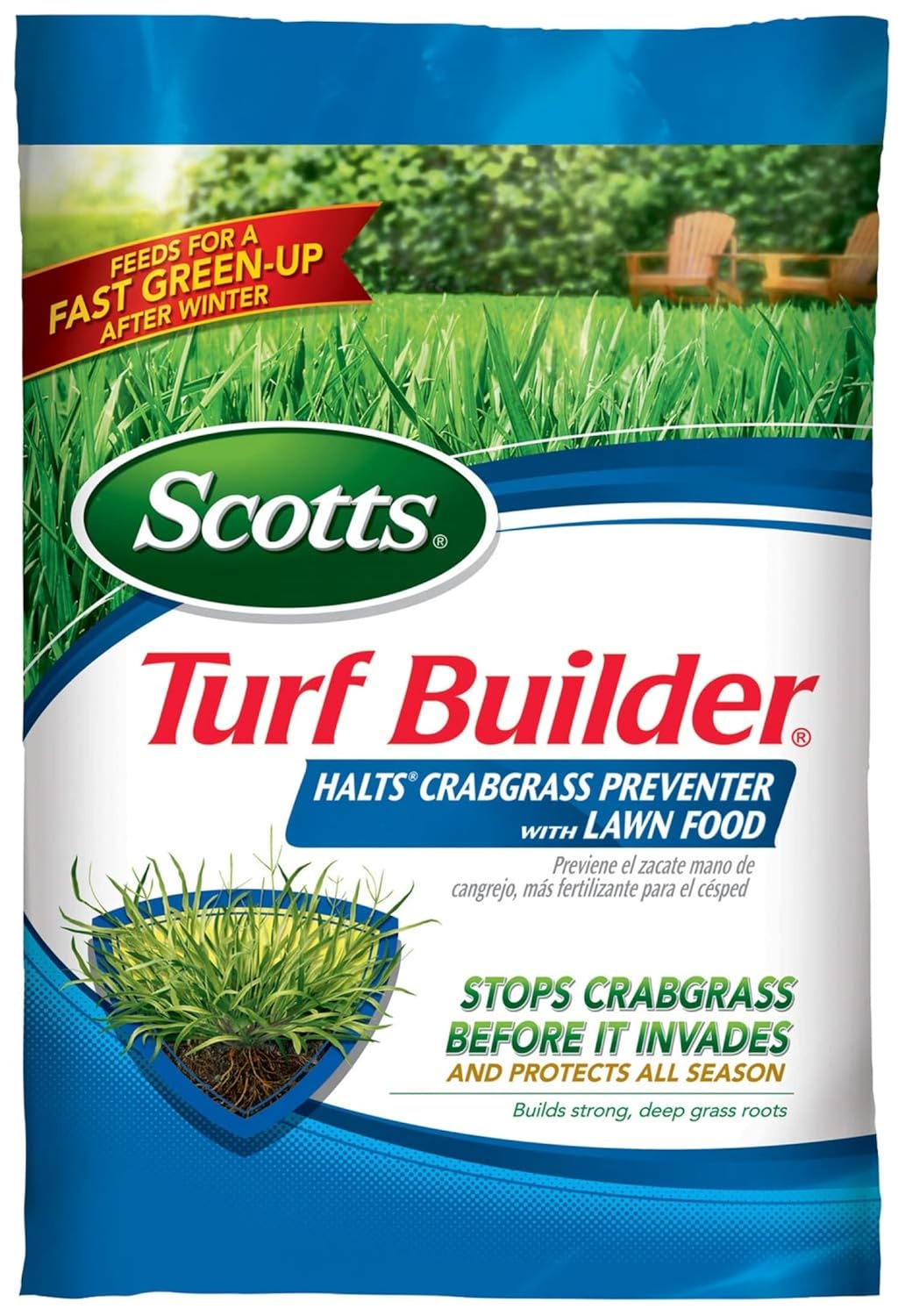
Scotts Turf Builder Halts Crabgrass Preventer with Lawn Food (covers 5,000 sq. ft.)
| Item Form | Granule |
|---|---|
| Coverage | 5000 square feet |
| Unit Count | 213.6 Ounce |
| Fertilizer analysis | 30-0-4 |
Scotts Turf Builder Halts combines a pre-emergent crabgrass preventer with a granular lawn fertilizer to protect and feed an established lawn through the spring. You apply it once in early spring to a dry lawn before regular hot weather, using a broadcast or drop spreader and then water the lawn lightly within 2 to 3 days so the active ingredient forms a barrier in the soil. The product covers 5,000 sq. ft. per bag and is formulated to prevent several grassy and broadleaf weeds while the 30-0-4 fertilizer helps grass green up quickly and build deeper roots. Practical benefits include season-long prevention of new crabgrass and simultaneous feeding, which reduces extra steps in spring lawn care. Limitations are that it will not kill mature crabgrass or existing weeds and it is not suitable for certain turf types like dichondra or bentgrass. Also, correct spreader settings and post-application watering are important for reliable performance, so casual or inexperienced applicators should follow directions closely.
Best for: Homeowners who prioritize reliable, season-long prevention and want a simple spring treatment that both blocks new crabgrass and feeds the lawn.
Less Ideal for: People needing a post-emergent weed killer for existing crabgrass or those managing dichondra or bentgrass turf should choose a different product.
- Pre-emergent formula prevents crabgrass and several other grassy weeds when applied correctly
- Includes fertilizer (30-0-4) for fast green-up and stronger root development
- Single-application coverage for 5,000 sq. ft. reduces repeat treatments in spring
- Granular form works with common broadcast and drop spreaders for even application
- Does not control established or mature crabgrass or existing weeds
- Not safe for use on dichondra and bentgrass lawns
Verdict: Choose this product if you want a dependable one-time early-spring treatment that prevents new crabgrass while feeding and strengthening your lawn.
Scotts Liquid Turf Builder Plus 2 Weed Control, 32 fl. oz.

| Liquid Volume | 32 fluid ounces |
|---|---|
| Coverage | 6000 square_feet |
| Item Form | Spray |
| Active Ingredients | Nitrogen |
This ready-to-spray Scotts Liquid Turf Builder combines a quick nitrogen boost with broadleaf weed control in a hose-end applicator that makes treatment fast and DIY-friendly. You connect the bottle to a garden hose, spray the lawn while weeds are actively growing, then avoid watering for 48 hours so the weed control can work. The formula is designed to control common weeds such as dandelions, clover, chickweed and ground ivy while feeding bluegrass, fescue, ryegrass and several warm-season grasses; coverage is listed as up to 6,000 sq ft on warm-season lawns and 4,000 sq ft on cool-season lawns. Practical benefits include the ease of application, immediate nitrogen availability for visible greening, and a targeted list of controlled broadleaf weeds. Important limitations are that it is for lawn grasses only so it must not be used in garden beds, it requires calm conditions and temperatures under 85°F for best results, and some stubborn weeds may need a second application after 3 to 4 weeks.
Best for: Buyers who want a simple, low-effort solution to both feed their lawn and knock back broadleaf weeds without specialized equipment and who value products with established brand recognition and many user experiences.
Less Ideal for: Those who need a granular slow-release fertilizer, want products safe for nearby flower beds or vegetables, or who prefer organic weed control methods.
- Ready-to-spray hose-end applicator for quick, tool-free application
- Provides fast-acting nitrogen to green and feed lawns
- Controls a wide list of common broadleaf lawn weeds
- Large stated coverage per bottle for typical yard sizes
- Not safe for use in garden beds or on non-listed plants
- Performance is weather-dependent and limited above 85°F
- Some hard-to-control weeds may require repeat applications
Verdict: If you want a fast, no-fuss hose-ready product that feeds your lawn and knocks back common broadleaf weeds, this Scotts liquid ready-to-spray is an effective one-step option.
Choosing the Right Lawn Fertilizer with Weed Killer: Key Factors to Consider
Nutrient Ratio and Release Type
The balance of nitrogen, phosphorus, and potassium controls growth, root development, and stress tolerance. A product with a moderate nitrogen percentage and a mix of quick-release and slow-release sources gives an initial green-up followed by sustained feeding rather than a short-lived flush.
Release type matters because fast-release nitrogen can burn thin turf in hot weather, while too much slow-release delays visible improvement. Consider your lawn goals: a higher quick-release component helps recover from early-season yellowing, while a higher slow-release portion reduces mowing frequency and feeding stress over the season.
Weed Active Ingredients and Spectrum
Check which broadleaf weeds the product controls and the active ingredients listed on the label. Some actives target dandelion, clover, and plantain reliably, while others add control for tougher weeds like knotweed and chickweed. The breadth of control determines whether the product will reduce overall weed pressure or only handle a subset.
Also note whether the herbicide is contact-only or systemic. Systemic actives move into the weed and kill roots for longer control, which is preferable for persistent species. Match the spectrum to the weeds actually present in your lawn for best results.
Turf Safety and Appropriate Timing
Different grass species tolerate combined fertilizer-plus-herbicide products differently. Warm-season grasses and cool-season grasses have distinct windows when they are actively growing and resilient enough to handle chemical treatment. Applying at the wrong time can stress grass, causing yellowing or burn.
Read label directions about reseeding, overseeding, or spring green-up. Many combined products advise waiting after seeding or avoiding application during drought or summer heat. Planning application around active growth periods improves uptake and reduces injury risk.
Application Method and Coverage Control
Granular spreads and liquid sprays behave differently in the garden. Granular products are often applied with a broadcast spreader for even feeding and weed control, while liquids can give more precise targeting but require proper dilution and spray technique.
Consider how easy it is to calibrate your spreader or sprayer, how uniform the product distributes, and whether the label offers application rates for your lawn size. Inconsistent coverage can leave patches of poor feed or untreated weeds.
Residual Effects and Environmental Risk
Combined products may contain herbicide components with varying soil persistence. Longer residuals can help prevent new weeds but increase risk to nearby ornamentals, vegetable beds, and waterways. Choose products with appropriate residual profiles for your landscape layout.
Take into account rainfall and irrigation schedules after application. Heavy rain soon after treating can transport chemicals off the lawn. Look for guidance on buffer zones and recommended wait times before irrigation to reduce runoff risk.
Label Clarity and Safety Instructions
A clear, detailed label helps avoid misapplication and reduces the chance of damage. Labels that provide precise spreader settings, spray volumes, and step-by-step mixing instructions are easier to use correctly. Safety information on personal protective equipment and re-entry intervals protects you during and after application.
Good labeling will also include clear guidance for different grass species and for steps to take after accidental overspray on ornamentals. Prefer products that make safe use straightforward.
When to Treat Your Lawn
Timing determines both fertilizer effectiveness and herbicide safety. Apply combined products when the turf is actively growing so the grass can take up nutrients and tolerate the herbicide. For cool-season grasses that is usually early fall and early spring; for warm-season grasses the optimum window is late spring through early summer.
Avoid treating during drought stress, extreme heat, or immediately after seeding. If you plan overseeding, follow label guidance on waiting periods so new seedlings are not harmed.
- Apply to actively growing grass for best uptake
- Avoid treatment during heat waves or drought
- Check reseeding wait times before overseeding
Spot Treatment Versus Broadcast Application
If weeds are in isolated patches, spot treating with a targeted herbicide can limit chemical use and reduce risk to surrounding plants. Broadcast products are better when weeds are widespread or when you want a single pass to feed the whole lawn.
Consider the labor and precision trade-off. Spot treatment is more time-consuming but reduces overall chemical exposure. Broadcast application is faster and typically more uniform but requires careful calibration to avoid over- or under-application.
- Spot treat small infestations to protect adjacent beds
- Broadcast when weeds are widespread for efficiency
- Use shields or mask sprays to prevent ornamental damage
Application Equipment and Calibration Tips
Correct spreader or sprayer settings are essential for consistent results. For granular products, calibrate the spreader and practice a pass pattern on a driveway to check uniform flow. For liquids, verify nozzle type and pressure produce a fine, even spray without drift.
Measure lawn area before you begin so you can apply the proper rate. Over-application increases burn risk and environmental load, while under-application reduces both feeding benefit and weed control.
- Calibrate spreader or sprayer before treating
- Measure lawn area to calculate correct rate
- Wear recommended protective gear during application
Post-Application Care
After applying a combined fertilizer and weed control product, follow label guidance for irrigation and mowing. Some products require delaying irrigation to allow herbicide uptake, while others benefit from light watering to activate granules.
Wait the recommended interval before overseeding, planting nearby ornamentals, or allowing pets on the treated area if specified. Proper post-application care helps secure control of weeds while minimizing turf stress.
- Follow irrigation recommendations on the label
- Delay mowing if label advises to maximize herbicide contact
- Observe treated areas for signs of stress and act accordingly
Integrated Weed Management Strategies
A combined fertilizer-herbicide product is a tactical tool, not a sole solution. Pair chemical control with cultural practices like mowing at the correct height, overseeding thin areas, and improving soil health to reduce future weed pressure.
Addressing underlying causes such as compacted soil, poor drainage, or nutrient imbalances will make weed-control products more effective and reduce the frequency of chemical interventions.
- Mow at recommended heights to shade out weed seedlings
- Overseed thin patches to increase turf competition
- Improve soil with aeration and organic matter where needed
How We Chose the Best Lawn Fertilizer with Weed Killer
We focused on practical, garden-tested attributes that matter when you want fertilizer and broadleaf weed control in one bottle or bag. Primary evaluation criteria included nutrient formulation and release type to judge green-up and lasting feed; weed control spectrum and active ingredient effectiveness to measure which common broadleaf weeds are controlled; turf safety across common grass species and timing windows to reduce burn and stress risk; ease of application and coverage consistency for accurate spreading or spraying; and environmental and runoff considerations to limit damage to ornamentals and waterways. We also considered label clarity and mixing or spreader calibration guidance since correct application is essential for safety and results. Excluded items included narrow-use herbicide concentrates without balanced feeding, products intended only for spot treatment without broadcast options, and formulations labeled exclusively for new-seed establishment. The final shortlist balances reliable feeding with meaningful broadleaf control while favoring products with clear instructions and predictable turf response.
FAQ
Can I apply a fertilizer with weed killer right after overseeding?
Usually you should wait after overseeding. Most combined products advise a waiting period because herbicides can harm seedlings. Check the label for specific reseeding intervals, which vary by product and grass species.
Will a combined product control crabgrass and other grassy weeds?
Combined fertilizer-plus-weed killer products typically focus on broadleaf weeds. Control of grassy weeds like crabgrass often requires a separate pre-emergent or a product formulated for grassy weed control. Read the label to confirm what species are listed.
How soon will I see results after applying a combined product?
You may notice green-up from the fertilizer within a week depending on release type and growing conditions. Herbicide effects on broadleaf weeds can be visible in a few days to a couple of weeks for systemic actives. Results depend on weed species and weather.
Is it safe to use near flower beds and vegetables?
There is some risk to nearby ornamentals and vegetables from drift or runoff. Use buffer zones, avoid spraying on windy days, and follow label precautions about distances from desirable plants. For high-risk areas, consider spot treatment or physical weed removal.
Can I apply a combined product during drought?
Applying during drought increases the risk of turf burn and poor herbicide uptake. Many labels advise against application when the lawn is moisture-stressed. Wait for recovery or a period of active growth before treating.
Final Verdict
Choose a combined fertilizer and weed control product by prioritizing nutrient balance that suits your turf type, a weed spectrum that matches the species in your lawn, and timing that coincides with active grass growth. Give special attention to application method, spreader or sprayer calibration, and label instructions to avoid turf stress and environmental issues. If you need fast broadleaf reduction and feeding in one step, opt for a product with systemic weed actives and a balanced release of nutrients, but be prepared to supplement with targeted treatments or cultural improvements for persistent problems.
