

Note: This article contains affiliate links. If you click on these links and make a purchase, I may earn a small commission at no extra cost to you. This helps support my research and content. Read my full affiliate disclosure here.
If you want weeds gone without damaging your lawn, a selective weed killer is the tool for the job. The right product targets common broadleaf and annual weeds while leaving grass species healthy and green, so you do not sacrifice turf density or appearance when treating problem areas. This guide covers six shortlisted weed killers chosen for their selective action in lawns, safety profile for common turfgrasses, and practical ease of use in real yard conditions. We evaluated how quickly each option works, how much monitoring and retreatment is needed, and what application technique produces the best results. Read on for a concise look at what to expect when treating weeds while protecting grass.
Top Picks at a Glance
| Best Overall The best all-around choice for most situations | Ortho WeedClear Lawn Weed Killer Ready-to-Use with Comfort Wand, 1 gal. |  |
| Best Quality Built to a higher standard if you want something more solid | PBI/Gordon SpeedZone EW Lawn Weed Killer, 20 fl oz |  |
| Best Value The sweet spot between price and what you get | Spectracide Weed Stop for Lawns Plus Crabgrass Killer, Ready-to-Use, 1 Gal |  |
| Best Budget The cheapest option that still gets the job done reliably | Spectracide Weed Stop for Lawns Concentrate Ready-to-Spray, 32 oz |  |
| Highest Rated A top-rated pick with lots of positive feedback | T-Zone Turf Herbicide Broadleaf Weed Killer, 1 Quart |  |
| Most Popular A crowd favorite that many people choose with confidence | Scotts Liquid Turf Builder Plus 2 Weed Control, Ready‑to‑Spray, 32 fl. oz. |  |
Ortho WeedClear Lawn Weed Killer Ready-to-Use with Comfort Wand, 1 gal.

| Unit Count | 128 Fluid Ounces |
|---|---|
| Item Form | Liquid |
| Coverage | Protection against over 250 types of weeds on various grass types |
| Included Components | Comfort Wand attached, ready-to-use bottle |
This ready-to-use Ortho WeedClear comes in a 1 gallon bottle with a battery-powered Comfort Wand that makes spot treating broadleaf weeds straightforward. It is formulated for southern and common lawn grasses and claims control of over 250 broadleaf weeds including dandelion, clover, chickweed and dollarweed, with visible results in hours. Typical use is to attach the wand, select a spray pattern and target individual weeds when they are actively growing and temperatures are below 90°F for several hours. Practical benefits include the convenience of a pre-mixed spray, precise application to avoid treating the whole lawn, and a wand that reduces bending and over-spray. Important limitations are that it is intended only for spot treatments, not whole-lawn applications, and it works best on young actively growing weeds and under recommended temperature conditions. Users must follow safety directions to keep people and pets off treated areas until dry and wear protective clothing during application.
Best for: Homeowners who want a convenient, targeted solution to remove common broadleaf lawn weeds without treating the entire yard and prefer easy application with a wand.
Less Ideal for: Gardeners needing whole-lawn weed control, long-term year-round prevention, or solutions for tough brush and vines should consider other products or professional services.
- Ready-to-use formula for no-mix convenience
- Battery-powered Comfort Wand enables precise spot treatment and less bending
- Targets a wide range of broadleaf weeds including dandelion, clover and dollarweed
- Fast-acting with visible results in hours when used on actively growing weeds
- Not intended for broadcast or whole-lawn applications
- Effectiveness decreases on mature weeds or in hot conditions above recommended temperatures
Verdict: Choose this product if you want a convenient, ready-to-spray spot treatment that kills common broadleaf weeds without harming lawn grass when used as directed.
PBI/Gordon SpeedZone EW Lawn Weed Killer, 20 fl oz

| Unit Count | 20 Fluid Ounces |
|---|---|
| Item Form | Liquid |
| Coverage | Mix 1.8 fl oz (warm) or 1.5 fl oz (cool) per 0.5–1 gallon to treat 1000 sq ft |
| Active Ingredients | 2,4-D ester; Dicamba; Carfentrazone-ethyl; Mecoprop-p |
SpeedZone EW is a concentrated, post-emergent liquid herbicide designed to knock back more than 90 listed broadleaf weeds while preserving common turfgrasses. You mix small amounts with water in a handheld or pump sprayer and apply to actively growing weeds; the label gives different mix rates for warm- and cool-season lawns. It combines four active ingredients for broad-spectrum control, delivers visible injury within hours, and typically produces plant death in about a week to ten days. The product is labeled for common turf species including Kentucky bluegrass, perennial rye, tall fescue, bermudagrass, and zoysiagrass, and it becomes rainfast in as little as three hours so you do not have to delay applications long after light rain. Important practical limits are following the label for safe use and re-seeding intervals and taking care with spray overlap near desirable ornamentals, because the formulation contains multiple potent actives; personal protective equipment and precise mixing are required. For gardeners focused on fast, broad-spectrum weed control in managed lawns, it delivers professional-level performance when used as directed.
Best for: Gardeners and lawn stewards who prioritize fast, broad-spectrum weed control and want a product that is safe on common established turf when applied carefully.
Less Ideal for: People who prefer non-chemical weed removal methods or who need a ready-to-use spray for spot treatment of tiny patches should consider alternative approaches.
- Controls a very broad spectrum of more than 90 listed broadleaf weeds including clover and dandelion
- Works in cool weather and shows visible weed injury within hours with plant death in 7 to 10 days
- Labeled for common cool- and warm-season turfgrasses so it can be used on many established lawns
- Becomes rainfast in about three hours, reducing the chance of wash-off after light rain
- Contains multiple strong active ingredients so careful mixing, PPE, and adherence to label directions are required
- Not suitable for application where overspray could contact sensitive ornamentals or nonlisted turf species
Verdict: Choose SpeedZone EW when you need fast, broad-spectrum control of common broadleaf weeds while keeping established turfgrass intact when used as directed.
Spectracide Weed Stop for Lawns Plus Crabgrass Killer, Ready-to-Use, 1 Gal

| Item Form | Spray |
|---|---|
| Coverage | Up to 5,000 sq ft |
| Liquid Volume | 1 gallons |
This ready-to-use Spectracide formula is designed to kill a wide range of broadleaf and grassy weeds, including crabgrass, while minimizing harm to turf when instructions are followed. It comes in a one-gallon spray container intended for spot treatments or treating larger lawn areas up to the stated coverage. The active-contact formulation produces visible wilting in as little as five hours and is labeled to kill weeds down to the root, which helps reduce quick re-growth. Practical features include no mixing, clear temperature and mowing guidance for best results, and specific cautions for Bermudagrass to avoid discoloration in hot conditions. Expect fast results on exposed weeds and an easy application process, but you must follow label directions on temperature and pre-mowing to avoid turf stress and to protect sensitive grass types. This is a straightforward option if you want rapid, contact-based weed control and prefer a ready-to-use product rather than measuring and mixing concentrates.
Best for: Buyers who want a no-fuss, fast-acting lawn weed treatment and prioritize easy application and quick visible results over custom-mixed concentrates. Ideal for homeowners who treat common yard weeds themselves and follow label directions.
Less Ideal for: Not the best choice for users who need systemic, long-term preemergent control or who require a weed killer safe for use on highly sensitive or newly seeded lawns.
- Ready-to-use spray eliminates mixing and simplifies application
- Kills both broadleaf and grassy weeds including crabgrass and yellow nutsedge
- Produces visible results in about five hours for quick confirmation of effectiveness
- Label provides clear application guidance including temperature and mowing recommendations
- Kills by contact so it works best on actively growing, exposed weeds rather than through the turf canopy
- Has temperature limits and can cause temporary discoloration on Bermudagrass if used in hot conditions
Verdict: A convenient ready-to-use spray that delivers fast contact kill of a wide range of weeds while being practical for homeowners who want quick, easy lawn cleanup.
Spectracide Weed Stop for Lawns Concentrate Ready-to-Spray, 32 oz

| Coverage | 8,000 square feet |
|---|---|
| Item Form | Liquid |
| Liquid Volume | 32 fluid ounces |
| Active Ingredients | 2,4-D, Mecoprop-P, Dicamba, Sulfentrazone |
Spectracide Weed Stop for Lawns is a ready-to-spray, liquid concentrate that connects to your garden hose and treats broadleaf weeds across home lawns. It is designed to kill more than 460 listed weed types, including dandelion, chickweed and clover, by contact down to the root with visible results in about three hours. Typical use is to mow two to three days before treatment, attach the QuickFlip sprayer to a hose, and spray until weeds are wet when daytime temperatures are between 45 and 90 degrees. Practical benefits include fast visible control, wide weed coverage, and an easy hose-on applicator that removes measuring and mixing for many users. Important limitations are that it is a contact herbicide so thorough coverage is needed for good control, it should not be applied to zoysiagrass coming out of dormancy, and application above 90 degrees risks lawn injury. Follow label directions about re-seeding timing and keeping people and pets off the treated area until dry.
Best for: Homeowners who want an inexpensive, easy-to-use lawn weed control that treats a wide range of broadleaf weeds without complicated mixing or equipment and prefer quick visible results.
Less Ideal for: People looking for selective pre-emergent control, systemic long-term weed suppression without repeat applications, or users who need a product labeled for newly emerged zoysiagrass.
- Ready-to-spray QuickFlip applicator attaches to a garden hose for fast, no-mix application
- Kills over 460 listed broadleaf weeds with visible results in about three hours
- Formulated to be safe on common turf grasses when used according to label
- Rainproof in about one hour, letting treated lawns return to normal activity sooner
- Contact action requires thorough spray coverage and may miss weeds if not saturated
- Not suitable for zoysiagrass emerging from dormancy and should not be applied above 90°F
Verdict: If you want a budget-friendly, hose-attach solution that quickly knocks back common broadleaf lawn weeds without complex mixing, this Spectracide concentrate delivers.
T-Zone Turf Herbicide Broadleaf Weed Killer, 1 Quart
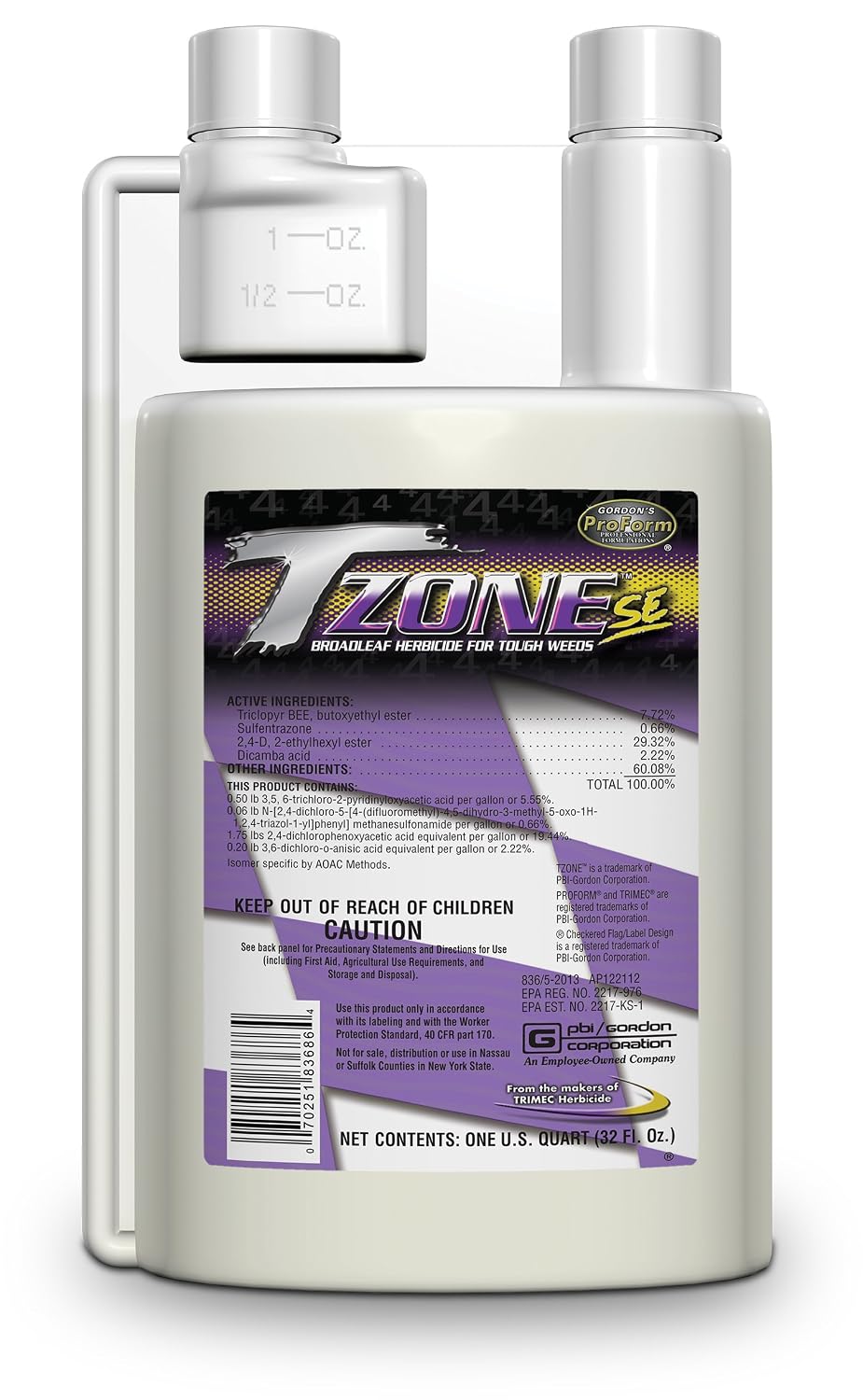
| Unit Count | 32 Fluid Ounces |
|---|---|
| Item Form | Liquid |
| Coverage | broad-leaf weeds, grassy weeds |
| Active Ingredients | Dicamba, triclopyr |
T-Zone Turf Herbicide is a ready-to-mix liquid designed to target broadleaf weeds and certain grassy pests in lawns without killing desirable turf when used as directed. It combines active ingredients including triclopyr, dicamba, and others to deliver fast visual control and includes formulations effective in cooler temperatures down to about 50°F. Typical use is spot treatments or broadcast applications on residential, commercial, or golf sites to suppress weeds like yellow nutsedge and common broadleaf species. The practical benefits are predictable, relatively fast knockdown and a label that supports turf safety when applied at recommended rates, which suits users who need reliable results and fewer retreatments. Important limitations are the need for careful handling and protective gear, and the product requires correct mixing and timing to avoid off-target damage to ornamentals or sensitive plants. It is also an herbicide that targets specific weed classes so persistent or deeply rooted weeds may need follow-up treatments or complementary control methods.
Best for: Buyers who prioritize dependable, turf-safe weed control and want a product that delivers consistent, fast knockdown when applied according to directions.
Less Ideal for: Gardeners who avoid synthetic herbicides altogether or those needing an all-in-one solution for very deep-rooted perennial weeds should consider alternative or supplemental approaches.
- Formulated to control broadleaf weeds and some grassy weeds while labeled for turf use
- Contains multiple active ingredients for faster visible control
- Effective at cooler temperatures down to around 50°F for extended application window
- Suitable for residential, commercial, and golf turf use
- Requires careful handling and personal protective equipment during mixing and application
- Can harm non-target plants if applied or drifted onto ornamentals
- May need repeat treatments for persistent or deep-rooted weeds
Verdict: A reliable turf-safe liquid herbicide that delivers fast, dependable control of common broadleaf and some grassy weeds when used as directed.
Scotts Liquid Turf Builder Plus 2 Weed Control, Ready‑to‑Spray, 32 fl. oz.

| Item Form | Spray |
|---|---|
| Liquid Volume | 32 fluid ounces |
| Coverage | 6000 square_feet |
| Active Ingredients | Nitrogen |
This Scotts ready-to-spray lawn treatment combines a fast-acting liquid fertilizer with a selective broadleaf weed killer so you can feed grass and control common weeds in one pass. You connect the bottle to a garden hose and spray when weeds are actively growing; the hose-end applicator makes coverage straightforward for typical yards. The formula is 25-0-2 NPK with nitrogen as the active nutrient and lists control for dandelions, clover and several other broadleaf weeds. One bottle covers up to 6,000 sq ft on warm-season lawns and 4,000 sq ft on cool-season lawns, and weeds typically begin to curl within days with repeat sprays suggested for stubborn weeds. Important limitations are that it is labeled only for listed grass types and weeds, can cause temporary injury on some bermudagrass, and you must avoid watering for 48 hours after application to allow herbicide activity. It is best used on calm days under 85°F and by homeowners who follow label directions closely for safe, predictable results.
Best for: Buyers who want a simple, low-effort way to feed their lawn and reduce common broadleaf weeds in a single application and who prefer proven brand formulations backed by many user reports.
Less Ideal for: Gardeners who need a product for beds, ornamentals, or vegetable gardens or who require non-chemical or fully organic weed control methods should look elsewhere.
- Ready-to-spray hose-end applicator for fast, easy application
- Combines fertilizer and selective broadleaf weed control in one product
- Covers large areas per bottle (specified coverage for warm and cool season lawns)
- Works quickly on listed weeds with visible curling within days
- Only labeled safe for listed grass types and listed weeds, not for vegetable gardens or flower beds
- May cause temporary injury to some bermudagrass varieties if used under certain conditions
Verdict: Use this ready-to-spray Scotts formula when you want a quick, easy combined fertilizer plus broadleaf weed treatment for common lawn grasses.
Choosing the Right Weed Killer That Kills Weeds But Not Grass: Key Factors to Consider
Active Ingredient and Selectivity
Active ingredient determines which weeds are controlled and how safe the product is on different grass species. Some herbicides target broadleaf weeds while leaving grasses alone because of physiological differences between plant types. Understanding the active chemistry helps you avoid turf injury and choose products effective against the weeds you see in your lawn.
Match the active ingredient to the weeds present. Some ingredients are better against dandelions and clover, while others work on grassy weeds or sedges. Read label turf species lists to confirm compatibility with your grass type and note any restrictions for newly planted or thin lawns.
Application Method and Timing
How a product is applied affects coverage, drift risk, and the potential to harm non-target plants. Ready-to-use pumps and aerosol spot treatments simplify small jobs, while hose-end and concentrated formulations are better for treating larger areas but require careful dilution and flow rate control.
Timing matters too. Apply selective weed killers when target weeds are actively growing, usually in cool, moist conditions in spring and fall for many broadleaf weeds. Avoid application during heat stress or drought, and follow rainfast windows to prevent wash-off and reduced effectiveness.
Turf Type Compatibility
Not all selective herbicides are safe on every grass species. Warm-season grasses and cool-season grasses can react differently to the same product. Labels specify which turf species are listed as safe, and some products restrict use on newly seeded or sodded areas for a period after planting.
Confirm compatibility before widespread application. If your lawn is mixed or you have sensitive ornamental grasses nearby, consider spot treating or testing a small patch first to observe turf response before full-scale use.
Residual Control and Need for Repeat Treatments
Residual activity determines how long a product continues to affect germinating weeds after application. Products with longer soil residuals can suppress new weed seedlings but may limit seeding or overseeding schedules and increase risk to desirable seedlings. Shorter residuals require follow-up treatments but allow quicker replanting.
Decide whether you prefer a one-time residual suppression approach or are comfortable revisiting problem spots. Follow label guidance for intervals between applications and any limitations on reseeding or planting after treatment.
Safety for People, Pets, and Nearby Plants
Labels provide key information about re-entry intervals, pet exposure, and precautions to protect children and ornamental plants. Some selective herbicides require treated turf to dry before people or pets walk on it, while others permit immediate re-entry after application. Take precautions to avoid drift onto flower beds, vegetable gardens, or landscape plants that may be more sensitive.
Use appropriate protective gear during mixing and application and follow disposal recommendations for leftover product and rinse water to minimize environmental exposure.
Environmental Conditions and Weather
Temperature, humidity, and rainfall in the hours and days after application influence efficacy and safety. High temperatures and drought stress can increase turf sensitivity and reduce weed translocation, while rain soon after application can wash away spray before it is absorbed.
Plan applications during stable weather windows, check the rainfast period on the label, and avoid windy conditions that increase drift risk. Consider soil moisture and recent irrigation so the herbicide can be taken up effectively by target weeds.
Common Lawn Weeds and How Selective Herbicides Work
Broadleaf weeds, grassy weeds, and sedges differ in anatomy and growth patterns. Selective herbicides exploit these differences to damage weeds while leaving turfgrasses largely unaffected. Knowing the common targets in your yard helps you choose a product with the right activity spectrum.
Some selective products are systemic, taken up and moved through plant tissues to the roots, which suits perennial weeds. Others are contact actives, working where they touch and better for small, annual weeds. Match the mode of action to the weed biology for more reliable control.
- Systemic action is preferable for deep-rooted perennials like dandelion and plantain.
- Contact herbicides can quickly scorch small annuals but may require repeat applications.
- Sedge-specific chemistries are often needed for yellow nutsedge and other grassy sedges.
Spot Treatment Versus Broadcast Application
Spot treating visible weeds conserves product and reduces non-target exposure. For scattered patches or isolated clumps, use a targeted applicator or brush-on product rather than treating the entire lawn.
Broadcast applications make sense for widespread infestations but demand careful calibration, overlapping-free spraying, and strict adherence to label rates to avoid turf damage. Consider treating the most affected areas first and re-evaluating after a treatment cycle before applying broadly.
- Spot treatment minimizes chemical use and lowers risk to nearby ornamentals.
- Broadcast treatments require uniform coverage and accurate dilution to be safe and effective.
- Combine mechanical removal with spot treatment for large, established weeds.
Safety Practices for Application and Storage
Prepare and apply herbicides in well-ventilated conditions and wear recommended personal protective equipment. Keep children and pets away from treated areas according to label re-entry times.
Store concentrates in a cool, dry place out of reach of children and pets, and keep containers sealed. Dispose of rinse water and leftover diluted spray according to local regulations and label instructions to avoid contaminating water sources.
- Use a dedicated sprayer for herbicides and rinse it thoroughly after use.
- Avoid applying near storm drains, waterways, or desirable plants that are sensitive to herbicide drift.
- Record application dates, rates, and weather conditions to track treatments and plan follow-ups.
Integrating Cultural Practices with Chemical Control
Cultural practices such as mowing height, irrigation timing, and regular fertilization strengthen turf and reduce weed pressure. A dense, healthy lawn shades the soil and makes it harder for weed seedlings to establish, lowering reliance on herbicides.
When herbicides are needed, combine them with corrective cultural measures to improve long-term outcomes. Overseeding thin areas after appropriate waiting periods, adjusting mower height to favor your grass species, and correcting soil fertility issues all support sustained weed suppression.
- Mow at the recommended height for your turf species to encourage vigor.
- Water deeply and infrequently to promote deep roots in grass rather than shallow-rooted weeds.
- Repair bare patches following label guidance on reseeding intervals after herbicide use.
Managing Tough or Recurring Weed Problems
Perennial weeds and recurrent seedlings may require a multi-season strategy. Persistent targets like clover, dandelion, or chickweed often need follow-up treatments timed to the plant growth cycle, along with cultural corrections that reduce their competitive edge.
Rotate modes of action when possible to reduce the chance of herbicide-resistant weed populations. Combining mechanical removal for isolated large plants with selective herbicides for surrounding patches can reduce seed return and gradually lower weed pressure.
- Schedule follow-up applications in accordance with label minimum intervals.
- Use mechanical removal for large tap-rooted perennials before applying a systemic treatment.
- Monitor treated areas over several weeks to judge effectiveness and plan next steps.
How We Chose the Best Weed Killer That Kills Weeds But Not Grass
We shortlisted products based on criteria that reflect how gardeners actually use selective herbicides in lawns. We prioritized chemistry selectivity so the active ingredients are known to suppress common broadleaf weeds without significant injury to typical turf species when applied at label rates. Application flexibility was important, including availability in ready-to-use sprays and hose-end concentrates and whether spot treatment and movement to non-target plants are manageable. Speed of visible control and residual activity were evaluated to balance quick results against the need to avoid repeated applications. Safety profile for pets, children, and desirable plants was considered through label directions and re-entry/re-spray guidance. We also examined label limits for turf types and any restrictions for newly seeded or sodded lawns. Exclusions: we excluded non-selective, total vegetation killers, products without turf use directions, and experimental or unregistered chemistries. The final picks meet the listed criteria and are appropriate for gardeners seeking selective weed control in established lawns.
FAQ
Can I use selective weed killers on newly sodded or seeded lawns?
It depends on the product. Many selective herbicides restrict use on newly seeded or sodded lawns until grass is established. Check the label for recommended waiting periods to avoid damaging young turf and follow seeding or overseeding guidance before applying.
How long after application is a lawn safe for pets and children?
Re-entry times vary by product. Some allow entry once spray has dried, while others have a specified waiting period. Always follow label directions for re-entry and keep pets off treated areas until the stated interval has passed.
Will a selective weed killer harm my flower beds if it drifts?
Yes, drift can injure sensitive ornamentals. Use low-drift nozzles, avoid spraying on windy days, and limit application to spot treatments near beds. If drift onto desirable plants occurs, rinse foliage with water according to label emergency guidance.
How soon should I see visible results after applying a selective herbicide?
Visible symptoms often appear within a few days to a couple of weeks depending on the weed and herbicide mode of action. Contact products can act quickly, while systemic options may take longer as they translocate to roots.
Can I overseed after applying a weed killer?
Overseeding timing depends on the product's residual activity. Products with longer soil residuals may require waiting several weeks or months before seeding. Check label instructions for recommended intervals to protect new seedlings.
Final Verdict
Prioritize products with proven selectivity for your turf species and an application method that fits the size of the problem. Balance the desire for quick visible control with safety considerations for children, pets, and nearby plants, and plan follow-up treatments based on residual activity and weed biology. With appropriate timing, proper application, and complementary cultural practices, you can reduce weeds while keeping your lawn healthy and green.
