

Note: This article contains affiliate links. If you click on these links and make a purchase, I may earn a small commission at no extra cost to you. This helps support my research and content. Read my full affiliate disclosure here.
If soil tests or persistent leaf symptoms point to low zinc, choosing the right zinc fertilizer makes the difference between a short setback and a productive season. You need a product that supplies the correct form and concentration of zinc for your crops, matches how you like to apply nutrients, and behaves predictably in your soil pH and texture. This guide shortlists the top picks for Best Zinc Fertilizer across common garden and small-scale orchard situations. We evaluate concentration, formulation, and ease of use so you can pick an option suited to foliar sprays, soil drench, container culture, or broadcast applications. Below are the products we shortlisted and the criteria used to assess them, followed by practical advice for application and troubleshooting.
Top Picks at a Glance
| Best Overall The best all-around choice for most situations | Southern Ag Zinc Sulfate Granular (5 lb) |  |
| Best Quality Built to a higher standard if you want something more solid | Greenway Biotech Chelated Zinc EDTA Fertilizer (14%, 1 lb) |  |
| Best Value The sweet spot between price and what you get | Alpha Chemicals Zinc Sulfate Monohydrate 35.5% Zn, 10 lb |  |
| Best Budget The cheapest option that still gets the job done reliably | Alpha Chemicals Zinc Sulfate Monohydrate 35.5% Zn, 2 lb |  |
| Highest Rated A top-rated pick with lots of positive feedback | Lancaster Agriculture Products Zinc Granules, 5 lb |  |
| Most Popular A crowd favorite that many people choose with confidence | Alpha Chemicals Zinc Sulfate Monohydrate – 35.5% Zinc, 1 lb |  |
| Best Seller A high-volume bestseller chosen again and again | Hi-Yield Zinc Sulfate Granules, 4 lb |  |
Southern Ag Zinc Sulfate Granular (5 lb)

| Item Form | Granules |
|---|---|
| Coverage | Full |
| Target Species | pecans, avocado, beans, citrus, corn, peaches, nectarines, trees, shrubs, berry bushes, fruit trees |
| Unit Count | 80 Fluid Ounces |
Southern Ag Zinc Sulfate Granular is a 31% zinc granular fertilizer intended to correct zinc deficiency problems such as blind nut disorder in pecans and mottleleaf in avocados, citrus, beans, corn, peaches and nectarines. It is applied dry as a broadcast around the root zone and then watered in, with a recommended rate tied to trunk diameter for trees. The granular form makes it easy to spread across beds, orchards, or landscape plantings without mixing, and the high zinc content delivers a concentrated dose so fewer applications are needed to correct deficiencies. Practical benefits include targeted correction of zinc-related disorders and suitability for a wide range of trees, shrubs and row crops. Important limitations are that it addresses only zinc deficiency and must be applied at the correct rate for safe use; it also requires soil or tissue testing to confirm zinc deficiency before use to avoid unnecessary application. This product is best used as a corrective treatment rather than an all-purpose fertilizer in mixed-nutrient programs.
Best for: Gardeners and small-scale orchard owners who need a reliable, focused zinc corrective for fruit, nut and field crops and who check soil or tissue tests before treating.
Less Ideal for: Gardeners seeking a complete multi-nutrient fertilizer or those who prefer liquid foliar micronutrient applications for quick uptake.
- High zinc concentration (31% metallic) for effective correction of zinc deficiency
- Granular form is easy to broadcast over beds, orchards or around trees
- Label includes application guidance such as rate by trunk diameter for trees
- Addresses specific disorders like blind nut in pecans and mottleleaf in several fruit crops
- Treats only zinc deficiency and does not supply other macro or micronutrients
- Requires correct diagnosis and application rates to avoid overapplication
Verdict: Use this concentrated granular zinc sulfate when you need a straightforward, effective corrective for zinc deficiency in fruit and nut trees.
Greenway Biotech Chelated Zinc EDTA Fertilizer (14%, 1 lb)

| Item Form | Powder |
|---|---|
| Specific Uses For Product | Hydroponics |
| Application Method | irrigation or foliar sprays |
| Target Species | Herb |
| Liquid Volume | 1 liters |
This chelated zinc EDTA from Greenway Biotech supplies zinc in a highly plant-available form for hydroponic and soil applications. It dissolves fully in water, so you can apply it via irrigation, foliar spray, or as a liquid feed; the manufacturer also lists simple tablespoon-per-gallon dosing for both foliar and liquid treatments. The 14% zinc chelate is designed to correct deficiencies quickly and support enzyme activity, root development, and overall vigor, which is especially useful for high-yield crops and performance-focused growers. Compatibility with other nutrients and low precipitation risk mean it mixes well into nutrient programs without frequent blocking. Limitations to note are that this is a micronutrient-only product, so it must be used alongside a balanced NPK and other trace elements, and precise dosing is important to avoid excess micronutrient build-up. The powder format requires careful measuring and full dissolution before use but gives growers flexibility to treat seedlings through mid-season crops.
Best for: Growers who prioritize plant performance and rapid correction of micronutrient deficiencies and who follow a measured nutrient program for hydroponic or high-yield soil production.
Less Ideal for: Casual gardeners seeking an all-in-one fertilizer or beginners who prefer pre-mixed liquid formulas may find this product less convenient.
- High plant availability due to EDTA chelation for faster correction of zinc deficiency
- Completely water soluble for use in hydroponic reservoirs, irrigation, or foliar sprays
- Compatible with other nutrients and formulated to minimize precipitation with mixes
- Versatile application window from seedlings through mid-season
- Contains only zinc so additional fertilizers are required for macro‑nutrient needs
- Powder requires accurate measuring and full dissolution to avoid uneven dosing
Verdict: Choose this chelated zinc if you need a fast‑acting, water‑soluble zinc source that integrates into performance nutrient programs.
Alpha Chemicals Zinc Sulfate Monohydrate 35.5% Zn, 10 lb

| % Assay of Chemical(s) | 35.5 |
|---|---|
| Item Weight | 10 pounds |
| Unit Count | 160 Ounce |
This 10-pound Alpha Chemicals zinc sulfate monohydrate is a straightforward source of zinc for soil and water applications. With a 35.5% assay of zinc it is typically used as a corrective zinc fertilizer for trees and crops or as an additive in water treatment and animal feed systems. The product comes in a bulk bag that makes it practical for treating multiple plants or larger trees such as pecans. Its strengths are simple composition and a high zinc concentration that lets you apply smaller quantities to reach target zinc rates. Because it is a raw inorganic salt, it dissolves readily for foliar sprays or soil drenches but requires careful measuring and handling to avoid overapplication and leaf burn on sensitive plants. It contains no micronutrient blends or coatings, so users wanting a calibrated fertilizer mix or a controlled-release option will need to mix or pair it with other products. For buyers who prioritize an economical, high-concentration zinc source, this performs as expected when used with proper safety and application rates.
Best for: Gardeners and small-scale growers who want an economical, high-strength zinc corrective for trees and crops and who are comfortable measuring and mixing raw inputs.
Less Ideal for: Casual gardeners who prefer ready-to-use fertilizer blends or anyone seeking a slow-release or multi-micronutrient product.
- High zinc concentration (35.5% Zn) provides an economical source of elemental zinc
- Large 10 pound quantity suits treatment of multiple plants or larger trees
- Dissolves readily for use in soil drenches or foliar sprays
- Simple single-ingredient formulation makes it easy to calculate application rates
- No blended nutrients or slow-release formulation for calibrated fertilization
- Requires careful handling and measurement to avoid overapplication and plant damage
Verdict: Buy this if you need a no-frills, high-concentration zinc source to correct zinc deficiencies economically and can handle basic measuring and mixing.
Alpha Chemicals Zinc Sulfate Monohydrate 35.5% Zn, 2 lb

| Active ingredient | Zinc sulfate monohydrate |
|---|---|
| Zinc content | 35.5% Zn |
| Purity | 99% pure |
| Net weight | 2 Pounds |
This zinc sulfate monohydrate is a straightforward, no-frills source of elemental zinc for gardeners and growers who need to correct zinc deficiency. With a 35.5% zinc content in a 2-pound bag, it can be dissolved for foliar sprays or applied in small, measured amounts to soil for micronutrient correction. The product is essentially a pure chemical salt with minimal additives, which makes it versatile for moss remediation, leather preservation, or standard zinc fertilization tasks listed on the label. Practical benefits include high concentration per pound and a simple formulation that mixes predictably into water. Limitations are that it requires careful handling, accurate dosing, and knowledge of soil test results to avoid overapplication, and it does not include application instructions tailored to specific crops or rates. For someone on a budget who understands how to use mineral supplements safely, this delivers concentrated zinc without premium packaging or extras.
Best for: Gardeners and small-scale growers who want an economical, concentrated zinc source and are comfortable measuring and mixing their own nutrient solutions.
Less Ideal for: Beginners who prefer ready-to-use, labeled fertilizers with crop-specific directions or people unwilling to use chemical salts that require protective handling.
- High zinc concentration (35.5% Zn) provides strong micronutrient value per ounce
- Simple, near-pure formulation that mixes predictably for foliar or soil applications
- 2-pound size gives enough material for multiple treatments or small garden seasons
- Versatile uses beyond fertilization such as moss remediation and preservative applications
- No crop-specific application rates or detailed instructions included
- Requires careful measuring and handling to avoid plant damage or overapplication
Verdict: A budget-friendly, high-concentration zinc source for growers who can safely measure and apply a straight mineral supplement.
Lancaster Agriculture Products Zinc Granules, 5 lb
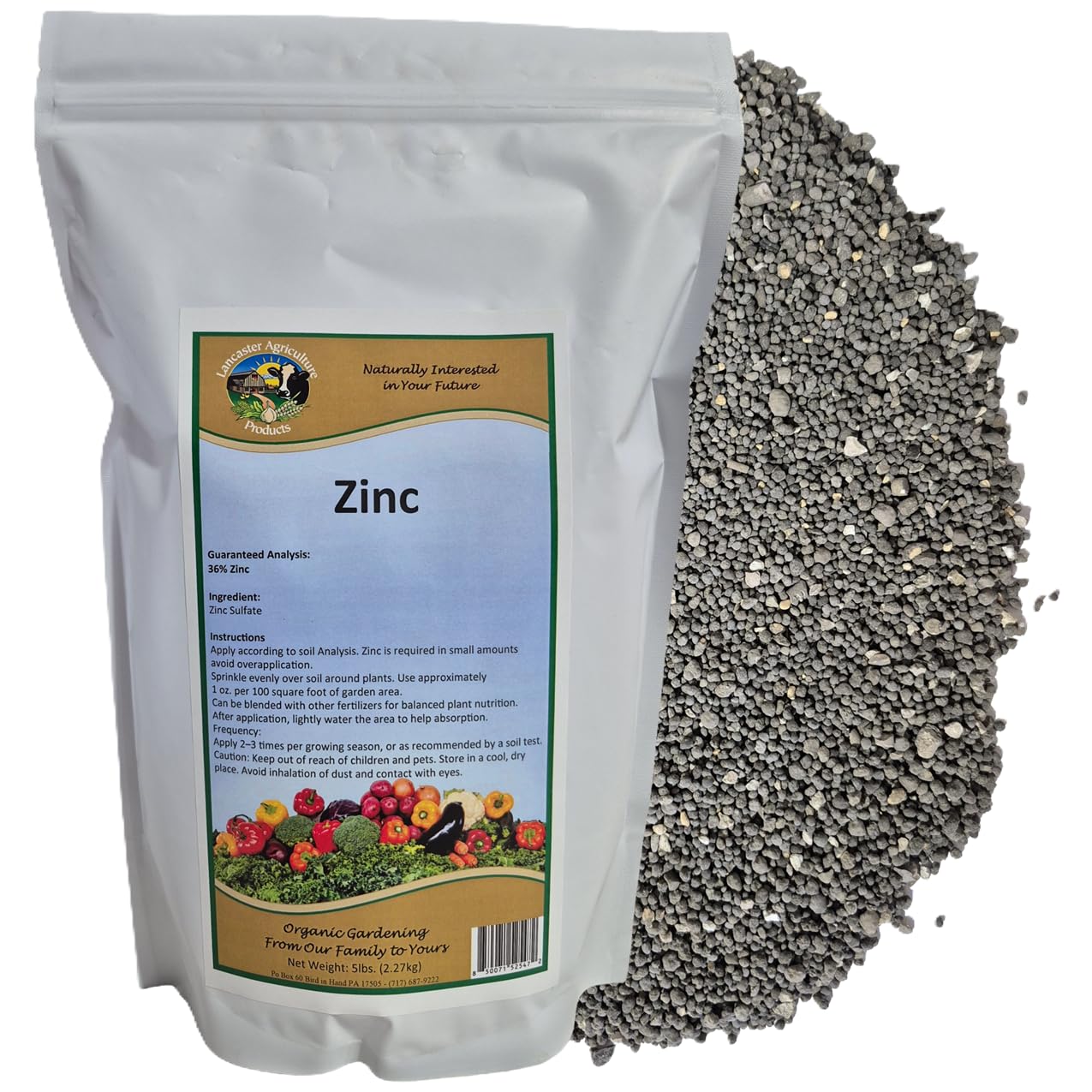
| Item Form | Granules |
|---|---|
| Application Method | Mix evenly into soil |
| Target Species | Plants, Crops |
| Ingredients | Zinc Sulfate |
| Item Weight | 5 pounds |
Lancaster Agriculture Products Zinc is a straightforward micronutrient supplement supplied as granules for soil application. It is intended to correct zinc deficiencies in gardens, row crops, fruit trees and pastures by supplying zinc sulfate that supports enzyme activity, root development and improved nutrient uptake. Use is simple: follow a soil test and mix the recommended amount evenly into the soil or blend with other fertilizers. The product’s single-ingredient formulation makes it easy to target zinc without adding extra macronutrients, and the 5 lb bag is convenient for small to medium plots. Expect visible benefits where zinc deficiency is present, such as stronger root systems and better vigor, but results depend on correct diagnosis and application rates. This is not a complete fertilizer so you will still need a balanced program for nitrogen, phosphorus and potassium. Also granular zinc works slowly compared with foliar chelates when an immediate correction is needed.
Best for: Gardeners and small-scale growers who want a reliable, no-nonsense zinc source to correct soil deficiencies and support steady plant development.
Less Ideal for: People who need a fast foliar fix for acute deficiency symptoms or those seeking an all-in-one complete fertilizer solution.
- Single-ingredient zinc sulfate for targeted correction of zinc deficiency
- Granular form that blends easily into soil or with other fertilizers
- Suitable for a variety of uses including gardens, fruit trees and pastures
- 5 lb package size is practical for small to medium plantings
- Not a complete fertilizer so other nutrients must be supplied separately
- Slower to correct acute deficiencies compared with foliar-applied chelated zinc
Verdict: A dependable, single-ingredient zinc sulfate granule that reliably corrects soil zinc deficiencies for healthier roots and steadier plant growth.
Alpha Chemicals Zinc Sulfate Monohydrate – 35.5% Zinc, 1 lb

| Unit Count | 16 Ounce |
|---|---|
| Manufacturer | Alpha Chemicals |
| Item model number | PD-35167 |
| Manufacturer (listed in product details) | Alpha Chemicals |
| ASIN | B00T6I1SKS |
Alpha Chemicals Zinc Sulfate Monohydrate is a straightforward, single-ingredient zinc source sold in a one-pound package. In garden use it provides a soluble source of zinc that can be dissolved for soil or foliar applications to correct zinc deficiency in zinc-responsive crops. The product lists 35.5% Zn which means small measured amounts deliver appreciable zinc levels when mixed into irrigation water or spray tanks. Its purity claim and simple formulation make handling and dosing predictable for someone following established application rates. Practical benefits include easy dissolvability compared with some granular zinc products and flexibility to use in both soil and foliar treatments. Important limitations are that this is a concentrated chemical rather than a slow-release fertilizer, so it requires careful measurement and pH-aware mixing to avoid leaf burn when used foliarly, and it offers no other nutrients or soil conditioning effects. Users should follow crop-specific rates and safety guidance when measuring and applying this material.
Best for: Gardeners or small-scale growers who want a reliable, high-purity zinc source to correct confirmed zinc deficiencies and who will follow measured application rates and safety precautions.
Less Ideal for: People seeking an all-in-one fertilizer or slow-release micronutrient product, or those uncomfortable handling concentrated mineral salts, should consider blended or chelated zinc fertilizers instead.
- Provides a high concentration of elemental zinc (35.5%) for rapid correction of zinc deficiencies
- Simple, single-ingredient formulation makes dosing predictable
- Comes as a water-soluble form suitable for foliar sprays and irrigation delivery
- One-pound package is convenient for gardeners testing and treating small to medium areas
- Concentrated, fast-acting chemical that can cause foliar burn if improperly mixed or overapplied
- Contains only zinc and no complementary macro- or micronutrients
Verdict: A concentrated, water-soluble zinc source that lets informed gardeners quickly correct zinc shortages when applied carefully and to recommended rates.
Hi-Yield Zinc Sulfate Granules, 4 lb

| Item Form | Granules |
|---|---|
| Specific Uses For Product | Soil Treatment |
| Target Species | Pecan Tree |
| Unit Count | 64 Ounce |
| Mixing Ratio | 1 tbsp per 3 gal or 1 lb per 50 gal |
Hi-Yield Zinc Sulfate is a straightforward granular zinc source for correcting zinc deficiency in pecan trees and other fruiting ornamentals. It can be applied as a foliar spray (mixing directions provided) or broadcast to the soil from trunk to dripline, which makes it useful for both quick foliar correction and longer term soil applications. The product lists 36% zinc and 17% sulfur so it supplies a concentrated micronutrient boost where pecans commonly show rosette or leaf deformation from zinc shortage. Packaging in a 4 pound unit covers small-to-medium orchards or individual trees and the granular form is easy to store and measure using the label mixing rates. Important limitations are that this is a single-nutrient amendment so it will not address other deficiencies or soil pH issues and correct dosing is important to avoid overapplication; follow label directions for safe, effective use.
Best for: Gardeners and small-acreage pecan growers who want a proven, concentrated zinc remedy to correct visible zinc deficiency and prefer a product with established usage instructions and strong user feedback.
Less Ideal for: Growers looking for a complete multi-nutrient fertilizer or a soil amendment that also adjusts pH should consider broader formula options instead.
- High zinc concentration (36%) provides a targeted correction for zinc-deficient pecan trees
- Can be used as foliar spray or soil broadcast with clear mixing rates on the label
- Granular form stores easily and is simple to measure for repeat applications
- Only supplies zinc (and sulfur) so it does not correct other nutrient imbalances
- Requires careful dosing and application to avoid phytotoxicity or excess accumulation
Verdict: Use this concentrated zinc sulfate when pecan trees show zinc deficiency and you need a reliable, label-guided micronutrient correction.
Choosing the Right Zinc Fertilizer: Key Factors to Consider
Zinc Form and Concentration
Zinc is sold in several chemical forms, and each behaves differently in soil and on leaves. Chelated zinc and zinc sulfate supply zinc in forms plants can take up readily, while zinc oxide is less soluble and often used in formulations where slow release is desired. The percentage of elemental zinc per unit determines how much product you will need to apply to reach a corrective dose.
Knowing the chemical form helps you predict results. For foliar sprays, more soluble forms are usually preferable because they dissolve in spray water and penetrate leaf tissue. For soil treatments, consider how the soil pH and organic matter will affect zinc availability; some forms bind tightly in alkaline soils and become less effective.
Application Method Compatibility
Think about how you normally apply nutrients. Foliar sprays, soil drenches, and incorporation into potting mixes each require different formulation characteristics. Foliar applications need fine solubility and low phytotoxicity risk at working concentrations. Soil drenches and banded applications should have predictable mobility so zinc reaches the root zone without excessive tie-up.
If you plan to tank-mix zinc with other foliar sprays or liquid fertilizers, verify label compatibility and recommended concentrations. Container growers should favor formulations that measure easily and do not alter substrate pH dramatically.
Mixing Ease and Measurement Accuracy
Many gardeners work with small volumes of concentrate, so clear dosing instructions and easily measured units are essential. Liquid concentrates with graduated caps or powders with simple weight-to-volume conversion reduce dosing errors. Over-application can cause leaf burn in foliar sprays and micronutrient antagonism in the root zone.
Check whether labels specify tablespoons, teaspoons, or milliliters per gallon for common concentrations. Products that provide practical mixing tables for different crop stages or plant types make it easier to apply correct rates across the garden.
Soil Behavior and Mobility
Zinc movement in soil is limited compared with mobile nutrients like nitrate. Soil texture, pH, and phosphate levels influence how much zinc becomes plant-available. In alkaline or high-phosphate soils, zinc can precipitate or bind to particles and remain unavailable unless applied in more soluble or chelated forms.
For in-ground gardens, localized banding near roots or multiple low-rate applications can be more effective than a single broadcast dose. In containers, where substrate volume is small, careful measurement and occasional supplemental foliar feeding may be necessary to maintain adequate zinc without creating excess accumulation.
Phytotoxicity Risk and Timing
Because zinc is a micronutrient, the window between deficiency correction and toxic levels can be narrow if products are misused. Foliar applications are effective but carry a higher risk of leaf burn if concentrations are too strong or if applied in hot sun. Follow label concentration limits and prefer early-morning or late-afternoon sprays to reduce stress.
Timing also matters for crop stages. Apply corrective zinc when young leaves are expanding for best uptake, and avoid heavy foliar doses during flowering unless label guidance supports it. Staged applications at lower rates reduce phytotoxicity risk while improving uptake over time.
When to Test and When to Treat
Soil testing is the most reliable way to detect zinc deficiency, but visual symptoms can also guide immediate action. Interveinal chlorosis on young leaves, stunted shoot growth, and small or distorted leaves are common indicators. If symptoms are mild and local, a foliar correction can provide a quick supply while you send a soil sample for confirmation.
If a soil test shows low zinc, match the treatment to your planting situation. Container-grown plants often need lower total zinc amounts than field beds. For trees and shrubs, banded or localized soil applications near the feeder roots are often more effective than broadcast treatments.
- Use foliar sprays for fast correction of visible leaf symptoms.
- Use soil-applied zinc for longer-term correction and tree or shrub treatments.
- Always follow label rates and re-evaluate with a soil test after a season.
Mixing Foliar Treatments Safely
Prepare small test batches when using a new product or mixing with other sprays. Dissolve the product fully and check for precipitation. Apply foliar sprays at cooler parts of the day to reduce evaporation and risk of leaf burn.
Start at the lower end of labeled rates and observe plants for 3 to 7 days before repeating applications. If you need to tank-mix with an insecticide or fungicide, perform a jar test to ensure physical compatibility and avoid clogged nozzles or phytotoxic combinations.
- Perform a jar compatibility test before full-scale tank mixes.
- Spray in the morning or late afternoon for best uptake and safety.
- Wear protective gear and avoid drift onto sensitive plants.
Managing Zinc in Raised Beds and Containers
Small-volume systems need careful dosing because micronutrient concentrations can climb quickly. Use dilute, measured applications and consider slow-release or chelated forms designed for potting mixes. Periodic liquid feeds at low concentration often work better than one large corrective dose.
Monitor new growth after application. In containers, flushing with plain water can help if you suspect excess buildup. For long-term maintenance, adjust your base fertilizer program to include an adequate trace element package to reduce the need for corrective treatments.
- Prefer measured, low-rate liquid feeds for containers.
- Consider substrate replacement or leaching for persistent excess levels.
- Balance phosphate and zinc inputs to avoid precipitation and lock-up.
Using Zinc with Other Nutrients
Micronutrients interact. High soil phosphate, iron, or manganese levels can affect zinc availability and uptake. Conversely, correcting zinc can sometimes alter how a plant responds to other nutrients, so watch for unexpected changes in leaf color or growth after treatment.
Plan your nutrient program holistically. If you apply zinc as a foliar spray, avoid simultaneous heavy nitrogen applications that can alter leaf uptake. For soil programs, stagger applications of trace elements and major nutrients when possible to reduce antagonism.
- Avoid applying high phosphate rates immediately before zinc corrections.
- Stagger foliar micronutrient applications to reduce antagonistic interactions.
- Use soil and tissue tests to guide integrated nutrient adjustments.
Safety and Storage
Store micronutrient concentrates in a cool, dry place away from direct sunlight and out of reach of pets and children. Keep original labeling so mixing ratios and safety instructions remain available when you need them.
Follow disposal guidance on the product label for unused or expired material. When handling concentrated forms, use gloves and eye protection to prevent irritation, and rinse equipment thoroughly after use to avoid contamination of future mixes.
- Keep products sealed and labeled during storage.
- Rinse application equipment after use to avoid cross-contamination.
- Follow local disposal regulations for concentrated materials.
How We Chose the Best Zinc Fertilizer
We focused on attributes that matter in real-world garden and small-acreage growing situations. Primary evaluation criteria included the zinc concentration and chemical form, because availability to plants depends on whether zinc is chelated, sulfate, or oxide. We assessed formulation and application flexibility to determine whether a product works for foliar sprays, soil drenches, or incorporation into potting mixes. Ease of measuring and mixing was considered to reduce risk of over-application, especially for foliar use. Compatibility with common tank mixes and fertilizer programs was evaluated, since many gardeners combine trace-element products with other sprays. Finally, product stability and shelf storage were considered to ensure consistent dosing over a season. We excluded bulk industrial-grade zinc materials not formulated for garden or horticultural use and any products lacking clear concentration or application instructions. The filters emphasized usable, labeled formulations intended for home gardens, containers, small orchards, and greenhouses. These selection rules align with the scoring criteria above and shaped the final shortlist.
FAQ
How quickly will plants respond after a foliar zinc spray?
Plants often show improvement in leaf color within a week when foliar sprays are used, although full recovery of growth may take several weeks. Response speed depends on deficiency severity, plant species, and whether environmental stresses are present.
Can I add zinc to my regular liquid fertilizer tank for weekly feeding?
You can include low concentrations of zinc in regular feeds if the product label indicates compatibility. Use dilute rates and avoid repeated high-concentration foliar doses. Periodic soil or tissue testing helps avoid accumulation or antagonism with other nutrients.
Is chelated zinc better than zinc sulfate?
Chelated zinc is typically more available to plants across a wider pH range and can be less prone to binding in soil. Zinc sulfate is a soluble and often effective corrective, but it can tie up in some soils. Which is best depends on soil pH, organic matter, and application method.
Can zinc cause leaf burn if I spray too much?
Yes. Foliar applications of zinc can cause phytotoxicity if concentrations or application frequency exceed label recommendations, especially in hot, sunny weather. Start at lower labeled rates and test a small area before treating the whole planting.
How often should I retest soil after correcting a zinc deficiency?
Retest soil after one growing season to confirm that available zinc levels have been restored. For long-lived plantings such as orchards, periodic testing every 2 to 3 years is reasonable unless symptoms reappear sooner.
Final Verdict
Choose a zinc fertilizer that fits how you garden and the symptoms you are treating. If you need a fast fix for young foliage, a soluble foliar formulation or chelate is often best. For longer-term correction in soil or for larger plants, choose a formulation with predictable mobility and clear dosing instructions. Prioritize zinc form, application compatibility, and safe mixing practices. Use soil and tissue tests to guide when to treat and monitor results to avoid over-application. With the right product and careful timing, you can correct deficiencies without stressing plants and maintain healthy growth going forward.
