

Note: This article contains affiliate links. If you click on these links and make a purchase, I may earn a small commission at no extra cost to you. This helps support my research and content. Read my full affiliate disclosure here.
If your yard has bumps, slopes, or a lumpy soil profile, a standard robotic mower can struggle to deliver an even cut and may stall or get stuck. Choosing a robotic lawn mower for uneven ground matters because these machines must combine traction, ground clearance, and navigation intelligence to stay mobile and cut consistently across variable surfaces. This guide shortlists seven top machines designed to handle uneven terrain and explains the features that make them suitable for bumpy yards. We evaluated candidates on traction and slope handling, battery runtime, and navigation reliability to help you narrow the field.
Top Picks at a Glance
| Best Overall The best all-around choice for most situations | roborock RockNeo Q110H Robot Lawn Mower |  |
| Best Quality Built to a higher standard if you want something more solid | LYMOW One Plus Robot Lawn Mower with RTK+VSLAM Navigation and Tracked Drive |  |
| Best Value The sweet spot between price and what you get | Mammotion LUBA mini 2 AWD 1500H Robot Lawn Mower |  |
| Best Budget The cheapest option that still gets the job done reliably | RoboUP Raccoon 2 SE Robot Lawn Mower (Wire-Free, for up to 0.15 Acre) |  |
| Highest Rated A top-rated pick with lots of positive feedback | HOOKII Neomow X SE Robotic Lawn Mower (3D LiDAR Navigation) |  |
| Most Popular A crowd favorite that many people choose with confidence | Segway Navimow i105N Robot Lawn Mower (wire-free, RTK+Vision) |  |
| Best Seller A high-volume bestseller chosen again and again | Sunseeker S4 Robot Lawn Mower with 3D LiDAR and Vision AI (Wire-Free) |  |
roborock RockNeo Q110H Robot Lawn Mower

| Power Source | Battery Powered |
|---|---|
| Operation Mode | Automatic |
| Maximum Adjustable Cutting Height | 3.1 inches |
| Battery Average Life | 130 minutes |
| Minimum Adjustable Cutting Height | 1.6 inches |
The roborock RockNeo Q110H is a feature-rich robotic mower designed to handle complex, uneven yards without perimeter wires. It uses full-band RTK combined with VSLAM for stable positioning under trees and near fences, while dual-camera AI vision helps it detect and avoid people, pets, and garden obstacles so mowing runs with minimal human supervision. Setup relies on app-controlled mapping or an AI auto-mapping mode, letting you define multiple zones and custom schedules from the Roborock app. A floating cutting deck and large wheels let the mower follow ground contours, climb steep slopes up to 45 percent, and roll over low obstacles for continuous coverage. Battery life is rated around 130 minutes, which suits medium-sized properties up to roughly a quarter acre in a single session with efficient routing. Important trade-offs are the unit weight and complexity: heavier construction and advanced navigation add installation and learning curve compared with simpler models, and high-end sensors mean repairs or replacements could be costlier. This model targets yards with uneven terrain and many features, not buyers who want the simplest, lowest-cost solution.
Best for: Best for homeowners with uneven, complex lawns who want a hands-off, high-capability mower that handles slopes, narrow passages, and frequent obstacles while offering advanced mapping and scheduling.
Less Ideal for: Not a great fit for buyers prioritizing the lowest possible upfront cost or those with only a very small, simple lawn who prefer a basic plug-and-play robotic mower.
- Wire-free dual mapping with AI auto-mapping or manual app mapping for flexible boundary setup
- Full-band RTK plus VSLAM navigation for precise positioning in shaded or complex layouts
- Stereo AI vision obstacle avoidance that detects and steers clear of people, pets, and garden objects
- Floating cutting deck and large-diameter wheels for contour-following and slope capability up to 45%
- App control with multi-zone scheduling and a real-time progress dashboard
- Relatively heavy and feature-dense, which raises complexity for initial setup and maintenance
- Battery life of about 130 minutes may require return-to-base cycles on larger properties
Verdict: Pick the RockNeo Q110H if you need a heavy-duty, wire-free robot mower that reliably navigates complex, sloped lawns with advanced obstacle avoidance and multi-zone app control.
LYMOW One Plus Robot Lawn Mower with RTK+VSLAM Navigation and Tracked Drive

| Cutting width | 16 inches |
|---|---|
| Minimum Adjustable Cutting Height | 1.2 inches |
| Maximum Adjustable Cutting Height | 4 inches |
| Power Source | Battery Powered |
The LYMOW One Plus is a purpose-built robotic mower for large, hilly properties that combines high-precision RTK positioning with VSLAM visual mapping and a tracked drive system to handle very steep terrain. Setup is wire-free via smartphone and you define virtual boundaries and no-go zones in the app; once configured it runs autonomously, auto-recharges, and resumes tasks. Notable hardware includes a 16-inch dual-rotary blade deck with adjustable heights from 1.2 to 4 inches, a high-capacity LiFePO4 battery that supports multiple daily cycles, and a heavy-duty track drive that claims 45° slope capability and good obstacle-crossing. The onboard AI vision and ultrasonic sensors provide real-time obstacle detection, while the cyclone airflow and dual blades aim for even cuts and mulching of clippings. Trade-offs are its size and complexity: this is a premium, robust machine intended for large or challenging lawns rather than small plots, and initial mapping plus occasional maintenance of blades and tracks will be required to keep performance consistent.
Best for: Buyers who need a capable, low-supervision mower for large properties with steep slopes and complex boundaries and who value precise mapping and hands-off operation.
Less Ideal for: Those with small, simple lawns or buyers seeking a minimal-maintenance, budget entry-level robotic mower should consider simpler wheeled models instead.
- Tracked drive and reinforced motor enable climbing and stable operation on slopes up to 45°
- RTK plus VSLAM navigation provides precise, wire-free mapping and consistent coverage
- Large-capacity LiFePO4 battery supports multiple cycles per day for wide area coverage
- 16-inch dual rotary blades with airflow lift and mulching reduce missed cuts and return fine clippings to the lawn
- Designed for large, complex lawns so it may be oversized for small yards
- Higher mechanical complexity means more maintenance on tracks and blades than a basic wheeled mower
Verdict: If you need a robust, wire-free robot that can reliably mow steep, uneven lawns with high precision, the LYMOW One Plus is built for that job.
Mammotion LUBA mini 2 AWD 1500H Robot Lawn Mower

| Power Source | Battery Powered |
|---|---|
| Operation Mode | Automatic |
| Cutting Height | 2.2-4.0 inches |
| Number of Positions | 7 |
| Cutting width | 7.9 inches |
The Mammotion LUBA mini 2 AWD 1500H is a purpose-built robotic mower for small residential yards with steep or complex terrain. It uses 360° LiDAR and dual‑camera AI vision to detect obstacles early and plan smoother routes, and its AWD drivetrain with two independent motors can climb slopes up to 80 percent while negotiating curbs and roots. Dual cutting discs including a dedicated edge blade deliver closer trimming along borders, and the main disc height can be adjusted from the app for seasonal or turf changes. The mower supports up to 20 independent mowing zones and a DropMow mode for quick one‑off jobs without mapping. Battery features such as custom charge limits and off‑peak charging help preserve battery life and cut energy costs. Practical limitations to expect are modest coverage per model (about 0.37 acre) so larger properties will need a bigger unit, and being a sophisticated autonomous machine it requires initial setup and occasional app management and blade replacements. For homeowners prioritizing safe, hands‑free mowing on slopes, this model balances power and smart navigation.
Best for: Homeowners who need a reliable, autonomous mower that can handle steep, uneven lawns and prefer safety‑focused features and simpler hands‑off operation.
Less Ideal for: Owners of large lawns significantly bigger than 0.37 acre or those who want a purely plug‑and‑play pushbutton mower with no app or setup work.
- 360° LiDAR plus dual‑camera AI vision for improved obstacle detection and navigation.
- All‑wheel drive with independent motors and adaptive suspension for climbs up to 80% and better traction on uneven terrain.
- Dual cutting discs including a dedicated edge blade for cleaner margins and automatic height adjustment via app.
- Multi‑zone support and DropMow mode handle complex lawns and quick temporary jobs without permanent mapping.
- Battery management options (custom charge limit and off‑peak charging) to extend battery life and reduce running costs.
- Rated for about 0.37 acre coverage per charge, so not suited for larger properties.
- Advanced features require initial setup and occasional app interaction and maintenance.
Verdict: Choose the LUBA mini 2 AWD 1500H when you want a compact, safety‑oriented robot mower that confidently handles very steep slopes and complex residential lawns.
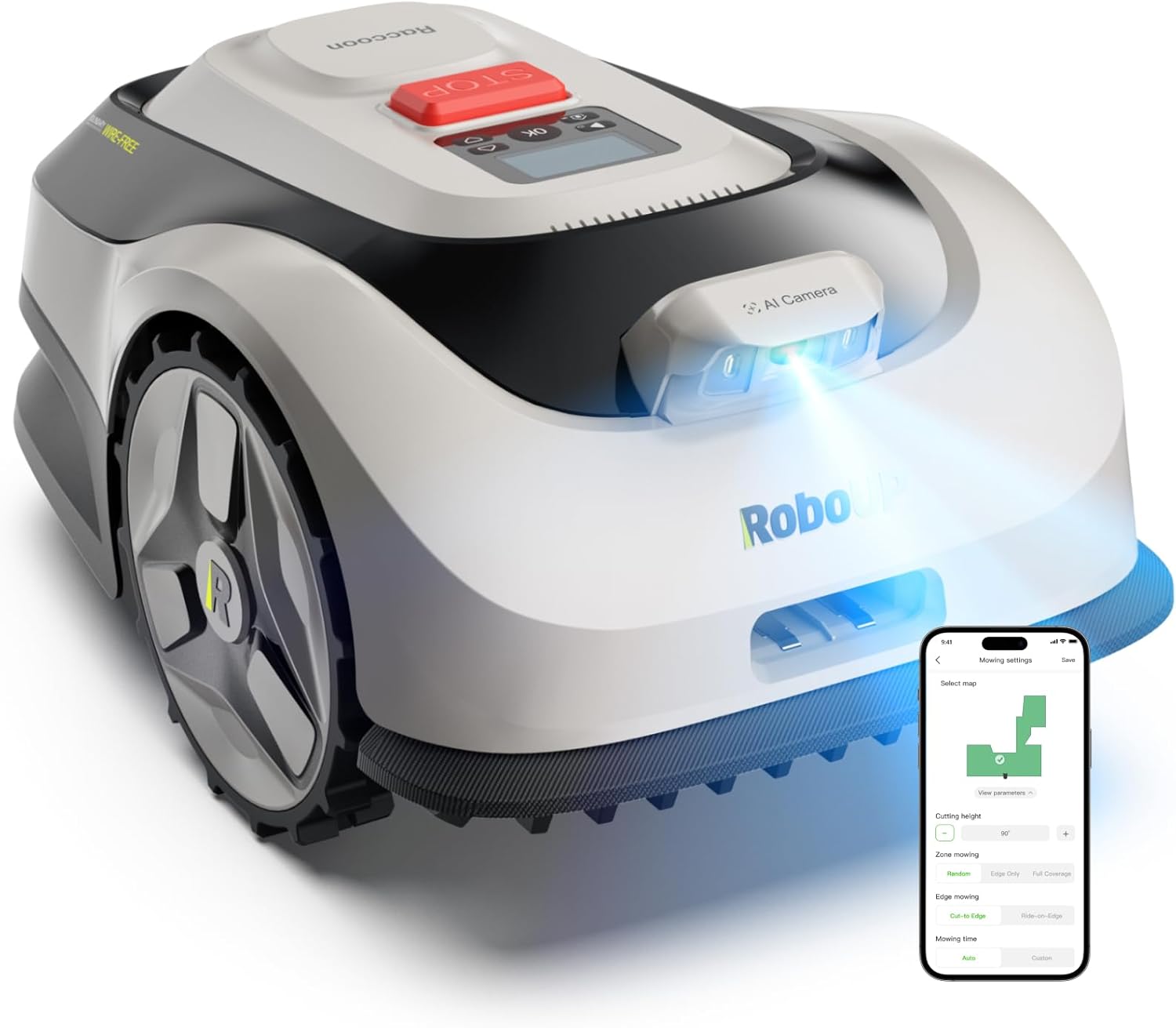
RoboUP Raccoon 2 SE Robot Lawn Mower (Wire-Free, for up to 0.15 Acre)
| Power Source | Battery Powered |
|---|---|
| Operation Mode | Automatic |
| Maximum Adjustable Cutting Height | 3.15 inches |
| Minimum Adjustable Cutting Height | 1.18 inches |
| Number of Positions | 5 |
The Raccoon 2 SE is a wire‑free robot mower built for small yards and straightforward layouts. It auto‑maps your lawn and can start with a single button press or be managed via app, offering scheduled mowing, multi‑zone support and electric height adjustment for a cleaner, more consistent cut. The mower uses AI vision and bumper sensors to avoid people, pets and common obstacles, handles slopes up to 36 percent, and will climb modest obstacles and navigate narrow passages. A 5Ah battery delivers long runtime and fast 70‑minute recharge cycles while the unit automatically returns to its dock when the battery is low or rain is detected. Practical benefits include quiet operation, OTA updates, and safety features such as lift and tilt detection and IPX6 water protection. Limitations to consider are the small coverage area limited to about 0.15 acre, the relatively narrow 7.9‑inch cutting width which increases run time on larger lawns, and the expectation that clearly defined boundaries or optional stakes are needed for optimal guidance on open edges.
Best for: Buyers who want a budget‑minded, low‑effort upgrade from push mowers for a small, well‑defined yard and value simple setup, quiet operation and app scheduling.
Less Ideal for: Owners of larger, irregular or heavily landscaped properties who need wider cutting decks, higher coverage area, or advanced RTK navigation for complex boundaries.
- Wire‑free auto mapping and one‑touch start for quick setup on simple lawns
- AI vision plus bumper sensors for obstacle avoidance and safe operation
- Long runtime from a 5Ah battery with 70‑minute fast recharge
- Handles steep slopes up to 36 percent and can climb small obstacles
- App control, scheduling and OTA updates for ongoing improvements
- Designed for small lawns only with a maximum recommended area of about 0.15 acre
- Narrow 7.9‑inch cutting width increases time needed on larger or complex yards
- May require optional boundary stakes for reliable edge control in open areas
Verdict: A practical, feature‑focused robotic mower for small yards that minimizes setup and hands‑on mowing while delivering quiet, app‑controlled performance.
HOOKII Neomow X SE Robotic Lawn Mower (3D LiDAR Navigation)

| Cutting Width | 11 in |
|---|---|
| Cutting Height Range | 1.18–3.35 in |
| Battery Capacity | 13,000 mAh |
| Mowing Time Per Charge | Approx. 120 minutes |
| Max. Mowing Area | 0.75 Acre |
The HOOKII Neomow X SE is a high-end robotic lawn mower built for large yards that need reliable autonomous mowing with minimal setup. It uses 360° 3D LiDAR combined with AI vision to map lawns, avoid more than 200 obstacle types, and deliver centimeter-level positioning without boundary wires or RTK stations. Typical use is set-and-forget: you map zones and no-go areas in the app, schedule mowing, and the mower repeatedly follows U-shaped or grid routes, returning to charge when needed. Notable features include an 11-inch cutting deck with floating design to handle uneven ground, adjustable cutting heights across seven positions, a 13,000 mAh battery that runs about two hours per charge, IPX5 water resistance for outdoor use, and multiple connectivity options (Wi-Fi, Bluetooth, 4G). Practical benefits are thorough coverage (claimed ≥95%), precise avoidance of small objects, and breakpoint resume so it finishes after charging. Limitations to consider are the stated maximum coverage per unit for continuous operation (about 0.17 acre per charge) which means larger properties will require longer or multiple charging cycles, and the product complexity which may require some app setup and occasional maintenance.
Best for: Homeowners with larger lawns who want a reliable, low-hands-on autonomous mower that navigates complex yards and prioritizes safe obstacle avoidance and precise mapping.
Less Ideal for: People who prefer the simplest possible plug-and-play solution or who need nonstop single-pass mowing of very large properties without periodic recharging.
- 3D LiDAR plus AI vision provides precise mapping and obstacle avoidance without external RTK hardware
- Supports mapping, multi-zone management, and no-go zones through app with Wi‑Fi, Bluetooth, and 4G
- Floating 11-inch cutting deck and adjustable heights adapt to uneven terrain for consistent cut
- IPX5 waterproofing and breakpoint resume let it operate in varied outdoor conditions and continue after charging
- Two-hour runtime covers about 0.17 acre per charge, so larger yards may need longer total mowing time
- Advanced sensors and app features add setup complexity compared with simple boundary-wire mowers
Verdict: Choose the Neomow X SE if you want a feature-rich, LiDAR-guided robotic mower that reliably maps and avoids obstacles for large, complex yards.
Segway Navimow i105N Robot Lawn Mower (wire-free, RTK+Vision)

| Power Source | Battery Powered |
|---|---|
| Operation Mode | Automatic |
| Cutting width | 7.1 inches |
| Maximum Adjustable Cutting Height | 2 inches |
| Number of Positions | 5 |
The Navimow i105N is a wire-free robotic mower designed for small lawns up to one eighth of an acre. It creates an AI-assisted map via a smartphone app, then autonomously follows planned mowing patterns and returns to its charging base when needed. Key features include EFLS 2.0 with RTK+Vision for centimeter-level positioning in low-satellite conditions, a 140° camera that recognizes many common obstacles, multi-zone scheduling for up to 12 areas, OTA software updates, and selectable edge-mowing modes for a cleaner border. In practice the no-wire setup cuts installation time and makes it easier to reconfigure zones, while the vision system reduces collisions with toys, garden furniture, and small features. It is relatively quiet at the reported 58 dB(A) and includes spare blades and an installation kit. Important limitations are the small 7.1-inch cutting width and the maximum cutting height range, so it works best for regular maintenance rather than heavy overgrown lawns, and advanced positioning features are most useful where GNSS signal is weak but add system complexity. Overall the i105N suits owners who want low-touch, reliable mowing for compact, regularly maintained yards.
Best for: Buyers who want a low-maintenance, fuss-free robot mower for a small, regularly maintained yard and prioritize reliable navigation and safety over aggressive cutting power.
Less Ideal for: Large properties, very overgrown lawns, or owners who need wide cutting swaths for faster work should consider larger commercial-style mowers instead.
- Wire-free, app-guided mapping simplifies setup and zone management
- RTK+Vision positioning improves navigation under trees and in narrow areas
- Camera-based obstacle detection identifies many common objects to reduce collisions
- Multiple-zone scheduling and OTA updates allow flexible remote control and improvements
- Includes charging station, GNSS antenna kit and spare blades for out-of-the-box use
- Designed for small lawns only with a narrow 7.1-inch cutting width
- Not optimized for heavy overgrowth or infrequent deep cuts due to limited cutting width and height range
Verdict: Choose the Navimow i105N if you want a simple wire-free robot mower with RTK-enhanced navigation and strong obstacle avoidance for a small, regularly maintained lawn.
Sunseeker S4 Robot Lawn Mower with 3D LiDAR and Vision AI (Wire-Free)

| Max cutting area | 0.25 Acre (Complex Yards) |
|---|---|
| Navigation system | 3D LiDAR + Vision AI |
| Max slope capability | 42% (22°) |
| Cutting width and height | 7 in width, 1.6–3.2 in height |
| Operation mode | Automatic |
The Sunseeker S4 is designed for homeowners who need reliable autonomous mowing in complicated, uneven yards. It builds a 3D map using 360° LiDAR plus Vision AI so it can navigate under trees, around obstacles, and in low light without a boundary wire. Typical use is set-and-forget: you map zones in the app, schedule daily runs, and let the mower follow systematic parallel routes while a rain sensor and fixed-point resume protect turf and restart interrupted sessions. Notable features include rear-wheel drive that manages slopes up to 42% (22°), a floating deck with six blades for cleaner cuts on rough ground, and the ability to save multiple maps and up to 100 zones for multi-area properties. Practical benefits are less edging and trimming, fewer missed spots on uneven terrain, and simple wire-free setup. Important limitations are the 0.25-acre coverage ceiling, which makes it unsuitable for larger properties, and the reliance on lithium batteries that require temperature-aware charging and safe handling. The S4 is a strong choice for cautious buyers who prioritize dependable navigation and local support for complex lawns.
Best for: Homeowners with small to mid-size yards that are shaded, cluttered, or uneven who want a dependable, low-maintenance mower and prefer a product with local support.
Less Ideal for: Owners of larger properties or those who want the lowest-cost basic robotic mower for simple, flat lawns should consider other models.
- 3D LiDAR plus Vision AI creates detailed maps for reliable navigation in shade and clutter
- Wire-free setup lets you map and manage multiple zones without perimeter wiring
- Rear-wheel drive and floating deck handle slopes and uneven ground for cleaner cuts
- App control with scheduling, fixed-point resume, and rain-sensor reduces manual oversight
- Rated for up to 0.25 acre, so not suitable for larger lawns
- Lithium-ion battery needs temperature-aware charging and safe handling precautions
Verdict: Choose the S4 if you need a wire-free robot mower that reliably navigates shaded, cluttered, and uneven small yards with strong local support.
Choosing the Right Robotic Lawn Mower for Uneven Ground: Key Factors to Consider
Traction and Wheel Design
Traction determines whether a robotic mower can climb gentle slopes, cross ruts, and pull itself out of soft patches without spinning out. Look for aggressive tread patterns, larger wheel diameter, and wider contact patches which help the unit maintain grip on variable surfaces. Softer rubber compounds can improve bite on damp grass, while harder treads resist wear on sandy or gritty soils.
Wheel placement and drive configuration also influence performance. Four-wheel drive or differential torque control can distribute power to the wheels with traction while reducing the risk of bogging down. Consider how tightly the wheels tuck into the body; exposed wheel hubs are easier to service after knocks from stones or roots.
Slope Handling and Stability
Slope capability is critical for uneven ground because angles and sudden grade changes will test a cutter's balance and motor torque. Manufacturers often state a maximum gradient rating, but real-world stability also depends on center of gravity and weight distribution. A lower center of gravity resists tipping on cross slopes, while a heavier chassis can improve traction but may struggle in very soft soil.
Stability features such as tilt sensors and automatic braking when the unit detects excessive lean help prevent rollovers. Pay attention to whether the mower can climb slopes or only traverse them; some systems are optimized for lateral stability more than climb power.
Ground Clearance and Chassis Protection
Uneven lawns frequently have hidden obstacles like small rocks, roots, or buried objects. Higher ground clearance reduces the chance of the mower scraping its deck or becoming hung up. Look for a chassis design that deflects impacts and protects blades and drive components from knocks.
A modular or elevated cutting deck can help avoid snagging, and easily replaceable skid plates or bumpers minimize downtime after collisions. Consider how easy it is to rinse or brush out the undercarriage, because mud build-up under the deck quickly affects cutting performance on uneven ground.
Navigation Intelligence and Obstacle Handling
Smart navigation helps a robot find workable paths through variable terrain rather than repeatedly crossing the same worn tracks. Systems that map the lawn, detect obstacles, and adapt cutting patterns will spread wear across the turf and avoid getting trapped in hollows. Reactive collision sensors are useful but mapping and GPS-assisted navigation reduce aimless circling on sloped or patchy surfaces.
Some units use sensor fusion-bumper switches, wheel odometry, ultrasonic or vision sensors-to infer when they have become stuck and attempt recovery maneuvers. Evaluate how the navigation system reports and handles problems such as wheel slip or repeated obstacle contacts.
Battery Runtime and Recharge Behavior
Battery runtime matters more on uneven ground because extra traction, climbs, and recovery attempts consume more energy than steady, flat mowing. A longer runtime reduces the number of return-to-base cycles and the need to cross difficult patches repeatedly. Also consider how quickly the mower recharges and whether it resumes cutting where it left off or restarts a new pattern.
Systems with efficient power management and smart scheduling can break large jobs into manageable runs, but high-capacity batteries add weight and affect traction and ground compaction. Check how the battery performs in cooler or wet conditions if your yard experiences such weather.
Durability and Weather Resistance
Uneven yards often expose a mower to impacts, moisture, and grit that accelerate wear. Components such as gearboxes, wheel bearings, and electronic enclosures must tolerate occasional shocks and ground spray. Look for sealed housings, IP-rated electronics protection, and serviceable parts that can be replaced without specialist tools.
Corrosion-resistant coatings on metal parts and UV-stable plastics reduce long-term degradation from sun and rain. Consider the availability of simple replacement parts like treads, bumpers, and blade assemblies so you can keep a machine running after knocks and scrapes.
How Uneven Lawns Change Mowing Strategy
Uneven lawns need more than a straight cutting pass. High and low spots change how the cutter meets grass height, producing visible striping or missed patches if the mower follows a rigid pattern. You should expect slower progress and more frequent recovery attempts on rough surfaces, so planning cutting windows and pattern variety matters.
Adjusting the mower schedule to shorter, more frequent runs helps maintain an even finish because each pass removes less material. That approach reduces strain on traction systems and lowers the chance of scalping high spots while simultaneously preventing low areas from becoming overgrown.
- Shorter, more frequent runs reduce scalping and stress on drive systems
- Alternating cutting patterns distributes wear across the lawn
- Timing runs during drier conditions helps traction and prevents wheel slip
Preparing an Uneven Yard for Robotic Mowing
A little prep improves a robot's success. Rake out stones, trim protruding weeds, and mark or remove shallow obstacles where possible. Filling deep holes and leveling isolated high spots will reduce repeated snags and keep the mower from getting stuck in the same place.
Consider installing low-visibility markers around persistent trouble spots so the mower learns to avoid them. Regular inspection and minor ground repairs are easier than repeatedly rescuing a stuck unit.
- Remove debris and mark problem areas
- Fill holes and trim exposed roots where practical
- Check for drainage issues that create soft patches after rain
Tire and Traction Upgrades Gardeners Can Try
If a mower allows wheel swaps or aftermarket treads, choosing a more aggressive pattern can improve grip. Larger wheels increase clearance and roll over bumps more smoothly. Weight distribution tweaks, such as adjusting ballast if the design supports it, can also enhance stability on slopes.
Test changes carefully on a small area before committing them across the lawn. Increasing traction often increases turf compaction, so balance grip gains with the health of your lawn.
- Choose deeper tread profiles for damp or loamy soils
- Larger-diameter wheels smooth out bumps and increase clearance
- Monitor compaction after traction upgrades and aerate if necessary
Maintaining Performance Over Seasons
Maintenance keeps a robotic mower reliable on rough ground. Clean the undercarriage and wheel treads after wet weather, check for bent blade holders or stripped gear teeth, and replace worn rubber parts promptly. Seasonal battery care preserves capacity and reduces the chance of mid-run failures on long or difficult jobs.
Store the unit undercover during long wet or freezing periods and inspect seals and electronics for ingress. Regular software updates to navigation logic can also improve obstacle avoidance and path planning as manufacturers refine algorithms.
- Clean and inspect wheels and deck after each wet period
- Replace worn treads and bumpers proactively
- Keep firmware updated to benefit from navigation improvements
When a Robotic Mower Is Not the Right Solution
Extremely steep slopes, very rocky ground, or yards with many large obstacles may remain better suited to human-operated mowers or alternative approaches. Robots struggle when grade changes exceed their design limits or when repeated rescues become routine.
In those cases, consider selective robotic use on the most suitable areas and maintain high-risk zones manually. Combining approaches can give you the convenience of automation where it works and the control of manual mowing where terrain is too severe.
- Avoid full automation on hills beyond the machine's rated slope capability
- Use robots for flatter sections and manual methods for extreme terrain
- Designate rescue and inspection routes for manual intervention
How We Chose the Best Robotic Lawn Mower for Uneven Ground
We focused on robots engineered to cope with real-world lawn irregularities rather than flat test-plot performance. Selection started with machines whose specifications and user reports emphasized traction systems, ground clearance, and explicit slope-capable ratings. We prioritized models with adaptive navigation or obstacle-handling that reduce frequent stalls on uneven surfaces. Battery runtime and recharge behavior were included because longer runtimes reduce the need to cross difficult terrain repeatedly. Durability and water resistance were considered to ensure components tolerate mud and small impacts. We excluded units designed strictly for flat, manicured lawns or indoor use and machines without any manufacturer slope guidance. Final inclusions were verified for practical features that matter in uneven yards: wheel design and torque, chassis clearance, adaptive cutting patterns, battery capacity and recharge cadence, and sensor/navigation robustness.
FAQ
Can a robotic mower handle steep slopes in an uneven yard?
It depends on the machine's slope rating and how the slope changes across the lawn. Many robots handle moderate gradients but struggle on steep, abrupt inclines. Check the documented maximum gradient and consider real-world factors like traction and soil firmness.
How often will I need to rescue a mower on bumpy ground?
Rescue frequency varies with lawn condition and the mower's traction and navigation. With proper prep and a model suited for uneven surfaces, rescues become occasional. However, expect more intervention than on a flat, manicured lawn.
Does higher ground clearance affect cutting quality?
Higher clearance reduces the chance of snagging on obstacles but can slightly alter cut consistency on very short turf. Many machines balance clearance with adjustable cutting heights so you can maintain desired finish while avoiding deck strikes.
Will heavier machines perform better on soft patches?
Heavier machines can improve traction on slopes but may increase turf compaction on soft ground. The right balance depends on soil type; in very soft areas, lighter units with better tread design may be preferable.
Are certain navigation systems better for uneven lawns?
Systems that combine mapping, wheel-slip detection, and obstacle sensing typically perform better than basic random-pattern units. Mapping and GPS help avoid repeated passes over the same ruts and improve coverage on variable terrain.
Final Verdict
For uneven ground, prioritize traction, slope capability, and ground clearance over features designed for flat, ornamental lawns. Accept tradeoffs: higher clearance and larger wheels improve mobility but can slightly change cut appearance and add weight. Choose a mower with robust navigation and recovery behaviors so it can find workable paths and minimize rescues. With the right combination of grip, stability, and battery runtime you can automate most of a bumpy lawn while keeping manual mowing reserved for the most extreme sections.
