

Note: This article contains affiliate links. If you click on these links and make a purchase, I may earn a small commission at no extra cost to you. This helps support my research and content. Read my full affiliate disclosure here.
If your yard has slopes, bumpy ground, and mixed grass patches, a standard robotic mower may struggle. A Robotic Lawn Mower for Rough Terrain must manage traction, maintain cut quality on uneven ground, and run long enough to finish irregularly shaped lawns without frequent recharges. This guide looks at seven shortlisted options that perform better in these conditions and explains the practical traits that matter in day-to-day use. We evaluated machines on hill capability, wheel and drive design, battery runtime, and durability so you can pick the best fit for your landscape. Read on to see the top picks and the criteria we used to judge them before the product list.
Top Picks at a Glance
| Best Overall The best all-around choice for most situations | DREAME A3 AWD Pro 3500 LiDAR Robot Lawn Mower, 4WD, 15.8" Dual-Disc Cutting |  |
| Best Quality Built to a higher standard if you want something more solid | roborock RockMow X115H Robot Lawn Mower with 4WD and Quad-Vision Navigation |  |
| Best Value The sweet spot between price and what you get | roborock RockNeo Q110H Robot Lawn Mower |  |
| Best Budget The cheapest option that still gets the job done reliably | HOOKII Neomow X2 Air 3D LiDAR Robotic Lawn Mower (11" Cut, 13Ah) |  |
| Highest Rated A top-rated pick with lots of positive feedback | dreame A3 AWD LiDAR Robot Lawn Mower (Bundle C) |  |
| Most Popular A crowd favorite that many people choose with confidence | Mammotion LUBA 2 AWD 3000HX Robot Lawn Mower (All-Wheel-Drive, RTK & UltraSense AI) |  |
| Best Seller A high-volume bestseller chosen again and again | Husqvarna 410iQ Automower Robotic Lawn Mower (Wire-Free, App Controlled) |  |
DREAME A3 AWD Pro 3500 LiDAR Robot Lawn Mower, 4WD, 15.8" Dual-Disc Cutting

| Power Source | Battery Powered |
|---|---|
| Operation Mode | Automatic |
| Maximum Adjustable Cutting Height | 4 inches |
| Battery Average Life | 1 days |
The DREAME A3 AWD Pro 3500 is a high-capacity robotic mower built to handle complex, uneven yards without boundary wires. It uses 360-degree LiDAR plus binocular AI vision to map yards, avoid more than 300 obstacles, and navigate reliably around trees and tight corners while the Dreamehome app manages schedules, zones, and no-go areas. True 4WD hub motors and heavy-duty off-road wheels let it climb slopes up to 38.7 degrees and drive over small curbs and roots, while dual floating cutting discs deliver a 15.8-inch cutting width for faster coverage. Practical benefits include quiet day-or-night operation, one-tap height adjustment for different grasses, built-in GPS/4G tracking and theft alerts, and IPX6-level cleaning convenience. Important limitations are its weight and size compared with consumer push mowers, and reliance on the app and cellular tracking for advanced features. For large acreage use expect professional-level setup of zones and an understanding that maintenance of blades, battery health, and occasional firmware or connectivity checks are part of ownership.
Best for: Homeowners with larger, irregularly shaped or hilly lawns who want hands-off, high-precision mowing and are comfortable managing app-based mapping and zone setup.
Less Ideal for: People with very small, simple lawns or buyers who prefer minimal tech and plug-and-play devices without app or cellular dependence.
- LiDAR plus binocular AI vision for stable, wire-free mapping and obstacle avoidance
- True 4WD hub motors and off-road wheels that handle slopes up to 38.7 degrees
- Wide 15.8-inch dual-disc cutting for faster coverage and consistent edge trimming
- App control with multi-zone mapping, scheduling, and GPS/4G anti-theft tracking
- Large and relatively heavy unit that may be more complex to service than simpler mowers
- Advanced features depend on app connectivity and cellular services
Verdict: Choose this model if you need a wire-free, LiDAR-guided 4WD mower that can reliably handle steep, complex acreage with minimal daily attention.
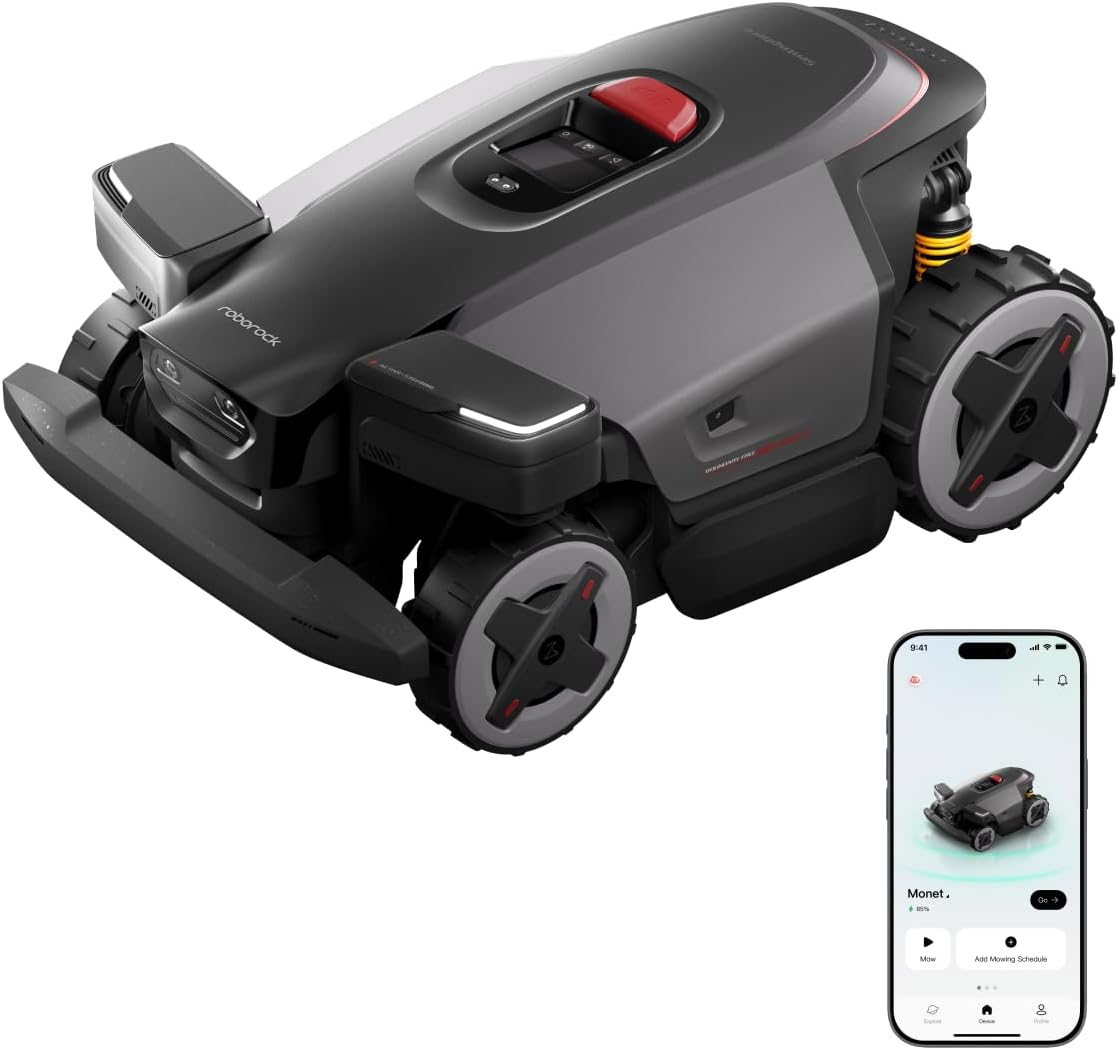
roborock RockMow X115H Robot Lawn Mower with 4WD and Quad-Vision Navigation
| Power Source | Battery Powered |
|---|---|
| Operation Mode | Automatic |
| Battery Average Life | 120 minutes |
| Maximum Adjustable Cutting Height | 3.5 inches |
| Cutting width | 9.5 inches |
The roborock RockMow X115H is built to handle demanding yards where slopes, obstacles, and uneven ground are the norm. It operates wire-free and maps lawns using AI auto-mapping or manual app-guided mapping, then navigates with Full-Band RTK plus quad-camera vision for precise positioning even under trees or near fences. The 4WD drivetrain, active steering, dynamic suspension, and floating cutting deck let it climb very steep inclines and cross sizable obstacles while keeping a consistent cut. A 9.5-inch cutting deck and three cutting-height positions cover common turf needs, and the 120-minute battery life supports extended runs on medium-size properties. App control, multi-zone scheduling, anti-theft features, and rain sensing add practical convenience. Be aware this is a substantial unit intended for rugged use, so it is heavier and more complex than consumer-grade mowers and may require more setup and occasional maintenance to keep sensors and cameras functioning optimally. For rough, irregular lawns it delivers professional-level capability but is more than some buyers need for a simple, flat yard.
Best for: Buyers who need a robust autonomous mower for steep, uneven, or obstacle-filled lawns and prioritize dependable navigation and traction over simplicity. Ideal for owners who want a high-performance, hands-off solution for challenging terrain.
Less Ideal for: Not a great fit for buyers with small, flat yards who want a lightweight, low-maintenance mower or for those who prefer the lowest possible purchase and upkeep complexity.
- Wire-free mapping options for flexible setup without burying perimeter wire
- Full-Band RTK plus quad-vision gives highly accurate positioning in challenging environments
- 4WD, active steering and dynamic suspension enable climbing steep slopes and crossing large obstacles
- Multi-sensor obstacle avoidance improves safety around garden features, people, and pets
- App control with multi-zone scheduling, real-time dashboard and built-in anti-theft features
- Relatively heavy and mechanically complex, which can mean more maintenance and handling effort
- Battery life may limit continuous coverage on larger properties beyond specified 0.37 acre
Verdict: If you need a professional-capable robot mower that reliably climbs steep slopes and navigates complex, rough terrain, the RockMow X115H is built for that job.
roborock RockNeo Q110H Robot Lawn Mower

| Power Source | Battery Powered |
|---|---|
| Operation Mode | Automatic |
| Maximum Adjustable Cutting Height | 3.1 inches |
| Battery Average Life | 130 minutes |
| Minimum Adjustable Cutting Height | 1.6 inches |
The roborock RockNeo Q110H is a feature-rich robotic mower designed to handle complex, uneven yards without perimeter wires. It uses full-band RTK combined with VSLAM for stable positioning under trees and near fences, while dual-camera AI vision helps it detect and avoid people, pets, and garden obstacles so mowing runs with minimal human supervision. Setup relies on app-controlled mapping or an AI auto-mapping mode, letting you define multiple zones and custom schedules from the Roborock app. A floating cutting deck and large wheels let the mower follow ground contours, climb steep slopes up to 45 percent, and roll over low obstacles for continuous coverage. Battery life is rated around 130 minutes, which suits medium-sized properties up to roughly a quarter acre in a single session with efficient routing. Important trade-offs are the unit weight and complexity: heavier construction and advanced navigation add installation and learning curve compared with simpler models, and high-end sensors mean repairs or replacements could be costlier. This model targets yards with uneven terrain and many features, not buyers who want the simplest, lowest-cost solution.
Best for: Best for homeowners with uneven, complex lawns who want a hands-off, high-capability mower that handles slopes, narrow passages, and frequent obstacles while offering advanced mapping and scheduling.
Less Ideal for: Not a great fit for buyers prioritizing the lowest possible upfront cost or those with only a very small, simple lawn who prefer a basic plug-and-play robotic mower.
- Wire-free dual mapping with AI auto-mapping or manual app mapping for flexible boundary setup
- Full-band RTK plus VSLAM navigation for precise positioning in shaded or complex layouts
- Stereo AI vision obstacle avoidance that detects and steers clear of people, pets, and garden objects
- Floating cutting deck and large-diameter wheels for contour-following and slope capability up to 45%
- App control with multi-zone scheduling and a real-time progress dashboard
- Relatively heavy and feature-dense, which raises complexity for initial setup and maintenance
- Battery life of about 130 minutes may require return-to-base cycles on larger properties
Verdict: Pick the RockNeo Q110H if you need a heavy-duty, wire-free robot mower that reliably navigates complex, sloped lawns with advanced obstacle avoidance and multi-zone app control.
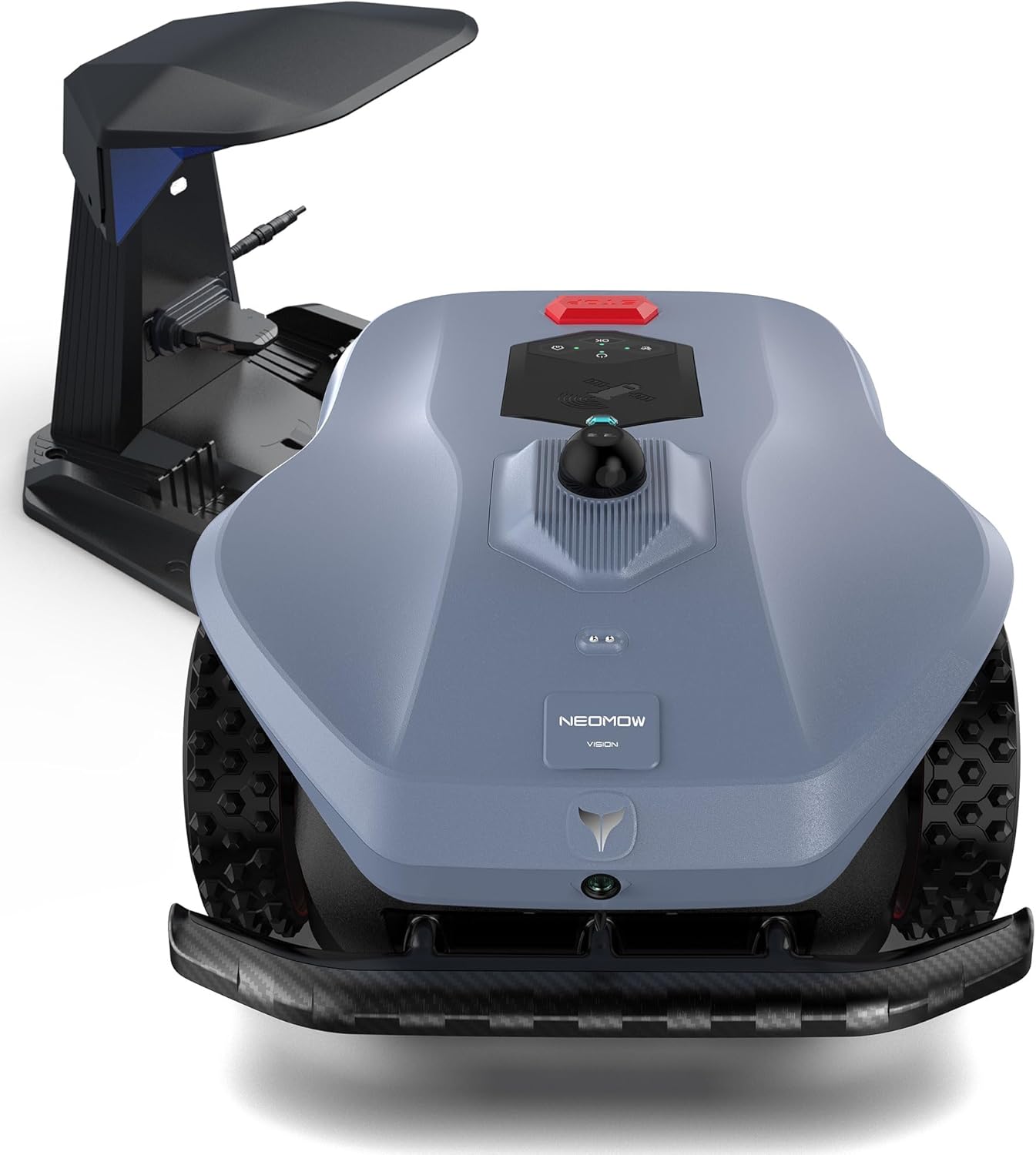
HOOKII Neomow X2 Air 3D LiDAR Robotic Lawn Mower (11" Cut, 13Ah)
| Cutting width | 11 in |
|---|---|
| Battery Capacity / Voltage | 13 Ah / 18 V |
| Mowing Area Per Charge | 0.17 Acre / 700 ㎡ |
| Max. Mowing Area | 0.37 Acre |
| Waterproof Level | IPX6 |
The HOOKII Neomow X2 Air is a compact robotic mower built around a 360° 3D LiDAR SLAM system and AI vision to map and mow small or fragmented lawns with minimal setup. It is typically used for daily or scheduled maintenance on yards up to 0.37 acre and can manage multiple zones and return paths. Notable features include inch-level positioning without an RTK antenna, a reserved port for an optional AI triple-vision camera, WiFi/4G/Bluetooth connectivity and an app for mapping, scheduling and remote monitoring. The electric cutting platform with an 11-inch deck and adjustable height (1.18 to 3.35 inches) handles common turf types and offers three preset mowing modes plus customization. Practical benefits are quiet operation, IPX6 water resistance for outdoor use, anti-theft alerts and GPS tracking, and about 120–150 minutes runtime per charge for roughly 0.17 acre per run. Limitations to consider are the modest cutting width and 0.37 acre maximum mapping area, which make this model best for smaller properties, and some advanced AI features require paid or optional hardware upgrades.
Best for: Buyers who prioritize reliable navigation and hands-off, precise mowing on small to medium fragmented lawns and want advanced sensing and app control over raw cutting capacity.
Less Ideal for: Homeowners with large continuous lawns who need faster coverage or a wider cutting deck should consider higher-capacity models.
- 360° 3D LiDAR SLAM plus AI vision for accurate mapping and obstacle detection
- Multiple wireless connections (WiFi, 4G, Bluetooth) and a mobile app for remote setup and monitoring
- IPX6 waterproof rating allows rinsing the unit after use
- Adjustable cutting height range and three preset mowing modes for turf flexibility
- Anti-theft alarm, GPS tracking and remote lock increase security
- Designed for small lawns only with an 0.37 acre mapping limit and ~0.17 acre per charge coverage
- 11-inch cutting width requires longer runtime to cover larger areas
Verdict: Choose the Neomow X2 Air if you want a budget-friendly, LiDAR-guided robot that delivers precise, low-intervention mowing for small, complex yards.
dreame A3 AWD LiDAR Robot Lawn Mower (Bundle C)

| Power Source | Battery Powered |
|---|---|
| Operation Mode | Automatic |
| Maximum Adjustable Cutting Height | 4 inches |
| Minimum Adjustable Cutting Height | 1 inches |
| Battery Average Life | 1 days |
The dreame A3 AWD is a high-capability robotic lawn mower aimed at hands-off, reliable lawn care. It uses 360° 3D LiDAR plus binocular AI vision to map yards quickly without perimeter wire and avoid more than 300 obstacles, while AWD hub motors give it traction on steep slopes and uneven terrain. Typical use is set-it-and-forget-it scheduling via the Dreamehome app and 4G/HDR monitoring for anti-theft and real-time alerts. Notable features include edge-to-edge cutting modes, multiple mowing patterns, an adjustable cutting height range, fast charging that shortens recharging time, and IPX6-rated cleaning for low-maintenance upkeep. Practical benefits are consistent coverage on complex properties, quiet operation that permits night scheduling, and integrated security and app control that reduce hands-on intervention. Important limitations are its relatively narrow cutting width compared with walk-behind mowers and the need to purchase some accessories such as the optional trimmer module separately for tighter edging; it is also a significant one-time equipment investment. For a homeowner prioritizing dependable, autonomous mowing on hilly or multi-zone lawns, this mower minimizes ongoing labor and oversight.
Best for: Homeowners who value a dependable, low-touch solution for maintaining multi-zone or sloped lawns and want a mower that can run reliably with minimal daily supervision.
Less Ideal for: People with very small lawns who prefer a simpler, lower-cost mower or homeowners who need very wide single-pass cutting for large acreage.
- 360° 3D LiDAR with binocular AI vision enables wire-free yard mapping and strong obstacle avoidance
- All-wheel drive hub motors handle steep slopes and rough terrain for reliable traction
- Fast 45-minute charging reduces downtime between mowing sessions
- Built-in 4G and HDR camera provide real-time monitoring and anti-theft protection
- IPX6 cleaning protection and removable bundle tools simplify maintenance
- Relatively narrow 7.87-inch cutting width compared with larger commercial or walk-behind mowers
- Some edging and trimming capabilities require optional accessories sold separately
- Higher upfront cost than basic robotic models
Verdict: Buy this if you want a robust, wire-free robotic mower that reliably maps, navigates, and mows complex or hilly yards with minimal hands-on upkeep.
Mammotion LUBA 2 AWD 3000HX Robot Lawn Mower (All-Wheel-Drive, RTK & UltraSense AI)

| Cutting width | 15.7 inches |
|---|---|
| Cutting Height Range | 2.2–4.0 in. |
| Battery Capacity | 12 Ah |
| Charging Time | 120 min |
| Connectivity | Bluetooth, Wifi, 4G |
The Mammotion LUBA 2 AWD 3000HX is built for demanding lawns where traction, precision, and autonomous navigation matter. It combines a 165 W all-wheel-drive motor and omni-style wheels to tackle steep slopes up to 80 percent and rough terrain that would stop many consumer mowers. UltraSense AI vision with RTK positioning enables perimeter-wire-free operation, zero-distance edge cutting, and multi-zone mapping so the mower can manage up to 30 separate areas and resume after charging. Practical benefits include a 15.7 inch cutting width with dual cutting discs for efficient passes, several mowing patterns and remote control via 4G/Wi-Fi/Bluetooth, and built-in GPS anti-theft tracking. Limitations to note are the relatively short mowing area per charge (about 0.25 acre) and a 120 minute charge time, which means larger properties or very heavy grass will require multiple recharges and longer overall runtimes. Setup and fine-tuning of zones and no-go areas take some initial effort, but once configured the unit delivers reliable automated performance on challenging sites.
Best for: Buyers who prioritize mowing performance and reliable navigation on steep or uneven yards and want a perimeter-wire-free solution that can handle complex zones and obstacles.
Less Ideal for: Homeowners with continuously large lawns substantially over 0.25 acre who need one-pass coverage without interruptions should consider higher-capacity models or multiple units.
- All-wheel-drive with 165 W motors handles steep slopes and rough terrain up to 80% incline.
- UltraSense AI vision plus RTK enables perimeter-wire-free operation and precise edge cutting.
- Supports multi-zone management and several mowing patterns for tailored coverage.
- Connectivity via 4G/Wi‑Fi/Bluetooth and GPS anti-theft tracking for remote monitoring and security.
- Mowing area per charge is limited to about 0.25 acre, requiring recharges for larger lawns.
- Charging time of around 120 minutes can extend total mowing time on bigger properties.
Verdict: Choose the LUBA 2 AWD 3000HX if you need a perimeter-wire-free robotic mower built to handle steep, rough, and multi-zone lawns with high-precision navigation.
Husqvarna 410iQ Automower Robotic Lawn Mower (Wire-Free, App Controlled)

| Power Source | Battery Powered |
|---|---|
| Maximum Adjustable Cutting Height | 4 inches |
| Minimum Adjustable Cutting Height | 1 inches |
| Operation Mode | Automatic |
| Item Type Name | Robotic Mower |
The Husqvarna 410iQ is a high-performance wire-free robotic mower built to automate regular lawn maintenance on medium-sized yards. It uses EPOS satellite positioning and cellular connectivity to create centimeter-accurate virtual maps and lets you set stay-out zones, change cut height, and schedule mowing from the Automower Connect app. The mower handles slopes up to 45 percent and offers a 1 to 4 inch adjustable cutting height across a 9.4 inch cutting width, so it can manage varied grass lengths and terrain transitions without perimeter wires. Larger wheels and a reinforced bumper improve traversal over driveways and uneven surfaces, and the unit is hose-washable for easy cleanup. Built-in anti-theft alarm and GPS tracking add security. Expect practical benefits like truly hands-off weekly trimming, predictable cut patterns, and multi-zone mapping for complex yards. The main compromises are the relatively narrow cutting width that makes jobs take longer on larger lawns and the upfront complexity of initial setup and mapping versus a simple perimeter-wire system.
Best for: A buyer who prioritizes precise, hands-off lawn performance and smart connectivity for a medium-sized yard and wants predictable, automated mowing with multi-zone control.
Less Ideal for: Large properties significantly over half an acre or buyers who need the fastest possible pass-to-pass mowing speed should consider larger commercial mowers or wider cutting options.
- Wire-free EPOS positioning enables centimeter-accurate virtual mapping and stay-out zones without perimeter wire
- Handles steep slopes up to 45 percent and negotiates surface transitions with larger wheels
- App control with Wi-Fi, Bluetooth and 4G for scheduling, cut-height changes, and remote tracking
- Built-in anti-theft alarm and GPS tracking for added security
- Hose-washable design and included charging station make maintenance straightforward
- Narrow 9.4 inch cutting width increases time needed to mow larger areas
- Initial setup and mapping can be more complex than perimeter-wire systems
Verdict: Choose the 410iQ if you want a wire-free, app-driven robotic mower that delivers precise mapping, slope capability, and secure hands-off mowing for up to a half acre.
Choosing the Right Robotic Lawn Mower for Rough Terrain: Key Factors to Consider
Slope Handling and Traction
Steep or uneven sections stress drive systems and wheels. Look for machines with higher slope ratings and low-center-of-gravity designs that resist tipping. Large, aggressive tires or track systems help maintain grip on wet grass and loose soil.
Traction also affects cut consistency. A mower that slips will miss swaths or leave ragged edges, so consider torque specs and whether the drive is wheel-based or uses tracks. In practice, a little extra traction reduces repeated passes and prevents the mower from getting stuck on inclines.
Battery Capacity and Real-World Runtime
Rough terrain demands more power for climbing and accelerating over obstacles, so runtime figures under ideal conditions are often optimistic. Give priority to battery capacity and the claimed coverage area, but also check typical recharge time and whether the mower supports partial-charge scheduling.
A longer runtime reduces the number of return-to-dock cycles and ensures completion of irregularly shaped lawns. For larger or more broken-up properties, fast recharge or the ability to continue from a paused point matters more than a marginally larger battery.
Cutting System Adaptability
Uneven ground causes variable cutting heights and frequent encounters with dips and humps. Mowers with floating cutting decks or adaptive blade systems maintain a more even finish across changes in grade. Multiple cutting height presets give flexibility for seasonal conditions and grass type.
Also consider blade type and protection mechanisms. Pivoting blades or anti-shock mounts reduce damage when the mower hits rocks or roots, and they help the unit resume normal cutting after minor impacts without manual intervention.
Build Durability and Weather Resistance
Rough yards expose equipment to knocks, mud, and moisture. Robust chassis materials, reinforced bumpers, and sealed electronics extend service life. Check for IP ratings or manufacturer guidance on rain operation and expected maintenance intervals.
Durability also affects long-term ownership cost. Durable components reduce the frequency of part replacements and limit service downtime, which is especially important when a machine must operate unattended over complex terrain.
Navigation Intelligence and Boundary Management
Complex yards need reliable navigation to avoid getting trapped or repeatedly crossing the same area. Look for systems with GPS-assisted mapping, adaptive path planning, or multi-zone scheduling to handle segmented lawns, narrow passes, and obstacles.
Good boundary control reduces human intervention. Features like automatic obstacle avoidance and clear virtual perimeter setup simplify managing garages, flower beds, and steep drop-offs without continual remapping.
Ease of Maintenance and On-Site Serviceability
Rough-terrain machines will need more frequent inspection for wear on tires, blades, and undercarriage parts. Choose models that allow easy blade swaps, accessible battery compartments, and simple cleaning of debris channels.
Availability of replaceable parts and straightforward troubleshooting steps keeps downtime low. For gardeners who prefer DIY upkeep, user-replaceable consumables and clear maintenance intervals make a real difference in owning a mower for rugged conditions.
Preparing Rough Terrain Before Installation
Before running a robotic mower across uneven ground, take time to remove obvious obstacles and mark hidden hazards. Trim back low branches, clear loose stones, and level out the worst ruts where feasible. Minor grading in key runways reduces the chance the mower will become stuck or suffer component damage.
Create clean approach lines near the docking station so the unit can find and align with its charger even when terrain is bumpy. On very irregular yards, consider temporary guides or border strips during the first few weeks while the mower learns the layout.
- Clear stones and large sticks from typical routes
- Mark or protect delicate flower beds and steep drop-offs
- Provide a stable, level docking area for reliable charging
Tire and Track Options Explained
Tire size, tread pattern, and whether a mower uses tracks have a major impact on performance. Larger tires with deep treads shed mud and grip irregular surfaces better than small, smooth wheels. Tracks distribute weight and can prevent digging on soft soil, but they add mechanical complexity.
Consider the terrain texture: for stony or root-filled ground, aggressive, puncture-resistant tires reduce the chance of failure. In wetter climates, choose a tread that channels water away from the contact patch to maintain traction.
- Large, aggressive tires for mixed soil and slopes
- Tracks for very soft or highly uneven ground
- Tire replacements and spares should be accessible
Mapping Complex Lawns and Multi-Zone Scheduling
Lawns with terraces, islands, or detached sections benefit from mowers that support multi-zone mapping. These systems let you assign different schedules and cutting intensities depending on grass type or slope. Good software reduces needless crossovers and ensures steep sections are tended at times when traction is best, such as mid-day instead of early morning dew.
Initial mapping sessions may require supervision to tune boundaries and to identify pinch points. After the learning period, the mower should follow efficient routes and reduce battery strain by avoiding unnecessary climbs.
- Set separate schedules for steep vs flat zones
- Use maps to limit access to sensitive garden areas
- Run supervised validation passes after setup
Seasonal Care for Rough Yards
Seasonal changes affect traction and cut quality. In wet seasons, reduce mowing frequency or raise cutting height to avoid scalping and wheel slip. During dry spells, blades can stay sharper longer but dusty conditions increase abrasive wear on moving parts.
Winter preparation should include cleaning debris, removing batteries if storage at low temperatures is recommended, and protecting exposed components from ice. Regular inspection after heavy storms ensures the mower did not suffer damage while unattended.
- Raise cutting height in wet conditions
- Clean underside and wheels after muddy runs
- Perform thorough inspection after storms or heavy use
Practical Safety Considerations on Slopes
Safety is a key concern when mowers operate on slopes near drop-offs or pedestrian areas. Verify the slope rating and avoid asking any robotic mower to tackle inclines beyond its specification. Physical barriers or virtual boundaries can keep the unit away from hazardous edges.
Teach family members and groundskeepers how the boundary system works and place warning signs if the mower will be active in visible areas. Regularly check sensors and emergency stop functions so the machine responds correctly to unexpected obstructions.
- Use barriers or virtual limits near drop-offs
- Regularly test emergency stop and sensors
- Educate household members about mower schedules
How We Chose the Best Robotic Lawn Mower for Rough Terrain
We focused on capabilities that make robotic mowers reliable in rough, uneven yards rather than on feature checklists that matter only for flat lawns. Our selection began by filtering for machines explicitly designed or marketed with enhanced traction, higher slope ratings, or adaptive drive systems. We excluded compact models intended solely for small, flat lawns and any units lacking clear specifications for slope angle or battery runtime. Evaluation criteria covered hill handling and traction, battery capacity and real-world runtime, cutting system adaptability to uneven turf, deck and chassis durability against bumps and debris, and navigation intelligence for complicated boundaries. We also checked ease of setup and maintenance for yard owners who may not want to spend hours tuning settings. Final picks balance mechanical design and software navigation so the mowers can maintain a consistent cut across varied surfaces without constant intervention.
FAQ
Can robotic mowers handle steep slopes reliably?
They can handle slopes up to the manufacturer-specified angle, but performance varies. Higher-rated models with low centers of gravity and aggressive tires perform better, while traction loss is common on wet or loose surfaces.
How do I prevent a mower from getting stuck on uneven ground?
Prepare the main routes by clearing debris and leveling deep ruts. Choose a model with suitable tire tread or tracks and set mapping zones to avoid pinch points. Supervised initial runs help identify trouble spots to mitigate.
Will rough terrain shorten battery life?
Rough terrain increases power draw from climbing and overcoming obstacles, which can reduce runtime and cycle count over time. Regular maintenance and avoiding unnecessary climbs help preserve battery longevity.
Are tracks better than wheels for uneven yards?
Tracks distribute weight and can reduce sinkage in soft soils, but they add mechanical complexity and might be harder to service. For mixed rocky and grassy yards, large aggressive tires are often a better compromise.
How often should I inspect the mower after runs on rough terrain?
Inspect the underside, wheels, and blades weekly during heavy use periods and after heavy storms. Check for loose fasteners, damage to protective covers, and embedded debris that could impair operation.
Can I use a robotic mower in wet conditions on slopes?
It depends on the model and local conditions. Wet grass reduces traction and increases slipping risk. If you must mow when damp, raise the cutting height and supervise initial passes to ensure stable operation.
Final Verdict
Prioritize slope capability, traction, and battery endurance when choosing a robotic mower for rough terrain. Durable construction and adaptive cutting systems reduce maintenance and produce a more consistent finish across bumps and grades. Balance advanced navigation features with mechanical robustness so the mower can operate reliably with minimal supervision. By focusing on these tradeoffs, you can select a machine that keeps an uneven yard tidy while minimizing downtime and intervention.
