

Note: This article contains affiliate links. If you click on these links and make a purchase, I may earn a small commission at no extra cost to you. This helps support my research and content. Read my full affiliate disclosure here.
Winter weeds behave differently than warm-season pests. When temperatures drop, some broadleaf weeds become more visible as cool-season turf thins, and timing and product selection matter more than in summer. You want a treatment that controls cold-season weeds without injuring dormant or slow-growing grass, and that fits your maintenance schedule and runoff concerns. This guide covers five top lawn weed killers for winter chosen for real-garden performance. We looked at winter control, turf safety, application practicality, and environmental considerations so you can pick an option that works where you garden. Read on for the evaluation criteria and practical notes to help you match a winter strategy to your lawn conditions.
Top Picks at a Glance
| Best Overall The best all-around choice for most situations | Scotts Turf Builder WinterGuard Fall Weed & Feed (33.84 lb) |  |
| Best Quality Built to a higher standard if you want something more solid | The Andersons Barricade Professional-Grade Granular Pre-Emergent Weed Control (40 lb) |  |
| Best Value The sweet spot between price and what you get | BioAdvanced Season Long Lawn Weed Killer + Preventer for Southern Lawns, 10 lb |  |
| Highest Rated A top-rated pick with lots of positive feedback | Scotts Turf Builder WinterGuard Fall Weed & Feed, 11.43 lb |  |
| Most Popular A crowd favorite that many people choose with confidence | Scotts Halts Crabgrass & Grassy Weed Preventer, 10.06 lb. |  |
Scotts Turf Builder WinterGuard Fall Weed & Feed (33.84 lb)

| Item Form | Granule |
|---|---|
| Coverage | 12000 sq ft |
| Unit Count | 541.44 Ounce |
Scotts Turf Builder WinterGuard Fall Weed & Feed is a granular all-in-one product for fall lawn care that combines weed control and fertilizer to strengthen turf before winter. It is applied with a broadcast or drop spreader to a wet lawn on calm days when weeds are actively growing and temperatures are between 60°F and 90°F. The formulation claims control of over 50 listed weeds such as dandelion and clover while delivering nutrients to build stronger roots and help turf recover from summer stress. Practical benefits include wide coverage from a single 33.84 lb. bag, straightforward spreader settings provided by the manufacturer, and timing guidance that helps maximize efficacy. Important limitations are that it is season-specific for fall application and requires following precise conditions around moisture, temperature, and no rain for 24 hours after application to work correctly. Also it is a conventional chemical treatment so users should follow safety instructions to avoid exposure to children, pets, and non-target plants.
Best for: Homeowners who prioritize a dependable, single-step fall treatment to reduce weeds and strengthen lawns for spring and who follow label directions and application timing carefully.
Less Ideal for: People seeking an all-season weed control plan or organic/chemical-free alternatives should consider different products or integrated approaches.
- Combines weed control and fertilizer in one fall application to simplify lawn care
- Manufacturer provides specific spreader settings for accurate application
- Covers up to 12,000 sq ft from a single bag for broad yard coverage
- Targets over 50 common lawn weeds while promoting stronger root development
- Formulated for fall use only and not suitable as a general year-round weed solution
- Requires specific weather and moisture conditions and a 24-hour rain-free window for best results
Verdict: A reliable fall-focused weed-and-feed that simplifies prep for a healthier lawn next spring by combining broad weed control with fertilizer in one application.
The Andersons Barricade Professional-Grade Granular Pre-Emergent Weed Control (40 lb)

| Item Form | Granule |
|---|---|
| Coverage | 12880 square_feet |
| Active Ingredients | Herbicide (prodiamine 0.48%) |
| Unit Count | 640 Ounce |
The Andersons Barricade is a granular pre-emergent designed to stop common weeds before they emerge rather than kill existing plants. It contains 0.48% prodiamine and uses a dispersible granule formulation that dissolves quickly with watering so the active ingredient moves into the soil where seeds germinate. Typical use is a broadcast application across established turf and ornamental beds in early spring or fall following label rates to cover up to the listed square footage. Notable features include small particle granules for broader coverage and a professional-strength active ingredient used to prevent crabgrass, poa annua, goosegrass and many broadleaf weeds. The practical benefits are long-lasting prevention when timed correctly and efficient coverage for larger yards thanks to the 40 lb bag. Limitations to plan for are that it will not remove existing weeds, it requires precise application timing and watering to activate, and safety precautions are necessary because the product is harmful if ingested or contacts skin.
Best for: Buyers who prioritize proven, professional-strength prevention for medium to large lawns and want a product backed by many user reviews and established performance.
Less Ideal for: Gardeners who need to eliminate established weeds, have very small yards where large-volume packaging is impractical, or prefer non-chemical weed control methods.
- Dispersible granule formula that dissolves quickly with water to move the active ingredient into the soil
- Professional-grade active ingredient prodiamine effective against common grassy and broadleaf weeds
- Small particle size for broader coverage per square inch
- Large 40 lb bag intended to cover a wide area without frequent repurchasing
- Does not control or kill existing weeds, only prevents new ones
- Requires correct timing and follow-up watering to be effective
- Contains herbicide active ingredients that require careful handling and adherence to safety directions
Verdict: Choose Barricade when you need a reliable, professional-strength pre-emergent to prevent common lawn weeds across a large area.
BioAdvanced Season Long Lawn Weed Killer + Preventer for Southern Lawns, 10 lb

| Item Form | Granule |
|---|---|
| Coverage | 4000 square feet |
| Unit Count | 160 Ounce |
| Active ingredients | Dicamba acid 0.088%, Penoxsulam 0.041%, Indaziflam 0.027% |
This granular formula is designed for one-application, season-long control on southern warm-season turf. Applied with a rotary or drop spreader and followed by light watering, it starts working quickly to stop weed growth and delivers residual activity for up to six months against many listed broadleaf and grassy weeds including crabgrass. The product is targeted for established southern species named on the label and covers about 4,000 sq ft per 10 lb bag. Practical advantages include easy broadcast application, broad spectrum control of common lawn weeds, and a built-in preventer so you do not need separate preemergent treatments for much of the season. Important limitations are the label restrictions on which grasses and states are approved and the need to follow safety and timing instructions precisely to avoid turf damage or off-target effects; it is not a spot spray and is intended for full-lawn broadcast use. Expect best results when applied to actively growing weeds and on the specific grass types listed by the manufacturer.
Best for: Homeowners with established southern warm-season lawns who want a single broadcast application to suppress common broadleaf weeds and prevent crabgrass across a full lawn.
Less Ideal for: Gardeners with non-southern or small patch problem lawns, or those who need a spot-treatment solution or live in states excluded on the label.
- One-application granules that provide up to six months of weed control and prevention
- Covers approximately 4,000 square feet per 10 lb bag for whole-lawn treatment
- Formulated specifically for southern warm-season lawns with broadleaf and grassy weed control
- Easy to apply with a rotary or drop spreader and activated by light irrigation
- Label-restricted to listed southern turf species and excluded states so not universally applicable
- Not intended for spot treatment of small patches and can cause off-target damage if misapplied
Verdict: A convenient granular one‑application solution for southern warm‑season lawns that gives broadleaf and crabgrass control plus up to six months of prevention.
Scotts Turf Builder WinterGuard Fall Weed & Feed, 11.43 lb

| Item Form | Granule |
|---|---|
| Coverage | 4000 square feet |
Scotts Turf Builder WinterGuard is a fall granular weed-and-feed formulated to kill common broadleaf weeds such as clover and dandelion while feeding cool- and warm-season grasses. It is applied with a broadcast or drop spreader to a moist lawn on a calm day when temperatures are between 60°F and 90°F. Notable features include WeedGrip Technology to improve granule adhesion to weed leaves, instructions tuned for Scotts spreaders, and coverage sized for about 4,000 square feet per 11.43 lb bag. In practice it simplifies a seasonal task by combining weed control and fertilization in one application, which helps build root strength and recover summer stress heading into winter. Important limitations are that it is labeled for specific grass types only and must not be used on St. Augustinegrass, bentgrass, or several groundcover species, and you must avoid watering for 24 hours after application for best effect. For homeowners who want a dependable, single-step fall treatment for typical lawn weeds, this performs as advertised; those with unsupported grass types or very large lawns will need a different product or multiple bags.
Best for: Homeowners who prioritize a reliable, low-effort fall solution to eliminate clover and other broadleaf weeds while feeding their lawn for winter hardiness.
Less Ideal for: Properties planted with unsupported turf species or buyers who need coverage for very large lawns without buying multiple bags.
- Kills over 50 listed lawn weeds including clover and dandelion
- Combined fertilizer and weed control saves an extra application
- WeedGrip Technology helps granules stick to moist weed leaves for better uptake
- Clear application guidance for use with Scotts spreaders and recommended timing
- Labeled for specific grass types only and should not be used on St. Augustinegrass, bentgrass, or certain groundcovers
Verdict: Choose this product if you want a dependable one-step fall treatment that both kills clover and feeds your lawn to build stronger roots for spring.
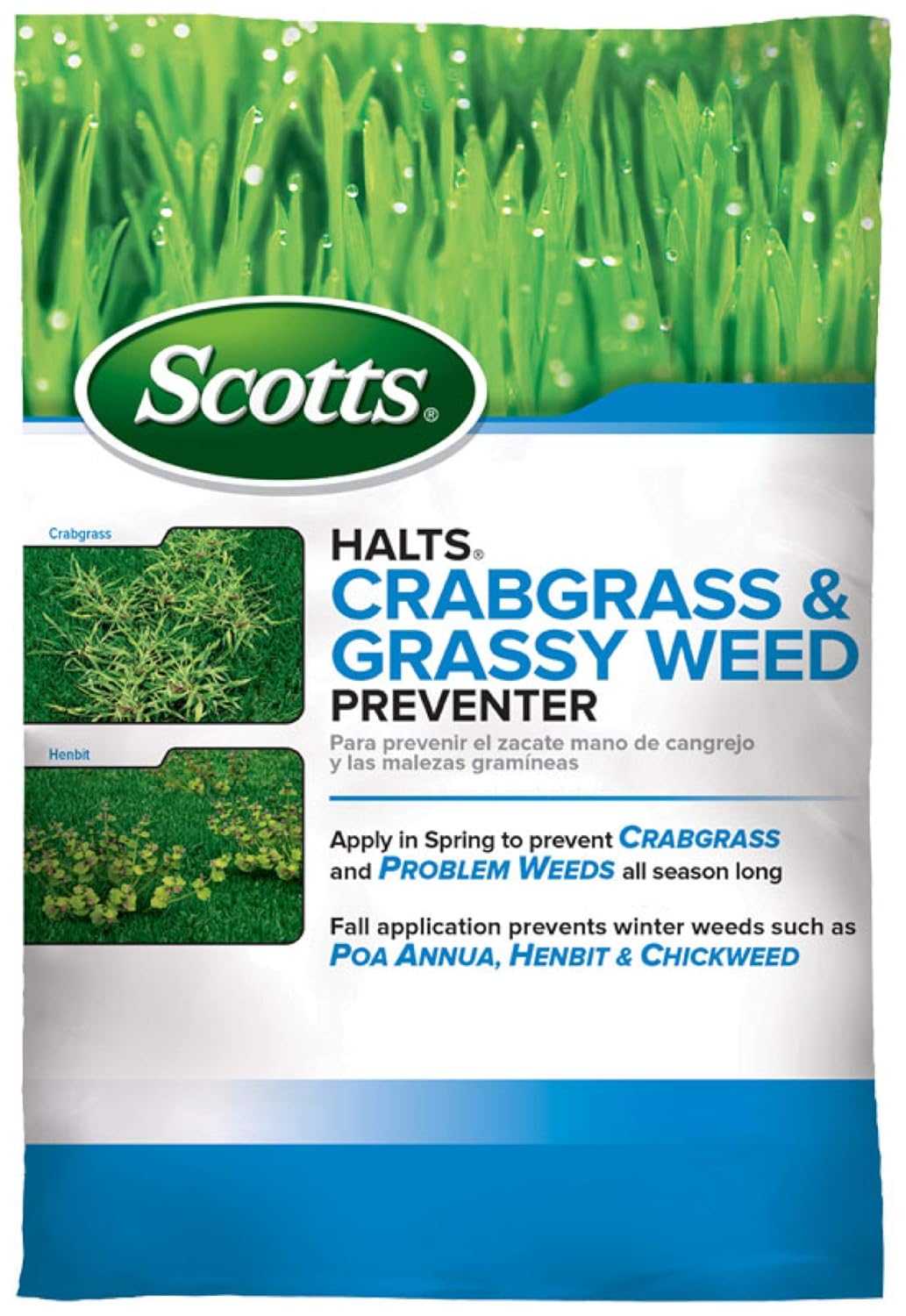
Scotts Halts Crabgrass & Grassy Weed Preventer, 10.06 lb.
| Item Form | Granule |
|---|---|
| Coverage | 5000 square_feet |
| Active Ingredients | Pendimethalin 1.71% |
Scotts Halts is a granular pre-emergent formulated to stop crabgrass and seeded grassy weeds from germinating across established lawns. You apply it dry with a broadcast spreader in early spring or fall, then water it in as directed; the active ingredient pendimethalin forms a soil barrier that prevents weed seedlings from emerging and is advertised as resistant to rain, snow, or freezing after application. This bag treats up to 5,000 square feet and is intended for use on most turf types except Dichondra and Bentgrass. The practical benefits are straightforward: a single timed application protects turf from several common annual weeds without needing spot herbicide treatments, and the granule form makes even coverage with a spreader easy. Important limitations are that it does not kill existing mature weeds and cannot be used on newly seeded or sprigged areas until months later, so timing and measuring lawn area matter. Also repeat applications for certain weeds like goosegrass may be necessary according to label instructions.
Best for: Homeowners who plan lawn care around seasonal timing and want a preventive, low-effort way to stop annual grassy weeds before they emerge.
Less Ideal for: People needing to remove existing weed infestations, those reseeding or establishing new turf within months, or gardeners who require immediate weed knockdown.
- Pre-emergent action prevents crabgrass and listed grassy weeds before they germinate
- Covers up to 5,000 sq ft per bag for single-application protection
- Granule form designed for even spreader application and easy watering activation
- Rain, snow, or freezing after application will not reduce effectiveness
- Does not control existing mature weeds so not useful for established infestations
- Not safe for newly seeded or freshly sprigged lawns for several months
Verdict: Use this granular pre-emergent if you want a seasonal, preventative barrier against crabgrass and common grassy weeds on an established lawn up to 5,000 sq ft.
Choosing the Right Lawn Weed Killer for Winter: Key Factors to Consider
Target Weed Species and Growth Stage
Knowing which winter weeds are active in your lawn shapes product choice. Cool-season broadleaf weeds such as chickweed, dollarweed, henbit, and oxalis respond differently depending on how actively they are growing. Products formulated for post-emergent contact control can work well when weeds have fresh growth, while systemic options may be necessary for deep-rooted perennials.
Timing matters because many winter weeds slow growth during cold snaps. Applying when weeds are actively photosynthesizing, typically on milder days, increases uptake for systemic materials. If you misjudge growth stage, you may see reduced control and need repeat applications.
Turfgrass Type and Dormancy
The species of grass in your lawn affects tolerance. Cool-season turfs tolerate many herbicides differently than warm-season varieties. In winter, some grasses enter partial dormancy and become more sensitive to chemical stress. Choosing a product with explicit label guidance for your turf type and winter application reduces the chance of discoloration or damage.
Also consider overseeded lawns. If you have a recent seeding or overseed, many winter treatments have restrictions for young grass. Follow label timelines for reseeding and avoid aggressive mixes until new turf is established.
Temperature Windows and Timing
Cold temperatures slow plant physiology and herbicide uptake. Most labels specify minimum and maximum temperatures for effective application and safe turf contact. Applying in temperatures that are too low can reduce effectiveness or increase turf injury risk. Plan treatments for daytime periods when temperatures rise above the label-specified minimum and avoid nights when frost or freezing is expected.
Also factor in precipitation forecasts. Rain soon after application can wash off contact products, while some systemic materials need a period without heavy rain to absorb into plants. Timing around expected weather helps preserve both efficacy and environmental safety.
Active Ingredient Behavior and Persistence
Different active ingredients act in varied ways in cold soils and on low-growth weeds. Some degrade quickly and present less long-term soil activity, while others persist and can affect future plantings or nearby ornamentals. Longer persistence can help with multi-week control but raises runoff and non-target risk. Choose based on whether you need quick knockdown or extended control and the sensitivity of adjacent plants.
Also consider how the ingredient moves in the plant. Contact herbicides may require thorough coverage of foliage, while systemic herbicides are absorbed and translocated. In winter, systemic movement can be slower, so persistent actives might be preferable for deep-rooted winter weeds.
Application Method and Equipment
Cold-weather application can be harder because pump sprayers may be sluggish and drift conditions change with temperature inversions. Select a product compatible with the equipment you already own and that has label instructions for mixing, nozzle selection, and spray volume appropriate for winter use. Some concentrates require precise dilution and agitation that is harder in cold conditions.
If you prefer granular products, check that they distribute evenly at lower temperatures and do not cake in the spreader. Always calibrate equipment before treating to ensure consistent coverage and avoid spot overdosing that could harm turf.
Environmental Risk and Runoff Management
Winter rain and thaw cycles can mobilize herbicides into storm drains and adjacent beds. Evaluate a product's runoff potential and follow label directions for buffer zones near water, irrigation timing, and disposal. Products with high solubility or long soil persistence require extra caution in sloped yards or near impervious surfaces.
Mitigation strategies include treating on dry days with low runoff risk, avoiding applications before heavy rain, and using barrier methods or targeted spot treatments to reduce overall chemical load.
When To Treat Winter Weeds
Treat winter weeds during mild periods when daytime temperatures consistently meet the label minimum for uptake. That is often late fall through early spring, depending on your region and specific weather patterns.
Avoid applications during frosts, immediate pre-freeze conditions, or when a hard freeze is forecast. Even if weeds are visible, poor physiological activity at very low temperatures makes most treatments less effective and increases the risk of turf discoloration.
- Aim for days with active sunlight and temperatures above the label minimum.
- Check short-term weather to avoid rain within 24 hours for contact products.
- Delay treatment if turf is stressed from drought or salt damage.
Spot Treatment Versus Whole-Lawn Applications
Spot treating visible patches of winter weeds reduces chemical use and limits turf exposure. For small infestations or isolated patches, targeted sprays or hand-pulling combined with a follow-up spot herbicide is often the most practical approach.
Whole-lawn treatments make sense when weeds are widespread or when using a systemic product intended to manage a broad infestation. Consider the tradeoff between convenience and potential non-target effects, especially near garden beds or slopes.
- Reserve whole-lawn treatment for heavy infestations or when recommended on the label for your turf type.
- Use a shield or low-drift nozzle for spot treatments near sensitive areas.
- Record treated areas and dates to avoid overlapping applications.
Application Tips for Cold Conditions
Warm your sprayer components and mix liquids according to label instructions to maintain proper flow. Use weather-appropriate nozzles that deliver better coverage at lower pressures to reduce drift and improve contact with low-growing winter weeds.
Work in shorter passes to avoid rewetting turf and give treated areas time to absorb the active ingredient. If using granulars, check for even distribution and avoid spreading when the ground is frozen solid to prevent bounce and uneven coverage.
- Use daytime hours when the sun is out to speed foliage drying and uptake.
- Clean equipment promptly after use to prevent residue buildup that can clog sprayers in cold weather.
- Wear appropriate protective gear and follow label PPE recommendations, which often include gloves and eye protection.
Managing Risk Near Water and Plantings
Protect ponds, streams, and garden beds by maintaining buffer zones and using lower-drift nozzles. Avoid treating when heavy rain is expected, and consider mechanical removal or targeted hand control in immediate buffer areas.
Rinse and dispose of leftover mixes according to local rules and label instructions to reduce contamination risk. If you must treat near sensitive plantings, test a small area first or use a product with lower soil mobility.
- Keep at least the label-recommended distance from water bodies.
- Use physical barriers or bean-type shields when spraying next to ornamentals.
- Consider spot treatments or manual removal adjacent to vulnerable plantings.
Post-Treatment Care and Follow-Up
Monitor treated areas for symptom development over one to three weeks; many winter-active herbicides take time to show results in cool temperatures. Record the dates and any environmental conditions to inform potential reapplication timing.
Avoid heavy traffic on recently treated turf until label re-entry intervals have passed and the grass has recovered. If control is incomplete, consider a follow-up application only if the label allows and after adjusting timing to improve uptake.
- Inspect treated zones weekly during the first month.
- Water only if the label directs; some products need dry periods to absorb.
- Document treatments and avoid overlapping chemistries that could stress turf.
How We Chose the Best Lawn Weed Killer for Winter
We focused on product attributes that matter for winter lawn care rather than broad-season claims. Key evaluation criteria included wintertime weed efficacy on common cool-season broadleaf species, demonstrated turf safety at low temperatures and when grass is semi-dormant, label guidance for cool-weather application windows, and environmental behavior such as persistence and runoff risk. We also considered ease of application in cold conditions, including spray coverage and compatibility with typical homeowner sprayers or spreaders, and the clarity of label instructions for winter timing and re-entry or irrigation restrictions. Products with poor winter-specific documentation or that required summer-only application windows were excluded. We did not include products lacking clear label instructions for turf safety in low-temperature situations or those with unusually high persistence that elevates off-target risk. This process produced a shortlist that balances winter weed control, turf safety, user practicality, and environmental caution-criteria reflected in the scoring metrics used for each pick.
FAQ
Can I apply lawn weed killer during light frosts?
Applying during light frosts usually reduces herbicide uptake because plant metabolism slows. It is best to wait for a frost-free day with temperatures within the label-specified window to improve effectiveness and reduce turf injury risk.
Will winter weed treatments harm dormant grass?
Some products can damage grass that is fully dormant or stressed. Choosing materials with explicit winter-turf guidance and following label rates reduces the chance of injury. If your lawn is deeply dormant, delay treatment until a milder period when grass shows some activity.
How long before rain should I apply a winter herbicide?
The ideal interval depends on the product. Contact herbicides often require 24 hours of dry time, while some systemic materials may need longer to be absorbed. Always follow the specific rainfast timing on the product label.
Are granular products better for winter use than liquid sprays?
Granulars can be easier to apply in cold conditions and reduce drift, but they may not provide the same coverage for low-growing winter weeds. Liquids can offer better foliage contact. Choose based on the infestation pattern, equipment, and label winter suitability.
How soon can I overseed after a winter weed treatment?
Overseeding timelines depend on the active ingredient and its persistence. Many labels recommend waiting several weeks to months after application before seeding. Consult the product label and consider mechanical removal or delaying treatment if immediate seeding is planned.
Final Verdict
Selecting a lawn weed killer for winter requires balancing effective control of cool-season broadleaf weeds with protecting turf that may be partially dormant. Prioritize products with clear winter application guidance, suitable action on the target species, and low runoff potential for your site. Consider spot treatments for small patches and reserve whole-lawn applications for widespread infestations. Match timing to mild, frost-free days and follow label instructions for your turf type and weather conditions. With careful timing and appropriate product choice, you can reduce winter weed pressure while minimizing harm to grass and nearby plants.
