

Note: This article contains affiliate links. If you click on these links and make a purchase, I may earn a small commission at no extra cost to you. This helps support my research and content. Read my full affiliate disclosure here.
Choosing the right axe for felling and splitting matters if you work with standing trees and process large logs for firewood. The same tool must deliver enough weight and edge retention to sever trunk fibers, yet be controllable and safe when swinging from a ladder or on uneven ground. This guide covers seven shortlisted axes that suit a range of felling and splitting tasks, from bucking small trunks to splitting seasoned rounds. We evaluate each option on structural durability, head geometry, handle ergonomics, and how well it transfers energy into the cut. Read on to understand which features matter most for your yard or property and why these axes earned a spot on the shortlist.
Top Picks at a Glance
| Best Overall The best all-around choice for most situations | Fiskars Pro IsoCore 8 lb Splitting Maul, 36" |  |
| Best Quality Built to a higher standard if you want something more solid | 1844 Helko Werk Forester Full-Size Felling Axe (Made in Germany) |  |
| Best Value The sweet spot between price and what you get | Fiskars 28" A-Series Chopping Axe |  |
| Best Budget The cheapest option that still gets the job done reliably | INTERTOOL 36" Felling Axe HT-0264 — 2.8 lb Carbon Steel Head with Fiberglass Handle |  |
| Highest Rated A top-rated pick with lots of positive feedback | DWFKHT 31.3" 6.6 lb Splitting Maul with Hickory Handle and Leather Sheath |  |
| Most Popular A crowd favorite that many people choose with confidence | Fiskars X27 Super Splitting Axe, 36-inch |  |
| Best Seller A high-volume bestseller chosen again and again | Fiskars 28" Chopping Axe |  |
Fiskars Pro IsoCore 8 lb Splitting Maul, 36"

| Head Type | Splitting Maul |
|---|---|
| Blade Material | Forged Steel |
| Handle Material | Steel,Wood |
| Head Weight | 6.4 pounds |
The Fiskars Pro IsoCore 8 lb Splitting Maul is a purpose-built wood-splitting tool that combines a heavy forged-steel head and a long 36-inch handle to deliver strong, controlled swings for medium to extra-large logs. Typical use is splitting firewood at a backyard woodpile or campsite where leverage and one-strike splits matter. Notable features include Fiskars IsoCore shock control system in the handle that reduces strike shock and vibration, a high-performance textured grip that helps prevent slips, and an advanced blade geometry with a sharp edge that drives through wood and pulls free more easily. The durable construction and rust-resistant head make it suited to regular outdoor use, and the long handle gives taller users extra leverage. Limitations are that the 36-inch length and 8 lb head make it heavier and less maneuverable for tight spaces or users who prefer a lighter, more compact tool, and safe use requires proper technique and protective gear due to the maul's power.
Best for: Buyers who want a robust, reliable maul for regular firewood splitting and value leverage and reduced vibration to get through larger logs efficiently.
Less Ideal for: People who need a compact or lightweight splitting tool for tight spaces, frequent transport, or who have limited upper-body strength should consider smaller axes or splitting mauls.
- IsoCore shock-absorbing handle reduces vibration and hand strain during repeated swings
- 36-inch handle provides strong leverage for splitting medium to large logs
- Forged steel head with advanced blade geometry promotes deeper penetration and easier removal
- Textured, slip-reducing grip improves control on powerful swings
- Long 36-inch profile can be awkward in confined spaces or for shorter users
- Heavier overall weight requires more user strength and can fatigue during long sessions
Verdict: Choose this maul if you want a powerful, vibration-reducing 36-inch tool built to split medium to extra-large logs with fewer swings.
1844 Helko Werk Forester Full-Size Felling Axe (Made in Germany)

| Head Material | C50 high carbon steel |
|---|---|
| Head Type | Felling |
| Head Weight | 3.5 lb |
| Handle Material | American hickory |
| Handle Length | 31 in |
The Helko Werk Forester is a purpose-built full-size felling axe that brings a hand-forged C50 high carbon steel head and a carefully selected American hickory handle to demanding tree work. With a roughly 3.5 lb head and a 31 inch handle it delivers the mass and reach needed to fell medium and large trees while remaining manageable for a single user. The polished finish on the head reduces cutting friction and helps resist surface rust, and the handle is sanded and treated with boiled linseed oil for a comfortable grip. Included leather sheath and a small bottle of protective Axe Guard oil make basic care and transport straightforward. Because it is a premium handmade tool, the Forester emphasizes edge retention and balance over low cost and requires routine sharpening and proper storage to protect the wooden handle and carbon steel. It is not lightweight for casual pruning but shines when you need a reliable, well-balanced axe that holds an edge for sustained chopping tasks.
Best for: A buyer who prioritizes chopping performance and durability for regular tree-felling or heavy-duty yard work and wants a precision-forged tool that holds an edge and feels balanced under swing.
Less Ideal for: Not a good fit for casual gardeners, light pruning, or ultralight backpacking where a smaller hatchet or lightweight saw would be easier to handle.
- Hand-forged C50 high carbon steel head for strong edge retention and durability
- Balanced full-size design (3.5 lb head, 31 in handle) suited to felling medium and large trees
- Premium grade A American hickory handle finished with boiled linseed oil for comfort and shock absorption
- Polished head finish reduces cutting friction and helps resist surface rust
- Includes leather sheath and Axe Guard oil for protection and basic maintenance
- Requires regular sharpening and oiling to maintain the carbon steel head and prevent rust
- Heavier and longer than compact axes, so it is less suitable for tight spaces or extended backpacking carries
Verdict: Buy this axe if you want a high-performance, hand-forged felling axe that combines weight, balance, and premium materials for reliable tree-chopping results.
Fiskars 28" A-Series Chopping Axe

| Head Type | Felling |
|---|---|
| Blade Edge | Hardened, non-stick |
| Handle Material | Steel,Wood |
| Blade Material | Alloy Steel |
The Fiskars 28" A-Series Chopping Axe is built for heavy backyard chopping and light tree felling. It pairs a low-friction, hardened alloy-steel blade with a precision-balanced head that helps the blade bite deeper on each swing, so you get cleaner cuts and fewer stuck strikes when felling small trees or splitting logs. The handle combines steel and wood construction with a shock-absorbing FiberComp-style design to reduce vibration and make repeated swings less fatiguing. Practical benefits include an ultra-sharp edge that stays effective through routine use and a balanced feel that multiplies swing power for faster work. Limitations are that this is a midweight, 28-inch tool intended for small to medium trunks rather than heavy timber, and its mixed-material handle may require occasional care compared with full-composite or all-wood traditional designs. For routine firewood prep, campsite work, and clearing small trees, it offers a reliable, user-friendly chopping performance.
Best for: Buyers who want a dependable, easy-to-swing axe for routine tree felling, firewood prep, and yard cleanup and who value tools with solid real-world performance evidence.
Less Ideal for: Professional arborists or anyone who regularly needs to fell very large trunks should choose a heavier, longer-handled felling axe or specialized chainsaw instead.
- Balanced head design increases swing power and cutting efficiency
- Hardened alloy-steel blade with low-friction coating reduces sticking
- Shock-absorbing handle reduces vibration during repeated swings
- Sharp edge and blade geometry suitable for clean felling and log splitting
- 28-inch length and midweight construction are not ideal for very large or old-growth trees
- Handle uses mixed materials that may need occasional maintenance
Verdict: A well-balanced, sharp 28-inch axe that delivers efficient, low-sticking cuts for felling small trees and prepping firewood.
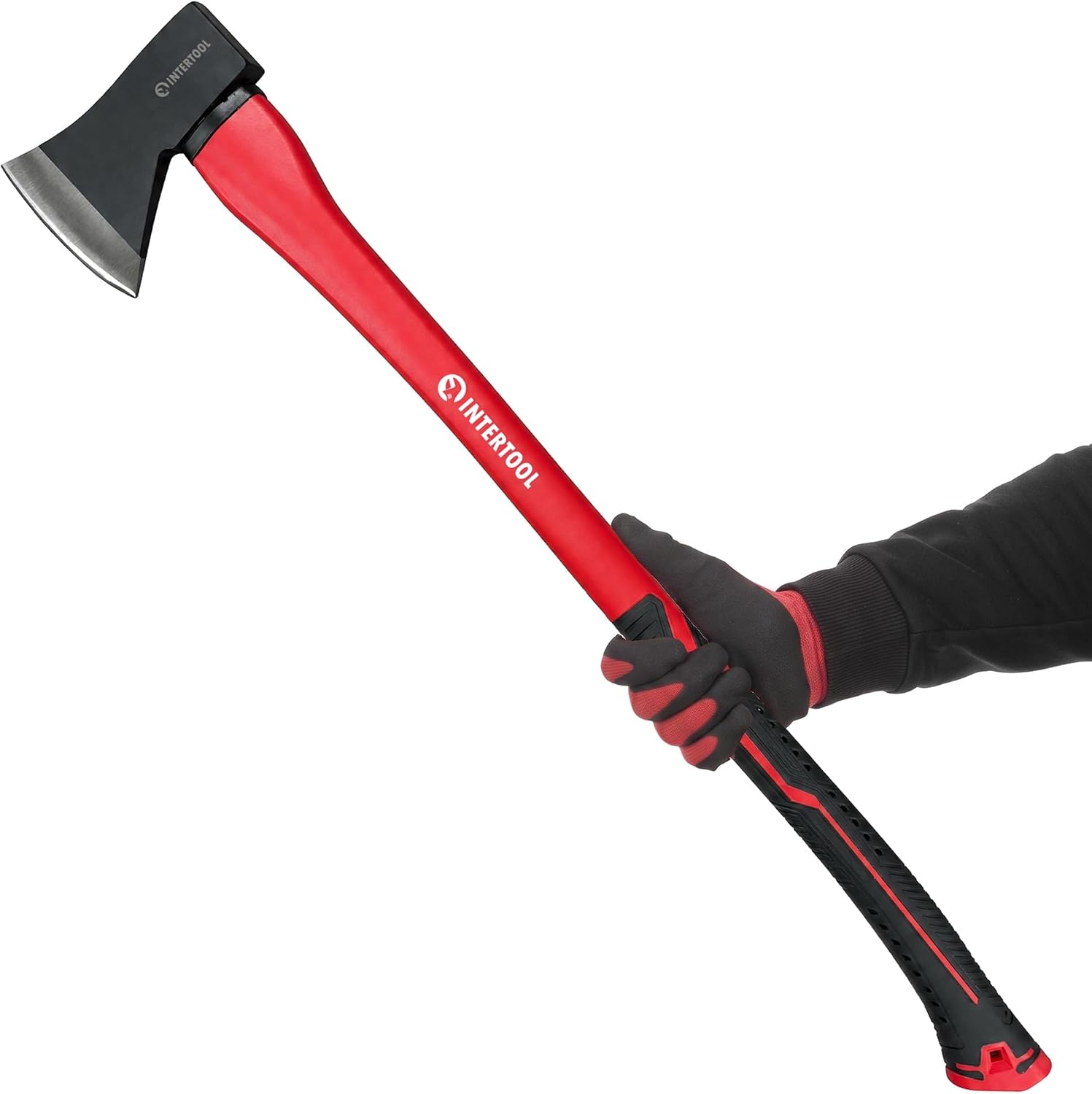
INTERTOOL 36" Felling Axe HT-0264 — 2.8 lb Carbon Steel Head with Fiberglass Handle
| Head Type | Felling |
|---|---|
| Head Weight | 2.8 pounds |
| Handle Material | Fiberglass |
| Blade Length | 5.1 inches |
The INTERTOOL HT-0264 is a long-handled felling axe built for yard work and cutting firewood. With a 36-inch fiberglass handle it gives good leverage for deeper swings, while the 2.8 pound forged carbon steel head arrives pre-sharpened and coated to resist rust. The textured, non-slip rubber grip and shock-absorbing handle reduce vibration and make repetitive chopping more comfortable. Use it for felling smaller trees, limbing, and splitting rounds into firewood; the head-to-handle balance improves swing control so you can place cuts more accurately. The included sheath protects the blade during storage and transport. Limitations to expect are the midweight head, which is better suited to smaller trunks and splitting than to heavy-duty professional felling, and the fiberglass handle, which while low-maintenance is less traditional than wood and may feel different to some users. For routine property maintenance it combines power, corrosion resistance, and user comfort in a practical package.
Best for: Buyers who want a practical, low-maintenance felling axe for regular property work and firewood preparation and who prioritize leverage, comfort, and corrosion resistance over maximum head mass.
Less Ideal for: Not the best choice for professional arborists or anyone who needs a very heavy head for felling large trees or for those who insist on a traditional wooden handle feel.
- Long 36-inch fiberglass handle gives improved leverage for longer swings and deeper cuts.
- Forged, heat-treated carbon steel head (2.8 lb) ships pre-sharpened and has a protective coating to resist rust.
- Shock-absorbing handle and textured rubber grip reduce vibration and improve control during repetitive chopping.
- Comes with a blade sheath for safer transport and storage.
- 2.8 lb head is midweight and may be underpowered for large-diameter trees or heavy professional felling.
- Fiberglass handle offers less traditional feel and may not suit users who prefer wooden handles.
Verdict: A practical, comfortable long-handled felling axe that delivers good leverage and durability for routine tree felling and firewood work.
DWFKHT 31.3" 6.6 lb Splitting Maul with Hickory Handle and Leather Sheath

| Head Material | 1065 High-Carbon Steel |
|---|---|
| Handle Material | Hickory Wood |
| Head Weight | 6 pounds |
| Overall Length | 31.3 inch |
| Blade Length | 3.5 inches |
This DWFKHT splitting maul is built for dependable, heavy-duty firewood work. The 1065 high-carbon steel head is forged and heat-treated to hold a hardened splitting edge, and the 6.6 lb head mass plus a 31.3-inch hickory handle provide strong swing momentum for driving the wedge-shaped head through large logs. The hickory handle offers natural shock absorption and an ergonomic profile for a secure grip during extended use, and the included leather sheath protects the edge for transport and storage. In practice the maul excels at splitting hardwood and larger rounds where raw force and a durable edge matter more than finesse. Expect longer sessions with less fatigue compared with shorter tools, but the size and weight make it less suited to fine trimming or jobs that require long carry distances. This is a straightforward, workmanlike tool intended for users who prioritize long-term performance and solid construction over lightweight portability.
Best for: Buyers who need a rugged, no-nonsense splitting tool for regular firewood preparation and prioritize a durable head and dependable performance over lightweight convenience.
Less Ideal for: Not a good choice for users who need a lightweight, multiuse camp axe or for frequent backpacking where weight and bulk matter.
- Forged 1065 high-carbon steel head for durability and edge retention
- 6.6 lb head and 31.3-inch handle provide strong splitting power for large logs
- Genuine hickory handle delivers good shock absorption and comfortable grip
- Wedge-shaped head geometry penetrates and separates wood fibers efficiently
- Includes leather sheath to protect the blade during storage and transport
- Heavier and longer than standard axes, which reduces portability for trekking or carry-heavy use
- Single-edge maul design is specialized for splitting and not ideal for chopping or carving tasks
Verdict: If you want a reliable, heavy-duty maul that delivers consistent splitting power for large logs, this forged 1065 steel maul is a work-ready choice.
Fiskars X27 Super Splitting Axe, 36-inch

| Included Components | Fiskars X27 Super Splitting Axe (36") |
|---|---|
| Head Weight | 4.3 pounds |
| Handle Material | Steel,Wood |
| Blade Material | Alloy Steel |
The Fiskars X27 is a purpose-built splitting axe that pairs a long 36-inch handle with a razor-sharp, convex-ground alloy steel head to make one-strike splits more likely on medium and large firewood. In typical use you stand with the longer handle to generate extra leverage and swing for deep blade penetration, then let the widened head and bevel geometry drive the split apart. Notable features include an insert-molded forged steel head for durability, a shock-absorbing textured handle to reduce hand strain and improve control, and a protective sheath for safe storage. The design emphasizes efficient, higher-power swings so you can split more wood with fewer strikes, which is especially helpful when prepping large cords of firewood or working by a fire pit. The axe is built for longevity with hardened blade steel and a handle meant to resist breakage, but the heavier head and long reach make it best suited to outdoor splitting rather than fine detail work or confined spaces.
Best for: Buyers who want an efficient, durable splitting axe for processing medium to large firewood and who value extra leverage and fewer swings when cutting cords of wood.
Less Ideal for: People who need a lightweight, maneuverable hatchet for camping, fine carpentry, or working in tight spaces should consider smaller tools instead.
- Long 36-inch handle provides extra leverage for taller users and harder swings
- Convex bevel and hardened alloy-steel head increase one-strike splitting performance
- Insert-molded forged steel head and shock-absorbing handle for durability and reduced vibration
- Includes protective sheath for safe transport and storage
- Long, heavy design is less maneuverable for small or precise jobs
- Not intended for indoor use or tight spaces
Verdict: Choose the Fiskars X27 if you want a rugged, long-handled splitting axe that maximizes leverage and one-swing splitting power for medium to large logs.
Fiskars 28" Chopping Axe

| Included Components | Chopping Axe (28") |
|---|---|
| Handle Material | Fiberglass |
| Blade Material | Forged Steel |
| Head Type | Felling |
| Blade Edge | Proprietary Grind |
The Fiskars 28" Chopping Axe is built for chopping and felling small- to medium-sized trees and for splitting kindling around the yard or campsite. Its forged steel blade uses Fiskars proprietary grind and a low-friction coating so the edge bites deeper and slices with less resistance, which reduces swings and user fatigue. The fiberglass FiberComp handle and insert-molded head create a strong, impact-resistant connection that stands up to heavy use and resists breaking. The axe’s weight distribution is tuned to increase swing speed and power without making the tool feel unwieldy, so it works well for extended sessions of chopping. Practical limits are that this size is intended for smaller trunks and campsite tasks rather than large timber, and hardened users may want a heavier splitting axe for big rounds. Maintenance is straightforward: keep the edge sharp and store dry to preserve the coating and handle.
Best for: Gardeners and outdoor enthusiasts who want a reliable, durable axe that handles most backyard felling and campsite chopping tasks with fewer swings and less strain.
Less Ideal for: Professional loggers or users who regularly cut large-diameter trees should choose a heavier felling or splitting axe designed for large timber.
- Proprietary ground forged-steel blade with low-friction coating for deeper, cleaner cuts
- FiberComp fiberglass handle and insert-molded head give high impact resistance and durability
- Balanced weight distribution increases swing speed and perceived power
- Suitable for chopping, felling small to medium trees, and splitting kindling around camp or yard
- 28-inch chopping axe is not optimal for very large trunks or heavy-duty industrial felling
Verdict: A well-balanced, virtually unbreakable 28-inch chopping axe that delivers deeper cuts and reliable performance for felling small to medium trees and general outdoor chopping tasks.
Choosing the Right Axe for Felling and Splitting: Key Factors to Consider
Head Mass and Intended Use
Head mass governs how much kinetic energy the axe delivers on impact. Heavier heads accelerate more force into a cut, which helps when felling larger-diameter trunks or splitting dense hardwood rounds. Lighter heads are easier to control and allow faster follow-up strikes, which can be preferable for smaller trees, limbing, or when precision is more important than sheer power.
Choose a head weight that matches your typical work. Too heavy a head increases fatigue and reduces accuracy, while too light a head requires many more swings. Also consider how head mass interacts with handle length; a balanced pairing makes both felling and splitting more efficient.
Bevel Profile and Wedge Geometry
The bevel angle and overall wedge shape determine whether the axe slices through fibers or forces them apart. A narrower bevel with a sharper edge cuts cleanly and is better for felling where you want a controlled cut through grain. A more pronounced wedge delivers splitting force, driving wood fibers apart and reducing the need for repeated strikes.
For multi-use axes, look for a compromise geometry that allows efficient chopping for felling while retaining enough wedging action for splitting. If you mostly split large, knotty rounds choose a more aggressive wedge profile. If you mainly fell trees and limb them, favor a thinner, slicing bevel.
Handle Material, Shape, and Attachment
Handle material affects durability, vibration dampening, and repairability. Traditional hickory offers shock absorption and is relatively easy to replace in the field. Synthetic handles can resist weathering and cracking but vary in how they transmit shock. The handle shape and thickness influence grip security, wrist alignment, and how the tool feels through a complete swing.
Equally important is the head-to-handle attachment. A tight, well-seated head with a secure wedge or bonded fit minimizes the risk of the head loosening during repeated heavy blows. Consider whether you want a handle you can replace or a bonded construction designed for minimal maintenance.
Balance, Reach, and Swing Dynamics
Balance affects how the axe feels during the strike and follow-through. A well-balanced axe will feel like an extension of the arms, allowing you to deliver energy with less effort. Handle length sets reach and leverage: longer handles give more power but require more room to swing and more control. Shorter handles improve precision and are safer when working with limited clearance.
Think about the environments you work in. If you often fell trees near obstacles or work from ladders, a slightly shorter, better-balanced tool may be safer and more effective than a long-handed splitting axe.
Edge Retention and Field Sharpening
Edge retention determines how long the axe holds a working edge between sharpenings. Harder steels can keep a sharper edge longer but may be more brittle and harder to sharpen in the field. Softer or medium-hardness steels are easier to resharpen with files or stones but require more frequent maintenance.
Consider whether you will maintain the axe yourself in the yard or expect occasional professional re-sharpening. Also factor in how easy it is to reprofile the bevel and access the edge when working outdoors.
Safety Features and User Ergonomics
Design elements that reduce kickback, improve grip under sweat or wet conditions, and prevent accidental slips are important for sustained heavy work. A textured or contoured grip, a comfortable shoulder for the hand, and a secure head fit all contribute to safer operation. Protective finishes that resist rot and moisture extend handle life and prevent sudden failures.
Ergonomics also covers how fatigued you feel after a day of chopping. Tools that reduce vibration, distribute impact forces, and fit your body size will let you work longer and with fewer mistakes.
Choosing the Right Handle Length
Handle length changes how you apply force and where you can safely swing. Longer handles increase leverage and power for splitting big rounds, while shorter handles improve control when felling in tight spaces or when working from a ladder.
Measure the clearance where you work and test different lengths if possible. A general approach is to pick a handle length that lets you generate full-body momentum without endangering nearby branches, structures, or people.
- Short handles: better control, safer in cluttered sites
- Long handles: more power and reach for larger logs
- Consider transport and storage when choosing length
Maintenance and Sharpening in the Field
Keeping a sharp edge is practical and safer. A blunt axe bounces and requires more force, increasing the chance of glancing blows. Carry basic sharpening tools like a file and a sharpening stone, and perform quick touch-ups between tasks.
Regularly check the handle and head fit for looseness and inspect the haft for cracks. Clean sap and grit off the head after use and lightly oil exposed steel to slow corrosion.
- Carry a round file and a small stone for bevel and edge upkeep
- Inspect the head wedge and handle collar before heavy use
- Store dry and ventilated to prevent handle rot
Using an Axe Safely for Felling and Splitting
Safe technique reduces strain and accidents. For felling, plan the escape route and understand hinge formation so the tree falls predictably. For splitting, brace logs safely and use a stable chopping block to avoid glancing strikes.
Wear appropriate eye and hand protection. Maintain a clear work area so your swing and follow-through are unobstructed. If you feel uncontrolled or tired, stop and rest or switch to a lighter task.
- Use a chopping block to raise rounds to a comfortable height
- Keep bystanders well outside swing radius
- Replace damaged handles or heads before continuing work
When to Use an Axe Versus a Splitting Maul
Axes and mauls share some overlap but excel at different jobs. An axe with a slimmer blade is better for cutting across grain and making felling notches. A maul typically has a heavier, blunter head designed to force wood apart and resist wedge bounce in large rounds.
If your work is a mix of felling and moderate splitting, a multipurpose axe with a balanced wedge may be the most practical. If you mainly split very large logs, pairing an axe for cutting and a heavier maul for splitting can be more efficient.
- Axe: best for chopping, notching, and lighter splitting
- Maul: best for heavy splitting and large, knotted rounds
- Consider keeping both if you regularly do both tasks
Transport, Storage, and Weather Resistance
How you transport and store your axe affects longevity. A leather or synthetic sheath protects the edge and prevents accidental cuts during transport. Keep handles out of prolonged moisture and avoid leaving wooden hafts in direct sunlight for extended periods.
If you work in wet conditions often, prioritize handles and finishes that resist water ingress and swelling. Synthetic handles can offer an advantage for low-maintenance durability, while wooden handles need more attention but can be replaced in the field.
- Use an edge cover for safe transport
- Store in a dry, temperature-stable place
- Treat wooden handles periodically to slow rot
How We Chose the Best Axe for Felling and Splitting
We focused on attributes that matter in real-world felling and splitting work. Every candidate had to demonstrate durable head construction and a reliable attachment method to the handle so it resists loosening under repeated strikes. Blade geometry and bevel profile were evaluated because they determine how cleanly an axe severs wood fibers for felling or wedges apart a log for splitting. Handle material and shape were assessed for shock absorption, grip security, and reach-critical for control when swinging full power or working from elevated positions. Balance and weight distribution were considered to ensure the tool transfers energy efficiently without causing excessive user fatigue. We also considered edge retention and how easily the head can be re-sharpened in the field. Excluded from our list were axes intended solely for light camping tasks or decorative pieces that lack the structural heft for sustained felling and splitting. Tools with unclear attachment systems or obviously fragile handles were not considered. The final selections reflect a mix of head mass, bevel design, and handle ergonomics that suit both cutting across grain and wedging along the grain.
FAQ
What head weight is best for general felling and splitting?
It depends on the timber size and your strength. A midweight head often gives a good balance for mixed work: heavy enough to deliver decisive blows on moderate trunks and logs, yet manageable for extended use. Very large trunks may require a heavier head or a team approach.
Can one axe handle both felling trees and splitting firewood?
Often a well-designed multipurpose axe with a balanced wedge and comfortable handle can perform both tasks adequately. The tradeoff is that it will not match a specialized maul for heavy splitting nor a slim-felled axe for delicate limbing, but it provides versatility for varied yard work.
How do I know when the axe handle needs replacing?
Replace the handle if you see visible cracks, severe wear at the eye, or any loosening of the head. A handle that causes excessive vibration or creaks under load is a safety concern and should be repaired or replaced before continued heavy use.
How often should I sharpen an axe used for felling and splitting?
Sharpening frequency depends on wood species and usage intensity. For regular backyard use, a quick file-up after a few hours of work and a more thorough stone sharpening every few weeks of frequent use is typical. Monitor cutting behavior: if the axe starts to bounce or needs more force, it is time to sharpen.
Are synthetic handles better than wooden handles for heavy use?
Synthetic handles resist moisture and cracking more than wood and often require less maintenance. However, some users prefer wooden handles for their shock-dampening properties and ease of field replacement. The right choice depends on your maintenance willingness and the working environment.
Final Verdict
Pick an axe that matches the balance of tasks you do most often. Prioritize a head and bevel geometry that suit whether you want cleaner cuts for felling or more wedge action for splitting, and pair that with a handle length and material that you can control safely for long periods. Remember that maintenance, a secure head fit, and safe technique matter as much as raw specs. With those tradeoffs in mind, focus on the structural and ergonomic features discussed here to choose the best tool for felling and splitting.
