

Note: This article contains affiliate links. If you click on these links and make a purchase, I may earn a small commission at no extra cost to you. This helps support my research and content. Read my full affiliate disclosure here.
If you have steep sections in your yard, a robotic lawn mower for slopes changes how you maintain those areas. Machines designed for inclines handle traction, safe navigation, and consistent mowing patterns so you do not need to wrestle with a push mower on a hillside. This guide covers seven shortlisted options built to perform on graded lawns. We evaluated each on hill handling, boundary control, battery and runtime, and durability so you can pick the unit that best matches your garden layout and maintenance rhythm.
Top Picks at a Glance
| Best Overall The best all-around choice for most situations | roborock RockMow X130H Robot Lawn Mower with 4WD and Quad-Vision Navigation |  |
| Best Quality Built to a higher standard if you want something more solid | LYMOW One Plus Robot Lawn Mower with RTK+VSLAM Navigation and Tracked Drive |  |
| Best Value The sweet spot between price and what you get | Segway Navimow i206 AWD Robot Lawn Mower |  |
| Best Budget The cheapest option that still gets the job done reliably | ECOVACS GOAT O1000 RTK Robotic Lawn Mower |  |
| Highest Rated A top-rated pick with lots of positive feedback | HOOKII Neomow X SE Robotic Lawn Mower (3D LiDAR Navigation) |  |
| Most Popular A crowd favorite that many people choose with confidence | Mammotion LUBA 2 AWD 5000HX Robot Lawn Mower with Cleaning Stand |  |
| Best Seller A high-volume bestseller chosen again and again | Husqvarna 410iQ Automower Robotic Lawn Mower (Wire-Free, App Controlled) |  |
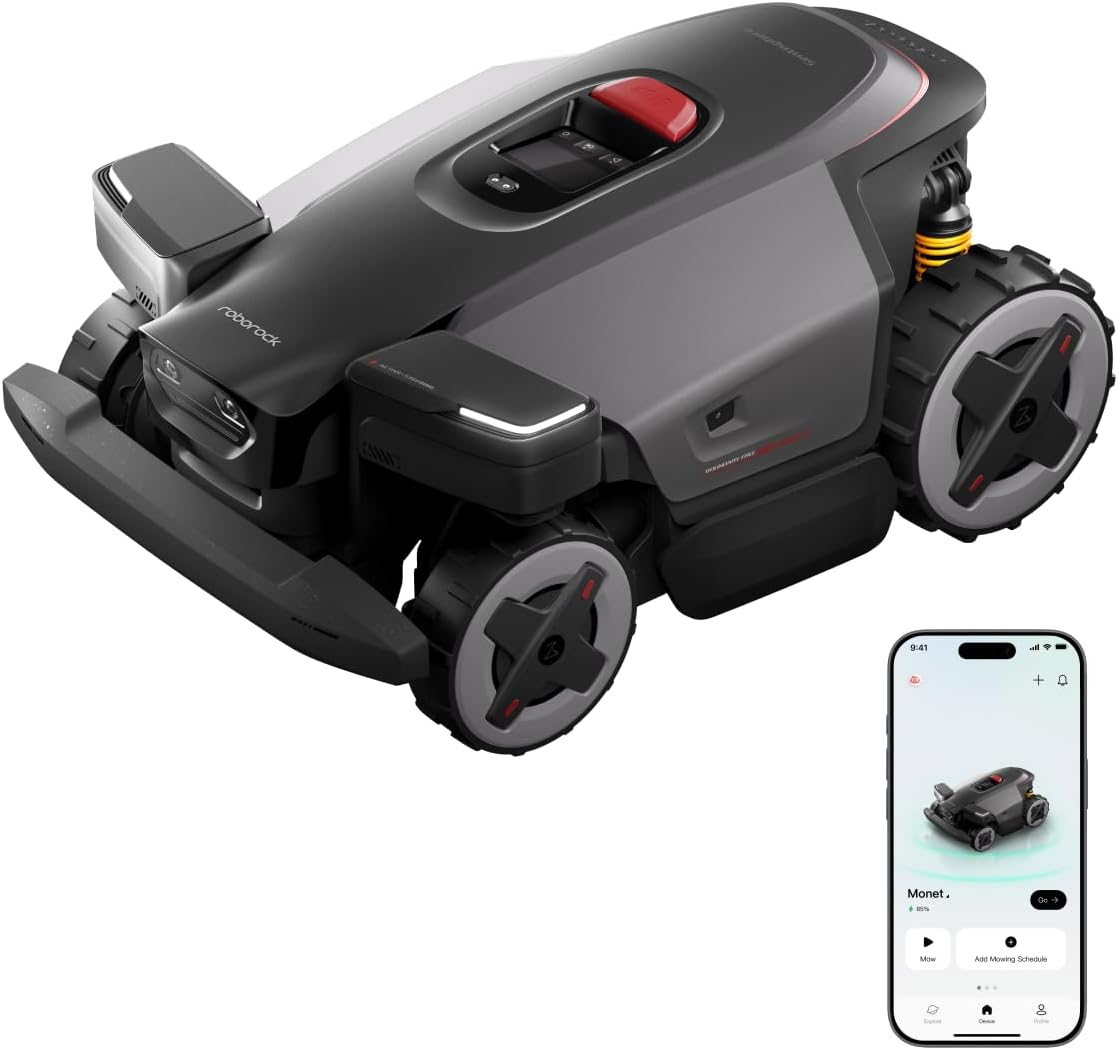
roborock RockMow X130H Robot Lawn Mower with 4WD and Quad-Vision Navigation
| Power Source | Battery Powered |
|---|---|
| Cutting width | 9.5 inches |
| Maximum Adjustable Cutting Height | 3.5 inches |
| Battery Average Life | 140 minutes |
The roborock RockMow X130H is a high-capability robot mower built to handle steep, uneven, and complex lawns without a buried perimeter wire. It uses Full-Band RTK plus a quad-camera AI vision system for precise positioning and dual mapping modes so you can either auto-map open areas or manually trace boundaries from the app. The pro-grade four-wheel drive, active steering, and dynamic suspension let it climb slopes up to 80% and roll over obstacles up to about 3.1 inches while keeping a floating cutting deck for consistent surface-following. Practical benefits include a relatively wide 9.5-inch cut to reduce runtime, multi-zone scheduling and a real-time app dashboard, plus anti-theft features and 4G connectivity. Important limitations are its weight and size for handling and storage, and the advanced navigation and connectivity mean a learning curve during setup and when customizing complex zones. For homeowners with steep or irregular yards who want largely hands-off mowing, this mower brings robust, reliable performance.
Best for: Homeowners with steep, irregular, or obstacle-filled lawns who want a durable, hands-off mower that prioritizes precise navigation and traction over simplicity.
Less Ideal for: Small, flat lawns or buyers who want a very lightweight, simple plug-and-play robot mower with minimal setup and fewer connectivity features.
- Four-wheel drive, active steering, and dynamic suspension that handle slopes up to 80% and 3.1-inch obstacles
- Full-Band RTK plus quad-camera AI vision for accurate positioning under trees and near fences
- Wire-free dual mapping options with app control and multi-zone scheduling for flexible setup
- 9.5-inch cutting width and floating deck for efficient, even mowing across contours
- Built-in anti-theft features including PIN lock, alarm, and GPS tracking
- Heavy and bulky compared with smaller robotic mowers, making manual transport and storage more cumbersome
- Advanced navigation and connectivity increase setup complexity and may require time to fine-tune for complex yards
Verdict: Choose the RockMow X130H if you need a wire-free, high-traction robot mower that can reliably conquer steep, uneven lawns with precise navigation.
LYMOW One Plus Robot Lawn Mower with RTK+VSLAM Navigation and Tracked Drive

| Cutting width | 16 inches |
|---|---|
| Minimum Adjustable Cutting Height | 1.2 inches |
| Maximum Adjustable Cutting Height | 4 inches |
| Power Source | Battery Powered |
The LYMOW One Plus is a purpose-built robotic mower for large, hilly properties that combines high-precision RTK positioning with VSLAM visual mapping and a tracked drive system to handle very steep terrain. Setup is wire-free via smartphone and you define virtual boundaries and no-go zones in the app; once configured it runs autonomously, auto-recharges, and resumes tasks. Notable hardware includes a 16-inch dual-rotary blade deck with adjustable heights from 1.2 to 4 inches, a high-capacity LiFePO4 battery that supports multiple daily cycles, and a heavy-duty track drive that claims 45° slope capability and good obstacle-crossing. The onboard AI vision and ultrasonic sensors provide real-time obstacle detection, while the cyclone airflow and dual blades aim for even cuts and mulching of clippings. Trade-offs are its size and complexity: this is a premium, robust machine intended for large or challenging lawns rather than small plots, and initial mapping plus occasional maintenance of blades and tracks will be required to keep performance consistent.
Best for: Buyers who need a capable, low-supervision mower for large properties with steep slopes and complex boundaries and who value precise mapping and hands-off operation.
Less Ideal for: Those with small, simple lawns or buyers seeking a minimal-maintenance, budget entry-level robotic mower should consider simpler wheeled models instead.
- Tracked drive and reinforced motor enable climbing and stable operation on slopes up to 45°
- RTK plus VSLAM navigation provides precise, wire-free mapping and consistent coverage
- Large-capacity LiFePO4 battery supports multiple cycles per day for wide area coverage
- 16-inch dual rotary blades with airflow lift and mulching reduce missed cuts and return fine clippings to the lawn
- Designed for large, complex lawns so it may be oversized for small yards
- Higher mechanical complexity means more maintenance on tracks and blades than a basic wheeled mower
Verdict: If you need a robust, wire-free robot that can reliably mow steep, uneven lawns with high precision, the LYMOW One Plus is built for that job.
Segway Navimow i206 AWD Robot Lawn Mower

| Mowing Area per Charge | 1,350 ft² |
|---|---|
| Locating System | Network RTK+Vision |
| Cutting Height | 2–3.6 inches |
| Cutting Width | 7.1 inches |
| Battery Capacity | 2.55Ah |
The Navimow i206 AWD is a compact robotic mower aimed at hands-off lawn maintenance on small to medium yards. It uses built-in Network RTK+Vision auto mapping so you can set it up without a perimeter wire and control up to 20 zones from the app. All-wheel drive, automotive-grade stability control, and zero-turn steering help it climb steep slopes and pivot cleanly around obstacles while leaving finely mulched clippings on the lawn. A 2.55Ah battery delivers about 60 minutes of run time per charge, which the company rates as enough for roughly 1,350 sq ft on a full battery, and the mower will auto-return to charge and resume. Notable practical benefits are the simple wire-free installation, quiet operation, and the ability to manage multiple zones and receive real-time alerts through the app. Limitations to plan for are the relatively short single-charge runtime and narrow 7.1 inch cutting width, which make this best for smaller lawns rather than large properties where longer run time and wider decks are more efficient.
Best for: Buyers who want a practical, low-maintenance solution to automate mowing on a small to medium lawn and prioritize easy setup, dependable slope performance, and app-based zone control.
Less Ideal for: Those with large properties or long contiguous lawns who need longer runtime and a wider cutting deck for faster coverage.
- Wire-free setup with RTK+Vision auto mapping reduces installation time and avoids boundary wire
- All-wheel drive and stability control handle steep slopes up to 45 percent
- Zero-turn steering and adjustable cutting height produce tidy edges without turf scuffing
- App control with support for up to 20 mowing zones and real-time alerts
- About 60 minutes runtime per charge limits coverage to smaller yards
- Narrow 7.1 inch cutting width increases the time required to mow larger areas
Verdict: Choose the Navimow i206 AWD if you want an easy-to-install, wire-free robotic mower that excels on small lawns and steep slopes while offering app-based zone management.
ECOVACS GOAT O1000 RTK Robotic Lawn Mower

| Power Source | Battery Powered |
|---|---|
| Operation Mode | Automatic |
| Maximum Adjustable Cutting Height | 3.2 inches |
| Battery Average Life | 65 minutes |
| Minimum Adjustable Cutting Height | 1.2 inches |
The ECOVACS GOAT O1000 RTK is a wire-free robotic lawn mower designed to automate regular mowing on small to mid-size yards. It maps your lawn automatically using RTK-enhanced LiDAR and vision, then follows planned routes to deliver consistent coverage without perimeter wire. Users control schedules, cutting height and no-go zones from the app, and the mower’s AIVI 3D obstacle avoidance helps it detect toys, furniture and pets while navigating narrow passages and slopes up to 45%. The 8.66-inch cutting width and adjustable 1.2–3.2 inch deck are appropriate for frequent, low-profile maintenance rather than heavy overgrowth removal. Runtime is listed around 65 minutes per charge so expect recurring charging cycles on larger runs. The main practical benefits are quick setup, accurate navigation that reduces missed areas, and hands-off scheduling that saves weekend time. Limitations include a relatively narrow cutting width and moderate battery runtime, which mean multiple passes or more run time are needed on larger or faster-growing lawns, and occasional app or sensor setup may be required to refine perimeter mapping.
Best for: Homeowners who want to minimize hands-on lawn work and prefer a setup-first, optimize-later approach to keep a quarter-acre or smaller yard consistently trimmed.
Less Ideal for: People with large properties, very fast-growing turf, or those who need heavy-duty cutting in a single pass should consider a wider, longer-run mower instead.
- RTK + vision + 3D sensing for centimeter-level positioning and cleaner coverage
- Wire-free automatic mapping ready in about five minutes for fast setup
- AIVI 3D obstacle avoidance that detects common yard objects and navigates narrow passages
- App control with zone scheduling, no-go areas and cutting height adjustment for hands-off management
- 8.66-inch cutting width is relatively narrow, requiring more passes on larger lawns
- Battery life around 65 minutes may need frequent recharges for bigger or dense lawns
Verdict: Choose this model if you want a fast, wire-free robotic mower that delivers precise, app-managed mowing for yards up to a quarter acre.
HOOKII Neomow X SE Robotic Lawn Mower (3D LiDAR Navigation)

| Cutting Width | 11 in |
|---|---|
| Cutting Height Range | 1.18–3.35 in |
| Battery Capacity | 13,000 mAh |
| Mowing Time Per Charge | Approx. 120 minutes |
| Max. Mowing Area | 0.75 Acre |
The HOOKII Neomow X SE is a high-end robotic lawn mower built for large yards that need reliable autonomous mowing with minimal setup. It uses 360° 3D LiDAR combined with AI vision to map lawns, avoid more than 200 obstacle types, and deliver centimeter-level positioning without boundary wires or RTK stations. Typical use is set-and-forget: you map zones and no-go areas in the app, schedule mowing, and the mower repeatedly follows U-shaped or grid routes, returning to charge when needed. Notable features include an 11-inch cutting deck with floating design to handle uneven ground, adjustable cutting heights across seven positions, a 13,000 mAh battery that runs about two hours per charge, IPX5 water resistance for outdoor use, and multiple connectivity options (Wi-Fi, Bluetooth, 4G). Practical benefits are thorough coverage (claimed ≥95%), precise avoidance of small objects, and breakpoint resume so it finishes after charging. Limitations to consider are the stated maximum coverage per unit for continuous operation (about 0.17 acre per charge) which means larger properties will require longer or multiple charging cycles, and the product complexity which may require some app setup and occasional maintenance.
Best for: Homeowners with larger lawns who want a reliable, low-hands-on autonomous mower that navigates complex yards and prioritizes safe obstacle avoidance and precise mapping.
Less Ideal for: People who prefer the simplest possible plug-and-play solution or who need nonstop single-pass mowing of very large properties without periodic recharging.
- 3D LiDAR plus AI vision provides precise mapping and obstacle avoidance without external RTK hardware
- Supports mapping, multi-zone management, and no-go zones through app with Wi‑Fi, Bluetooth, and 4G
- Floating 11-inch cutting deck and adjustable heights adapt to uneven terrain for consistent cut
- IPX5 waterproofing and breakpoint resume let it operate in varied outdoor conditions and continue after charging
- Two-hour runtime covers about 0.17 acre per charge, so larger yards may need longer total mowing time
- Advanced sensors and app features add setup complexity compared with simple boundary-wire mowers
Verdict: Choose the Neomow X SE if you want a feature-rich, LiDAR-guided robotic mower that reliably maps and avoids obstacles for large, complex yards.
Mammotion LUBA 2 AWD 5000HX Robot Lawn Mower with Cleaning Stand

| Cutting width | 15.7 inches |
|---|---|
| Operation Mode | Automatic |
| Number of Positions | 7 |
| Power Source | Battery Powered |
| Battery Capacity | 12 Ah |
The Mammotion LUBA 2 AWD 5000HX is built for demanding yards: its four-wheel 165 W drive and all-wheel traction let it tackle steep slopes and uneven terrain while the dual-blade disk and 15.7-inch cutting width deliver efficient, clean cuts. It uses UltraSense AI vision plus RTK positioning to map lawns precisely, mow close to edges, and avoid more than 200 object types without a physical boundary wire. You can manage up to 50 zones, set planned patterns, and control the mower remotely via 4G/Wi‑Fi/Bluetooth and the Mammotion app; it also offers GPS tracking and anti-theft safeguards. Charge time and area-per-charge figures indicate this is sized for roughly 1.25 acres per the spec sheet, and automatic return-and-resume behavior keeps large multi-zone jobs moving. Expect a setup and learning curve for mapping complex properties and reliance on app connectivity for advanced features, plus periodic maintenance on blades and sensors like any robotic mower. For performance-focused owners this mower prioritizes terrain capability, precise routing, and autonomy over the simplicity of basic consumer models.
Best for: Buyers who prioritize robust off-road performance and precise autonomous control for large, varied lawns and steep terrain and who are comfortable using app-driven features to optimize mowing patterns.
Less Ideal for: Small, flat lawns where a simpler, lower-cost robotic mower or push mower would be more practical or for buyers who want a fully plug-and-play device with minimal setup.
- True all-wheel-drive and 165 W motors provide strong traction for steep slopes and rough terrain
- UltraSense AI Vision with RTK navigation enables precise mapping, edge cutting, and obstacle recognition
- Supports management of up to 50 mowing zones and multiple mowing patterns for complex properties
- Connectivity via 4G, Wi‑Fi, and Bluetooth plus app control allows remote monitoring and customized schedules
- GPS tracking and anti-theft features help protect investment on larger properties
- Requires app connectivity and initial mapping that can be complex for intricate landscapes
- Plastic bodywork may need careful handling in very rough environments
Verdict: Choose the LUBA 2 AWD 5000HX when you need a heavy-duty, terrain-capable robotic mower that delivers precise AI-guided mowing and full multi-zone control for challenging large lawns.
Husqvarna 410iQ Automower Robotic Lawn Mower (Wire-Free, App Controlled)

| Power Source | Battery Powered |
|---|---|
| Maximum Adjustable Cutting Height | 4 inches |
| Minimum Adjustable Cutting Height | 1 inches |
| Operation Mode | Automatic |
| Item Type Name | Robotic Mower |
The Husqvarna 410iQ is a high-performance wire-free robotic mower built to automate regular lawn maintenance on medium-sized yards. It uses EPOS satellite positioning and cellular connectivity to create centimeter-accurate virtual maps and lets you set stay-out zones, change cut height, and schedule mowing from the Automower Connect app. The mower handles slopes up to 45 percent and offers a 1 to 4 inch adjustable cutting height across a 9.4 inch cutting width, so it can manage varied grass lengths and terrain transitions without perimeter wires. Larger wheels and a reinforced bumper improve traversal over driveways and uneven surfaces, and the unit is hose-washable for easy cleanup. Built-in anti-theft alarm and GPS tracking add security. Expect practical benefits like truly hands-off weekly trimming, predictable cut patterns, and multi-zone mapping for complex yards. The main compromises are the relatively narrow cutting width that makes jobs take longer on larger lawns and the upfront complexity of initial setup and mapping versus a simple perimeter-wire system.
Best for: A buyer who prioritizes precise, hands-off lawn performance and smart connectivity for a medium-sized yard and wants predictable, automated mowing with multi-zone control.
Less Ideal for: Large properties significantly over half an acre or buyers who need the fastest possible pass-to-pass mowing speed should consider larger commercial mowers or wider cutting options.
- Wire-free EPOS positioning enables centimeter-accurate virtual mapping and stay-out zones without perimeter wire
- Handles steep slopes up to 45 percent and negotiates surface transitions with larger wheels
- App control with Wi-Fi, Bluetooth and 4G for scheduling, cut-height changes, and remote tracking
- Built-in anti-theft alarm and GPS tracking for added security
- Hose-washable design and included charging station make maintenance straightforward
- Narrow 9.4 inch cutting width increases time needed to mow larger areas
- Initial setup and mapping can be more complex than perimeter-wire systems
Verdict: Choose the 410iQ if you want a wire-free, app-driven robotic mower that delivers precise mapping, slope capability, and secure hands-off mowing for up to a half acre.
Choosing the Right Robotic Lawn Mower for Slopes: Key Factors to Consider
Slope Grade Capability
Understanding the maximum incline a robotic mower can handle is essential because not all machines perform equally on hills. Manufacturers or spec sheets often list a slope percentage; know the steepest pitch in your yard and compare it to that rating. Keep in mind that real-world performance varies with grass length, soil firmness, moisture, and surface irregularities.
Steeper grades amplify the risk of slipping, wheel spin, or the mower stalling. If you regularly mow wet grass or your slope has loose soil, choose a unit with higher slope capability and traction-focused drive systems. Also consider how the mower approaches slopes: repeated starts and stops on an incline demand sustained traction and battery capacity.
Traction System and Wheel Design
Wheel tread, material, and drive configuration matter on slopes. Deeper treads and grippy rubber compounds help maintain contact on wet or loose surfaces, while larger wheel diameters can roll over uneven patches more smoothly. Some units use all-wheel drive or specialized traction control to distribute power when climbing, which reduces wheel spin and improves stability.
Also check wheel placement and ground clearance. A low center of gravity and wheels positioned to reduce tipping risk can make a practical difference on sloped lawns. If your yard has a mix of turf and compacted paths, look for designs that balance grip with minimal turf scuffing.
Boundary and Navigation Options
Accurate perimeter systems prevent the mower from straying down a slope into hazardous areas or landscaping beds. Traditional buried boundary wire is precise but takes installation effort and can be damaged by digging or frost. Some modern systems use GPS-assisted navigation or virtual boundaries that simplify setup, but GPS can struggle in densely wooded or narrow sloped areas.
Consider how the mower transitions between flat and sloped sections and whether it can be configured with safety buffers or restricted zones. For complex landscapes, choose a system that supports multi-zone programming or virtual fences so you can keep the machine safely away from drop-offs, water features, or soft ground at the base of slopes.
Battery Performance and Charging Strategy
Battery runtime determines how much of your sloped lawn the mower can cover before needing recharge. Slopes increase power demands, so real-world runtime on inclines is often shorter than flat-lawn estimates. Look for machines with sufficient battery capacity to complete the area or with intelligent scheduling that allows multiple passes without operator intervention.
Also note the charging strategy: how the mower returns to base on a slope, and whether it can recover and resume mowing reliably. Rapid charging or exchangeable battery options help in larger or segmented gardens where long slope climbs are frequent. Pay attention to stated cycle life and how battery performance declines over seasons.
Safety Features and Fail-Safes
On slopes, safety mechanisms are not optional. Robust lift and tilt sensors stop the blades immediately if the unit tips or is picked up. Obstacle detection and automatic slowdown on steep approaches reduce the chance of losing control. Some systems include fail-safe behaviors that park and cut power if wheel slip is detected.
Also verify perimeter cut-off responses and whether the mower can safely handle sudden grade changes or soft ground. Mowers intended for slopes should also have clear instructions and safety limitations for operation on inclines to prevent misuse.
Serviceability and Weather Resistance
Steep lawns often expose machines to more dirt, stones, and moisture, so durability is important. Corrosion-resistant components, sealed electronics, and easy-to-remove cutting units simplify maintenance after dusty or muddy slope work. Replaceable wear parts and clear access to the cutting system reduce downtime.
Consider how easy it is to access the mower for debris removal or blade changes, and whether the design protects key components from impact when rolling over uneven ground. Good service documentation and modular parts help you keep the mower reliable season after season.
Preparing a Sloped Lawn for Robotic Mowing
Before introducing a robotic mower to hilly sections, inspect the slope for hidden hazards like rocks, divots, or erosion channels. Remove any loose branches, stones, or temporary obstacles that could interfere with wheel traction or become projectiles when struck.
Trim long grass and smooth severe bumps where possible. Gradual grading at transition points and establishing clear perimeter boundaries reduces repeated start-stop events that strain traction and battery life.
- Mark steep drop-offs and fragile planting areas with visible stakes.
- Level or fill shallow depressions that trap water and soften the ground.
- Create clear, stable paths for the mower to approach the slope rather than forcing tight turns.
Installation Tips for Boundary Systems on Inclines
When laying boundary wire on a slope, follow contours closely so the signal remains consistent. Avoid long, loose loops that can snag or be pulled by frost heave. Secure wire with durable staples and test the perimeter signal at multiple points along the grade.
If using guide or docking lines, route them to minimize steep approach angles. Some installations benefit from intermediate guide beacons or virtual fences near the base and top of slopes to help the mower align safely for climbs and returns.
- Bury wire slightly deeper where soil disturbance is common to prevent exposure.
- Use gentle curves instead of sharp turns in the boundary layout to maintain smoother navigation.
Managing Wet Conditions and Seasonal Changes
Wet grass and soft ground reduce traction and increase slipping risk. If your slope receives heavy runoff or stays damp after rain, plan mowing schedules for drier windows and consider raising cut height to reduce drag. Some mowers include rain sensors or schedule delays that help avoid poor traction periods.
Winter and freeze-thaw cycles can shift boundary wire and change slope firmness. Recheck perimeter integrity in spring and after heavy weather events, and clear accumulated debris that might hide hazards beneath the turf.
- Avoid mowing immediately after prolonged rain or irrigation.
- Increase inspection frequency on erosion-prone slopes.
Designing Zones and Schedules for Sloped Yards
Split large or complex lawns into shorter work zones so the mower can handle one section without long climbs draining the battery. Use scheduling to run slope sections during cooler, drier parts of the day and reserve flatter zones for when battery levels are lower.
For gardens with interconnected terraces or multiple incline angles, prefer multi-zone programming and flexible charging behavior so the mower can park, recharge, and resume without human intervention.
- Program steeper zones for shorter, more frequent passes.
- Stagger mowing times to avoid repeated full-battery climbs in one cycle.
Maintaining Traction and Reducing Wear
Regularly clean wheels and check treads for wear. Debris and embedded stones reduce grip and accelerate wear on tires designed for slope work. Swap worn tires or wheel inserts when traction declines.
Rotate cutting discs or replace blades when uneven cutting patterns appear, since dull blades increase required forward power and can exacerbate wheel slip on grades.
- Inspect wheel hubs and drive belts for damage after rough terrain use.
- Keep battery contacts clean and docking area level to maintain reliable charge cycles.
How We Chose the Best Robotic Lawn Mower for Slopes
We shortlisted robotic mowers that are engineered to operate on sloped lawns and evaluated each candidate against measurable, gardener-relevant criteria. Key dimensions included hill climbing and traction under wet and dry conditions, the precision and flexibility of boundary and perimeter systems, effective cut quality across uneven turf, battery runtime and recovery for repeated slope work, and durability against debris and dampness common on inclines. We also considered safety systems like tilt and lift cut-off and reliable obstacle detection to reduce mower roll or uncontrolled movement on grades. Units that lacked clear slope handling specifications, did not offer configurable boundary solutions, or had poor reported uptime were excluded. We focused on mowers that provide concrete traction solutions or drive systems designed to maintain grip on inclines, and we filtered out toys or urban lawn robots intended only for flat, small lawns. The result is a group of models that meet practical performance expectations for gardeners managing hills, along with robust safety and serviceability features.
FAQ
What slope angle can a robotic mower safely handle?
Maximum slope capability varies by machine and is usually given as a percentage grade. Many models handle modest inclines well, but steeper pitches require units rated specifically for high-grade operation. Also consider soil and grass conditions because wet or loose ground reduces safe operating incline.
Can a robotic mower return to its charging station on a steep lawn?
Some mowers are designed to navigate back to their dock on inclines, while others need docks placed on flatter ground or at the top of the slope. Look for units with reliable guide systems or the ability to use intermediate waypoints to ensure dependable returns on graded terrain.
How does wet grass affect slope performance?
Wet grass makes slipping more likely and increases the power required to climb, which shortens runtime. Running on dry windows, raising cut height, or postponing mowing after rain improves safety and reduces strain on traction systems.
Do I need to change my boundary wiring for a sloped installation?
Basic boundary wiring principles remain the same, but on slopes you should secure the wire more firmly and test signal strength across the grade. In some cases, adding guide wires or virtual boundary segments can improve navigation and prevent the mower from attempting risky approaches.
How often should I service a robotic mower used on slopes?
Service frequency depends on use intensity, but slope use typically increases wear on wheels and blades. Inspect the mower monthly during heavy season for wheel wear, blade sharpness, and any chassis damage. Clean debris after working rough or gravelly slopes to prevent long-term issues.
Final Verdict
Choosing a robotic lawn mower for slopes means prioritizing traction, reliable boundary control, and appropriate battery capacity. Consider how steep and how often the mower will climb, along with local soil and weather patterns that influence grip and runtime. Decide which tradeoffs matter most for your yard: higher slope ratings and rugged wheels reduce slipping but can increase maintenance needs, while flexible boundary systems simplify installation in complex terrain. Use the evaluation criteria above to match a mower to your slope profile and service expectations so you can maintain a safer, more consistent hillside cut.
