

Note: This article contains affiliate links. If you click on these links and make a purchase, I may earn a small commission at no extra cost to you. This helps support my research and content. Read my full affiliate disclosure here.
A healthy zoysia lawn responds differently than cool-season grasses, so the right fertilizer makes a visible difference in color, density, and drought tolerance. You want products that feed steadily without forcing excessive top growth or spiking thatch. This guide covers seven shortlisted options chosen for steady nitrogen delivery, soil health benefits, and suitability for warm-season zoysia management. Below you will find practical notes on what matters for zoysia lawns, the editorial criteria used to pick these top options, and helpful guidance for timing and application based on common yard conditions.
Top Picks at a Glance
| Best Overall The best all-around choice for most situations | The Andersons Professional PGF 16-0-8 Lawn Fertilizer with Humic DG, 40 lb |  |
| Best Quality Built to a higher standard if you want something more solid | The Andersons Professional PGF Complete 16-4-8 Granular Fertilizer with Humic DG |  |
| Best Value The sweet spot between price and what you get | Milorganite All-Purpose Slow-Release Nitrogen Fertilizer, 5 lb |  |
| Best Budget The cheapest option that still gets the job done reliably | GreenView Lawn Food 22-0-4, 16 lb Bag |  |
| Highest Rated A top-rated pick with lots of positive feedback | Ferti-lome Slow Release Nitrogen Lawn Fertilizer 15-0-15 with Iron (2 Pack) |  |
| Most Popular A crowd favorite that many people choose with confidence | Scotts Turf Builder Weed & Feed (42.87 lb) |  |
| Best Seller A high-volume bestseller chosen again and again | Scotts Turf Builder Lawn Food, 12.5 lb |  |
The Andersons Professional PGF 16-0-8 Lawn Fertilizer with Humic DG, 40 lb

| Model Number | PGF 16-0-8 |
|---|---|
| Item Form | Granules |
| Specific Uses For Product | Lawns |
| Mixing Ratio | 1:4.5 |
This granular lawn fertilizer combines quick- and slow-release nitrogen with humic DG, iron, and micronutrients to feed turf for up to eight weeks per application. It is designed for use with a broadcast spreader and the super-fine granules aim to give even distribution, which helps avoid patchy green-up when applied at the recommended rate of 3.6 lbs per 1,000 sq ft. Typical use is every 6 to 8 weeks during the growing season; there are directions for lower rates on centipede grass and clear precautions about keeping product out of water and off hard surfaces. The resealable bag is convenient for storage between applications. Limitations to note are that the formula contains no phosphorus and it is not intended for use in certain states, and like any granular fertilizer it requires proper spreader calibration and care to prevent runoff or overapplication. For Zoysia, the balanced nitrogen profile and added humic acids support steady, deep greening when applied according to label timing.
Best for: Homeowners seeking a reliable, low-maintenance fertility program for warm-season lawns who want steady greening and multiweek feeding rather than fast, short-lived results.
Less Ideal for: Gardeners needing a phosphorus source for soil correction or those who require state-compliant products where this formulation is restricted.
- 16-0-8 formula with both quick- and slow-release nitrogen for immediate and extended feeding
- Includes humic DG, iron, and micronutrients to support turf vigor and color
- Super-fine granules designed for even distribution with a spreader
- Resealable bag for cleaner storage between applications
- No phosphorus, so may not address phosphorus-deficient soils
- Not approved for sale in some states
- Requires careful spreader calibration to avoid uneven application
Verdict: A balanced quick-and slow-release granular fertilizer with humic additives that delivers steady, multiweek feeding ideal for maintaining healthy Zoysia lawns.
The Andersons Professional PGF Complete 16-4-8 Granular Fertilizer with Humic DG

| Item Form | Granules |
|---|---|
| Specific Uses For Product | Soil Conditioning |
| Target Species | lawn grasses |
| Mixing Ratio | 4-1-2 ratio |
This granular fertilizer is designed to deliver both immediate green-up and sustained feeding for up to eight weeks, making it a fit choice for performance-minded lawn care. It spreads as very fine particles for even coverage and contains a 16-4-8 N-P-K ratio with added iron, micronutrients, and Humic DG to improve nutrient availability and soil conditioning. Typical use is broadcast application with a rotary or drop spreader, walking at a steady pace and slightly overlapping passes; the label recommends watering in lightly to activate the DG technology. Practical benefits include a mix of quick- and slow-release nitrogen for reduced frequency of applications and added micronutrients that help color and density, especially useful for dense warm-season grasses like zoysia. Important limitations are that the product is granular so it requires proper spreader calibration to avoid streaking and it is not labeled for sale in California, which affects availability in that state. Safety precautions like gloves and dust protection are advised when handling.
Best for: Serious homeowners or lawn care enthusiasts who prioritize rapid green-up and longer intervals between feedings for warm-season lawns like zoysia.
Less Ideal for: Casual gardeners who prefer liquid fertilizers or those who need a product approved for use in California should look elsewhere.
- Balanced 16-4-8 formulation delivers immediate and extended nitrogen for sustained feeding
- Very fine granules promote even distribution and reduce streaking when spread correctly
- Includes iron and micronutrients to improve turf color and density
- Humic DG aids nutrient uptake and soil conditioning
- Granular form requires careful spreader calibration and consistent walking speed to avoid uneven application
- Not for sale in California
Verdict: Choose this fertilizer when you want professional-style, extended-release feeding and added micronutrients to boost zoysia color and density with fewer applications.
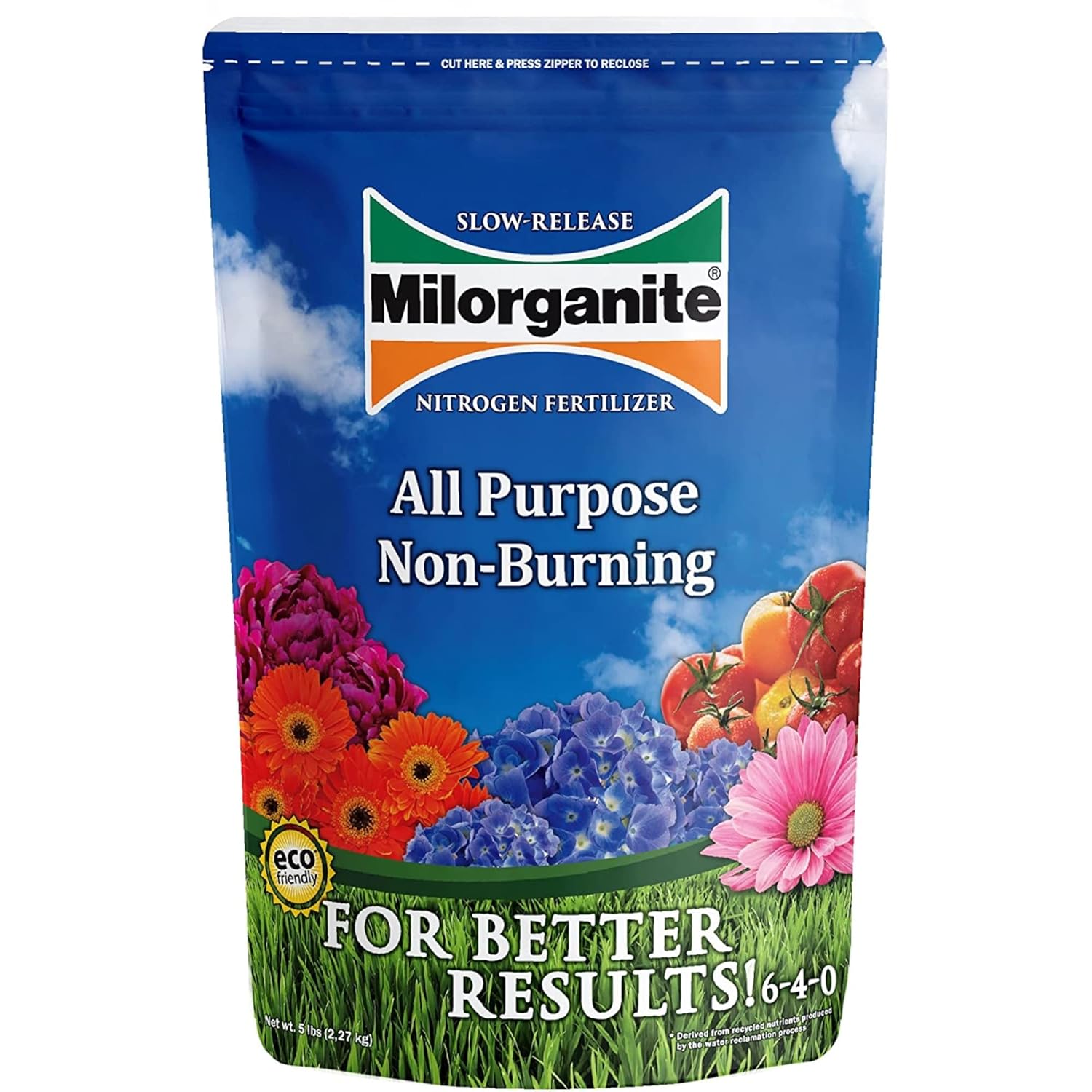
Milorganite All-Purpose Slow-Release Nitrogen Fertilizer, 5 lb
| Item Form | Granules |
|---|---|
| Specific Uses For Product | Lawns, Flowers and Gardens |
| Coverage | 390 Square Feet |
| Ingredients | Nitrogen |
Milorganite is an organic, slow-release granular fertilizer that supplies nitrogen and iron to lawns and garden plants without the burn risk of high-salt synthetics. It is typically broadcast over turf or worked lightly into soil around flowers, shrubs, vegetables, and trees and is intended to be applied on an 8–10 week schedule during the growing season. Notable features include a biosolid-based formula with high organic matter content and an earthy aroma that fades after watering. Practical benefits for a zoysia lawn include steady, long-lasting nitrogen release that supports deep roots and a steady green color without rapid flushes of growth, plus low salt content that reduces burn risk in hot weather. Limitations are that it acts slowly so it will not produce an immediate green-up and some pets may be attracted to the scent until the area is watered. Also a 5-pound bag covers a relatively small area, so larger yards will require multiple bags or a larger size.
Best for: Homeowners who prioritize steady, low-risk fertilization and improved soil health for warm-season grasses like zoysia and who prefer less frequent applications.
Less Ideal for: People who need a rapid, fast-acting green-up or who have large lawns and want to buy a single, high-coverage bag instead of multiple small bags.
- Slow-release nitrogen feeds for about 8–10 weeks, reducing frequency of applications
- Low salt formulation minimizes risk of burning grass in heat or drought
- Adds organic matter that can improve soil structure and microbial activity
- Contains organically complex iron to help deepen lawn color without staining concrete
- Slow action means it will not deliver a quick green-up for immediate visual results
- Five-pound bag covers about 390 sq ft, which is small for medium or large lawns
Verdict: Choose Milorganite for steady, low-salt, slow-release feeding that improves soil health and keeps zoysia lawns green with fewer applications.
GreenView Lawn Food 22-0-4, 16 lb Bag

| NPK | 22-0-4 |
|---|---|
| Form | Granules |
| Coverage | 5,000 sq. ft. |
| Application | Broadcast or drop spreader |
GreenView Lawn Food is a granular lawn fertilizer formulated to promote root development and extended feeding with a 22-0-4 NPK and MESA controlled-release nitrogen technology. It is applied with a broadcast or drop spreader to cover up to 5,000 sq. ft. and is intended for routine spring or fall feedings to encourage faster green-up, deeper roots, and improved drought tolerance. The controlled-release nitrogen reduces the chance of quick surge growth while providing steady nutrition for about eight weeks, which lowers the frequency of applications. The zero phosphate formula is appropriate for areas with phosphate restrictions and helps reduce runoff risk. Limitations include a single NPK ratio that is not a starter formula for new sod and the need for a spreader for even coverage; hand spreading is discouraged. For a budget-focused lawn program this bag covers a substantial area and simplifies seasonal feeding, but users with specialized nutrient needs or very small lawns may prefer a different product or size.
Best for: Homeowners who want an affordable, low-maintenance seasonal feed to improve turf color and root strength across a medium-sized lawn and prefer fewer applications per season.
Less Ideal for: People establishing new Zoysia from seed or sod who need a starter fertilizer or those with very small lawns who need smaller package sizes.
- Controlled-release MESA nitrogen provides steady feeding for up to eight weeks
- Covers up to 5,000 sq. ft. from one 16 lb bag, stretching value for money
- Zero phosphate formulation complies with most local restrictions and reduces runoff concerns
- Suitable for broadcast or drop spreaders for quick application over large areas
- Single NPK ratio (22-0-4) is not a starter fertilizer for new sod or seed
- Requires a spreader for proper, even application and does not recommend hand spreading
Verdict: A cost-effective, steady-release lawn food that covers a large area and reduces how often you need to fertilize.
Ferti-lome Slow Release Nitrogen Lawn Fertilizer 15-0-15 with Iron (2 Pack)

| Plant food formula | 15-0-15 |
|---|---|
| Item form | Granules |
| Included components | Lawn Fertilizer |
| Target species | Lawn Grass |
| Number of packs | 2 |
This two-pack of Ferti-lome 15-0-15 slow-release granular fertilizer is built for steady, low-maintenance feeding across larger yards. Each 16 lb bag is formulated to apply 16 lbs per 4,000 sq ft and delivers nitrogen slowly over time, which reduces the need for frequent reapplication and helps avoid quick growth surges that demand extra mowing. Added iron and micronutrients support deeper green color, making it a practical choice for color-conscious homeowners. It lists broad compatibility with common warm-season grasses including Zoysia, so it can be used in spring and fall to maintain turf health through the growing season. The main limitations are that coverage and application rates are fixed to the package guidance and the product is a single N-P-K ratio without phosphorus, so corrective feeding for soil-specific nutrient deficiencies will still require additional products or soil testing. For someone who wants a dependable base fertilizer to keep a Zoysia lawn consistently fed and green, this product simplifies routine applications.
Best for: Homeowners who prioritize a consistent, low-maintenance feeding program for their Zoysia or other warm-season lawns and want reliable, season-long color without frequent applications.
Less Ideal for: Users needing a customizable fertilizer plan based on soil test results or those managing small lawns that require very small, precise application amounts.
- Slow-release nitrogen provides steady feeding and reduces reapplication frequency
- Includes iron and micronutrients to improve lawn color
- Two-bag pack covers larger lawns or multiple applications
- Broad compatibility with warm-season grasses including Zoysia
- Contains no phosphorus so it will not correct phosphorus deficiencies
- Fixed N-P-K ratio limits flexibility for tailored soil nutrient plans
Verdict: A dependable slow-release 15-0-15 fertilizer pack that keeps Zoysia lawns consistently fed and greener with fewer reapplications.
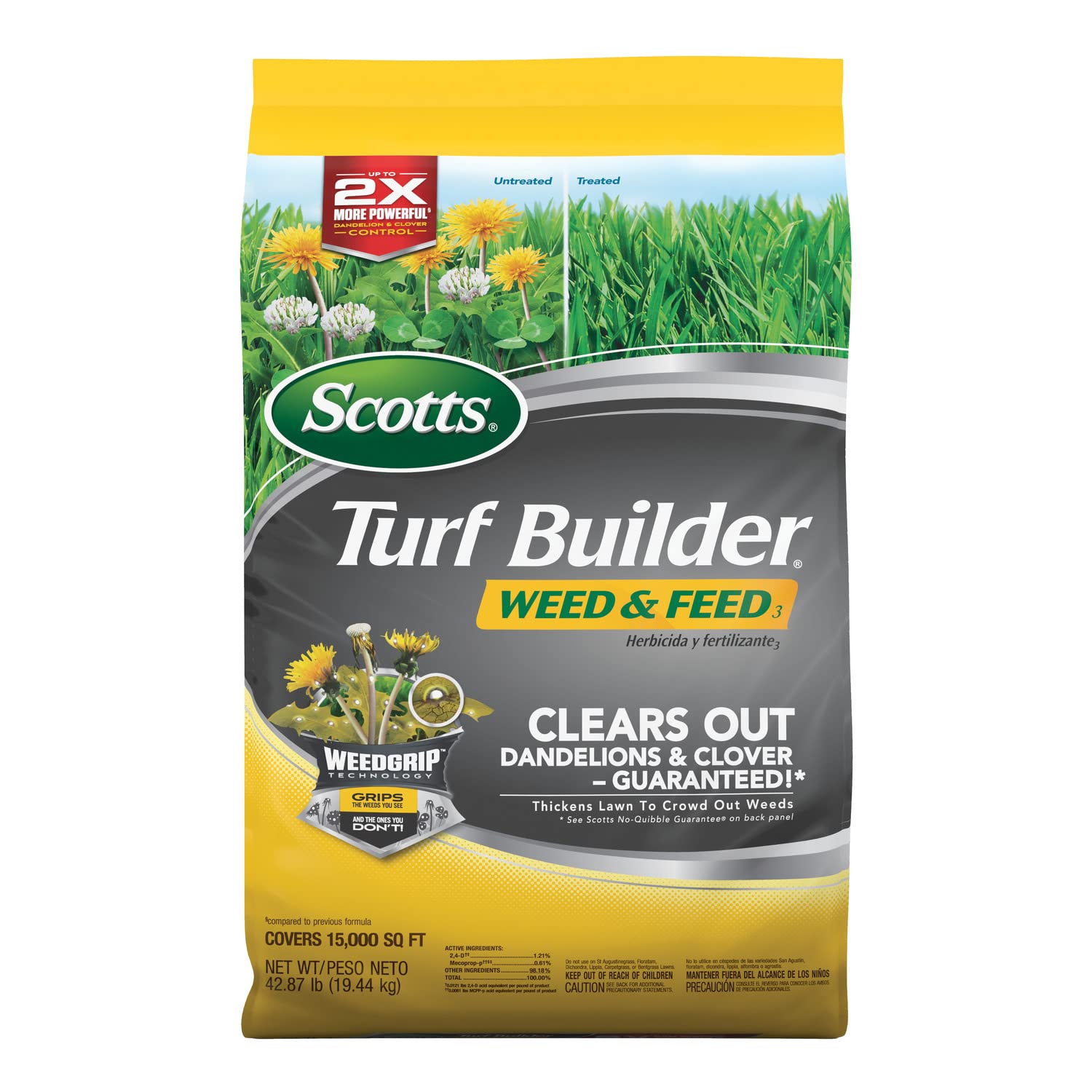
Scotts Turf Builder Weed & Feed (42.87 lb)
| Item Form | Granule |
|---|---|
| Coverage | 15000 square_feet |
| Active Ingredients | 24-D Mecoprop-p |
Scotts Turf Builder Weed & Feed is a large granular bag designed to combine weed control and fertilization in one late-spring application. It delivers fertilizer plus herbicide actives formulated to control common broadleaf weeds such as dandelion and clover while feeding grass to thicken turf. Typical use is on an actively growing lawn when daytime temperatures are between 60°F and 90°F and the turf is moist; Scotts recommends applying with a broadcast or drop spreader and not watering for 24 hours after application so granules stick to weed leaves. Practical benefits include broad weed coverage, a proven brand formula, and enough material to treat up to 15,000 sq. ft. in a single bag, which reduces repeat purchases for medium to large yards. Important limitations: the label prohibits use on St. Augustinegrass, Dichondra, Lippia, Carpetgrass, and Bentgrass and it is not formulated specifically for Zoysia, so results on Zoysia can vary and you should check compatibility before applying. Follow label directions carefully for timing, spreader settings, and safety around children and pets.
Best for: Homeowners who prioritize proven, convenient seasonal treatments and want a single product to reduce visible broadleaf weeds while feeding established lawns.
Less Ideal for: Do not choose this if you maintain Zoysia with a highly conservative or experimental approach without consulting the label or a turf specialist, or if you need a product explicitly formulated for Zoysia care.
- Combines weed control and lawn fertilizer in one application for convenience
- Covers up to 15,000 sq. ft. per bag, suitable for medium to large yards
- WeedGrip technology formulated to improve contact and control of broadleaf weeds
- Granular form works with common broadcast and drop spreaders for even application
- Label explicitly forbids use on several grass types and does not list Zoysia as a recommended turf
- Must be applied when weeds are actively growing and weather is dry for 24 hours, limiting scheduling flexibility
Verdict: A single large bag that combines broadleaf weed control with lawn feeding for treating up to 15,000 sq. ft., best for homeowners wanting a convenient seasonal weed-and-feed solution.
Scotts Turf Builder Lawn Food, 12.5 lb

| Item Form | Powder |
|---|---|
| Specific Uses For Product | Lawn |
| Coverage | 5,000 sq. ft. |
| Mixing Ratio | 32:0:4 |
Scotts Turf Builder Lawn Food is a straight-forward granular fertilizer for routine feeding of lawns. It is applied with a broadcast or drop spreader to wet or dry turf and one 12.5 lb bag covers about 5,000 sq ft. The formula feeds grass and is intended to thicken turf and promote stronger, deeper roots, which helps lawns tolerate heat and absorb water and nutrients better than unfed turf. Typical use is a quarterly feeding program or spot applications where a quick green-up and overall vigor are desired. The product is pesticide-free, so it focuses on nutrition rather than weed control. Practical benefits include easy application with recommended spreader settings printed on the bag, and the option to water in for faster results. Limitations for this specific article topic: the bag is a generic all-grass formula and does not list nutrient adjustments for Zoysia specifically, so those seeking a Zoysia-tailored NPK balance or integrated weed control may need complementary products or a specialized blend.
Best for: Homeowners who want a reliable, easy-to-use general lawn fertilizer to maintain and strengthen Zoysia turf without specialty blends or pesticides and who prioritize predictable, low-risk results.
Less Ideal for: Gardeners seeking a fertilizer formulated specifically for Zoysia nutrient needs or a product that combines feeding with herbicide action should consider a targeted or combination product instead.
- Designed to thicken and green lawns by feeding grass and building deeper roots
- Works on any grass type so it can be used on Zoysia without safety concerns
- Clear application guidance with spreader settings for easy, consistent coverage
- Pesticide-free formula focuses on nutrition and is suitable for regular feeding schedules
- Not formulated specifically for Zoysia so it may lack nutrient tuning some Zoysia experts prefer
- Does not include weed control, so additional products are needed where weeds are a concern
Verdict: A dependable, easy-to-apply lawn food that strengthens turf and is a safe, low-risk choice for maintaining Zoysia lawns.
Choosing the Right Zoysia Lawn Fertilizer: Key Factors to Consider
Nitrogen Release Profile
How nitrogen is delivered matters for zoysia because this warm-season grass benefits from steady, moderate feeding rather than quick spikes. Slow-release nitrogen supports gradual green-up, encourages deeper rooting, and reduces the risk of soft, succulent growth that increases disease and mowing. Read label language about coated granules, methylene urea, polymer-coated sulfur-coated urea, or other slow-release carriers to understand timing.
Fast-release soluble nitrogen can fix a yellow lawn quickly, but it also wears off fast and may require more frequent mowing and reapplication. For most home zoysia lawns, a fertilizer that supplies a significant portion of its nitrogen as slow-release will give better seasonal performance and lower maintenance.
NPK Balance For Zoysia
Zoysia typically thrives on a fertilizer with moderate nitrogen, adequate potassium, and balanced phosphorus depending on soil test results. Nitrogen drives leaf color and density, while potassium improves stress tolerance and recovery from heat and drought. Phosphorus should be included only if soil tests show a deficiency because excess phosphorus can harm waterways and is unnecessary in established turf.
Choosing the right NPK ratio affects mowing frequency, root development, and seasonal hardiness. Look for formulations that emphasize nitrogen for active growth periods and elevated potassium for late-season applications to harden the turf before dormancy.
Micronutrient Content
Micronutrients like iron, manganese, and zinc influence color and metabolic health in zoysia. Iron often improves deep green without stimulating rapid top growth and is useful when soils tie up nutrients. Manganese supports enzyme systems that are important in warm-season grasses.
Products that include bioavailable micronutrients can correct subtle chlorosis and enhance color without excessive nitrogen. However, micronutrient needs depend on soil pH and existing soil fertility, so these ingredients are most valuable when matched to a soil test or observed deficiency.
Soil Compatibility and pH
Soil texture, organic matter, and pH change how fertilizers behave. Sandy soils leach soluble nutrients quickly and benefit from more slow-release nitrogen and potassium to maintain steady feeding. Heavy clay soils retain nutrients but can bind certain micronutrients at high pH.
Understanding your soil helps you choose formulations that release nutrients at the right rate and include amendments to avoid lockup. If pH is outside the ideal range, addressing that first will improve fertilizer efficiency and grass response.
Application Timing and Flexibility
Zoysia has active growth in late spring and summer, then slows in cooler months. A good fertilizer plan matches that cycle: feeding as growth ramps up and using potassium-rich applications late in the season. Products that allow split applications or label guidance for multiple timings give you more control over growth and turf health.
Also consider spreader calibration and product granule size. A fertilizer that spreads evenly at common homeowner settings reduces the risk of streaking and burn. Compatibility with typical push and broadcast spreaders increases practical usability.
Environmental Impact and Runoff Risk
Fertilizer applied to lawns can run off into storm drains and waterways if not managed correctly. Slow-release formulations reduce soluble nutrient pulses and lower short-term runoff risk. Products designed to minimize salt index and with clear application rates reduce the chance of over-application.
Choose products with label instructions for buffer distances to water bodies and avoid applying before heavy rain. Considering environmental impact also means matching application rate to lawn needs using a soil test rather than defaulting to higher feeding rates.
When to Fertilize Zoysia
Timing depends on your local climate and when zoysia breaks dormancy. Start applications after the grass is actively growing and soil temperatures consistently rise in spring. Avoid early applications while the turf is still recovering from winter dormancy.
Split your seasonal nitrogen into two or three applications spaced through the active growth window rather than one heavy feeding. Reserve a late-summer or early-fall potassium-focused application to improve stress tolerance ahead of cooler weather.
- Begin feeding when soil temps are regularly above 60°F
- Use lighter, repeated feedings to avoid rapid top growth
- Do a final potassium-rich application several weeks before dormancy
How to Apply Fertilizer Safely
Calibrate your spreader and follow label rates to avoid over-application. Apply at recommended rates per 1,000 square feet and overlap pass lines slightly to ensure even coverage. Sweep fertilizer off hard surfaces promptly to prevent runoff into drains.
Water in according to label recommendations. Many slow-release products need light irrigation to activate but do not require heavy immediate watering. Avoid applying before heavy rainfall to reduce nutrient loss.
- Calibrate spreader for the specific granule size
- Avoid applying on slopes without irrigation management
- Store fertilizer in a dry, secure place away from pets and children
Using Soil Tests to Guide Feeding
A soil test is the most reliable way to match fertilizer to what your zoysia actually needs. Tests show current pH, phosphorus, potassium, and other nutrients so you can prioritize amendments. Testing prevents unnecessary phosphorus use and helps set appropriate nitrogen rates.
Most extension services provide clear interpretation for turf. Use test results to select a product with the right NPK and micronutrient package, and adjust application timing to correct deficiencies without overfeeding.
- Test every two to three years or when symptoms appear
- Adjust pH first if it is outside the optimum range for nutrient availability
- Match fertilizer potassium to test results to improve stress tolerance
Managing Fertilizer in Shade and Drought
Zoysia tolerates moderate shade but reduced sunlight decreases nutrient needs. In shady areas, reduce nitrogen rates to avoid weak, leggy growth. Focus on soil health and light management rather than trying to force dense turf with high feeding.
During drought, hold off on heavy nitrogen applications that encourage top growth. Use potassium-rich or low-nitrogen products to support stress tolerance, and consider light, infrequent applications when the turf is under prolonged water stress.
- Lower nitrogen in dense shade to prevent thin, weak growth
- Prioritize potassium when drought stress is likely
- Integrate cultural fixes like selective pruning to increase light
Granule Types and Spreader Settings
Granule size and coating affect how evenly a product distributes and how it releases nutrients. Polymer-coated granules release more predictably over time, while sulfur-coated or other organic carriers have different release curves. Match granule size to your spreader setting and check the label for recommended calibration.
If you see streaks or uneven greening after application, reduce spreader speed or adjust pattern and reapply at reduced rates to correct coverage. Even application saves fertilizer, reduces the risk of localized burn, and produces a more uniform lawn appearance.
- Follow label spreader settings for the specific granule size
- Test on a small area when using a new product to confirm spread pattern
- Use overlapping passes and consistent walking speed for uniform coverage
How We Chose the Best Zoysia Lawn Fertilizer
We focused on specifications and gardener-relevant performance instead of marketing claims. Key evaluation criteria included nutrient formulation tailored for warm-season turf, with emphasis on the nitrogen source and the presence of potassium for stress tolerance; release profile distinguishing true slow-release carriers from fast-release salts; micronutrient content that supports color and root function without overfeeding; and compatibility with common soil types and local water regimes. Application flexibility and clear label instructions were also weighted so homeowners can match product to spreader and turf area. We gave extra consideration to products that support steady growth to limit mowing and reduce thatch build-up. Products were excluded if labels lacked clear guaranteed analysis, if the release mechanism was unspecified, or if the formulation was primarily for cool-season grasses. We also filtered out mixes that relied solely on high soluble nitrogen spikes rather than blended or coated slow-release sources. The outcome is a selection of fertilizers that suit the biological rhythms of zoysia while addressing real-yard constraints like drought, shade, and mowing frequency.
FAQ
How often should I fertilize zoysia lawn during the growing season?
Most zoysia lawns perform well with two to three feedings during active growth, spaced several weeks apart. Frequency depends on the fertilizer release profile and soil fertility, so slow-release formulas may reduce how often you need to apply.
Can I use a regular lawn fertilizer on zoysia?
You can use general-purpose lawn fertilizers, but choose one with an appropriate release profile and NPK balance for warm-season turf. Avoid high-soluble-nitrogen mixes intended for rapid green-up if you want steady growth and lower maintenance.
Is iron necessary for a good zoysia color?
Iron can deepen green color without excessive top growth and is helpful if soil is high pH or shows iron deficiency. It is not always necessary if overall fertility is balanced, so use iron when tests or visual symptoms indicate a need.
What should I do if my lawn shows uneven greening after application?
Uneven greening often comes from poor spreader calibration or application on wet or windy days. Lightly water according to label directions and correct spreader settings before the next pass. If streaks persist, consider reapplying at a reduced rate to even out coverage.
Can I fertilize zoysia during drought conditions?
Avoid heavy nitrogen applications during drought because they promote tender growth that the grass cannot support. If you must fertilize, use low-nitrogen or potassium-focused products and apply only when the turf is at least minimally active and able to receive light irrigation.
Final Verdict
Focus on matching fertilizer type and timing to the growth rhythm of zoysia. Prioritize slow-release nitrogen, adequate potassium for stress resilience, and micronutrients guided by a soil test. Consider your soil texture and shade conditions to fine-tune rates and reduce maintenance. Choosing a fertilizer that fits your lawn goals and local conditions makes the biggest difference. Lean toward steady-release formulations and clear application instructions so you can get reliable green-up with fewer passes and less environmental risk.
