

Note: This article contains affiliate links. If you click on these links and make a purchase, I may earn a small commission at no extra cost to you. This helps support my research and content. Read my full affiliate disclosure here.
Picking the right LED grow light under $400 matters because lighting shapes plant growth, flowering, and energy use in indoor spaces. You want enough usable light for your canopy without overheating small tents, balconies, or compact grow shelves. This guide covers seven shortlisted LED options that fit the sub-$400 budget and examines how they perform across spectrum balance, usable intensity, and thermal behavior. Below you will find practical evaluation criteria and clear explanations to help you match a light to your grow space and plants. Read on for the factors we weighed and what to consider before you buy.
Top Picks at a Glance
| Best Overall The best all-around choice for most situations | Spider Farmer SF1000D 100W Dimmable Full-Spectrum LED Grow Light |  |
| Best Quality Built to a higher standard if you want something more solid | VIVOSUN LumaLight 200W Full Spectrum Dimmable LED Grow Light |  |
| Best Value The sweet spot between price and what you get | Spider Farmer SF1000 100W Full Spectrum LED Grow Light |  |
| Best Budget The cheapest option that still gets the job done reliably | LEOTER 4-Head LED Grow Light with Full Spectrum, Timer and 10-Level Dimming |  |
| Highest Rated A top-rated pick with lots of positive feedback | Spider Farmer G4500 LED Grow Light 320W (App‑Controlled, Dimmable) |  |
| Most Popular A crowd favorite that many people choose with confidence | GooingTop HY-021 6000K Full-Spectrum Clip Grow Light |  |
| Best Seller A high-volume bestseller chosen again and again | Barrina T5 1 ft LED Grow Light, 5000K Full Spectrum (4-pack) |  |
Spider Farmer SF1000D 100W Dimmable Full-Spectrum LED Grow Light

| Light Source Wattage | 100 watts |
|---|---|
| Light Source Type | Light Emitting Diode |
| Light Source Special Features | Samsung LM301B diodes, full spectrum, no-fan design |
| Number of Light Sources | 600 |
| Input Voltage | AC110-130V |
The Spider Farmer SF1000D is a compact, 100W full-spectrum LED built for small grow spaces such as 2×2 tents. It uses high-density Samsung/Bridgelux-type diodes arranged across a waterproof board and an aluminum heat sink to deliver even canopy coverage with low noise because it has a no-fan design. Typical use is ceiling- or hook-mounted over a 2×2 to 3×3 area for seed starting, vegetative growth, and flowering; the manufacturer lists a veg footprint around 3×3 and a flowering footprint of 2×2. The dimmable driver makes it easy to dial light intensity for different growth stages, and the low 100W draw offers better energy efficiency than comparable HID fixtures, with less heat to manage. Practical benefits include quiet operation, solid build materials, and protective cable covers for safer tent installations. Limitations are the modest output for larger or commercial setups and the fixed coverage pattern that may require raising or adding fixtures for denser canopies.
Best for: Growers who want a quiet, energy-efficient light for a single 2×2 tent and who value straightforward, adjustable performance across all plant stages.
Less Ideal for: Commercial growers or hobbyists running multiple tents or large canopies who need higher total output or advanced control features.
- Full spectrum with blue, 3000K, 5000K, deep red (660-665nm) and IR suitable for all growth stages
- Dimmable 100W driver for adjustable intensity across veg and flower phases
- No-fan design with large aluminum heat sink provides quiet operation and passive cooling
- Waterproof LED board and protective cable covers improve safety inside tents
- 100W total output is ideal for 2×2 tents but may be insufficient for larger or heavily canopied grows
- No integrated controller or app features for scheduling or advanced automation
Verdict: A quiet, energy-efficient 100W full-spectrum LED that gives balanced, adjustable light for a single 2×2 tent setup.
VIVOSUN LumaLight 200W Full Spectrum Dimmable LED Grow Light

| Wattage | 200 watts |
|---|---|
| Light Source Type | LED |
| Dimmable | Yes, 25%–100% via knob |
| Mounting Type | Ceiling Mount |
| IP Rating | IP65 |
The VIVOSUN LumaLight 200W is a performance-focused LED grow light engineered to push vegetable growth from seedling through harvest. It combines a full spectrum (white, blue, red, and far-red) with 672 diodes arranged to produce a high and even PPFD across the canopy, which helps reduce edge-to-center variation and encourages consistent leaf and fruit development. Use it mounted over a single grow bench or small tent where you need concentrated output; the four-level dimming knob (25 to 100 percent) and compatibility with VIVOSUN GrowHub let you tune intensity and schedules to crop stage. Thermal management keeps surface temperatures lower than many HID options, and IP65 protection means it tolerates humid conditions and light washdowns common in vegetable grows. Practical limits are its coverage: at 200 watts it is best for 2×2 to 3×3 spaces rather than large multi-plant rooms, and advanced growers who need fully tunable spectrums or integrated fans may prefer higher-end fixtures. For focused, reliable vegetable production in modest indoor spaces, it delivers strong, usable light with smart control options.
Best for: Growers seeking reliable, high-intensity light to maximize vegetable yields in a 2×2 to 3×3 indoor setup who prioritize steady performance and simple intensity control.
Less Ideal for: Large-scale hobbyists or commercial growers who need broad coverage or fully tunable spectrum controls should consider higher-wattage or more advanced fixtures.
- Full spectrum LEDs including far-red to support all growth stages and flowering
- High diode count and strategic layout for uniform PPFD across the canopy
- Dimmable 25%–100% with local knob and GrowHub compatibility for scheduling
- IP65 rated for resistance to humidity and light washdowns
- 200W output is optimized for small tents or single benches rather than large rooms
- No built-in fan or advanced spectrum tuning compared with premium tunable fixtures
Verdict: A compact, high-intensity full-spectrum LED that gives vegetable growers tunable, uniform light for small indoor gardens to improve yields.
Spider Farmer SF1000 100W Full Spectrum LED Grow Light

| Light Source Type | LED |
|---|---|
| Light Output Maximum | 10000 lumens |
| Light Source Wattage | 100 watts |
| Light Source Special Features | Dimmable |
| Specification Met | IP67 |
The Spider Farmer SF1000 is a compact 100W full spectrum LED grow light intended for 2×2 to 3×3 grow spaces and small tents. It uses a high diode count and upgraded LED chips to deliver broad-spectrum output that supports seedlings through flowering, with a dimmer knob to reduce intensity for early stages and ramp up for bloom. The fanless design and thick aluminum heatsink keep operation quiet while providing passive cooling, and the fixture meets IP67 for durable performance. Typical use is ceiling or tent mounting above individual plants or a small canopy where uniform coverage and deeper canopy penetration matter. Notable features include daisy-chain compatibility for linking multiple units under unified dimming, a 0–100% dimmable control, and a driver claimed to offer efficient power delivery. Practical benefits are even light distribution in a small footprint, predictable veg-to-flower capability, and near-silent operation. Limitations are inherent to its class: it is sized for small areas so you will need multiple units for larger tents, and the product description emphasizes specs from manufacturer tests rather than independent third-party PPFD maps.
Best for: Growers who want a quiet, compact full spectrum light for a small tent or single-plant setup and value adjustable intensity for each growth stage.
Less Ideal for: People running larger multi-plant rooms or commercial operations who need higher total output and broader single-fixture coverage.
- Full spectrum output suitable for all growth stages with added red and IR for flowering
- Dimmable 0–100% control lets you tailor light intensity to seedlings, veg, and bloom
- Fanless design with sturdy aluminum heatsink for quiet, low-maintenance operation
- Compact footprint ideal for 2×2 to 3×3 tents and small indoor setups
- Daisy-chain capable so multiple fixtures can be linked and dimmed together
- Coverage and power are intended for small grows so larger areas require multiple units
- Manufacturer gives efficiency and coverage figures without independent third-party PPFD charts
Verdict: A quiet, dimmable 100W full spectrum fixture that is a practical, balanced choice for hobbyists running 2×2 to 3×3 tents.
LEOTER 4-Head LED Grow Light with Full Spectrum, Timer and 10-Level Dimming

| Light Source Type | LED |
|---|---|
| Number of Light Sources | 80 |
| Wattage | 80 watts |
| Control Method | Remote |
| Mounting Type | Clip On |
The LEOTER 4-head grow light is a USB-powered, clip-on lamp built for indoor plant care that combines full-spectrum and targeted red/blue diodes to support seedlings, vegetative growth and flowering. It uses 80 LEDs arranged across four adjustable heads on flexible goosenecks so you can position light over individual large plants or groupings. Notable features are three spectral modes (red+blue, warm/full spectrum, and combined), a circular memory timer with 3/9/12-hour presets, and ten brightness levels for fine control over intensity. The strong metal clip and flexible necks make it simple to aim light at tall foliage without permanent installation. Practical benefits include reduced need for supplemental natural light, convenient daily scheduling for busy users, and a compact footprint that suits shelves or plant stands. Important limitations are that the unit is described as a clip/desk lamp rather than a wide-panel fixture, so coverage for very large single specimens may require placing heads close to foliage or using multiple units, and the timer resets if unplugged so it needs occasional reprogramming after power loss.
Best for: Buyers who want a controllable, space-efficient grow light to supplement indoor sun for larger houseplants and prefer a proven, feature-rich unit with preset timers and adjustable heads.
Less Ideal for: Growers who need single-fixture coverage for floor-to-ceiling specimens or large multi-plant setups should consider full-size panel fixtures or multiple units instead.
- Full spectrum plus red and blue LEDs (80 total) to support all growth stages
- Ten dimming levels for precise intensity control
- Three timer presets with memory function for hands-off daily scheduling
- Adjustable 4-head design and flexible goosenecks for targeted placement
- Strong metal clip allows mounting on shelves, desks, or plant stands
- Designed as a clip-on lamp so single-unit coverage is limited for very large plants
- Timer settings must be reset after the light is unplugged
Verdict: A versatile, adjustable clip-on grow light that gives busy indoor gardeners precise control over spectrum, intensity and scheduling to boost large plant growth in compact spaces.
Spider Farmer G4500 LED Grow Light 320W (App‑Controlled, Dimmable)

| Light Source Type | LED |
|---|---|
| Wattage | 320 watts |
| Light Source Special Features | Dimmable, App-Controlled, Daisy-Chain Function |
| Power Source | Corded Electric |
The Spider Farmer G4500 is a high-efficiency LED grow light built for full-cycle indoor growing in small commercial or serious hobby setups. It delivers 320 watts using high-density Bridgelux diodes and a long bar design that spreads light more evenly across the canopy, making it suited to 2×4 and up to 3×5 coverage areas. The fixture is dimmable from 10 to 100 percent, supports daisy-chaining up to 50 units for synchronized control, and connects to the Spider Farmer app for scheduling and remote brightness adjustments. Practical benefits include strong PPE (listed at 2.85 umol/J in the G series data), low heat output from efficient diodes, and an aluminum housing that helps with passive cooling. The light is aimed at growers who prioritize uniform penetration and programmable control rather than novelty extras. Limitations are typical of high-output fixtures: you will need appropriate ventilation and mounting height to avoid light stress, and the elongated bar requires enough horizontal space in the tent or room. Assembly is not required but plan for cable management and app setup time.
Best for: Growers who want strong, uniform light and programmable control for full-cycle performance in a 2×4 to 3×5 tent or small grow room and who prioritize output and efficiency over minimal footprint.
Less Ideal for: Casual plant owners with a single small shelf or tabletop setup who need a compact, low-intensity lamp rather than a high-output grow fixture.
- High-efficiency Bridgelux diodes with reported PPE of 2.85 umol/J for strong light output per watt
- Elongated bar design for more uniform edge-to-edge canopy coverage over 2×4 to 3×5 areas
- Dimmable 10–100% plus daisy-chain support for synchronized control of multiple units
- App control with scheduling, remote dimming, and sunrise/sunset simulation for hands-off management
- Aluminum housing that helps dissipate heat and supports continuous operation
- Requires adequate ventilation and mounting height to manage intensity and heat in small enclosures
- Large footprint compared with compact panels, so it needs enough horizontal space in the grow area
Verdict: Buy this if you need a high-efficiency, app-controlled LED that delivers uniform, high-output coverage for performance-focused 2×4 to 3×5 indoor grows.
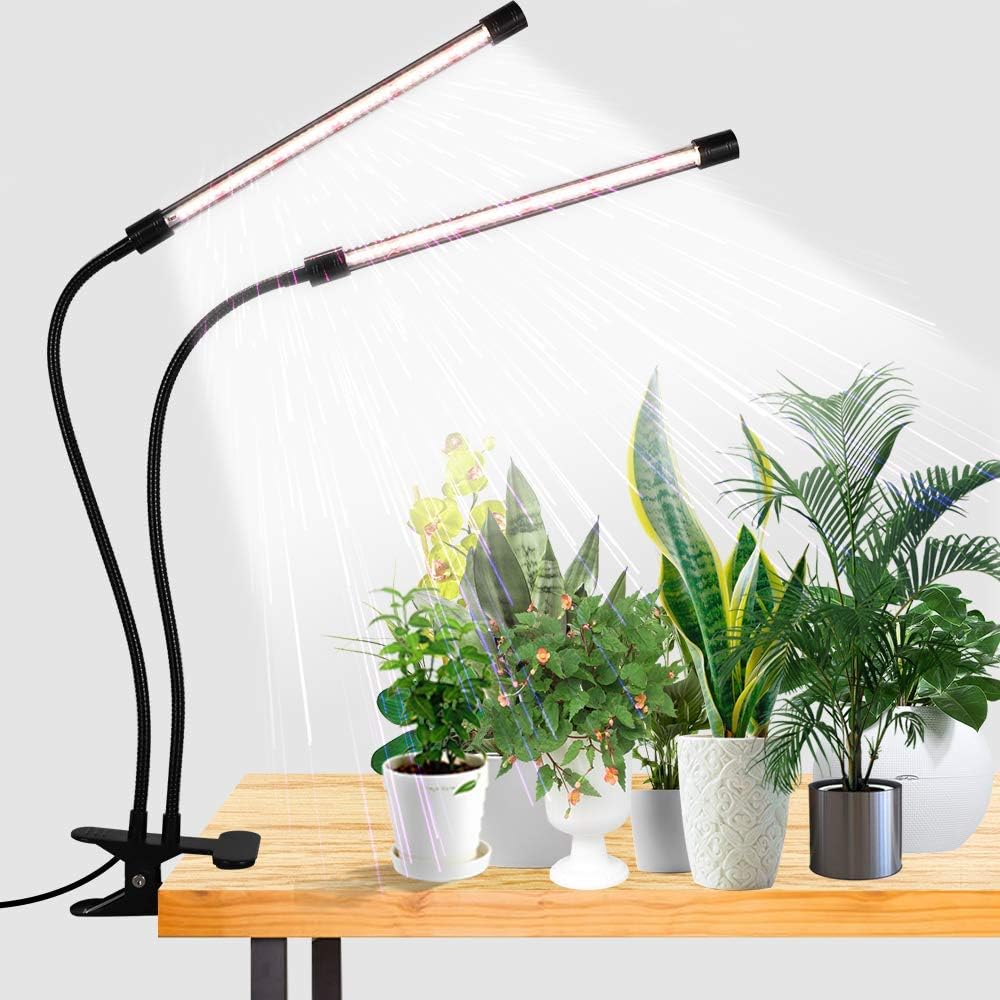
GooingTop HY-021 6000K Full-Spectrum Clip Grow Light
| Power Source | Corded Electric |
|---|---|
| Color Temperature | 6000 Kelvin |
| Light Output Maximum | 2500 lumens |
| Light Source Special Features | Dimmable |
| Number of Light Sources | 84 |
This GooingTop HY-021 is a compact clip-on grow light built for small houseplants, seedlings and shelf gardens. It uses 84 LEDs (white plus deep red) to deliver a 6000K full-spectrum output intended to mimic midday sun, with a high color-rendering output that also makes it pleasant as a reading lamp. Two flexible gooseneck heads and a strong clamp let you aim light precisely over pots and seed trays, while the attached remote provides 50%/100% dim levels and repeating timers at 4, 8 or 12 hours for hands-off scheduling. Practical benefits include low power draw (listed as roughly 10 W LED draw), a claimed 1 to 2 square meter coverage for seedlings, and an included timer that simplifies day/night cycles. Limitations are its design for small setups rather than large grow racks and the clip mounting limits placement compared with freestanding fixtures. The unit also relies on the corded remote instead of a smartphone app and the lifespan claim is typical of LEDs but not independently verifiable from the listing.
Best for: Buyers who want a simple, low-power, plug-and-play grow light to boost seedlings and a few houseplants on a desk or shelf and who value an easy-to-use timer and adjustable brightness.
Less Ideal for: Growers planning multi-shelf installations, larger vegetable grows, or who need networked or app-based control should consider larger bar lights or fixtures designed for commercial racks.
- Full-spectrum 6000K output with added 660 nm red LEDs to support vegetative growth and flowering
- Attached remote with dimming (50%/100%) and repeat timer settings (4/8/12 hours) for easy scheduling
- Flexible dual goosenecks and strong clamp enable precise positioning over small pots and seed trays
- High reported color rendering for comfortable viewing and accurate plant color assessment
- Low electrical draw around 10 W while covering small growing areas
- Clip-mount design and stated 1–2 m² coverage make it better suited to individual plants or small trays rather than large multi-shelf setups
- No smart app or wireless control option; remote is cord-attached which limits placement flexibility
Verdict: A compact, easy-to-use clip grow light that delivers full-spectrum light and convenient timer/dim controls for small indoor plant setups.
Barrina T5 1 ft LED Grow Light, 5000K Full Spectrum (4-pack)

| Wattage | 5W per fixture |
|---|---|
| Color temperature | 5000K Full Spectrum |
| Linkable | Link up to 16 lights |
| Control | Separate on/off switch per fixture |
| Included accessories | Power cords, connecting cords, clips, double-sided tape |
The Barrina T5 1 ft LED grow light kit supplies full-spectrum 5000K light in a compact, linkable T5 form that is useful for starting and growing tomato seedlings under artificial light. Each 1 ft fixture draws 5W and has its own on/off switch so you can run a single tube or multiple fixtures to match light needs. The set includes power cords, connecting cords, clips, double-sided tape and cable ties for quick plug-and-play installation and you can chain up to 16 lights in series to light multiple trays or shelf levels. Practical benefits for seedlings are even, high-PPFD output from an efficient LED array and the ability to tailor coverage by switching fixtures on or off. Limitations are that the small 1 ft form gives narrow coverage per tube so larger seed flats or full-width racks will need many fixtures, and the product is non-magnetic so mounting options depend on the included clips or your own hardware. Overall this kit is a straightforward, budget-friendly choice for growers who want controllable, linkable light for early-stage tomato plants.
Best for: Growers who want a compact, energy-efficient, controllable lighting solution for starting and growing tomato seedlings on shelves or seed trays.
Less Ideal for: People needing single wide-coverage fixtures for large benches or commercial-scale propagation should consider longer tubes or high-output panels instead.
- Full-spectrum 5000K output suitable for seedlings and vegetative growth
- Separately controllable fixtures let you run only the number of tubes needed
- Linkable design supports chaining up to 16 lights for multi-shelf setups
- Includes mounting clips, power and connecting cords for quick plug-and-play setup
- Small 1 ft length provides limited coverage per fixture so more units are needed for larger trays
Verdict: A compact, linkable full-spectrum T5 kit that gives efficient, controllable light ideal for raising healthy tomato seedlings on shelves and seed trays.
Choosing the Right LED Grow Light: Key Factors to Consider
Coverage Area and Canopy Size
Coverage determines how many plants a fixture can light effectively. Measure your canopy footprint and match it to the manufacturer's useful coverage numbers at realistic hanging heights. Small tents and single-rack grows need focused light with higher PPFD at short hang distances, while wider setups benefit from even spread.
Ignoring coverage can lead to hot spots and underlit edges. Consider whether you will cluster fixtures, use reflective walls, or run a single larger fixture. Coverage affects how many lights you need to hit target intensities without wasting energy.
Light Intensity and PPFD Distribution
Specification sheets often list total output in micromoles per second, but PPFD maps show how much usable light reaches the canopy. Look for fixture data at common hang distances and pay attention to center-to-edge dropoff. Plants respond to light where it lands, so peak numbers mean little if the canopy edges are starved.
Also think about the crop stage. Seedlings and clones need much lower PPFD than heavy-flowering plants. Choose a light that can be raised or dimmed to provide a range of intensities for both veg and bloom cycles.
Light Spectrum and Crop Needs
Spectral distribution affects morphology, leaf development, and flower formation. Full-spectrum fixtures that combine varieties of diodes or include white LEDs give an even balance of blue for compact vegetative growth and red for flowering response. Additional far-red or UV channels can influence stretch and resin production but are not essential for all growers.
Consider whether the fixture allows spectral tuning or fixed output. Tuning lets you emphasize veg or bloom spectra without changing fixtures, which can be helpful if you grow mixed crops or like to fine-tune plant response.
Thermal Performance and Longevity
LEDs run cooler than many alternatives, but heat still affects diode lifespan and room temperature. Good thermal design either uses passive heat sinks with large surface area or active cooling with quiet, durable fans. For enclosed tents, lower fixture heat reduces ventilation needs and protects canopy temperature-sensitive crops.
Check for temperature ratings, whether drivers are external or integrated, and serviceability. Poor heat management can cause premature lumen depreciation and uneven light output over time.
Energy Use and Electrical Considerations
Energy efficiency determines running cost and cooling demands. Compare input wattage to delivered PPFD to gauge how effectively a fixture converts electricity into usable plant light. Also verify voltage compatibility, cable length, and whether the fixture supports dimmers or digital controllers.
Overlooking electrical details can create installation headaches or underpowered circuits. Calculate expected run hours and factor efficiency into long-term cost of operating your indoor garden.
Mounting Options and Physical Fit
How a light mounts and its physical dimensions affect where it can be used. Look for adjustable hang points, included ratchets or D-rings, and low-profile options for shallow cabinets. Some designs allow daisy-chaining multiple fixtures which simplifies wiring in larger setups.
Consider access for maintenance, whether the fixture obstructs shelving, and how easy it is to reposition. A physically awkward light can complicate watering, pruning, and harvesting.
Matching Lights to Grow Space
Start by mapping the footprint of your grow area and deciding target intensities for the crops you plan to grow. Vegetative growth needs a fraction of the light that heavy-flowering plants require. Use PPFD targets appropriate to your plants and choose a fixture that can reach those numbers at a practical hanging height.
If you are fitting lights into tents or shelves, prioritize a uniform spread and manageable heat. For table-top or small-closet grows, low-profile panels and adjustable hangers make installation easier and reduce light loss from improper angles.
- Measure canopy area and desired PPFD for crop stage.
- Look at PPFD maps rather than peak output alone.
- Prefer multiple smaller fixtures over one oversized lamp for even coverage when possible.
Practical Setup Tips for Small Budgets
When working under a fixed budget, prioritize fixtures that balance PPFD and spectrum rather than chasing the highest claimed wattage. Cheaper units can be effective if they provide usable light where the plants need it and include decent thermal design.
Consider used or refurbished units with verified output data if they meet safety and spec requirements. Always plan for adequate ventilation and simple hanging hardware to avoid unnecessary DIY modifications that can compromise safety.
- Budget for ventilation or an inline fan if your fixture generates heat.
- Choose dimmable fixtures to extend utility across plant stages.
- Verify electrical compatibility before installation.
Controlling Heat and Humidity in Small Indoor Gardens
Heat from grow lights affects canopy microclimate and influences transpiration and disease pressure. Keep fixtures high enough to avoid scorching but close enough to provide required PPFD. Use fans and passive airflow to move air across leaf surfaces and the fixture's heat sink.
For humid environments, favor fixtures with sealed or corrosion-resistant components. Regularly monitor canopy temperature and humidity during peak light hours and adjust ventilation or fixture distance accordingly.
- Measure canopy temperature in addition to air temperature.
- Use oscillating fans to prevent stagnant pockets of moist air.
- Check manufacturer guidance on safe hang distances to avoid heat stress.
Installation and Maintenance Best Practices
Mount fixtures securely with rated hardware and route cables away from irrigation points. Clean lenses and heat sinks periodically to maintain light transmission and thermal performance. If a unit uses fans, clean or replace filters to preserve airflow.
Keep an eye on lumen depreciation and any color shifts. Gradual drop in output is normal, but sudden changes in spectrum or fan noise can indicate failing components that need attention or replacement.
- Use waterproof cable connections in humid spaces.
- Schedule monthly quick inspections of fans and wiring.
- Record fixture height and PPFD readings so you can reproduce successful setups.
Scaling and Combining Fixtures
As your garden grows, you may combine multiple fixtures to expand coverage. Matching color temperature and spectral balance across units helps keep plant response consistent. When daisy-chaining, ensure circuit capacity and that cables and connectors are rated for continuous load.
Staggered mounting heights and slight overlap reduce edge losses. For mixed-stage crops, place adjustable fixtures over younger plants so you can raise intensity as they develop.
- Plan electrical layout before adding more fixtures.
- Mix fixtures only when spectra are similar or dimmable.
- Overlap coverage slightly to avoid underlit edges.
How We Chose the Best LED Grow Light
We focused on LED fixtures that deliver usable light for common indoor garden sizes while staying under the specified price cap. Selection emphasized measurable lighting attributes gardeners can verify in product specs and real use. Key evaluation criteria included spectral balance for vegetative and bloom stages, usable photosynthetic photon flux density (PPFD) across a realistic canopy, thermal management and fan or passive cooling design, build durability for humid indoor environments, energy efficiency and input wattage, and mounting or coverage flexibility for different grow setups. We excluded miniature hobby lamps that only serve seedlings and very large commercial fixtures that exceed the budget. We also filtered out units lacking clear light output data or those with poor thermal design that could shorten LED lifespan. The resulting shortlist balances practical performance, garden fit, and long-term durability for home growers working within the under $400 constraint.
FAQ
How high should I hang an LED grow light above canopy?
Height depends on the fixture's output and crop stage. Low-intensity panels might hang 12 to 24 inches above seedlings, while high-output units require greater distance to avoid light stress. Check PPFD maps and start higher, lowering gradually while monitoring plant response.
Can one LED fixture cover both veg and bloom stages?
Often yes. Full-spectrum or tunable LEDs can support both stages if they provide sufficient PPFD for bloom. Dimmable controls or adjustable hang height let you reduce intensity for seedlings and increase it for flowering plants.
Does a higher wattage mean better plant growth?
Not necessarily. Input wattage is only part of the story. What matters is usable light at the canopy measured as PPFD and the spectrum delivered. A more efficient fixture can out-perform a higher-wattage unit with poor optics or spectrum.
How important is a fan in LED grow lights?
Fans help with active cooling and can extend component life, but they add noise and require maintenance. Passive-cooled fixtures with large heat sinks can be quieter and durable if designed well. Choose based on your space and tolerance for fan noise and upkeep.
Are white LEDs better than full-spectrum diodes?
White LEDs offer a natural-looking spectrum and good coverage for general growth, while mixed diode arrays can provide targeted peaks for specific responses. Both can be effective; selection depends on whether you want tunability or a broad, visually accurate light for plant inspection.
How do I know if a listed light will actually fit my tent or shelf?
Compare the fixture dimensions, recommended hanging clearance, and available mounting points to your grow space. Also check cable length and whether the driver is external, as that affects placement within confined setups.
Final Verdict
Choosing an LED grow light under $400 means balancing usable light intensity, spectral needs, and thermal behavior against the physical limits of your grow space. Prioritize fixtures that show clear PPFD data, offer a usable spectrum for both veg and bloom, and manage heat without excessive noise or maintenance. Make tradeoffs based on your canopy size and crop goals. For compact setups, aim for even coverage and modest heat output. For heavier flowering, choose higher usable PPFD and ensure ventilation capacity. With those priorities in mind, you can confidently select a unit that fits the budget and supports reliable indoor growth.
