

Note: This article contains affiliate links. If you click on these links and make a purchase, I may earn a small commission at no extra cost to you. This helps support my research and content. Read my full affiliate disclosure here.
Picking the right planter for a small farm changes how easily you convert space into productive beds. The wrong container limits root growth, increases watering chores, and raises winter storage headaches. This guide looks at five shortlisted planters suited to small-farm use and explains how each meets the demands of real vegetable and herb production. We evaluated options for capacity, material resilience, ease of planting and maintenance, and seasonal handling so you can match a planter to your crop plan, water resources, and labor. Below are the top picks and the practical criteria used to assess them.
Top Picks at a Glance
| Best Overall The best all-around choice for most situations | SHALL 3‑piece Galvanized Round Raised Garden Bed Kit (24"×12") with Seed Tools |  |
| Best Quality Built to a higher standard if you want something more solid | SnugNiture Galvanized Oval Raised Garden Bed, 2-Pack (4×2×1 ft) |  |
| Best Value The sweet spot between price and what you get | Outsunny 2-Pack Galvanized Steel Raised Garden Beds (2' x 2') |  |
| Highest Rated A top-rated pick with lots of positive feedback | Gardeal Galvanized Raised Garden Bed Kit (4 x 2 x 1 ft) |  |
| Most Popular A crowd favorite that many people choose with confidence | Land Guard Galvanized Oval Raised Garden Bed Kit (4×2×1 ft) |  |
SHALL 3‑piece Galvanized Round Raised Garden Bed Kit (24"×12") with Seed Tools

| Capacity | 108 liters |
|---|---|
| Number of Levels | 1 |
| Material Type | Galvanized Steel |
| Mounting Type | Floor Standing |
| Indoor Outdoor Usage | Outdoor |
This kit supplies three 24‑inch round galvanized steel raised beds designed for small-scale vegetable, herb, and flower plots on a small farm or backyard. Each planter has an open-bottom design to prevent waterlogging and let roots extend into native soil, which helps drainage and encourages deeper rooting for vegetables and small fruit plants. The galvanized steel construction and rust‑resistant finish make the beds suitable for season‑to‑season outdoor use, and folded top edges with rubber strips reduce sharpness for safer handling. The set includes a mini seed spreader, disk seeder, two transplanters and gloves so you can plant and transplant seedlings right away. Assembly is straightforward and comes with basic tools and instructions, though the metal finish is unfinished so you may want to paint or line the interior if aesthetics or long‑term contact with soil is a concern. Because each bed is shallow, they work best for shallow‑rooted or layered planting rather than deep‑root crops.
Best for: Practical small‑farm or homestead gardeners who want durable, ready‑to‑use raised planters for intensive small beds and immediate seeding; good for succession planting of vegetables, herbs, and flowers.
Less Ideal for: Growers who need deep raised beds for large root vegetables or those seeking decorative, finished planters for formal landscape displays.
- Galvanized steel construction and rust resistant finish for outdoor durability
- Open base improves drainage and allows roots to access native soil
- Includes basic seeding and planting tools so beds are ready to use as a kit
- Folded top edge with rubber strip and rounded corners for safer handling
- Relatively shallow depth limits suitability for deep‑rooted crops or large root vegetables
- Unfinished metal aesthetic may require lining or painting for some gardeners
Verdict: A durable, all‑in‑one galvanized raised bed kit that lets small‑farm gardeners quickly establish multiple drainable planting stations for vegetables and herbs.
SnugNiture Galvanized Oval Raised Garden Bed, 2-Pack (4×2×1 ft)

| Material Type | Metal |
|---|---|
| Finish Types | Powder Coated |
| Indoor Outdoor Usage | Outdoor |
| Other Special Features of the Product | Drainage Hole |
| Number of Pieces | 2 |
These SnugNiture raised garden beds come as a two-piece kit of oval, powder-coated galvanized steel planters designed to sit directly on soil. They assemble with included stability rods and a protective rubber rim, and the open-bottom frame lets roots extend into native soil for better drainage and nutrient access. At 1 foot deep each, the beds suit shallow-rooted vegetables and herbs and can be placed side-by-side or separated for flexible layouts. The metal construction and powder coating offer corrosion resistance for season-long use, and the built-in drainage hole and bottomless design simplify watering and soil renewal. Expect straightforward, tool-light assembly but plan to add weed barrier fabric if you want to block weeds from the open base. Also, the 12-inch depth limits very deep-rooted crops and the metal sides can warm quickly in full sun, so monitor moisture for tomatoes during heat waves. For gardeners who value durable, space-efficient containers that connect to native soil, these beds are a practical option.
Best for: Gardeners who want low-maintenance, durable raised beds to grow tomatoes, herbs, and shallow-rooted vegetables while keeping a compact, attractive layout and relying on proven product quality.
Less Ideal for: Growers planning large, deep-rooted tomato systems or heavy feeders who need taller beds or planters with contained soil volumes should consider deeper or larger raised beds.
- Open-bottom design lets roots access native soil for improved drainage and nutrient uptake
- Galvanized steel with powder coating resists rust and holds up outdoors
- Two-pack provides flexibility to group or spread beds for multiple crops
- Includes stability rods and protective rubber edging for safer assembly and durability
- One-foot depth is shallow for deep-rooted varieties like indeterminate tomatoes grown in large systems
- Open bottom requires a weed barrier if weeds are a concern
Verdict: Choose this two-pack of galvanized, open-bottom raised beds if you want durable, space-efficient planters that let tomato roots tap native soil for better drainage and growth.
Outsunny 2-Pack Galvanized Steel Raised Garden Beds (2' x 2')
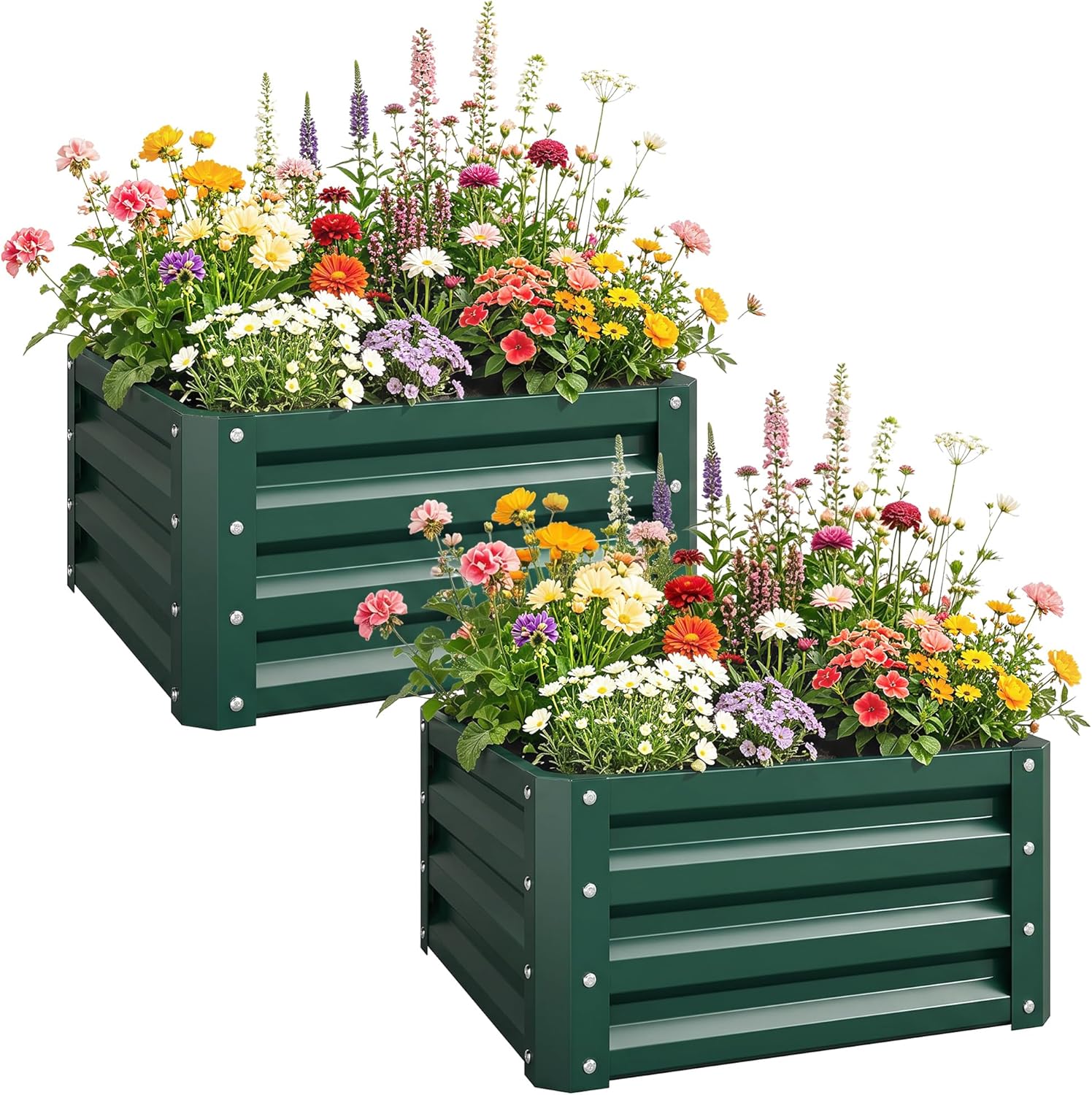
| Material Type | Galvanized Steel |
|---|---|
| Finish Types | Powder Coated |
| Number of Pieces | 2 |
| Capacity | 28.75 gallons |
These two compact raised garden beds are a practical choice for small-scale vegetable or herb plots. Made from powder-coated galvanized steel, the boxes resist rot and rust better than wood and assemble quickly from the included parts. Their open-bottom design encourages drainage and lets roots tap into native soil, which helps nutrient access and reduces stagnant moisture. Because each bed is short and square they are easy to position on small plots, patios, or alongside rows on a small farm for intensive planting of herbs, salad greens, or succession crops. The set is lightweight enough to move when empty but stable once filled with soil. Limitations to expect are shallow planting depth, which restricts larger root crops, and modest capacity per box, so you will need multiple units or supplemental deep beds for potatoes or long-season crops. Also, metal can warm faster in sun and may need shading or mulching in very hot climates to avoid overheating root zones.
Best for: Buyers who want a durable, low-maintenance way to add multiple compact planting units to a small farm or intensive garden and prioritize efficient use of limited space.
Less Ideal for: Growers needing deep, high-volume beds for root crops or full-season large vegetables should choose deeper raised beds or in-ground rows instead.
- Galvanized steel construction resists rot and corrosion for longer outdoor life
- Open bottom promotes drainage and allows roots to access ground soil
- Set of two provides instant multiple planting units for successive or companion crops
- Powder-coated finish and straightforward assembly make setup quick and low-maintenance
- Shallow depth limits use for deep-rooted or large root vegetables
- Limited soil volume means more frequent watering and fertilizing compared with deeper beds
Verdict: A tough, space-efficient pair of galvanized raised beds that quickly expand productive planting area on a small farm.
Gardeal Galvanized Raised Garden Bed Kit (4 x 2 x 1 ft)

| Capacity | 7.14 cubic feet |
|---|---|
| Number of Levels | 1 |
| Mounting Type | Railing Mount |
| Material Type | Galvanized, Stainless Steel |
| Other Special Features of the Product | Open Base |
This Gardeal raised garden bed is a small, heavy-duty metal planter meant to give a reliable planting platform for vegetables, herbs, or flowers. Made from double-galvanized steel with reinforced edges and a wavy profile, it resists warping and corrosion for long-term outdoor use. The kit arrives with pre-drilled holes and wing nuts so it can be assembled without tools in roughly ten minutes and then placed directly on soil thanks to its open-bottom design, which improves drainage and encourages deeper root growth. At roughly a foot tall it reduces bending for lighter ergonomic work while still holding a useful volume of soil for compact plots. Important limitations are its modest footprint and single low height, which restrict how much you can grow in each bed and make it less suitable for taller crops or bulk vegetable production. For small-scale farm plots or compact vegetable rows where durability and quick setup matter, this bed is a practical, low-maintenance choice.
Best for: Buyers who want a durable, low-maintenance raised bed for reliable seasonal production on a small farm or compact plot and value long-term corrosion resistance and quick setup.
Less Ideal for: Farmers planning to grow large root crops or need high-volume beds for bulk production should choose deeper or larger planters instead.
- Double-galvanized steel construction resists rust for long outdoor life
- Reinforced edges and wavy design increase structural strength and reduce deformation
- Tool-free assembly with pre-drilled holes and wing nuts for fast setup
- Open-bottom design promotes natural drainage and better root development
- Small footprint and 1 ft height limit soil volume and capacity for larger crops
- Made of metal so it can heat up in full sun and may require insulation or shading for heat-sensitive plants
Verdict: A tough, quick-to-assemble galvanized steel bed that gives small farms a corrosion-resistant, low-maintenance planting unit ideal for reliable seasonal production.
Land Guard Galvanized Oval Raised Garden Bed Kit (4×2×1 ft)

| Material Type | Metal |
|---|---|
| Finish Types | Double-layer galvanized |
| Capacity | 7.14 cubic feet |
| Mounting Type | Floor Standing |
This Land Guard raised garden bed is a simple, durable option for planting vegetables, herbs, or mixed annuals in a compact outdoor space. The kit arrives as flat panels that assemble into an oval planter about 4 by 2 feet and 1 foot deep, and setup is straightforward so you can fill and plant in minutes. Its double-layer galvanized steel construction and wave-shaped panels are intended to resist corrosion and add rigidity, and the manufacturer states thicker panels at stress points to reduce deformation. An open base design lets excess water drain and helps avoid root rot if placed on soil or lawn. Practical benefits include low maintenance, a tidy planted border that keeps soil contained, and a metal finish that lasts longer than untreated steel. Limitations are the shallow depth for deep-rooted crops and the likelihood the metal will warm quickly in hot sun, which may require more frequent watering or shade management. It is best used as a portable, long-lasting planter for raised-bed style container gardening rather than a full replacement for deeper in-ground beds.
Best for: Gardeners who want a quick-to-assemble, durable raised planter to grow vegetables or herbs in small outdoor spaces and who prioritize evidence of longevity over decorative complexity.
Less Ideal for: Growers who need deep soil for large root crops, or those looking for insulated or fully enclosed beds to control soil temperature and moisture long-term.
- Galvanized double-layer steel resists corrosion for multi-season outdoor use
- Oval, interlocking panel design assembles quickly with included tools
- Open base allows natural drainage to reduce standing water and root rot
- Compact footprint fits small patios, balconies, and tight garden beds
- Only 12 inches deep which limits planting of larger, deep-rooted vegetables or shrubs
- Metal surface can heat up in full sun and increase watering needs
Verdict: A tough, easy-to-assemble galvanized oval raised bed that gives small-space gardeners a durable, low-maintenance container for vegetables and herbs.
Choosing the Right Planter for Small Farm: Key Factors to Consider
Planting Capacity and Root Depth
How much soil volume a planter holds directly affects the range of crops you can grow. Larger root crops and vigorous herbs need deeper, wider containers to avoid root restriction and frequent re-potting.
On a small farm, planting capacity also influences planting density and labor efficiency. A planter with more volume reduces the need for constant watering and allows for longer production cycles between soil refreshes. Think in terms of usable soil depth and total liters or cubic feet rather than external dimensions alone.
Material Durability and Weather Resistance
The material determines how a planter stands up to sun, frost, and day-to-day abrasion. Metal can dent and corrode unless treated, plastics can become brittle in UV and cold, and wood may rot without proper treatment.
Durable materials reduce replacement frequency and lower lifetime cost for a small farm. Consider UV stabilization, rot-resistant finishes, and whether the material will transfer heat to roots in hot weather. Also evaluate how the planter ages cosmetically versus structurally, since functionality matters more than appearance on a working farm.
Water Management and Drainage
Good drainage prevents waterlogged roots while design features that retain the right moisture reduce watering time. Drainage hole size, placement, and the ability to add or block holes for different seasons affects how you manage moisture.
Compatibility with drip irrigation or wicking inserts can dramatically reduce daily watering chores. For farms with limited water or drought-prone seasons, choose planters that retain moisture well without risking root rot and that allow for simple integration with water-saving irrigation systems.
Ease of Handling and Seasonal Movement
Planters used on small farms are often repositioned for crop rotation, sun exposure, or storage. Weight when filled, built-in lifting points, and wheel or pallet compatibility determine whether you can move planters by hand or need equipment.
Consider how you will empty, transport, and store planters between seasons. Stackability or nestability when empty saves space. If seasonal labor is limited, choose planters that minimize handling without compromising durability.
Repairability and Long-Term Maintenance
On a small farm, being able to repair a planter extends its service life and reduces waste. Materials that can be patched, welded, or resealed with common supplies are easier to keep in service.
Evaluate access to replacement parts, whether liners are removable, and how simple routine tasks like cleaning and repainting are. Planters that require specialized repairs or have glued components are harder to maintain on site and may lead to premature replacement.
Crop Suitability and Microclimate Effects
Different planters create different microclimates around roots. Dark-colored materials heat soil more, shallow containers dry faster, and enclosed bottoms can change air flow. These effects determine which crops will thrive and which will struggle.
Match planter characteristics to the crops you intend to grow and your farm's microclimate. For example, choose shallow, cooler options for lettuces and deeper insulated planters for tomatoes or root vegetables.
Sizing Planters to Your Small-Farm Layout
Measure planting area and plan how many planters fit without creating tight work aisles. On a small farm, efficient layout reduces wheelbarrow trips and makes daily tasks like harvesting and weeding faster.
Think in modules that match your workflow. Standardized planter sizes let you swap soil mixes, rotate crops, and reuse irrigation setups. Keep pathways wide enough for loaded carts and for two people to work side by side during peak season.
- Match planter width to bed spacing to avoid wasted edges
- Use consistent depths so root crops can be rotated easily
- Leave access around planters for watering and pest checks
Integrating Irrigation and Fertility
Planters should work with your existing irrigation system or be easy to retrofit. Look for designs that allow drip lines to sit below mulch or attach wicking inserts for low-water setups.
Fertilizer regimes differ in containers because nutrients leach faster. Planter choices that permit top-dressing, side-dressing, or insertion of slow-release media make feeding crops simpler and more consistent.
- Locate drainage so irrigation runoff does not pool nearby crops
- Choose planters that accept standard drip fittings when possible
Seasonal Care and Overwintering
Decide whether planters will remain outside year-round or be emptied and stored. Some materials crack in freeze-thaw cycles if left filled; others can survive but may need temporary covers or insulation.
Plan for composting or soil refresh between seasons. Removable liners or modular designs let you replace spent soil more easily and keep long-term fertility high across crop cycles.
- Empty and dry planters before prolonged freezing weather if material is sensitive
- Store stacked if design permits to save space in off-season
Pest Management Considerations
Planters change the pest landscape compared with in-ground beds. Elevated containers can reduce rodent access but may attract other pests. Material gaps and seams can create hiding spots for insects or slugs.
Choose planters that allow easy inspection and cleaning. Smooth interiors, removable bottoms, or access panels simplify spot treatments and reduce pest carryover between crops.
- Inspect root zones when rotating crops to check for soil-borne pests
- Use physical barriers where planters sit on the ground to deter burrowing pests
Sourcing Soil and Mixes for Container Productivity
Soil used in planters needs to be lighter and more friable than field soil to ensure drainage and root oxygenation. On a small farm, mixing your own blend saves cost and lets you tailor fertility for specific crops.
Factor in replacement intervals. High-production containers may need partial soil renewal each season. Consider amendments that hold moisture while retaining good structure, such as compost, coconut coir, or well-rotted manure.
- Test mixes in a small number of planters before committing farm-wide
- Keep a record of yields and soil life to refine mix ratios over time
How We Chose the Best Planter for Small Farm
We shortlisted planters that make sense on a small farm by applying selection filters focused on real-world use. Our editorial criteria prioritized planted volume and root depth because those determine what crops a container will support. We also weighed material durability and UV resistance to predict lifespan in outdoor exposure. Water management was assessed through drainage options and irrigation compatibility to reflect everyday watering work. Handling and logistics measured how easy it is to move, store, or overwinter planters between seasons. Finally, construction and repairability evaluated whether common damage can be fixed on the farm rather than replaced. Excluded were decorative-only containers and tiny desktop pots that cannot support productive vegetable or herb yields. We did not consider single-season novelty items or planters without practical drainage or enough depth for typical small-farm crops. The resulting list emphasizes durable, serviceable planters that balance capacity, longevity, and manageable labor demands.
FAQ
What planter depth is best for common small-farm vegetables?
Depth needs vary by crop. Leafy greens and herbs do well in 6 to 8 inches of good soil, while tomatoes, peppers, and most root crops perform better with 12 inches or more. When in doubt, choose a deeper planter to allow flexibility.
Can planters be used year-round on a small farm?
Often yes, but it depends on material and climate. Some planters handle freeze-thaw cycles without damage, while others should be emptied and stored. Consider insulation or temporary covers to protect roots and materials in extreme weather.
How do I water planters efficiently without wasting water?
Integrating drip irrigation or wicking systems reduces evaporation and directs water to the root zone. Mulching the surface and using mixes that retain moisture help cut watering frequency. Monitor moisture by feel and use simple tensiometers if precision is needed.
Are raised planters better than in-ground beds for pest control?
They can be. Elevation can deter some ground pests and make monitoring easier, but planters can also create new pest habitats if not cleaned between crops. Choose planters with accessible interiors and keep a hygiene routine to limit pest carryover.
How often should I replace soil in planters used for continuous production?
It depends on intensity. For heavy production, refresh a portion of the soil each season and fully replace or deeply amend every two to three years. Regular compost top-dressing maintains fertility and soil structure between larger renewals.
Final Verdict
Select planters that match the crops you plan to grow and the labor you have to maintain them. Prioritize sufficient planting volume and good drainage first, then material durability and ease of handling. Remember that irrigation compatibility and repairability will determine how manageable planters are across seasons. A practical small-farm planter balances capacity with serviceability. Focus on the tradeoffs between weight when filled and long-term resilience so you end up with containers that support steady yields without excessive replacement or labor.
