

Note: This article contains affiliate links. If you click on these links and make a purchase, I may earn a small commission at no extra cost to you. This helps support my research and content. Read my full affiliate disclosure here.
If you want steady moisture for vegetables without daily watering runs, a self watering vegetable planter can save time and improve plant health. These planters use reservoirs, wicking systems, or capillary fabrics to keep root zones evenly moist, which reduces transplant shock and helps fruiting crops set more reliably. This guide covers seven shortlisted self watering vegetable planters that perform well in a range of garden situations from small patios to raised beds. We evaluated reservoir capacity, ease of filling and cleaning, material durability, and how well each system supports common vegetable crops. Read on to see which features matter most for your space and growing goals.
Top Picks at a Glance
| Best Overall The best all-around choice for most situations | Keter Splendor 31.7 Gallon Elevated Self-Watering Raised Garden Bed |  |
| Best Quality Built to a higher standard if you want something more solid | Vegepod Small Raised Garden Bed Kit with Self-Watering System and Protective Cover |  |
| Best Value The sweet spot between price and what you get | Giantex Self-Watering Raised Planter with Arch Trellis and Wheels |  |
| Best Budget The cheapest option that still gets the job done reliably | Suteck Raised Garden Bed Planter Box with Adjustable Trellis (2-Pack) |  |
| Highest Rated A top-rated pick with lots of positive feedback | Permasteel Self-Watering Raised Garden Bed with Locking Wheels |  |
| Most Popular A crowd favorite that many people choose with confidence | Keter Urban Bloomer 12.7 Gallon Elevated Raised Garden Bed |  |
| Best Seller A high-volume bestseller chosen again and again | The Lakeside Collection 58" Self-Watering Vegetable Planter with Trellis and Wheels |  |
Keter Splendor 31.7 Gallon Elevated Self-Watering Raised Garden Bed

| Capacity | 31.7 gallons |
|---|---|
| Material Type | Plastic |
| Other Special Features of the Product | Drainage Hole |
| Indoor Outdoor Usage | Indoor |
| Mounting Type | Inside Mount,Outside Mount |
The Keter Splendor is an elevated self-watering raised bed aimed at small-space vegetable and herb gardening. It combines a 31.7 gallon planting area with a built-in water reservoir and an easy-to-read gauge so you can monitor moisture without frequent digging. The unit has a drainage tap that lets you remove excess water and convert between indoor and outdoor use, and its ergonomic height reduces bending for comfortable tending. Constructed from polypropylene resin with a rattan-style finish, it resists rot and seasons of outdoor use better than untreated wood while remaining lightweight for repositioning. Assembly is straightforward with illustrated instructions. Limitations to consider are that plastic construction offers less thermal mass than wood or metal, so soil temperatures may fluctuate more, and the overall planting volume is modest for larger root crops or extensive vegetable rows. For gardeners who want low-maintenance container-grown produce on a patio or balcony, this makes watering and access much simpler.
Best for: Buyers who want an easy-care, elevated self-watering planter for growing herbs and small vegetables on patios, balconies, or decks and who prioritize low maintenance and accessibility.
Less Ideal for: Those needing large-scale vegetable production, deep beds for big root crops, or heavy-duty materials for extreme climates should consider larger or different-material raised beds.
- Integrated water reservoir with gauge for straightforward moisture monitoring
- Drainage tap allows manual removal of excess water and indoor/outdoor flexibility
- Ergonomic elevated design reduces bending and improves accessibility
- Durable polypropylene resin resists rot and is lightweight for easy placement
- Planting capacity is relatively small for large root vegetables or multiple full-size plants
- Plastic has lower thermal mass than wood or metal, which can increase soil temperature swings
Verdict: A convenient elevated self-watering planter that makes small-space vegetable and herb growing easier by combining a reservoir, gauge, and drain for low-maintenance watering.
Vegepod Small Raised Garden Bed Kit with Self-Watering System and Protective Cover

| Capacity | 4 cubic feet |
|---|---|
| Features | Self Watering |
| Material Type | Iron, Plastic, Polypropylene (PP) |
| Indoor Outdoor Usage | Outdoor |
The Vegepod small raised garden bed kit is a compact container-style planter built to simplify growing vegetables in constrained outdoor spaces. It combines a molded base with an internal wicking reservoir so soil stays consistently moist, which helps established plants tolerate longer periods between watering. The included Vegecover creates a sheltered microclimate that reduces sun stress, deters pests and birds, and can extend the growing season for heat- or cold-sensitive crops. Assembly is modular and straightforward, and the kit can be elevated on a stand to bring planting to waist height for easier maintenance. Practical benefits include reduced watering frequency, protection from common garden pests, and a neat, contained footprint for balconies, patios, or courtyards. Limitations are the small soil volume, which restricts the size and number of plants compared with larger raised beds, and the plastic and iron construction that may warm quickly in strong sun and eventually show wear outdoors. For gardeners focused on dependable, low-maintenance production in a small area, the Vegepod delivers a high-utility solution.
Best for: Gardeners who want reliable, low-maintenance vegetable production in a small outdoor space and prioritize consistent moisture and crop protection over large-scale yields.
Less Ideal for: People who need high-volume production, deep-rooted crops, or a long-term heavy-duty raised bed solution for a large garden.
- Self-watering wicking system keeps soil consistently moist and reduces watering frequency
- Protective Vegecover creates a microclimate and helps block pests and harsh sun
- Modular kit assembles quickly and can be raised to waist height for ergonomic access
- Compact footprint fits balconies, patios, and small courtyards
- Small soil capacity limits how many or how large vegetable plants you can grow
- Plastic and iron parts may heat up in direct sun and will age with outdoor exposure
Verdict: If you need a compact, low-maintenance planter that keeps vegetables consistently watered and protected, this Vegepod kit is a strong performance-focused choice for small spaces.
Giantex Self-Watering Raised Planter with Arch Trellis and Wheels

| Material Type | Metal, Polypropylene (PP) |
|---|---|
| Included Components | 1 x Raised Garden Bed with Trellis, 1 x User’s Manual |
| Features | Self-watering siphon, drainage holes with plungers, lockable wheels |
| Number of Items | 1 |
This Giantex raised planter combines two connected planting boxes with a built-in siphon self-watering system and an arched trellis to support climbing vegetables like tomatoes, cucumbers, and beans. It is typically set up on a patio, deck, or balcony where you want easy mobility and vertical growing space; eight lockable caster wheels let you reposition the unit to follow sun or shelter it from bad weather. The planters use faux rattan PP panels and PE-coated metal tubing that resist cracking and rust for low-maintenance outdoor use. Practical details include drainage holes with plungers to avoid waterlogging, tool-free snap-on assembly, and two layout configurations so you can fit different spaces. Because the water reservoir reduces how often you need to hand-water, it saves time for gardeners who want consistent moisture without daily attention. The main limitations are that the boxes are relatively shallow compared with in-ground beds, so very deep-rooted crops are not ideal, and the lightweight construction means it may need securing in high wind or extreme conditions.
Best for: Gardeners who want a low-maintenance, movable vegetable planter that saves time on watering and adds vertical support for vining crops in small outdoor spaces.
Less Ideal for: Growers planning to cultivate large, deep-rooted crops or those who need a heavy, permanent raised bed for exposed, high-wind sites.
- Integrated siphon self-watering system with reservoir reduces watering frequency
- Arched trellis with textured lattice provides solid support for climbing plants
- PE-coated metal and PP rattan panels resist rust and cracking for outdoor durability
- Eight lockable caster wheels make it easy to move and lock the planter in place
- Tool-free connectors and snap-on design allow quick assembly and reconfiguration
- Planter boxes are shallow and may restrict very deep-rooted vegetables
- Lightweight materials could be less stable in high winds or extreme weather
Verdict: Choose this planter if you want a mobile, low-maintenance self-watering solution that supports climbing vegetables in small outdoor spaces.
Suteck Raised Garden Bed Planter Box with Adjustable Trellis (2-Pack)
| Material Type | Plastic, Steel |
|---|---|
| Finish Type | Powder Coated |
| Item Highlight | Adjustable Height Steel Support Frame for Climbing Plants |
| Number of Items | 2 |
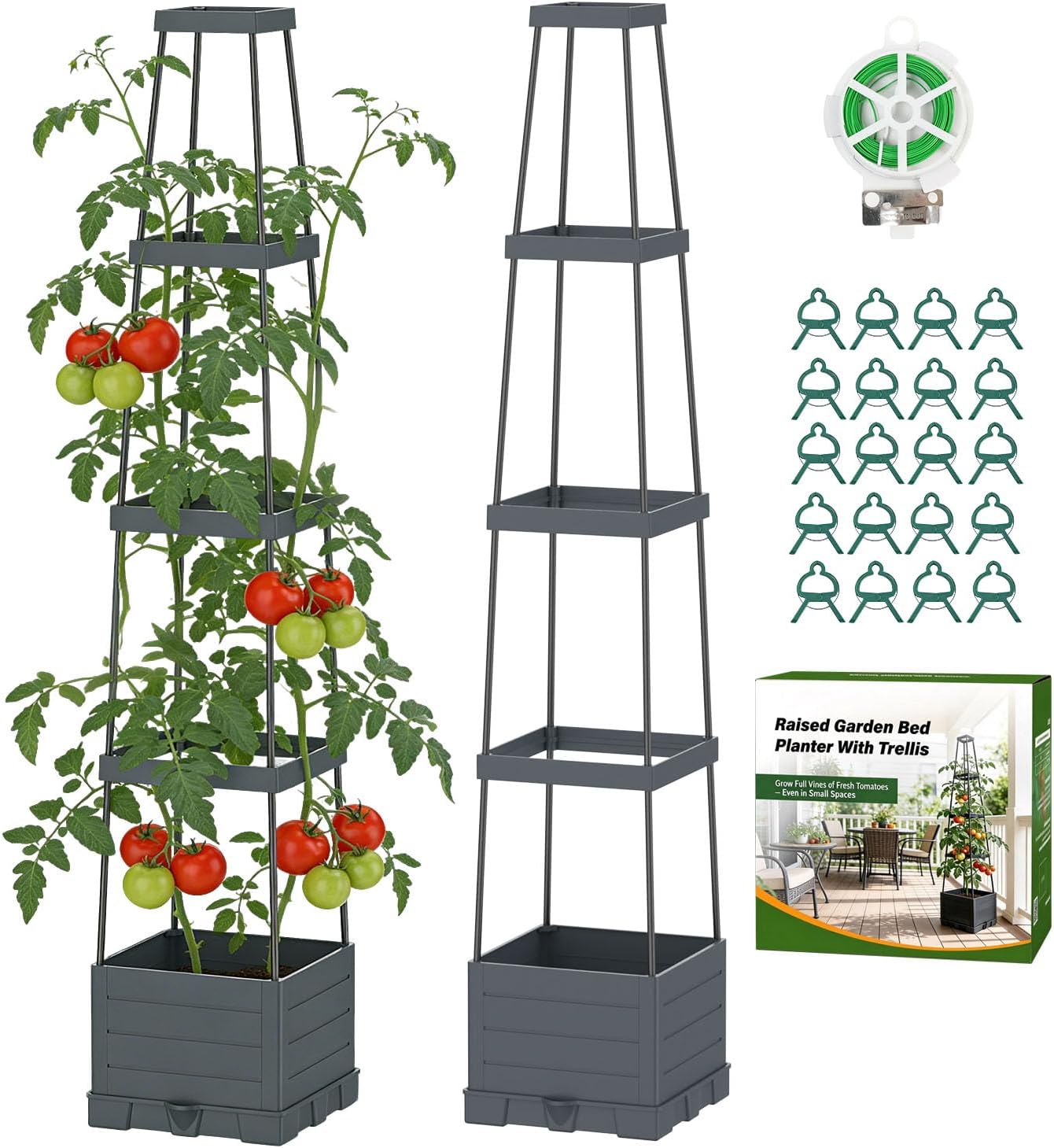
This 2-pack Suteck raised garden bed combines a shallow planter with a detachable, adjustable-height trellis to support tomatoes, cucumbers, peas and other vining crops in small outdoor spaces. The plastic planter includes a bottom water reservoir and drainage holes to reduce how often you need to water, while the powder-coated steel support rods assemble without tools and can be extended as plants grow. In use it lets you grow vertically on patios, decks or balconies to free up floor area and protect stems from bending under fruit weight. The modular, lightweight parts are easy to move and store but the shallow plastic tray means it will not replace a deep raised bed for heavy feeders or large root crops. Expect to top up water and fertilizer more often than with a full-size bed, and anchor the trellis securely in windy spots. For the price conscious gardener who needs a compact, low-effort solution for climbing plants, this gives a durable, space-saving option that is simple to assemble and maintain.
Best for: Budget-minded patio or balcony gardeners who want an easy, space-saving way to grow vining vegetables or flowers without a deep raised bed.
Less Ideal for: Gardeners looking to grow large root crops or heavy-feeding plants that require deep soil and long-term large-volume containers.
- Built-in water reservoir with drainage holes reduces watering frequency
- Adjustable trellis height adapts as plants grow
- Powder-coated steel supports offer better durability and rust resistance than plain plastic
- Tool-free, modular assembly for quick setup and compact storage
- Shallow plastic planter limits soil volume so heavy-feeding or deep-rooted plants may underperform
- Lightweight tray may need anchoring in windy locations
Verdict: A budget-friendly, space-saving planter with a self-watering tray and adjustable steel trellis that lets apartment and patio gardeners grow climbing vegetables with minimal fuss.
Permasteel Self-Watering Raised Garden Bed with Locking Wheels

| Material Type | Powder Coated Steel |
|---|---|
| Capacity | 2 cubic feet |
| Other Special Features of the Product | Self Watering, UV Resistant, Lightweight, Portable |
| Mounting Type | Floor Standing |
This Permasteel raised garden bed is a compact, self-watering planter built from powder-coated steel for outdoor use. It separates a water reservoir from the soil with an elevated soil platform and wicking pockets so roots can access moisture without sitting in standing water. The unit includes a water level indicator, fill tube and drain valve for easy maintenance and flood control, plus swivel casters with two locking wheels and large side handles to move it when planted. For vegetables, herbs, and small fruiting plants it reduces daily watering chores and helps prevent overwatering-related root problems. The steel construction and UV resistant finish make it durable in sun-exposed spaces, but the 2 cubic foot soil capacity limits how many larger plants you can grow at once and requires more frequent nutrient management than larger beds. Assembly and occasional rust-preventive care will help prolong the finish in harsh climates.
Best for: Buyers who prioritize a low-maintenance, dependable planter for growing vegetables and herbs in a patio or small outdoor space and want consistent moisture without daily watering.
Less Ideal for: People who need large growing volume for big or many crops or who prefer fully permanent in-ground raised beds for long-term heavy production.
- Self-watering reservoir with fill tube and water-level indicator reduces daily watering needs
- Powder-coated steel construction with UV resistance for outdoor durability
- Locking swivel casters and large handles make the bed easy to move and secure in place
- Drain valve allows flushing and winter draining to protect roots and the unit
- Small soil capacity (2 cubic feet) limits plant size and requires more frequent feeding
- Requires assembly and occasional maintenance to protect the powder coat in harsh conditions
Verdict: Choose this Permasteel self-watering raised bed if you want a reliable, low-maintenance steel planter that keeps vegetable and herb roots consistently moist with minimal daily effort.
Keter Urban Bloomer 12.7 Gallon Elevated Raised Garden Bed

| Capacity | 22.4 gallons |
|---|---|
| Material Type | Resin |
| Other Special Features | Fade Resistant |
| Mounting Type | Floor Standing |
| Indoor Outdoor Usage | Outdoor |
The Keter Urban Bloomer is an elevated raised garden bed built for simple, low-maintenance herb and small-vegetable gardening on patios, balconies, or decks. It uses a built-in reservoir and water gauge to reduce watering frequency and help prevent overwatering and root rot, while a manual drainage tap allows you to empty the reservoir for indoor moves or heavy rain. The included seed sprouting tray makes starting seedlings neater, and the resin, wood-look finish is UV protected so it resists fading and rot better than real wood. Assembly is straightforward and the rectangular, floor-standing form fits alongside outdoor furniture. Because it is a single-piece plastic/resin planter, it is lightweight and weatherproof but will not provide the insulating or aesthetic qualities of natural wood or heavier materials. Capacity is limited compared with large raised beds, so it is best for herbs, salad greens, and a few compact vegetables rather than large crops.
Best for: Gardeners who want a practical, low-effort elevated planter for growing herbs and small salad greens on a balcony or patio and who prioritize easy watering management and low maintenance.
Less Ideal for: People planning to grow large vegetables, heavy production beds, or who want the look and thermal benefits of natural wood or metal raised beds.
- Self-watering reservoir with visible water gauge helps maintain consistent moisture and prevents overwatering
- Manual drainage tap makes it easy to drain excess water and move the planter indoors without leaks
- UV-protected resin construction resists fading, rot, and rust for low outdoor maintenance
- Included seed sprouting tray simplifies starting seedlings and transplanting into the bed
- Relatively small soil capacity limits the number and size of plants compared with full-size raised beds
- Resin construction lacks the natural insulation and aesthetic of wood or heavier materials
Verdict: If you want a compact, low-maintenance elevated planter that simplifies watering and seed starting for herbs and small veggies, this is a practical choice.
The Lakeside Collection 58" Self-Watering Vegetable Planter with Trellis and Wheels

| Capacity | 10 gallons |
|---|---|
| Material Type | Polypropylene (PP) |
| Plant or Animal Product Type | herbs,vegetable |
| Mounting Type | Tabletop |
This self-watering planter combines a large soil capacity, built-in reserve, and a detachable trellis to simplify growing herbs and small vegetables on a patio or balcony. It is typically used as a tabletop or raised container where you fill the lower reservoir, add potting mix to the main compartment, and plant seedlings; the 3-gallon water storage zone reduces daily watering and helps protect plants from short dry spells. The planter’s two wheels and handle make it straightforward to reposition for sun or shelter as seasons change, and sectional trellis panels provide support for vining or taller varieties up to about 3 feet. Constructed from polypropylene, it is lightweight and weather-tolerant for outdoor use while remaining easy to clean. Limitations to note are modest planting width for larger crops and the single-level layout, so it is best for concentrated beds of herbs, salad greens, or a few vegetable plants rather than a large mixed vegetable garden.
Best for: Buyers who want a low-maintenance, moveable container for herbs and small vegetables and prefer a reliable self-watering solution that reduces daily care.
Less Ideal for: Growers who need a wide, multi-plant vegetable bed or who plan to grow many large fruiting plants should choose a larger or multi-level planter system.
- Integrated 3-gallon reservoir provides passive self-watering to reduce frequency of surface watering
- Wheels and handle allow easy relocation to follow sunlight or protect plants in bad weather
- Sectional trellis supports vining plants up to about 3 feet as they grow
- Durable polypropylene construction resists outdoor conditions and is easy to clean
- Single-level, narrow planting area limits the number and size of larger vegetable plants
- Marked as intended for indoor usage in product details which may confuse outdoor longevity expectations
Verdict: Choose this planter if you want a compact, durable self-watering box with wheels and a trellis to simplify growing herbs and small vegetables with minimal daily maintenance.
Choosing the Right Self Watering Vegetable Planter: Key Factors to Consider
Reservoir Size and Refill Frequency
Reservoir size determines how often you need to top up water. Larger reservoirs or designs that place water close to the root zone will extend the time between refills, which is useful for busy gardeners or those who travel. Consider your watering habits, local temperatures, and the water needs of the vegetables you grow.
A deep-rooting tomato will draw more water than herbs, so match reservoir capacity to crop water demand. Also account for evaporation in hot, exposed sites. If you want minimal maintenance, choose a planter with a larger reservoir, clear fill indicators, and an easy-access fill port.
Wicking Design and Soil Contact
How the planter transfers water from the reservoir to the soil affects how uniformly moisture reaches roots. Options include capillary wicks, soil-filled columns, or permeable bottoms. Effective wicking maintains an even moisture profile and prevents dry patches that stunt growth.
Look for systems that keep the wicking medium in consistent contact with the planted soil and that allow for different potting mixes. Strong wicking is especially important for seedlings and for crops that resent fluctuating moisture, like peppers.
Drainage, Overflow, and Flood Protection
A reliable self watering planter balances water retention with excess water removal. Proper drainage prevents waterlogging and root rot during heavy rain or accidental overfilling. Some designs include overflow outlets, float valves, or raised plant platforms that separate roots from standing water.
Evaluate how the planter handles heavy precipitation in your area and whether it has a secondary drain or overflow channel. Good drainage also helps flush salts from container soil over time, which is important when feeding vegetables.
Material Longevity and UV Resistance
Materials determine how long the planter will stand up to sun, weather, and repeated wet-dry cycles. Look for UV-stabilized plastics, rot-resistant composites, or powder-coated metals that resist corrosion. Thin or non-UV-stabilized containers can become brittle and crack after a few seasons outdoors.
Also consider the planter's construction detail: seams, glued joints, and thin fittings are common failure points. Heavier, well-fitted components typically last longer and are easier to repair if needed.
Ease of Planting and Maintenance
Planters should be easy to fill with potting mix, allow straightforward planting, and permit periodic maintenance like root inspection or reservoir cleaning. Removable planting trays, access panels, and clear fill indicators make seasonal tasks less frustrating.
Consider how simple it is to replace soil, divide crops, or clean algae and sediment from reservoirs. If the reservoir is impossible to access without disassembling the whole container, routine upkeep will be more time-consuming.
Portability and Site Fit
Think about where the planter will live. Portability matters if you need to move containers to chase sun or protect plants from weather. Some planters are heavy when filled and intended to be stationary, while others are lightweight and easy to reposition when empty.
Also check footprint and depth to ensure the planter fits your balcony, patio, or raised-bed edge and provides enough rooting depth for the vegetables you plan to grow. Matching planter size to crop root systems avoids overcrowding and underperformance.
Best Planting Mix for Self Watering Systems
A well-draining but moisture-retentive potting mix is crucial for self watering vegetable planters. Use a premium potting blend amended with components that promote capillary action, such as coco coir or finely aged compost, to help the wicking system work consistently.
Avoid heavy garden soil or mixes with large bark chunks that interrupt water movement. If you need more aeration for heavy feeders like brassicas, blend in perlite but keep particle size moderate so the wicking action is not impaired.
- Aim for a light, crumbly texture that holds moisture yet drains excess.
- Include organic matter to supply nutrients and support microbial life.
- Match mix depth and composition to your chosen crops for best root development.
Setting Up and Filling a Reservoir Planter
Position the planter on a level surface and check the fill port location before adding soil. Some reservoirs have float indicators or sight tubes to show water level; learn how those features work so you know when to refill.
When filling, add mix in stages and firm lightly to eliminate large air pockets without compacting. If the planter includes a wicking insert, make sure it is fully in contact with the potting mix before planting.
- Prime new wicks by moistening them before planting to jump-start capillary action.
- Avoid burying fill tubes or vents under soil which would trap water and prevent proper functioning.
- Top up water through the designated port rather than pouring directly into the soil.
Common Troubleshooting Tips
If plants appear water-stressed despite a full reservoir, check for gaps between the wicking medium and soil or clogged wicking material. Roots that grow into the reservoir can also alter water distribution and may need managing.
Algae growth in the reservoir is usually harmless but can clog ports over time. Clean reservoirs annually and flush sediment to maintain reliable water flow.
- If overwatering symptoms appear, confirm drainage and inspect overflow mechanisms.
- Replace compacted soil or degraded wicking fabrics to restore even moisture.
- Use a moisture meter to diagnose inconsistent wetting patterns before changing plants.
Vegetables That Benefit Most From Self Watering Planters
Fruiting crops like tomatoes, peppers, and cucumbers benefit from steady moisture because it reduces blossom drop and supports consistent fruit set. Leafy greens and herbs also do well when soil stays evenly damp rather than cycling through dry spells.
Root crops can benefit, but avoid complete saturation for crops like carrots and beets. Use shallower reservoirs or adjust watering frequency for sensitive roots to prevent splitting or poor form.
- Best matches: tomatoes, peppers, bush beans, leaf lettuce, and herbs.
- Use shallower fills and lighter mixes for carrots and baby root crops.
- Monitor fruiting crops closely during heat spells as evaporation increases demand.
Winter Care and Off-Season Storage
Drain reservoirs and clean planters before storing for winter if you live where freezing is common. Water left in reservoirs can expand when frozen and crack plastic or composite containers.
Store removable parts indoors and scramble planters in a sheltered spot if they cannot be emptied. If leaving in place, raise planters slightly off cold surfaces and cover them to limit freeze-thaw damage.
- Empty and rinse reservoirs to remove debris and algae.
- Store wicking inserts flat and dry to preserve material performance.
- Consider planting cold-hardy greens in insulated planters through late season.
How We Chose the Best Self Watering Vegetable Planter
We focused on features that actually influence vegetable success and gardener convenience. Key evaluation criteria included reservoir capacity and refill frequency, because larger or more efficient reservoirs reduce choretime for busy gardeners. We assessed wicking system design and soil contact to judge how uniformly moisture reaches the root zone. Ease of filling and maintenance was measured by access to reservoirs, removable parts, and how straightforward cleaning is. Build materials and UV-resistant finishes were used to estimate durability outdoors, and drainage and overflow controls were evaluated to prevent root rot and handle heavy rains. We excluded containers that rely solely on passive soak mats without a true reservoir or that are designed only for ornamentals with shallow root systems. Also excluded were novelty or decorative containers with no functional water-management features. The shortlist prioritizes planters suited to typical vegetable root depths and common garden conditions so the picks are useful for edible growers looking for reliable, low-maintenance watering systems.
FAQ
How often will I need to refill the reservoir?
Refill frequency varies by reservoir size, plant type, and weather. In moderate conditions a well-sized reservoir can last a week or more for small to medium vegetables. Hot weather and heavy-feeding crops may require more frequent top-ups.
Can I use my regular potting soil in a self watering planter?
Often you can, but mixes that are light and retain moisture work best. Avoid heavy garden soil or coarse mulch pieces that disrupt wicking. Amending with coco coir or fine compost improves water movement.
Will roots grow into the reservoir and cause problems?
Roots commonly grow toward moisture and can reach the reservoir in some designs. Many planters use root barriers or raised planting trays to limit intrusion. If roots enter the reservoir, trim or repot as needed and inspect the wicking setup.
Are self watering planters suitable for balcony or container gardens?
Yes, they are especially useful for balconies where access to a hose is limited. Choose sizes that fit your space and consider weight when filled; smaller planters are easier to move and still provide reliable moisture control.
How do I prevent algae or mosquito breeding in reservoirs?
Keep fill ports covered, clean reservoirs periodically, and use opaque materials that block light to limit algal growth. Proper maintenance and occasional cleaning prevent standing water problems and keep systems functioning.
Final Verdict
When choosing a self watering vegetable planter, prioritize reservoir capacity that matches your crop water needs and a wicking design that delivers even moisture to the root zone. Balance durability and maintenance access so the planter lasts multiple seasons and is easy to clean. Tradeoffs are inevitable: larger reservoirs reduce refill frequency but add weight, and more complex fill systems simplify use but can be harder to repair. Focus on the few features that matter most for your growing situation and site, and you will get consistently healthier vegetables with less daily effort.
