

Note: This article contains affiliate links. If you click on these links and make a purchase, I may earn a small commission at no extra cost to you. This helps support my research and content. Read my full affiliate disclosure here.
If you want a hands-off approach to regular lawn maintenance, a garden robotic lawn mower can keep grass trimmed without daily effort. These machines handle scheduled mowing, short clipping cycles, and can reduce stress on turf and the gardener. Choosing the right robotic mower matters because cutting performance, navigation accuracy, and battery runtime determine how well it suits your lawn size, slope, and layout. This guide covers seven shortlisted options that fit common garden situations. We evaluated them on criteria that affect real-world use so you can match features to your yard. Below are the decision factors we used, followed by the full guide to help you pick the best fit for your lawn and routine.
Top Picks at a Glance
| Best Overall The best all-around choice for most situations | LOPKIN L2500-NEO Robot Lawn Mower with NetRTK, AI Vision, Wi‑Fi HaLow |  |
| Best Quality Built to a higher standard if you want something more solid | Husqvarna 410iQ Automower Robotic Lawn Mower (Wire-Free, App Controlled) |  |
| Best Value The sweet spot between price and what you get | roborock RockNeo Q110H Robot Lawn Mower |  |
| Best Budget The cheapest option that still gets the job done reliably | RoboUP Raccoon 2 SE Robot Lawn Mower (Wire-Free, for up to 0.15 Acre) |  |
| Highest Rated A top-rated pick with lots of positive feedback | LEBOSBO V3 AI Vision Robotic Lawn Mower (1600 sq ft) |  |
| Most Popular A crowd favorite that many people choose with confidence | ECOVACS GOAT O1000 RTK Care Robot Lawn Mower (Wire-Free, RTK Navigation) |  |
| Best Seller A high-volume bestseller chosen again and again | ECOVACS GOAT O1000 RTK Robotic Lawn Mower |  |
LOPKIN L2500-NEO Robot Lawn Mower with NetRTK, AI Vision, Wi‑Fi HaLow

| Power Source | Battery Powered |
|---|---|
| Cutting width | 9.45 inches |
| Maximum Adjustable Cutting Height | 3 inches |
| Battery Average Life | 4 hours |
| Operation Mode | Automatic |
The LOPKIN L2500‑NEO is a high-capability robotic mower built for large, complex yards where running boundary wire is undesirable. It uses NetRTK plus GNSS/INS fusion and AI vision to map and navigate reliably around trees, buildings, and common obstacles while app-based multi-zone management stores many maps and custom schedules. The mower supports steep slopes, offers adjustable cutting heights, and runs for roughly three hours per charge with an 8Ah battery and fast charger. Practical benefits include precise wire-free positioning, automatic obstacle avoidance that reduces collisions with toys or garden features, and a HaLow router for more consistent remote control across long distances. Important limitations are that effective performance depends on good initial mapping and that advanced features like NetRTK and HaLow add setup steps compared with simpler robot mowers. The unit is IP66 rated and has rain sensing for automatic returns, but users should expect occasional mapping tweaks in very cluttered or heavily shaded areas.
Best for: Homeowners with larger or complicated yards who want a wire-free, app-managed mower that prioritizes accurate navigation and multi-zone automation to minimize hands-on mowing time.
Less Ideal for: Small, simple lawns where a basic, lower-cost robot mower or traditional push mower would be faster to buy and easier to maintain.
- Centimeter-level NetRTK plus GNSS/INS fusion for accurate wire-free navigation
- AI vision obstacle avoidance that recognizes and avoids common objects
- Wi‑Fi HaLow long-range connectivity with included auto-pairing router
- Multi-zone mapping and app scheduling for managing several separated lawn areas
- IP66 weather protection and automatic rain-sensing return
- Advanced navigation and connectivity add setup complexity compared with basic robot mowers
- Performance in very cluttered, heavily shaded, or signal-blocked microenvironments may need occasional map adjustments
Verdict: Choose the LOPKIN L2500‑NEO if you need a wire-free robot mower that reliably handles large, complex yards with precise navigation and long-range connectivity.
Husqvarna 410iQ Automower Robotic Lawn Mower (Wire-Free, App Controlled)

| Power Source | Battery Powered |
|---|---|
| Maximum Adjustable Cutting Height | 4 inches |
| Minimum Adjustable Cutting Height | 1 inches |
| Operation Mode | Automatic |
| Item Type Name | Robotic Mower |
The Husqvarna 410iQ is a high-performance wire-free robotic mower built to automate regular lawn maintenance on medium-sized yards. It uses EPOS satellite positioning and cellular connectivity to create centimeter-accurate virtual maps and lets you set stay-out zones, change cut height, and schedule mowing from the Automower Connect app. The mower handles slopes up to 45 percent and offers a 1 to 4 inch adjustable cutting height across a 9.4 inch cutting width, so it can manage varied grass lengths and terrain transitions without perimeter wires. Larger wheels and a reinforced bumper improve traversal over driveways and uneven surfaces, and the unit is hose-washable for easy cleanup. Built-in anti-theft alarm and GPS tracking add security. Expect practical benefits like truly hands-off weekly trimming, predictable cut patterns, and multi-zone mapping for complex yards. The main compromises are the relatively narrow cutting width that makes jobs take longer on larger lawns and the upfront complexity of initial setup and mapping versus a simple perimeter-wire system.
Best for: A buyer who prioritizes precise, hands-off lawn performance and smart connectivity for a medium-sized yard and wants predictable, automated mowing with multi-zone control.
Less Ideal for: Large properties significantly over half an acre or buyers who need the fastest possible pass-to-pass mowing speed should consider larger commercial mowers or wider cutting options.
- Wire-free EPOS positioning enables centimeter-accurate virtual mapping and stay-out zones without perimeter wire
- Handles steep slopes up to 45 percent and negotiates surface transitions with larger wheels
- App control with Wi-Fi, Bluetooth and 4G for scheduling, cut-height changes, and remote tracking
- Built-in anti-theft alarm and GPS tracking for added security
- Hose-washable design and included charging station make maintenance straightforward
- Narrow 9.4 inch cutting width increases time needed to mow larger areas
- Initial setup and mapping can be more complex than perimeter-wire systems
Verdict: Choose the 410iQ if you want a wire-free, app-driven robotic mower that delivers precise mapping, slope capability, and secure hands-off mowing for up to a half acre.
roborock RockNeo Q110H Robot Lawn Mower

| Power Source | Battery Powered |
|---|---|
| Operation Mode | Automatic |
| Maximum Adjustable Cutting Height | 3.1 inches |
| Battery Average Life | 130 minutes |
| Minimum Adjustable Cutting Height | 1.6 inches |
The roborock RockNeo Q110H is a feature-rich robotic mower designed to handle complex, uneven yards without perimeter wires. It uses full-band RTK combined with VSLAM for stable positioning under trees and near fences, while dual-camera AI vision helps it detect and avoid people, pets, and garden obstacles so mowing runs with minimal human supervision. Setup relies on app-controlled mapping or an AI auto-mapping mode, letting you define multiple zones and custom schedules from the Roborock app. A floating cutting deck and large wheels let the mower follow ground contours, climb steep slopes up to 45 percent, and roll over low obstacles for continuous coverage. Battery life is rated around 130 minutes, which suits medium-sized properties up to roughly a quarter acre in a single session with efficient routing. Important trade-offs are the unit weight and complexity: heavier construction and advanced navigation add installation and learning curve compared with simpler models, and high-end sensors mean repairs or replacements could be costlier. This model targets yards with uneven terrain and many features, not buyers who want the simplest, lowest-cost solution.
Best for: Best for homeowners with uneven, complex lawns who want a hands-off, high-capability mower that handles slopes, narrow passages, and frequent obstacles while offering advanced mapping and scheduling.
Less Ideal for: Not a great fit for buyers prioritizing the lowest possible upfront cost or those with only a very small, simple lawn who prefer a basic plug-and-play robotic mower.
- Wire-free dual mapping with AI auto-mapping or manual app mapping for flexible boundary setup
- Full-band RTK plus VSLAM navigation for precise positioning in shaded or complex layouts
- Stereo AI vision obstacle avoidance that detects and steers clear of people, pets, and garden objects
- Floating cutting deck and large-diameter wheels for contour-following and slope capability up to 45%
- App control with multi-zone scheduling and a real-time progress dashboard
- Relatively heavy and feature-dense, which raises complexity for initial setup and maintenance
- Battery life of about 130 minutes may require return-to-base cycles on larger properties
Verdict: Pick the RockNeo Q110H if you need a heavy-duty, wire-free robot mower that reliably navigates complex, sloped lawns with advanced obstacle avoidance and multi-zone app control.
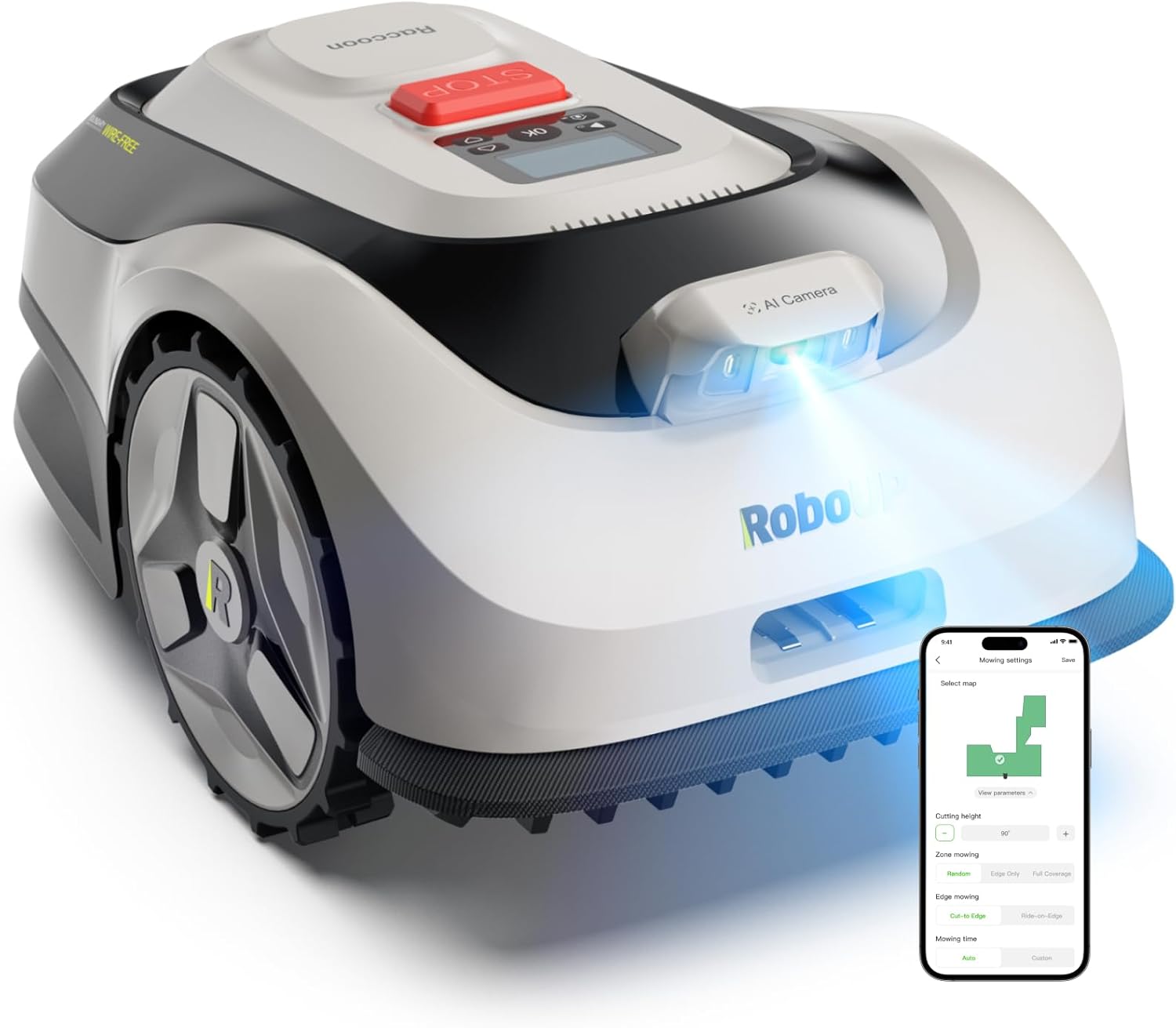
RoboUP Raccoon 2 SE Robot Lawn Mower (Wire-Free, for up to 0.15 Acre)
| Power Source | Battery Powered |
|---|---|
| Operation Mode | Automatic |
| Maximum Adjustable Cutting Height | 3.15 inches |
| Minimum Adjustable Cutting Height | 1.18 inches |
| Number of Positions | 5 |
The Raccoon 2 SE is a wire‑free robot mower built for small yards and straightforward layouts. It auto‑maps your lawn and can start with a single button press or be managed via app, offering scheduled mowing, multi‑zone support and electric height adjustment for a cleaner, more consistent cut. The mower uses AI vision and bumper sensors to avoid people, pets and common obstacles, handles slopes up to 36 percent, and will climb modest obstacles and navigate narrow passages. A 5Ah battery delivers long runtime and fast 70‑minute recharge cycles while the unit automatically returns to its dock when the battery is low or rain is detected. Practical benefits include quiet operation, OTA updates, and safety features such as lift and tilt detection and IPX6 water protection. Limitations to consider are the small coverage area limited to about 0.15 acre, the relatively narrow 7.9‑inch cutting width which increases run time on larger lawns, and the expectation that clearly defined boundaries or optional stakes are needed for optimal guidance on open edges.
Best for: Buyers who want a budget‑minded, low‑effort upgrade from push mowers for a small, well‑defined yard and value simple setup, quiet operation and app scheduling.
Less Ideal for: Owners of larger, irregular or heavily landscaped properties who need wider cutting decks, higher coverage area, or advanced RTK navigation for complex boundaries.
- Wire‑free auto mapping and one‑touch start for quick setup on simple lawns
- AI vision plus bumper sensors for obstacle avoidance and safe operation
- Long runtime from a 5Ah battery with 70‑minute fast recharge
- Handles steep slopes up to 36 percent and can climb small obstacles
- App control, scheduling and OTA updates for ongoing improvements
- Designed for small lawns only with a maximum recommended area of about 0.15 acre
- Narrow 7.9‑inch cutting width increases time needed on larger or complex yards
- May require optional boundary stakes for reliable edge control in open areas
Verdict: A practical, feature‑focused robotic mower for small yards that minimizes setup and hands‑on mowing while delivering quiet, app‑controlled performance.
LEBOSBO V3 AI Vision Robotic Lawn Mower (1600 sq ft)

| Power Source | Battery Powered |
|---|---|
| Operation Mode | Automatic |
| Maximum Adjustable Cutting Height | 2.4 inches |
| Minimum Adjustable Cutting Height | 0.8 inches |
| Cutting width | 6.3 inches |
The LEBOSBO V3 is a plug-and-play robotic mower aimed at homeowners with small lawns who want reliable, low-effort grass maintenance. It uses AI vision to identify lawn edges and obstacles so you can skip perimeter wire installation, and the included 32 ft magnetic strip lets you create no-mow zones quickly. You control scheduling and modes through a smartphone app, and the mower operates quietly while cutting between 0.8 and 2.4 inches with a 6.3-inch cutting width. Practical benefits include reduced manual mowing, easy setup for nontechnical users, and the ability to protect flower beds or play areas with magnetic strips. Limitations to expect are a random mowing pattern that can take longer to fully cover complex layouts and a recommendation to manually trim very tall grass before use since the mower may treat dense, tall patches as obstacles. For routine maintenance on a small, mostly flat yard this model offers dependable convenience, but it is less suited to larger lawns or highly irregular terrain.
Best for: Homeowners who prioritize a dependable, low-maintenance solution for a small, mostly flat lawn and want a simple setup with app control rather than complex wiring.
Less Ideal for: Owners of large properties, highly irregular yards, or lawns with frequent tall or dense grass who need faster systematic coverage or heavy-duty cutting power.
- AI vision navigation removes need for perimeter wires for most yards
- Includes 32 ft magnetic strip to quickly define no-mow zones
- Smartphone app lets you schedule and monitor mowing remotely
- Low-noise operation suitable for daytime or evening use
- Random mowing pattern may require more time to fully cover complex lawns
- May struggle with grass taller than about 2.6 inches and requires pre-cutting taller growth
Verdict: Choose the V3 if you want a quiet, easy-to-install robotic mower that reliably maintains small lawns without perimeter wires.
ECOVACS GOAT O1000 RTK Care Robot Lawn Mower (Wire-Free, RTK Navigation)

| Power Source | Battery Powered |
|---|---|
| Operation Mode | Automatic |
| Battery Average Life | 90 minutes |
| Maximum Adjustable Cutting Height | 3.2 inches |
| Minimum Adjustable Cutting Height | 1.2 inches |
The ECOVACS GOAT O1000 RTK Care is a wire-free robot mower designed to replace routine mowing on small suburban lawns. It uses RTK satellite positioning to follow efficient, systematic paths rather than random wandering, which yields cleaner lines and consistent coverage without perimeter wires. Setup centers on placing the RTK antenna and using the included extension cable for stronger signal in yards with trees or structures, then mapping zones in the app to schedule automatic mowing and recharging. Practical benefits include quiet operation at about 62 dB, adjustable cutting height between 1.2 and 3.2 inches, and a CARE bundle that supplies 36 extra replacement blades to reduce maintenance trips. Battery runtime is listed at about 90 minutes, which is suitable for many quarter-acre properties but may require recharges on larger or dense lawns. The mower is plastic-bodied and relatively heavy, so occasional manual handling for transport or cleaning is needed. It is best for homeowners who value set-and-forget convenience and precise navigation in a small to medium yard.
Best for: Homeowners who want reliable, low-effort lawn maintenance for a small to medium yard and who prefer precise navigation and app control over fiddly perimeter wiring.
Less Ideal for: People with large lawns well above a quarter acre, very steep or highly irregular terrain, or those who need an ultra-light unit for frequent manual carrying.
- RTK navigation provides centimeter-level positioning for systematic, accurate mowing without boundary wires
- Wire-free operation simplifies installation compared with perimeter-cable systems
- Includes 36 extra blades to extend maintenance intervals and keep cutting performance consistent
- App-based auto mapping and multi-zone scheduling make hands-off lawn management straightforward
- Relatively quiet at around 62 dB for minimal neighborhood disturbance
- Battery runtime of about 90 minutes may require returns to dock on larger or dense yards
- Plastic construction and 44.5 lb weight mean occasional effort is required to move or service the unit
Verdict: Choose this mower if you want a wire-free, RTK-guided robot that delivers precise, low-maintenance mowing and includes extra blades for long-term upkeep.
ECOVACS GOAT O1000 RTK Robotic Lawn Mower

| Power Source | Battery Powered |
|---|---|
| Operation Mode | Automatic |
| Maximum Adjustable Cutting Height | 3.2 inches |
| Minimum Adjustable Cutting Height | 1.2 inches |
| Number of Positions | 11 |
The ECOVACS GOAT O1000 RTK is a self‑navigating robotic lawn mower designed to maintain small to mid‑sized yards without perimeter wires. It scans and builds an editable map of your lawn, then follows efficient U‑shaped mowing patterns and a TruEdge routine to deliver consistent edge‑to‑edge cuts. The mower is battery powered and controlled through a smartphone app where you can set no‑go zones, adjust cutting height and speed, and schedule runs for different areas. Notable features include RTK positioning for accurate boundary recognition, AIVI 3D obstacle avoidance that detects pets and small objects, and an IPX6 waterproof rating for wet conditions. Practical benefits are low hands‑on time once the map is established, fewer missed spots near edges, and the ability to tailor behavior by zone. Important limitations are its modest 8.66-inch cutting width which means longer run times on larger properties, and a slimmer, lightweight plastic body that may be less durable under frequent heavy use compared with heavy commercial mowers.
Best for: Homeowners who want a low‑hands‑on, worry‑reducing mower for a modestly sized yard and value safety features and accurate mapping over bulky commercial power.
Less Ideal for: Those with large properties, commercial mowing needs, or buyers who need a wider cutting path and a heavy industrial build should look at larger, more rugged machines.
- RTK and automated mapping remove the need to install perimeter wire
- 3D AIVI obstacle avoidance reduces collisions with pets and garden objects
- App control with editable maps and zone customization simplifies scheduling and settings
- IPX6 waterproofing lets it operate reliably in wet weather
- Narrow 8.66-inch cutting width increases run time on larger lawns
- Plastic construction and consumer weight suggest lighter-duty build compared with heavy commercial units
Verdict: If you want a low‑maintenance, perimeter‑wire‑free mower with strong obstacle detection and precise mapping for a small to mid‑sized yard, the GOAT O1000 RTK is a practical choice.
Choosing the Right Garden Robotic Lawn Mower: Key Factors to Consider
Cutting System and Finish
The cutting system determines the lawn appearance after each cycle. A mower with a well-designed cutter deck and sharp, replaceable blades produces finer clippings that mulch back into the grass rather than leaving ragged edges. Blade placement and cutting width influence how many passes are needed and how quickly the mower covers the lawn.
For lawns with thin turf or uneven areas, look for a unit that offers multiple cutting heights and a consistent blade-to-ground relationship. Frequent short cuts are the typical robotic mower approach, so the system should produce even clippings without scalping or creating striping.
Navigation Method and Boundary Detection
Navigation affects how thoroughly and efficiently the mower covers complex yards. Some mowers use perimeter wires to define the mowing area, while others use GPS-assisted path planning or ultrasonic sensors. Perimeter wire systems are reliable in compact, well-defined lawns but require layout time and occasional adjustment. GPS or sensor-based systems reduce setup but can struggle near dense obstacles or in tight garden beds.
Pay attention to how the mower detects narrow passages, handles obstacles, and returns to charge. Reliable boundary detection prevents accidental mowing of flower beds or stepping onto driveways.
Battery Life and Charging Behavior
Battery runtime determines how much lawn a single cycle can cover and how often the mower needs to recharge. Longer runtime reduces the need for frequent returns to the charging base, which is helpful for larger plots. Also consider how the mower schedules charging: intelligent units resume where they left off and manage charge cycles to complete coverage rather than starting over.
Battery type affects longevity and replacement costs. Look for systems that balance runtime with charging speed and that can complete typical weekly mowing without constant recharges.
Slope Capability and Traction
Many gardens have gradients and banks that challenge smaller machines. Slope capability is expressed as a maximum gradient the mower can safely climb while maintaining traction. Drive wheel design, weight distribution, and traction treads all influence performance on inclines and wet grass.
If your yard has steep sections, prioritize models rated for higher slopes and test for wheel slip and turning ability. Poor slope handling leads to missed areas, stalled blades, or excessive wear on the drive system.
Safety Features and Noise Level
Robotic mowers operate autonomously in open spaces, so safety features are essential. Look for collision sensors, lift and tilt shutoffs, and PIN or geo-fencing options that prevent unauthorized operation. Some mowers include child-lock modes or alarms that trigger if the unit is lifted.
Noise level matters if the mower will run during early morning or evening hours. Quieter units allow more flexible schedules and reduce disturbance for neighbors, while louder machines may be limited to daytime operation.
Durability and Weather Tolerance
Because these machines live outdoors, construction quality and weatherproofing determine service life. Sealed electronics, corrosion-resistant materials, and sturdy casings help a mower tolerate rain, dew, and frequent exposure. Also consider how easily the unit can be cleaned after mowing damp grass or debris.
Maintenance access for blades and underside clearing influences long-term reliability. Durable units that are simple to maintain reduce downtime and repair needs over multiple seasons.
Which Lawns Work Best for a Robotic Mower
Robotic mowers are ideal for small to medium lawns with mostly continuous turf and moderate complexity. They excel on lawns without too many tight garden beds, steep steps, or frequent loose debris. Regular, short mowing cycles suit turf health and keep clippings fine enough to mulch.
Lawns with many narrow corridors, dense shrub borders, or frequent obstacles may still work but will need careful planning of boundary layout and possibly additional sensors. Very large or highly irregular estates often remain better served by ride-on or professional mowing services.
- Best fit: compact to medium lawns with gentle slopes
- Less ideal: yards with many isolated islands or narrow passages
- Consider perimeter planning for gardens with complex beds
Planning Installation and Boundary Layout
Installation usually involves placing a charging base on level ground and defining the mowing area. Perimeter wire methods require staking and routing a wire around beds, trees, and driveways. Plan wire placement so the mower has clear approach paths and does not cross planting beds.
For GPS or sensor-based units, map out obstacle locations and consider adding low-profile markers to help the mower detect tricky spots. Give the base station an unobstructed approach and a short, clear path for the mower to return for charging.
- Choose a base site that is protected from standing water
- Keep charging contacts clear of debris for reliable recharging
- Plan access routes so the mower can reach all turf areas
Seasonal Care and Winter Storage
Robotic mowers are not always intended to run year-round. In colder climates, store the unit indoors during winter or follow the manufacturer's guidelines for cold-weather operation. Remove batteries for long-term storage when recommended and clean the cutting area before storing to prevent corrosion.
During the growing season, check blades frequently and inspect wheels for wrapped grass or debris. Running short, frequent mowing cycles reduces strain on both the blades and the battery compared with long, infrequent sessions.
- Clean underside and blades before seasonal storage
- Store in a dry, frost-free location when not in use
- Charge batteries per storage recommendations to prolong life
Maintenance Tasks You Will Do Regularly
Expect to perform simple upkeep such as blade replacement, underside cleaning, and perimeter wire inspections. Blades wear with use and should be replaced or sharpened according to cutting frequency and the condition of your turf. Clearing grass build-up prevents clogging and reduces motor load.
Check tire treads, test sensors periodically, and ensure firmware updates are applied if supported. Keeping the charging contacts and base area free of vegetation ensures consistent charging cycles and reduces failed starts.
- Routine blade checks every few weeks during peak season
- Weekly removal of debris from wheels and underside
- Periodic software or firmware updates when available
Integrating a Robotic Mower Into Garden Routines
Use the mower's scheduling features to align with times when neighbors are less likely to be disturbed and when grass is dry for cleaner cuts. Coordinate other garden tasks, such as aeration or overseeding, around the mower schedule to avoid interference.
If you use a sprinkler system, schedule watering so the mower runs on dry grass. Also plan manual interventions like edging and trimming in areas the mower cannot reach, and consider a short hand-mowing session for fine detail work.
- Run mowing on dry days for best finish
- Combine robotic mowing with occasional hand-trimming
- Adjust schedules seasonally as grass growth rate changes
How We Chose the Best Garden Robotic Lawn Mower
We prioritized characteristics that determine how a garden robotic lawn mower performs in everyday yard conditions. Key evaluation criteria included cutting performance and deck design for an even finish, navigation systems and boundary sensing for reliable coverage, battery life and recharge patterns for uninterrupted schedules, slope handling and traction for inclined lawns, and durability plus weather resistance for season-long outdoor use. We assessed ease of setup and maintenance because simpler installation and blade access reduce time spent tinkering. Noise levels and safety features were also considered since they affect where and when a mower can run. We excluded units that are clearly underspecified for typical small and medium lawns or that lack essential safety or navigation capabilities. We also excluded specialty units intended only for very large commercial turf. The remaining picks were chosen to represent a range of yard shapes, runtimes, and feature sets that match common homeowner needs.
FAQ
Can a robotic lawn mower handle lawns with trees and garden beds?
Often yes, but performance depends on boundary setup and the mower's navigation system. Perimeter wiring or accurate sensor mapping keeps the mower away from trees and beds, though narrow passages or many obstacles may require additional planning or manual trimming.
How steep a slope can these mowers manage?
Slope capability varies by model and drive system. Many residential units handle gentle to moderate slopes reliably, while steeper banks may cause wheel slip or missed areas. Check slope ratings and prioritize traction features for inclined yards.
Will a robotic mower mulch grass clippings finely enough for the lawn?
Usually yes. Robotic mowers are designed for frequent, short cuts that produce small clippings which return nutrients to the turf. Ensure blades remain sharp and cutting height is set appropriately to avoid clumping.
How often do I need to replace blades and batteries?
Blade replacement depends on usage and terrain and often occurs more frequently than with traditional mowers because of constant short cycles. Batteries typically last multiple seasons but degrade over time; replacement frequency depends on charge cycles and storage practices.
Can these mowers run in the rain?
Many models tolerate light rain and damp grass, but heavy rain or standing water can damage electronics or reduce traction. It is safer to avoid mowing in heavy wet conditions and to choose units with good weather sealing if your climate is wet.
Are robotic mowers noisy for early morning operation?
They tend to be quieter than gas mowers, which allows earlier or later operation in many neighborhoods. Noise levels still vary between units, so check decibel ratings if quiet operation is important for your schedule.
Final Verdict
Choosing the right garden robotic lawn mower comes down to matching machine capabilities to your lawn layout, slope, and mowing expectations. Prioritize consistent cutting performance and reliable navigation for tidy coverage, then weigh battery runtime and weather tolerance against the size and complexity of your yard. Safety features and ease of maintenance reduce hands-on time. For most small to medium lawns, a mower that balances dependable boundary control with solid battery life and simple upkeep will deliver the best day-to-day results. Focus on the tradeoffs that matter most for your garden and pick the features that make autonomous mowing genuinely lower-maintenance for you.
