

Note: This article contains affiliate links. If you click on these links and make a purchase, I may earn a small commission at no extra cost to you. This helps support my research and content. Read my full affiliate disclosure here.
Quackgrass spreads through tough, long underground rhizomes, so choosing the right herbicide for quackgrass is about controlling roots without wrecking desirable turf or garden plants. You want a product that weakens or kills the rhizomes, fits your planting situation, and can be applied safely according to your lawn or garden schedule. This guide shortlists the top options and explains how we judged them on control strength, selectivity, and application safety. Below you will find practical notes on what to expect from each type of herbicide and the evaluation criteria used to pick these seven top-rated options.
Top Picks at a Glance
| Best Overall The best all-around choice for most situations | Tenacity Turf Herbicide, 8 fl oz |  |
| Best Quality Built to a higher standard if you want something more solid | Ornamec Over-The-Top Grass Herbicide, 1 Quart |  |
| Best Value The sweet spot between price and what you get | Compare-N-Save Glyphosate Concentrate Herbicide, 1 Gallon |  |
| Best Budget The cheapest option that still gets the job done reliably | Ortho WeedClear Lawn Weed Killer Ready-to-Spray, 32 fl. oz. |  |
| Highest Rated A top-rated pick with lots of positive feedback | Quali pro Quinclorac 1.5L Liquid Herbicide |  |
| Most Popular A crowd favorite that many people choose with confidence | Spectracide Weed & Grass Killer with AccuShot Power Sprayer, 1.33 gal |  |
| Best Seller A high-volume bestseller chosen again and again | Roundup Weed & Grass Killer4 with Pump 'N Go 2 Sprayer, 1.33 gal |  |
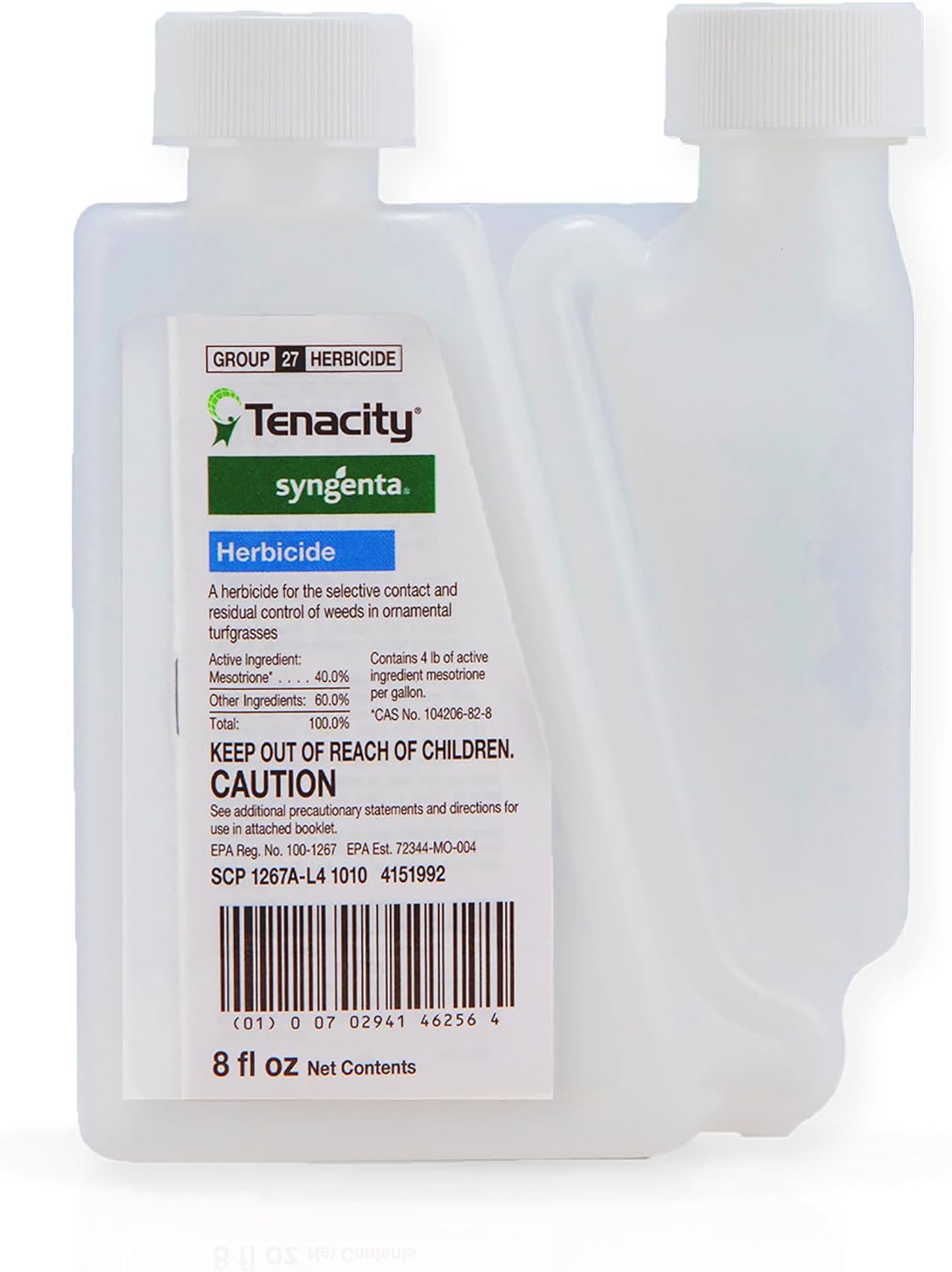
Tenacity Turf Herbicide, 8 fl oz
| Unit Count | 8 Fluid Ounces |
|---|---|
| Item Form | Liquid |
| Coverage | 2000 ft^2 per 1sp of product |
| Active Ingredients | Mesotrione |
Tenacity Turf Herbicide is a liquid mesotrione formulation designed for both pre-emergent and post-emergent weed control in turfgrass. It is typically mixed and applied with a garden sprayer to treat lawns where selective control is needed for problems such as crabgrass, clover, dandelion, chickweed and several grassy weeds. The product offers systemic action plus residual control, so it can prevent emerging weeds as well as suppress established ones, and the stated coverage makes the 8-ounce bottle suitable for treating several hundred to a couple thousand square feet when mixed per label directions. Practical benefits include broad-spectrum activity against common lawn weeds and a long shelf life when stored properly. Limitations are that it is a chemical herbicide that requires careful application to avoid non-target damage, specific turfgrass and timing restrictions on the label, and it does not replace cultural lawn care practices for long-term weed prevention.
Best for: Homeowners who want a balanced, science-backed herbicide to control a variety of common lawn weeds and who are comfortable following label directions for selective turf treatments.
Less Ideal for: People seeking an organic or non-chemical lawn solution or those unwilling to follow application timing and turf-specific restrictions should consider other options.
- Selective control for many grassy and broadleaf lawn weeds using mesotrione
- Works as both pre-emergent and post-emergent, offering residual suppression
- Liquid formulation that mixes for sprayer application and even coverage
- Long shelf life when stored away from direct sunlight and extreme temperatures
- Requires careful adherence to label restrictions to avoid harm to desirable turf and nearby plants
- Not a standalone solution for long-term turf health without complementary cultural practices
Verdict: Choose Tenacity when you need a reliable selective herbicide that provides both pre-emergent and post-emergent control of common turf weeds.
Ornamec Over-The-Top Grass Herbicide, 1 Quart

| Unit Count | 32 Ounce |
|---|---|
| Item Form | Spray |
| Coverage | Annual |
| Active Ingredients | Herbicide |
Ornamec Over-The-Top is a concentrated post-emergent herbicide designed to control unwanted grasses in and around ornamentals without requiring soil incorporation. It is mixed with water (8 to 10 ounces per gallon) and applied with a hand or backpack sprayer; the formulation includes a nonionic surfactant to improve uptake. In practice it stops visible grass growth within 48 hours and typically produces complete control in one to three weeks, which makes it useful for managing bermudagrass, crabgrass, dallisgrass, and quackgrass in beds and container production. The label lists over 400 ornamentals safe for over-the-top use, so it is practical for professional landscape maintenance and nursery situations where selective grass control cuts hand-weeding time. Important limitations are the need to follow label directions closely to avoid phytotoxicity on sensitive species and to mix accurately for effective coverage; it is not a pre-emergent and will not prevent future grass seedlings from emerging.
Best for: Landscape professionals, nursery growers, and serious home gardeners who need a reliable post-emergent solution to remove established grassy weeds around ornamentals and reduce hand-weeding labor.
Less Ideal for: Gardeners seeking a preventive soil treatment or those with many highly sensitive species that require strictly directed spot treatments instead of over-the-top applications.
- Fast action that halts grass growth within about 48 hours
- Label permits over-the-top application on more than 400 ornamental species
- Includes surfactant in the premix to improve herbicide uptake
- Effective against tough grassy weeds such as bermudagrass and quackgrass
- Not a pre-emergent so it does not prevent new grass seedlings
- Requires careful mixing and application to avoid damage to sensitive plants
Verdict: Choose Ornamec when you need a fast, label-approved over-the-top herbicide to selectively kill established grasses around ornamentals and cut weeding time.
Compare-N-Save Glyphosate Concentrate Herbicide, 1 Gallon

| Active Ingredients | glyphosate |
|---|---|
| Liquid Volume | 1 gallons |
| Item Form | Spray |
| Coverage | 25000 square_feet |
This 1-gallon concentrate uses glyphosate to provide fast post-emergent control of most annual and perennial weeds and grasses. Mixed with water at the recommended rates, it makes up to about 85 gallons of ready-to-use spray, letting you treat driveways, fences, pathways, garden edges, and areas being prepared for planting without buying multiple ready-to-use bottles. It is rainproof in roughly two hours and typically shows visible dieback within 2 to 4 days because the active ingredient moves to the root. The label notes higher mixes for stubborn perennials and suggests avoiding spray drift since it will kill any green plants it contacts. Important practical considerations are following safety directions, using protective gear, and observing replanting intervals for edible gardens. This product is efficient for large or repeated clearing tasks but requires careful handling and precise application to avoid harming desirable plants.
Best for: Buyers who want a cost-effective concentrate to clear large areas of weeds, renovate beds, or prepare planting sites and who are comfortable following label safety and mixing instructions.
Less Ideal for: Gardeners who need a selective or gentler option for spot-treating weeds among desirable plants or those unwilling to use a strong synthetic herbicide.
- High-concentration formulation stretches to make a large volume of spray for broad coverage
- Glyphosate active ingredient translocates to roots for effective kill of perennial weeds
- Rainproof within about two hours, reducing risk of wash-off after application
- Versatile use areas including driveways, fence lines, walkways, brush control, and site prep
- Nonselective herbicide that will kill any green plant it contacts, requiring strict application control
- Contains glyphosate and requires protective equipment and careful handling due to health and safety warnings
Verdict: A concentrated, budget-friendly glyphosate herbicide for efficiently killing and clearing weeds across large outdoor areas when used with proper safety precautions.
Ortho WeedClear Lawn Weed Killer Ready-to-Spray, 32 fl. oz.

| Item Form | Spray |
|---|---|
| Coverage | 5000 square_feet |
| Liquid Volume | 32 fluid ounces |
| Active Ingredients | 2,4-D; Quinclorac; Dicamba |
Ortho WeedClear Ready-to-Spray is a convenient hose-end weed killer formulated to remove common lawn weeds like dandelion, clover, chickweed and crabgrass with one application. You attach the sprayer to a garden hose, switch it on, and spray evenly until the turf surface is wet; the formula claims visible results in hours and becomes rainproof within one hour. Notable features include coverage for up to 5,000 square feet from a single 32 fl. oz. bottle and active ingredients used for broadleaf and grassy weed control. The main practical benefits are speed and ease of use: no measuring, mixing or separate sprayer required, and it is labeled for many common lawn grasses when used as directed. Important limitations are that it is not safe for several warm-season or specialty turf types and must be applied within recommended temperature ranges; treated areas should be kept off-limits to people and pets until dry. For spot treatments or small lawns the ready-to-use format saves time, but repeat applications or tougher weeds may require follow-up.
Best for: Homeowners who want an affordable, no-fuss way to treat common lawn weeds quickly across a typical yard without mixing concentrates or renting equipment.
Less Ideal for: Gardens with sensitive ornamentals, specialty turf types, or large-scale professional treatments that need wholesale weed control or year-long prevention.
- Ready-to-use hose-end applicator requires no mixing or extra equipment
- Covers up to 5,000 sq. ft. from a single 32 fl. oz. bottle
- Fast-acting formula with visible results in hours and rainproof in one hour
- Labeled safe for many common lawn grasses when directions are followed
- Not safe for several turf types and ornamental areas, limiting where it can be used
- Effectiveness on very large, established or resistant weeds may require repeat applications
Verdict: A straightforward, cost-conscious ready-to-spray option for DIY homeowners who need fast, easy control of common lawn weeds across a typical yard.
Quali pro Quinclorac 1.5L Liquid Herbicide

| Liquid Volume | 1.5 liters |
|---|---|
| Item Form | Liquid |
| Coverage | Crabgrass and broadleaf weeds |
| Active ingredient concentration | 17.79% Quinclorac |
This 1.5 liter liquid formulation of quinclorac is built for dependable crabgrass and broadleaf weed control across lawns and commercial turf. It is mixed into spray applications and used on residential lawns, golf courses, athletic fields, and other turf areas to target crabgrass, foxtail, kikuyugrass, bindweed, clover, dandelion, and similar weeds. Notable features include a 17.79% active ingredient concentration, a formulation that mixes well with minimal agitation even in cold water, and fast plant uptake with rainfast protection in under an hour. In practice it offers professional-strength performance that reduces repeat treatments when applied correctly, and the liquid form makes measuring and dissolving straightforward. Important limitations are that it is a specialized turf herbicide rather than a general garden weed killer and it requires correct application timing and coverage for best results; it is intended for turf areas, so users must follow label directions to avoid damage to desirable plants. For buyers who prioritize consistent, effective weed control, it performs like a professional-grade option.
Best for: Buyers who need reliable, professional-level control of crabgrass and common turf weeds for lawns, sports fields, or commercial turf and who follow label directions for safe application.
Less Ideal for: Gardeners looking for a multipurpose weed killer for flower beds, vegetable gardens, or non-turf ornamentals should choose a product labeled for those uses instead.
- Professional-strength active ingredient (17.79% quinclorac) for wide spectrum turf weed control
- Liquid formulation mixes easily with minimal agitation, including in cold water
- Fast plant uptake and becomes rainfast in under one hour for quicker results
- Suitable for both residential lawns and larger turf areas like golf courses and athletic fields
- Specialized for turf use and not appropriate for general garden beds or non-turf ornamentals
- Requires correct application timing, dilution, and label compliance to avoid turf or non-target plant injury
Verdict: Choose this product for dependable, professional-grade crabgrass and turf weed control when you need fast, rainfast results.
Spectracide Weed & Grass Killer with AccuShot Power Sprayer, 1.33 gal

| Unit Count | 170 Fluid Ounces |
|---|---|
| Item Form | Spray |
| Coverage | 1 gallon |
| Active Ingredients | Diquat Dibromide 0.12%, Fluazifop-p-butyl 0.06%, Dicamba 0.04% |
Spectracide Weed & Grass Killer is a ready-to-use non-selective herbicide intended for clearing weeds and grasses on patios, driveways, walkways and around fences or beds. The formula acts through leaf contact and moves to the root, with visible browning in as little as three hours and rainfast protection after about 15 minutes. The bundled AccuShot sprayer is battery powered and provides continuous spray with an extendable wand for improved accuracy and less hand fatigue than a manual pump sprayer. Practical benefits include the ability to treat around hard surfaces and replant in treated areas after a short waiting period. Important limitations are that it will kill any plant it touches so careful aiming is required, the sprayer relies on four AA batteries and needs occasional maintenance, and the product is toxic to aquatic life so it should not be used near water. Follow label safety guidance and PPE recommendations when applying.
Best for: Buyers who prioritize reliable, fast spot or surface weed control and want a powered sprayer to reduce hand fatigue and improve accuracy while treating hardscape and border areas.
Less Ideal for: Gardners or yard owners who need selective lawn-safe weed control or who regularly work near ponds, streams, or other water features should choose a different product.
- Kills weeds and grasses down to the root for longer-lasting control
- AccuShot battery-powered wand provides continuous spray and extendable reach for accuracy
- Fast visible results in as little as three hours and rainfast in about 15 minutes
- Can be used on hard surfaces and around borders where non-selective control is desired
- Non-selective formula will damage desirable plants if contacted
- Requires four AA batteries for the AccuShot sprayer and periodic maintenance
- Not suitable for use near water due to aquatic toxicity
Verdict: Choose this if you want a fast-acting, non-selective weed killer with a battery-powered wand for accurate, low-effort applications on hardscapes and borders.
Roundup Weed & Grass Killer4 with Pump 'N Go 2 Sprayer, 1.33 gal

| Unit Count | 170 Fluid Ounces |
|---|---|
| Item Form | Spray |
| Coverage | 300 Square_Feet |
| Active Ingredients | Triclopyr, Triethylamine Salt, Fluazifop-P-Butyl, Diquat Dibromide |
This packaged Roundup kit combines a 1.33 gallon formulated weed-and-grass killer with a Pump 'N Go 2 sprayer, letting you treat patches of weeds and grassy intruders without mixing chemicals or carrying a separate sprayer. The extendable wand and up to 10 minutes of continuous spray make targeted application around flower beds, patios, gravel, and edges easier and reduce bending. The formula claims visible results in hours, becomes rainproof in about 30 minutes, and permits replanting within the stated window. Practical benefits include convenience of an integrated sprayer, good coverage for small to medium areas, and a broad activity spectrum against dandelions, crabgrass, clover, and other common broadleaf weeds. Important limitations are safety precautions and restricted access after application since it is an herbicide that can harm desirable plants and requires protective clothing and keeping people and pets away until dry. Also, this product is for spot and surface treatments rather than long-term lawn renovation or nonchemical weed control approaches.
Best for: Buyers who want a convenient, ready-to-use herbicide for spot-treating visible weeds and grass around hardscapes and landscape beds and who prefer an integrated sprayer to simplify application.
Less Ideal for: People seeking organic, nonchemical weed control or a product for large-scale lawn renovation should consider alternative methods or professional services.
- Includes Pump 'N Go 2 sprayer with extendable wand for accurate, continuous spray
- Ready-to-use formulation so no measuring or mixing is required
- Produces visible results in hours and is rainproof in about 30 minutes
- Designed for use around beds, patios, driveways, gravel, and edging
- Contains potent active ingredients that require safety precautions and restrict access to treated areas
- Not suitable for nonchemical or preventive long-term weed management
Verdict: If you want a no-mixing, spot-treatment herbicide with a built-in sprayer for quick, targeted weed control, this all-in-one Roundup kit is a practical choice.
Choosing the Right Herbicide for Quackgrass: Key Factors to Consider
Efficacy Against Rhizomes
Quackgrass survives and spreads through long underground rhizomes, so surface wilting does not indicate success. A herbicide that can translocate into the root and rhizome system is more likely to give lasting control. Gardeners should look for products whose labeled claims include suppression or control of perennial grassy weeds and rhizomes.
Repeated follow-up treatments are often necessary because established rhizome networks can send up new shoots from stored energy. Expect to monitor treated patches for several weeks and reapply according to label directions when regrowth appears.
Selectivity and Lawn Safety
Selectivity determines whether the herbicide will harm desirable turfgrass or ornamentals. Some active ingredients target grasses broadly and will damage turf, while other chemistries are more selective for grassy weeds when used at correct rates. Consider the grass species in your lawn and any nearby ornamental beds when choosing a product.
If you need to preserve a specific turf type, choose an approach with a labeled tolerance for that grass or plan to spot-treat rather than broadcast-spray. Misapplication can kill patches of lawn or nearby plants, so reading the label for compatibility is crucial.
Application Timing and Method
Timing affects translocation into rhizomes. Applications when plants are actively growing and moving carbohydrates down into roots-typically spring and fall-tend to be more effective. Hot, drought-stressed, or frost-damaged plants may not translocate herbicide as well, reducing efficacy.
Method matters too. Spot treatments concentrate the herbicide on problem clumps and reduce non-target exposure. Broadcast applications may be needed for large outbreaks but require careful calibration of equipment and rates to avoid harming desirable plants.
Residual Activity and Re-treat Needs
Some herbicides leave residual activity in the soil that can prevent quick replanting or affect nearby seedlings. If you plan to reseed or transplant into an area after treatment, check the product's residual profile and recommended wait times.
Low-residual options reduce planting delays but may require more frequent reapplication. Choose a balance based on whether you need a quick return to planting or a longer suppression window to exhaust the quackgrass rhizome reserve.
Environmental and User Safety Considerations
Herbicide choice should factor in runoff risk, label precautions for pollinators, and re-entry intervals. Products vary in toxicity to aquatic life and beneficial insects, and some require strict buffer zones near water or bloom periods.
Personal protective equipment needs and cleanup procedures differ by formulation. Gardeners should follow label directions for gloves, eye protection, and clothing, and be aware of any special instructions for disposal or accidental spills.
Cost Versus Treatment Strategy
The total cost of control includes the herbicide, any specialized application equipment, and follow-up treatments. Concentrated formulations can be more economical per treated area but require careful measuring and mixing. Ready-to-use sprays are convenient for spot treatments but may cost more per square foot.
Match the product form to your treatment strategy: small spots are often handled with ready-to-use or small concentrates, while larger infestations benefit from bulk concentrates and proper calibration of spreaders or sprayers.
Preparing the Site for Treatment
Before applying any herbicide, remove surface debris and mow or cut back quackgrass to improve spray contact. Shorter foliage concentrates spray droplets on actively growing tissue, which helps translocation into the root system.
Mark desirable plantings and protect them with physical barriers or by wetting and covering to reduce drift. Check weather conditions and avoid spraying when wind or heavy rain is forecasted within 24 hours.
- Mow quackgrass low several days before application to stimulate fresh growth
- Water the area a day or two before if plants are drought stressed, but avoid wet foliage at spray time
- Use cardboard or plastic shields to protect nearby plants during spot treatments
Spot Treatment Versus Broadcast Application
For small patches, spot treatment limits herbicide use and reduces risk to nearby turf. Use a targeted applicator tip or a handheld sprayer to apply product directly to quackgrass foliage and avoid overspray.
Broadcast application may be necessary for widespread infestations but requires accurate calibration of sprayer output and careful rate calculations to avoid turf injury. Consider splitting large treatments into two passes at label rates rather than overapplying once.
- Spot treatment: best for isolated clumps and sensitive landscapes
- Broadcast treatment: suited to heavy infestations in non-sensitive areas
- Calibrate sprayers on a small test area before treating the whole lawn
Integrated Control: Combining Mechanical and Chemical Methods
Mechanical control such as digging or repeated shallow tilling can remove or weaken rhizome masses but often leaves fragments that regrow. Combining physical removal with timed herbicide applications improves long-term suppression.
Divide larger infestations into manageable zones. Use mechanical removal where practical, then follow up with targeted herbicide applications on regrowth to reduce rhizome reserves over a season or two.
- Dig out intensely infested clumps when practical, removing as much rhizome as possible
- Follow mechanical removal with a timed herbicide application on any regrowth
- Monitor and retreat treated zones through the growing season
Reseeding and Replanting After Treatment
Wait times for reseeding or replanting depend on the herbicide's residual activity. Read the product label for recommended intervals before establishing new turf or ornamentals.
For low-residual treatments, you may be able to overseed within weeks, while longer-residual chemistries can require months. If quick restoration is a priority, choose a product labeled for short replant intervals and plan follow-up spot treatments as needed.
- Check label for specific wait times before seeding or transplanting
- Lightly rake and monitor for quackgrass regrowth before planting
- Consider temporary cover crops or mulches in longer wait periods to suppress regrowth
Safety and Environmental Best Practices
Always follow personal protective equipment guidance on the label and mix only the amount needed for the job. Store concentrates securely out of reach of children and pets and clean application equipment thoroughly after use.
Minimize runoff by avoiding application before heavy rain and maintain buffer zones near water features. Dispose of rinse water and leftover product per local regulations and label directions.
- Wear recommended gloves, eye protection, and long clothing during mixing and application
- Avoid spraying on windy days or when rain is expected within 24 hours
- Rinse sprayers in a designated area away from desirable plants and water sources
How We Chose the Best Herbicide for Quackgrass
We focused on products and formulations that are commonly used to manage perennial grassy weeds that spread via rhizomes and roots. Selection emphasized demonstrated control of underground growth, reduced impact on desirable turf or ornamentals when applied correctly, and clear instructions for timing and reapplication. We prioritized formulations with evidence-based application windows for lawns, gardens, or non-crop areas and those with guidance for spot treatment versus broadcast use. Concrete evaluation criteria included efficacy against rhizomes and regrowth, selectivity for common turf and ornamental plants, application flexibility and timing, and safety guidance for users and non-target plants. We also considered ease of use in the field, including mixing, spotting, and cleanup procedures. Products were excluded if they lacked credible application instructions for home lawns and gardens, did not address perennial grass rhizomes, or had unclear re-entry and environmental guidance. The resulting shortlist favors herbicides that balance strong quackgrass suppression with practical safety and application features.
FAQ
When is the best time to apply herbicide for quackgrass?
Applications are usually most effective when quackgrass is actively growing and moving carbohydrates into roots, commonly in late spring and early fall. Avoid treating during drought stress, extreme heat, or immediately before frost, because translocation to rhizomes may be reduced.
Can I reseed my lawn immediately after treating quackgrass?
That depends on the herbicide's residual activity. Some products allow seeding within a few weeks, while others require several months. Check the product label for specific replanting intervals and plan accordingly.
Is spot treatment better than spraying the whole lawn?
Spot treatment is usually preferable when infestations are localized because it minimizes non-target damage and reduces product use. Broadcast spraying can be appropriate for large, widespread problems but requires careful calibration and compatible turf species.
Will one treatment eliminate quackgrass permanently?
Often not. Established rhizome networks store energy and can resprout, so multiple treatments or an integrated approach combining mechanical removal and follow-up applications are commonly necessary for long-term control.
How can I protect nearby ornamentals during application?
Use physical barriers, spray shields, or wet and cover sensitive plants to reduce drift. Apply herbicide on calm days and use targeted applicator tips to limit overspray. Read the label for specific drift precautions.
Are there environmental risks I should be aware of?
Yes. Some herbicides can be toxic to aquatic life, pollinators, or non-target plants. Observe buffer zones near water, avoid spraying during bloom periods when pollinators are active, and follow disposal instructions to minimize environmental impact.
Final Verdict
Choose an herbicide for quackgrass that matches your planting situation and long-term plans. Prioritize products with proven translocation into rhizomes if sustained control is the goal, and select formulations that are compatible with your turf or nearby ornamentals. Balance residual needs against reseeding plans, and be prepared to follow up with mechanical or repeat treatments for stubborn infestations. With careful timing, accurate application, and attention to safety instructions, you can significantly reduce quackgrass presence while protecting desirable plants and the surrounding environment.
