

Note: This article contains affiliate links. If you click on these links and make a purchase, I may earn a small commission at no extra cost to you. This helps support my research and content. Read my full affiliate disclosure here.
Choosing the right fertilizer for flowering plants makes a visible difference in bloom size, color intensity, and how long flowers stay on the plant. Whether you have containers on a sunny patio, a perennial border, or potted annuals for a small balcony, the right feed supports bud formation and sustained flowering. This guide covers seven shortlisted fertilizers that suit a range of flowering situations and gardener preferences. We evaluate each option on nutrient balance, application method, and how it fits common garden uses so you can pick a practical feed that matches your planting style.
Top Picks at a Glance
| Best Overall The best all-around choice for most situations | Miracle-Gro Water Soluble Bloom Booster Flower Food, 10-52-10, 1 lb |  |
| Best Quality Built to a higher standard if you want something more solid | FoxFarm Big Bloom Liquid Plant Food, 16 fl oz |  |
| Best Value The sweet spot between price and what you get | Miracle-Gro Water Soluble Bloom Booster Flower Food, 4 lb |  |
| Best Budget The cheapest option that still gets the job done reliably | Miracle-Gro Water Soluble All Purpose Plant Food, 1.5 lb |  |
| Highest Rated A top-rated pick with lots of positive feedback | FoxFarm Tiger Bloom Liquid Plant Food, 16 fl oz |  |
| Most Popular A crowd favorite that many people choose with confidence | Miracle-Gro Water Soluble All Purpose Plant Food, 5 lb |  |
| Best Seller A high-volume bestseller chosen again and again | TPS NUTRIENTS African Violet Liquid Fertilizer, 8 oz |  |
Miracle-Gro Water Soluble Bloom Booster Flower Food, 10-52-10, 1 lb

| Item Form | Liquid |
|---|---|
| Application Method | Water Soluble |
| Coverage | 500 square feet |
| Target Species | all blooming plants |
| Mixing Ratio | 1 tablespoon/gallon (1.5 tsp/gal for indoor) |
Miracle-Gro Bloom Booster is a water-soluble flower food formulated with a high phosphorus ratio to encourage bigger blooms and stronger color in flowering annuals and perennials. You mix it with water—one tablespoon per gallon for outdoor use or a reduced rate for indoor plants—and apply every 7 to 14 days during bud set and bloom. The formula feeds quickly through roots and leaves, works with watering cans or the Miracle-Gro garden feeder, and claims coverage of roughly 500 square feet per refill. Practical benefits include fast visible results, easy mixing instructions, and compatibility with both containers and in-ground plantings. Limitations to expect are the need for regular reapplication during the growing season and care to follow label rates to avoid overfeeding; it is a bloom-focused formula and not balanced for foliage or long-term soil building. For gardeners seeking an easy-to-use boost for flower production, this product performs predictably when used as directed.
Best for: Gardners who want an easy, reliable way to boost flower size and color during the blooming season and prefer clear, repeatable application steps.
Less Ideal for: Those looking for a balanced all-season fertilizer or a product focused on long-term soil health and nutrient buildup should consider a different formulation.
- High phosphorus formulation to promote bigger, more abundant blooms
- Fast-acting water-soluble formula that feeds through roots and leaves
- Simple mixing ratios and flexible application by watering can or garden feeder
- Suitable for both containers and in-ground flowering annuals and perennials
- Requires frequent reapplication during bloom period to maintain effect
- Focused on bloom stimulation rather than overall soil nutrition
Verdict: Use this water-soluble, high-phosphorus booster when you want quick, easy improvement in flower size and color during bloom.
FoxFarm Big Bloom Liquid Plant Food, 16 fl oz

| Item Form | Liquid |
|---|---|
| Specific Uses For Product | Organic |
| Application Method | watering can, sprayer, or drip system |
| Liquid Volume | 16 fluid ounces |
FoxFarm Big Bloom is a concentrated liquid bloom fertilizer intended for flowering and fruiting plants. It mixes with water (manufacturer recommends about 4 tablespoons per gallon) and can be applied with a watering can, sprayer, or through a drip system, so it fits routine watering schedules and irrigation setups. The formula highlights organic inputs such as bat guano and earthworm castings and is OMRI listed for organic gardening, which means it supplies readily available nutrients without synthetic sources. In practice it gives a quick nutrient boost that can help struggling plants recover and extend bloom and fruiting periods when used every other watering. The flexible application methods and full-coverage claim make it useful in containers, beds, and raised rows. Important limits are that it contains phosphorus, so local runoff rules may restrict use on some lawns, and concentrated liquids require careful measuring to avoid overfeeding. Expect steady bloom support rather than instant dramatic changes in plant size.
Best for: Gardeners focused on boosting flower and fruit production who want an organic, easy-to-apply liquid fertilizer that integrates with existing watering routines and irrigation systems.
Less Ideal for: People who need a phosphorus-free fertilizer for turf or who prefer slow-release granular formulas that require less frequent application.
- Organic, OMRI-listed ingredients including bat guano and earthworm castings for natural nutrient sources
- Fast-acting liquid formula that can be taken up quickly by plants
- Compatible with watering cans, sprayers, hose-end applicators, and drip systems for flexible application
- Formulated to support blooms and fruiting across all growth stages
- Contains phosphorus which may be restricted by local runoff regulations
- Concentrated liquid requires careful measuring and mixing to avoid overapplication
Verdict: Choose Big Bloom when you want an OMRI-listed liquid fertilizer that quickly supports more blooms and fruit while fitting into standard watering and irrigation systems.
Miracle-Gro Water Soluble Bloom Booster Flower Food, 4 lb

| Item Form | Powder |
|---|---|
| Application Method | Water Soluble |
| Target Species | flowers |
| Mixing Ratio | 1 tablespoon per gallon |
This Bloom Booster is a water‑soluble powder designed to give flowering plants a quick dose of bloom‑promoting nutrients. Mix the recommended amount into a watering can or use with the Miracle‑Gro Garden Feeder and apply every 7 to 14 days during the growing season. The high phosphorus formula (10-52-10) is aimed at increasing flower production and enhancing color, which makes it useful for containers, window boxes and in‑ground annuals and perennials. Practical benefits include an easy mixing ratio (1 tablespoon per gallon for outdoor use), fast uptake because it is water soluble, and compatibility with common watering tools. Important limitations are that it is a targeted bloom formula rather than an all‑purpose feed, so it is not ideal as a sole long‑term tonic for foliage development or nonflowering plants, and frequent applications are required to maintain results.
Best for: Gardeners who prioritize maximizing flower production and color in containers or garden beds and want a convenient, fast‑acting booster they can add to routine watering.
Less Ideal for: Those seeking a single product to feed foliage, lawns, or long‑term balanced nutrition for all plant types should look for an all‑purpose or slow‑release fertilizer instead.
- High phosphorus NPK (10-52-10) specifically formulated to boost blooms and color.
- Water‑soluble powder for fast nutrient uptake and easy mixing.
- Works with a watering can or the Miracle‑Gro Garden Feeder for flexible application.
- Clear mixing instructions (1 tablespoon per gallon outdoor) simplify dosing.
- Focused on bloom promotion so it does not prioritize leaf growth or general balanced nutrition.
- Requires frequent reapplication (every 7–14 days) to maintain flowering results.
Verdict: Choose this Bloom Booster if you want a convenient, water‑soluble fertilizer that reliably increases flower production and color.
Miracle-Gro Water Soluble All Purpose Plant Food, 1.5 lb

| Item Form | Powder |
|---|---|
| Application Method | Watering Can |
| Target Species | All flowers, vegetables, trees, shrubs and houseplants |
| Mixing Ratio | 24-8-16 |
Miracle-Gro Water Soluble All Purpose Plant Food is a powder fertilizer you dissolve in water to feed flowers, vegetables, houseplants, shrubs and trees. It is typically mixed into a watering can or used with a garden feeder and applied to the soil at the plant base every 7 to 14 days outdoors or every two weeks for indoor plants. The 24-8-16 NPK formula supplies a high dose of nitrogen for leafy growth while still providing phosphorus and potassium for blooms and root development. Because it is water-soluble it starts working quickly and is convenient for regular, targeted feedings in containers and in-ground beds. Practical benefits include easy measuring with the included scoop, compatibility with common watering workflows, and coverage suitable for small to medium flower beds. Important limitations are the relatively high nitrogen ratio which may favor foliage over blooms if overused and the need for frequent reapplication versus slow-release granular options. Gardeners should follow mixing rates to avoid overfeeding and pair this product with bloom-focused feeding if the primary goal is more abundant flowering.
Best for: Gardeners on a budget who want a single, easy-to-use feed for a mixed collection of flowering plants and container displays and are willing to feed regularly for quick results.
Less Ideal for: Growers seeking a low-frequency, slow-release fertilizer or those who prioritize maximum flower production without additional bloom-specific supplements.
- Water-soluble formula that feeds plants quickly when mixed and applied
- Broadly labeled for use on flowers, vegetables, houseplants, trees and shrubs
- Includes scoop and straightforward mixing instructions for watering-can or feeder use
- High nitrogen content supports vigorous vegetative growth and fast green-up
- High nitrogen ratio may reduce flower production if used too frequently without bloom-specific feeding
- Requires regular reapplication every 1 to 2 weeks rather than providing long-term slow release
Verdict: A fast-acting, budget-friendly soluble plant food that makes regular feeding simple for mixed flower beds and containers.
FoxFarm Tiger Bloom Liquid Plant Food, 16 fl oz
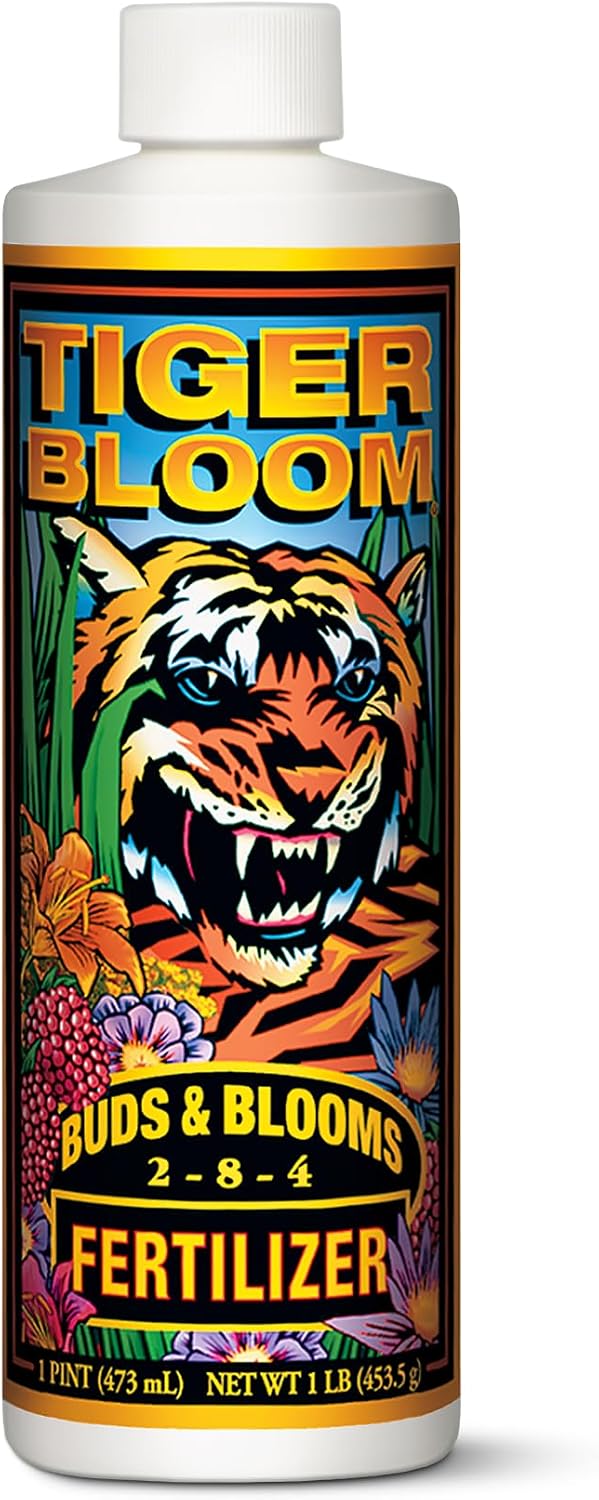
| Nutrient ratio | 2-8-4 |
|---|---|
| Form | Liquid |
| Application | Watering; Foliar spraying |
| Specific uses | Hydroponic |
| Mixing ratio | 1:200 or 1:300; 2-3 tsp/gal (regular), 4 tsp/gal (heavy) |
Tiger Bloom is a concentrated liquid fertilizer designed to encourage abundant buds, blooms, and fruit by supplying a phosphorus‑heavy 2‑8‑4 nutrient profile. Use it during the flowering phase by diluting the concentrate into irrigation water or applying as a foliar spray; the product lists mixing guidance of about 2 to 3 teaspoons per gallon for regular feeding and up to 4 teaspoons for heavier feeding. It works in both soil and hydroponic setups and is formulated for quick nutrient uptake and stable micronutrient availability thanks to its low pH. Practical benefits include easy measuring, compatibility with common watering routines, and a small 16 ounce bottle that is convenient for hobby and small-scale growers. Important limitations are that the formula is phosphorus‑focused so it should be used specifically for flowering stages rather than general vegetative feeding, and local restrictions on phosphorus use near water bodies should be checked before applying on turf or large landscapes.
Best for: Gardeners who prioritize consistent, reliable bloom support for flowering plants and want a ready‑to‑use liquid fertilizer that fits into regular watering or hydroponic schedules.
Less Ideal for: People seeking a single all‑season fertilizer for both vegetative growth and flowering or those managing large landscapes where low‑phosphorus restrictions or bulk purchasing are primary concerns.
- High phosphorus formula targeted to boost buds and flower development
- Suitable for both soil and hydroponic systems for flexible use
- Quick nutrient uptake and low pH for micronutrient stability
- Clear mixing instructions make dosing straightforward for routine feeding
- Focused on flowering stage so not ideal as an all‑purpose fertilizer
- Small bottle size may require frequent repurchasing for larger plantings
Verdict: Choose Tiger Bloom when you want a dependable, phosphorus‑focused liquid fertilizer to reliably push buds and blooms in soil or hydroponic flowering cycles.
Miracle-Gro Water Soluble All Purpose Plant Food, 5 lb

| Item Form | Powder |
|---|---|
| Application Method | watering can |
| Target Species | all plants |
| Mixing Ratio | 24-8-16 |
This water-soluble Miracle-Gro formula is a straightforward boost fertilizer for flowering plants and general garden use. Dissolve the powder in a watering can or feeder and apply to the soil around container or in-ground plants; the small scoop is for houseplants and the larger scoop for outdoor use. Its 24-8-16 NPK blend supplies a high nitrogen dose that encourages vigorous green growth and helps support larger flowers when paired with regular watering and light management. The product works quickly because nutrients are immediately available to roots, and a 5 lb bag covers a large area so you do not need to refill often. Limitations to note are the high nitrogen ratio, which can favor foliage over bloom if overused, and the need to follow mixing directions to avoid overfeeding. Also this is a water-soluble powder rather than a slow-release option, so it requires repeat applications every 1 to 2 weeks for best results.
Best for: Buyers who want a proven, fast-acting fertilizer to quickly correct nutrient needs and support bigger flowering displays and vigorous garden growth, backed by widespread positive reviews.
Less Ideal for: Gardeners seeking a low-maintenance, slow-release feeding plan or those who prefer organic or specialty bloom-boost formulas should consider alternatives.
- Fast-acting water-soluble formula delivers nutrients immediately to roots
- Versatile for indoor and outdoor use including containers, flowers and vegetables
- Large 5 lb size covers a substantial garden area before needing replacement
- Includes measured scoop sizes and clear mixing instructions for easy dosing
- High nitrogen ratio may encourage leafy growth more than blooms if used excessively
- Requires frequent reapplication compared with granular slow-release fertilizers
Verdict: Choose this if you want a reliable, fast-acting water-soluble fertilizer that feeds a wide range of flowering plants and shows visible results quickly.
TPS NUTRIENTS African Violet Liquid Fertilizer, 8 oz

| Item Form | Liquid |
|---|---|
| Specific Uses For Product | Plant Food |
| Coverage | Medium |
| Target Species | African Violet |
| Mixing Ratio | 1:128-1:256 |
This TPS NUTRIENTS African Violet liquid fertilizer is designed for delicate indoor flowering plants and delivers a dilute, easy-to-use feed aimed at promoting continuous blooms and healthier leaves. It comes as an 8 fl oz bottle with instructions to dilute 5 to 10 drops per quart of water, or follow the listed mixing ratio of 1:128–1:256, and to feed every two weeks. The liquid form reduces risk of salt buildup compared with granular feeds and the product emphasizes gentle nutrition to avoid burning sensitive roots. Practical benefits include simple measured dosing, suitability for routine watering, and a formula targeted to rebloom cycles and root support. Limitations are the small bottle size for larger collections and the need to follow precise dilution to avoid over- or under-feeding; this is not a one-application concentrated solution and requires regular biweekly use for best results.
Best for: For cautious indoor gardeners who prioritize gentle, plant-specific nutrition and prefer a low-risk liquid feed for maintaining regular blooms on African violets and similar flowering houseplants.
Less Ideal for: Not a good fit for growers who want an all-in-one, infrequent-use fertilizer or who need concentrated bulk fertilizer for large collections or outdoor beds.
- Formulated specifically for African violets and other sensitive indoor flowering plants
- Liquid concentrate allows even feeding and lower risk of salt buildup
- Very dilute mixing ratios reduce chance of root burn when used as directed
- Clear directions for dilution and biweekly feeding make it easy for routine care
- Small 8 oz bottle may require frequent replacement for larger collections
- Requires careful measurement and regular application to be effective
Verdict: A gentle, easy-to-dosage liquid fertilizer aimed at safely encouraging repeat blooms on African violets and other sensitive flowering houseplants.
Choosing the Right Fertilizer for Flowering Plants: Key Factors to Consider
Nutrient Ratio and Formulation
Flowering plants rely on an appropriate balance of nitrogen, phosphorus, and potassium, with phosphorus and potassium often encouraging bud set and flower development. Look for formulations that list a bloom-focused N-P-K profile and consider whether micronutrients like magnesium, iron, and trace elements are included.
How the fertilizer presents those nutrients matters too. Water-soluble formulas deliver immediately available nutrients, which can be useful during active bloom phases, while controlled-release granules feed steadily over weeks. Choose a formulation that matches how quickly you want results and how often you want to apply feed.
Application Method
Different application methods suit different planting situations. Liquid feeds are fast-acting and ideal for container-grown annuals or when you need an immediate boost before a showy bloom. Granular and slow-release options reduce frequency of feeding and work well in beds and larger borders.
Foliar sprays can correct micronutrient deficiencies quickly but are not a substitute for balanced root-feeding. Consider accessibility, how often you realistically will feed, and whether you need a method that works well for hanging baskets or high containers.
Release Profile and Longevity
Release profile determines how often you must reapply and how consistent nutrient supply will be. Quick-release fertilizers show fast effects but can create nutrient peaks and require more frequent applications. Slow-release or coated granules provide steadier supply and lower the risk of root burn.
For long flowering seasons, a steady, low-dose feed is often safer and more convenient. Match release longevity to your maintenance rhythm and the length of the plant's bloom period to avoid lapses or excesses.
Plant Safety and Salt Accumulation
Some fertilizers can increase soluble salts in potting mixes or soil, which stresses roots and reduces flowering. Materials with high salt indices or that require frequent concentrated applications raise that risk, especially in containers with limited leaching.
Choose formulations labeled safe for the plant types you grow, and follow recommended dosages. Consider occasional flushing for containers and monitoring for signs of burn or leaf browning after feeding.
Ease of Use and Measurement
Practical considerations like how easy a product is to measure, mix, and apply determine whether you will use it consistently. Premeasured spikes and slow-release granules minimize effort, while concentrates require careful dilution.
Clear directions and simple dosing reduce errors. If you maintain many pots or a large border, low-labor options can save significant time over a season, while small-scale gardeners may prefer the precision of liquid feeds.
Compatibility with Growing Conditions
Different flowering plants and growing environments have varied needs. Acid-loving shrubs, container annuals, and Mediterranean shrubs may prefer different nutrient balances and feeding cadences. Soil type, irrigation frequency, and sunlight levels also influence how plants uptake nutrients.
Match the fertilizer to both the plant species and the environment. For example, fast-draining soils or frequent irrigation can flush nutrients more rapidly and may favor slow-release forms, while shaded sites with slower growth may need lighter feeding.
When to Feed Flowering Plants
Timing feed applications to the plant's growth cycle makes the fertilizer more effective. Begin a regular feeding schedule when active growth and bud formation start, and taper off after major bloom flushes unless a specific formulation is intended for continuous bloom support.
For spring-flowering perennials, a light feed as shoots emerge and a second dose at bud set usually suffices. For summer annuals and repeat-blooming shrubs, feeding every few weeks with a balanced or bloom-focused formula keeps flowers coming.
- Start feeding at first sign of active growth.
- Avoid heavy late-season feeding on plants that need to harden off before cold weather.
- Adjust frequency based on observed vigor and bloom set.
Feeding Containers Vs In-Ground Plants
Containers hold limited soil and are prone to rapid nutrient depletion and salt buildup. Use either frequent light liquid feeds or a controlled-release granule designed for pots. Ensure containers have good drainage and occasionally flush the mix to prevent salt accumulation.
In-ground plants have more buffering capacity but can still benefit from targeted feeding at bud set or during prolonged blooming. Slow-release options are low maintenance for large beds, while spot-feeding with liquids works well for specimen plants.
- Containers: favor soluble feeds or specialized slow-release pot formulas.
- Beds: granular slow-release or occasional liquid boosts at key times.
- Hanging baskets benefit from regular liquid feeds for consistent bloom.
Correcting Common Nutrient Issues
Yellowing leaves, poor bud set, or dull flower color often point to specific nutrient shortages. Nitrogen deficiency shows as general yellowing and weak growth, while poor flowering with lush leaf growth can indicate excessive nitrogen relative to phosphorus and potassium.
Use targeted formulas or supplemental micronutrient sprays to correct specific shortages. Always confirm the problem by observing growth patterns and, when in doubt, start with milder feeds to avoid overcorrection and further stress.
- Poor bud formation: consider boosting phosphorus and potassium.
- Yellowing between veins: test for iron or magnesium deficiency.
- Excessive leaf growth with few flowers: reduce nitrogen-rich feeding.
Organic Vs Synthetic Options
Organic fertilizers release nutrients more slowly as microbes break down materials and often add organic matter to the soil. They can improve soil life and are less likely to cause quick nutrient spikes, but their effects take longer to appear.
Synthetic formulas provide predictable, fast-acting nutrient availability and are easier to tailor for bloom promotion. Many gardeners use a combination: organic base amendments for soil health and occasional synthetic boosts when immediate flowering response is desired.
- Organic: slower release, improves soil structure and biology.
- Synthetic: fast results, precise nutrient control.
- Consider a mixed approach for both soil health and quick bloom support.
Practical Tips for Application and Storage
Follow label instructions for dilution and frequency to avoid overfeeding. Measure carefully when using concentrates and keep a feeding calendar to avoid accidental double applications. When applying granular products, work them into the soil surface and water in so nutrients reach roots.
Store fertilizers in a cool, dry place away from children and pets. Keep bags and containers sealed to prevent moisture clumping or nutrient loss, and rotate stock so older material is used first.
- Use clean measuring tools and avoid guessing doses.
- Water after applying granules to move nutrients to the root zone.
- Label storage containers and keep them dry to preserve effectiveness.
How We Chose the Best Fertilizer for Flowering Plants
We prioritized products that specifically support bud set and sustained flowering, and evaluated items across four to six measurable dimensions gardeners care about. Key criteria included nutrient ratio and bioavailability to judge how well a fertilizer supplies the macro- and micronutrients flowers need. We assessed application methods and flexibility to account for container gardeners, in-ground beds, and hanging baskets. Release profile and longevity were examined to determine how often gardeners must reapply and the risk of nutrient spikes or deficiencies. Ease of use and safety considerations were reviewed so common mistakes such as overfeeding can be minimized. We excluded broad, non-flowering-specific soil amendments and products intended only for lawns or non-flowering edible crops. Final selections favored formulations and delivery systems that reliably support flower development across typical garden conditions.
FAQ
How often should I feed flowering container plants?
Often depends on the feed type. Water-soluble fertilizers are usually applied every one to two weeks during active bloom, while slow-release granules can last several months. Check the product guidance and watch plant response to adjust frequency.
Can too much fertilizer reduce flowering?
Yes. Excessive nitrogen encourages leaf growth at the expense of blooms, and overfeeding can cause root stress from salt buildup. Use balanced or bloom-focused feeds and avoid heavy applications.
Is a bloom booster necessary for all flowering plants?
Not always. Many established perennials and shrubs bloom well with a balanced fertilizer or good soil health. Bloom boosters are helpful for annuals, containers, and plants that need extra phosphorus and potassium to improve bud set.
When is the best time of day to apply liquid feed?
Apply liquid feed in the morning or late afternoon when temperatures are cooler to reduce stress and evaporation. Avoid mid-day application in hot sun to prevent leaf scorch and rapid nutrient loss.
Will organic fertilizers make flowers less showy than synthetic ones?
Organic feeds release nutrients more slowly, so results appear more gradually, but they do not inherently make flowers less showy. Over time, improved soil health from organics can support robust flowering; synthetics give quicker visible responses.
Final Verdict
Prioritize a fertilizer that matches how you grow flowering plants and the results you want. Balance targeted nutrients for bud setting with an application method you will follow consistently, and watch for signs of overfeeding or deficiency. Focus on nutrient ratio, release profile, and plant safety when choosing a feed. With a suitable formula and a modest, regular feeding routine, you can encourage larger, longer-lasting blooms while avoiding common pitfalls.
