

Note: This article contains affiliate links. If you click on these links and make a purchase, I may earn a small commission at no extra cost to you. This helps support my research and content. Read my full affiliate disclosure here.
Choosing the right garden bed fertilizer shapes how well vegetables, flowers, and ornamentals establish, bloom, and set fruit. The wrong formula can leave soil unbalanced, create weak growth, or require frequent corrective amendments. This guide focuses on carefully shortlisted options that work in typical garden beds and raised beds, showing how they behave in real yard and container-adjacent growing situations. We evaluated products for nutrient composition, release type, soil compatibility, and gardener-friendly application methods. Below you will find the top picks and the reasoning behind them, followed by what matters most when selecting a fertilizer for your garden beds.
Top Picks at a Glance
| Best Overall The best all-around choice for most situations | Dr. Earth Organic Tomato, Vegetable & Herb Fertilizer (4 lb) |  |
| Best Quality Built to a higher standard if you want something more solid | Down To Earth Organic Vegetable Garden Fertilizer 4-4-4, 5 lb |  |
| Best Value The sweet spot between price and what you get | Jobe's Organics Granular Tomato & Vegetable Fertilizer, 4 lb |  |
| Best Budget The cheapest option that still gets the job done reliably | Miracle-Gro Shake 'N Feed All Purpose Plant Food, 1 lb |  |
| Highest Rated A top-rated pick with lots of positive feedback | BRUT Worm Castings Organic Plant Food, 5 lb |  |
| Most Popular A crowd favorite that many people choose with confidence | Miracle-Gro Shake 'N Feed All Purpose Plant Food, 4.5 lb. |  |
| Best Seller A high-volume bestseller chosen again and again | Osmocote Smart‑Release Plant Food Plus Outdoor & Indoor, 1 lb |  |
Dr. Earth Organic Tomato, Vegetable & Herb Fertilizer (4 lb)

| Item Form | Granules |
|---|---|
| Specific Uses For Product | Organic |
| Coverage | Medium |
| Target Species | Herb |
| Unit Count | 64 Ounce |
This 4 lb Dr. Earth organic granular fertilizer is made for home vegetable gardens, raised beds and containers and is intended to boost yield and flavor in tomatoes, vegetables and herbs. It supplies a balanced set of primary nutrients in an organic formula and includes probiotic soil microbes and eight strains of mycorrhizae to improve nutrient uptake and drought tolerance. In practice you can work it into planting holes, side-dress established plants, or use it to make compost tea; the brand recommends repeat applications roughly every six weeks for containers. The granules release nutrients quickly and continue feeding for several months, so you will see responses without resorting to synthetic chemicals. Important limitations: it contains phosphorus so local restrictions may apply near waterways and it is sold in a modest 4 lb poly bag, which may be small for larger beds. For gardeners prioritizing organic inputs and healthier soil biology this product delivers clear practical benefits, especially in small to medium vegetable plots and container setups.
Best for: Home vegetable gardeners who want an organic, biologically active fertilizer for raised beds, patio plots and container vegetables and who value improved soil health as well as crop quality.
Less Ideal for: Large-acreage growers or landscapers who need bulk quantities and lower-cost synthetic feeds should look for higher-volume commercial fertilizers.
- Certified organic formula with no GMOs or chemical additives
- Includes multiple strains of beneficial microbes and mycorrhizae to enhance nutrient availability
- Granular form that releases nutrients quickly and provides feeding for months
- Versatile for use at planting, transplanting, side-dressing, containers and compost tea
- Small 4 lb bag may require frequent repurchases for larger garden beds
- Contains phosphorus which may be restricted in some localities
Verdict: Choose this fertilizer if you want an organic, microbe-rich granular feed that improves soil biology and boosts vegetable and herb performance in small to medium garden beds.
Down To Earth Organic Vegetable Garden Fertilizer 4-4-4, 5 lb

| Item Form | Granules |
|---|---|
| Specific Uses For Product | Vegetables, greens, tomatoes, herbs |
| Application Method | Apply directly to the soil or mix into garden beds |
| Mixing Ratio | 4-4-4 |
This granular fertilizer is formulated to feed vegetables, herbs and greens with a balanced 4-4-4 NPK and a slow-release profile that supplies nutrients over time. It is applied by distributing into the planting hole, mixing into topsoil, or working into raised beds at planting and during the season for maintenance. Notable features include all-natural ingredients sourced from plant, marine and mineral resources and OMRI-friendly formulation that supports organic gardening and beneficial soil life. Practically, the slow-release granules reduce the need for frequent feeding and help avoid nutrient spikes that can stress plants. The 5 lb unit is convenient for small to medium beds but means frequent repurchasing for larger plots. While it is versatile across vegetables and herbs, gardeners who need rapid corrective feeding for a specific deficiency will still need a targeted amendment or foliar feed in addition to this product.
Best for: Gardeners who prioritize steady, reliable plant performance and want an organic, low-maintenance fertilizer for raised beds and small plot vegetable production.
Less Ideal for: Growers managing large acreage or those needing immediate corrective nutrient treatments should look for bulk or fast-acting specialty products instead.
- Balanced 4-4-4 NPK suitable for overall vegetable development
- Slow-release granular formula for sustained feeding
- Made from all-natural ingredients and compatible with organic systems
- Easy to apply directly to soil or mix into raised beds
- Small 5 lb size may require frequent replacement for larger gardens
- Not formulated for quick correction of specific nutrient deficiencies
Verdict: Choose this product when you want an organic, slow-release 4-4-4 fertilizer that delivers steady nourishment for productive vegetable beds.
Jobe's Organics Granular Tomato & Vegetable Fertilizer, 4 lb

| Item Form | Granules |
|---|---|
| Specific Uses For Product | Plant Growth, Root Development, Seed Development, Soil Conditioning |
| Target Species | Vegetable and tomato |
| Mixing Ratio | 2-5-3 |
This granular fertilizer is designed for vegetable beds and tomato plants, delivering slow-release nutrition that targets roots over the growing season. You apply it every 4 to 6 weeks by sprinkling the granules around plants or working lightly into the topsoil, which makes it straightforward for routine bed maintenance. The formula is OMRI listed and based on bone meal and processed poultry manure, so it supports fruit and flower production with higher phosphate and modest nitrogen. Practical benefits include steady feeding without frequent reapplication, easy measurement to avoid overfertilizing, and suitability for use around children and pets. It is a good match for organic beds where you want to boost blooms and yields without synthetic inputs. Limitations are that results build over time with repeated applications rather than providing an immediate flush, and the granular form requires manual spreading rather than a liquid feed for quick uptake. Follow label directions for timing and amounts to get the best, predictable results in vegetable garden beds.
Best for: Gardeners who manage raised beds or in-ground vegetable plots and prioritize steady, low-maintenance organic feeding to maximize yields over a season.
Less Ideal for: Growers who need rapid correction of nutrient deficiencies or who prefer water-soluble feeds and fertigation systems for quick uptake.
- OMRI listed for organic gardening
- Balanced 2-5-3 NPK focused on flower and fruit production
- Granular slow-release formula reduces frequency of applications
- Simple application schedule of every 4–6 weeks
- Granular form gives slower, less immediate nutrient uptake than soluble fertilizers
- Requires manual spreading or incorporation into soil
Verdict: A reliable organic granular feed that gives vegetable beds steady, low-effort nutrition to improve blooms and yields across the season.
Miracle-Gro Shake 'N Feed All Purpose Plant Food, 1 lb

| Item Form | Granules |
|---|---|
| Application Method | Shake and work into soil |
| Target Species | Flowers, Vegetables, Herbs |
| Mixing Ratio | 10-10-10 |
Miracle-Gro Shake 'N Feed All Purpose is a granular, slow-release fertilizer designed for in-ground beds and containers. You shake the granules onto the soil around the root zone then lightly work them into the top inch or three and water to activate a feeding that lasts up to three months. The formula includes macronutrients and micronutrients and is intended to nourish both plants and soil microbes to support root development and water efficiency. In practice it is easy to apply across flower beds and vegetable patches, and the 1 lb container covers roughly 30 sq ft so it is handy for small beds or for spot treatments. Limitations to consider are that this is an all-purpose 10-10-10 style product and not tailored to specific crops or bloom-boosting needs, and a small 1 lb size means frequent repurchasing for larger gardens. For routine seasonal feeding of mixed beds it is simple and low-effort, but larger areas will be better served by bulk options or crop-specific fertilizers.
Best for: Home gardeners on a budget who need a simple, low-effort fertilizer for small beds, container gardens, or spot treatments and prefer seasonal, hands-off feeding.
Less Ideal for: Gardeners managing large vegetable plots or beds who want crop-specific NPK formulations or who prefer to buy in bulk to lower per-area cost.
- Slow-release granules feed plants up to three months after a single application
- Works for both in-ground beds and container plants
- Easy to apply by shaking and lightly working into soil
- Contains micronutrients to support root health and soil microbes
- Small 1 lb container covers only about 30 sq ft so not ideal for larger gardens
- All-purpose NPK means it is not specialized for flowering or fruiting boosts
Verdict: A convenient, easy-to-use granular all-purpose fertilizer that delivers three months of feeding for small beds and container gardens.
BRUT Worm Castings Organic Plant Food, 5 lb

| Item Form | Granules |
|---|---|
| Specific Uses For Product | Gardening,Organic |
| Coverage | Full |
| Target Species | All plants |
| Mixing Ratio | 1:5 |
BRUT Organic Worm Castings are a ready-to-use organic soil amendment designed to improve soil fertility, structure, and microbial life. Typically used as a mixing amendment or top dressing, the product is added to potting mixes at a 1:5 ratio for new indoor plants or sprinkled around established plants and worked into garden beds. Notable features include OMRI/CDFA-listed organic castings in granular form, a manufacturer-recommended mixing ratio, and guidance for application rates across seedlings, trees, shrubs, and lawns. In practice this means easier root development, better moisture retention and aeration, and slow-release nutrients that lower the risk of burn compared with synthetic fertilizers. The bag size and granular form make it straightforward to measure and spread, but gardeners managing very large beds will need multiple bags and should plan on repeated seasonal applications for sustained fertility. Also follow safety guidance and use gloves when handling to avoid contact with soil microbes.
Best for: Gardeners who prioritize consistent, natural soil improvement and want a low-risk fertilizer to build long-term fertility in raised beds and container gardens.
Less Ideal for: People who need a one-time, high-nitrogen boost or precise NPK dosing for a large-scale commercial operation should consider concentrated or lab-analyzed fertilizers instead.
- Certified organic castings that supply beneficial microbes and slow-release nutrients.
- Clear application guidance with a 1:5 mixing ratio for potting and specific per-area rates for garden beds and lawns.
- Granular form is easy to mix into soil or spread as a top dressing.
- Suitable for both indoor plants and outdoor garden beds, including seedlings, shrubs, and lawns.
- 5 lb bag requires multiple purchases to treat large garden beds or multiple applications per season.
- No detailed NPK breakdown provided on the product listing for precise nutrient planning.
Verdict: Choose BRUT Worm Castings when you want a reliable, certified-organic soil amendment that steadily improves soil health and plant growth in garden beds and containers.
Miracle-Gro Shake 'N Feed All Purpose Plant Food, 4.5 lb.

| Item Form | Granules |
|---|---|
| Application Method | Shake onto soil and work into top 1-3 inches |
| Target Species | flowers, vegetables, herbs |
| Unit Count | 72 Ounce |
Miracle-Gro Shake 'N Feed is a granular, continuous-release plant food intended for both in-ground garden beds and containers. You sprinkle the granules over soil, work them into the top 1 to 3 inches, then water to activate a slow nutrient release that lasts about three months. The formula includes natural additives that feed soil microbes and supplies micronutrients aimed at stronger roots and improved water efficiency, which can help flowers, vegetables and herbs stay productive through the season. Its dry, no-mix application makes it quick to use for regular maintenance of raised beds or established container plantings. Limitations to expect are that it is a general-purpose fertilizer rather than a crop-specific formula and it relies on correct application rates to avoid overfeeding, so gardeners who want tailored NPK ratios or very fast results will need a different product. For typical garden beds wanting low-effort seasonal feeding this is a convenient choice.
Best for: Gardeners who want a low-effort, reliable seasonal fertilizer for beds and containers and prioritize products with broad user approval and predictable performance.
Less Ideal for: Growers who need crop-specific NPK ratios, rapid foliar feeding, or precise professional-grade formulations should consider specialized fertilizers instead.
- Continuous-release granules feed plants for up to three months per application
- Easy dry application no mixing required for quick seasonal maintenance
- Formulated to support soil microbes and root development
- Suitable for both in-ground beds and container gardens
- All-purpose formula may not match nutrient needs of specialized crops
Verdict: A convenient, long‑lasting granular fertilizer that simplifies seasonal feeding for most garden beds and container plantings.
Osmocote Smart‑Release Plant Food Plus Outdoor & Indoor, 1 lb
| Item Form | Granules |
|---|---|
| Specific Uses For Product | Plant Food |
| Application Method | sprinkle around the base and work into the soil |
| Coverage | Full |
| Unit Count | 16 Ounce |
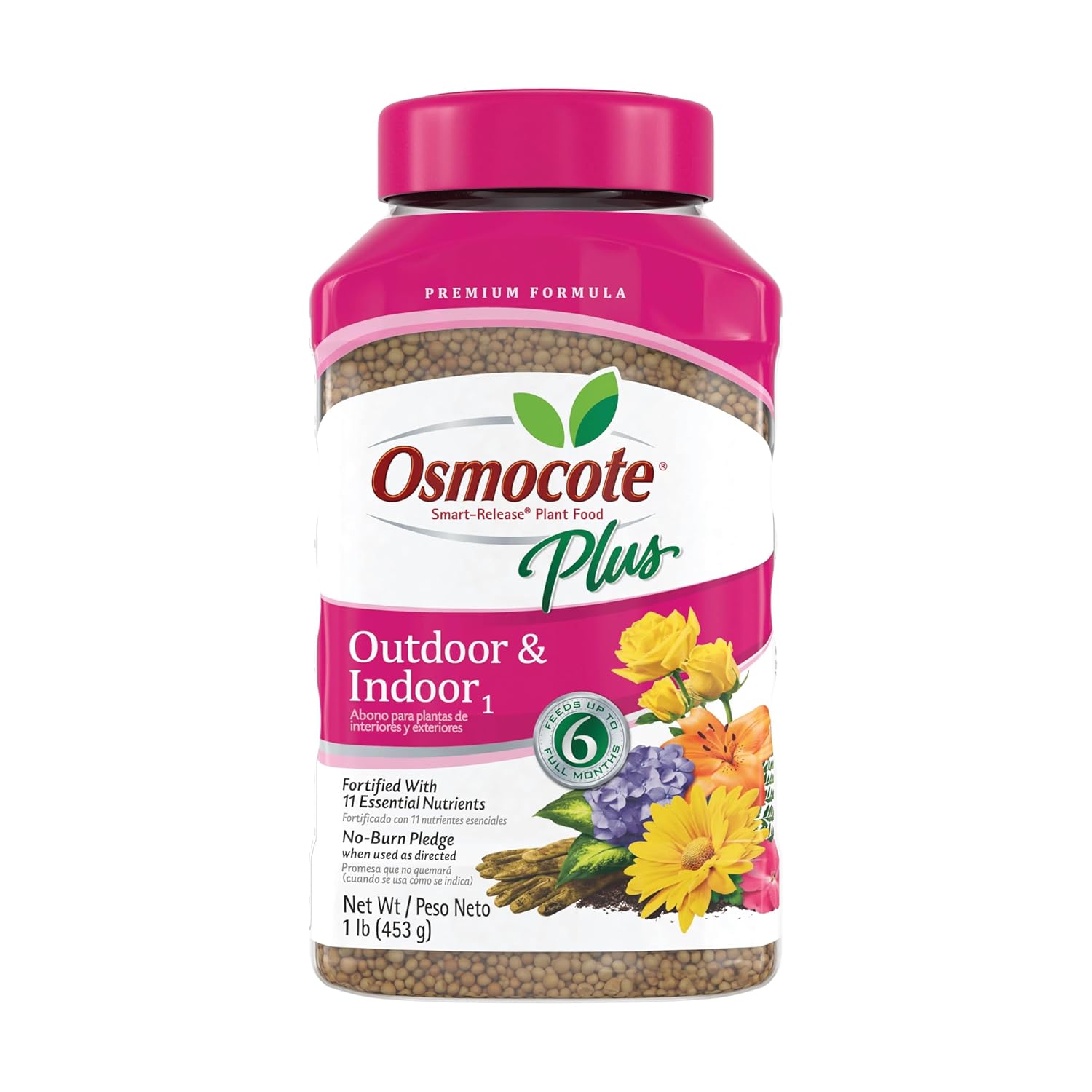
Osmocote Smart‑Release Plant Food Plus is a granular, slow‑release fertilizer designed for containers, raised beds, and in‑ground garden use. You sprinkle the granules around the base and mix lightly into the top inch or two of soil, then water; the resin coating meters nutrients over up to six months so you do not need frequent feeding. It contains 11 essential nutrients and is labeled safe for a wide range of plants including flowers, vegetables, shrubs, and houseplants. Practical benefits include multi‑season coverage from a single application, predictable feeding that reduces the risk of overfertilizing, and a no‑burn pledge when used as directed. Limitations are that coverage from a 1 lb container is modest so larger beds will require multiple units, and precise application rates matter because indoor plants need about half the outdoor rate. Beginners should follow the package dosing and reapply on a six‑month schedule for consistent results.
Best for: Good for gardeners who want a low‑maintenance, reliable fertilizer that reduces the chance of overfeeding and supports mixed beds and container plantings with minimal repeat applications.
Less Ideal for: Not the best choice for gardeners who want fast, immediate nutrient correction or those managing very large garden beds who prefer bulk or custom nutrient mixes.
- Resin‑coated granules release nutrients slowly for up to six months
- Formulated with 11 essential nutrients suitable for many plant types
- Simple application: sprinkle, mix into topsoil, and water
- No‑burn pledge when used according to directions reduces risk of damage
- One‑pound container covers only about 37 sq ft so larger beds need more product
- Indoor use requires halved dosing which adds a step for mixed indoor/outdoor gardeners
Verdict: Choose this if you want a low‑effort, slow‑release fertilizer that feeds a variety of plants for months with minimal risk of burning.
Choosing the Right Garden Bed Fertilizer: Key Factors to Consider
Nutrient Balance and Ratios
The balance of nitrogen, phosphorus, and potassium determines a fertilizer's effect on leaf growth, roots, and flowering. For general garden beds, a moderate N-P-K suited to vegetables and mixed plantings prevents excessive leafy growth or weak flowering.
Pay attention to secondary nutrients like calcium, magnesium, and sulfur, and to micronutrients such as iron and zinc. Beds with known deficiencies can benefit from formulas that include these elements, while neutral soils usually do well with balanced complete fertilizers.
Release Profile and Feeding Frequency
Slow-release formulations provide steady nutrients over weeks to months, reducing the need for frequent applications and lowering burn risk. Quick-release or soluble fertilizers deliver nutrients immediately, which can be useful at planting or during rapid growth phases but may require repeated dosing.
Consider how often you want to work in the bed and whether you need an immediate boost for transplants or a low-maintenance feeding plan. Release profile affects timing of applications relative to planting and harvest cycles.
Soil Type and Compatibility
Loam, clay, and sandy soils take up and hold nutrients differently. Heavy soils retain nutrients longer but may need conditioners to improve root access, while sandy soils leach nutrients more quickly and benefit from slow-release forms and organic matter additions.
Match fertilizer choice to your soil test results when possible. Certain formulas are designed to work well with high-organic beds or amended raised beds, while others presuppose mineral-based, in-ground soil conditions.
Application Method and Workability
Fertilizers come as granules, powders, liquids, or spikes. Granules are often broadcast or side-dressed and work well in larger beds. Liquids and soluble powders are easy to apply for small patches, container-adjacent beds, or foliar feeding. Spikes and time-release pellets offer targeted feeding but can be uneven in mixed beds.
Consider how you normally maintain your beds: if you do frequent light watering, a water-soluble option may be convenient. If you prefer seasonal top-dressing, a granular slow-release product could be a better fit.
Plant Type and Growth Stage
Different crops and flowers have distinct nutrient needs. Leafy greens often benefit from higher nitrogen early on, while root crops and flowering plants need more phosphorus and potassium at key stages. Seedlings and transplants require gentler feeding to avoid burn.
Plan fertilizer timing around growth stages: starter feeds at transplant, balanced maintenance during vegetative growth, and bloom/fruit formulas as plants set flowers and fruit. Using the same fertilizer for all stages can work but may demand careful rate adjustments.
Environmental and Soil-Health Considerations
Look for fertilizers that support soil life rather than harming beneficial microbes. Organic-derived nutrients and products with slow-release carriers tend to be gentler on soil biology. Overapplication of soluble salts can damage roots and increase runoff risk.
Understand how a product breaks down and whether it leaves residues. If you garden near waterways, choose options and application timing that minimize leaching and runoff during heavy rains.
Interpreting Soil Test Results
A soil test is the most reliable way to choose a fertilizer for a garden bed. Tests show pH and nutrient levels so you can match amendment types and rates. For example, low phosphorus indicates a need for a fertilizer with higher P content or a phosphorus-rich organic amendment.
Soil pH affects nutrient availability. If your pH is off, correcting it can be as important as adding nutrients. Use test results to avoid overapplying elements that are already abundant, which can create new imbalances.
- Test every 2 to 4 years for established beds
- Use pH adjustments before heavy nutrient additions
- Target deficiencies rather than blanket feeding when possible
Timing Fertilizer Applications
Timing influences plant response and reduces waste. Apply slow-release fertilizers early in the season so nutrients are available during active growth. Use soluble feeds sparingly during peak growth or to correct temporary deficiencies.
Avoid feeding immediately before heavy rain, which can wash nutrients away. For fall cleanup, reduce nitrogen to encourage plant hardening rather than late tender growth.
- Feed at planting for transplants or seedlings with a light starter dose
- Side-dress heavy feeders mid-season
- Cut back late-season nitrogen to promote dormancy
Combining Organic Matter and Fertilizer
Incorporating compost or well-rotted manure improves soil structure, water retention, and microbial life, helping fertilizers function more effectively. Organic matter acts as a slow nutrient bank and buffers pH swings.
Pairing a modest fertilizer program with regular compost top-dressing reduces dependence on frequent synthetic feeding and supports longer-term fertility in vegetable and flower beds.
- Top-dress with compost annually to build soil
- Use compost teas or extracts cautiously and in rotation with other feeds
- Avoid fresh manure in beds near planting time to prevent seedling burn
Special Considerations for Raised Beds
Raised beds drain faster and can heat up more quickly than in-ground beds, which alters nutrient availability and watering needs. Because they can lose nutrients through leaching, choose slow-release or periodic liquid feeding depending on how often you water.
Consider using a balanced, low-salt fertilizer in raised beds to reduce the risk of salt buildup. Frequent light feedings with soluble fertilizer can work well for high-intensity vegetable beds.
- Monitor moisture closely to avoid nutrient loss
- Replenish organic matter more frequently than in-ground beds
- Watch for faster nutrient depletion in shallow planting mixes
Safe Storage and Handling
Keep dry products in sealed containers to prevent caking and moisture absorption. Liquids should be stored according to label instructions to avoid degradation or contamination. Proper storage preserves product efficacy across seasons.
Handle concentrated fertilizers with gloves and follow mixing instructions carefully. Overmixing or improper dilution can produce overly strong solutions that damage roots or foliage.
- Label containers with purchase and expiration dates
- Store fertilizers away from children and pets
- Keep organic and synthetic products separate to avoid cross-contamination
How We Chose the Best Garden Bed Fertilizer
We prioritized fertilizers that deliver consistent, garden-ready results across a range of soil types and common garden crops. Key evaluation criteria included nutrient balance and N-P-K ratios relevant to general bed use, the release profile that affects feeding frequency and risk of burn, and compatibility with soil biology to support long-term fertility. Application practicality was measured by ease of spreading, mixing, or dissolving, plus clear instructions for common bed sizes. We also looked at formulation stability and storage safety for seasonal gardeners. Environmental considerations such as the presence of slow-release ingredients or organic-derived nutrients guided selections for sustainable garden practices. Excluded items included specialty fertilizers designed solely for houseplants, turf, or industrial agriculture, along with products lacking clear composition data. Our approach favored options that matched the needs of home vegetable and flower beds while minimizing follow-up amendments.
FAQ
How often should I fertilize a garden bed during the growing season?
It depends on the product. Slow-release formulas may only need one application at planting or once early in the season, while water-soluble feeds are often applied every 2 to 4 weeks. Also factor in crop type and soil test recommendations.
Can I use the same fertilizer for vegetables and flower beds?
Often a balanced general-purpose fertilizer works for both, but some vegetables and flowering ornamentals benefit from targeted ratios at certain stages. Adjust application rates rather than switching products unless a specific deficiency is identified.
Will fertilizer change my soil pH?
Some fertilizers influence soil pH over time, particularly those with high ammonium or elemental sulfur components. For significant pH changes, address pH directly with lime or sulfur based on test results rather than relying on fertilizer alone.
Is organic fertilizer always better for garden beds?
Organic fertilizers support soil biology and release nutrients slowly, which is beneficial for long-term soil health. However, they may release nutrients more slowly and can require larger application volumes. Choose based on your management style and crop needs.
How do I avoid fertilizer burn in seedlings and transplants?
Use lower strength starter feeds designed for young plants, apply dilute liquid solutions, or place granular fertilizers away from seedling stems and roots. Always follow label mixing rates and err on the side of underfeeding with new transplants.
Final Verdict
Focus on matching fertilizer type and timing to your soil test results, crop types, and maintenance habits. Prioritize balanced nutrient profiles and appropriate release mechanisms to reduce the need for corrective applications and to protect soil life. Decide whether you want the convenience of slow-release feeding or the control of water-soluble applications, and adjust rates by plant stage and bed type. With attention to soil health and application practices, you can choose a garden bed fertilizer that reliably supports stronger growth and better yields.
