

Note: This article contains affiliate links. If you click on these links and make a purchase, I may earn a small commission at no extra cost to you. This helps support my research and content. Read my full affiliate disclosure here.
Picking the right hand seed spreader matters when you are seeding lawns, patches of wildflower, or vegetable beds where even distribution and seed health count. A well-chosen hand spreader makes it easier to meter seed, avoid clumping, and finish small areas fast without trampling plants. This guide narrows the field to seven top hand seed spreaders that suit patios, small yards, and raised beds. We shortlisted models that balance controlled flow, comfortable handling, and durable construction, and we evaluate them on practical gardener-focused criteria so you can match a tool to the way you work in the garden.
Top Picks at a Glance
| Best Overall The best all-around choice for most situations | Scotts Whirl Hand-Powered Spreader |  |
| Best Quality Built to a higher standard if you want something more solid | SOLO 421S 20 lb Portable Chest-Mount Spreader |  |
| Best Value The sweet spot between price and what you get | CHAPIN 8706G Hand Crank Lawn Spreader |  |
| Best Budget The cheapest option that still gets the job done reliably | CHAPIN 8740A 64 oz Hand Shaker Spreader |  |
| Highest Rated A top-rated pick with lots of positive feedback | ZXJ Handheld Seed Shaker Hand Spreader — 90 oz Capacity |  |
| Most Popular A crowd favorite that many people choose with confidence | Scotts Whirl Hand-Powered Handheld Spreader |  |
Scotts Whirl Hand-Powered Spreader

| Material Type | Metal, Plastic |
|---|---|
| Handle Material | Rubber |
| Capacity Coverage | Up to 1,500 sq. ft. |
| Additional Features | Adjustable Arm Support, Smooth Even Coverage |
The Scotts Whirl is a compact, hand-powered spreader built for small lawns and spot treatments. It comes ready to use and is designed to distribute grass seed, granular fertilizer, ice melt, or salt with an agitator that promotes smooth, even coverage. Its adjustable arm support and light weight make it comfortable for short jobs like overseeding patches, treating narrow strips, or spreading ice melt on walkways. Because it is hand-held and intended for up to 1,500 square feet, it delivers control and reduced waste compared with tossing product by hand. The main limitation is capacity and speed: for larger lawns you will need a wheeled spreader or multiple refills, and fine-tuning the setting for very light seed rates can take a few test passes. Materials are basic metal and plastic with a rubber handle, so it is practical for seasonal use rather than heavy commercial work.
Best for: Homeowners with small lawns or those who need precise control for patch seeding, fertilizing, or winter ice-melting, who prioritize reliability and simplicity over high capacity.
Less Ideal for: Owners of medium to large lawns who need fast coverage or professional users who require higher durability and throughput.
- Compact handheld design ideal for small yards and spot treatments
- Engineered to deliver smooth, even product coverage across application area
- Adjustable arm support increases comfort during use
- Ready to use out of the box with simple hand-powered operation
- Limited capacity suitable only up to about 1,500 sq. ft., requiring frequent refills for larger lawns
- Not ideal for high-volume or commercial spreading tasks
Verdict: A simple, reliable handheld spreader that gives risk-averse homeowners controlled, even application for small lawns and spot jobs.
SOLO 421S 20 lb Portable Chest-Mount Spreader

| Capacity | 20 lbs |
|---|---|
| Drive | Crank/gear drive |
| Controls | Fingertip flow and direction levers |
| Hopper material | Polyethylene |
The SOLO 421S is a purpose-built chest-mounted spreader for precision broadcast application on uneven or confined terrain. You carry it on a padded cross-shoulder strap while a crank-driven, gear-driven impeller disperses material; fingertip levers let you adjust flow rate, volume, and direction for accurate placement. The 20-pound polyethylene hopper and agitator handle everything from fine seeds to rock salt without frequent refills, and the twist-on cap prevents spills when loading or transporting. Stainless steel components and a fully enclosed, lubricated gearbox reduce clogging and extend service life for frequent use. Because it is chest-mounted rather than wheeled, it excels in beds, islands, and slopes where maneuverability matters, but you will be carrying the load rather than pushing it, which can be tiring over long distances. Setup and cleaning are straightforward, and the unit is versatile across seasons for seed, fertilizer, ice melt, and absorbents.
Best for: Buyers who prioritize precise, efficient application in beds, islands, slopes, or other confined or uneven areas and want a durable tool that gives fine control over spread patterns.
Less Ideal for: People who need to cover very large, flat lawns quickly or who prefer a push-or tow-style spreader to avoid carrying the material on their body.
- 20 lb hopper reduces refill frequency for larger jobs
- Fingertip controls for precise flow, volume, and spread direction
- Durable polyethylene body with stainless steel parts and enclosed lubricated gearbox
- Agitator and impeller design prevents clogs and promotes even distribution
- Chest-mounted design requires carrying the full load which can be tiring for long jobs
- Not suited for very large lawns where wheeled tow-behind or walk-behind spreaders are faster
Verdict: Choose the SOLO 421S when you need a durable, highly controllable handheld spreader for precise application in tight or uneven areas.
CHAPIN 8706G Hand Crank Lawn Spreader

| Item model number | 8706G |
|---|---|
| Manufacturer | Chapin |
| Item Weight | 1.06 pounds |
The CHAPIN 8706G is a compact hand-crank spreader intended for small patches, spot seeding and light fertilizer work. You fill the 1.6 liter poly hopper, hold the unit in one hand and turn the crank with the other while using the thumb-adjust gate to change material flow. The impeller is designed to produce an even distribution for seed and most granular fertilizers, and the mostly plastic construction keeps the tool light and easy to carry across yards. Practical benefits include simple one-handed filling with the hopper used as a scoop, easy cleaning, and limited corrosion risk because metal parts are minimized. Important limitations are its small capacity and that it is not recommended for rock salt, sand mixes, pelletized lime or powdery lime products, so it is best for true lawn seed and standard granular fertilizers. For larger lawns or commercial tasks you will need a larger tow-behind or broadcast spreader, but for targeted home use this model is efficient and easy to maintain.
Best for: Buyers who want an affordable, no-frills hand spreader for spot seeding, patch repair and small yard fertilizer jobs and who prioritize ease of use and low maintenance.
Less Ideal for: People who need to cover large lawns, commercial properties, or who plan to spread heavy or abrasive materials should choose a larger or more robust spreader.
- Lightweight poly construction makes it easy to carry and reduces corrosion risk
- Thumb-adjust gate and crank operation allow one-handed flow control while moving
- Impeller designed to deliver a consistent, even spread pattern for seed and standard granules
- Hopper can be used as a scoop for convenient filling and quick topping up
- Small hopper capacity limits continuous coverage on larger lawns
- Not recommended for rock salt, sand mixes or lime powders which restricts versatility
Verdict: A simple, lightweight hand-crank spreader that makes spot seeding and small fertilizer jobs quicker and easier for homeowners.
CHAPIN 8740A 64 oz Hand Shaker Spreader

| Capacity | 1.8 kg |
|---|
The CHAPIN 8740A is a straightforward hand shaker that makes targeted spreading tasks quick and low-effort. Fill the 64-ounce poly bottle through a wide screw-top, select one of three lid openings by twisting for fine, medium, or wide flow, and apply product with one hand while walking small areas like sidewalks, steps, lawn patches or garden beds. The large handle and glove-friendly design make scooping and pouring easier in cold weather. Because it uses no motors or complex parts it is extremely durable and inexpensive to maintain, and it can stand upright on a shelf even with material inside. The trade-offs are its manual operation and limited reach compared with broadcast or wheeled push spreaders, so it is best for spot jobs rather than treating an entire lawn. Plastic construction keeps it lightweight but means it is less robust than metal tools for heavy-duty commercial use.
Best for: Small‑scale homeowners or renters who need an affordable, no-fuss tool for spot seeding, fertilizing, or deicing around walkways and small lawn areas.
Less Ideal for: Those who need to cover large lawns, commercial properties, or want a precise motorized broadcast spreader for even whole‑lawn applications.
- High 64-ounce capacity reduces refills for small jobs
- Three twist-select lid openings for fine, medium and wide distribution
- Large, glove-friendly handle that is easy to scoop and operate one-handed
- Simple, no-maintenance plastic design that stores upright with contents inside
- Manual operation limits speed and is inefficient for large yards
- Plastic construction is less durable under heavy commercial use
Verdict: A cheap, durable hand shaker perfect for budget-minded gardeners who need an easy, no-frills tool for spot spreading tasks.
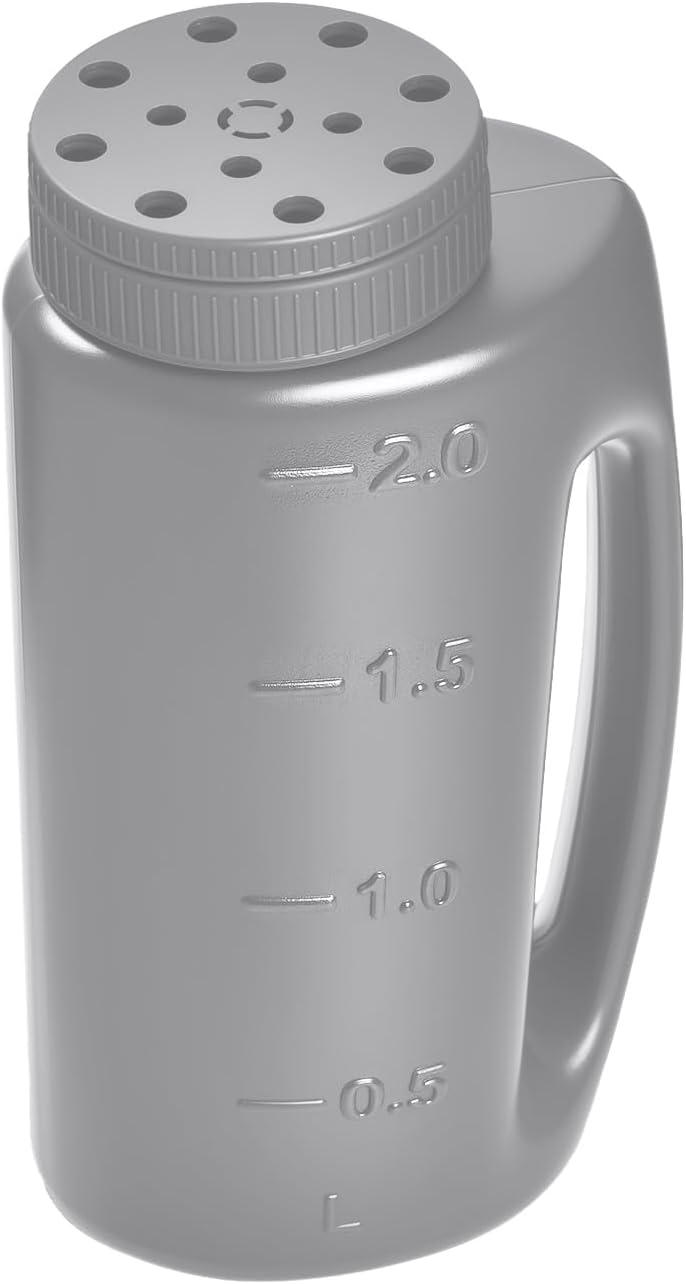
ZXJ Handheld Seed Shaker Hand Spreader — 90 oz Capacity
| Capacity | 90 oz |
|---|---|
| Included accessory | Garden gloves |
| Material | Weather-resistant plastic |
| Adjustable openings | Three settings |
The ZXJ Handheld Seed Shaker is a compact broadcast spreader aimed at small to medium yard tasks. It uses a front-facing diffuser and three adjustable openings to control flow so you can switch between fine grass seed and coarser materials like ice melt. The 90 oz capacity reduces refills compared with tiny hand spreaders, and the included garden gloves and ergonomic handle make longer passes more comfortable. Built from weather-resistant plastic, it is lightweight and easy to rinse after use. Expect good uniformity on lawns and walkways when cranked to the right setting, but it lacks a motorized or hopper-agitation system so very damp or clumpy products may need pre-breaking. The unit is straightforward to operate and store, making it a practical, no-frills choice for routine lawn seeding, fertilizing small plots, or spreading salt in winter.
Best for: Homeowners who want an affordable, easy-to-use spreader for routine lawn seeding, fertilizing, and occasional ice-melt tasks and who prioritize simplicity and low maintenance.
Less Ideal for: Commercial landscapers or users who need to treat very large areas quickly or handle consistently wet, clumpy materials should choose a heavier-duty or motorized spreader.
- Large 90 oz hopper reduces trips to refill during small to medium jobs
- Three adjustable openings provide flow control for seeds, fertilizer, or ice melt
- Ergonomic handle and included gloves improve comfort during extended use
- Weather-resistant plastic construction is easy to clean and store
- No mechanical agitation or motor makes it less effective with damp or clumpy materials
- Lightweight plastic may feel less durable under heavy professional use
Verdict: A budget-friendly, easy-to-use handheld spreader that delivers good control and reduced refills for small to medium seasonal lawn and ice-melt tasks.
Scotts Whirl Hand-Powered Handheld Spreader

| Material Type | Poly |
|---|---|
| Capacity coverage | Up to 1,500 sq. ft. |
| Included Components | Scotts – 71060 |
The Scotts Whirl is a simple, hand-powered spreader designed for small yards and spot treatments. It delivers smooth, even coverage of grass seed, fertilizer, salt, or ice melt by turning a small spreader wheel as you walk. Its ergonomic, adjustable arm support makes repeated passes more comfortable than basic handheld scoops, and the unit arrives fully assembled so you can use it right away. With a capacity rated up to 1,500 square feet it is best for modest lawns, beds, and patch repairs rather than large properties. Construction is lightweight poly, which keeps it easy to carry and maneuver but means it is not as rugged as metal commercial units. The straightforward mechanical design keeps maintenance trivial and there are no batteries or power hooks to worry about. If you want a low-cost, low-effort tool to improve distribution and avoid clumping during seeding or fertilizing, this does the job well, but those needing heavy-duty durability or very large coverage will want a larger tow-behind or broadcast spreader.
Best for: Buyers who want a practical, no-frills tool to improve distribution for routine lawn care on small to medium yards and value ease of use and low maintenance.
Less Ideal for: Homeowners with large lawns, commercial landscapers, or anyone needing a heavy-duty, high-capacity spreader should consider larger tow-behind or broadcast models.
- Provides smooth, even coverage for seed, fertilizer, salt, and ice melt
- Ergonomic adjustable arm support for more comfortable use during extended passes
- Lightweight poly construction makes it easy to carry and maneuver
- Comes fully assembled so it is ready to use out of the box
- Poly construction is less durable than metal alternatives for heavy or commercial use
- Capacity is limited to small lawns and spot treatments, not appropriate for large properties
Verdict: A lightweight, ready-to-use handheld spreader that delivers even coverage for small lawns and routine spot treatments.
Choosing the Right Hand Seed Spreader: Key Factors to Consider
Distribution Control and Flow Adjustment
How finely you can adjust the spread rate determines how well seeds land at the intended spacing. A hand seed spreader with a graduated gate, variable aperture, or calibrated settings helps you dial in coverage for different seed sizes and desired seeding rates. Precise control matters most with small seeds such as turf grass or carrots, where over-application quickly leads to overcrowding and wasted seed.
Practical use also includes how the spread pattern behaves at walking speed. Some spreaders favor a narrow, fanlike path that reduces overspray; others distribute broadly and require overlap. Consider how the mechanism responds to small adjustments and whether flow remains consistent as the hopper empties.
Ergonomics and Operator Comfort
You will use a hand seed spreader while walking and holding it for repeated passes, so grip shape, weight distribution, and trigger feel matter. A well-designed handle reduces hand fatigue and helps keep your sowing line steady over longer runs. Look for padded or contoured grips if you seed often, and consider whether the spreader can be used comfortably with either hand.
Balance is also important. A top-heavy hopper will make the tool feel cumbersome as you walk; a spreader that keeps weight low and centered is easier to maneuver across beds and paths. If you plan on seeding multiple small areas in a session, ergonomics become a deciding factor in how quickly you can work without strain.
Build Materials and Corrosion Resistance
Garden environments expose tools to moisture, soil, and sometimes fertilizer or seed treatments. Materials that resist rust and UV degradation extend the usable life of a hand seed spreader. Metal parts should be stainless or powder-coated when possible, and plastic components should be sturdy, UV-stabilized polymer rather than brittle, thin plastic.
Also consider moving parts such as bearings, shafts, and gate linkages. Simple, robust mechanisms with fewer small fasteners tend to survive heavy garden use better than intricate assemblies that trap debris. Inspecting how the hopper connects and seals against the metering gate gives a sense of long-term reliability.
Hopper Capacity and Seed Compatibility
Capacity affects how often you stop to refill while seeding. For small lawns, flower patches, or raised beds, a moderate hopper that supports a continuous pass without being overly bulky is ideal. Very large hoppers add weight and can make precise control harder.
Seed compatibility is equally important. Some spreaders are optimized for granular lawn seed and cannot handle larger cover-crop seed or pelleted mixes. Check whether the manufacturer or packaging describes ranges of seed sizes or whether the spreader uses interchangeable inserts or screens to adapt to different seed types.
Ease of Cleaning and Maintenance
Seed coatings, dirt, and dust build up inside hoppers and gates and can change flow behavior over time. A spreader that disassembles easily or has smooth, accessible surfaces is faster to clean and keeps settings reliable. Look for removable hoppers, simple gate linkages, and parts that rinse clean without special tools.
Maintenance also includes replacement parts and simple lubrication points. Models that allow you to clear obstructions without special tools will save time in the garden and reduce frustration during busy seeding windows.
When to Use a Hand Seed Spreader
Hand seed spreaders are best for small to mid-size tasks where accuracy matters more than sheer speed. They excel for patch repairs, sowing small lawns, overseeding thin patches, spreading wildflower or pollinator mixes, and planting cover-crop strips between beds. Because you control the line directly, they are ideal where you need to avoid nearby plants or pathways.
- Small lawn repairs and patching seed
- Overseeding narrow strips or pathways
- Sowing wildflower and pollinator mixes in confined areas
- Seeding raised beds and container planting zones
Preparing the Area Before Seeding
Good seed-to-soil contact starts with proper preparation. Remove weeds and debris, rake the surface to loosen the topsoil, and level any dips to prevent pooling. For lawns, dethatch or lightly scarify compacted spots so seed can reach mineral soil. If you are seeding vegetable beds, smooth and firm the seedbed to the desired depth before applying seed.
- Clear debris and weeds first
- Loosen compacted soil for better contact
- Level the surface to avoid low spots that collect water
- Lightly firm the soil after sowing for consistent germination
Techniques for Even Coverage
Walk at a steady pace and keep the spreader at a consistent height and angle. Overlap passes slightly to avoid striping but avoid excessive overlap that causes clumping. Adjust the flow setting on a trial swath with a measured area to confirm seed rate before tackling the whole bed. For very small seeds, make multiple lighter passes rather than one heavy pass to improve uniformity.
- Maintain steady walking speed and height
- Test a measured strip to check seeding rate
- Overlap passes minimally to avoid double-seeding
- Use lighter multiple passes for very fine seeds
Storing and Winter Care
Empty and clean the hopper before storage to prevent clogs and corrosion during wet months. Store the spreader in a dry location away from direct sunlight to slow polymer degradation. If the tool has metal linkages, apply a small amount of lubricant to pivot points to keep them moving smoothly at the start of the next season.
- Clean out seed and debris after use
- Store in a dry, shaded place
- Lubricate moving parts before long-term storage
- Inspect seals and fasteners annually for wear
How We Chose the Best Hand Seed Spreader
We focused on features that directly affect how a hand seed spreader performs in everyday garden tasks. Primary evaluation criteria included precision of distribution and flow control, because accurate metering reduces waste and improves germination uniformity. Ergonomics and handling were judged for comfort during repetitive sowing and for compatibility with different hand sizes. Build quality and materials were assessed for resistance to corrosion from fertilizers and long-term exposure to sun and moisture. Hopper capacity and seed compatibility were measured to ensure the tool suits both small-plot work and slightly larger patch jobs without constant refills. Finally, ease of cleaning and maintenance was considered, since sticky seed coatings and dust can clog mechanisms. We excluded broadcast-only devices intended for large lawns or tractor-mounted systems, and we did not include bulk commercial seeders meant for professional crews. The shortlist favors handheld spreaders that balance precise distribution with durability and straightforward upkeep. Models that failed to offer adjustable flow or that used fragile moving parts were not considered. Our selection is aimed at gardeners who need reliable, repeatable results in small to medium garden spaces.
FAQ
Can a hand seed spreader handle very small seeds like grass or lettuce?
Often yes, but it depends on the spreader's metering range and gate adjustment. Many hand spreaders allow fine calibration for small seeds, though you may need to use the lowest settings and make multiple light passes for the most even results.
How do I avoid seed clumping in the hopper?
Keep the hopper dry and avoid overfilling. Cleaning the hopper after each use and shaking or gently tapping during application can reduce clumps. For coated seeds, check whether the spreader recommends a particular setting or an insert to improve flow.
Is a bigger hopper always better for seeding efficiency?
Not always. Larger hoppers reduce refills but add weight and can make precise control more difficult. For small areas, a moderate-size hopper offers a better balance between capacity and manageable handling.
Can I use a hand seed spreader for fertilizer or granular soil amendments?
Sometimes. Some hand seed spreaders handle fertilizer or similar granules, but check compatibility because heavier or irregular particles may affect the metering mechanism and flow rate. Use the spreader only if the manufacturer indicates it is suitable for granular materials beyond seed.
How often should I clean and maintain my hand seed spreader?
Clean it after every few uses or whenever you switch seed types, especially if seeds are treated or dusty. Perform a quick inspection and light lubrication of moving parts at the start and end of the season to prevent corrosion and sticking.
Final Verdict
For small lawns, wildflower patches, and raised-bed sowing, prioritize a hand seed spreader with reliable distribution control and comfortable handling. Expect tradeoffs between hopper size and maneuverability, and favor corrosion-resistant materials if you plan frequent use or live in a humid climate. Focus on a spreader that is easy to clean and offers clear flow adjustment so you can reproduce results across multiple passes. With those priorities in mind, you can pick a tool that minimizes waste, speeds sowing, and gives consistent germination for small-area projects.
