

Note: This article contains affiliate links. If you click on these links and make a purchase, I may earn a small commission at no extra cost to you. This helps support my research and content. Read my full affiliate disclosure here.
If you have a yard with significant inclines, picking a robotic mower designed for steep hills changes how often you need to intervene and how level the cut stays across slopes. A mower that struggles on grades will bog down, leave stripes, or fail to return to base reliably, so matching capabilities to your terrain matters. This guide covers seven top-rated robotic lawn mowers shortlisted for steep-slope performance. We evaluate each on traction, boundary and navigation handling, battery runtime on slopes, and cutting consistency so you can pick a model that actually works on your hillier lawn. Read on to see the practical strengths and tradeoffs for slopes and broken terrain.
Top Picks at a Glance
| Best Overall The best all-around choice for most situations | roborock RockMow X130H Robot Lawn Mower with 4WD and Quad-Vision Navigation |  |
| Best Quality Built to a higher standard if you want something more solid | Husqvarna Automower 550 Robotic Lawn Mower (Commercial, 1.25 Acre) |  |
| Best Value The sweet spot between price and what you get | Mammotion LUBA 2 AWD 5000HX Robot Lawn Mower with Cleaning Stand |  |
| Highest Rated A top-rated pick with lots of positive feedback | LOPKIN L2500 Robotic Lawn Mower with NetRTK, AI Vision, GNSS/INS Navigation |  |
| Most Popular A crowd favorite that many people choose with confidence | Husqvarna 410iQ Automower Robotic Lawn Mower (Wire-Free, App Controlled) |  |
| Best Seller A high-volume bestseller chosen again and again | ECOVACS GOAT O1000 RTK Robotic Lawn Mower |  |
roborock RockMow X130H Robot Lawn Mower with 4WD and Quad-Vision Navigation
| Power Source | Battery Powered |
|---|---|
| Cutting width | 9.5 inches |
| Maximum Adjustable Cutting Height | 3.5 inches |
| Battery Average Life | 140 minutes |
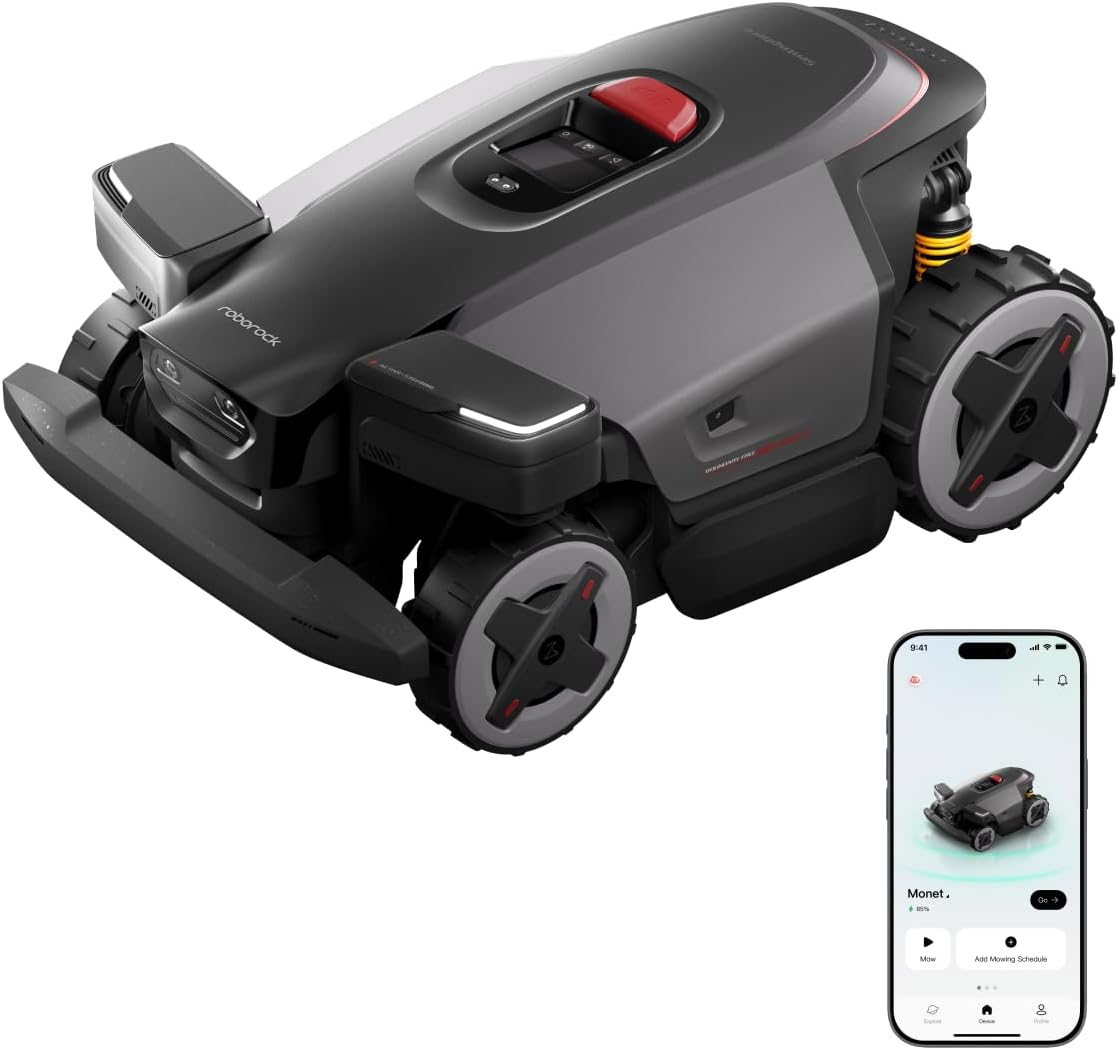
The roborock RockMow X130H is a high-capability robot mower built to handle steep, uneven, and complex lawns without a buried perimeter wire. It uses Full-Band RTK plus a quad-camera AI vision system for precise positioning and dual mapping modes so you can either auto-map open areas or manually trace boundaries from the app. The pro-grade four-wheel drive, active steering, and dynamic suspension let it climb slopes up to 80% and roll over obstacles up to about 3.1 inches while keeping a floating cutting deck for consistent surface-following. Practical benefits include a relatively wide 9.5-inch cut to reduce runtime, multi-zone scheduling and a real-time app dashboard, plus anti-theft features and 4G connectivity. Important limitations are its weight and size for handling and storage, and the advanced navigation and connectivity mean a learning curve during setup and when customizing complex zones. For homeowners with steep or irregular yards who want largely hands-off mowing, this mower brings robust, reliable performance.
Best for: Homeowners with steep, irregular, or obstacle-filled lawns who want a durable, hands-off mower that prioritizes precise navigation and traction over simplicity.
Less Ideal for: Small, flat lawns or buyers who want a very lightweight, simple plug-and-play robot mower with minimal setup and fewer connectivity features.
- Four-wheel drive, active steering, and dynamic suspension that handle slopes up to 80% and 3.1-inch obstacles
- Full-Band RTK plus quad-camera AI vision for accurate positioning under trees and near fences
- Wire-free dual mapping options with app control and multi-zone scheduling for flexible setup
- 9.5-inch cutting width and floating deck for efficient, even mowing across contours
- Built-in anti-theft features including PIN lock, alarm, and GPS tracking
- Heavy and bulky compared with smaller robotic mowers, making manual transport and storage more cumbersome
- Advanced navigation and connectivity increase setup complexity and may require time to fine-tune for complex yards
Verdict: Choose the RockMow X130H if you need a wire-free, high-traction robot mower that can reliably conquer steep, uneven lawns with precise navigation.
Husqvarna Automower 550 Robotic Lawn Mower (Commercial, 1.25 Acre)

| Power Source | Electric |
|---|---|
| Operation Mode | Automatic |
| Covers | 1.25 acres |
| Maximum Adjustable Cutting Height | 3.5 inches |
| Minimum Adjustable Cutting Height | 2 inches |
The Husqvarna Automower 550 is a heavy-duty robotic mower built for large or divided properties up to roughly 1.25 acres. It uses triple guide wires, five remote start points, and GPS-assisted navigation to find and evenly mow complex lawns while large coarse-tread wheels handle slopes up to 45%. Primary use is autonomous scheduled mowing managed through Husqvarna Fleet Services and the Automower Connect app, with remote start, geofencing and theft tracking for peace of mind. Practical benefits include reduced labor, consistent cut heights between 2 and 3.5 inches, and flexible charging-station placement that simplifies installation on commercial sites. Smart home integration with major voice assistants and fleet controls make it straightforward to coordinate multiple machines or monitor status remotely. Important limitations are that this is a commercial product intended for larger properties and fleet management workflows, so it may be more complex to set up and maintain than consumer models and carries capabilities that exceed simple residential needs.
Best for: Buyers who need a robust, mostly hands-off mower for a large or divided 1-acre-plus lawn and who prioritize reliable coverage and remote fleet-style management.
Less Ideal for: Homeowners with small yards under 0.5 acres or buyers who want a simple plug-and-play consumer robot without fleet features or professional setup.
- Designed for properties up to 1.25 acres so it covers larger lawns without constant intervention
- Triple guide wires and five start points reduce search time on divided or complex sites
- GPS navigation plus geofencing and theft tracking provide reliable location awareness and security
- Large coarse-tread wheels offer traction on slopes up to 45% for hilly terrain
- Commercial-grade features and fleet management add setup complexity compared with consumer models
- Higher operational and maintenance demands typical of professional equipment
Verdict: Choose the Automower 550 when you need a professional, remotely managed robotic mower that reliably covers large or divided lawns up to about 1.25 acres.
Mammotion LUBA 2 AWD 5000HX Robot Lawn Mower with Cleaning Stand

| Cutting width | 15.7 inches |
|---|---|
| Operation Mode | Automatic |
| Number of Positions | 7 |
| Power Source | Battery Powered |
| Battery Capacity | 12 Ah |
The Mammotion LUBA 2 AWD 5000HX is built for demanding yards: its four-wheel 165 W drive and all-wheel traction let it tackle steep slopes and uneven terrain while the dual-blade disk and 15.7-inch cutting width deliver efficient, clean cuts. It uses UltraSense AI vision plus RTK positioning to map lawns precisely, mow close to edges, and avoid more than 200 object types without a physical boundary wire. You can manage up to 50 zones, set planned patterns, and control the mower remotely via 4G/Wi‑Fi/Bluetooth and the Mammotion app; it also offers GPS tracking and anti-theft safeguards. Charge time and area-per-charge figures indicate this is sized for roughly 1.25 acres per the spec sheet, and automatic return-and-resume behavior keeps large multi-zone jobs moving. Expect a setup and learning curve for mapping complex properties and reliance on app connectivity for advanced features, plus periodic maintenance on blades and sensors like any robotic mower. For performance-focused owners this mower prioritizes terrain capability, precise routing, and autonomy over the simplicity of basic consumer models.
Best for: Buyers who prioritize robust off-road performance and precise autonomous control for large, varied lawns and steep terrain and who are comfortable using app-driven features to optimize mowing patterns.
Less Ideal for: Small, flat lawns where a simpler, lower-cost robotic mower or push mower would be more practical or for buyers who want a fully plug-and-play device with minimal setup.
- True all-wheel-drive and 165 W motors provide strong traction for steep slopes and rough terrain
- UltraSense AI Vision with RTK navigation enables precise mapping, edge cutting, and obstacle recognition
- Supports management of up to 50 mowing zones and multiple mowing patterns for complex properties
- Connectivity via 4G, Wi‑Fi, and Bluetooth plus app control allows remote monitoring and customized schedules
- GPS tracking and anti-theft features help protect investment on larger properties
- Requires app connectivity and initial mapping that can be complex for intricate landscapes
- Plastic bodywork may need careful handling in very rough environments
Verdict: Choose the LUBA 2 AWD 5000HX when you need a heavy-duty, terrain-capable robotic mower that delivers precise AI-guided mowing and full multi-zone control for challenging large lawns.
LOPKIN L2500 Robotic Lawn Mower with NetRTK, AI Vision, GNSS/INS Navigation

| Power Source | Battery Powered |
|---|---|
| Operation Mode | Automatic |
| Maximum Adjustable Cutting Height | 3 inches |
| Battery Average Life | 4 hours |
The LOPKIN L2500 is built to automate mowing on large, complex lawns while minimizing hands-on intervention. It uses NetRTK combined with GNSS/INS fusion and AI vision to map yards and navigate without a boundary wire, and a dedicated Wi-Fi HaLow router keeps the app connected across long ranges. Typical use is app-driven: you map zones (automatic or manual), schedule runs, and monitor progress remotely. Notable features include AI obstacle recognition for safer, collision-free operation, a 10Ah battery that supports up to four hours of runtime with fast charging, and an IP66-rated chassis for weather resistance. The drive system is engineered for steep grades, rated up to 57% slope, which makes it suitable for hilly properties. Practical benefits are reliable positioning near trees or buildings, long continuous runtime for larger plots, and flexible mapping for multiple lawn zones. Important limitations are that advanced navigation and HaLow router add setup complexity and dependency on the proprietary app, and the mower is relatively heavy which may affect portability for maintenance.
Best for: Homeowners who prioritize a dependable, autonomous mower that can handle large, steep yards with minimal boundary setup and consistent performance in challenging signal or terrain conditions.
Less Ideal for: People who want a lightweight, simple plug-and-play mower with minimal setup or those with very small, flat lawns where advanced navigation and long range connectivity are unnecessary.
- NetRTK and GNSS/INS fusion with AI vision for precise, wire-free navigation
- Capable on steep slopes up to 57% for reliable hill performance
- Long runtime up to 240 minutes and 5A fast charging for shorter downtime
- IP66-rated housing and built-in rain sensor for all-weather operation
- Requires app and HaLow router setup which can be more complex than basic models
- Heavy unit weight reduces ease of manual handling and transport
Verdict: Choose the LOPKIN L2500 when you need a robust, wire-free robotic mower that reliably navigates and mows steep, complex yards with long runtime and strong obstacle avoidance.
Husqvarna 410iQ Automower Robotic Lawn Mower (Wire-Free, App Controlled)

| Power Source | Battery Powered |
|---|---|
| Maximum Adjustable Cutting Height | 4 inches |
| Minimum Adjustable Cutting Height | 1 inches |
| Operation Mode | Automatic |
| Item Type Name | Robotic Mower |
The Husqvarna 410iQ is a high-performance wire-free robotic mower built to automate regular lawn maintenance on medium-sized yards. It uses EPOS satellite positioning and cellular connectivity to create centimeter-accurate virtual maps and lets you set stay-out zones, change cut height, and schedule mowing from the Automower Connect app. The mower handles slopes up to 45 percent and offers a 1 to 4 inch adjustable cutting height across a 9.4 inch cutting width, so it can manage varied grass lengths and terrain transitions without perimeter wires. Larger wheels and a reinforced bumper improve traversal over driveways and uneven surfaces, and the unit is hose-washable for easy cleanup. Built-in anti-theft alarm and GPS tracking add security. Expect practical benefits like truly hands-off weekly trimming, predictable cut patterns, and multi-zone mapping for complex yards. The main compromises are the relatively narrow cutting width that makes jobs take longer on larger lawns and the upfront complexity of initial setup and mapping versus a simple perimeter-wire system.
Best for: A buyer who prioritizes precise, hands-off lawn performance and smart connectivity for a medium-sized yard and wants predictable, automated mowing with multi-zone control.
Less Ideal for: Large properties significantly over half an acre or buyers who need the fastest possible pass-to-pass mowing speed should consider larger commercial mowers or wider cutting options.
- Wire-free EPOS positioning enables centimeter-accurate virtual mapping and stay-out zones without perimeter wire
- Handles steep slopes up to 45 percent and negotiates surface transitions with larger wheels
- App control with Wi-Fi, Bluetooth and 4G for scheduling, cut-height changes, and remote tracking
- Built-in anti-theft alarm and GPS tracking for added security
- Hose-washable design and included charging station make maintenance straightforward
- Narrow 9.4 inch cutting width increases time needed to mow larger areas
- Initial setup and mapping can be more complex than perimeter-wire systems
Verdict: Choose the 410iQ if you want a wire-free, app-driven robotic mower that delivers precise mapping, slope capability, and secure hands-off mowing for up to a half acre.
ECOVACS GOAT O1000 RTK Robotic Lawn Mower

| Power Source | Battery Powered |
|---|---|
| Operation Mode | Automatic |
| Maximum Adjustable Cutting Height | 3.2 inches |
| Minimum Adjustable Cutting Height | 1.2 inches |
| Number of Positions | 11 |
The ECOVACS GOAT O1000 RTK is a self‑navigating robotic lawn mower designed to maintain small to mid‑sized yards without perimeter wires. It scans and builds an editable map of your lawn, then follows efficient U‑shaped mowing patterns and a TruEdge routine to deliver consistent edge‑to‑edge cuts. The mower is battery powered and controlled through a smartphone app where you can set no‑go zones, adjust cutting height and speed, and schedule runs for different areas. Notable features include RTK positioning for accurate boundary recognition, AIVI 3D obstacle avoidance that detects pets and small objects, and an IPX6 waterproof rating for wet conditions. Practical benefits are low hands‑on time once the map is established, fewer missed spots near edges, and the ability to tailor behavior by zone. Important limitations are its modest 8.66-inch cutting width which means longer run times on larger properties, and a slimmer, lightweight plastic body that may be less durable under frequent heavy use compared with heavy commercial mowers.
Best for: Homeowners who want a low‑hands‑on, worry‑reducing mower for a modestly sized yard and value safety features and accurate mapping over bulky commercial power.
Less Ideal for: Those with large properties, commercial mowing needs, or buyers who need a wider cutting path and a heavy industrial build should look at larger, more rugged machines.
- RTK and automated mapping remove the need to install perimeter wire
- 3D AIVI obstacle avoidance reduces collisions with pets and garden objects
- App control with editable maps and zone customization simplifies scheduling and settings
- IPX6 waterproofing lets it operate reliably in wet weather
- Narrow 8.66-inch cutting width increases run time on larger lawns
- Plastic construction and consumer weight suggest lighter-duty build compared with heavy commercial units
Verdict: If you want a low‑maintenance, perimeter‑wire‑free mower with strong obstacle detection and precise mapping for a small to mid‑sized yard, the GOAT O1000 RTK is a practical choice.
Choosing the Right Robotic Lawn Mower for Steep Hills: Key Factors to Consider
Maximum Gradient Rating
Knowing the maximum gradient a mower can handle is the baseline for any steep-hill purchase. Manufacturers often quote a percentage slope or degree value; match that figure to your steepest lawn sections and allow a safety margin. Real lawns have mixed angles and transitions, so a mower rated for just your steepest measurement may still struggle when crossing from flat to steep.
Gradients also interact with ground surface. A mower that handles a dry, compact slope may still slip on wet grass or loose soil. When planning, walk the lawn and note prolonged runs of steep grade versus short inclines. Continuous steep runs demand higher graded capability than brief hills between flat areas.
Traction and Wheel Geometry
Wheel diameter, tread pattern, and whether a wheel is driven independently affect uphill grip and stability. Larger diameter wheels traverse bumps and transitions more smoothly and reduce the chance of bottoming out on a slope. Aggressive treads or softer rubber compounds improve purchase on wet or uneven turf but can increase wear.
Some mowers use differential wheel control or individually driven wheels to pivot without losing grip on a slope. Consider how wheel placement affects the mower's center of gravity because too-high weight forward can make a mower nose-dive on steep climbs. Durable wheel bearings and sealed motors are also important since slope work stresses drive systems more than flat mowing.
Battery Capacity and Runtime Under Load
Mowing uphill consumes more energy than flat mowing, so published runtime on level ground can be optimistic for steep yards. Look for higher-capacity batteries and efficient motor control systems that manage power when climbing. Some models adjust cutting patterns or throttle to preserve charge; others may require more frequent returns to base on hilly terrain.
Also check charge time and whether the mower supports partial runs that can be resumed without losing pattern efficiency. If your lawn has long uphill stretches, prioritize models with extra runtime or fast recharging to avoid unfinished sessions that leave strips of uncut grass.
Navigation System and Boundary Control
Reliable navigation reduces stalls and ensures even coverage across complex slopes. Systems that use GPS-assisted mapping, adaptive route algorithms, or robust perimeter guidance handle hill transitions and narrow passes better than simple random patterns. Boundary wire anchoring becomes more critical on slopes where tension changes and grass growth can hide wire segments.
Also consider the mower's ability to detect and navigate around obstacles common on sloped lawns such as terraces, retaining walls, and exposed roots. Models with adjustable boundary sensitivity and clear recovery behaviors when they lose signal will reduce downtime and manual corrections.
Cut Quality and Blade Engagement on Inclines
On inclines, the effective cutting height and blade contact angle change, which can cause uneven clipping or scalping at transitions. A mower with stable chassis geometry and consistent blade speed under load will leave a more uniform finish. Multiple smaller blades distributed across the deck can conform better to uneven surfaces than a single large blade but may require more frequent sharpening.
Also consider adjustable cutting heights that are easy to change without tools. If your hillside includes different microzones, being able to quickly raise the deck for sensitive areas helps preserve turf health while maintaining a good-looking cut elsewhere.
Serviceability and Durability for Slope Work
Steep lawns accelerate wear on drive components, wheels, and cutting assemblies. Choose mowers with easily replaceable wear parts, accessible service points, and durable materials for exposed components. Corrosion resistance and sealed electronics matter if your slope sees runoff or regular moisture.
Simple maintenance routines you can perform at home reduce downtime during the growing season. Look for clear user-access panels, widely available spare parts, and documented maintenance intervals so hill-related stress does not reduce the mower's useful life.
Assessing Your Slope Before Buying
Measure the steepest parts of your yard and note how long those runs are. Short, steep patches behave differently than long continuous inclines because the mower has less time to climb and recover battery charge. Sketching a simple map with slope percentages or degree estimates helps you match mower specifications to real terrain.
Check surface conditions such as soil type, grass variety, and drainage. Slippery or loose ground reduces effective traction even if the mower's rated gradient looks sufficient. Identifying trouble spots like terraces, steps, or exposed roots will guide where you might need additional boundary guidance or manual intervention.
- Walk the lawn with a smartphone slope app or basic inclinometer to record grade.
- Note transitions between flat and steep zones where scalping is likely.
- Mark electrical or irrigation fixtures that could obstruct the mower on slopes.
Installation Tips for Hilly Lawns
If your mower uses a boundary wire, ensure it is staked and tensioned firmly along slopes so it remains detectable. Burying the wire slightly where possible reduces exposure to mower traffic and helps keep the signal stable despite ground movement.
Place the charging base on a stable, relatively level area with good drainage. A base located at the bottom of a slope can ease return routines, but make sure the mower can approach and leave the dock without repeated re-routing. Some gardeners add small gravel pads or pavers under the base to keep the area stable.
- Avoid placing the base where runoff gathers or where mud will collect.
- Use additional anchors or ground staples on boundary wire in high-tension spots.
- Test the mower's return path manually before regular operation.
Maintaining a Consistent Cut on Uneven Terrain
Regularly check blade condition and cutting height settings because steep slopes amplify the effects of a dull blade or incorrect deck height. Keep blades sharp and balanced to avoid vibration that can reduce traction and precision on climbs.
Rotate mowing patterns and schedules. Varying the direction of passes helps prevent grooves and compaction forming along the same lines on sloped areas. If the mower supports adaptive patterns, enable them so the unit can adjust coverage according to the lawn shape.
- Inspect and tighten wheel fittings and bearings more frequently.
- Adjust cutting height at the start of season and when grass type changes.
- Clear debris from wheel treads to preserve traction.
Safety Considerations Specific to Slopes
Ensure the mower has tilt and lift sensors that stop blade rotation if the unit flips or is lifted. On slopes, strong stopping mechanisms and responsive sensors prevent accidents and reduce the chance of the mower continuing to spin blades unattended.
Plan for human oversight during initial runs on a steep lawn. Watch how the mower approaches transitions, and be ready to adjust boundary settings or manually remove it from a trouble spot. Even machines designed for slopes can encounter unpredictable ground conditions that require prompt action.
- Keep pets and children away during early testing runs.
- Have a manual disable or emergency stop procedure ready.
- Check local regulations about autonomous gardening equipment operation in public view if applicable.
When to Consider Professional Site Preparation
If your slope has serious erosion, loose soil, or abrupt terraces, professional grading or reinforcement may be worth considering before adding a robotic mower. Stabilizing the slope reduces slip and wear and creates a more predictable surface for an autonomous machine.
A landscaper can also advise on gentle terracing, retaining walls, or planting groundcovers that improve traction and reduce maintenance needs. These improvements can expand your choice of suitable robotic mowers and extend equipment life.
- Target problem spots rather than altering the entire yard when possible.
- Small retaining features or planting can make a big difference in traction.
- Consult a pro if erosion or drainage threatens mower safety.
How We Chose the Best Robotic Lawn Mower for Steep Hills
We started by filtering robotic mowers that explicitly rate acceptable gradient or slope handling and that offer traction or wheel features engineered for inclines. From that pool we prioritized models with strong uphill runtime and consistent blade engagement on sloped surfaces. Maneuverability and boundary control were also required; mowers that lack reliable perimeter or virtual wire handling on uneven terrain were excluded. Our editorial filters focused on concrete, garden-relevant specs: maximum gradient capability, wheel and traction design, battery performance under load, navigation and obstacle-handling systems, and serviceability for hill-related wear. We excluded units intended only for flat, small lawns or indoor robotic trimmers. We also screened for safety features important on slopes such as tilt and lift sensors and robust stop mechanisms. The result is a shortlist of seven robotic lawn mowers selected for real-world slope performance, dependable navigation, and the ability to maintain a consistent cut on challenging lawns. These are the dimensions we scored and described in each product summary.
FAQ
What slope percentage can a robotic mower safely handle?
It depends on the model. Many units are rated for moderate slopes, while specialized hill-capable models handle higher percentages. Check the published gradient rating and allow a safety margin for wet or loose conditions.
Will a robotic mower slip more in wet weather on a steep lawn?
Often yes. Wet grass reduces traction and can cause slipping even for mowers rated for the same gradient in dry conditions. If your yard is frequently wet, prioritize aggressive treads and consider limiting operation after heavy rain.
Can boundary wire stay reliable on sloped ground?
Usually, if it is properly anchored. Slopes can change tension and move wire over time, so secure staking and occasional checks are important. Burying the wire slightly where possible improves long-term stability.
Do I need extra maintenance for a mower that works mostly on hills?
Yes. Hill use increases stress on drive components, wheels, and blades, so more frequent inspections and part replacements are common. Regular cleaning and prompt attention to wear extend service life.
Is a charging base location important for sloped yards?
Yes. The base should be on stable ground with good drainage and an approach that the mower can use reliably. Bases at the bottom of a slope often make returns easier, but each yard is different and should be tested.
Are tilt and lift sensors necessary for slope operation?
Usually. These sensors stop blade rotation if the mower tips or is lifted, improving safety on uneven ground. They are an important feature when using autonomous cutting equipment on steeper lawns.
Final Verdict
Choosing a robotic lawn mower for steep hills means balancing slope rating, traction, battery endurance, and navigation robustness. Prioritize a mower whose gradient capability exceeds your steepest runs, paired with good wheel design and reliable boundary control to reduce stalls and manual retrievals. Expect more frequent maintenance on machines that work steep terrain and plan installation carefully. With the right match to your hillside and simple site prep, a robotic mower can deliver safer, more consistent cuts and reduce the physical work of mowing challenging lawns.
