

Note: This article contains affiliate links. If you click on these links and make a purchase, I may earn a small commission at no extra cost to you. This helps support my research and content. Read my full affiliate disclosure here.
When you need to bring down standing trees, the right axe makes the task safer, faster, and less tiring. An axe for felling trees is a different tool from a splitting maul or a small camp hatchet. You want a head geometry and handle length that deliver deep, predictable bites, balanced weight for repeated swings, and materials that stand up to repeated striking. This guide shortlists seven top choices suitable for various forests and trunk sizes. We evaluated each entry for cutting power, balance, durability, and ease of handling so you can pick an axe that matches how and where you plan to fell trees. Read on for the decision factors we used and practical guidance for use and maintenance.
Top Picks at a Glance
| Best Overall The best all-around choice for most situations | Fiskars 28" Chopping Axe |  |
| Best Quality Built to a higher standard if you want something more solid | 1844 Helko Werk Forester Full-Size Felling Axe (Made in Germany) |  |
| Best Value The sweet spot between price and what you get | INTERTOOL 36" Felling Axe HT-0264 — 2.8 lb Carbon Steel Head with Fiberglass Handle |  |
| Highest Rated A top-rated pick with lots of positive feedback | Gränsfors Bruks American Felling Axe, 35" Curved Handle |  |
| Most Popular A crowd favorite that many people choose with confidence | Fiskars 28" A-Series Chopping Axe |  |
| Best Seller A high-volume bestseller chosen again and again | Fiskars X24 24" Universal Axe |  |
Fiskars 28" Chopping Axe

| Included Components | Chopping Axe (28") |
|---|---|
| Handle Material | Fiberglass |
| Blade Material | Forged Steel |
| Head Type | Felling |
| Blade Edge | Proprietary Grind |
The Fiskars 28" Chopping Axe is built for chopping and felling small- to medium-sized trees and for splitting kindling around the yard or campsite. Its forged steel blade uses Fiskars proprietary grind and a low-friction coating so the edge bites deeper and slices with less resistance, which reduces swings and user fatigue. The fiberglass FiberComp handle and insert-molded head create a strong, impact-resistant connection that stands up to heavy use and resists breaking. The axe’s weight distribution is tuned to increase swing speed and power without making the tool feel unwieldy, so it works well for extended sessions of chopping. Practical limits are that this size is intended for smaller trunks and campsite tasks rather than large timber, and hardened users may want a heavier splitting axe for big rounds. Maintenance is straightforward: keep the edge sharp and store dry to preserve the coating and handle.
Best for: Gardeners and outdoor enthusiasts who want a reliable, durable axe that handles most backyard felling and campsite chopping tasks with fewer swings and less strain.
Less Ideal for: Professional loggers or users who regularly cut large-diameter trees should choose a heavier felling or splitting axe designed for large timber.
- Proprietary ground forged-steel blade with low-friction coating for deeper, cleaner cuts
- FiberComp fiberglass handle and insert-molded head give high impact resistance and durability
- Balanced weight distribution increases swing speed and perceived power
- Suitable for chopping, felling small to medium trees, and splitting kindling around camp or yard
- 28-inch chopping axe is not optimal for very large trunks or heavy-duty industrial felling
Verdict: A well-balanced, virtually unbreakable 28-inch chopping axe that delivers deeper cuts and reliable performance for felling small to medium trees and general outdoor chopping tasks.
1844 Helko Werk Forester Full-Size Felling Axe (Made in Germany)

| Head Material | C50 high carbon steel |
|---|---|
| Head Type | Felling |
| Head Weight | 3.5 lb |
| Handle Material | American hickory |
| Handle Length | 31 in |
The Helko Werk Forester is a purpose-built full-size felling axe that brings a hand-forged C50 high carbon steel head and a carefully selected American hickory handle to demanding tree work. With a roughly 3.5 lb head and a 31 inch handle it delivers the mass and reach needed to fell medium and large trees while remaining manageable for a single user. The polished finish on the head reduces cutting friction and helps resist surface rust, and the handle is sanded and treated with boiled linseed oil for a comfortable grip. Included leather sheath and a small bottle of protective Axe Guard oil make basic care and transport straightforward. Because it is a premium handmade tool, the Forester emphasizes edge retention and balance over low cost and requires routine sharpening and proper storage to protect the wooden handle and carbon steel. It is not lightweight for casual pruning but shines when you need a reliable, well-balanced axe that holds an edge for sustained chopping tasks.
Best for: A buyer who prioritizes chopping performance and durability for regular tree-felling or heavy-duty yard work and wants a precision-forged tool that holds an edge and feels balanced under swing.
Less Ideal for: Not a good fit for casual gardeners, light pruning, or ultralight backpacking where a smaller hatchet or lightweight saw would be easier to handle.
- Hand-forged C50 high carbon steel head for strong edge retention and durability
- Balanced full-size design (3.5 lb head, 31 in handle) suited to felling medium and large trees
- Premium grade A American hickory handle finished with boiled linseed oil for comfort and shock absorption
- Polished head finish reduces cutting friction and helps resist surface rust
- Includes leather sheath and Axe Guard oil for protection and basic maintenance
- Requires regular sharpening and oiling to maintain the carbon steel head and prevent rust
- Heavier and longer than compact axes, so it is less suitable for tight spaces or extended backpacking carries
Verdict: Buy this axe if you want a high-performance, hand-forged felling axe that combines weight, balance, and premium materials for reliable tree-chopping results.
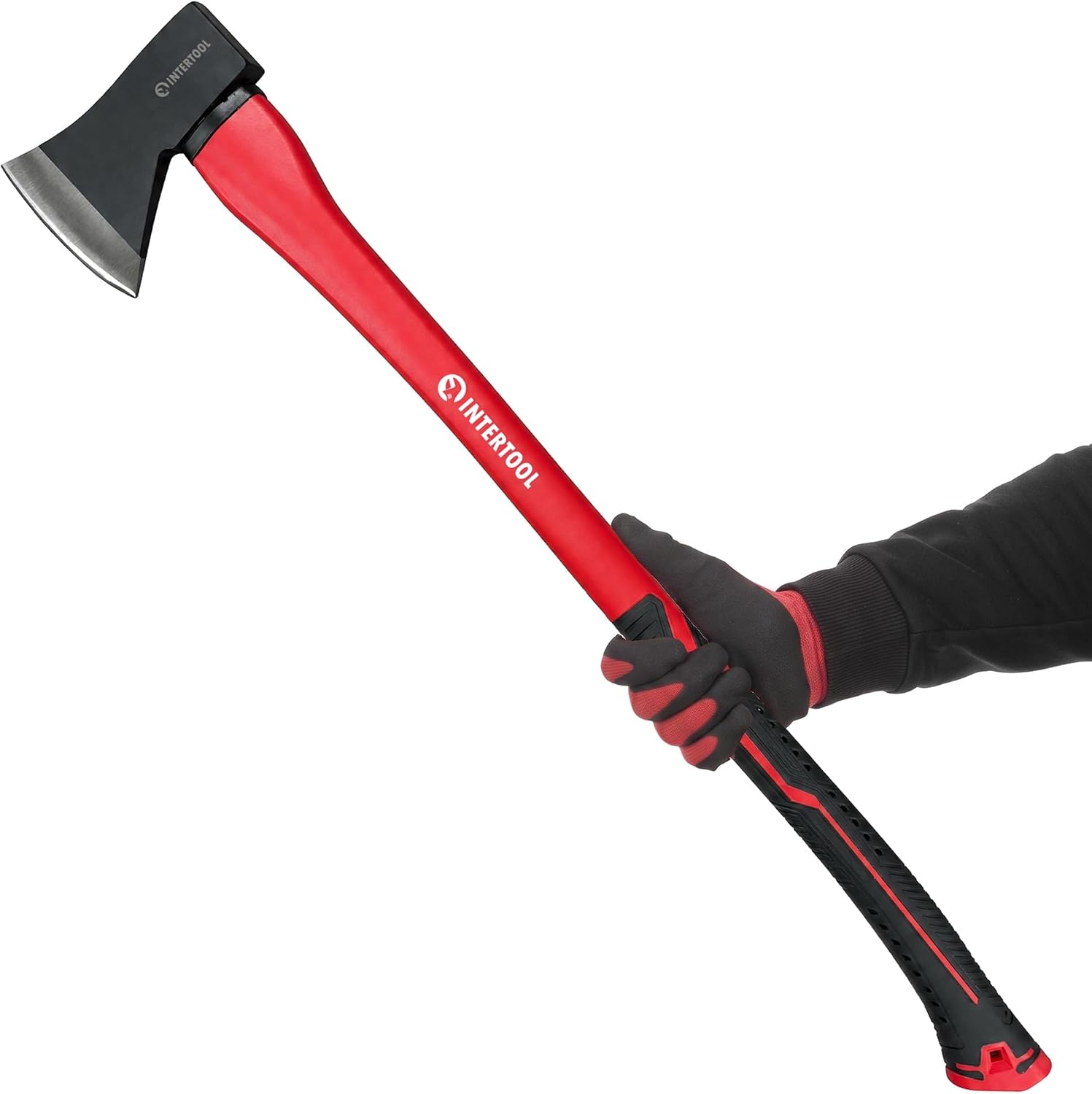
INTERTOOL 36" Felling Axe HT-0264 — 2.8 lb Carbon Steel Head with Fiberglass Handle
| Head Type | Felling |
|---|---|
| Head Weight | 2.8 pounds |
| Handle Material | Fiberglass |
| Blade Length | 5.1 inches |
The INTERTOOL HT-0264 is a long-handled felling axe built for yard work and cutting firewood. With a 36-inch fiberglass handle it gives good leverage for deeper swings, while the 2.8 pound forged carbon steel head arrives pre-sharpened and coated to resist rust. The textured, non-slip rubber grip and shock-absorbing handle reduce vibration and make repetitive chopping more comfortable. Use it for felling smaller trees, limbing, and splitting rounds into firewood; the head-to-handle balance improves swing control so you can place cuts more accurately. The included sheath protects the blade during storage and transport. Limitations to expect are the midweight head, which is better suited to smaller trunks and splitting than to heavy-duty professional felling, and the fiberglass handle, which while low-maintenance is less traditional than wood and may feel different to some users. For routine property maintenance it combines power, corrosion resistance, and user comfort in a practical package.
Best for: Buyers who want a practical, low-maintenance felling axe for regular property work and firewood preparation and who prioritize leverage, comfort, and corrosion resistance over maximum head mass.
Less Ideal for: Not the best choice for professional arborists or anyone who needs a very heavy head for felling large trees or for those who insist on a traditional wooden handle feel.
- Long 36-inch fiberglass handle gives improved leverage for longer swings and deeper cuts.
- Forged, heat-treated carbon steel head (2.8 lb) ships pre-sharpened and has a protective coating to resist rust.
- Shock-absorbing handle and textured rubber grip reduce vibration and improve control during repetitive chopping.
- Comes with a blade sheath for safer transport and storage.
- 2.8 lb head is midweight and may be underpowered for large-diameter trees or heavy professional felling.
- Fiberglass handle offers less traditional feel and may not suit users who prefer wooden handles.
Verdict: A practical, comfortable long-handled felling axe that delivers good leverage and durability for routine tree felling and firewood work.
Gränsfors Bruks American Felling Axe, 35" Curved Handle

| Head Weight | 4.6 pounds |
|---|---|
| Item Weight | 5.3 pounds |
| Handle Material | Leather, Wood |
| Blade Material | Stainless Steel |
| Head Type | Felling |
The Gränsfors Bruks American Felling Axe is a professional, hand-forged tool built for cutting down large trees and making deep, controlled felling cuts. It pairs a heavy 4.6 lb head with an extended curved handle to deliver strong momentum and reach, which helps the blade bite into fresh, resinous woods like pine and spruce. The curved bit and long, broad 11.5 cm edge are suited to smooth, efficient chopping rather than fine carving, and the stainless steel blade plus vegetable-tanned leather sheath make it durable and straightforward to maintain. Typical use is repeated felling swings from standing or on a low stump and clearing large limbs where power per strike matters more than lightness. The axe is noticeably heavier than small forest axes, so it reduces the number of swings needed but requires more physical effort and control, especially over long sessions. For users who prioritize a long-lasting, purpose-built felling tool, this axe brings dependable performance, though it is not optimized for backpacking or very prolonged overhead work.
Best for: Buyers who want a durable, professional-grade felling tool for regular tree-felling and heavy forest work and who prioritize reliable cutting power over minimal weight.
Less Ideal for: Gardeners needing a lightweight multipurpose axe for occasional trimming or users who must carry an axe long distances on foot.
- Hand-forged heavy head delivers powerful, deep cuts suited to large trees
- Curved 11.5 cm cutting edge and curved bit improve bite into resinous wood
- Stainless steel blade and vegetable-tanned leather sheath offer durable, low-maintenance materials
- Long curved handle increases reach and swing momentum for efficient felling
- Heavier head and longer handle make it more tiring to use for extended periods
- Not appropriate for backpacking or light-duty pruning tasks
Verdict: Choose this axe when you need a rugged, hand-forged felling tool that delivers dependable cutting power for large trees.
Fiskars 28" A-Series Chopping Axe

| Head Type | Felling |
|---|---|
| Blade Edge | Hardened, non-stick |
| Handle Material | Steel,Wood |
| Blade Material | Alloy Steel |
The Fiskars 28" A-Series Chopping Axe is built for heavy backyard chopping and light tree felling. It pairs a low-friction, hardened alloy-steel blade with a precision-balanced head that helps the blade bite deeper on each swing, so you get cleaner cuts and fewer stuck strikes when felling small trees or splitting logs. The handle combines steel and wood construction with a shock-absorbing FiberComp-style design to reduce vibration and make repeated swings less fatiguing. Practical benefits include an ultra-sharp edge that stays effective through routine use and a balanced feel that multiplies swing power for faster work. Limitations are that this is a midweight, 28-inch tool intended for small to medium trunks rather than heavy timber, and its mixed-material handle may require occasional care compared with full-composite or all-wood traditional designs. For routine firewood prep, campsite work, and clearing small trees, it offers a reliable, user-friendly chopping performance.
Best for: Buyers who want a dependable, easy-to-swing axe for routine tree felling, firewood prep, and yard cleanup and who value tools with solid real-world performance evidence.
Less Ideal for: Professional arborists or anyone who regularly needs to fell very large trunks should choose a heavier, longer-handled felling axe or specialized chainsaw instead.
- Balanced head design increases swing power and cutting efficiency
- Hardened alloy-steel blade with low-friction coating reduces sticking
- Shock-absorbing handle reduces vibration during repeated swings
- Sharp edge and blade geometry suitable for clean felling and log splitting
- 28-inch length and midweight construction are not ideal for very large or old-growth trees
- Handle uses mixed materials that may need occasional maintenance
Verdict: A well-balanced, sharp 28-inch axe that delivers efficient, low-sticking cuts for felling small trees and prepping firewood.
Fiskars X24 24" Universal Axe

| Handle Material | Fiberglass |
|---|---|
| Blade Material | Forged Steel |
| Head Type | Felling |
| Blade Edge | Wide |
The Fiskars X24 is built for routine felling and all-purpose chopping where control and durability matter. Its thin, wide forged-steel edge and proprietary double-hardening grind deliver clean cuts through fresh, resinous wood while a low-friction coating helps the blade slide and resist corrosion. The 24-inch FiberComp handle is lighter than steel and absorbs shock, reducing hand fatigue during repeated swings, and the insert-molded head design minimizes the risk of the head loosening. A textured oversized SoftGrip and hooked end improve hold and control when swinging. The axe ships with a sheath for safer storage. Limitations to note are that the 24-inch universal length and head geometry favor felling and chopping rather than heavy splitting of large seasoned rounds or delicate one-handed work, and users should still follow safe cutting technique and maintain the edge for best performance.
Best for: A cautious buyer who values a dependable, low-maintenance axe for regularly felling trees and chopping fresh wood and who prioritizes safety, control, and durable construction.
Less Ideal for: Those who need a purpose-built splitting axe for splitting large, dry rounds or a compact hatchet for light one-handed tasks should consider a different tool.
- Forged steel blade with double-hardening and low-friction coating for longer edge life and reduced blade sticking
- FiberComp handle that is lighter than steel and absorbs shock to cut down on hand fatigue
- Insert-molded head design for strong head-to-handle connection and overstrike protection
- Textured oversized SoftGrip and hooked handle end provide secure, non-slip control
- Includes a protective sheath for safer storage and transport
- Design and length are optimized for felling and chopping, not for heavy splitting of large, seasoned logs
Verdict: Choose the Fiskars X24 if you want a well-balanced, durable felling axe that prioritizes control, reduced vibration, and clean cuts in fresh wood.
Choosing the Right Axe for Felling Trees: Key Factors to Consider
Head Mass and Geometry
Head mass determines how much kinetic energy the axe delivers on impact. For felling trees you want enough mass to drive the blade deep into the wood on each swing without forcing you to overexert. Geometry is equally important: a slightly convex, wedge-shaped face helps split fibers cleanly and draws the blade through the cut, while an overly tapered or thin profile can stick or require many more swings.
Consider that heavier heads increase fatigue but reduce the total number of swings needed. Choose a balance between mass and control based on the size of trees you plan to fell and your physical strength.
Handle Length and Materials
Handle length affects reach and torque. Longer handles deliver greater swing speed and leverage for larger trees but require more space to swing safely. Shorter handles improve control for tighter or uneven stands but reduce bite depth per swing. Wood handles like hickory provide vibration damping and are easy to replace; synthetic handles may resist weathering and are less likely to crack but can transmit more shock.
Grip shape and thickness influence hand placement and control during repeated swings. A slightly flared end helps prevent slippage during heavy follow-through, while a comfortable midsection prevents hotspots on the palm.
Edge Steel and Heat Treatment
The blade steel and how it is heat treated determine how long the edge stays sharp and how well it resists chipping when it contacts embedded dirt or knots. Steels with good toughness will absorb impact without brittle fractures, while harder steels hold an edge longer but may be more prone to chipping if not properly tempered.
For felling work where the blade can encounter gritty contact, prioritize steels with a balance of toughness and edge retention that can be resharpened in the field when needed.
Head Attachment and Durability
Secure attachment between head and handle is critical for safety and longevity. Traditional wedges and tight-fit eye designs work well when installed correctly, while modern mechanical fixings or epoxy can add redundancy. Check how the head is seated and what reinforcements are used; loose heads or poorly seated eyes are a common failure point when felling.
Durability also includes resistance to weather and repeated impacts. Handles designed to be replaceable and heads finished to resist corrosion will extend service life.
Weight Distribution and Balance
An axe that feels balanced in the swing reduces muscle strain and increases accuracy. Weight distribution between head and handle affects the moment of inertia and how the axe accelerates and recovers. A head-heavy axe may deliver more power but can be tiring and harder to redirect between swings. A more evenly balanced tool offers greater control for precisely placed cuts.
Try to match weight distribution to the size of trees and your swing style: felling larger trunks benefits from slightly head-biased tools, while varied forest work often favors a neutral balance for versatility.
Choosing the Right Length for the Stand
Match handle length to the environment where you will fell. In open spaces you can use longer-handled axes for maximum leverage. In denser woods, a slightly shorter handle helps avoid hitting branches during the backswing.
Also consider your height and stance. A longer handle amplifies reach but increases the moment arm; select a length that lets you swing comfortably while maintaining good footing.
- Long handles for open-stand felling and larger trunks
- Medium-length handles for mixed-use and trail work
- Short handles for tight terrain and precise cuts
Maintenance and Field Sharpening
Keeping the blade sharp and free of nicks is essential for safe, efficient felling. Learn basic sharpening using a file and a sharpening stone. A coarse file re-establishes the bevel while finer stones refine the edge for cleaner bites.
After use, clean sap and debris from the head and lightly oil the blade to prevent rust. Regularly inspect the eye seating and handle for signs of loosening or cracking and address small issues before they become dangerous failures.
- Carry a compact file and stone for field touch-ups
- Wipe and oil the head after damp or wet work
- Replace or repair cracked handles promptly
Safe Felling Techniques
Proper technique reduces the risk of injury and improves cut efficiency. Use controlled, full-body swings that engage your legs and hips rather than relying only on the arms. Plan escape routes and clear surrounding hazards before any felling work.
Make standard notch and backcut sequences and avoid overcutting that can pinch the blade. If you encounter embedded dirt or chain-sawn stumps, anticipate more resistance and adjust swing power accordingly.
- Keep bystanders well clear and wear eye and hearing protection
- Always maintain a stable footing and avoid swinging on uneven ground
- If a cut binds, avoid excessive force; back out carefully and inspect
Transport and Storage Considerations
Transport axes with the edge covered and secured to prevent accidental contact. For longer trips, consider a protective sheath that stays on during transport to keep the blade protected and other gear safe.
Store axes in a dry area with moderate temperature. Wood handles benefit from occasional conditioning with linseed oil to prevent drying and cracking. Inspect stored tools before use to confirm secure head seating.
- Use a sheath or edge guard during transport
- Condition wooden handles periodically
- Store in a dry, ventilated location
When to Choose a Splitting Tool Instead
An axe for felling trees is optimized to make clean, deep cuts across grain and to produce a hinge for controlled tree fall. Splitting mauls or wedges are designed to force apart wood fibers along the grain and are better suited to splitting rounds and firewood.
If your primary work is processing felled trunks into split firewood, prioritize a splitting tool rather than a felling axe. Using the right head shape for the task reduces wear and improves safety.
- Felling axes for cross-grain cutting and hinge creation
- Splitting mauls for splitting along the grain
- Carry both types if you will fell and process on site
How We Chose the Best Axe for Felling Trees
We shortlisted axes based on criteria that matter for felling standing timber in real-world conditions. Cutting power was measured by head mass and blade geometry suited to produce deep, controlled cuts rather than thin chopping strikes. Balance and swing dynamics were evaluated to reflect how the axe behaves over repeated high-force swings and how quickly it recovers for follow-up cuts. Handle length and handshake comfort were considered to ensure reach and torque without excessive strain. Edge material and durability focused on steel type and heat treatment characteristics that retain a useful edge under repeated impacts and make resharpening practical. Construction and handle attachment examined head-to-handle security and how the design withstands repeated use. We excluded tools designed primarily for splitting, carving, or light campsite chores if their head geometry, mass, or handle length made them unsuitable for felling. We also excluded axes that clearly lacked robust head attachment systems or used materials unlikely to last through felling work. The final picks reflect performance, durability, and user safety features that matter when taking down trees.
FAQ
What handle length is best for felling medium-sized trees?
For medium-sized trees, a handle in the range of 28 to 36 inches often balances reach and control. The exact choice depends on your height and available swing space; taller users and open stands favor the longer end of the range.
How often should I sharpen an axe used for felling?
Frequency depends on contact with dirt and knots, but many users touch up the edge daily during heavy felling and do a more thorough sharpening every few days of sustained work. Keep a file handy for quick removal of nicks between sessions.
Is a heavier head always better for felling trees?
Not always. Heavier heads deliver more bite per swing but increase fatigue and can reduce control. Match head mass to the size of trees you will fell and to your strength and endurance for safe, repeatable swings.
Can synthetic-handled axes be used for felling?
Yes. Synthetic handles can resist weathering and are less prone to splitting, but they may transmit more vibration. Many are well suited for felling if the attachment and balance are correct.
How do I tell if an axe head is becoming loose?
Signs include any wobble in the head, visible gaps at the eye, creaking during a swing, or movement when you strike a surface. If you notice these signs, stop using the tool and reseat or replace the handle before further felling work.
Should I use a sheath when working in the woods?
Yes. A sheath protects the edge when the axe is being carried and prevents accidental cuts. Keep it on during transport and remove only when ready to work to reduce the chance of damage or injury.
Final Verdict
Choosing an axe for felling trees comes down to balancing cutting power, handle reach, and durability against the terrain and tree sizes you will work on. Prioritize a head geometry and mass that deliver deep, efficient bites while selecting a handle length that suits your stance and the space you have to swing. Maintain the blade and inspect the head-to-handle fit regularly. By focusing on balance, blade steel, and secure construction, you can pick an axe that lets you fell trees safely and with fewer swings, while minimizing fatigue and maintenance downtime.
