

Note: This article contains affiliate links. If you click on these links and make a purchase, I may earn a small commission at no extra cost to you. This helps support my research and content. Read my full affiliate disclosure here.
If you want greener, thicker turf with less effort, a liquid lawn aerator can help by improving soil porosity and making fertilizers work harder. Choosing the right liquid lawn aerator matters because coverage, concentration, and how the product interacts with your soil determine whether you see quick improvement or wasted effort. This guide shortlists seven top options and explains how they compare on application ease, soil penetration, and nutrient uptake. We evaluate products on real garden concerns so you can pick the approach that fits your lawn size and soil type.
Top Picks at a Glance
| Best Overall The best all-around choice for most situations | GS Plant Foods Liquid Humic Acid Soil Amendment, 1 gal |  |
| Best Quality Built to a higher standard if you want something more solid | GS Plant Foods Soft Soil Liquid Aerator & Soil Loosener, 1 gal |  |
| Best Value The sweet spot between price and what you get | LawnStar Liquid Lawn Aerator, 32 fl oz |  |
| Best Budget The cheapest option that still gets the job done reliably | LawnStar Liquid Lawn Aerator, 32 oz |  |
| Highest Rated A top-rated pick with lots of positive feedback | Farm Made Organics Humic+ Liquid Humic Acid Soil Conditioner, 32 oz |  |
| Most Popular A crowd favorite that many people choose with confidence | Simple Lawn Solutions Liquid Soil Loosener, 32 oz |  |
| Best Seller A high-volume bestseller chosen again and again | Covington Naturals Liquid Lawn Aerator (1 Gallon) |  |
GS Plant Foods Liquid Humic Acid Soil Amendment, 1 gal

| Item Form | Liquid |
|---|---|
| Specific Uses For Product | Plant Growth, Root Develpoment, Nutrient Uptake |
| Application Method | Sprayer |
| Liquid Volume | 1 gallons |
| Mixing Ratio | 1:64 |
GS Plant Foods Liquid Humic Acid is a 6% leonardite-derived soil amendment meant to be used alongside regular fertilizers to help lawns and plants access nutrients more effectively. Applied through a sprayer, it mixes with most liquid fertilizers (avoid low-pH, high-liquid-calcium products and calcium nitrate) and is dosed at 4 oz per gallon for an initial treatment and 2 oz per gallon for follow-ups, usable as often as every three weeks. The liquid form and clear mixing ratio make it easy to add to standard lawn-care spray rigs for broad-area applications or to smaller sprayers for beds and containers. Practical benefits include improved root development, better micronutrient uptake, and economical coverage from a single jug when used at the recommended rates. Limitations are that it is not a fertilizer so it will not supply N-P-K and it requires careful mixing compatibility checks with certain fertilizers; heavy users will need to plan integrations with their regular feeding schedule rather than expect a standalone feed.
Best for: Gardeners and homeowners who want an easy-to-apply soil amendment to boost root health and nutrient uptake across lawns, beds, and containers and who plan to use it alongside their existing fertilizer routine.
Less Ideal for: People seeking a standalone fertilizer or those unwilling to check compatibility with their current liquid fertilizers should consider combined fertilizer options instead.
- Liquid form that mixes into standard sprayers for easy lawn and garden application
- Clear label dosing (4 oz initial, 2 oz follow-ups) for predictable coverage
- Supports root development and micronutrient uptake without adding N-P-K
- Covers large areas from one jug when used at label rates
- Not a fertilizer so it must be used alongside a regular nutrient program
- Cannot be mixed with low-pH or high-liquid-calcium products and never with calcium nitrate
Verdict: Use this liquid humic acid when you want a straightforward, sprayable amendment that improves root function and helps lawns and plants take up nutrients more effectively.
GS Plant Foods Soft Soil Liquid Aerator & Soil Loosener, 1 gal

| Item Form | Liquid |
|---|---|
| Application Method | Spray |
| Coverage | 16,000 square feet |
| Target Species | Lawn Grass |
| Mixing Ratio | 4:1 |
GS Plant Foods Soft Soil is a one-gallon concentrate formulated as a liquid alternative to core aeration for compacted or clay lawns. You mix 4 ounces per gallon of water and apply with a hose-end or pump sprayer; each mixed gallon covers about 500 sq ft so a full bottle treats up to 16,000 sq ft. The formula combines humic and fulvic acids, kelp extract, and beneficial microbes to help open soil, improve drainage, and let air and water reach roots without pulling plugs or renting equipment. It is used on established, new, and reseeded lawns and can be repeated every 3 to 4 weeks as needed. Practical benefits include easy application, broad coverage from a single bottle, and suitability for typical lawn grasses and problem clay soils. Expect incremental improvements rather than instant results; liquid aeration is less aggressive than mechanical core aeration and may require multiple treatments for heavily compacted turf. Also, correct mixing and even spraying are important to get the advertised coverage and results.
Best for: Homeowners and groundskeepers who want a low-effort, repeatable way to reduce mild to moderate soil compaction and improve drainage across large lawns without renting or operating heavy machinery.
Less Ideal for: Those needing immediate, deep core loosening on heavily compacted sports fields or high-traffic lawns should consider mechanical core aeration instead.
- Concentrated formula treats up to 16,000 sq ft per gallon of concentrate when mixed as directed
- Easy to apply with a hose-end or pump sprayer—no heavy equipment or core aerator required
- Contains humic and fulvic acids plus kelp extract and microbes to support soil structure and drainage
- Suitable for all lawn types including new, reseeded, and sod
- Less effective than mechanical core aeration for severely compacted or heavily trafficked turf
- Requires repeat applications every 3–4 weeks to build noticeable change
Verdict: Choose this product if you want an easy, spray-on liquid aerator that improves drainage and reduces mild to moderate compaction across large lawns without using a core aerator.
LawnStar Liquid Lawn Aerator, 32 fl oz

| Item Form | Liquid |
|---|---|
| Coverage | 30,000 square feet |
| Target Species | lawn grasses |
| Unit Count | 128 Fluid Ounces |
LawnStar Liquid Lawn Aerator is a ready-to-use 32 fl oz bottle formulated to help relieve compacted turf without mechanical aeration. It is typically applied with a hose-end sprayer or pump sprayer and works by conditioning soil to improve water infiltration and oxygen movement to grassroots. The label states a large coverage area, so a single bottle treats substantial lawn space when diluted and applied as directed. Practical benefits include easier application than spike or plug aerators, no heavy equipment, and an even, chemical-free method to help reduce runoff and pooling. Notable features are its liquid form for spray application and explicit targeting of lawn grasses. Limitations are that results are gradual and depend on correct application and existing soil conditions, and it will not replace core aeration when lawns are severely compacted or heavily thatched. For best results this product is most effective as part of a broader lawn care routine.
Best for: Homeowners who want a low-effort way to improve lawn drainage and soil condition without renting equipment and who prioritize routine, preventive lawn care.
Less Ideal for: Property owners with extremely compacted soils, heavy thatch, or compacted clay who need core aeration or professional soil remediation.
- Liquid formula for easy spray application across large areas
- Designed to improve water penetration and soil oxygenation
- Covers a large area per bottle when used according to directions
- No heavy equipment required, simpler than mechanical aeration
- Works gradually and may be insufficient for severely compacted or heavily thatched lawns
- Effectiveness depends on proper dilution and application technique
Verdict: A convenient spray-on solution to improve water infiltration and soil oxygenation for routine lawn maintenance without using heavy equipment.
LawnStar Liquid Lawn Aerator, 32 oz

| Item Form | Liquid |
|---|---|
| Application Method | Spray |
| Coverage | 30,000 square feet |
| Unit Count | 32 Fluid Ounces |
| Mixing Ratio | 1:1024 |
LawnStar Liquid Lawn Aerator is a concentrated spray-on solution intended to break up compacted lawn soil and boost water and nutrient penetration without mechanical aeration. You mix the concentrate with water using a garden sprayer or hose-end applicator and apply it across turf; one 32 oz bottle claims coverage up to about 30,000 sq ft at the recommended dilution. In practice the product’s surface-active formula helps reduce soil surface tension so water soaks in more readily and roots receive more oxygen, which can make turf feel fluffier after one to two weeks. The obvious benefit is ease of use compared with core aerators or spike tools and very large coverage from a small bottle keeps ongoing costs low. Limitations are that results depend on soil type and compaction level — severe compaction or deep clay layers may still need mechanical aeration — and you must follow dilution directions for even coverage. For homeowners with widespread but moderate compaction, this is a low-effort supplement to routine lawn care.
Best for: Homeowners who want a low-cost, low-effort way to reduce surface compaction and improve water uptake across medium to large lawns.
Less Ideal for: Gardeners who need immediate, deep aeration for heavily compacted turf or for professional turf management requiring mechanical core removal.
- Very concentrated formula covers large areas from a single 32 oz bottle
- Easy to apply with standard garden or hose-end sprayers
- Designed to improve water infiltration and fertilizer uptake by reducing soil surface tension
- Non-toxic formulation described as safe for people, pets, plants and wildlife
- May be less effective on severely compacted or deep clay soils compared with mechanical core aeration
- Performance depends on correct dilution and even application
Verdict: Choose this if you want an affordable, easy-to-apply liquid solution to reduce surface compaction and improve water absorption across a large lawn.
Farm Made Organics Humic+ Liquid Humic Acid Soil Conditioner, 32 oz

| Item Form | Liquid |
|---|---|
| Specific Uses For Product | Plant Growth, Root Development, Seed Development, Soil Conditioning |
| Application Method | Liquid Application |
| Target Species | Lawn Grass, Flowers, Vegetables, Trees, Shrubs |
Farm Made Organics Humic+ is a liquid humic acid concentrate formulated to improve soil structure and help plants access nutrients already present in the soil. It is used diluted and applied with common garden equipment such as a hose-end sprayer, backpack sprayer, or watering can every two to four weeks during the growing season. Key features are a higher 5% humic acid concentration sourced from Leonardite, added fulvic acid and sea kelp for biological support, and soluble potash as a supplemental nutrient. In practice this product loosens compacted soil, encourages deeper root growth, and can make fertilizers more effective by improving nutrient uptake. The product is straightforward to mix and versatile across lawns, vegetables, ornamentals, shrubs, trees, and indoor plants. Expect an earthy sea kelp smell on application that dissipates after watering in. Because it is a soil conditioner rather than a mechanical aerator or a complete fertilizer, results are gradual and will be most noticeable over multiple applications rather than immediately.
Best for: Buyers who prioritize a dependable, farm-tested soil conditioner to slowly improve soil structure and root development across lawns and planted beds, and who value predictable, repeatable application routines.
Less Ideal for: Gardeners seeking instant results from mechanical aeration or a one-stop complete fertilizer solution should consider other tools or products tailored to those needs.
- Higher 5% Leonardite humic acid concentration compared with typical liquid humics
- Includes fulvic acid and sea kelp to support soil biology and nutrient availability
- Simple to mix and apply with common sprayers and watering cans
- Versatile use across lawns, vegetables, flowers, shrubs, trees, and indoor plants
- Works gradually as a soil conditioner and does not provide immediate mechanical aeration
- Distinct earthy sea kelp odor on application that some users may find unpleasant
Verdict: Choose this concentrated humic acid conditioner if you want a reliable, farm-proven liquid product to steadily improve soil health and root strength across lawns and garden beds.
Simple Lawn Solutions Liquid Soil Loosener, 32 oz

| Item Form | Liquid |
|---|---|
| Specific Uses For Product | Lawn |
| Application Method | Sprayer |
| Coverage | 32000 |
| Target Species | Lawn Grass |
Simple Lawn Solutions Liquid Soil Loosener is a 32-ounce concentrated treatment intended to improve vertical water movement and reduce compaction across lawns. You apply it with a separate sprayer and it is typically used either before mechanical or core aeration or on its own to help standing water drain and to increase water infiltration. The product covers a very large area per bottle and is described as suitable for all common grass types, so it is practical for homeowners who want to treat broad lawn areas without repeated applications. Key features are its concentrated formula, compatibility with standard sprayers, and guidance to water it in for best performance. Important limitations are that it should be applied at least four weeks before seeding because it can affect germination and that you must supply your own spray equipment and follow the watering recommendation. For managing compacted soil and improving drainage on established lawns this liquid treatment is straightforward and easy to integrate into a regular turf care routine.
Best for: Homeowners who want a low-effort way to reduce compaction and improve drainage across established lawns and who prioritize treatments backed by frequent positive user experiences.
Less Ideal for: Those establishing new seed beds, overseeding soon after treatment, or users who need a product that can be applied without any external spray equipment.
- Concentrated 32-ounce formula covers a large area, reducing frequency of repurchase
- Formulated to improve vertical drainage and water infiltration in compacted soils
- Works alone or as a supplement to mechanical or core aeration
- Suitable for all common lawn grass types, making it versatile for many yards
- Must be applied at least four weeks before seeding because it can affect germination
- Requires a separate sprayer and post-application watering for best results
Verdict: A concentrated, easy-to-use liquid treatment that helps loosen compacted lawns and improve drainage when applied and watered in correctly.
Covington Naturals Liquid Lawn Aerator (1 Gallon)
| Item Form | Liquid |
|---|---|
| Coverage | 14200-32000 Sq Ft (OR) 4-9 oz per 1000 Sq ft |
| Liquid Volume | 1 gallons |
| Mixing Ratio | 1:1 |
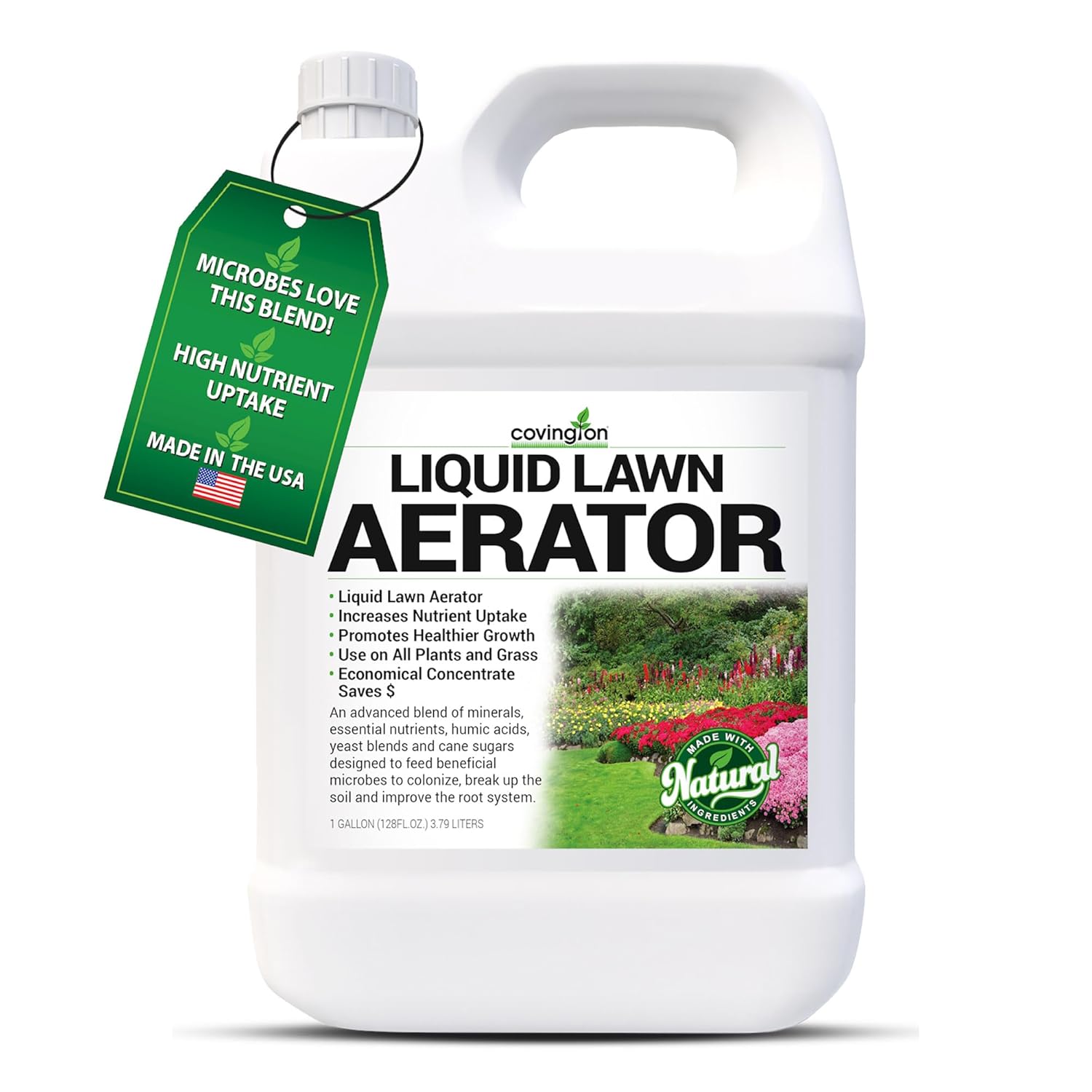
Covington Naturals Liquid Lawn Aerator is a 1-gallon concentrate designed as an easy alternative to mechanical core aeration. You mix the concentrate with water (1:1 stock mix, then use 2–8 oz per 1,000 sq ft depending on compaction) and apply with a sprayer to soften clay and compacted lawns, encourage root growth, and improve water infiltration. The formula highlights humic and amino acids plus kelp to feed beneficial microbes, so repeated applications every 45–60 days are recommended for cumulative improvement. Practical benefits include broad coverage from one bottle, no need for heavy equipment, and a solution that can be applied quickly before watering in. Limitations: it will not remove thatch or replace the deep, immediate oxygenation that core aeration provides and results take several applications to become apparent. Also follow temperature and watering directions closely to avoid runoff or ineffective treatment.
Best for: Homeowners who prefer low-risk, low-effort lawn care and want a maintenance-friendly product to gradually improve compacted or clay soils without heavy equipment.
Less Ideal for: Those needing immediate, dramatic results or professional turf managers who require deep core aeration and structural thatch removal.
- Concentrated formula covers large areas when mixed according to instructions
- Easy to apply with a sprayer so no core aerator or aerator shoes are required
- Contains humic acids, amino acids and kelp to support soil biology and gradual structure improvement
- Not a substitute for mechanical core aeration when soil is heavily compacted or thatch-bound
- Requires repeat applications over weeks to see measurable results
Verdict: A convenient, concentrated liquid aerator for homeowners who want an easy, equipment-free way to gradually loosen compacted and clay soils.
Choosing the Right Liquid Lawn Aerator: Key Factors to Consider
Coverage and Dilution Rate
Coverage determines how much lawn area a given container treats and affects cost per application. Look for clear dilution instructions and a stated coverage rate so you can calculate how many treatments a bottle provides for your lawn size.
Dilution affects how much active material reaches the soil. Overly weak mixes may have little effect, while overly concentrated mixes can harm turf or leave residues. Knowing the product's dilution range helps match it to your sprayer and schedule.
Soil Penetration and Surfactants
Liquid aerators rely on surfactants or wetting agents to move water and soluble nutrients deeper into compacted soils. Effective formulas reduce surface tension so water penetrates faster and reaches root zones instead of running off.
Consider products that describe the type of surfactant or penetration aid they use and how they perform in clay versus sandy soils. Penetration matters most where compaction restricts root growth and water percolation.
Compatibility With Other Lawn Treatments
You will often apply aerators alongside fertilizers, seed, or weed controls. Compatibility means you can tank-mix or sequence treatments without harming turf or reducing efficacy.
Check labels for recommended pairings and any warnings about mixing with herbicides or biological amendments. Choosing a formulation that plays well with common fertilizers simplifies maintenance and avoids accidental damage.
Application Method and Equipment Needs
Different liquid aerators are intended for hose-end sprayers, pump-up garden sprayers, battery sprayers, or professional boom equipment. The required application method affects how evenly the product is distributed and how much time you will spend treating the lawn.
Think about the sprayer you already own and whether the product's dilution and nozzle recommendations suit that equipment. Ease of measuring, mixing, and rinsing the sprayer after use also matters for convenience and safety.
Safety, Environmental Profile, and Residues
Home lawn applications should prioritize products with clear safety instructions, low toxicity to pets and people, and biodegradable carriers where possible. Residues that persist in soil or runoff can impact beneficial microbes or nearby plantings.
Look for manufacturer guidance on re-entry intervals, pet safety, and whether the product breaks down quickly after doing its job. A documented environmental profile helps you avoid unintended impacts on pollinators and waterways.
Speed of Visible Results
Gardeners want to know when they will see greener turf, better water infiltration, or improved seed germination after treating the lawn. Some formulations produce faster visible improvement because they accelerate water movement and nutrient uptake.
Expect variability depending on weather, soil type, and how compacted the lawn is. Products that provide realistic timelines for results help set expectations and plan follow-up treatments.
When Liquid Aeration Is the Right Choice
Liquid aeration is best when compaction is moderate, you need to treat large areas quickly, or mechanical aeration is impractical. It is not a perfect substitute for core aeration in heavily compacted soils but can significantly improve infiltration and nutrient movement in established lawns.
Use liquid aerators where roots are shallow, surface crusting limits seed-to-soil contact, or when you want to boost water movement ahead of overseeding or fertilization. They also work well for spot treatments around high-traffic areas like play zones and dog runs.
- Improves water movement and nutrient uptake in moderately compacted lawns
- Useful before overseeding to help seedbed moisture retention
- Quicker application for large lawns compared with mechanical aeration
Best Timing and Weather Conditions
Apply liquid aerators when soil moisture is moderate and not waterlogged. Too-dry soil limits penetration and too-wet soil reduces oxygen for roots. Early spring or early fall are common windows when turf is actively growing and can use the increased nutrient availability.
Avoid application immediately before heavy rain to reduce runoff risk. A period of light rain or irrigation after application can help move the product into the soil profile as intended.
- Aim for 48 to 72 hours of stable weather when possible
- Light irrigation after application can improve penetration
- Plan applications to coincide with active turf growth for best uptake
How to Apply Safely and Effectively
Measure lawn area before mixing to get correct dilution and avoid over- or under-treating. Follow labeled rates for sprayer type and nozzle size. Apply uniformly in overlapping passes to prevent streaking or missed strips.
Rinse equipment thoroughly after use and follow any re-entry or pet safety guidance on the label. Store concentrates in a cool, dry place away from children and pets and dispose of rinse water according to local guidelines if the label instructs.
- Calibrate sprayer to ensure even application
- Apply with consistent walking speed and nozzle height
- Rinse and flush equipment after use to prevent buildup
Combining Liquid Aerators With Overseeding and Fertilization
Liquid aerators can improve seed-to-soil contact and moisture retention, boosting germination when used in combination with overseeding. Apply a light starter fertilizer or compatible seed treatment after the aerator has been absorbed into the soil.
Sequence treatments according to label guidance. If tank-mixing, confirm compatibility first. When overseeding, reduce mowing height slightly and keep soil consistently moist to support new seedlings.
- Apply aerator before seed to improve moisture movement
- Use compatible starter fertilizers to support young grass
- Monitor new seedlings and avoid heavy foot traffic until established
Common Mistakes to Avoid
Skipping calibration and guessing dilution rates leads to uneven results and may waste product. Also avoid applying under extreme heat or drought because plants under stress will not respond as well to treatment.
Do not assume all liquid aerators are interchangeable. Differences in surfactant chemistry and recommended equipment mean a product that works with a hose-end sprayer might underperform in a different setup.
- Do not apply during heat waves or drought stress
- Avoid mixing without checking compatibility
- Do not ignore label safety and re-entry instructions
How We Chose the Best Liquid Lawn Aerator
We focused on features that matter for applying liquid lawn aeration treatments in real turf conditions. Key evaluation criteria included coverage rate and dilution clarity to estimate how much area a bottle treats per application; soil penetration and surfactant performance to gauge how well the formula moves water and nutrients into compacted layers; compatibility with common fertilizers and seed treatments to avoid harmful interactions; ease of application and required equipment to match homeowners who use pump sprayers, hose-end units, or professional rigs; and safety and environmental profile, emphasizing biodegradable carriers and clear label instructions. We excluded products that only claim vague benefits without specifying active ingredients, dilution rates, or application guidance. We also filtered out concentrated mixes that require specialized commercial equipment beyond typical homeowner sprayers. The shortlist reflects products that provide usable application data, measurable coverage estimates, and balanced environmental and safety information aligned with turf care practices.
FAQ
How often should I apply a liquid lawn aerator?
Frequency depends on soil condition and product concentration. Many homeowners apply two to three treatments per growing season for maintenance, while compacted lawns may benefit from more frequent applications or a complementary mechanical aeration once a year.
Can I use a liquid aerator right after fertilizing?
You can sequence treatments but check compatibility. Some products are formulated to be applied before or with liquid fertilizers, while others recommend waiting. Following label guidance avoids reducing efficacy or harming turf.
Will a liquid aerator fix severely compacted soil?
Liquid aeration helps with moderate compaction by improving water and nutrient movement, but it is unlikely to fully resolve severe compaction. For heavy compaction, core aeration or mechanical intervention is usually necessary.
Is liquid aeration safe for pets and children?
Safety varies by formulation. Many products provide short re-entry times once the spray has dried and the product has absorbed, but always read label precautions and follow any re-entry or pet-safety instructions before allowing access.
Can I tank-mix a liquid aerator with herbicides or biologicals?
Tank-mixing depends on the specific product. Some formulas are compatible with certain herbicides or biological amendments, but many labels advise testing a small area or avoiding mixing entirely. When in doubt, apply separately with appropriate intervals.
Final Verdict
When choosing a liquid lawn aerator, prioritize coverage rate, penetration ability, and compatibility with your other lawn inputs. Match the product to your sprayer and your lawn's soil type, and time applications for active turf growth and stable weather. Liquid aeration offers a low-effort way to improve water and nutrient movement for many lawns, but be realistic about its limits in heavily compacted sites. Use the evaluation criteria above to weigh tradeoffs and pick an approach that fits your maintenance routine and lawn condition.
