

Note: This article contains affiliate links. If you click on these links and make a purchase, I may earn a small commission at no extra cost to you. This helps support my research and content. Read my full affiliate disclosure here.
Choosing the right liquid fertilizer for fruit trees changes how quickly trees leaf out, bloom, and set fruit. Liquid feeds deliver nutrients directly to roots or foliage, which can be useful for correcting deficiencies at specific stages like pre-bloom or fruit fill. Whether you have a single backyard tree or a small home orchard, the right option reduces stress, supports flowering, and helps develop better-sized fruit. This guide covers the top shortlisted liquid fertilizers for fruit trees and explains the practical differences between them. We evaluate each product on nutrient formulation, uptake speed, ease of application, and suitability for common fruit species to help you pick the best fit for your trees.
Top Picks at a Glance
| Best Overall The best all-around choice for most situations | Farmer's Secret Fruit Tree Booster Liquid Fertilizer (32 oz) |  |
| Best Quality Built to a higher standard if you want something more solid | Neptune's Harvest Fish Fertilizer 2-4-1 (1 Gallon) |  |
| Best Value The sweet spot between price and what you get | Farmer's Secret Fruit Tree Booster Liquid Fertilizer (128 oz) |  |
| Best Budget The cheapest option that still gets the job done reliably | Miracle-Gro Liquid All Purpose Plant Food Concentrate, 32 oz |  |
| Highest Rated A top-rated pick with lots of positive feedback | GrowThrive Citrus Liquid Fertilizer, 10 oz Concentrate |  |
| Most Popular A crowd favorite that many people choose with confidence | TPS Nutrients Lemon Tree Fertilizer Liquid, 8 fl oz |  |
| Best Seller A high-volume bestseller chosen again and again | TPS Nutrients Lemon Tree Fertilizer Liquid Plant Food, 32 oz |  |
Farmer's Secret Fruit Tree Booster Liquid Fertilizer (32 oz)

| Item Form | Liquid |
|---|---|
| Specific Uses For Product | Fruit Tree Care |
| Coverage | 1 teaspoon per gallon |
| Target Species | Apple, Banana, Peach |
| Unit Count | 32 Fluid Ounces |
This concentrated liquid fertilizer is formulated to strengthen roots and push fruit production for a wide range of fruit trees, including banana. It is mixed at 1 teaspoon per gallon and applied weekly as a soil drench around the drip line or as a foliar feed, which makes it easy to use with a watering can, sprayer, or irrigation system. The formula emphasizes higher phosphorus and includes macronutrients and trace minerals to support root expansion, disease resistance, and quicker nutrient uptake compared with granular products. One 32 oz bottle is highly concentrated so a small volume treats a full season for a mature tree, and the brand notes compatibility with young trees at higher per-feed rates. Practical limitations are that results depend on timing, tree age, and local conditions, and weekly applications may be more maintenance than slow-release granules. Also the label gives general guidance rather than crop-specific feeding charts for bananas, so growers wanting precise macronutrient ratios may prefer a product with an explicit NPK breakdown.
Best for: Growers focused on boosting fruit production and root development who are willing to follow a regular liquid feeding schedule and want quick nutrient availability for banana trees.
Less Ideal for: People who prefer low-maintenance, infrequent feeding or who need a fertilizer with an exact NPK label for tailored nutrient management.
- Highly concentrated formula stretches a 32 oz bottle across many feedings
- Phosphorus-rich blend aimed at improving root development and fruit set
- Usable as soil drench or foliar spray and compatible with irrigation systems
- Contains trace minerals in addition to NPK to support overall tree health
- No explicit NPK ratio listed on the provided specs for precise nutrient planning
- Requires weekly applications which can be more work than slow-release options
Verdict: A concentrated, phosphorus-forward liquid that gives banana growers a fast, professional-style boost to roots and fruit when used weekly.
Neptune's Harvest Fish Fertilizer 2-4-1 (1 Gallon)

| Item Form | Liquid |
|---|---|
| Specific Uses For Product | Organic |
| Application Method | soil drench or foliar feed |
| Mixing Ratio | 1:128 |
Neptune's Harvest Fish Fertilizer is a one-gallon liquid concentrate made from cold-processed North Atlantic fish intended to deliver broad, biologically rich nutrition rather than just NPK. You dilute at the manufacturer-recommended 1 oz per gallon and apply as a soil drench or foliar spray every 2 to 3 weeks during the growing season. Notable features include an OMRI listing, a focus on preserving micronutrients and enzymes through a hydrolysate process, and a formulation that feeds soil microbes and improves soil structure over time. In practice it helps leafy growth, flowering and fruit set while also acting as a natural sticker for foliar applications. Because it supplies trace elements and amino acids, it can improve plant vigor and produce quality where used regularly. Limitations are typical for organic concentrates: it is lower in NPK compared with synthetic fertilizers so results are cumulative and require repeated use, and some gardeners may notice a mild fishy odor when handling concentrated product or immediately after application to foliage.
Best for: Gardeners focused on real growth performance and long-term soil health who want a biologically rich organic fertilizer for vegetables, ornamentals and lawns and are willing to apply it regularly.
Less Ideal for: People seeking an immediate high-nitrogen boost or quick-fix synthetic results, or those who need a no-odor fertilizer solution.
- Cold-process fish hydrolysate preserves vitamins, amino acids and enzymes for fuller nutrition
- OMRI listed organic concentrate suitable for edible gardens and ornamentals
- Versatile application as soil drench or foliar feed with a simple 1:128 mixing ratio
- Supports soil biology and improves soil structure over repeated use
- Lower straight NPK numbers compared with synthetic feeds so effects build over time
- Concentrated product can have a noticeable fish odor during handling
Verdict: Choose this product when you want a performance-focused organic fish fertilizer that builds plant vigor and soil biology rather than a fast-acting synthetic spike.
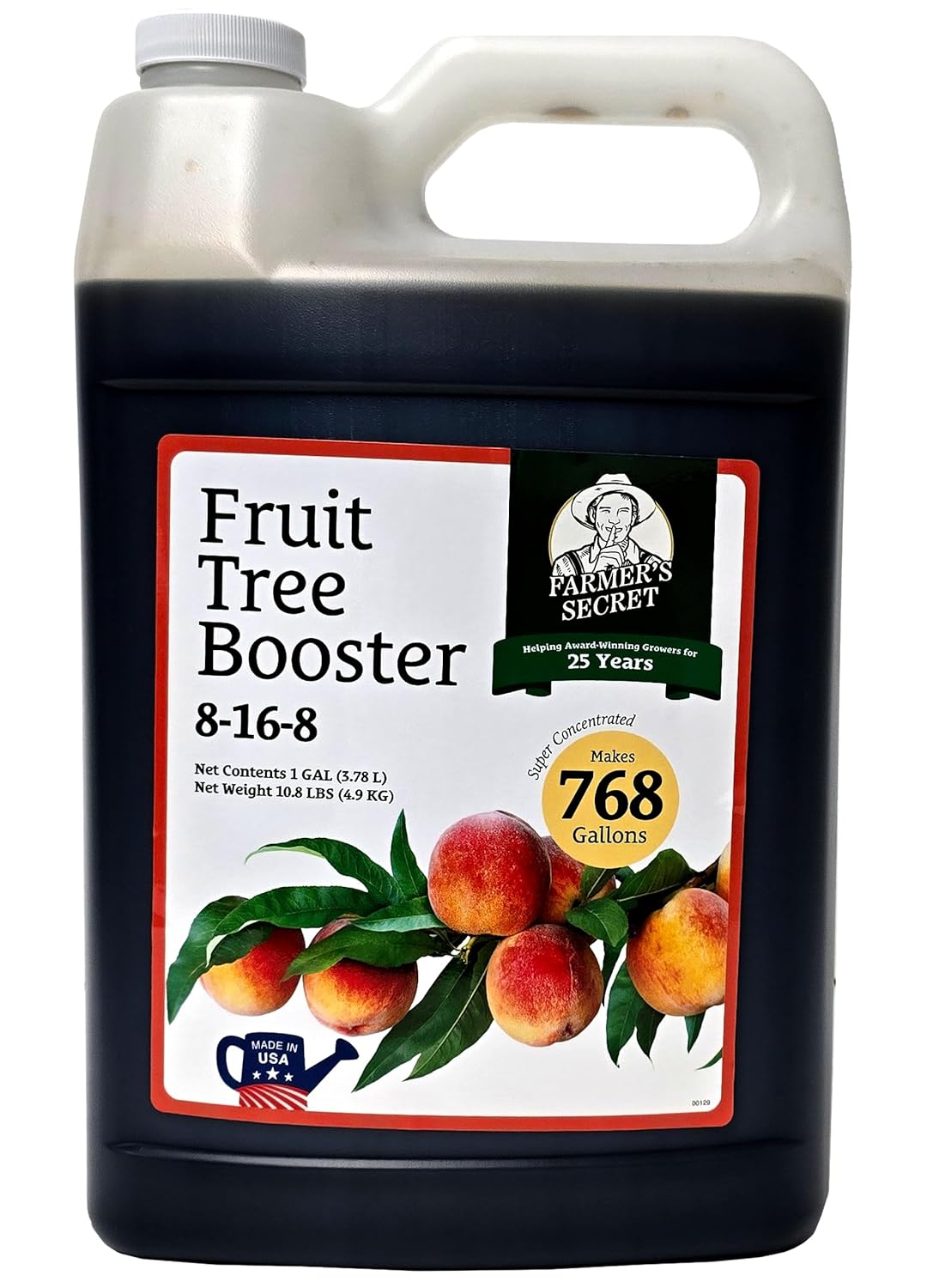
Farmer's Secret Fruit Tree Booster Liquid Fertilizer (128 oz)
| Item Form | Liquid |
|---|---|
| Specific Uses For Product | Plant Growth |
| Target Species | fruit trees |
| Unit Count | 128 Fluid Ounces |
| Mixing Ratio | 1:128 |
This concentrated liquid fertilizer is designed for routine feeding of fruit trees after dormancy through early fruiting. It mixes at 1 teaspoon per gallon, so the 128 oz bottle supplies many applications and is suited to both soil drench around the drip line and foliar feeding with a sprayer. The formula emphasizes phosphorus plus macronutrients and trace minerals to encourage stronger roots, improved nutrient uptake, and potentially better fruit set. Application guidance covers young trees through mature specimens and the product is compatible with irrigation and simple watering can or sprayer use. Practical benefits include immediate availability of nutrients versus granular feeds, low dilution rate that reduces shipping of water, and guidance that makes it approachable for beginners. Important limitations are that it is a general‑purpose booster rather than a stage‑specific program; users wanting tailored N‑P‑K ratios at different crop stages may still need to switch formulas, and safety precautions should be followed when handling and applying concentrated liquid fertilizer.
Best for: Gardeners who want a straightforward, high‑impact liquid fertilizer to boost root development and fruit production without fuss and who prioritize efficiency and frequent feedings.
Less Ideal for: Growers seeking a full season nutrient program with different N‑P‑K profiles at each stage or those who prefer slow‑release granular products for less frequent applications.
- Very concentrated mix yields many feedings from one bottle
- Phosphorus‑forward formula to support root expansion and fruiting
- Can be applied as soil drench or foliar spray and works with irrigation systems
- Clear, simple dilution and weekly schedule suitable for beginners
- Not a stage‑specific nutrient program so may need pairing with lower‑nitrogen formulas later in season
- Contains concentrated chemicals that require gloves and careful handling
Verdict: A highly concentrated, easy‑to‑use liquid booster that delivers phosphorus and trace minerals to quickly support root strength and fruiting for practical, efficiency‑minded gardeners.
Miracle-Gro Liquid All Purpose Plant Food Concentrate, 32 oz

| Item Form | Liquid |
|---|---|
| Specific Uses For Product | Plant Growth, Root Development |
| Application Method | Mix with water in a watering can |
| Mixing Ratio | 1:10 (concentrate to water, estimate) |
Miracle-Gro Liquid All Purpose is a water-soluble concentrate you mix into a watering can and apply every 1 to 2 weeks to container and in-ground plants. It is formulated for general plant growth and root development and is marketed for flowers, vegetables, shrubs and houseplants, so it works as a straightforward feed for flowering bulbs like calla lilies. The bottle’s mixing guidance (cap measures for garden application and 1 teaspoon per gallon for containers) makes it easy to dose for pots or small beds. Practical benefits include fast uptake through the soil when applied as directed and compatibility with routine watering schedules. Limitations to note are that it is an all-purpose formula rather than a bloom-focused or calcium-rich fertilizer tailored specifically to calla lilies, so growers seeking targeted bloom enhancement or specialty nutrition may want a supplement. Also, frequent use at higher-than-recommended strength can risk fertilizer burn, so follow the mixing directions and schedule.
Best for: Buyers who want an affordable, easy-to-use liquid fertilizer to keep calla lilies and other flowering plants regularly fed without fuss.
Less Ideal for: Growers seeking a specialist bloom-boost or a fertilizer formulated for specific micronutrient needs should consider a targeted or bloom-specific product instead.
- Concentrated liquid mixes easily with water for quick application
- Clear dosing instructions for both garden beds and container plants
- Suitable for a wide range of plant types including flowering bulbs and houseplants
- General all-purpose formula not specifically formulated for enhancing blooms of calla lilies
Verdict: A budget-friendly, easy-to-use liquid concentrate that reliably feeds calla lilies and other common garden plants on a regular schedule.
GrowThrive Citrus Liquid Fertilizer, 10 oz Concentrate

| Item Form | Liquid |
|---|---|
| Specific Uses For Product | Plant Growth, Root Development, Seed Development, Soil Conditioning |
| Application Method | foliar spray, root drench, direct application |
| Coverage | 8 Fluid Ounces |
| Mixing Ratio | 1:400 |
This 10 oz GrowThrive citrus liquid concentrate is designed to feed citrus trees gently while supporting root development and improved foliage. It is used as a dilute foliar spray or root drench and the label provides mixing guidance (mixing ratio 1:400 and specific tablespoon-per-gallon instructions), so you measure into water and apply regularly to leaves or the root zone. Notable features include an organic micro-nutrient formula and a probiotic-style soil blend aimed at improving soil structure and microbial activity, which helps nutrient availability without heavy salts that cause seedling burn. Practical benefits for tangerine trees are strengthened roots, fuller leaves, and potentially better fruit set when used as part of routine feeding. Limitations are the small bottle size for larger trees and the need to follow dilution instructions carefully since concentrates require accurate measuring; it will not replace a complete soil test or correct major nutrient deficiencies on its own.
Best for: Buyers who prioritize reliable, gentle nutrition for tangerine trees and want a product that supports soil biology as part of routine maintenance.
Less Ideal for: Growers needing large-volume feeding for mature orchard-sized trees or those seeking a single product to correct severe nutrient deficiencies.
- Concentrated formula that treats many applications from a small bottle
- Organic micro-nutrients and microbial blend to support soil biology
- Clear mixing ratios for foliar and root applications
- Suitable for citrus and a range of fruiting plants
- Small 10 oz bottle may require frequent repurchasing for mature trees
Verdict: A gentle, micro-nutrient-rich concentrate that reliably supports tangerine tree root and foliage health when used as a regular, measured feed.
TPS Nutrients Lemon Tree Fertilizer Liquid, 8 fl oz

| Item Form | Liquid |
|---|---|
| Application Method | Watering can, hose end sprayer, or leaf misting |
| Target Species | Lemon Trees |
| Mixing Ratio | 1:200 |
| Liquid Volume | 8 fluid ounces |
This 8 fl oz liquid fertilizer from TPS Nutrients is made specifically for lemon and other citrus trees and is used by diluting at the recommended 1:200 ratio and applying with a watering can, hose‑end sprayer, or by leaf misting. It is designed to promote fruit production, support healthy leaves and shoots, and build stronger roots so trees absorb water and nutrients more effectively. The liquid form delivers nutrients quickly for potted trees on patios as well as in-ground specimens, and the medium coverage makes it suitable for individual trees or small groups. Practical benefits include fast absorption, simple dilution and multiple application methods that fit common garden routines. Limitations are the small 8 ounce bottle size, which means frequent repurchasing for larger citrus collections, and lack of detailed NPK values on the label for gardeners who prefer exact nutrient ratios. Overall this is a convenient, citrus-focused supplement for home growers seeking straightforward feeding for Meyer and dwarf varieties.
Best for: Home gardeners who want a ready-to-use, citrus-specific feed for one or a few lemon trees and prefer simple dilution and flexible application methods.
Less Ideal for: Growers managing larger orchards or multiple mature trees who need bulk quantities or exact NPK formulations should consider commercial‑scale fertilizers instead.
- Formulated specifically for lemon and citrus so nutrients suit citrus needs.
- Liquid concentrate with 1:200 mixing for quick uptake and flexible application.
- Multiple application methods: watering can, hose‑end sprayer, or foliar misting.
- Suitable for both potted and in‑ground citrus, useful for patios and small orchards.
- Small 8 fl oz bottle may not last for multiple trees or large plantings.
- Product listing does not provide explicit NPK numbers for precise nutrient planning.
Verdict: A convenient liquid concentrate tailored to lemon and citrus that makes regular feeding easy for home growers with one or a few trees.
TPS Nutrients Lemon Tree Fertilizer Liquid Plant Food, 32 oz

| Item Form | Liquid |
|---|---|
| Specific Uses For Product | Plant Food |
| Target Species | citrus |
| Unit Count | 32 Fluid Ounces |
| Mixing Ratio | 2 tablespoons per gallon of water |
This 32 oz liquid fertilizer is aimed at citrus care and is easy to use for in-ground and container lemon trees. It is a fast-absorbing, ready-to-mix concentrate with a manufacturer-recommended ratio of 2 tablespoons per gallon of water, so you can feed trees without complicated measuring. The formula advertises support for root growth, shoots and stems, and fruit development, which translates to fuller foliage and potentially better yields when used as directed. Practical benefits include suitability for Meyer and dwarf varieties and clear safety directions so you can apply it around patios and orchards. Because it is liquid, it is faster acting than granular products but requires regular mixing and application, and you must follow the label for frequency and dilution to avoid overfeeding. The product is focused on citrus specifically and does not list broader nutrient analysis on the product page, so gardeners who want granular schedules or exact N-P-K values may need additional information before long-term planning.
Best for: Home gardeners who want a straightforward, citrus-focused liquid fertilizer for patio or backyard lemon trees and prefer predictable, simple mixing and application instructions.
Less Ideal for: Gardeners who need detailed N-P-K breakdowns for precise nutrient planning or who prefer low-maintenance slow-release granular fertilizers.
- Formulated specifically for lemon and citrus trees, supporting fruit and shoot development
- Liquid concentrate mixes at a simple ratio for quick absorption and easy foliar or soil feeding
- Suitable for both in-ground and potted/ container citrus, including dwarf varieties
- No detailed nutrient analysis (N-P-K values) listed on the product page
- Requires regular mixing and repeat applications compared with slow-release granules
Verdict: A simple, citrus-specific liquid concentrate that makes regular feeding of lemon trees quick and predictable.
Choosing the Right Liquid Fertilizer for Fruit Trees: Key Factors to Consider
Nutrient Ratio and Fruiting Needs
Fruit trees need different nutrient ratios at different growth stages. Higher nitrogen helps vegetative growth in young trees, but excess nitrogen during bloom can reduce fruit set. Phosphorus and potassium support flowering, fruit development, and winter hardiness, so look for liquid formulations that allow you to match the N-P-K balance to the season.
Micronutrients like zinc, boron, and iron are often required in small amounts but can limit fruit quality if missing. A liquid fertilizer that lists micronutrient analysis helps you address subtle deficiencies without guessing. Choosing a product with clear seasonal guidance makes it easier to shift ratios across the year.
Uptake Method: Soil Drench Versus Foliar Feed
Liquid fertilizers can be applied as a soil drench to feed roots or sprayed onto leaves for rapid correction of deficiencies. Soil drenches rely on active root uptake and are better for building reserves and feeding established trees. Foliar sprays are faster and useful when deficiencies appear suddenly or when rooting is weak.
Effective programs often combine both methods: foliar sprays for quick micronutrient fixes during bloom and early fruit set, and root applications for steady macro-nutrient supply. Make sure the product's label supports both methods if you plan to alternate application techniques.
Concentration, Dilution, and Tank Compatibility
Concentrated liquids require careful dilution to avoid burning roots or foliage. Products that offer a broad dilution range are more versatile across tree sizes, from newly planted saplings to mature standards. Check whether the fertilizer mixes readily in water and whether it is compatible with standard garden sprayers and hose-end applicators.
Also consider whether the product separates in storage or needs continuous agitation during application. A formula that mixes uniformly and provides clear mixing instructions reduces application errors and uneven feeding.
Timing and Seasonal Use
Applying the right feed at the right time makes the most difference for fruit trees. Pre-bloom and bloom feeds emphasize phosphorus and micronutrients to promote healthy flowers and pollination. Post-bloom and during fruit development, potassium supports fruit size and color. Late-season feeds should favor lower nitrogen to encourage dormancy and hardiness.
A liquid fertilizer with explicit timing guidance for young versus mature trees helps you avoid common mistakes like late-season high-nitrogen applications that prolong soft growth ahead of winter.
Salt Content and Root Safety
Liquid fertilizers vary in soluble salt levels. High salt concentrations can lead to root burn or reduced soil microbial activity when overused. For frequent applications or use on container-grown fruit trees, select a formulation with lower salt index or that allows lighter dilutions.
If you have alkaline or marginal soils, be cautious with products that concentrate salts near the root zone. Periodic soil testing and using soil drench volumes that move salts below the root mat help protect tree roots.
Ease of Application and Equipment Needs
Ease of use affects how consistently you feed trees. Look for products compatible with common garden gear like pump sprayers, backpack sprayers, or hose-end applicators. Ready-to-use or pre-diluted bottles save time but may be less economical for larger trees or multiple specimens.
Consider whether applications require protective gear, special nozzles, or frequent shaking. The more straightforward the application, the more likely you are to maintain a regular feeding schedule that benefits fruit production.
When to Feed Fruit Trees With Liquid Fertilizer
Timing liquid fertilizer applications around the tree's active growth phases yields the best results. Start with a light feed at bud break to support early leaf growth, then focus on phosphorus and micronutrients at bloom to support flowers and pollination.
After petal fall, switch to a formulation or dilution that emphasizes potassium and moderate nitrogen to help fruit set and size. Avoid heavy nitrogen late in the season so trees can harden off properly before dormancy. For container or patio trees, more frequent, lighter feeds are usually safer than infrequent heavy doses.
- Bud break: low to moderate nitrogen for leafing
- Bloom: phosphorus and micronutrients for flowers
- Post-bloom: higher potassium for fruit development
- Late season: reduce nitrogen to encourage dormancy
Applying Liquid Fertilizer Safely
Protect roots and foliage by following dilution instructions precisely and avoiding application in hot, sunny conditions that can increase leaf burn risk. Apply foliar sprays in the early morning or evening when stomata are open and temperatures are cooler.
For soil drenches, water the root zone before and after applying a concentrated feed to help move nutrients into the rooting area and reduce salt concentration at the surface. Wear basic protective equipment as directed on the product label and rinse sprayers thoroughly after use.
- Apply foliar feeds during cool parts of the day
- Pre-wet soil before root drenches and follow with water
- Rinse equipment to prevent buildup and nozzle clogging
Adjusting Feeds by Tree Age and Size
Young trees have smaller root systems and need gentler, more frequent feeds. Use lighter dilutions and shorter application intervals to avoid overloading roots. Mature trees can handle higher rates and less frequent applications but still benefit from tailored timing.
For dwarf or container-grown fruit trees, reduce concentration and increase application frequency compared with full-sized orchard specimens. Monitor tree response and adjust feeding strength if you see leaf scorch, excessive vegetative growth, or poor fruiting.
- Saplings: lighter dilution, more frequent applications
- Mature trees: stronger feeds, timed to season
- Container trees: lowest concentrations, shortest intervals
Monitoring Tree Response and Soil Testing
Watch for visual signs of nutrient imbalance: yellowing may indicate nitrogen or iron issues, while poor fruit set can signal phosphorus or pollination problems. Regularly inspect leaves, blossoms, and fruit for clues before changing your fertilizer program.
Soil and leaf tissue testing are the most reliable ways to identify deficiencies and avoid unnecessary feeding. Test every few years for established trees and adjust your liquid fertilizer schedule to match measured nutrient levels rather than guesswork.
- Use leaf tissue tests for micronutrient diagnostics
- Soil tests reveal pH and base nutrient availability
- Adjust fertilizer ratios based on test results, not assumptions
Combining Liquid Fertilizers With Other Inputs
Liquid fertilizers work well alongside composts, mulches, and slow-release granular products. Use liquids for targeted corrections and quick boosts, while organic matter improves long-term soil structure and microbial health.
Avoid applying high-salt liquid feeds immediately after soil-applied herbicides or wetting agents that could increase root stress. When in doubt, separate different applications by several days and monitor the tree for any adverse reactions.
- Use liquids for quick fixes and granulars for long-term nutrition
- Allow spacing between different chemical applications
- Incorporate mulches to stabilize moisture and reduce salt buildup
How We Chose the Best Liquid Fertilizer for Fruit Trees
We shortlisted products that suit home orchard and small-scale backyard fruit trees, focusing on formulations and application methods that matter in real garden use. Key evaluation criteria included nutrient balance and targeted ratios for fruiting, speed of nutrient uptake through soil drench and foliar feeding, and concentration flexibility for different tree ages and sizes. We also looked at ease of mixing and application, compatibility with common spray equipment, and label clarity for timing and dilution. Longevity of effect and risk of salt buildup were considered to favor options that minimize root stress when used according to instructions. Products that required specialized equipment, or that lacked clear application guidance for fruit trees, were excluded. We prioritized options that offer clear guidance for seasonal timing, measurable N-P-K and micronutrient content, and pathways for both corrective and maintenance feeding.
FAQ
How often should I apply liquid fertilizer to established fruit trees?
Often it depends on formulation and concentration, but many gardeners apply liquid feedings three to four times during the growing season: bud break, pre-bloom, post-bloom, and mid-summer. Container trees typically need lighter, more frequent applications.
Can I use foliar sprays instead of root drenches for fruit trees?
Foliar sprays are useful for rapid correction of micronutrient deficiencies and short-term boosts, but they do not replace root feeding for long-term macronutrient needs. Combining both methods gives fast correction and sustained supply.
Will liquid fertilizer burn my tree's roots or leaves?
It can if applied too concentrated or in hot conditions. Follow dilution instructions closely, apply during cooler hours for foliar feeds, and water the root zone when using concentrated soil drenches to reduce salt concentration.
Should I change fertilizer strategy for newly planted trees?
Yes. New plantings have limited root systems and need gentler, lower-rate feeds more often rather than heavy applications. Overfeeding young roots can slow establishment and increase stress.
Do liquid fertilizers affect soil pH?
Some formulations can temporarily alter soil surface pH, especially when applied frequently. Significant long-term pH changes are uncommon, but regular soil testing helps detect trends so you can adjust your program or add pH amendments.
Can I mix a liquid fertilizer with other spray treatments?
Often it depends on product compatibility. Many liquids can be tank-mixed with certain pest or disease sprays, but always check label instructions and compatibility guidance. When unsure, perform a small jar test or separate applications by time.
Final Verdict
When choosing a liquid fertilizer for fruit trees, match nutrient ratios and application methods to the tree's age and the seasonal needs of flowering and fruit development. Prioritize clear label instructions, manageable dilution ranges, and options that provide both macro- and micronutrients. Balance fast-acting foliar corrections with routine root feeds, monitor tree response, and use soil or tissue tests to refine your schedule. With attention to timing and salt management, liquid fertilizers are an effective tool for healthier trees and better fruit yields.
