

Note: This article contains affiliate links. If you click on these links and make a purchase, I may earn a small commission at no extra cost to you. This helps support my research and content. Read my full affiliate disclosure here.
Getting the right fertilizer for root development matters whether you are setting out seedlings, transplanting established shrubs, or repairing a stressed lawn. The wrong formulation or application method can encourage top growth at the expense of root establishment, or leave roots shallow and vulnerable to drought and disease. This guide looks at seven vetted fertilizer options that gardeners choose when the primary objective is stronger, deeper roots. We shortlisted products that focus on nutrient balance, delivery method, and compatibility with common garden soils and planting situations. Below you will find how we evaluated those options and practical advice for picking and using a root-focused fertilizer.
Top Picks at a Glance
| Best Overall The best all-around choice for most situations | Xtreme Gardening Mykos Granular Mycorrhizal Inoculant (2.2 lb) |  |
| Best Quality Built to a higher standard if you want something more solid | Plant Success Great White Mycorrhizal Root Booster (1 oz) |  |
| Best Value The sweet spot between price and what you get | YARDi Root & Grow Liquid Plant Food 8-16-8 (32 oz) |  |
| Best Budget The cheapest option that still gets the job done reliably | Bonide Root & Grow Concentrate 32 oz |  |
| Highest Rated A top-rated pick with lots of positive feedback | Espoma Organic Bio-Tone Starter Plus 4-3-3 Organic Starter Fertilizer, 8 lb |  |
| Most Popular A crowd favorite that many people choose with confidence | Burpee Bone Meal Fertilizer, 3 lb |  |
| Best Seller A high-volume bestseller chosen again and again | ferti-lome Root Stimulator and Plant Starter, 16 oz |  |
Xtreme Gardening Mykos Granular Mycorrhizal Inoculant (2.2 lb)

| Item Form | Granules |
|---|---|
| Coverage | 4 cubic feet |
| Specific Uses For Product | Gardening,Growth |
| Target Species | Pumpkin |
Xtreme Gardening Mykos is a granular mycorrhizal inoculant intended to colonize plant roots and expand their effective root zone, which helps plants take up water and nutrients more efficiently. Typically used at planting, transplanting, or as a soil amendment, the granules are mixed into potting media or placed in planting holes for direct root contact. The formula is OMRI listed and pitched as suitable for vegetables, herbs, flowers, trees, shrubs and containers, making it a versatile option for both garden beds and potted plants. Practical benefits include stronger root systems, improved resilience to dry spells, and potentially larger yields when paired with good cultural care. Directions are straightforward with measured rates for starts, soil amendment, and established plants. Important limitations are that results depend on existing soil biology and proper planting technique, and benefits are gradual rather than immediate; it does not supply macronutrients like NPK, so it works best alongside a balanced fertilization plan.
Best for: Gardeners who want a balanced, long-term boost to root development across beds and containers and who plan to use it alongside routine fertilization and good cultural care.
Less Ideal for: People looking for a quick foliar nutrient fix or an all-in-one fertilizer that supplies immediate NPK; not intended for users who need instant visible changes.
- OMRI listed organic mycorrhizal fungi appropriate for organic gardens
- Granular form for easy placement in planting holes or mixing into soil and coco coir
- Broad applicability across vegetables, herbs, ornamentals, trees and container plants
- Provides measurable coverage useful for amending several cubic feet of growing media
- Does not provide primary macronutrients so nutrient program must be maintained separately
- Effectiveness depends on existing soil conditions and correct application
- Benefits develop over weeks to months rather than immediately
Verdict: Use this OMRI listed granular mycorrhizal inoculant to strengthen roots and improve water and nutrient uptake as part of a balanced root-development program.
Plant Success Great White Mycorrhizal Root Booster (1 oz)

| Item Form | Powder |
|---|---|
| Specific Uses For Product | Root Development |
| Application Method | Powder |
| Liquid Volume | 1 fluid ounces |
| Mixing Ratio | 1:2 |
Great White is a concentrated powdered root booster designed for seed starting, transplanting, and improving established root systems. You mix the powder at the recommended ratio and apply it to seeds, transplants, or the root zone to introduce a broad consortium of microorganisms: nine endomycorrhizal species, a dozen beneficial bacteria, and two Trichoderma strains. In practice it helps seedlings establish more quickly, encourages finer root branching, and can improve water and nutrient uptake for better flowering and fruiting. The powder format and small 1 ounce jar make it easy to dose precisely for individual pots, trays, or targeted applications. Limitations are its small unit size for larger gardens and the need to follow mixing instructions for effective inoculation; performance also depends on existing soil biology and cultural care. For growers focused on stronger root performance, this product is a focused microbial amendment rather than a complete fertilizer program.
Best for: Serious gardeners and small-scale growers who prioritize faster establishment and maximal root performance for seedlings, transplants, and container plants.
Less Ideal for: Large-scale landscapers or gardeners needing broad-spectrum macronutrient fertilization across many beds who prefer bulk products and fertigated feeding programs.
- Broad microbial mix combining 9 endomycorrhizal species, beneficial bacteria, and Trichoderma for complementary root support
- Powder form allows precise dosing and easy mixing at the recommended ratio
- Intended for seed starting, transplanting, and improving nutrient and water uptake
- Compatible with soil and soilless systems, useful for greenhouse or container growing
- Small 1 ounce jar limits how many applications you can treat for medium to large gardens
- Effectiveness depends on proper mixing and existing soil microbial conditions
Verdict: Choose this concentrated microbial root booster when you want targeted, performance-focused support to accelerate root establishment and improve nutrient and water uptake.
YARDi Root & Grow Liquid Plant Food 8-16-8 (32 oz)

| Item Form | Liquid |
|---|---|
| Specific Uses For Product | Seedling Fertilizer |
| Unit Count | 32 Fluid Ounces |
| Coverage | Full |
YARDi Root & Grow is a concentrated liquid plant food designed to stimulate root mass and support early vegetative growth in outdoor vegetables, flowers, and ornamentals. The 8-16-8 NPK ratio emphasizes phosphorus to encourage stronger, deeper roots while still supplying nitrogen and potassium for leaf and stem development. It mixes easily with water at the recommended 1 to 2 teaspoons per gallon and can be applied as a soil drench, foliar spray, through drip irrigation, or with a hose-end, which makes it convenient for raised beds, garden rows, and container starts. Practical benefits include targeted early-stage feeding for seedlings and transplants, flexible application methods, and a concentrated formula so one 32 oz bottle covers a full garden with occasional feedings every 3 to 4 weeks. Limitations are that it is formulated for early growth and root development rather than continuous bloom or fruiting feeds, so gardeners will still need a different balance later in the season for heavy fruit set or flowering. Users should follow dilution directions to avoid overfeeding young plants.
Best for: Gardeners who prioritize establishing strong root systems for seedlings, transplants, and young vegetable or flower beds and want a straightforward, easy-to-mix feed to use at planting and early growth stages.
Less Ideal for: Growers seeking an all-season fertilizer for heavy fruiting or peak bloom should choose a bloom/fruit-focused formula later in the season or use in combination with other feeds.
- High phosphorus 8-16-8 formula targets root development
- Concentrated liquid mixes at low rates so a small bottle covers a whole garden
- Multiple application options: soil drench, foliar spray, drip or hose-end
- Clear directions for repeat use every 3–4 weeks during the growing season
- Formulated primarily for early-stage feeding and root growth rather than late-season bloom or fruiting needs
Verdict: Use this concentrated 8-16-8 liquid when you need a simple, effective feed to build strong roots and give seedlings and transplants a fast start.
Bonide Root & Grow Concentrate 32 oz
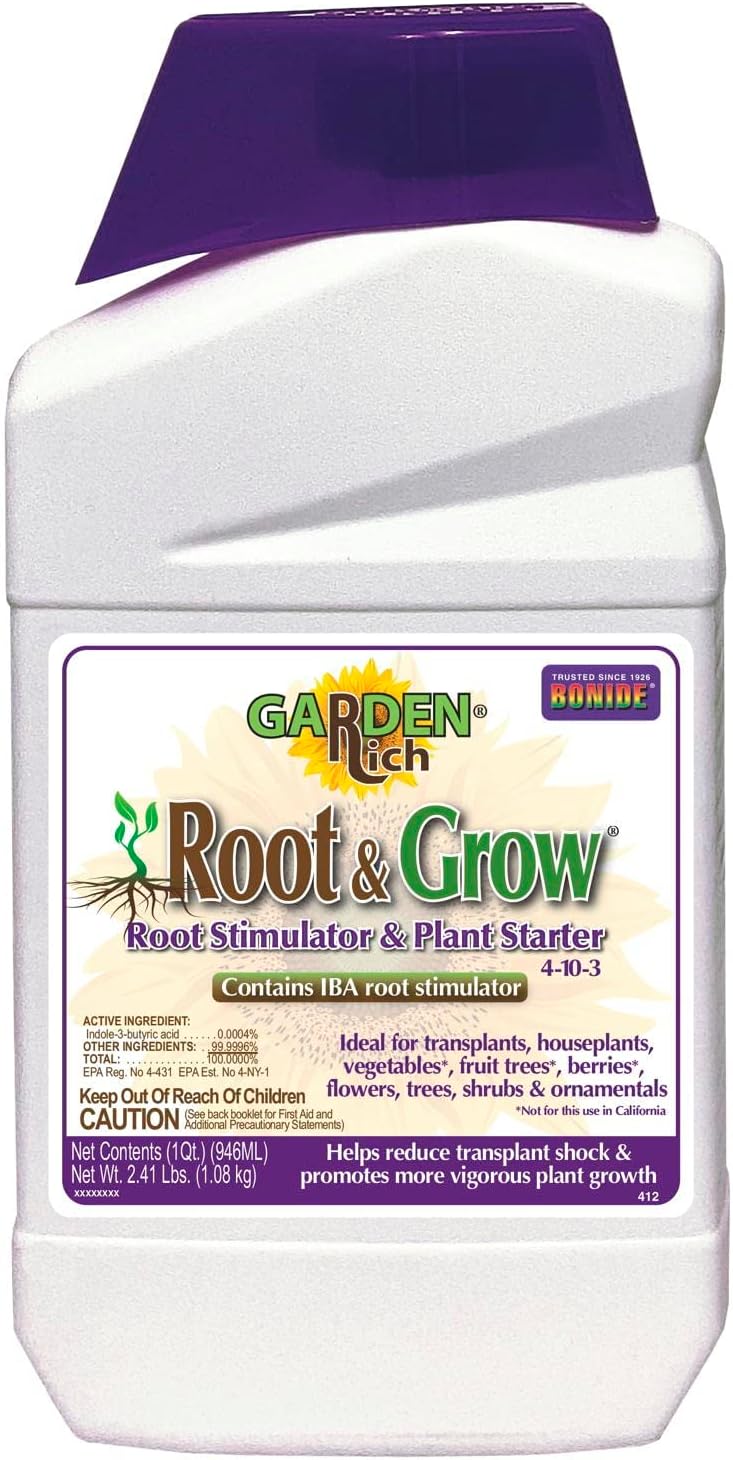
| Item Form | Liquid |
|---|---|
| Specific Uses For Product | Root Development |
| Application Method | Pouring directly onto the soil and roots |
| Target Species | fruit, vegetables, flowers, trees, and bedding plants |
| Mixing Ratio | 4:10:3 |
Bonide Root & Grow is a liquid concentrate designed for use when seeding or transplanting to speed early root formation and help plants establish. You dilute the concentrate per label instructions and pour the solution onto soil and roots when potting seedlings, transplanting plugs, or setting out young vegetables and ornamentals. Notable features include an active IBA rooting hormone and a 4-10-3 nutrient ratio that supplies extra phosphorus to support root growth. In practice it can reduce transplant shock and promote quicker, stronger root systems, which is useful for both container-grown seedlings and recently set out bedding plants. Because it is a concentrate, a single 32 oz bottle yields multiple applications, which stretches a limited budget. Important limitations are that it is a specialized root stimulator rather than an all-purpose feed for ongoing growth and it requires careful dilution and label compliance to avoid overapplication.
Best for: Buyers wanting an affordable, concentrated product to give seedlings and recent transplants a stronger start and who prioritize preventing transplant shock over routine feeding.
Less Ideal for: Gardeners looking for a general weekly fertilizer or a balanced feed for mature plants should choose a different product.
- Contains IBA rooting hormone to stimulate root initiation
- 4-10-3 fertilizer ratio provides extra phosphorus for root development
- Concentrated 32 oz bottle yields many applications, good for tight budgets
- Easy to apply by diluting and pouring directly onto soil and roots
- Formulated mainly for root stimulation so not ideal as a regular all-purpose feed
- Requires careful mixing and label reading to use safely and effectively
Verdict: A budget-friendly concentrated root stimulator that helps seedlings and transplants establish faster by combining IBA with a phosphorus‑rich fertilizer.
Espoma Organic Bio-Tone Starter Plus 4-3-3 Organic Starter Fertilizer, 8 lb

| Item Form | Granules |
|---|---|
| Application Method | Mix with soil |
| Specific Uses For Product | Gardening |
| Target Species | For everything you plant |
Espoma Organic Bio-Tone Starter Plus is a granular, ready-to-use starter fertilizer designed for planting and transplanting a wide range of garden plants. You mix it into backfill soil or potting mixes so the nutrients and added mycorrhizae sit in the root zone at planting time. The formula combines an organic 4-3-3 nutrient ratio with beneficial bacteria, humates, and both endo and ecto mycorrhizae to encourage faster root development, improved soil structure, and better establishment under stressful conditions. Typical uses include flower beds, bulbs, transplant holes, and planting mixes where quick root growth matters. Because it is organic and approved for organic gardening, it is suited to gardeners who prefer natural inputs. The main limitations are that it is intended as a starter or planting amendment rather than an all-season feed and dosing is by volume for different applications so you need to follow the mixing instructions for correct results. For gardeners wanting an easy organic boost at planting, this product provides a focused, microbially active start.
Best for: Gardeners who prioritize natural, microbially active amendments and want a reliable organic boost when planting or transplanting ornamentals, vegetables, and bulbs.
Less Ideal for: Buyers looking for a one-product solution for seasonal feeding or those who prefer liquid feeds or quick-release chemical fertilizers for immediate foliar results.
- Contains both endo and ecto mycorrhizae to aid root establishment
- Organic 4-3-3 formula enhanced with beneficial bacteria and humates
- Ready-to-use granules that are mixed into soil at planting
- Approved for organic gardening and made by a long-standing organic fertilizer brand
- Formulated primarily for initial planting and transplant use rather than ongoing feeding
- Dosing instructions vary by application and require measuring by volume for correct results
Verdict: Choose this if you want an organic, microbe-enhanced starter fertilizer to help new plantings establish strong roots.
Burpee Bone Meal Fertilizer, 3 lb

| Item Form | Powder |
|---|---|
| Specific Uses For Product | Plant Growth, Root Development |
| Coverage | 240 Sqaure Feet |
| Target Species | tomatoes, peppers, and bulbs |
Burpee Bone Meal is a slow-release granular fertilizer designed to boost early root development and flowering in root and bulb crops. Gardeners typically work it into planting holes for bulbs or mix it into soil and potting media when starting seeds or transplanting vegetables like carrots, beets, and onions. The product is OMRI listed for organic gardening and provides phosphorus and calcium that support stronger root systems and better early-season growth. Its fine granular texture makes it easy to apply evenly, and because it breaks down slowly it feeds plants over the season without burning them. Practical benefits include targeted support for root vegetables and an easy application method for beds and containers. Limitations are that it supplies mainly phosphorus and calcium rather than a balanced NPK profile, so it is best used alongside a nitrogen source if foliage development is needed, and results are gradual rather than immediate because of the slow-release nature.
Best for: Gardeners focused on improving root development and bulb planting who prefer organic inputs and want a simple amendment to add at planting or during bed preparation.
Less Ideal for: Growers seeking an all-in-one balanced fertilizer for both foliage and root development or those who need fast-acting, soluble nutrients for immediate correction.
- OMRI listed for organic gardening, suitable for certified organic beds
- Fine granular form that is easy to spread and incorporate
- Provides phosphorus and calcium to encourage strong root and bulb development
- Slow-release action reduces risk of burning plants and supplies season-long support
- Not a complete fertilizer profile so additional nitrogen may be needed for leafy growth
Verdict: A reliable organic bone meal to strengthen roots and jump-start bulbs and root vegetables when added at planting.
ferti-lome Root Stimulator and Plant Starter, 16 oz

| Item Form | Powder |
|---|---|
| Specific Uses For Product | Root Development |
| Target Species | trees, shrubs, roses, annuals and perennials |
| Mixing Ratio | 3-1/2 tablespoons per gallon of water |
This powdered root stimulator supplies indole butyric acid and a wetting agent to help young transplants and newly planted shrubs and trees establish stronger root systems. It is mixed into water (manufacturer directions specify 3.5 tablespoons per gallon) and applied when planting to reduce transplant shock and encourage quicker, greener growth. The product's powder form makes it shelf-stable and convenient to store until needed, and the directions cover both landscape plantings and smaller houseplants. Practical benefits include easier establishment of new plants, fewer setbacks after transplanting, and clearer dosing instructions for common uses. Important limitations are that it is a targeted root treatment rather than an all-purpose fertilizer so it will not replace balanced nutrient feeding, and it requires careful handling and dilution because it contains active rooting hormone; protective gloves and basic safety precautions are recommended. For gardeners focused on improving root development at planting time, this is a straightforward option that complements regular fertilization schedules.
Best for: Gardeners who prefer cautious, preventive care and want a reliable, purpose-built product to reduce transplant shock and encourage root establishment at planting time.
Less Ideal for: Gardeners seeking an everyday or balanced fertilizer for feeding established plants should consider a general-purpose plant food instead.
- Contains indole butyric acid to stimulate early root formation
- Powder form is shelf-stable and easy to store
- Clear mixing directions for landscape and houseplant use
- Reduces transplant shock and supports stronger root development
- Not a complete nutrient fertilizer so it does not replace regular feeding
- Contains concentrated rooting hormone and requires careful handling and dilution
Verdict: A simple, purpose-built root stimulator that reliably reduces transplant shock and helps new plantings establish stronger roots.
Choosing the Right Fertilizer for Root Development: Key Factors to Consider
Nutrient Ratio Focused on Roots
The nutrients you apply determine whether a plant invests in roots or shoots. For root development you want a fertilizer program that provides adequate phosphorus and potassium relative to nitrogen. Phosphorus supports root initiation and early root extension while potassium helps root strength and stress resilience. Too much nitrogen drives leafy growth and can suppress root depth.
When evaluating labels, look beyond the raw N-P-K numbers to the relative proportion and strength of the middle and last numbers. For seedlings and transplanting, a modestly higher middle number often supports root establishment. For long-term root health in established plants, balanced maintenance feeds with steady potassium and available phosphorus are useful.
Formulation and Delivery Method
How a fertilizer delivers nutrients affects how quickly roots can access them. Liquid feeds and soluble powders make phosphorus and other immobile elements available faster, which is useful at planting or right after transplanting. Granular slow-release products provide steadier supply over weeks or months, reducing the risk of nutrient burn from concentrated doses.
Consider the planting situation when choosing a format. Containers and small pots favor soluble or gentle liquid mixes because root volume is limited. In-ground plantings and large beds often benefit from coated granules or organic amendments that release nutrients slowly and improve soil structure over time.
Presence of Root-Stimulating Additives
Many fertilizers aimed at root development include additional components that support root biology. Beneficial microbes such as mycorrhizae can expand root absorbing area, while humic and fulvic acids can improve nutrient uptake and root growth. Seaweed extracts and certain amino acids are frequently included to reduce transplant shock and stimulate fine root branching.
These additives are not magic, but they often enhance outcomes when paired with appropriate nutrient ratios and good planting technique. Confirm compatibility with your planting type and check whether additives are live organisms requiring special storage or handling.
Application Rate and Timing
Correct application rate is critical. Overapplication can scorch roots or cause excessive vegetative growth, while underapplication will not help establishment. For transplants and newly rooted cuttings, a lighter, more frequent feeding approach often produces better root architecture than a single heavy dose.
Timing matters too. Apply a root-focused feed at planting, again at key establishment milestones (two to four weeks later depending on the product), and then move to maintenance schedules. In cool soils, root activity is slower, so reduce rates and avoid fertilizing until soils warm to avoid concentrating nutrients where roots cannot use them.
Soil Type and pH Effects
Soil texture and pH influence nutrient availability and therefore how effective a fertilizer will be for root growth. Phosphorus becomes less available in very acidic or very alkaline soils. Sandy soils drain quickly and may need more frequent, lower-dose applications, while heavy clay holds nutrients but can restrict root penetration if compacted.
Test or estimate your soil before selecting a product. Some fertilizers are formulated to help buffer pH effects or include chelated micronutrients that remain available across a wider pH range. Amendments that improve structure, such as compost or coarse organic matter, often pair well with root-focused fertilizers because they make it easier for roots to expand and access applied nutrients.
Suitability for Plant Type and Stage
Different plants and growth stages have differing root needs. Young seedlings and newly transplanted annuals often need a gentle, soluble formulation that encourages fine root branching. Perennials, shrubs, and trees generally benefit from a longer-term feeding strategy that supports root depth and resilience rather than rapid top growth.
Match the fertilizer's intended use to the species and stage you are treating. Check product guidance for use on edibles versus ornamentals if you plan to apply to vegetable gardens or fruiting shrubs.
How Root-Targeted Fertilizers Work in the Garden
Root-targeted fertilizers change the plant's allocation of resources by making certain nutrients more available where roots can use them. Phosphorus is often the focus because it supports root initiation and energy transfer, but a combination of steady potassium and supportive organic compounds will produce stronger, thicker root systems over time.
In practical gardening, this translates into faster establishment after transplanting, improved drought resilience, and better nutrient uptake for sustained plant health. The delivery method and soil conditions mediate how quickly those benefits appear.
- Liquids deliver quickly for immediate uptake at planting
- Granules or coated products provide steady feeding over weeks
- Microbial and humic additives support root biology rather than supplying macronutrients alone
Using Root Fertilizer at Transplanting
At transplant time, encourage root growth without overwhelming tender roots. Apply a light, soluble feed in the planting hole or water in a diluted solution after setting the plant. Avoid placing concentrated granules directly against roots to prevent burn and uneven uptake.
Also, focus on good planting technique. Loosen the backfill, create a shallow basin for water, and keep soil moist but not saturated while roots establish. A root-focused fertilizer is most effective when combined with proper planting and aftercare.
- Dilute liquid feeds are safer for new roots than concentrated granules
- Work gentle amendments into the backfill to improve structure and nutrient retention
- Water consistently to help roots access applied nutrients
Balancing Root Fertilizer with Soil Amendments
Fertilizer does not replace good soil structure. Adding compost or coarse organic matter improves aeration and water retention, making it easier for roots to grow deeper. In depleted soils, pair a root-focused fertilizer with regular organic amendments to rebuild biological activity.
If your soil is compacted, mechanical loosening or incorporation of coarse amendments is often necessary for roots to respond to fertilizer. Think of fertilizer as fuel and soil structure as the road network that lets roots travel to access that fuel.
- Combine fertilizers with compost to improve root zone environment
- Address compaction before relying on fertilizer to stimulate depth
- Use mulches to conserve moisture and reduce stress while roots expand
Safe Practices and Environmental Considerations
Apply fertilizers according to label directions to avoid runoff and nutrient leaching. Over-application, particularly in sandy soils or near slopes, can move phosphorus and nitrogen into waterways. Use targeted placement and conservative rates when working near water or when heavy rains are forecast.
Consider slow-release formats or organic sources when long-term soil health and reduced leaching risk are priorities. Proper storage and mixing practices also protect beneficial soil life that helps roots thrive.
- Avoid applying before heavy rain to reduce runoff risk
- Prefer slow-release or organic formulations in vulnerable landscapes
- Follow mixing and storage guidance to preserve additives like microbes
Common Mistakes Gardeners Make
A frequent error is assuming high overall nutrient numbers are better. Excessive nitrogen after planting can inhibit root system development while encouraging top growth that the young roots cannot sustain. Another mistake is applying concentrated granules in direct contact with roots, which can cause localized burning and uneven establishment.
Also watch timing and soil temperature. Fertilizing in cold soils where roots are inactive wastes product and can stress plants. Finally, neglecting soil tests leads gardeners to apply unnecessary nutrients or miss limiting factors such as pH or micronutrient deficiencies.
- Do not rely solely on high-nitrogen mixes for establishment
- Avoid placing undiluted granules against roots
- Test soil before heavy fertilization to target true deficiencies
How We Chose the Best Fertilizer for Root Development
We prioritized formulations and formats that demonstrably encourage root growth rather than just leafy response. Key evaluation criteria included the nutrient ratio and source, presence of root-stimulating additives, delivery method, and compatibility with common garden soils and planting situations. We also considered ease of use for home gardeners and the predictability of results across a range of planting scenarios. Specific filters removed products that were strictly high-nitrogen top-growth fertilizers, specialty lab-only formulations, or options requiring professional licensing to apply. We excluded products with unclear ingredient sourcing or inconsistent application instructions. The dimensions that mattered were N-P-K balance tailored for root development, presence and concentration of phosphorus and potassium where appropriate, inclusion of beneficial microbes or humic substances that support root establishment, how the nutrient is delivered (granular, liquid, or coated), and user-facing clarity of application rates for seedlings, transplants, and established plants. Our selection favored versatility across container, raised bed, and in-ground planting, predictable release profiles, and straightforward mixing or spread rates that a typical home gardener can follow. Safety and suitability around edibles and ornamentals were also considered when product directions supported both uses.
FAQ
When is the best time to apply a root-focused fertilizer?
Apply a root-focused fertilizer at planting or immediately after transplanting, then follow up at key establishment milestones. In cool soils wait until soil warms because root activity and nutrient uptake slow in cold conditions.
Are root stimulants like mycorrhizae necessary?
They are often helpful, especially in poor or disturbed soils, because they extend the absorbent area of roots. Their effectiveness depends on soil conditions and plant species, and they work best when combined with proper planting technique and organic amendments.
Can I use the same fertilizer for containers and in-ground plants?
You can use similar nutrient principles, but containers typically need gentler, more frequent feeding and soluble forms because of their limited soil volume. In-ground plants can tolerate slower-release formulations and less frequent applications.
How much phosphorus should a root fertilizer have?
There is no one-size-fits-all number, but fertilizers aimed at root development often have a relatively higher middle number compared with high-nitrogen feeds. Adjust amounts based on soil test results and avoid overapplication, especially in soils that already test adequate for phosphorus.
Will root fertilizers help plants recover from drought or transplant shock?
They can aid recovery by encouraging new root growth and improving nutrient uptake, but results depend on aftercare such as consistent watering and proper planting practices. Addressing soil compaction and moisture availability is equally important for recovery.
Can I combine root fertilizers with other garden inputs?
Yes, many root-focused fertilizers are compatible with compost and mulches, and some liquid formulations can be tank-mixed with compatible foliar feeds. Always check product directions for compatibility, especially when additives include live microbes.
Final Verdict
Prioritize nutrient balance, delivery method, and soil conditions when choosing a fertilizer for root development. Focus on products that provide an appropriate phosphorus and potassium profile, support soil biology with beneficial additives when useful, and fit your planting situation in terms of format and application timing. Tradeoffs include speed versus longevity of nutrient supply and immediate uptake versus long-term soil improvement. Choose the approach that matches your planting stage and soil type for the best chance of deeper, more resilient roots.
