

Note: This article contains affiliate links. If you click on these links and make a purchase, I may earn a small commission at no extra cost to you. This helps support my research and content. Read my full affiliate disclosure here.
A reliable lawn soil tester takes guesswork out of turf care by telling you what your grass actually needs. Whether you manage a small suburban yard or a larger property, knowing soil pH, moisture, and nutrient levels helps you time fertilizer, lime, and watering more effectively. This guide shortlists seven top lawn soil testers that perform well in real-world conditions and explains the practical differences that matter for daily lawn care. We evaluate ease of use, measurement accuracy, and durability so you can pick a tester that fits how you maintain your lawn.
Top Picks at a Glance
| Best Overall The best all-around choice for most situations | MySoil Professional Mail‑In Soil Test Kit (1 Test) |  |
| Best Quality Built to a higher standard if you want something more solid | LUVCOSY Digital Soil pH Meter GSph-w-LCp |  |
| Best Value The sweet spot between price and what you get | Luster Leaf Rapitest Soil Test Kit (20 tests) |  |
| Best Budget The cheapest option that still gets the job done reliably | Soonkoda S-9 3-in-1 Soil Tester (Moisture, Fertility, pH) |  |
| Highest Rated A top-rated pick with lots of positive feedback | Aenncci 2-in-1 Soil Test Kit — Soil Moisture and pH Meter |  |
| Most Popular A crowd favorite that many people choose with confidence | SONKIR MS02 3-in-1 Soil Moisture, pH and Light Tester |  |
| Best Seller A high-volume bestseller chosen again and again | XLUX T10 Plant Soil Moisture Meter (Battery-Free) |  |
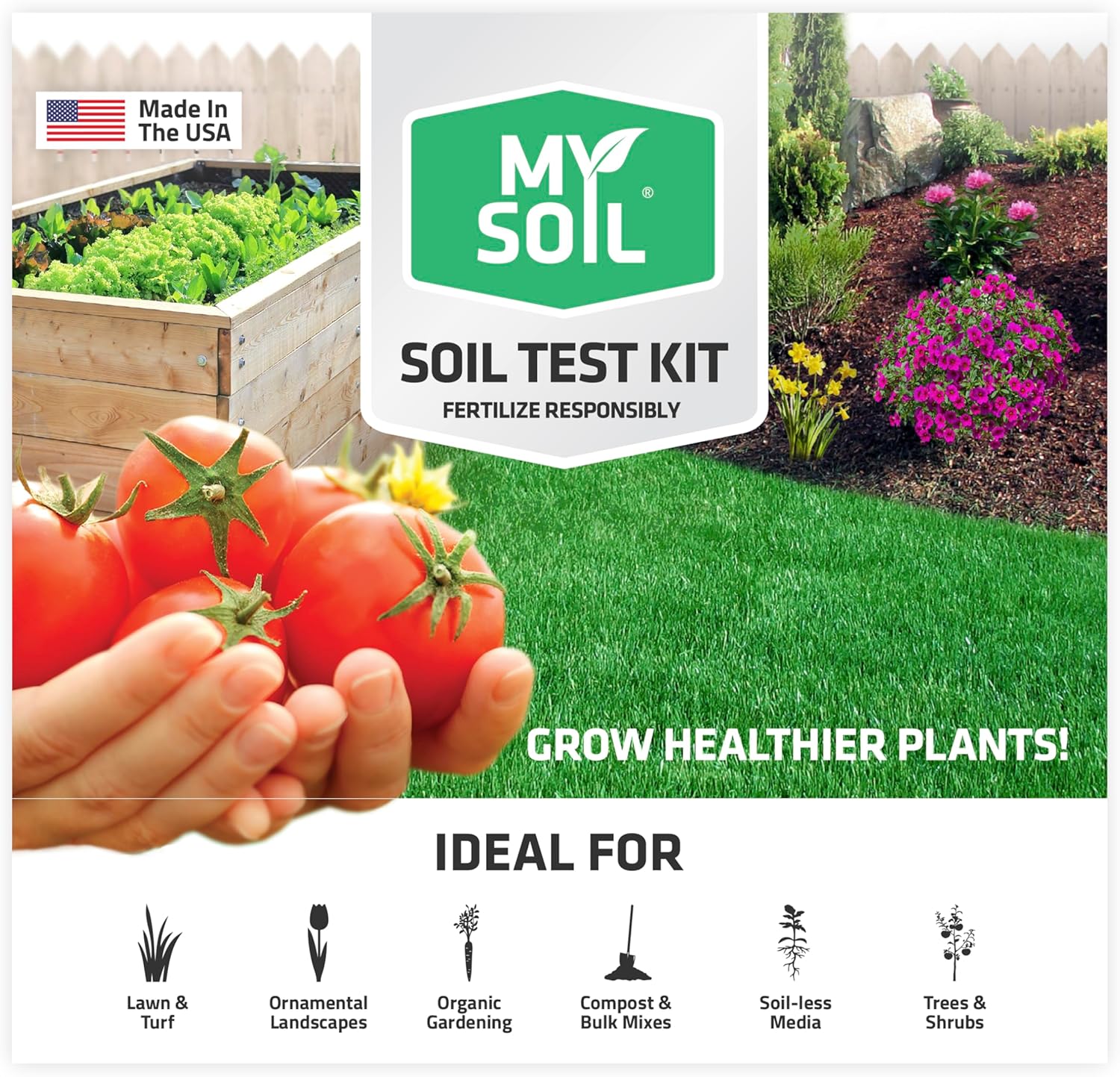
MySoil Professional Mail‑In Soil Test Kit (1 Test)
| Number of Packs | 1 |
|---|---|
| Unit Count | 1 Count |
| Manufacturer | Predictive Nutrient Solutions, Inc |
| Item Weight | 4.6 ounces |
The MySoil kit is a single‑use mail‑in soil test designed to give a professional laboratory analysis rather than an instant at‑home reading. You collect a sample in the included jar, register the kit online, mail the prepaid envelope to the lab, and get a detailed report in about 6–8 days. Results cover pH plus 13 plant‑available nutrients and include step‑by‑step recommendations for what to apply, how much, and when, with both organic and conventional options. That makes it useful for diagnosing lawn problems, planning fertilization for turf or vegetable beds, or checking soil before planting. The kit contains everything needed for one test and saves time by replacing guesswork with specific advice, which can reduce unnecessary product use. The main limitation is that each kit covers only a single sample, so testing multiple areas or repeated checks requires buying multiple kits; turnaround also depends on mailing times. For a homeowner who wants accurate, lab‑grade guidance for improving grass and garden soil, MySoil provides actionable results without complex equipment.
Best for: Homeowners focused on improving lawn health who want reliable, lab‑grade soil data and clear amendment instructions rather than DIY meters or strips.
Less Ideal for: People who need rapid, repeated tests across many spots or instant field readings should consider multi‑test packs or handheld meters instead.
- Laboratory analysis of pH plus 13 plant‑available nutrients for accurate results
- Includes prepaid mail envelope and everything needed to collect and send one sample
- Custom, easy‑to‑follow recommendations for what, when, and how much to apply
- Works for any soil type and a wide range of uses including lawn and turf
- Single‑use kit covers only one sample location
- Results take several days since samples are mailed to a lab
Verdict: For reliable, lab‑grade soil diagnostics and clear fertilizer guidance to improve grass and garden performance, choose this single‑test MySoil kit.
LUVCOSY Digital Soil pH Meter GSph-w-LCp

| pH Measurement Range | 3.0 – 9.0 pH |
|---|---|
| pH Measurement Resolution | 0.1 pH |
| Waterproof Level | IP54 |
| Operating Temperature | -20~60℃ |
The LUVCOSY Digital Soil pH Meter is a compact tester designed to give fast, repeatable pH readings for lawn and garden soils. You insert the probe into moist soil and the meter reports pH to 0.1 resolution across a 3.0 to 9.0 range, making it suitable for routine checks on turf and planting beds. The unit uses FDR and AC detection techniques the manufacturer says improve measurement accuracy, and the IP54 rating protects against splashes for outdoor use. Typical use is spot-testing multiple locations across a lawn to map acidity and decide where to apply lime or sulfur. Practical benefits include simple one-person operation, quick results without sending samples to a lab, and a lightweight form factor for frequent field checks. Important limitations are that it does not include calibration solutions or detailed instructions on calibration frequency and the probe performance depends on adequate soil moisture and proper insertion depth. For precise laboratory-level analysis or nutrient testing you will still need specialized lab services.
Best for: Gardeners and lawn care enthusiasts who prioritize reliable, repeatable pH readings to guide lime or sulfur applications and want a portable tool for frequent field checks.
Less Ideal for: Users needing full soil nutrient analysis, laboratory-grade precision, or integrated moisture/nutrient diagnostics should consider more comprehensive testing services or multi-parameter meters.
- Measures pH across a practical 3.0–9.0 range with 0.1 pH resolution for actionable turf decisions
- FDR and AC detection methods aimed at improving measurement stability and sensitivity
- IP54 splash resistance suitable for outdoor lawn use
- Lightweight and handheld for quick spot checks across a yard
- No calibration solutions included so you must buy or source them separately
- Accuracy depends on correct probe insertion and soil moisture which requires user attention
Verdict: A lightweight, field-ready pH meter that gives fast, actionable soil acidity readings to steer lawn pH correction efforts.
Luster Leaf Rapitest Soil Test Kit (20 tests)

| Brand Name | Luster Leaf |
|---|---|
| Unit Count | 20 Count |
| Item Type Name | Soil Test Kit |
| Model Number | 1602 |
The Luster Leaf Rapitest Soil Test Kit provides a simple, low-tech way to check garden soil pH and the three main nutrients gardeners track: nitrogen, phosphorus and potash. The kit includes reagents and comparators for 20 tests total (five tests per measurement), so you can sample several areas across a lawn or vegetable bed. Use involves mixing small soil samples with the provided capsules or solutions, then matching the resulting color against the included chart. That makes it fast and approachable for beginners and steady gardeners who want a practical snapshot before amending or fertilizing. The clear instructions and plant pH preference list for over 450 species are helpful for making actionable adjustments. Limitations are the coarse resolution of color-based readings and the limited number of tests compared with lab analysis, so it is best for routine spot checks rather than precise scientific monitoring.
Best for: Gardeners who want a straightforward, low-cost way to check soil health before amending and prefer practical, easy-to-follow results over lab-level precision.
Less Ideal for: Users who need laboratory-grade accuracy, quantitative nutrient concentrations, or frequent high-volume testing for professional soil management.
- Covers core measurements gardeners need: pH, nitrogen, phosphorus and potash.
- Includes materials for 20 total tests to sample multiple garden spots.
- Patented color comparator system makes results easy to read without special tools.
- Comes with detailed instructions and a plant pH preference list for many common species.
- Color-matching gives approximate results and is less precise than laboratory testing.
- Only five tests per measurement limits long-term or frequent monitoring without repurchasing.
Verdict: Buy this kit if you want an easy, affordable way to spot-check soil pH and basic nutrient levels across your garden before amending.
Soonkoda S-9 3-in-1 Soil Tester (Moisture, Fertility, pH)

| Brand Name | Soonkoda |
|---|---|
| Model | S-9 |
| Included Components | Soil Tester, English Manual, Paper Box |
| Unit Count | 1 Count |
The Soonkoda S-9 is a pocketable analog soil tester that checks moisture, nutrient level (fertility), and soil pH with a single probe. You use it by sliding the mode switch to MOIST, FERTILITY, or PH, inserting the probe about two thirds into the soil and reading the needle position after a few seconds. The meter gives color‑banded results (dry/ok/wet for moisture; low/ok/high for fertility; an acid-to-alkaline range for pH), which makes interpretation straightforward for casual gardeners. It is lightweight, requires no batteries, and comes with a manual and simple cardboard case. Limitations are that it provides approximate, relative readings rather than lab-accurate values, can struggle in very dry soils unless you moisten the sample first, and the single metal probe is not ideal for rocky or compacted beds. For a low-cost, entry-level tool it helps you spot watering mistakes and get a rough sense of soil condition before applying amendments.
Best for: Gardeners on a tight budget who want a quick, easy way to check soil moisture and get a rough sense of pH and nutrient level for lawns, raised beds, or potted plants.
Less Ideal for: Professional soil testing, precise pH management, or heavy clay/rocky sites where a single thin probe cannot be inserted reliably.
- Three-in-one function: moisture, fertility, and pH in one handheld unit
- Color-coded needle scale makes readings easy to interpret without training
- No batteries required and very lightweight for frequent spot checks
- Provides only approximate, relative values not lab-grade measurements
- Requires moist soil for reliable moisture readings in very dry conditions
Verdict: If you want the cheapest practical tool to spot-check moisture, pH, and fertility in the garden, this simple 3-in-1 tester gives fast, easy-to-read guidance.
Aenncci 2-in-1 Soil Test Kit — Soil Moisture and pH Meter

| Battery | None required |
|---|---|
| Functions | Soil moisture and pH |
| Use | Indoor and outdoor |
This compact 2-in-1 soil tester combines a moisture meter and pH meter in a single battery-free probe, making it a simple tool for routine checks in pots, garden beds, lawns, and raised beds. You insert the probe into the soil (recommended deeper than 4 inches) and read both values on the large dual dial without switching modes, which is convenient for quick spot checks across multiple plants. The single sturdy probe and high-sensitivity sensors aim to minimize root disturbance while delivering fast readings, and the lack of batteries means no ongoing power maintenance. Practical strengths are its ease of use, portability for moving between indoor and outdoor areas, and clear visual dials that work for inexperienced users. Important limitations are that the device is a spot-check instrument rather than a laboratory-grade meter and it requires correct insertion depth and periodic cleaning of the probe for consistent results. Expect reliable everyday guidance for watering and basic pH awareness rather than precision soil analysis for professional testing.
Best for: Buyers who prioritize a dependable, low-maintenance tool for routine plant care and want quick, easy checks of soil moisture and pH across indoor and outdoor plants.
Less Ideal for: Users seeking highly precise, lab-level soil analysis or continuous monitoring solutions for research or commercial production.
- Two measurements in one probe for simultaneous moisture and pH checks
- Battery-free design eliminates the need for replacements or charging
- Large dual dial makes readings easy to see at a glance
- Single sturdy probe designed to reduce root damage during use
- Not a lab-grade instrument so values are best used for general guidance
- Requires insertion to the correct depth and regular probe cleaning for consistent readings
Verdict: A simple, maintenance-free two-in-one probe meter that delivers fast, reliable spot checks of soil moisture and pH for everyday plant care.
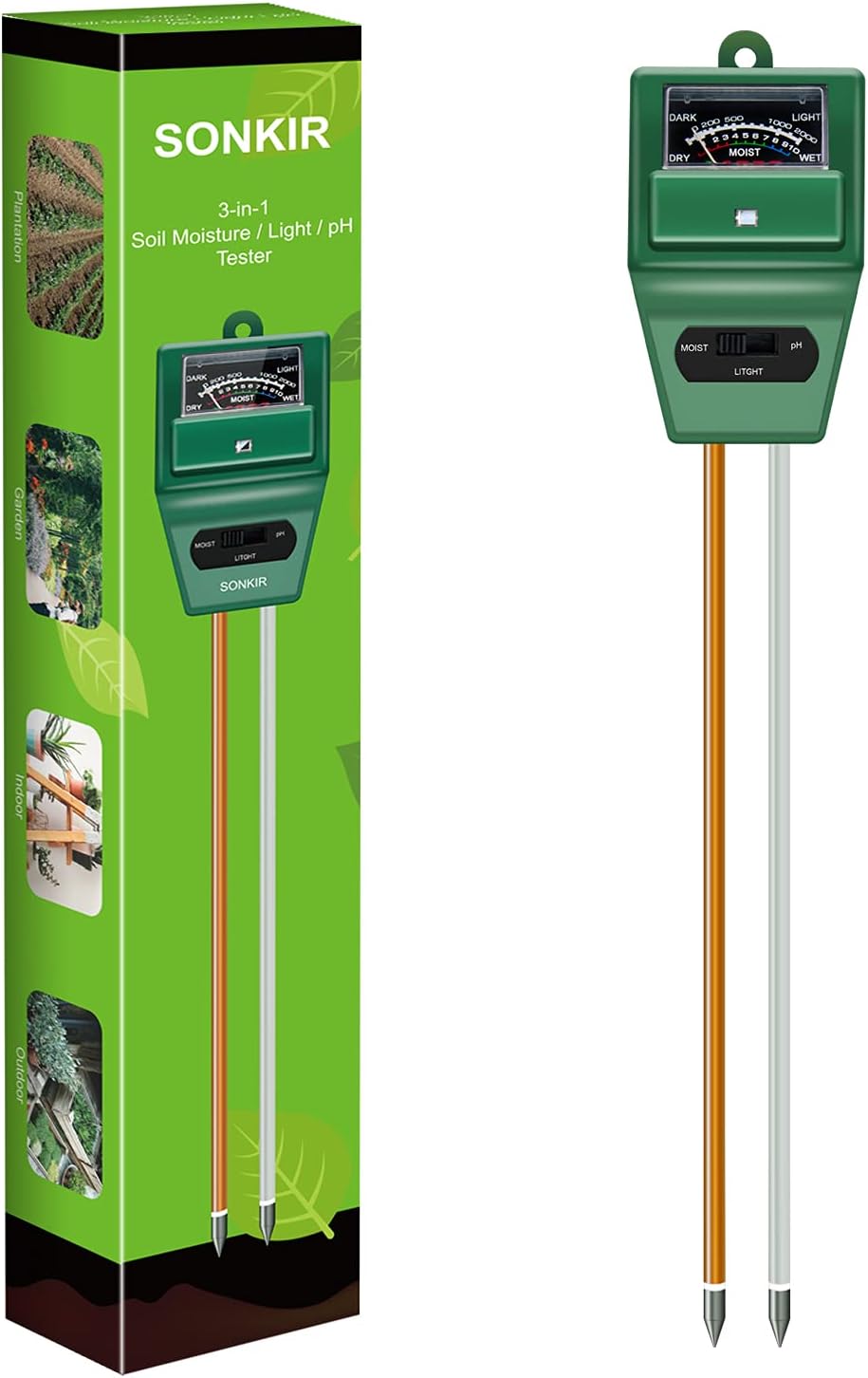
SONKIR MS02 3-in-1 Soil Moisture, pH and Light Tester
| pH range | 3.5-8 pH |
|---|---|
| Moisture range | 1-10 scale |
| Probe length | 7.9 inches |
| Power | No battery required |
The SONKIR MS02 is a handheld, no-battery soil meter that gives quick, visual readings of moisture, pH and sunlight to help you maintain healthier grass and garden plants. You switch the dial to the desired function, push the probe into the soil about 6 to 7 inches, wait roughly 10 minutes and read the needle on the analog display. The meter covers a practical pH range for lawns and gardens and shows moisture on a 1 to 10 scale so you can decide when to water. Its long probe and compact, lightweight body make it convenient for spot-checking multiple areas of a lawn or garden bed. Important limitations are that the pH probe is intended for soil only and the analog needle can be slow to move in very dry soils or close-to-neutral pH, so readings sometimes require rechecking after moistening the sample or testing several spots. The unit is best for gardeners who want an affordable, easy-to-use tool for routine soil checks rather than laboratory-accurate analysis.
Best for: Someone who wants an inexpensive, easy-to-use tool for routine soil checks across a lawn or garden and values practical, repeatable guidance over laboratory precision.
Less Ideal for: Users who need lab-grade pH or moisture measurements, continuous data logging, or digital readouts for precise record keeping should consider more advanced instruments.
- 3-in-1 functionality measures moisture, pH and sunlight without extra tools
- No battery required so it is always ready to use and low maintenance
- Long probe and compact form factor make spot checks across a lawn or garden quick
- Simple analog dial is straightforward for fast, at-a-glance decisions
- pH function is designed for soil only and cannot test water or other liquids
- Analog needle can be unresponsive in very dry soil or near-neutral pH, requiring repeated tests
Verdict: A straightforward, no-battery 3-in-1 tester that gives fast, practical soil moisture, pH and light checks for everyday lawn and garden care.
XLUX T10 Plant Soil Moisture Meter (Battery-Free)

| Battery Description | No batteries required |
|---|---|
| Mounting Type | Tabletop |
| Upper Temperature Range | 45 °C |
| Temperature Reading Accuracy | ±0.5 °C |
The XLUX T10 is a straightforward analog soil moisture meter designed to give instant moisture readings without batteries. You use it by inserting the slim 304 stainless steel probe into the potting mix or garden bed down to the root zone, then read the large color-coded dial that marks Dry, Moist, and Wet. Its single narrow probe minimizes root disturbance compared with thicker dual-prong meters, making it useful for potted houseplants and smaller garden beds. The tabletop mounting and protective sleeve help preserve the probe between uses, and the unit requires minimal maintenance beyond wiping the probe clean after each short test. Limitations to note are that it provides a general moisture level rather than precise soil moisture percentage and is intended for temporary tests only, so it is not a continuous-monitoring solution; accuracy can also vary by soil type and insertion depth. For gardeners who want a low-cost, low-effort way to remove guesswork from watering, the T10 offers reliable, easy-to-read results for everyday use.
Best for: Buyers who want a simple, low-maintenance tool to quickly check whether potted plants or small garden beds need water and who value easy-to-read, proven devices backed by many users.
Less Ideal for: If you need digital precision, continuous logging, or professional soil-moisture profiling for large-scale landscapes, this basic analog tester will be insufficient.
- Battery-free operation for instant readings without maintenance
- Slim single 304 stainless steel probe reduces root damage
- Large color-coded dial that is easy to read at a glance
- Protective sleeve included to prevent probe abrasion during storage
- Provides qualitative moisture ranges rather than numeric moisture percentage
- Designed for short, temporary tests only and not for continuous monitoring
Verdict: A no-fuss, battery-free moisture meter that gives quick, readable root-zone moisture guidance for everyday indoor and small garden plant care.
Choosing the Right Lawn Soil Tester: Key Factors to Consider
Measurement Accuracy and Range
Accurate readings for pH, moisture, and sometimes NPK or temperature are essential because small differences change what you apply and when. pH influences nutrient availability; a half-point swing can alter recommended lime or sulfur applications. Moisture readings help prevent overwatering and identify dry spots before turf stress appears.
Check the stated measurement range and resolution. A tester that reports pH to one decimal place is more useful than a device that only shows broad categories. For nutrients, note whether the tester provides a relative index or absolute concentration. For everyday lawn care, reliable pH and moisture figures are the highest priority.
Probe Design and Durability
Probes contact soil constantly and must resist bending, corrosion, and clogging from clay or thatch. Solid metal probes are common, but the metal type matters: stainless or treated alloys last longer in acidic or wet soils. Probe length matters too; longer probes reach below the surface layer where roots are actively growing, while short probes only sample the top inch.
Durability also includes how well the probe seals where it meets the body. Water intrusion into electronics is a common failure mode for outdoor testers. Look for robust joints and replaceable probes if you test often or have compacted soils that require more force to insert the sensor.
Ease of Reading and Interpretation
A tester is only useful if you can interpret the results without a microscope. Clear analog dials, backlit digital displays, or color-coded charts all speed decisions on the lawn. Consider whether the device gives direct actionable advice, such as a pH recommendation, or only raw numbers that you must translate against a separate chart.
Also consider ergonomics. A tester with a comfortable grip and a readable display reduces the time spent crouched and makes testing multiple locations less of a chore. Quick, intuitive feedback helps you spot variations across the lawn and prioritize corrective steps.
Calibration and Maintenance Requirements
Regular calibration keeps readings accurate over time. Some testers need occasional solution-based calibration, while others claim no calibration for a set period. For active lawn maintenance, a tester with simple calibration steps and readily available calibration fluids is preferable.
Maintenance also covers cleaning probes after testing heavy clay or fertilized soils and storing the unit to avoid moisture damage. If the tester needs frequent replacement batteries or fragile accessories, factor those ongoing tasks into whether it fits your routine.
Sampling Speed and Repeatability
Speed matters when you need to test many spots across a lawn to map variability. A tester that provides near-instant readings lets you sample more locations and build a reliable picture of soil conditions. Repeatability is equally important: repeated measurements at the same spot should stay consistent within an expected margin.
Devices that require long equilibration times or sample preparation slow down lawn surveys and increase the chance of inconsistent results. Look for testers designed for quick in-ground use rather than ones optimized for a single lab sample.
Suitability for Lawn Soil Types
Lawns can sit on a variety of soil textures from sandy to heavy clay, and the tester should handle that range. Sandy soils drain quickly and can show rapid moisture changes, so a moisture sensor calibrated for low moisture retention is helpful. Clay soils hold more moisture and resist probe insertion, so sturdier probes and sensors that account for soil density are better.
Also consider turf-specific issues like thatch and root crowns. Testers that require surface scraping or a specific insertion depth perform more reliably when instructions emphasize sampling below the thatch layer. Choose a device whose recommended use matches the most common soil types in your lawn.
How to Take Representative Lawn Readings
Test multiple spots across any lawn to capture variability between sunny and shady areas, low and high traffic zones, and spots with known drainage differences. A grid or walk pattern works well: take more samples where you see color or growth changes.
When sampling, remove surface thatch and insert the probe to the same depth each time, typically 2 to 4 inches for turf root zone readings. Record pH, moisture, and any temperature notes so you can compare conditions across the lawn and track changes after treatment.
- Avoid testing immediately after heavy rain or irrigation; wait a day for moisture to equilibrate.
- Take readings at several depths if you suspect compaction or a layered soil profile.
- Label sample locations if you plan follow-up treatments so you can retest the same spots.
Interpreting pH and Moisture Results
A pH around 6.0 to 7.0 is typical for many turfgrasses but ideal ranges vary by species. Use pH readings to decide whether to apply lime or sulfur, and pair that with a soil nutrient plan rather than acting on pH alone.
Moisture values help you schedule irrigation more efficiently. Instead of watering on a fixed schedule, use moisture readings to identify when soil moisture drops below the level that stresses turf. Combine moisture data with visual signs such as leaf folding, color change, and foot traffic stress.
- Use small adjustments over multiple maintenance cycles rather than large single treatments.
- Recheck areas after applying amendments to confirm the expected change in pH or moisture.
Maintaining Your Tester for Reliable Results
Rinse and dry probes after each use, especially when testing in fertilizer-rich or clay soils. Wipe off debris and avoid hitting probes on hard surfaces to prevent bending or damage.
Store the unit according to manufacturer guidance, usually in a dry place with protective caps on probes. Replace batteries before a long testing session and perform calibration checks at intervals recommended for the device type.
- Keep a small log of calibration dates and any discrepancies you notice over time.
- Replace worn probe tips or O-rings when signs of corrosion or leakage appear to maintain accuracy.
When to Consider Professional Soil Testing
Home testers are excellent for routine monitoring, but a professional laboratory test is useful when you need precise nutrient concentrations or when persistent problems do not respond to normal corrective steps. Labs provide standardized, quantitative results that cover micronutrients and recommendations tailored to turf species.
Use a lab test as a baseline every few years or when planning major renovation, then use a lawn soil tester to track more frequent changes and the short-term effects of treatments.
- Consider lab testing when pH or nutrient issues are extreme or when disease outbreaks persist.
- Combine lab results with regular in-ground testing to manage ongoing maintenance.
Comparing Digital and Analog Testers
Digital testers typically give faster, more granular numbers and sometimes store readings. They are useful if you want precise pH values and easier trend tracking. However, they need power and can be more sensitive to moisture intrusion over time.
Analog or color-chart testers require no power and are often simpler to maintain. They can be perfectly adequate for gardeners who want a quick indication of pH or moisture without the need for logged data. Choose based on how you intend to use the results and whether you need portability or data tracking.
- Digital units are better for repeated mapping and precise adjustments.
- Analog options are durable and low-maintenance for occasional checks.
How We Chose the Best Lawn Soil Tester
We focused on tools that deliver actionable readings gardeners can trust in routine lawn maintenance. Key evaluation criteria included measurement accuracy across pH and moisture ranges, sensor durability for repeated outdoor use, ease of reading and interpreting results, and the ability to function in typical turf conditions such as compacted or clay soils. We also considered calibration capability, build quality of probes, and whether the design resisted corrosion and water intrusion. Products were excluded if they lacked clear accuracy specifications, relied on single-use consumables without a reliable replacement pathway, or were optimized only for lab settings rather than in-ground lawn use. We prioritized testers that balance practical resilience with clear, repeatable readings so a gardener can make maintenance decisions without frequent retesting or confusing results. The final shortlist reflects tools suited to everyday lawn tasks rather than specialized soil science instruments.
FAQ
How often should I test my lawn soil?
Often test pH and moisture at least once every growing season and after major treatments like lime application. You may test more frequently, such as monthly, when establishing new turf or troubleshooting problem areas.
Can a lawn soil tester measure nutrients like nitrogen and phosphorus accurately?
Some consumer testers provide a rough nutrient index, but they are usually less precise than lab tests. For exact nutrient concentrations, consider sending a sample to a professional lab.
Will soil moisture readings be accurate after rain or irrigation?
Usually not immediately. Wait 24 to 48 hours after heavy rain or irrigation for moisture to level out before taking readings for routine scheduling decisions.
How deep should I insert the probe for turf readings?
Insert the probe to the turf root zone, typically about 2 to 4 inches, to capture the moisture and pH that affect most grass roots. Deeper sampling helps diagnose compaction or layered soil issues.
Do I need to calibrate my lawn soil tester?
Calibration is often necessary to maintain accuracy, though frequency depends on the device. Follow the manufacturer guidelines for calibration intervals and use standard buffer solutions when required.
Can heavy thatch affect tester readings?
Yes. Thatch can insulate the soil and trap moisture, causing surface readings to differ from the root zone. Remove or work around thick thatch to take consistent readings below that layer.
Final Verdict
Choose a lawn soil tester that matches how you manage turf: prioritize accurate pH and moisture readings if you adjust lime and irrigation often, or opt for a durable, low-maintenance model if you only spot-check lawn health. Balance probe strength and ease of reading with calibration needs and the types of soil in your yard. For most homeowners, a tester that delivers repeatable, readable results quickly will improve timing for feeding and watering and reduce guesswork in routine lawn care.
