

Note: This article contains affiliate links. If you click on these links and make a purchase, I may earn a small commission at no extra cost to you. This helps support my research and content. Read my full affiliate disclosure here.
If you grow herbs, a couple of tomatoes, or a dozen seedlings in a small tent or on a sunny shelf, the right 3X3 LED grow light changes how evenly your plants develop and how much energy you use. These compact fixtures are made to cover a roughly three-by-three-foot canopy with concentrated light while keeping heat and power draw manageable. This guide shortlists the top 3X3 LED Grow Light options for that use case and explains the practical differences you will notice in the garden. We evaluated spectrum control, output uniformity, and energy efficiency to surface the best choices. Read on to see how each light performs against the needs of small indoor gardens and what to prioritize for your setup.
Top Picks at a Glance
| Best Overall The best all-around choice for most situations | Spider Farmer SE3000 LED Grow Light, 300W, App Controlled |  |
| Best Quality Built to a higher standard if you want something more solid | AC Infinity IONFRAME EVO4 300W Samsung EVO Bar LED Grow Light |  |
| Best Value The sweet spot between price and what you get | Barrina GrowForce BG02 200W Full-Spectrum LED Grow Light (3×3 Coverage) |  |
| Best Budget The cheapest option that still gets the job done reliably | GroCruiser GL-CR1200 2000W Dimmable LED Grow Light (260W, Full Spectrum) |  |
| Highest Rated A top-rated pick with lots of positive feedback | Phovivis OptiGrowX240 LED Full-Spectrum Grow Light |  |
| Most Popular A crowd favorite that many people choose with confidence | Spider Farmer SF1000 100W Full Spectrum LED Grow Light |  |
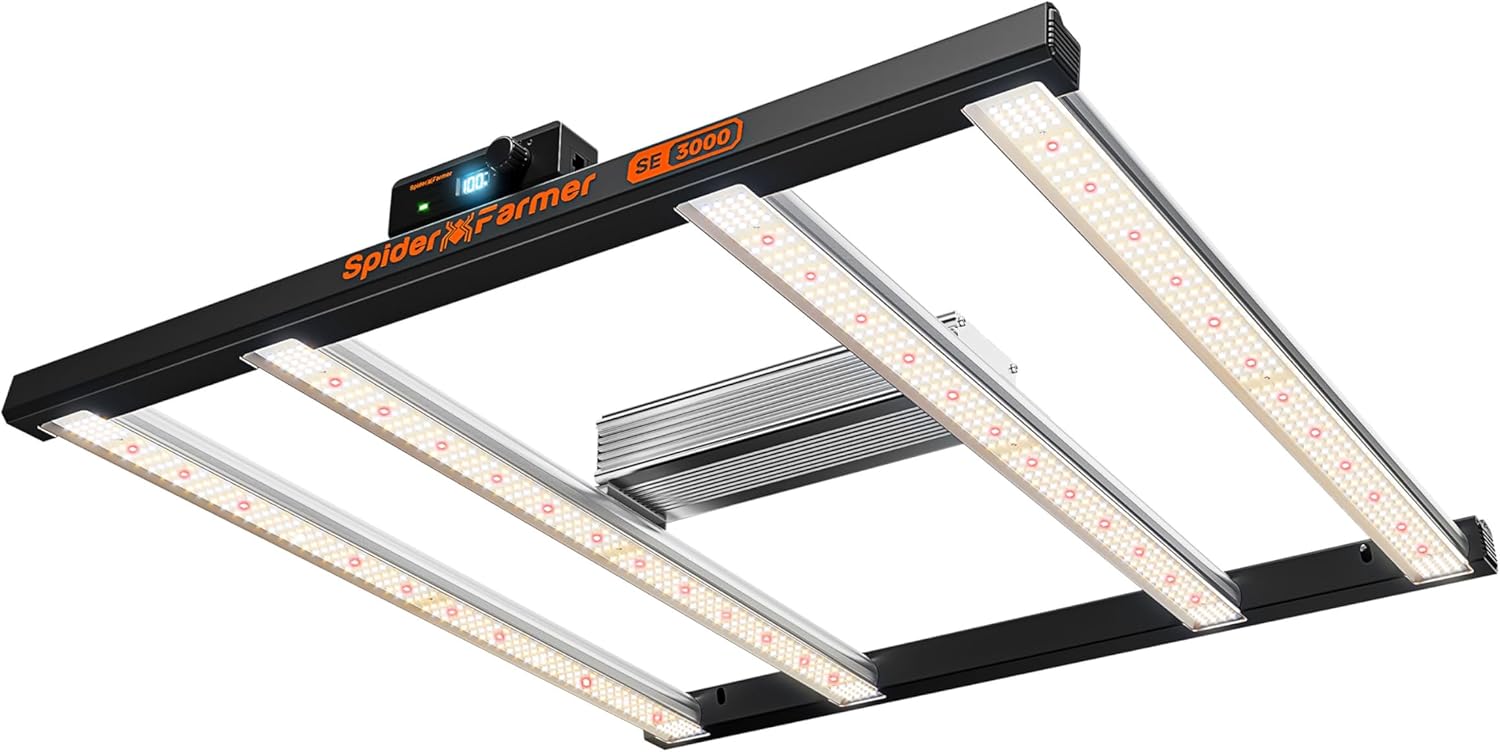
Spider Farmer SE3000 LED Grow Light, 300W, App Controlled
| Light Source Type | LED |
|---|---|
| Power Source | Corded Electric |
| Voltage | 120 volts_of_alternating_current |
| Light Source Wattage | 300 watts |
| Dimmable | dimmable |
The Spider Farmer SE3000 is a 300W full-spectrum LED bar-style grow light built to cover a roughly 3×3 foot grow area from seedling through flowering. It uses premium Bridgelux diodes and a plant-focused spectrum with strong deep red output to maximize photosynthesis while generating relatively low heat. App control and a digital dimming box let you set schedules, simulate sunrise and sunset, and fine-tune brightness for different stages, and the light supports daisy-chaining for multi-light setups. Aluminum construction helps dissipate heat and the design aims for even PPFD across the canopy, including edges. Practical benefits include lower energy draw compared with older HPS setups, precise light management via the app or manual dial, and a five-year repair coverage. Limitations are that the 300W draw may be more than necessary for very small micro-grows and you will still need to manage ventilation and hanging height to optimize uniformity; also advanced users seeking the absolute highest PPE numbers may prefer a larger commercial fixture.
Best for: Home growers who want a reliable, energy-efficient 3×3 light that handles the full growth cycle and prioritizes easy control and even canopy coverage.
Less Ideal for: Growers needing ultra-compact, low-wattage fixtures for tiny micro-grows or large commercial operators who need higher total output per fixture.
- Engineered full-spectrum with strong deep red output to support all growth stages
- App control plus digital dimming box allows schedules, sunrise/sunset simulation, and remote brightness adjustments
- Bar-style layout and premium Bridgelux diodes give even PPFD across a 3×3 ft canopy with reduced edge drop-off
- Aluminum construction improves heat dissipation for cooler operation compared with traditional HID lights
- Supports daisy-chaining for easier multi-light installations
- 300W power draw may be higher than needed for very small setups
- Requires external ventilation and proper hanging height to achieve optimal uniformity
Verdict: A user-friendly, energy-efficient 300W full-spectrum LED that reliably covers a 3×3 ft canopy with app-based scheduling and precise dimming.
AC Infinity IONFRAME EVO4 300W Samsung EVO Bar LED Grow Light

| Light Source Type | Light Emitting Diode |
|---|---|
| Wattage | 300 watts |
| Number of Light Sources | 896 |
| Color Rendering Index | 90 |
| Light Source Special Features | Schedule controls, sunrise/sunset dimming, 10 brightness levels, WiFi app control compatibility, daisy-chaining, IP-65 |
The AC Infinity IONFRAME EVO4 is a performance-focused 300W bar-style grow light designed for small indoor spaces such as a 3×3 tent. It uses Samsung LM301H EVO diodes and 896 LEDs to deliver high efficacy (3.14 µmol/J) and strong PPFD for canopy penetration, while the algorithmic diode spacing reduces hotspots for more even coverage. Programmable features include 10 brightness levels, sunrise/sunset dimming, daily scheduling, and compatibility with AC Infinity's WiFi app and controllers for remote automation. The unit supports daisy-chaining and has a removable passive-cooled driver to help manage heat without noisy fans, plus an IP65 rating for humid environments. Practical benefits include precise light scheduling, deep canopy reach for flower stages, and easy installation with magnetic mounting options. Limitations to expect are the need to pair it with AC Infinity controller hardware to unlock advanced automation and that a 300W fixture may still require close height and intensity management for very small seedlings or very dense canopies.
Best for: Growers who prioritize light performance and controllable schedules for a 3×3 tent and want precise, commercial-grade LEDs and automation-ready features.
Less Ideal for: Casual hobbyists who want a plug-and-play, controller-free lamp or growers with only a few seedlings who need very low-intensity starter lighting.
- High-efficiency Samsung LM301H EVO diodes rated at 3.14 µmol/J for strong light output per watt
- Programmable controls with 10 brightness levels, schedule and sunrise/sunset dimming for automated cycles
- Algorithmic diode spacing and 896 LEDs provide even coverage and improved canopy penetration
- Passive-cooled removable driver and IP65 rating allow quieter operation and use in humid grow tents
- Daisy-chaining support simplifies expanding light arrays without extra drivers
- Advanced app-based automation requires AC Infinity controller hardware (sold separately)
- At 300W it still needs careful positioning in a densely planted or seedling-heavy 3×3 tent to avoid light stress
Verdict: If you want a high-efficiency, automation-ready fixture that delivers even, high-PPFD coverage for a 3×3 tent, the IONFRAME EVO4 is a top performance choice.
Barrina GrowForce BG02 200W Full-Spectrum LED Grow Light (3×3 Coverage)

| Wattage | 200 watts |
|---|---|
| Light Source | LED |
| Recommended Uses For Product | Plant Growth |
| Mounting Type | Hanging Mount |
| Certification | ETL |
The Barrina GrowForce BG02 is a compact 200W full-spectrum LED fixture built for 3×3 foot grow spaces and small grow tents. It delivers high PPFD through 684 LEDs and concentrated 60° lenses on the red and infrared diodes to push light deeper into the canopy, which helps flowering and fruit development. The unit is dimmable with a push-button control and supports daisy-chaining so multiple fixtures can be synchronized. It mounts as a suspended pendant and comes with an included power driver. Practical benefits include strong light output for fast vegetative growth and the ability to tune intensity for seedlings through bloom stages. The light is ETL certified and made from aluminum, so it looks and performs like a purpose-built fixture. Important limitations are that it is not water resistant so it needs protection in humid setups and its brightness rating in lumens is modest versus its PPFD claims, so placement and distance matter to hit target light levels. The Ethernet connectivity note suggests wired control options but you should confirm control compatibility with your setup.
Best for: Growers who want a compact, efficient light to maximize yields in a 3×3 or small tent and who prioritize measurable light delivery and easy scaling with additional fixtures.
Less Ideal for: People who need waterproof fixtures for humid or flood-prone environments or growers who prefer integrated wireless smart controls out of the box.
- High reported PPFD and efficient PPE for strong photosynthetic light delivery in a 3×3 footprint
- Dimmable output and push-button control let you adjust intensity for different growth stages
- Daisy-chain support for synchronized control of multiple fixtures in larger setups
- ETL certified and aluminum construction for reliable, purpose-built hardware
- Not water resistant so it requires protection from humidity and moisture
- Manufacturer lists both lumens and PPFD values that require careful placement to achieve advertised canopy levels
Verdict: A compact, high-PPFD 200W LED built to push strong, tunable light into a 3×3 grow space and scale easily by daisy-chaining additional units.
GroCruiser GL-CR1200 2000W Dimmable LED Grow Light (260W, Full Spectrum)

| Light Source Type | LED |
|---|---|
| Wattage | 260 watts |
| Dimmable | Yes, 0-100% |
| Input Voltage | 100V-240VAC |
| Certification | CE, FCC, RoHS |
The GroCruiser GL-CR1200 is a flat-panel LED grow light aimed at small tents and compact grow spaces. It delivers a full spectrum from UV to far red with a claimed high PPFD suitable for veg and flowering stages and includes a 0–100% dimmer so you can dial output for seedlings through bloom. Practical features include quiet oversized fans for heat control, a hanging kit and daisy-chain capability for linking up to two units, and a US power cord in the box. Its stated coverage and PAR make it a fit for roughly a 2×4 ft to 3×3 ft area when positioned at the recommended heights. The light is relatively energy efficient versus older HID setups at about 260W draw but it is heavier and larger than tiny desk fixtures, so plan mounting and tent clearance accordingly. Build materials are aluminum and the unit meets CE, FCC and RoHS. If you need a compact, dimmable full-spectrum panel for a 3×3 setup, this offers useful controls and solid output, though buyers wanting precision PPFD charts or multi-unit commercial scaling may find the spec sheet light on detailed measurements.
Best for: A budget-minded home grower who needs a single, easy-to-install full-spectrum panel for a 3×3 or similar small tent and values adjustable output over detailed lab-style specs.
Less Ideal for: Large-scale growers or those who require verified PPFD maps and granular spectral data for precision multi-light setups should consider more fully documented commercial fixtures.
- Full spectrum LEDs spanning roughly 380–780nm suitable for all growth stages
- 0–100% dimmer lets you tailor intensity for seedlings, veg, and flowering
- Daisy-chainable power cord and included hanging kit simplify setup for small arrays
- Aluminum panel with oversized fans for consistent heat dissipation during long runs
- Manufacturer provides general PAR/PPFD claims but no detailed PPFD map or measurement data
- Rated power draw is 260W which is higher than low‑power hobby panels
Verdict: A practical, budget-friendly full‑spectrum LED panel with dimming and daisy-chaining that suits a single 3×3 grow tent.
Phovivis OptiGrowX240 LED Full-Spectrum Grow Light

| Wattage | 220 watts |
|---|---|
| Light Output Maximum | 33600 lumens |
| Color Temperature | 3500 Kelvin |
| Color Rendering Index | 95 |
| Light Source Type | Light Emitting Diode |
The Phovivis OptiGrowX240 is a compact, ceiling-mount LED grow light engineered for full-cycle indoor cultivation in 2×2–3×3 tents. It offers independent Veg and Bloom knobs so you can dial spectrum and intensity for seedlings through flowering without swapping fixtures. The light uses 952 LEDs across several color temperatures and bands to deliver a broad full spectrum while an advanced optical lens focuses usable photons into the canopy for deeper penetration. Measured output claims (high PPFD at typical tent heights) and a 220W draw position it as an efficient replacement for older 400W HPS fixtures, and the full-aluminum body with passive cooling helps with durability and quiet operation. Practical extras include dimming, a daisy-chain RJ45 for multi-light setups, and included hang kit and power cord. Limits to note: it is a single-panel unit best suited to small tents rather than large rooms, and large commercial users may need multiple units and external controllers to scale. The unit also requires proper placement and ventilation to hit the claimed canopy PPFD values.
Best for: Growers who prioritize reliable, tunable performance for a 3×3 tent and want a compact, low-maintenance fixture that handles full growth cycles without frequent swapping or complex setup.
Less Ideal for: Large-scale growers or those needing wide-area lighting for multiple tents or rooms should consider multi-panel fixtures or higher-output units instead.
- Dual Veg and Bloom controls for on-the-fly spectrum and intensity adjustments
- Advanced optical lens design for improved canopy penetration and more uniform coverage
- High-efficiency 220W output with claimed strong PPFD suitable for 3×3 tents
- Daisy-chain RJ45 and compatibility with external controllers for scalable setups
- Full-aluminum body with passive cooling and included hang kit for easy installation
- Single-panel design limits effective coverage beyond a 3×3 tent without adding more units
- Manufacturer PPFD and energy-savings claims should be validated in your own setup
Verdict: A compact, energy-efficient full‑spectrum LED built for dependable, tunable performance in a 3×3 grow tent.
Spider Farmer SF1000 100W Full Spectrum LED Grow Light

| Light Source Type | LED |
|---|---|
| Light Output Maximum | 10000 lumens |
| Light Source Wattage | 100 watts |
| Light Source Special Features | Dimmable |
| Specification Met | IP67 |
The Spider Farmer SF1000 is a compact 100W full spectrum LED grow light intended for 2×2 to 3×3 grow spaces and small tents. It uses a high diode count and upgraded LED chips to deliver broad-spectrum output that supports seedlings through flowering, with a dimmer knob to reduce intensity for early stages and ramp up for bloom. The fanless design and thick aluminum heatsink keep operation quiet while providing passive cooling, and the fixture meets IP67 for durable performance. Typical use is ceiling or tent mounting above individual plants or a small canopy where uniform coverage and deeper canopy penetration matter. Notable features include daisy-chain compatibility for linking multiple units under unified dimming, a 0–100% dimmable control, and a driver claimed to offer efficient power delivery. Practical benefits are even light distribution in a small footprint, predictable veg-to-flower capability, and near-silent operation. Limitations are inherent to its class: it is sized for small areas so you will need multiple units for larger tents, and the product description emphasizes specs from manufacturer tests rather than independent third-party PPFD maps.
Best for: Growers who want a quiet, compact full spectrum light for a small tent or single-plant setup and value adjustable intensity for each growth stage.
Less Ideal for: People running larger multi-plant rooms or commercial operations who need higher total output and broader single-fixture coverage.
- Full spectrum output suitable for all growth stages with added red and IR for flowering
- Dimmable 0–100% control lets you tailor light intensity to seedlings, veg, and bloom
- Fanless design with sturdy aluminum heatsink for quiet, low-maintenance operation
- Compact footprint ideal for 2×2 to 3×3 tents and small indoor setups
- Daisy-chain capable so multiple fixtures can be linked and dimmed together
- Coverage and power are intended for small grows so larger areas require multiple units
- Manufacturer gives efficiency and coverage figures without independent third-party PPFD charts
Verdict: A quiet, dimmable 100W full spectrum fixture that is a practical, balanced choice for hobbyists running 2×2 to 3×3 tents.
Choosing the Right 3X3 LED Grow Light: Key Factors to Consider
Light Spectrum and Plant Needs
Spectrum determines how plants use the light you deliver. Blue-rich wavelengths encourage compact vegetative growth and strong leaf development, while red and far-red boost flowering and fruiting. A fixture that offers a balanced full spectrum or switchable veg/flower modes lets you tailor light quality to each growth stage.
For mixed crops in a 3×3 area you will often want a broadly tuned spectrum that supports both phases without manual bulb swaps. Consider whether the manufacturer provides a spectral distribution chart so you can verify the relative amounts of blue, red, and white light rather than relying on vague marketing terms.
PPFD Output and Coverage Uniformity
PPFD, or photosynthetic photon flux density, measures how many usable photons hit your canopy per second. For a 3×3 footprint, both peak PPFD and uniformity matter: high center readings with deep falloff at the edges produce uneven growth and require frequent repositioning of plants.
Look for PPFD maps measured at common hanging heights across a 3×3 grid. Decide on the target PPFD based on crop type; leafy greens need lower average PPFD than heavy fruiting plants. Uniform distribution reduces the need to rotate pots and improves overall yields across the canopy.
Energy Use and Operating Cost
Energy efficiency, typically expressed as micromoles per joule, affects your electrical bill and heat production. More efficient fixtures deliver the same usable light for less power. Over a season, a modest efficiency gain compounds into meaningful savings, especially if you run lights long hours for seedlings or vegetative stages.
Also consider whether the fixture supports dimming or scheduled cycles. Being able to reduce output during propagation or early veg stages saves energy and extends the fixture life.
Heat Management and Ventilation
Even LEDs generate heat that can concentrate near the diodes and in a tent environment. Good thermal design-heatsinks, passive cooling channels, or low-noise fans-protects diodes from premature degradation and keeps canopy temperatures reasonable.
In small grow spaces, heat expelled by the fixture affects ventilation choices and fan runtimes. Assess whether a fixture runs quietly at full output if you keep it near living spaces, and whether its thermal profile will require additional exhaust capacity.
Fixture Size, Mounting, and Hanging Options
A 3×3 LED fixture should match the canopy geometry and allow flexible hanging heights. Mounting points that accept ratchets or adjustable ropes simplify tuning light distance as plants grow. Compact fixtures that concentrate light can also be placed closer, but that increases heat and intensity hot spots.
Check clearance above the tallest plants you expect to grow and whether the fixture footprint aligns with your tent, shelf, or bench layout. Cable length, power entry location, and included hanging hardware all affect installation speed and final light positioning.
Control Features and Usability
Practical controls make daily operations easier. Built-in dimmers, separate veg/flower channels, and simple timer compatibility reduce the need for extra controllers. Interfaces can be physical knobs, digital displays, or app-enabled controls; choose the style that fits how hands-on you are with light schedules.
Ease of maintenance also matters. Fixtures with accessible drivers and modular LED boards simplify repairs or upgrades, while sealed units minimize dust and moisture ingress but may be harder to service.
How Much Light Does Your Crop Need
Different crops have distinct light requirements. Leafy herbs and lettuce often thrive at lower PPFD levels and shorter daily light integrals, while flowering and fruiting plants need higher daily photon doses to set flowers and develop fruit.
Plan your target PPFD and daily photoperiod together. For a 3×3 canopy, choose a fixture that can be dimmed or raised to match seedlings, vegetative growth, and bloom without forcing you to move plants off the bench.
- Leafy greens: lower PPFD, longer photoperiods
- Flowering crops: higher PPFD, controlled flower-inducing light cycles
- Seedlings: low intensity and greater distance to avoid stretch
Setting Hanging Height and Light Distance
Start with the manufacturer's recommended hang height and measure PPFD at canopy level. If the center reads too hot relative to edges, raise the fixture and rely on dimming if available. Many 3×3 fixtures work well 12 to 24 inches above the canopy for moderate crops, but the ideal distance depends on output and spectrum.
Watch plant responses during the first week after installation. Leaf cupping or bleaching signals excessive intensity or heat, while leggy stems indicate too little light or too great a distance.
- Measure with a PAR meter if possible for precise tuning
- Adjust every few days for fast-growing seedlings
Managing Heat and Ventilation in Small Spaces
Small tents and cabinets trap heat more easily. Pair your 3×3 LED with adequate intake and exhaust airflow. Even efficient LEDs benefit from steady airflow to remove heat from the fixture and canopy.
Consider the noise and placement of inline fans. If the light's thermal solution includes fans, account for cumulative noise alongside ventilation equipment when placing your grow near living areas.
- Use thermostat-controlled exhaust to maintain stable temperatures
- Place intake lower and exhaust higher to promote natural circulation
Light Scheduling and Crop Timing
Photoperiod control shapes plant development. Use longer light periods for vegetative growth and shift to shorter, defined dark periods to induce flowering in photoperiod-sensitive species. Timers or fixtures with integrated scheduling simplify transitions.
Keep consistent cycles to avoid stress. Abrupt changes or frequent interruptions in the dark period can reduce yields or trigger unwanted developmental responses.
- Automate with reliable timers rather than manual switching
- Plan transitions several days ahead to observe plant acclimation
Maintenance and Longevity Considerations
LEDs typically last many hours, but longevity depends on operating temperature and duty cycles. Clean dust and debris from heatsinks and keep ventilation paths clear to maintain output over time.
Check warranty and accessibility of driver components. Fixtures that allow driver replacement or have modular boards can be serviced without full replacement, which matters if you plan many seasons of growing.
- Schedule quarterly inspections for dust and cable wear
- Keep spare hanging hardware and a basic tool kit handy
How We Chose the Best 3X3 LED Grow Light
We focused on attributes that matter to gardeners using lights to reliably produce healthy crops in a 3×3 canopy. The primary evaluation criteria were spectral quality and control, which determines whether the fixture supports both vegetative growth and flowering; actual delivered PPFD and coverage uniformity across a 3×3 footprint; energy efficiency measured as micromoles per joule, since operating cost and heat relate directly to that figure; thermal management and fan/noise behavior to avoid heat stress in small tents; build durability and IP ratings for humid or wet environments; and dimming/scheduling features for practical control. We prioritized fixtures that provide measured PAR output maps or manufacturer PPFD charts so expectations match in-garden results. We excluded fixtures intended only for propagation trays or full-room arrays where the geometry does not match a 3×3 canopy. We also filtered out lights with insufficient documentation of spectrum or output, and any units lacking basic safety and thermal specs. The scoring emphasized measurable light delivery and garden-relevant controls rather than marketing claims.
FAQ
What hang height should I start with for a 3×3 LED grow light?
Start with the manufacturer's recommended height, then observe plants for light stress. Many compact 3×3 fixtures begin around 12 to 24 inches above the canopy for general crops. Use a PAR meter to fine-tune distance based on your crop's target PPFD.
Can one 3×3 LED fixture cover more than a three-by-three area?
It depends on the fixture's output and beam pattern. Some high-output units can extend beyond a 3×3 footprint but may produce uneven edges. For uniform growth, match the fixture to the intended canopy or add a second unit rather than stretching coverage too thin.
How important is a veg and bloom switch on an LED for small grows?
Veg/bloom switches provide flexibility to shift spectrum and intensity without swapping fixtures. They are useful if you run mixed cycles in the same space, but dimming or scheduling can also achieve similar results when spectrum is broad and balanced.
Should I worry about LED heat in a small grow tent?
Yes, heat management matters even with LEDs. Poor thermal design or cramped ventilation can raise canopy temperatures and stress plants. Ensure your tent has sufficient airflow and that the fixture's thermal solution is appropriate for the space.
Is a PAR meter necessary when choosing a 3×3 LED?
A PAR meter is not strictly necessary but is the most reliable way to verify actual light at canopy level. If you cannot access a meter, use manufacturer PPFD maps and conservative hang heights, then watch plant responses to adjust distance and duration.
How long do LED grow lights typically last in a small indoor setup?
Rated lifespans often exceed many thousands of hours, but real-world life depends on operating temperature and usage patterns. Good thermal management and moderate duty cycles will extend diode life, while constant max output in a poorly ventilated space can shorten it.
Final Verdict
For a small tent or bench, prioritize fixtures that deliver measured PPFD across the full 3×3 canopy, offer reasonable energy efficiency, and include usable control options such as dimming or veg/flower channels. Balance output against heat: a powerful light is only useful if your ventilation and hanging height let you use it without stressing plants. Make your final choice based on the crops you grow and how hands-on you want to be with controls. Focus on spectrum, uniformity, and thermal design first, then consider mounting convenience and serviceability to ensure a reliable multi-season fixture.
