

Note: This article contains affiliate links. If you click on these links and make a purchase, I may earn a small commission at no extra cost to you. This helps support my research and content. Read my full affiliate disclosure here.
If you manage a small lawn or trim on a tight budget, the right budget lawn sweeper saves time and keeps grass healthier by removing leaves and clippings before they mat. You want a tool that picks up debris efficiently, rides smoothly across uneven turf, and stores without taking over a shed. This guide covers seven shortlisted options that fit budget-minded gardeners and evaluates them on real-world usability, debris pickup, and durability. Read on for practical notes on handling, capacity, and typical maintenance so you can pick a sweeper that makes weekly or seasonal cleanup less of a chore.
Top Picks at a Glance
| Best Overall The best all-around choice for most situations | EWORK 26-Inch Push Lawn Sweeper with 3.5 cu ft Hopper |  |
| Best Quality Built to a higher standard if you want something more solid | EAGWON 26" Push Lawn Sweeper with 7 cu ft Hopper and Adjustable Height |  |
| Best Value The sweet spot between price and what you get | MAXSA 26" Push Lawn Sweeper with 7 cu ft Hopper |  |
| Best Budget The cheapest option that still gets the job done reliably | Yilezena 26-Inch Push Lawn Sweeper with 7 cu ft Hopper |  |
| Highest Rated A top-rated pick with lots of positive feedback | Maxsa Innovations 21-Inch Push Lawn Sweeper with 6 cu. ft. Hopper |  |
| Most Popular A crowd favorite that many people choose with confidence | VEVOR 21" Push Lawn Sweeper with 3.5 cu. ft. Hopper |  |
| Best Seller A high-volume bestseller chosen again and again | Dapper Supply 21" Push Lawn Sweeper with 3.5 cu ft Hopper |  |
EWORK 26-Inch Push Lawn Sweeper with 3.5 cu ft Hopper

| Hopper capacity | 3.5 cu ft |
|---|---|
| Brush-to-wheel ratio | 5:1 |
| Wheel size | 10 inch |
| Manufacturer | EWORK |
This EWORK 26-inch push lawn sweeper is built for straightforward, no-frills yard cleanup. You push it across the lawn or hard surfaces while the 5:1 brush-to-wheel gearing spins the brushes to sweep up dry leaves, grass clippings, pine needles and similar debris into the 3.5 cu ft hopper. Height is tool-free adjustable via a side knob so you can tune brush contact for low grass, taller turf, or uneven areas, and the large tear-resistant bag dumps quickly with four quick-release buckles. Ten-inch wheels provide traction on damp or rough ground and the manufacturer highlights anti-rust construction for longer life. Assembly is simple since core parts arrive pre-mounted. Limitations to expect are that it is a manual push unit so it requires physical effort across large properties and its effectiveness will drop with very wet debris or heavy, oversized items like large acorns compared with powered sweepers. For reliability-focused buyers this sweeper emphasizes durable materials, easy maintenance, and straightforward mechanics rather than advanced features.
Best for: Buyers who prioritize a dependable, low-maintenance tool for regular yard pickups and want a durable, easy-to-use manual sweeper for leaves, clippings, and similar debris.
Less Ideal for: People with very large properties who prefer motorized or tow-behind sweepers for faster coverage or those who need a machine optimized for consistently wet debris.
- Large 3.5 cu ft hopper reduces frequency of emptying
- Tool-free adjustable brush height adapts to different turf and surfaces
- 10-inch wheels offer good traction on damp or rough ground
- Anti-rust, anti-deformation design aims to extend product life
- Manual push operation requires physical effort over larger yards
- Less effective on very wet debris or very large, heavy items like big acorns
Verdict: A sturdy, easy-to-use push sweeper that reliably handles routine dry-leaf and clippings cleanup with minimal maintenance.
EAGWON 26" Push Lawn Sweeper with 7 cu ft Hopper and Adjustable Height
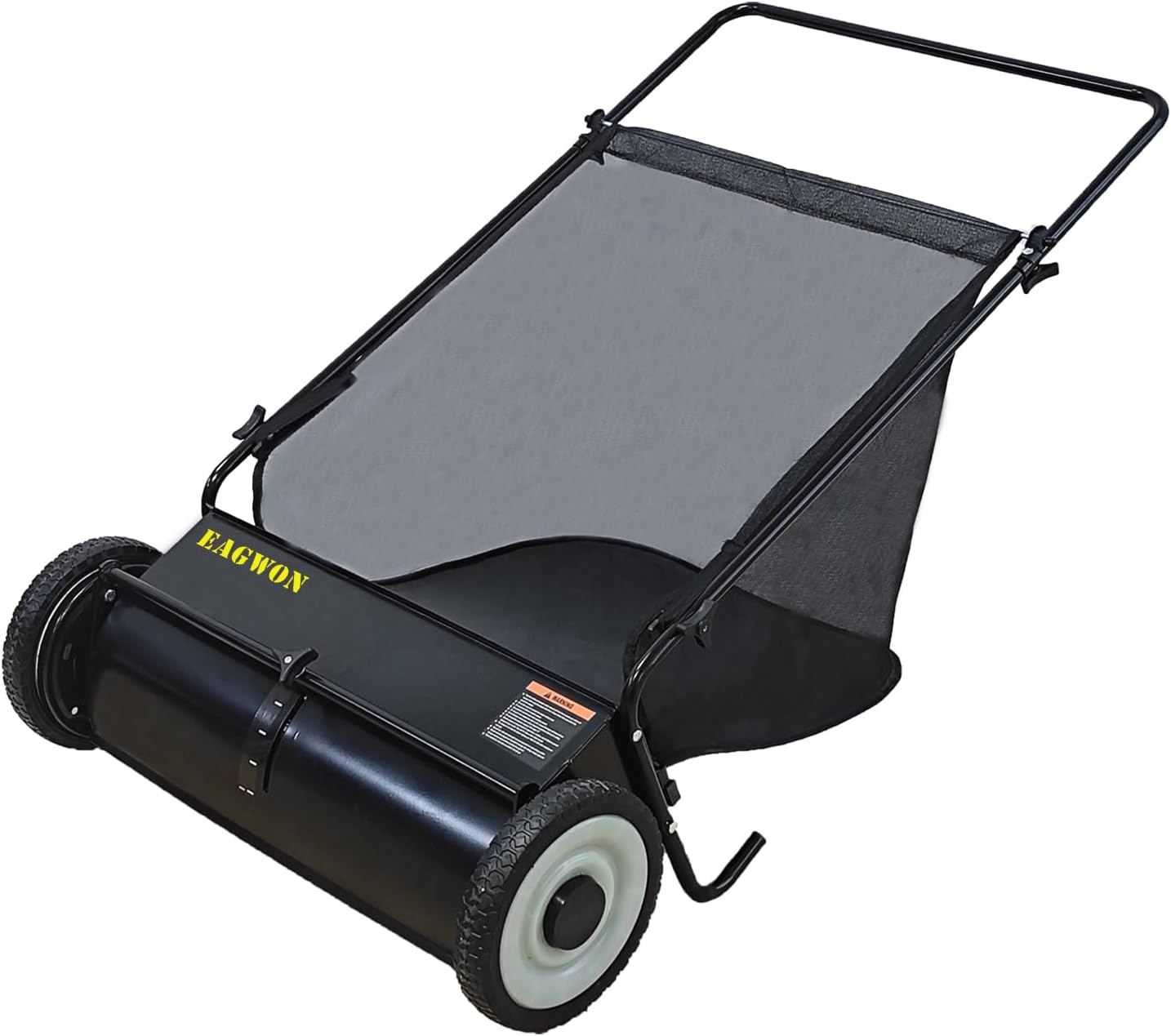
| Power Source | hand_powered |
|---|---|
| Operation Mode | Manual |
| Number of Positions | 5 |
| Material Type | Iron |
The EAGWON 26" push lawn sweeper is a manual, nonpowered tool that pulls debris into a large 7 cubic foot hopper as you push it across the lawn. It is typically used to collect leaves, grass clippings, pine needles and similar debris over medium to large yards; the adjustable height knob lets you raise or lower the brushes to suit turf or uneven surfaces. Construction uses a thickened steel frame and 10-inch rubber wheels that help it roll over rough ground, and four dense spinning brushes provide continuous pickup without bags clogging. The large hopper reduces trips to the compost or curb, and replacement parts are available if brushes or the bag wear. Expect some physical effort on steeper or very bumpy terrain since it is hand powered, and the steel frame and iron components add heft that can make assembly and handling less convenient than lighter models. For heavy debris like wet, compacted leaves or many acorns you may need multiple passes or to keep the brush height adjusted higher to avoid resistance.
Best for: Buyers who want a low-maintenance, no-fuel approach to routine yard cleanup and who prioritize covering larger areas between emptying the hopper.
Less Ideal for: People who need a powered or tow-behind sweeper for steep hills, very large properties, or frequent heavy wet debris like saturated leaves and large volumes of acorns.
- Large 7 cu ft hopper reduces how often you need to stop and empty debris
- Adjustable brush height adapts to lawns, driveways, and uneven terrain
- Durable steel frame and thickened brushes designed for frequent yard use
- Four spinning brushes provide continuous pickup across the 26-inch sweep width
- Manual operation requires steady pushing effort on slopes or when collecting heavy, wet debris
- Heavier iron/steel construction makes the unit bulky to assemble and store
Verdict: A sturdy, no-fuss push sweeper that maximizes hopper capacity and adjustable pickup for practical, fuel-free yard cleanup.
MAXSA 26" Push Lawn Sweeper with 7 cu ft Hopper

| Power Source | manual |
|---|---|
| Number of Positions | 5 |
| Cutting width | 26 |
| Item Weight | 37.9 pounds |
This MAXSA push lawn sweeper is built for routine, heavy-duty yard cleanup. The 26-inch brush path and four high-density brushes pick up leaves, grass clippings, and pine needles efficiently so you can cover large areas quickly. The oversized 7 cu ft breathable mesh hopper holds a lot of debris between stops and releases via a quick-release for relatively tidy emptying. You get five positions of tool-free height adjustment to tune brush contact for lawns, sidewalks, driveways or artificial turf, and the steel frame plus rubber wheels aim for stable, rust-resistant performance on uneven ground. Assembly and storage are straightforward thanks to one-click folding and an ergonomic padded handle that makes pushing easier for longer sessions. Expect the unit to be manual-push work rather than a powered substitute, and the weight and size mean it is better handled by users comfortable moving heavier garden tools and storing something substantial in the shed.
Best for: Buyers who want a durable, no-fuel solution to speed leaf and debris cleanup on medium to large lawns and who prioritize efficiency and fewer hopper empties over powered convenience.
Less Ideal for: Those who need zero-effort pickup for very large estates, steep slopes, or who prefer motorized equipment and compact, ultra-light tools for tight storage spaces.
- Large 26-inch brush path clears wide swaths for faster coverage
- 7 cu ft breathable mesh hopper reduces emptying frequency
- Tool-free 5-position height adjustment adapts to different surfaces
- Heavy-duty steel frame and rubber wheels for durable, stable operation
- Manual push operation requires physical effort on very large or steep properties
- Relatively heavy and bulky for tight storage or for users who need very lightweight equipment
Verdict: A robust manual sweeper that speeds up yard cleanup for medium to large lawns by combining a wide 26" sweep and a large 7 cu ft hopper.
Yilezena 26-Inch Push Lawn Sweeper with 7 cu ft Hopper

| Power Source | Manual |
|---|---|
| Operation Mode | Manual |
| Material Type | ABS+Steel(Q235) |
| Cutting width | 26 inches |
This Yilezena push lawn sweeper is a simple, manual tool for collecting leaves, grass clippings, pine needles, and light yard debris without fuel or power. You push it across the lawn and the four high-density brushes rotate to lift and deposit debris into a detachable 7 cu ft hopper, which reduces how often you need to stop and empty. Tool-free height adjustment makes it easy to set brush clearance for turf, sidewalks, or uneven ground, and the ABS plus steel frame gives a stable feel while the bag fills. Assembly is straightforward with quick-snap fasteners and the unit stores compactly when not in use. Expect good performance on light-to-moderate leaf loads and regular mowing debris; very heavy, wet leaves or large twigs will slow pickup and may require more passes or pre-raking. Because it is push-powered, larger properties or steep slopes will demand more effort than a tow-behind or powered sweeper, but for small to medium yards this is an economical, low-maintenance option.
Best for: Buyers wanting an inexpensive, low-maintenance way to collect leaves and grass clippings on small to medium lawns who prefer a push-powered, tool-free solution.
Less Ideal for: Those with large acreage, steep slopes, or frequent heavy wet-leaf loads should consider powered or tow-behind sweepers instead.
- Four high-density brushes for improved pickup compared with 2-brush designs
- Large 7 cu ft detachable hopper reduces emptying frequency
- Tool-free height adjustment lets you adapt quickly to different surfaces
- ABS and steel construction provides stable support during use
- Manual push operation can be tiring on larger lawns or hilly terrain
- Not ideal for very heavy, wet leaves or large woody debris which may require multiple passes
Verdict: A budget-friendly, manually powered lawn sweeper that efficiently collects light-to-moderate leaf and grass debris for small to medium yards.
Maxsa Innovations 21-Inch Push Lawn Sweeper with 6 cu. ft. Hopper

| Sweeping width | 21 inches |
|---|---|
| Hopper capacity | 6 cu. ft. |
| Brush-to-wheel ratio | 1:5 |
| Frame material | Metal |
This Maxsa Innovations push lawn sweeper is a straightforward, reliability-focused tool for routine yard cleanup. It uses three V-shaped rotating brushes driven by a 1:5 brush-to-wheel ratio to sweep debris into a dust-proof, detachable 6 cu. ft. hopper so you make fewer trips to empty it. Height adjustment on the brushes helps tune contact for different grass lengths and ground conditions, and the metal frame with foldable, disassemblable design makes storage in a garage or shed easy. PP-rubber hybrid wheels deliver good traction and resist wear for steady push performance on uneven ground. It is most effective on dry debris; sweeping wet leaves will reduce pickup and you may need replacement brushes for heavy-duty or long-term high-use scenarios. Assembly and occasional brush replacement are the main upkeep items, but for regular seasonal cleanup this model offers a durable, no-frills solution that reduces time compared with raking by hand.
Best for: Buyers who prioritize a reliable, low-maintenance tool for regular yard cleanup and want to reduce time spent raking without relying on powered equipment.
Less Ideal for: If you need a powered or high-capacity commercial sweeper for very large properties or frequent heavy-duty work, this manual model may not meet those demands.
- Large detachable 6 cu. ft. hopper cuts down on emptying trips
- 21-inch sweeping width cleans more lawn per pass
- Adjustable brush height for better contact on varied turf
- Sturdy metal frame with foldable design for compact storage
- Durable PP-rubber hybrid wheels for improved traction and wear resistance
- Performance drops on wet leaves or very damp debris
Verdict: A dependable, no-frills manual sweeper that saves time on routine cleanup by combining a wide 21-inch path with a large detachable hopper.
VEVOR 21" Push Lawn Sweeper with 3.5 cu. ft. Hopper

| Power Source | Manual |
|---|---|
| Working Width | 21" |
| Hopper Capacity | 3.5 cu. ft. |
| Material Type | Alloy Steel |
| Wheel Size | 9.8 inches |
The VEVOR 21" push lawn sweeper is a manual, walk-behind tool for picking up leaves, grass clippings, pine needles, and other dry debris on even lawns, driveways, and sidewalks. You push it like a wheeled cart; the turning wheels drive two spinning brushes that sweep debris into a removable non-woven hopper rated at 3.5 cubic feet. Height is adjusted with a simple front knob so you can raise or lower the brushes to suit surface conditions without tools. Its alloy steel frame and relatively large hopper reduce how often you need to stop and empty, and the design stores compactly with quick clips for the handle. Expect the best results on relatively flat, even ground and with dry material; the plastic V-shaped brush and manual drive are less effective on very wet, heavy debris or deeply matted leaves. Assembly and adjustment are straightforward but some users may prefer heavier wheels or a motorized unit for very large properties. For routine yard cleanups on small to medium lawns, it speeds collection compared with raking while avoiding power equipment noise.
Best for: Buyers who want a low-cost, low-maintenance way to collect leaves and grass clippings on small to medium, mostly even lawns and who value straightforward manual tools over powered equipment.
Less Ideal for: Not a good choice for owners of large properties, very hilly yards, or those who need reliable pickup of wet or deeply matted debris where a powered sweeper or blower would perform better.
- Large 3.5 cu. ft. removable hopper reduces trips to dump debris
- Adjustable brush height via front knob lets you tune pickup for different surfaces
- Alloy steel frame offers sturdy support for regular yard use
- Simple push operation requires no fuel or electricity and stores compactly
- Best performance is on even, dry terrain so pickup drops on steep, uneven, or wet surfaces
- Plastic-style brushes and manual drive may struggle with heavy or matted debris
Verdict: If you want a simple, affordable push sweeper to speed leaf and grass pickup on small to medium even lawns, this VEVOR model is a practical, low-maintenance option.
Dapper Supply 21" Push Lawn Sweeper with 3.5 cu ft Hopper

| Cutting width | 21 inches |
|---|---|
| Hopper capacity | 3.5 cu. ft. |
| Power Source | hand_powered |
| Operation Mode | Manual |
| Material Type | Plastic |
This Dapper Supply push lawn sweeper is a hand-powered tool that rolls across turf, driveways, and sidewalks while two spinning brushes lift and deposit debris into a removable 3.5 cubic foot hopper. Users adjust brush height with a simple knob to match surface conditions, which helps pick up leaves and grass clippings without scalping the lawn. The reinforced brushes are designed to resist deformation and the 21-inch sweep covers a decent swath per pass, reducing work time compared with raking. Assembly is straightforward thanks to quick clips and the unit stores compactly with support feet for stability. Because it is manual, expect effort on larger properties or wetter, matted debris where a powered option would be faster; very fine pine needles and embedded grit may not collect as cleanly as loose leaves. The plastic construction keeps weight down but may wear sooner under heavy commercial use. For typical homeowners looking to minimize raking, this sweeper offers a reliable, low-maintenance way to keep lawns tidy.
Best for: Homeowners who prefer a low-maintenance, manual solution to reduce raking time and keep small to medium lawns tidy with minimal complexity.
Less Ideal for: Those with very large properties, heavily matted or wet debris, or buyers who want a powered machine for faster pickup and less physical effort.
- Adjustable brush height adapts to different surfaces for more effective pickup
- Large 3.5 cu ft removable hopper reduces trips to the disposal area
- Reinforced brushes designed to resist deformation for consistent performance
- Simple assembly with quick clips and compact storage footprint
- Manual operation requires physical effort and is slower on large lawns
- Plastic components may wear faster under heavy or commercial use
Verdict: A straightforward, easy-to-use manual sweeper that cuts raking time for homeowners with small to medium lawns by combining adjustable brushes and a large removable hopper.
Choosing the Right Budget Lawn Sweeper: Key Factors to Consider
Debris Pickup Efficiency
How well a sweeper actually lifts and retains leaves, grass clippings, pine needles, and small twigs determines how many passes you must make. Brushes with adjustable height or multiple brush rows often collect more material on the first pass.
Poor pickup forces repeated passes that negate any time saved by a cheap unit. Consider brush material and pattern: stiffer, spaced brushes handle wet or matted leaves better, while softer brushes are kinder to turf and pick up fine debris like seed husks.
Hopper Capacity and Dumping
A larger hopper reduces stops for emptying during long runs and works better for heavy fall cleanup. But larger hoppers add weight and can be harder to maneuver or to hitch to a small lawn tractor.
Look for easy-release or quick-dump mechanisms so you can empty while standing. A hopper mounted higher on the frame reduces bending, and a removable bag or container simplifies cleaning. Consider how full-weight affects towing and whether the sweeper remains stable on slopes.
Wheel and Brush Traction on Different Turf
Wheel size, tread, and brush drive geometry influence how consistently the brushes rotate and maintain ground contact. Small, smooth wheels may struggle on bumpy lawns or wet turf, causing missed patches.
Larger wheels with some tread roll more easily and keep brush height consistent across uneven surfaces. If you plan to use the sweeper on slopes, look for wider wheelbases or a lower center of gravity to reduce tipping risk while maintaining brush contact.
Durability and Maintenance Needs
Budget sweepers often trade heavier construction for lower cost. Metal frames resist bending but can rust if not coated; plastic components are lighter but may crack under stress.
Check how easy it is to access wear items like brushes, sprockets, or belts and whether replacements are common sizes. Simpler designs with fewer moving parts usually last longer in backyard use and are easier to service without specialty tools.
Compatibility with Your Mower or Tractor
Some sweepers are push-style, others tow behind a mower or ATV. Hitch type, tongue length, and turning radius affect how the sweeper behaves behind small tractors or zero-turn mowers.
Confirm the hitch fits your equipment without risking mower deck clearance or sharp turning contact. For compact garden tractors, a shorter tongue improves maneuverability in tight spaces; for larger lawns, a longer hitch can help weight distribution and reduce scuffing on tight turns.
Storage, Weight, and Handling
A very compact, foldable unit is easier to store in a small shed but may sacrifice capacity or brush effectiveness. Heavier sweepers can feel more stable in use but are harder to lift or move by hand.
Consider whether you need a model that disassembles easily for winter storage and whether the unit can be tipped or rolled without tools. Lightweight construction helps if you load the sweeper into a trailer, while stable, heavier builds reduce bounce during use.
When a Budget Sweeper Makes Sense
A budget lawn sweeper is a practical choice if you do frequent light cleanup or have a small to medium yard where investing in a heavy-duty machine is unnecessary. These units save time where raking would otherwise take multiple sessions and help prevent thatch and debris from smothering grass.
They are particularly useful in autumn for leaf pickup and after mowing to gather clippings. Expect some tradeoffs: cheaper sweepers may need more careful handling and occasional maintenance, but they can be a cost-effective way to keep turf healthy without investing in larger equipment.
- Best for yards up to a few acres with regular light cleanup
- Useful for leaf and clipping collection to prevent matting
- Not intended to replace large tow-behind commercial sweepers
Setting Up and Adjusting Brush Height
Correct brush height is the single most important setup step for effective pickup. Too low and the brushes will scuff the lawn and wear quickly; too high and debris will pass underneath. Adjust incrementally and test on a small strip to find the sweet spot.
If your sweeper has a multi-position height adjustment, record the settings that work for different turf conditions so you can switch quickly between wet leaves, dry leaves, and post-mow clippings.
- Start with a middle setting and test
- Check after a few passes and readjust if necessary
- Keep a small tool kit for quick adjustments in the field
Tips for Using a Sweeper on Wet or Matted Leaves
Wet or matted leaves are harder to pick up and can clog brushes. If possible, wait until leaves dry. For persistent wet debris, raise brush height slightly and make slower passes so brushes can lift material without bogging down.
Empty the hopper more frequently to avoid adding weight that compresses the turf and reduces brush contact. After use, clean brushes and moving parts to prevent buildup that reduces future performance.
- Make slower passes on wet material
- Raise brush height slightly to reduce clogging
- Clean brushes after use to avoid compaction of debris
Storage and Off-Season Care
Proper storage extends the life of a budget sweeper. Clean out all debris, dry moving parts, and apply a light protective lubricant to exposed metal. Remove or secure the hopper to prevent wind damage in outdoor storage.
If you can store the unit indoors, keep tires off cold concrete or use a small pallet to prevent moisture transfer. For models with removable brushes, consider taking them off and storing them in a dry place to preserve bristle shape.
- Clean and dry before storage
- Lubricate pivot points and protect metal surfaces
- Store indoors or elevated from wet ground when possible
Common DIY Repairs and Replacement Parts
Brush wear, axle wobbles, and hitch loosening are the most common issues. Inspect brushes for uneven wear and rotate or replace them as needed. Tighten bolts and check bushings periodically to prevent wobble that reduces pickup efficiency.
Belts and simple drive chains on some sweepers are user-replaceable. Keep spare fasteners and a small selection of common-size brushes on hand if you rely on the tool frequently.
- Inspect brushes and axles after heavy use
- Keep spare fasteners and common brush sizes
- Address wobble early to avoid accelerated wear
How We Chose the Best Budget Lawn Sweeper
We focused on features that matter for gardeners choosing a budget lawn sweeper rather than on brand recognition or extras that inflate cost. Primary evaluation criteria were debris pickup efficiency, hopper capacity and dump convenience, wheel and brush design for different turf types, buildup and durability of moving parts, and overall ease of assembly and storage. We tested specifications and verified whether claimed features translate to practical benefits in small to medium yards. Weight, tow compatibility, and turf-friendliness were assessed to ensure the tools work with common push or tow setups. We excluded heavy commercial-grade sweepers and toy-like hand tools that are not practical for routine lawn maintenance. Units that required uncommon attachments or extensive tools to maintain were deprioritized. The final list balances pickup performance with low upfront cost, easy cleaning, and reasonable longevity for seasonal backyard use.
FAQ
Can a budget lawn sweeper handle wet leaves?
Wet leaves are more difficult to collect and often clog brushes. A budget sweeper can handle occasional wet pickup but works best when leaves are dry. Slow, careful passes and more frequent emptying improve results.
Will a lawn sweeper damage my grass?
If brush height is set too low or you make aggressive passes, brushes can scuff turf. Proper setup and lighter passes reduce risk. Softer brush materials and correct wheel pressure help protect delicate lawns.
Is a tow-behind or push sweeper better for a small yard?
Push sweepers are simple and inexpensive for very small areas, while tow-behind models cover ground faster for medium lawns. Consider your mower type and maneuvering needs when choosing between them.
How often should I empty the hopper?
Emptying depends on hopper size and debris density. During heavy fall cleanup you may need to empty after a few passes; lighter clipping collection can go longer. Emptying before the hopper is overfull keeps brushes working efficiently.
What maintenance keeps a budget sweeper performing well?
Regularly clean brushes and remove trapped debris, check and tighten fasteners, lubricate pivot points, and inspect wheels and axles for play. Replacing worn brushes promptly maintains pickup performance.
Can I use a sweeper on uneven or sloped lawns?
Yes, but performance depends on wheel size and stability. Larger wheels and a lower center of gravity help maintain brush contact on uneven ground. Take care on slopes to avoid tipping and reduce hopper load when working inclines.
Final Verdict
For budget-conscious gardeners, prioritize a lawn sweeper that delivers consistent debris pickup and is easy to maintain. Hopper capacity, brush adjustment, and wheel design matter more than cosmetic extras when you want practical, repeatable results. Accept tradeoffs on heavy construction if storage and cost are constraints, but do not compromise on brush accessibility and simple repairs. Focus on the criteria discussed here to choose a sweeper that reduces cleanup time and protects your turf without overspending.
