

Note: This article contains affiliate links. If you click on these links and make a purchase, I may earn a small commission at no extra cost to you. This helps support my research and content. Read my full affiliate disclosure here.
Choosing the right grow light for clones matters because small cuttings need steady, gentle light and minimal heat to form roots without stress. The wrong spectrum or too much intensity can desiccate tender tissue, while inadequate coverage produces leggy or slow-rooting cuttings. This guide summarizes the top shortlisted options for rooting cuttings indoors or in a humid cloning chamber. We evaluated each light on practical garden factors like spectral quality, footprint coverage, and thermal management. Read on to see how each pick addresses common cloning challenges and which features matter most for reliable rooting.
Top Picks at a Glance
| Best Overall The best all-around choice for most situations | Jump Start T5 Full Spectrum 6400K Reflector Grow Light (2 ft) |  |
| Best Quality Built to a higher standard if you want something more solid | Spider Farmer SF1000 100W Full Spectrum LED Grow Light |  |
| Best Value The sweet spot between price and what you get | LPMZMBL 36W Full Spectrum Ultra-Thin Grow Light Panel (4-Pack) |  |
| Best Budget The cheapest option that still gets the job done reliably | wolezek 10W LED Clip-On Grow Light with Timer and Adjustable Color Temperature |  |
| Highest Rated A top-rated pick with lots of positive feedback | Gavita LED Clone Bar (2-Pack) 18W 9000K Full Spectrum Grow Lights |  |
| Most Popular A crowd favorite that many people choose with confidence | GooingTop HY-021 6000K Full-Spectrum Clip Grow Light |  |
| Best Seller A high-volume bestseller chosen again and again | Barrina T5 1 ft LED Grow Light, 5000K Full Spectrum (4-pack) |  |
Jump Start T5 Full Spectrum 6400K Reflector Grow Light (2 ft)

| Light Type | Fluorescent |
|---|---|
| Color Temperature | 6400 Kelvin |
| Wattage | 54 watts |
| Indoor Outdoor Usage | Indoor |
| Power Source | Corded Electric |
This compact Jump Start T5 reflector is built to sit on or hang above humidity domes, seedlings, and clones, delivering full-spectrum 6400K daylight that encourages early vegetative growth. The fixture uses T5 fluorescent tubes and is offered with low power options (listed as 24W and 54W depending on lamp) so it runs cool enough to place directly on a dome without baking young plants. Its lightweight reflector design makes hanging or repositioning straightforward in tight propagation setups. Control is basic with push-button operation and an app-listed control method, so scheduling and adjustments are simple if you want remote control. Practical benefits include low heat output, easy placement for small trays, and a spectrum suited to green growth. Limitations are inherent to fluorescent T5s: light intensity and penetration are modest compared with modern LED grow lights, so larger or denser canopies will need more fixtures or closer placement to plants.
Best for: Growers who prioritize a compact, low-heat light for cloning and early seedling stages and want an easy-to-position fixture for a small propagation setup.
Less Ideal for: Growers needing high light intensity for larger plants or multiple canopy layers should choose higher-output LED fixtures or multiple T5 units instead.
- Full-spectrum 6400K output suited for vegetative growth
- Low heat output allows placement on humidity domes and close proximity to seedlings
- Lightweight reflector is easy to hang or move in small propagation spaces
- Low power consumption options reduce energy use during long propagation cycles
- Fluorescent T5s offer lower light intensity and canopy penetration than comparable LED fixtures
- Limited on-board controls beyond basic push-button functionality
Verdict: A simple, low-heat full-spectrum T5 reflector that is ideal for reliably lighting clones and seedlings in small propagation setups.
Spider Farmer SF1000 100W Full Spectrum LED Grow Light

| Light Source Type | LED |
|---|---|
| Light Output Maximum | 10000 lumens |
| Light Source Wattage | 100 watts |
| Light Source Special Features | Dimmable |
| Specification Met | IP67 |
The Spider Farmer SF1000 is a compact 100W full spectrum LED grow light intended for 2×2 to 3×3 grow spaces and small tents. It uses a high diode count and upgraded LED chips to deliver broad-spectrum output that supports seedlings through flowering, with a dimmer knob to reduce intensity for early stages and ramp up for bloom. The fanless design and thick aluminum heatsink keep operation quiet while providing passive cooling, and the fixture meets IP67 for durable performance. Typical use is ceiling or tent mounting above individual plants or a small canopy where uniform coverage and deeper canopy penetration matter. Notable features include daisy-chain compatibility for linking multiple units under unified dimming, a 0–100% dimmable control, and a driver claimed to offer efficient power delivery. Practical benefits are even light distribution in a small footprint, predictable veg-to-flower capability, and near-silent operation. Limitations are inherent to its class: it is sized for small areas so you will need multiple units for larger tents, and the product description emphasizes specs from manufacturer tests rather than independent third-party PPFD maps.
Best for: Growers who want a quiet, compact full spectrum light for a small tent or single-plant setup and value adjustable intensity for each growth stage.
Less Ideal for: People running larger multi-plant rooms or commercial operations who need higher total output and broader single-fixture coverage.
- Full spectrum output suitable for all growth stages with added red and IR for flowering
- Dimmable 0–100% control lets you tailor light intensity to seedlings, veg, and bloom
- Fanless design with sturdy aluminum heatsink for quiet, low-maintenance operation
- Compact footprint ideal for 2×2 to 3×3 tents and small indoor setups
- Daisy-chain capable so multiple fixtures can be linked and dimmed together
- Coverage and power are intended for small grows so larger areas require multiple units
- Manufacturer gives efficiency and coverage figures without independent third-party PPFD charts
Verdict: A quiet, dimmable 100W full spectrum fixture that is a practical, balanced choice for hobbyists running 2×2 to 3×3 tents.
LPMZMBL 36W Full Spectrum Ultra-Thin Grow Light Panel (4-Pack)

| Wattage | 36 watts |
|---|---|
| Light Output Maximum | 3600 lumens |
| Color Temperature | 6000 Kelvin |
| Number of Light Sources | 768 |
| Material Type | Aluminum |
This four-pack of ultra-thin LPMZMBL panels provides full-spectrum LED light intended to support seedlings, clones, and mature plants indoors. Each 36W panel contains 768 LEDs and delivers a daylight-balanced 6000K output with added red at 660nm to boost flowering and vegetative responses. The panels are made from aluminum for heat dissipation, are IP-rated for splash resistance, and include a daisy-chain connector that lets you link up to 10 units from one power source, which is useful for multi-tier racks or larger cloning setups. A built-in circular memory timer offers preset run times (4/8/12/16/20 hours) so you can automate light cycles without daily intervention. Practical accessories such as zip ties, double-sided tape, and cables simplify mounting in tight racks or shelves. Limitations to note are the non-dimmable output and the fixed 36W power per panel, so you cannot fine-tune intensity without physically changing panel count or distance. The unit is best when used close to young plants or in dense arrays where multiple panels provide higher PPFD.
Best for: Growers who want a practical, modular lighting solution for starting clones and seedlings or outfitting small multi-tier racks and who prioritize easy setup and automated schedules.
Less Ideal for: Large-scale commercial operations or growers who need fine-grain intensity control and dimming for precise PPFD management.
- Full-spectrum output (6000K plus 660nm red) suitable for all growth stages
- Daisy-chain connectors allow linking up to 10 panels from one power source for clean multi-tier setups
- Aluminum panel with good heat dissipation and IP-rated splash resistance for humid or greenhouse conditions
- Includes timer and mounting accessories for straightforward installation and automated light cycles
- Not dimmable so light intensity cannot be adjusted without changing panel count or distance
- Fixed 36W per panel may require several units to reach high PPFD for heavy fruiting or large canopy areas
Verdict: A compact, easy-to-install full-spectrum panel system that is especially useful for practical growers building multi-tier or clone racks with simple automated timing.
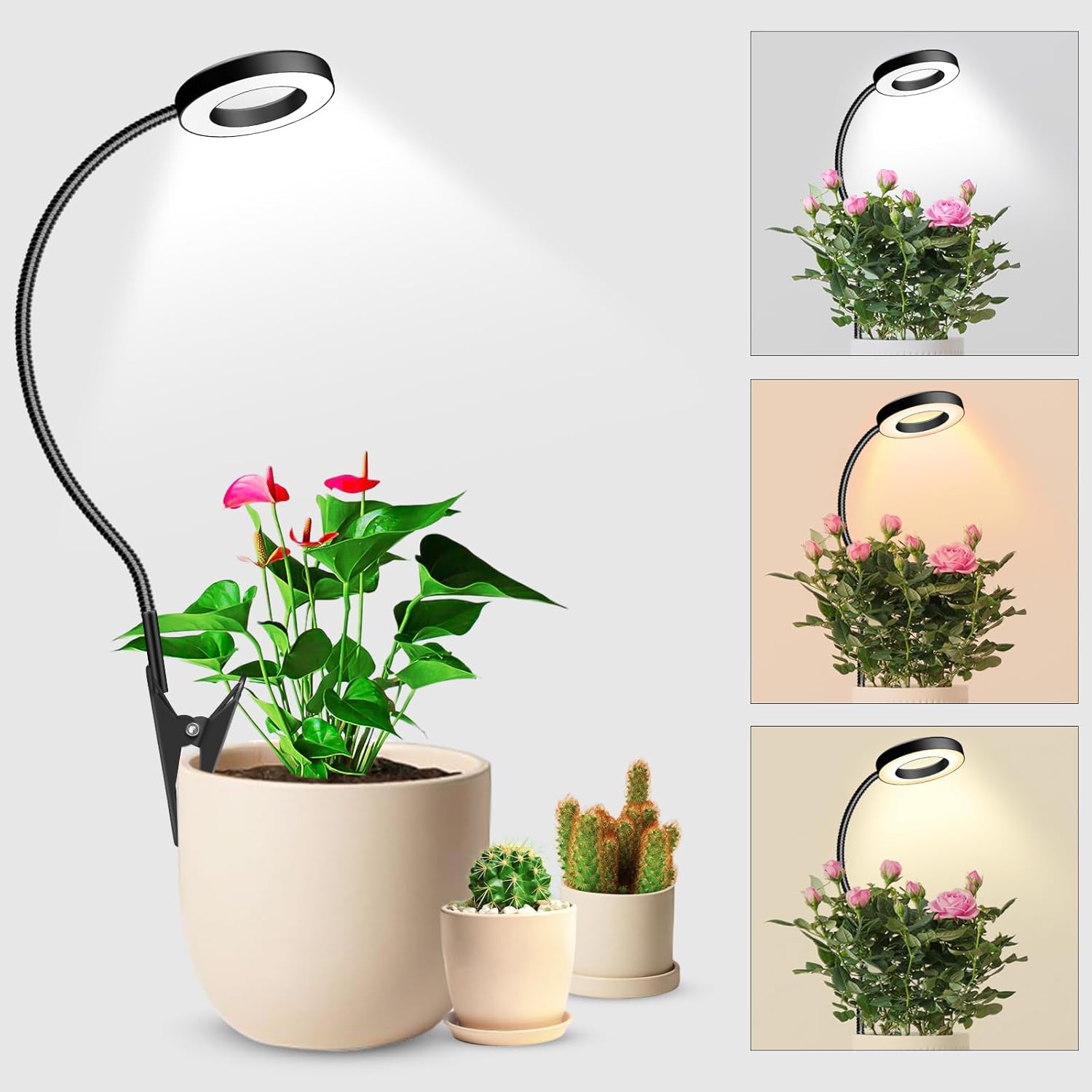
wolezek 10W LED Clip-On Grow Light with Timer and Adjustable Color Temperature
| Wattage | 10 |
|---|---|
| Mounting Type | Clamp Mount |
| Light Source Type | LED |
| Control Method | Remote |
| Connectivity Technology | USB |
This compact wolezek grow light is built for small-scale indoor propagation and potted clones. It clips to pots or inserts into soil and has a 360° gooseneck so you can aim the rectangular LED panel directly at new plants. The light offers three color-temperature modes and five dimming steps plus a 6/12/16 hour auto timer, which makes it easy to give clones consistent, stage-appropriate light without daily intervention. At 10 watts and USB-powered with an 80.7-inch cord it runs cool and is energy efficient, and the aluminum housing helps dissipate heat for longer continuous use. Practical limits to expect: the single small LED head covers only a few seedlings at close range so you will need multiple units or frequent repositioning for trays or larger propagation racks. The clamp and soil mount make it versatile for desktops and small shelves, and the included remote simplifies adjustments. For budget seed-starting and single-pot cloning this is a sensible, low-energy option; it is not meant to replace larger full-coverage fixtures for dense multi-plant setups.
Best for: A budget-minded grower propagating a few clones or maintaining individual starter pots who values low energy use and flexible placement over wide-area coverage.
Less Ideal for: Growers needing to light large seed trays, dense propagation racks, or whole shelves should choose a wider, higher-wattage fixture instead.
- Two installation choices (clamp or soil insert) for flexible placement on pots or small shelves
- Adjustable spectrum with three color modes and five brightness levels to match clone growth stages
- Built-in 6/12/16 hour timer for consistent, hands-off daily lighting
- Low 10W consumption and USB power for energy-efficient continuous use
- Aluminum body and gooseneck allow precise aiming and improved heat dissipation
- Single 10W head has limited coverage so multiple units are needed for larger trays
Verdict: A low-cost, energy-efficient clip/insert LED that gives consistent, stage-appropriate light for a few clones or starter pots.
Gavita LED Clone Bar (2-Pack) 18W 9000K Full Spectrum Grow Lights

| Wattage | 18 watts |
|---|---|
| Color Temperature | 9000 Kelvin |
| Beam Angle | 120° |
| IP Rating | IP66 |
| Power Source | Corded Electric |
The Gavita LED Clone Bar 2-pack is a purpose-built propagation light for clones and seedlings that balances targeted spectrum with robust construction. Each 18W bar outputs a 9000K full spectrum aimed at encouraging vegetative growth and root development while the 120° beam angle helps deliver even coverage across trays or nursery racks. These bars are energy efficient and can be daisy-chained up to 20 units, which makes them easy to scale from a small hobby bench to a larger propagation room. Practical benefits include IP66 wet rating and UL/ANSI safety compliance for humid nursery environments and included mounting hardware and a 120V cord for quick setup. The main limitations are that these are specialized clone/seedling fixtures rather than full-cycle grow lights and they ship as plastic-bodied bars, so users wanting heavy-duty metal housings or multi-spectrum tuning will need different fixtures. For growers prioritizing dependable, uniform light for early-stage plants, the Gavita bars deliver a compact, professional solution.
Best for: Growers who need a reliable, scalable lighting solution that consistently promotes vigorous vegetative growth and root development in clones and seedlings and who value durability and safety in humid propagation spaces.
Less Ideal for: Gardeners seeking an all-in-one full-cycle grow light or those who prefer heavy-duty metal fixtures for long-term overhead mounting.
- Tailored 9000K full spectrum optimized for clones and seedlings
- Wide 120° beam angle for uniform light distribution across trays
- Low 18W power draw for energy-efficient propagation
- IP66 wet rating and ETL/ANSI/UL compliance for safe use in humid environments
- Daisy-chainable up to 20 units for easy scalability
- Plastic housing rather than heavier metal construction
- Designed specifically for propagation so not intended as a full-cycle flowering fixture
Verdict: Choose the Gavita LED Clone Bar when you want a dependable, energy-efficient propagation light that delivers uniform 9000K spectrum and commercial-grade wet rating for consistent clone and seedling performance.
GooingTop HY-021 6000K Full-Spectrum Clip Grow Light

| Power Source | Corded Electric |
|---|---|
| Color Temperature | 6000 Kelvin |
| Light Output Maximum | 2500 lumens |
| Light Source Special Features | Dimmable |
| Number of Light Sources | 84 |
This GooingTop HY-021 is a compact clip-on grow light built for small houseplants, seedlings and shelf gardens. It uses 84 LEDs (white plus deep red) to deliver a 6000K full-spectrum output intended to mimic midday sun, with a high color-rendering output that also makes it pleasant as a reading lamp. Two flexible gooseneck heads and a strong clamp let you aim light precisely over pots and seed trays, while the attached remote provides 50%/100% dim levels and repeating timers at 4, 8 or 12 hours for hands-off scheduling. Practical benefits include low power draw (listed as roughly 10 W LED draw), a claimed 1 to 2 square meter coverage for seedlings, and an included timer that simplifies day/night cycles. Limitations are its design for small setups rather than large grow racks and the clip mounting limits placement compared with freestanding fixtures. The unit also relies on the corded remote instead of a smartphone app and the lifespan claim is typical of LEDs but not independently verifiable from the listing.
Best for: Buyers who want a simple, low-power, plug-and-play grow light to boost seedlings and a few houseplants on a desk or shelf and who value an easy-to-use timer and adjustable brightness.
Less Ideal for: Growers planning multi-shelf installations, larger vegetable grows, or who need networked or app-based control should consider larger bar lights or fixtures designed for commercial racks.
- Full-spectrum 6000K output with added 660 nm red LEDs to support vegetative growth and flowering
- Attached remote with dimming (50%/100%) and repeat timer settings (4/8/12 hours) for easy scheduling
- Flexible dual goosenecks and strong clamp enable precise positioning over small pots and seed trays
- High reported color rendering for comfortable viewing and accurate plant color assessment
- Low electrical draw around 10 W while covering small growing areas
- Clip-mount design and stated 1–2 m² coverage make it better suited to individual plants or small trays rather than large multi-shelf setups
- No smart app or wireless control option; remote is cord-attached which limits placement flexibility
Verdict: A compact, easy-to-use clip grow light that delivers full-spectrum light and convenient timer/dim controls for small indoor plant setups.
Barrina T5 1 ft LED Grow Light, 5000K Full Spectrum (4-pack)

| Wattage | 5W per fixture |
|---|---|
| Color temperature | 5000K Full Spectrum |
| Linkable | Link up to 16 lights |
| Control | Separate on/off switch per fixture |
| Included accessories | Power cords, connecting cords, clips, double-sided tape |
The Barrina T5 1 ft LED grow light kit supplies full-spectrum 5000K light in a compact, linkable T5 form that is useful for starting and growing tomato seedlings under artificial light. Each 1 ft fixture draws 5W and has its own on/off switch so you can run a single tube or multiple fixtures to match light needs. The set includes power cords, connecting cords, clips, double-sided tape and cable ties for quick plug-and-play installation and you can chain up to 16 lights in series to light multiple trays or shelf levels. Practical benefits for seedlings are even, high-PPFD output from an efficient LED array and the ability to tailor coverage by switching fixtures on or off. Limitations are that the small 1 ft form gives narrow coverage per tube so larger seed flats or full-width racks will need many fixtures, and the product is non-magnetic so mounting options depend on the included clips or your own hardware. Overall this kit is a straightforward, budget-friendly choice for growers who want controllable, linkable light for early-stage tomato plants.
Best for: Growers who want a compact, energy-efficient, controllable lighting solution for starting and growing tomato seedlings on shelves or seed trays.
Less Ideal for: People needing single wide-coverage fixtures for large benches or commercial-scale propagation should consider longer tubes or high-output panels instead.
- Full-spectrum 5000K output suitable for seedlings and vegetative growth
- Separately controllable fixtures let you run only the number of tubes needed
- Linkable design supports chaining up to 16 lights for multi-shelf setups
- Includes mounting clips, power and connecting cords for quick plug-and-play setup
- Small 1 ft length provides limited coverage per fixture so more units are needed for larger trays
Verdict: A compact, linkable full-spectrum T5 kit that gives efficient, controllable light ideal for raising healthy tomato seedlings on shelves and seed trays.
Choosing the Right Grow Light for Clones: Key Factors to Consider
Spectral Quality and Intensity
Spectral balance matters because young cuttings respond best to a spectrum with a stronger blue component and moderate total PAR. Too much red or very high intensity encourages stretch or stress and can hamper root initiation.
Intensity should be adjustable. Rooting cuttings need bright but gentle light; the ability to dial down output or move the fixture higher gives you control during the sensitive first days. Look for specifications showing usable PAR numbers at realistic hanging heights rather than only maximum wattage.
Coverage Footprint and Uniformity
A light's usable footprint determines how many clones you can fit under a single fixture without hotspots or shaded edges. Uniform coverage prevents some cuttings from becoming leggy while others get burned.
Match the fixture footprint to your tray sizes and layout. For multi-tray setups, consider fixtures that can be daisy-chained or placed to overlap slightly to avoid dark corners.
Heat Output and Thermal Control
Heat is a critical variable when cloning because high temperatures quickly dehydrate cuttings and reduce humidity in a propagation dome. Low heat output reduces the need for additional ventilation and makes maintaining stable humidity easier.
Good passive or active cooling keeps LEDs performing consistently over long cloning cycles. Fixtures with heat sinks and the option to raise the light or lower intensity provide safer light-to-plant distances for delicate cuttings.
Dimming, Controls, and Adjustability
Controls let you tailor light for the rooting window and make gradual changes as roots begin to form. Simple dials, onboard dimming, or external controllers are all useful depending on how hands-on you are.
Adjustability also includes hanging hardware and the ability to reposition or angle the fixture. Flexible mounting reduces the need for frequent manual adjustment as plants grow or as you move trays.
Durability and Water Resistance
Propagation areas are humid and occasionally wet. Fixtures with robust housings and some level of water resistance last longer in damp environments than delicate, open-circuit designs.
Consider corrosion-resistant materials and sealed drivers to avoid failures. Ease of cleaning also matters because rooting substrates and sprays can leave residues; a design that tolerates occasional wiping or rinsing is advantageous.
Energy Use and Long-Term Reliability
Grow lights often run for many hours a day during cloning cycles. Energy-efficient fixtures lower operating costs and generate less heat, which in turn reduces ventilation needs.
Look for lights with long rated lifespans and stable output over time. A slightly higher upfront efficiency can pay back through lower electricity use and fewer replacements over multiple propagation seasons.
Matching Fixture Size to Common Cloning Setups
Measure your trays and planters first. Standard clone trays and domes come in predictable sizes, and matching the light footprint to that tray prevents wasted light and uneven growth. For single-tray hobby setups, a compact panel that covers the whole dome is usually the most efficient choice. For multiple trays, plan fixtures so the brightest areas align with your densest cluster of cuttings.
Consider flexible layouts. Using multiple smaller fixtures or fixtures that can be linked gives you the option to expand without replacing a single large unit. That approach also helps when you need to move a few trays without disturbing the rest of the setup.
- Measure width and length of trays before choosing a fixture
- Smaller, modular lights can be positioned for even coverage
- Overlap light footprints slightly to eliminate dark edges
How Light Distance and Timing Affect Rooting
Distance from the canopy strongly influences intensity and heat at the cuttings. Keep tender cuttings farther away than you would seedlings under the same lamp power. If your fixture has a strong beam, raise it or dim it to avoid desiccation.
Light duration for clones is usually steady and moderate. Many gardeners use a schedule that favors longer photoperiods at modest intensity to encourage compact growth while the root system establishes. Avoid sudden large increases in intensity.
- Start with lower intensity and increase gradually as roots form
- Check dome temperature and humidity after adjusting height
- Use timers to maintain consistent daily light periods
Managing Humidity and Venting with Low-Heat Lights
Propagation domes rely on retained humidity, and low-heat lights make it easier to keep that environment stable. When lights produce little heat, you can maintain higher humidity without risking fungal issues or overheating cuttings.
If your fixture emits moderate heat, add gentle ventilation or slightly crack the dome to prevent hot spots. Balance is key: too much airflow dries cuttings, too little invites mold. Choosing a light with predictable thermal characteristics simplifies this management.
- Prefer fixtures with low radiant heat for enclosed domes
- Monitor both air and surface temperatures inside domes
- Use small fans or passive vents if heat becomes an issue
Control Options That Make Daily Care Easier
Dimming and simple control options reduce the need for constant hands-on adjustment. A fixture with a dimmer or remote control lets you fine-tune intensity as roots develop without moving the light constantly.
Programmable timers paired with dimming allow you to set gradual ramp-ups or ramp-downs in daily cycles. This mimicry of natural dawn and dusk reduces shock when you change intensity levels and gives you more consistent results across batches.
- Look for dimming or stepless control for precise adjustments
- Remote or external controllers are helpful for stacked racks
- Timers can automate consistent schedules and intensity shifts
Routine Care and Maintenance Tips
Keep fixtures free of residue from sprays and nutrient mist. Wipe housings with a damp cloth when powered off and avoid aggressive cleaners that can strip corrosion-resistant coatings.
Inspect mounting hardware and wiring periodically, especially in humid setups. Tighten hangers and replace any corroded fasteners to maintain safe, consistent light positions. Regular checks prevent sudden failures mid-rooting cycle.
- Wipe down housings and lenses when cool and powered off
- Check for corrosion on hangers and fasteners
- Verify timers and dimmers function before starting a new batch
How We Chose the Best Grow Light for Clones
We focused on characteristics that directly affect rooting success and day-to-day handling of cuttings. Key evaluation criteria included spectral output and adjustability, since clones need a balanced, low-to-moderate PAR with emphasis on blue wavelengths for compact growth. Coverage footprint and uniformity were measured against typical cloning tray sizes so lights could be matched to common setups. Heat management and distance flexibility were considered because excessive heat or inflexible hanging systems force constant repositioning or risk wilting. Energy efficiency and rated lifespan were included to reflect long-term running costs under continuous use during a cloning cycle. Build quality and water resistance were checked to ensure lights survive humid trays, misting, and the occasional splash. Finally, user controls and dimming options were reviewed to let growers fine-tune intensity during the different rooting stages. We excluded lights designed only for mature flowering or high-intensity canopy penetration where spectrum and intensity are inappropriate for fragile cuttings. Fixtures lacking basic dimming or with poor thermal specs were also removed. The final list highlights lights that balance low heat, even spectrum, and usable coverage for typical clone trays.
FAQ
What light spectrum is best for rooting clones?
A spectrum with a stronger blue component and balanced white light is usually best because blue light promotes compact growth and leaf development without encouraging excessive stretch. Avoid lights that emphasize deep red heavily during the early rooting phase.
How close should the light be to new cuttings?
Start with the light farther away or at low intensity to avoid drying the cuttings, then move it closer gradually as roots begin to form. Exact distances depend on fixture output; monitor dome temperature and leaf condition to guide adjustments.
Can I use high-power flowering lights for clones?
High-power flowering fixtures often emit too much intensity and heat for delicate cuttings. They can be used if they have reliable dimming and you can keep them at a safe distance, but purpose-designed or lower-intensity fixtures are generally easier to manage for clones.
How long should clones be under the grow light each day?
Many growers use steady, moderate photoperiods in the 16 to 18 hour range to support root formation while minimizing stress. The exact schedule depends on species and humidity; consistent timing is more important than lengthy hours at excessive intensity.
Do I need special humidity protection for the light?
Lights with basic water resistance or sealed drivers are preferable in humid propagation environments. You do not need industrial waterproof gear for most domes, but fixtures that can tolerate occasional moisture will last longer.
How important is energy efficiency for a cloning light?
Energy efficiency matters because lights often run many hours during cloning cycles. Efficient fixtures produce less waste heat and lower electricity use, which reduces running costs and simplifies climate control in the propagation area.
Final Verdict
When selecting a grow light for clones, prioritize spectral balance, adjustable intensity, and predictable thermal behavior. Those features directly influence how quickly and evenly cuttings root and how easy the fixture is to manage in a humid propagation setup. Tradeoffs typically occur between footprint size and portability or between feature-rich controls and simplicity. Choose a fixture whose coverage and controls match your tray layout and willingness to fine-tune settings. Focus on low heat, good uniformity, and the ability to dim so you can shepherd delicate cuttings through the most critical early days with minimal stress.
