

Note: This article contains affiliate links. If you click on these links and make a purchase, I may earn a small commission at no extra cost to you. This helps support my research and content. Read my full affiliate disclosure here.
If you manage large grounds, municipal properties, or a commercial landscaping crew, the right commercial leaf blower changes how quickly you clear leaves, debris, and grass clippings. You need a tool that keeps up with long shifts, stands up to heavy use, and moves large volumes of material without wasting operator energy. This guide covers seven shortlisted commercial leaf blowers that meet those demands. We evaluated machines on airflow, durability, ergonomics, fuel or battery management, and serviceability so you can match a blower to your daily workflow. Read on for what mattered in our selection and practical tips for using commercial blowers on real jobsites.
Top Picks at a Glance
| Best Overall The best all-around choice for most situations | Husqvarna 360BT Gas Backpack Leaf Blower |  |
| Best Quality Built to a higher standard if you want something more solid | Husqvarna 580BTS III 75.6cc Gas Backpack Leaf Blower |  |
| Best Value The sweet spot between price and what you get | PROYAMA 79.9cc Gas Backpack Leaf Blower PB990X |  |
| Best Budget The cheapest option that still gets the job done reliably | HASANEN 850CFM Backpack Gas-Powered Leaf Blower |  |
| Highest Rated A top-rated pick with lots of positive feedback | ECHO PB-9010T X Series 79.9cc Backpack Gas Blower |  |
Husqvarna 360BT Gas Backpack Leaf Blower

| Power Source | Gas Powered |
|---|---|
| Form Factor | Backpack |
| Air Flow Capacity | 890 cfm |
| Noise Level | 60 db |
| Speed | 8100 rpm |
The Husqvarna 360BT is a gas-powered backpack blower built for large yards and professional-style clearing tasks. It pairs a 65.6-cc X-TORQUE 2-cycle engine with an 890 CFM air flow and up to 232 MPH wind speed to move wet leaves, heavy debris, and grass clippings quickly. The backpack form factor uses a vented, load-reducing harness and wide shoulder straps plus an adjustable offset handle to make extended use more comfortable, while LowVib technology and cruise control reduce arm fatigue and effort on long passes. Practical features like an air purge system help with reliable starting and routine operation. Expect strong clearing performance and durability typical of Husqvarna, but keep in mind this is a gas unit so you will have fuel mixing, routine maintenance, and higher noise and emissions compared with battery models. The blower is best when you need sustained power for large properties or commercial jobs and are prepared for the upkeep that comes with a gas engine.
Best for: Owners of large properties, landscapers, or homeowners who need sustained, commercial-level clearing power and prioritize performance and endurance over minimal maintenance.
Less Ideal for: Small-yard owners, occasional users, or anyone seeking quieter, low-maintenance battery-powered equipment should consider cordless alternatives instead.
- High air volume and speed (890 CFM and up to 232 MPH) for moving wet or heavy debris
- Ergonomic backpack harness and wide shoulder straps reduce operator fatigue during long jobs
- LowVib technology and adjustable offset handle improve comfort and control
- Air purge system and cruise control simplify starting and steady operation
- Gas engine requires fuel mixing, routine maintenance, and produces more noise and emissions than electric models
- Backpack design and engine weight increase physical load compared with handheld blowers
Verdict: Choose the Husqvarna 360BT when you need sustained, professional-grade blowing power and ergonomic support for large-area cleanup.
Husqvarna 580BTS III 75.6cc Gas Backpack Leaf Blower

| Max air flow at nozzle | 1000 CFM |
|---|---|
| Max air speed | 220 MPH |
| Max blow force | 47 N |
| Engine displacement | 75.6 CC |
| Engine cycle | 2-Cycle |
The Husqvarna 580BTS III is a commercial-style backpack blower built to move large volumes of debris quickly. It pairs a 75.6 cc two-stroke X-TORQ engine with an efficient fan to produce up to 1000 CFM and 47 N of blow force, making it well suited to clearing heavy leaves, grass clippings, and wet debris across large properties. The ventilated, load-reducing harness and padded hip belt improve weight distribution so operators can work longer with less fatigue, and the tube-mounted throttle gives straightforward control while walking. A larger fuel tank reduces refueling stops during long shifts and the two-stage commercial air filter helps protect the engine in dusty conditions. Expect loud operation typical of powerful gas blowers and plan for regular 2-stroke maintenance and fuel mixing. This unit favors contractors or experienced homeowners who need sustained power and durability rather than occasional light-use tasks.
Best for: Buyers who need a rugged, high-output blower for frequent or large-area clearing—commercial landscapers and homeowners with extensive properties who prioritize performance and uptime.
Less Ideal for: Those with small yards, infrequent need for a blower, or who prefer quieter, low-maintenance electric models should consider smaller or battery-powered alternatives.
- Very high airflow and blow force suitable for commercial clearing (1000 CFM, 47 N)
- Ergonomic ventilated backpack harness and padded hip belt reduce operator fatigue
- Large fuel tank supports longer run times between refuels
- Tube-mounted throttle and adjustable speed give straightforward control during use
- Commercial two-stage air filter for better engine protection in dusty conditions
- High noise and typical 2-stroke maintenance requirements
- Backpack format and power are oversized for small yards or occasional light use
Verdict: Choose the 580BTS III when you need professional-level blowing power and endurance for large or frequent cleanup jobs.
PROYAMA 79.9cc Gas Backpack Leaf Blower PB990X

| Power Source | Gas Powered |
|---|---|
| Form Factor | Backpack |
| Additional Features | Instant Start |
| Fuel Tank Capacity | 3.4L |
The PROYAMA PB990X is a gas-powered backpack blower built for large yards and commercial-style cleanup. Its 79.9cc engine produces up to 1,150 CFM and 246 MPH, which clears heavy leaf buildup, grass clippings, and light debris quickly. The unit is worn as a padded backpack with a supportive waist belt and shock-absorbing spring system to reduce vibration during extended use. A 90° self-locking adjustable handle improves control for different tasks while the large 3.4L fuel tank offers long run times—manufacturer claims up to 90 minutes under specified conditions—so you spend less time refueling. Practical durability features include a metal outlet and a dual-layer air filter for cleaner intake and longer service life. Expect the usual gas-tool trade-offs: it requires fuel and maintenance and is louder and heavier than handheld electric models, and proper fit and initial assembly are important for comfort and performance. For intensive, frequent cleanup this blower delivers strong, sustained power and workplace-style ergonomics.
Best for: Buyers who need a durable, high-power blower for large properties or commercial jobs and prioritize runtime, airflow and operator comfort during long sessions.
Less Ideal for: Casual homeowners with small yards, users who prefer quiet low-maintenance electric tools, or those unable to perform basic engine upkeep should consider lighter electric alternatives.
- Very high airflow and airspeed suitable for heavy debris and large areas
- Backpack harness with padded back pad and waist belt for extended use comfort
- Large 3.4L fuel tank for long runtimes and fewer refills
- Durable metal outlet and dual-layer air filter for improved longevity
- 90° self-locking adjustable handle for better control and ergonomics
- Being a gas backpack unit it requires regular fuel, oil and maintenance
- Heavier and louder than electric or handheld blowers which may limit use in noise-sensitive areas
Verdict: Choose this PROYAMA backpack blower if you need commercial-level airflow and long runtimes for large properties or frequent heavy cleanup tasks.
HASANEN 850CFM Backpack Gas-Powered Leaf Blower

| Power Source | Gas Powered |
|---|---|
| Form Factor | Backpack |
| Additional Features | Adjustable Speed |
| Noise Level | 101 db |
| Maximum Speed | 6800 rpm |
This HASANEN backpack leaf blower is built around a 63cc two-stroke engine that produces strong airflow for moving leaves, gravel, light snow, and debris across large yards or commercial properties. It is worn on the back with adjustable, breathable straps and a padded backrest to distribute weight and keep engine heat away from the operator, which helps during long jobs. The blower includes adjustable nozzle angles and a long hose interface to broaden the cleaning reach, and a single-handle control that combines throttle and on/off for one-handed operation plus a cruise/constant speed switch to reduce fatigue. Practical benefits include a large 1.8L fuel tank for extended run time, PP housing that resists heat and impact, and multiple heat-dissipation features with a one-click shutdown for safety. Important limitations are typical of gas backpack blowers: it is loud at the listed noise level and requires fuel mixing and routine two-stroke maintenance, and the vibrating engine and overall weight can still be tiring over many hours despite the harness.
Best for: Buyers who prioritize reliable, high-power outdoor equipment and prefer proven gasoline engines for frequent or commercial clearing tasks and want a harnessed blower that reduces strain compared with handheld units.
Less Ideal for: Casual homeowners who need an occasional quiet, low-maintenance blower or users who cannot perform routine two-stroke maintenance should consider simpler electric or cordless models instead.
- High 63cc two-stroke engine delivers strong airflow suitable for commercial clearing
- Backpack design with padded backrest and adjustable breathable straps improves comfort for extended use
- Large 1.8L fuel tank supports longer run times between refills
- Adjustable nozzle angles and long hose interface expand reach and versatility
- Single-handle controls with a constant speed switch reduce operator fatigue
- Noise level is high at about 101 dB, so hearing protection is required
- Requires two-stroke fuel mixing and regular engine maintenance
- Backpack systems still transmit vibration and can be tiring during very long shifts
Verdict: Choose this backpack gas blower when you need powerful, continuous blowing performance for commercial or large-property work and want a harnessed design to ease long sessions.
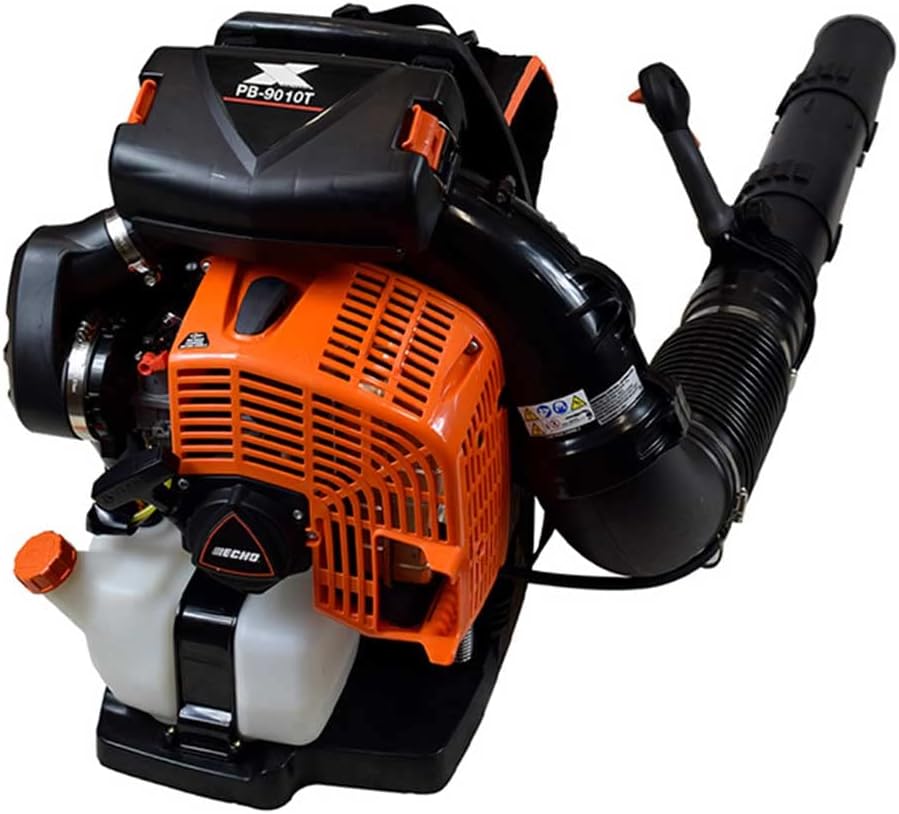
ECHO PB-9010T X Series 79.9cc Backpack Gas Blower
| Power Source | gasoline-powered |
|---|---|
| Form Factor | Backpack |
| Additional Features | Throttle Lock |
| Noise Level | 48 db |
| Maximum Speed | 220 miles_per_hour |
The ECHO PB-9010T X Series is a professional-style backpack blower built for heavy yard work and extended runs. Its 79.9 cc two-stroke engine produces up to 220 mph airspeed and a high airflow so you can move large piles of leaves, debris, and grass clippings quickly. The backpack form factor distributes the engine weight across the shoulders and hips for longer use than handheld units, and the tube-mounted throttle plus throttle lock help maintain a steady output during repetitive jobs. Practical benefits include strong clearing power for lawns, driveways, and beds and a design aimed at home users who need commercial-level performance. Limitations are the usual ones for gas backpack blowers: it requires fuel mixing and periodic engine maintenance, it is heavier and louder than electric alternatives, and it may be overkill for very small yards or infrequent light tasks.
Best for: Homeowners who need a reliable, high-power blower for frequent or large-area cleanup and who prioritize continuous performance over minimal maintenance.
Less Ideal for: Casual users with small yards, those who prefer low-maintenance electric equipment, or anyone seeking the quietest option for noise-sensitive neighborhoods.
- High reported maximum speed of 220 mph for strong clearing power
- Backpack form factor for longer, more comfortable operation than handheld blowers
- Tube-mounted throttle with throttle lock for steady speed control during extended use
- Gasoline power allows untethered operation and sustained output for large properties
- Requires fuel mixing and routine engine maintenance inherent to two-stroke gas engines
- Heavier and louder than electric or battery backpack models
- Likely more power than needed for very small yards or occasional use
Verdict: Buy this if you want a dependable, high-speed gas backpack blower that handles large yards and frequent heavy-duty cleanup.
Choosing the Right Commercial Leaf Blower: Key Factors to Consider
Airflow and Air Speed
Airflow volume and maximum air speed determine how quickly a blower moves material. High cubic feet per minute (CFM) helps shift loose leaves and grass over large areas, while peak air velocity is important for dislodging wet or compacted debris.
For commercial use, look for machines that maintain high CFM at working throttle settings rather than only at peak. That consistency reduces the number of passes and the time spent on each job, which matters when you bill by the hour or manage a route.
Power Source and Runtime
Commercial blowers come in gas, battery, and hybrid configurations, and each affects daily operations. Gas engines offer long runtime and quick refills but require fuel handling, mixing for two-stroke models, and routine engine maintenance. Battery blowers are quieter and have lower onsite emissions, but runtime depends on battery capacity and how many batteries you can rotate during a shift.
Consider the infrastructure you have for charging, spare batteries, and fuel storage when choosing a power type. Also factor in how runtime changes under load because cutting through wet leaves or heavy debris reduces operating time compared with light, dry conditions.
Durability and Serviceability
Commercial schedules demand equipment that tolerates drops, vibration, and extended runtime. Durable housings, reinforced mounts, and quality fasteners prevent frequent breakdowns. Equally important is serviceability: easy access to air filters, spark plugs, belts, or impellers reduces downtime and keeps machines earning rather than waiting for repair.
Check availability of replacement parts and whether the design allows common field repairs. Machines that require specialized tools or lengthy disassembly for routine maintenance slow crews and increase operating costs.
Operator Comfort and Ergonomics
Comfort affects productivity and safety over long shifts. Weight distribution, handle placement, and anti-vibration features reduce fatigue and the risk of repetitive strain. For backpack blowers, padded harnesses and adjustable straps matter. For handheld or tube blowers, trigger position and tube balance determine how long an operator can work without shifting grip.
Noise and heat are also operator concerns. Quieter units reduce hearing strain and the need for constant hearing protection. Models that isolate hot components away from the operator's hands and back help avoid discomfort during prolonged use.
Noise, Emissions, and Regulatory Compliance
Many commercial jobs take place in noise-sensitive areas such as schools, hospitals, or dense urban districts. Decibel ratings influence allowable work hours and may determine which sites you can service. Emissions matter for fleet-level environmental policies and local regulations that restrict high-emission two-stroke engines.
Prioritize equipment that meets or exceeds local noise and emissions rules, and plan routes and schedules around permitted operating times. Electric options often simplify compliance for noise and emissions, but weigh that against runtime and charging needs.
Weight and Portability
Total machine weight and how that weight is carried affect daily efficiency. Heavier blowers can be more durable and powerful, but they increase operator fatigue and may slow crews. Consider portability for jobs that require frequent transport between sites or climbing stairs.
Look for designs that offer quick-disconnect tubes, collapsible handles, or backpack harnesses with load-transfer ergonomics. For fleets, standardized mounting and transport solutions reduce setup time on each job.
When to Choose Gas Versus Battery
Gas models still lead on continuous power and fast refueling for back-to-back commercial routes. They are common for crews that need a full shift of operation with limited downtime for charging, and they perform well moving heavy, wet debris where sustained high airflow is necessary.
- Battery blowers are preferable for noise-restricted zones or early-morning work where lower sound levels matter.
- Hybrid or kit-based systems let crews swap batteries quickly but require charging infrastructure at the yard.
- For mixed routes, consider maintaining both gas and battery units to match the jobsite requirements.
Maintaining Performance on the Jobsite
Routine maintenance preserves airflow and prevents unexpected failures. Simple daily checks include inspecting air intakes for blockages, ensuring fuel and oil levels are correct for gas units, and looking for loose fasteners or cracked housings. Clean or replace air filters on a schedule driven by dusty or leaf-heavy conditions rather than calendar days alone.
- Carry basic spare parts such as spark plugs, air filters, and a small fastener kit.
- Log hours of operation to schedule preventive maintenance before serious wear appears.
- Train crews on manufacturer-recommended service intervals and easy field repairs to cut downtime.
Silencing and Emissions Strategies for Urban Work
If you work in noise-sensitive neighborhoods or near schools, choose quieter equipment or schedule noisy tasks later in the day when allowed. Mufflers, tuned exhausts, and electric drive systems reduce audible impact. For emissions, newer two-stroke designs with improved mixing or four-stroke engines lower pollutants and may comply with stricter local rules.
- Use baffles or sound-dampening enclosures on equipment storage areas to reduce reverberation during idling.
- Keep records of decibel and emission performance if contracts require proof of compliance.
- Consider electric options for routes with strict noise and emissions limitations.
Using Accessories to Improve Efficiency
Nozzle shapes, extension tubes, and collection attachments can change how a blower performs for specific tasks. Flat nozzles increase velocity for denser debris, while widened nozzles move more volume for light leaves. Backpack harnesses and padded grips increase comfort for prolonged use.
- Match nozzle geometry to common jobsite debris types.
- Invest in spare batteries and rapid chargers if you rely on electric systems.
- Use collection systems when bagging is needed to minimize follow-up sweeping.
How We Chose the Best Commercial Leaf Blower
We started by focusing on machines built for daily, heavy use rather than occasional homeowner models. Our selection filtered for engines, motors, and battery systems rated for commercial duty, frames and housings designed to resist impact and vibration, and components that are straightforward for field maintenance. We prioritized consistent, measurable performance indicators such as maximum airflow and airspeed, continuous runtime under load for battery models, and fuel efficiency for gas designs. Durability checks included inspection of housing materials, seals, and fasteners as well as attention to user-serviceable parts like spark plugs, air filters, and fan housings. Ergonomics and operator fatigue were judged by handle design, weight distribution, and available anti-vibration features. Noise output and emissions characteristics were considered where relevant to urban or regulatory-sensitive work. We excluded light-duty consumer blowers and single-season hobby models. Units with poor service documentation, limited parts availability, or a history of structural failures were also removed. The final list emphasizes real-world reliability, measurable airflow metrics, operator comfort, and maintainability for commercial workflows.
FAQ
How large an area can a commercial leaf blower handle in an hour?
Area coverage depends on blower airflow, airspeed, and the debris type. High-CFM, high-velocity units typically clear open turf faster, while wet or matted leaves slow progress. Expect widely varying rates; plan by measuring typical time on a representative section of a route.
Are battery commercial blowers powerful enough for professional landscaping?
Many battery systems now deliver sufficient airflow for a wide range of commercial tasks, especially for dry leaves and light debris. Their runtime under heavy load can be shorter than gas, so battery systems work best when you have spare batteries and charging capacity.
What routine maintenance keeps a blower reliable?
Daily checks should include air intake and nozzle inspection, mounting hardware tightness, and fuel or battery status. Replace air filters and spark plugs on the schedule recommended for commercial use and inspect impellers and tubes for cracks after heavy use.
Can noise restrictions prevent using certain blowers?
Yes. Local ordinances or site rules often set decibel limits and allowable working hours. Quieter electric blowers or scheduling work during permitted times are typical solutions to meet restrictions.
How important is parts availability for commercial units?
Very important. Readily available replacement parts and service documentation reduce downtime and keep crews productive. Equipment that requires long lead times for common parts can be expensive to operate for commercial work.
Final Verdict
Choose a commercial leaf blower by balancing raw airflow with real-world usability. Prioritize machines that sustain high CFM at working throttle settings, are easy to service in the field, and match your power-infrastructure limits for fuel or charging. Operator comfort and noise or emissions constraints will often decide between gas and electric options. Focus on the tradeoffs that matter most for your routes: runtime and refueling speed for long shifts, or lower noise and simpler maintenance for sensitive sites. With those priorities set, pick the unit that fits your crew workflow and maintenance capacity so equipment stays productive over many seasons.
