

Note: This article contains affiliate links. If you click on these links and make a purchase, I may earn a small commission at no extra cost to you. This helps support my research and content. Read my full affiliate disclosure here.
If you grow vegetables or compact flower beds in raised beds, a properly sized drip irrigation kit can cut back on hand-watering and give plants more consistent moisture. The right system fits bed size, delivers adjustable flow near roots, and resists clogging so you do not end up with dry patches or soggy spots. This guide shortlists seven top options suitable for raised beds and walks through the practical differences gardeners care about: installation complexity, emitter spacing and adjustability, filtration, and how well systems handle seasonal expansion. Read on to see the criteria we used to pick these kits and the features that matter in a real garden setting.
Top Picks at a Glance
| Best Overall The best all-around choice for most situations | Garden In Minutes 3×6 Garden Grid Watering System |  |
| Best Quality Built to a higher standard if you want something more solid | Drip Depot Premium Drip Irrigation Kit for 8 Raised Beds |  |
| Best Value The sweet spot between price and what you get | CARPATHEN 100 ft Drip Irrigation Kit with Adjustable Emitters |  |
| Best Budget The cheapest option that still gets the job done reliably | SMIDOLE 100FT Drip Irrigation System Kit with Quick-Connect Tubing and Adjustable Emitters |  |
| Highest Rated A top-rated pick with lots of positive feedback | MQJIAZHI 66 ft Drip Irrigation System with 40 Brass Nozzles |  |
| Most Popular A crowd favorite that many people choose with confidence | MIXC 200ft 1/4" Drip Irrigation Kit with 32 Adjustable Copper Nozzles |  |
| Best Seller A high-volume bestseller chosen again and again | Rain Bird LNDDRIPKIT 108-Piece Landscape & Garden Drip Irrigation Kit |  |
Garden In Minutes 3×6 Garden Grid Watering System
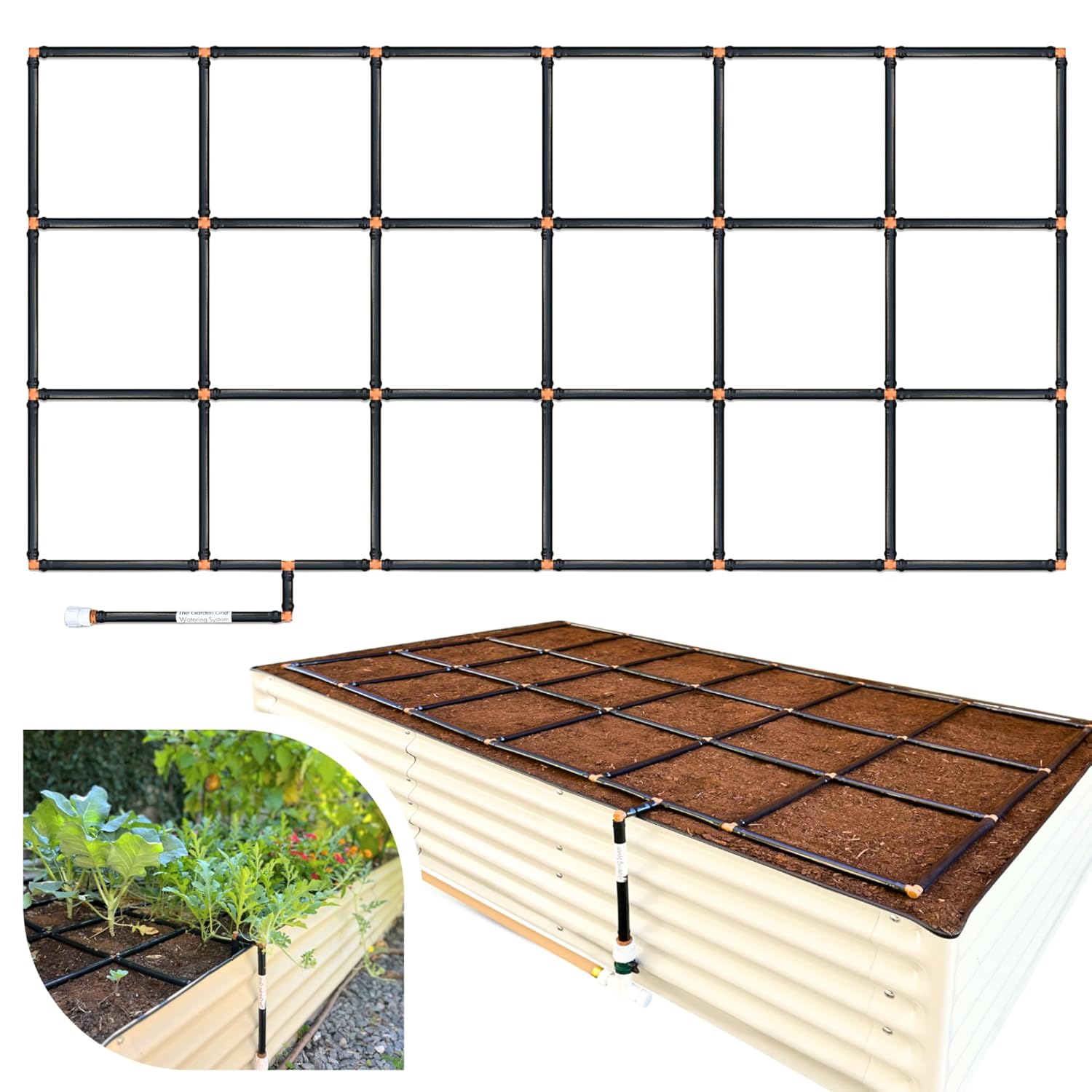
| Size | 3×6 |
|---|---|
| Hose Length | 66 inches |
| Number of Pieces | 12 |
| Special Features | Misting |
| Maximum Pressure | 50 psi |
The Garden In Minutes 3×6 Garden Grid is a prebuilt irrigation mat that snaps together and connects to a standard garden hose to water a 3×6 raised bed without punching hoses or placing emitters. It lays on the soil surface and supplies multiple low-angle misting streams to each of 18 square-foot planting positions, which helps eliminate dry spots and doubles as a simple planting guide. Setup is fast — press the three sections together, attach the feed tube and hose, and you can plant in minutes. Built from UV-resistant LLDPE tubing and durable POM fittings, it is intended for season-long use with fewer clog-prone parts than typical drip kits. The system is adjustable to change water angle and supports up to 50 psi, so it pairs well with a hose timer for automatic schedules. Limitations are that it sits on the soil (not buried irrigation), so it is best for beds where surface watering is acceptable, and it is sized specifically for 3×6 layouts which means larger or oddly shaped beds require additional connectors or multiple units.
Best for: Gardeners who want a low-effort, reliable irrigation solution for a standard 3×6 raised bed and prefer a ready-to-use system that minimizes installation work and maintenance.
Less Ideal for: Gardeners seeking buried or subsurface irrigation, custom-shaped beds, or a system for very large areas should consider other drip or emitter-based solutions.
- Preassembled sections for very quick setup with no cutting or emitter placement
- Even coverage across 18 planting squares to reduce dry spots
- Durable UV-resistant tubing and sturdy POM fittings meant for season-long use
- Adjustable tubing that can rotate to change water angle and misting distribution
- Designed to sit on the soil surface rather than be buried, so it may not suit subsurface drip preferences
- Sized for a 3×6 bed so larger or nonstandard beds need additional units or connectors
Verdict: If you want a fast, maintenance-light way to water a 3×6 raised bed with uniform coverage, this preassembled Garden Grid makes it simple.
Drip Depot Premium Drip Irrigation Kit for 8 Raised Beds

| Size | Premium – 8 Raised Beds |
|---|---|
| Special Features | Adjustable |
| Fit Type | Threaded |
| Material | Polyethylene |
The Drip Depot Premium kit is a self-contained drip irrigation system sized for eight standard raised beds and includes tubing, threaded fittings, and installation parts to connect directly to a garden hose or outdoor faucet. It is typically used to lay a simple grid of drip lines across 4'×8' beds so plants receive slow, even watering without daily hand-watering. Notable features include tool-free, hand-tightened threaded connections, polyethylene tubing that is easy to cut to length with household scissors, and a modular design that lets you add components later if you expand beds. Practical benefits are fast setup, compatibility with standard hose threads, and the ability to create a reliable, low-watering routine for vegetables and flowers. Important limitations are that the kit is built to the capacities specified for raised beds so it may need extra parts if your layout differs, and users should follow the kit capacity guidance to avoid overloading components. Basic instruction materials are provided online for installation and safe use.
Best for: Gardeners who want a reliable, ready-to-install drip system to automate watering for multiple raised beds and value straightforward setup and expandability.
Less Ideal for: People with nonstandard or irregular bed layouts, very large-scale vegetable plots, or those who need a fully pressurized, programmable valve system integrated into irrigation controllers.
- Complete, self-contained kit with fittings and tubing ready to connect to a standard outdoor faucet
- Tool-free assembly with hand-tightened threaded connections for quick installation
- Modular design allows straightforward expansion or replacement of parts
- Tubing made from polyethylene that is easy to cut and route for custom bed layouts
- Designed around standard 4'×8' raised beds so unusual bed sizes or complex layouts may require buying extra components
- Kit capacity limits must be observed when adding parts to avoid pressure drop or component strain
Verdict: A ready-to-install, expandable drip irrigation kit built to get up to eight standard raised beds reliably watered with minimal fuss.
CARPATHEN 100 ft Drip Irrigation Kit with Adjustable Emitters

| Hose Length | 100 feet |
|---|---|
| Included Components | 50ft 5/16" mainline and 50ft 1/4" distribution tubing |
| Maximum Pressure | 45 psi |
| Special Features | Adjustable emitters, UV resistant, for above- or below-ground installation |
This CARPATHEN kit supplies a complete starter system for keeping raised beds and small vegetable plots evenly watered without daily attention. It includes 50 ft of 5/16" mainline and 50 ft of 1/4" distribution tubing plus a wide selection of barbed tees, splitters, end plugs and adjustable vortex and stream emitters. The emitters are manually adjustable so you can dial flow from a trickle up to stronger output and the long stakes hold well in loose soil. The tubing and parts are UV resistant for outdoor use and the barbed connectors are sized to resist blow-offs at typical garden pressures. Setup is straightforward: run the mainline from a garden tap, branch with the 1/4" distribution lines, insert stakes at plant roots and fine-tune each emitter. Expect to customize layouts for rows and clusters since the kit supports up to about 30 emitters and works best at 20 to 45 psi. Limitations include plastic parts that will wear faster than metal fittings and a capped emitter count that may be small for larger beds without buying extra tubing and emitters.
Best for: Gardeners who want a practical, expandable starter system to automate watering of one to three raised beds and reduce daily watering chores.
Less Ideal for: Large-scale vegetable plots or gardeners who prefer all-metal fittings and fully automated electronic controllers; those users should look for higher-capacity or metal-component systems.
- Complete starter set with mainline and distribution tubing plus a range of connectors and end plugs
- Adjustable emitters and long stakes let you fine-tune flow to individual plants and keep stakes stable in loose soil
- UV resistant components designed for above- or below-ground installation
- Barbed fittings sized to reduce tubing blow-off under typical garden pressures
- Plastic fittings and tubing are durable for seasons but not as long-lived as metal hardware
- Kit supports a limited number of emitters out of the box so larger raised-bed systems will need additional tubing and emitters
Verdict: A practical, easy-to-expand drip kit that automates watering for small raised beds with adjustable emitters you can tune for each plant.
SMIDOLE 100FT Drip Irrigation System Kit with Quick-Connect Tubing and Adjustable Emitters

| Length | 100FT |
|---|---|
| Hose Length | 100 feet |
| Special Features | Adjustable |
| Fit Type | Quick-Connect |
This SMIDOLE 100FT drip irrigation kit supplies water directly to plant roots using a 25 ft 1/2" main line and 75 ft of 1/4" distribution tubing with push-fit quick-connects for tool-free assembly. The kit includes a mix of vortex drip emitters and stream emitters and 6-way connectors so you can route lines around raised beds and add multiple watering points. In practice it is easy to install in under 30 minutes for someone setting up a few beds or multiple rows of vegetables, and the adjustable emitters let you tailor flow for seedlings versus established plants. It is a simple, water-saving option for maintaining consistent moisture and reducing overhead watering. Expect straightforward plastic fittings and basic components that work well for small to medium raised beds but may not be as durable as pro-grade systems or ideal for very high-pressure setups. For a low-cost, do-it-yourself kit it gives clear practical value for routine raised-bed irrigation.
Best for: Budget-minded gardeners installing watering for raised beds or small vegetable plots who want a quick, DIY solution that saves water and time.
Less Ideal for: Large properties, commercial growers, or anyone needing heavy-duty fittings and long-term professional durability should consider more robust systems.
- Quick-connect fittings allow tool-free, leak-resistant assembly
- Includes both 1/2" main tubing and 1/4" distribution tubing for multi-zone layouts
- Adjustable vortex and stream emitters let you match flow to different plants
- Compact kit covers typical raised beds and can be set up in about 30 minutes
- Plastic components are basic and may show wear faster than commercial-grade systems
- Not designed for very high water pressure or large-scale irrigation without upgrades
Verdict: A low-cost, easy-to-install drip kit that delivers precise, adjustable watering for raised beds and small vegetable gardens.
MQJIAZHI 66 ft Drip Irrigation System with 40 Brass Nozzles

| Hose Length | 66 feet |
|---|---|
| Special Features | 360° Bendable, 40 Nozzles |
| Fit Type | Flexible Tubing, Adjustable Nozzles |
| Power Source | No |
This MQJIAZHI drip irrigation kit is built to supply steady, targeted moisture to raised beds and compact garden plots. The dual-head design and 40 adjustable brass nozzles spread water more evenly than a single-line setup, while the 360° bendable tubing lets you aim misting or drips precisely at seedlings, rows, or potted plants. Installation is designed to be DIY-friendly with tool-free connections and flexible tubing that can be trimmed to fit a 66 ft run. The brass nozzles resist rust and deliver a gentle, rain-like spray that is good for young plants and greenhouse starts. Materials are described as UV-resistant, which should extend outdoor life compared with basic plastics, though long-term durability will depend on local sun and freezing conditions. This kit favors simple, reliable coverage rather than fine-grain flow control or commercial-grade components, so expect easy setup and consistent watering rather than advanced programmability or high-pressure performance.
Best for: Gardeners who want a dependable, easy-to-install drip system to maintain consistent moisture in raised beds and small vegetable plots without complex setup or electronics.
Less Ideal for: People needing a fully automated, programmable irrigation solution or professional-grade systems for large properties should consider higher-end kits with controllers and pressure regulators.
- Dual-head layout and 40 nozzles provide wider, more even coverage across raised beds
- Brass nozzles are rust-resistant for more reliable long-term flow
- 360° bendable tubing allows precise placement of emitters for targeted watering
- Tool-free assembly and flexible tubing make installation quick and DIY-friendly
- No built-in pressure regulation or controller included for automated scheduling
- Durability claims rely on UV-resistant materials but may vary in extreme climates
Verdict: If you need a straightforward, reliable drip system to keep raised beds evenly watered with minimal fuss, this 66 ft kit delivers consistent, targeted coverage.
MIXC 200ft 1/4" Drip Irrigation Kit with 32 Adjustable Copper Nozzles

| Size | 200ft |
|---|---|
| Power Source | Water Pressure-driven |
| Fit Type | quick-connect |
| Maximum Pressure | 50 psi |
| Included Components | 200ft tubing, 32 nozzles, quick connectors, accessories |
This MIXC kit supplies 200 feet of 1/4" tubing plus connectors and 32 adjustable copper nozzles to build a flexible drip or mist system for raised beds, containers, and small lawns. It is assembled with quick-connect 2-way and 3-way fittings so you can lay runs, branch lines, and reposition emitters without special tools. The copper nozzles and aluminum-alloy wands allow a range of spray patterns and 360 degree adjustment, which is useful when irrigating mixed plantings or targeting root zones in raised beds. The manufacturer recommends no more than eight emitters per 50 feet of tubing to avoid pressure loss, so you may need a thicker main line or shorter runs for larger beds. The kit is water-pressure driven and rated to 50 psi, and it includes stakes, plugs, and ties to keep tubing neat. Practical limitations are that it lacks a timer and larger-diameter mains, so automatic scheduling and long low-pressure runs require adding a timer or 1/2" feed line. For gardeners who want an economical, modular way to water raised beds, this provides the core parts to get started quickly.
Best for: Gardeners setting up or expanding drip lines for raised beds who value a ready-to-install kit they can configure and adjust by hand and who prefer components that match common US tubing sizes.
Less Ideal for: Large acreage irrigation or gardeners who need a fully automated system out of the box with integrated timers and high-flow mains.
- Generous 200 ft of 1/4" tubing suitable for multiple raised bed runs
- Quick-connect fittings simplify assembly and reconfiguration without tools
- Durable copper nozzles and aluminum-alloy wands offer adjustable 360-degree spray patterns
- Includes stakes, plugs and cable ties to secure tubing and keep layout tidy
- No timer included so scheduling requires an added controller or manual operation
- Designed for 1/4" lateral runs so long runs may suffer pressure drop without a larger main line
Verdict: A hands-on, configurable 200 ft 1/4" kit that gives raised-bed gardeners durable adjustable nozzles and easy quick-connect plumbing to set up targeted drip or mist irrigation fast.
Rain Bird LNDDRIPKIT 108-Piece Landscape & Garden Drip Irrigation Kit

| Number of Pieces | 108 |
|---|---|
| Hose Length | 50 inches |
| Maximum Pressure | 50 psi |
| Power Source | Water |
| Material | Plastic |
The Rain Bird LNDDRIPKIT is a full 108-piece drip irrigation kit intended to replace hand watering in small gardens and raised beds. It includes 50 feet of 1/2" tubing and 50 feet of 1/4" tubing plus drippers, micro-bubblers, micro-sprays, stakes, couplings and a pressure regulator and backflow preventer so you can connect directly to an outdoor faucet and run lines to individual plants. The pressure-compensating, clog-resistant emitters make it straightforward to deliver consistent amounts of water to up to eight targeted spots, and the flexible professional-grade tubing maneuvers easily around beds and corners. For raised beds you can run the main 1/2" line along the bed and branch off with 1/4" lines to each plant, hiding tubing under mulch for a tidy look. The kit is aimed at practicality rather than advanced automation since timers are sold separately, and installation requires basic layout and cutting of tubing. For buyers who prefer reliable, low-maintenance irrigation, the included regulator, backflow preventer, and robust fittings reduce common setup problems and long-term fussiness.
Best for: Gardeners who want a low-maintenance, dependable drip solution for a few raised beds or small vegetable patches and prefer a kit that reduces common installation hassles.
Less Ideal for: People planning to water large multi-bed vegetable gardens without adding extra tubing or those who need an out-of-the-box automated timer and controller included.
- Complete 108-piece kit includes tubing, drippers, micro-bubblers, micro-sprays, fittings, stakes, pressure regulator and backflow preventer
- Pressure-compensating and clog-resistant emitters give uniform watering across runs
- Professional-grade flexible tubing resists UV, algae and chemicals and makes tight turns easier
- Includes emitter installation/removal tool to speed setup and adjustments
- Does not include an automatic timer so scheduling requires a separate purchase or manual control
- Designed for spot watering up to approximately eight targeted locations which may be limiting for larger raised bed setups
Verdict: A ready-to-assemble, reliable starter kit that delivers consistent, low-maintenance drip watering ideal for a few raised beds when you want dependable spot irrigation.
Choosing the Right Drip Irrigation Kit for Raised Beds: Key Factors to Consider
Emitter Type and Spacing
Emitter choice determines how water is delivered at the root zone. Point emitters, inline dripline with pre-spaced holes, and adjustable inline emitters all behave differently in a raised bed. Point emitters are easy to place near individual plants but can require more tubing runs. Inline dripline simplifies installation for closely spaced rows, but fixed spacing may not match every layout.
Spacing matters for root coverage. Closer spacing gives more uniform moisture but increases flow requirements. For mixed beds that include seedlings and larger vegetables, choose systems offering adjustable emitters or a mix of emitter types so you can tailor water delivery where plants need it most.
Flow Rate and Pressure Tolerance
A kit's emitter flow rates and the system's pressure tolerance affect uniformity across a raised bed. Low-flow emitters conserve water and are ideal for shallow-rooted herbs and seedlings. Higher-flow emitters suit larger vegetables but can create uneven distribution if pressure drops across long runs.
Check whether a kit needs a pressure regulator or if it includes one. Raised beds often connect to outdoor spigots without consistent pressure, so systems that tolerate typical household fluctuations produce steadier performance and reduce the need for additional components.
Filter and Clog Management
Garden water can contain fine particles, organic matter, and minerals that will clog small emitters over time. Kits that include a filter or clearly specify recommended filtration will last longer before maintenance is needed. Mesh filters, screened filters, and easy-to-clean housings are the most practical for hobby gardens.
Also consider access for flushing lines or replacing emitters. Systems designed with simple inline connectors and accessible end caps make seasonal cleaning and winterization much less work for gardeners.
Tubing Material and Connector Quality
Tubing flexibility, wall thickness, and connector fit determine how a system handles bending around bed corners and resisting damage from stepping or seasonal cycling. Thicker-walled tubing resists pinholes and kinks but can be harder to push fittings into. Soft tubing is easier to route but may be more susceptible to wear.
Good connectors lock firmly and are straightforward to disassemble when you reconfigure beds. For raised beds where you may rearrange plantings each season, durable fittings that do not leak after repeated use are especially valuable.
Ease of Installation and Layout Changes
Raised beds are often narrow and require careful emitter placement. Kits that include clear layout guides, pre-cut tubing lengths or easily cut distribution lines, and simple joiners reduce installation time. Quick-start kits that show typical layouts for common bed sizes help gardeners visualize pipe runs and emitter spacing.
The ability to expand or shorten runs without complex tools is helpful when you swap out crops or add new beds. Systems with modular components and standard-sized tubing make incremental upgrades and repairs less intimidating.
Compatibility with Timers and Water Sources
Automating watering with a timer makes drip systems most useful for raised beds, but compatibility varies. Some kits are ready to attach to a standard outdoor faucet and inline timer, while others are designed to work with gravity-fed barrels or pump systems. Knowing how you plan to supply water affects which kit will perform best.
Consider whether the kit supplies adapters or needs separate fittings for rain barrels, soaker hoses, or low-pressure emitters. If you plan to use a timer, verify the recommended pressure and confirm whether a backflow preventer or regulator is necessary for your setup.
Planning Layouts for Different Raised Bed Shapes
Raised beds come in long rows, squares, and irregular shapes. Before cutting tubing, sketch the bed and note plant spacing so emitters line up with root zones. For narrow beds, a single run of inline dripline down the center with emitters facing up or inserted laterally often provides even coverage without excessive tubing.
For beds with widely spaced larger plants, plan individual point emitters on short drop lines so each root zone gets targeted flow. Marking emitter positions with stakes or flags before final assembly saves time and reduces repositioning later.
- Center-line inline dripline for evenly spaced rows
- Short drops and point emitters for individual plants
- Use end caps and test runs before burying or mulching
Seasonal Maintenance and Winterizing
Seasonal maintenance keeps drippers flowing and reduces the work needed each spring. Flush lines at the start and end of the growing season to clear accumulated debris. Remove and clean filters every few weeks if your water has visible particulates or after heavy rains.
Before freezing weather, drain and store small components to prevent cracking. Leave removable emitters and connectors in a labeled container so you can reuse them instead of replacing damaged parts.
- Flush lines by removing end caps and letting water run
- Clean or replace mesh filters regularly
- Drain and store delicate components in cold climates
Mulching and Dripline Placement
Mulch preserves moisture and compliments drip systems by reducing surface evaporation. Place dripline beneath a thin layer of mulch or just on top of the soil and then cover with mulch. This reduces sun exposure to tubing and lowers the chance of algae growth inside clear lines.
Avoid burying lines too deep where future cultivation or planting changes will disturb them. Keep emitters close to the root zone and consider using short vertical stakes to hold tubing in place if you frequently cultivate the bed.
- Lay tubing under a light mulch layer for protection
- Use stakes to secure tubing near plants
- Check emitters after mulching to confirm proper placement
Watering Schedules and Soil Considerations
Soil type and plant maturity change how often you irrigate. Sandy soils drain quickly and benefit from more frequent, shorter irrigation cycles. Clay-rich soils hold water and need less frequent runs to avoid waterlogging. Use shorter cycles multiple times per day for seedlings and longer single cycles for established deep-rooted vegetables.
Monitor soil moisture with a finger test or a probe at root depth to adjust run time instead of relying solely on a preset schedule. Timers are convenient but respond best when combined with seasonal checks and edits.
- Adjust run length for soil texture and plant size
- Use multiple short cycles for shallow-rooted plants
- Check moisture at root depth before changing schedule
Expanding Systems When You Add Beds
Choose kits and tubing sizes that make it straightforward to add an extra run later. Standard diameters and modular connectors let you tap into an existing supply line without redoing the whole layout. Place accessible tees and couplers where future beds are likely to connect so expansion only needs a short connector run.
When extending a system, check pressure at the farthest emitter and add a pressure regulator or a secondary supply line if you see uneven output. Planning access points for future growth avoids disruptive retrofits.
- Install tees or spare connectors for future beds
- Test pressure at the end of new runs
- Match tubing diameter to the original system for compatibility
How We Chose the Best Drip Irrigation Kit for Raised Beds
We evaluated kits that are specifically appropriate for raised beds and small contiguous planting areas. Key evaluation criteria included emitter layout flexibility, installation simplicity, long-term clog resistance, build quality of tubing and fittings, and compatibility with common water sources and timers. Each product had to offer adjustable or varied emitter types so gardeners can deliver different volumes to seedlings, established vegetables, and shallow-rooted herbs. We looked for systems that include practical filtration or recommend filter options to prevent early blockages from garden water. Ease of adding or removing lines for seasonal changes was also a mandatory filter. Excluded items were garden watering products meant only for overhead sprinkling, non-drip micro-spray-only kits without targeted root emitters, and systems designed for large-field irrigation that do not scale down neatly to raised beds. We focused on real-world usability in raised beds rather than laboratory flow specs alone. Final selections balance installer friendliness with serviceable durability and emitter performance.
FAQ
How close should emitters be in a raised bed?
Emitter spacing depends on plant spacing and root spread. For closely sown rows, 6 to 12 inches is common. For individual larger vegetables, place an emitter near each plant's root zone so water goes where roots can use it.
Can I run a drip system from a rain barrel?
Often yes, but it depends on the barrel outlet and whether the system needs steady pressure. Gravity-fed barrels may require low-flow emitters or a small pump to keep pressure consistent. Check connectors and include a filter to prevent debris from clogging emitters.
What maintenance keeps tiny drippers from clogging?
Regularly clean or replace inline filters and flush the lines at least once per season. If emitters are removable, soak them in vinegar or clean water to dissolve mineral buildup. Using a screen filter at the water source reduces fine particles entering the system.
Is it better to bury dripline or lay it on top of the soil?
Both approaches work. Laying dripline just under a thin mulch layer protects tubing from sunlight while keeping emitters close to the surface roots. Burying too deep can complicate later adjustments. Surface placement with mulch is usually the easiest for raised beds.
Do I need a pressure regulator for a raised bed system?
It depends on your water supply. Household spigot pressure can vary, so a regulator helps ensure emitters perform as designed and prevents line blowouts. Many kits specify a recommended pressure range; use a regulator if your supply exceeds that range.
Final Verdict
Choose a drip irrigation kit for raised beds by matching emitter type and spacing to your bed layout and plant mix. Prioritize filtration and clog resistance if your water contains sediment, and pick tubing and connectors that will tolerate seasonal changes and repeated reconfiguration. Plan for simple installation and easy expansion so the system grows with your garden. With the right balance of emitter flexibility, durability, and straightforward maintenance, you can move from hand watering to consistent root-zone irrigation that supports healthier plants and saves time.
