

Note: This article contains affiliate links. If you click on these links and make a purchase, I may earn a small commission at no extra cost to you. This helps support my research and content. Read my full affiliate disclosure here.
If you want to keep kitchen scraps out of the trash but do not have outdoor space for a traditional composter, an indoor compost bin can make composting practical year-round. The right indoor unit reduces smells, fits limited counter or under-sink real estate, and simplifies transferring material to a larger pile or municipal collection. This guide covers seven shortlisted indoor compost bins chosen for small kitchens and apartments. We evaluated each option on ventilation, odor control, capacity, and ease of emptying to help you find the model that suits your cooking habits and storage constraints.
Top Picks at a Glance
| Best Overall The best all-around choice for most situations | Granrosi 1.3‑Gallon Stainless Steel Countertop Compost Bin (with 3 Charcoal Filters) |  |
| Best Quality Built to a higher standard if you want something more solid | OXO Good Grips Easy-Clean Compost Bin, 1.75 Gal |  |
| Best Value The sweet spot between price and what you get | PERFNIQUE 1.3‑Gallon Kitchen Compost Bin with Lid and Inner Pail |  |
| Best Budget The cheapest option that still gets the job done reliably | Kichly 0.8‑Gallon Indoor Compost Bin with Lid and Wall-Mount Holder |  |
| Highest Rated A top-rated pick with lots of positive feedback | Saluna 4L Electric Kitchen Composter with LED Display and Visible Window |  |
| Most Popular A crowd favorite that many people choose with confidence | Epica Stainless Steel Countertop Compost Bin, 1.3 Gallon |  |
| Best Seller A high-volume bestseller chosen again and again | Utopia Kitchen Countertop Compost Bin, 1.3 Gallon Stainless Steel |  |
Granrosi 1.3‑Gallon Stainless Steel Countertop Compost Bin (with 3 Charcoal Filters)

| Capacity | 1.3 gallons |
|---|---|
| Material Type | Stainless Steel |
| Filters Included | 3 activated charcoal filters |
| Style | Countertop oval |
This Granrosi countertop compost bin is designed to collect kitchen scraps neatly on the counter before you transfer them outdoors. It holds about 1.3 gallons of food waste and uses a fitted lid plus an activated charcoal filter to reduce odors; the bin ships with one filter installed and two replacements. The stainless steel body is described as food-safe and rust-resistant with a smooth interior that wipes clean, and a reinforced handle makes carrying the full pail to an outdoor compost or municipal bin straightforward. Practical benefits include the compact oval footprint that fits on a counter, no required liners, and nearly a year of filter coverage from the included three filters. Limitations are its small capacity, which means more frequent emptying for larger households, and recurring cost and maintenance to replace filters every few months. The finish and simple silhouette suit kitchens where appearance matters and where users want a durable, low-fuss receptacle for daily food scraps.
Best for: Buyers who want a tidy, countertop-friendly compost pail that looks presentable in the kitchen and makes daily collection of food scraps simple and low-maintenance.
Less Ideal for: Not a good fit for large households or people who prefer a single, high-capacity indoor container that can go longer between trips outdoors.
- Compact 1.3 gallon capacity fits on most countertops without cluttering workspace
- Three activated charcoal filters included for immediate and ongoing odor control
- Stainless steel body is food-safe, rust-resistant, and easy to wipe clean
- Reinforced handle makes emptying into an outdoor bin quick and mess-free
- Small capacity requires frequent emptying for households that generate more scraps
- Activated charcoal filters need replacement every 3–4 months, adding ongoing cost
Verdict: A stylish, durable countertop compost pail that keeps daily food scraps contained and largely odor-free for households that empty frequently.
OXO Good Grips Easy-Clean Compost Bin, 1.75 Gal

| Capacity | 6.62 liters |
|---|---|
| Material Type | Plastic |
| Item Type Name | OXO Good Grips Easy-Clean Compost Bin – 1.75 GAL/6.62 L |
The OXO Good Grips Easy-Clean Compost Bin is a small countertop bin built for regular kitchen use. It holds about 1.75 gallons, with a removable inner bucket that lifts out for emptying and is dishwasher safe for straightforward cleaning. The lid is designed to stay open when you are actively prepping and then close to limit odors and pests when idle, while the smooth interior reduces stuck-on residue. A folding handle makes it easy to move the bin to an outdoor compost pail or trash when full and tucks away when not needed. Practical details like a soft-close, odor-containing lid and a shape sized for most countertops make daily food-scrap collection low-effort. The main limitation is capacity: this is best as a small household or solo-cook solution and will require frequent emptying for larger families or heavy cooks.
Best for: Home cooks who want a low-effort, countertop solution for collecting daily fruit and vegetable scraps and who value easy cleaning and odor control.
Less Ideal for: Large families or households that generate substantial food waste and prefer a single, high-capacity indoor bin to minimize trips outside.
- Removable inner bucket that is dishwasher safe for easy, thorough cleaning
- Stay-open lid for convenient hands-free scraping during food prep
- Lid design helps contain odors and reduce pests
- Compact countertop size with a folding handle for easy transport
- Small 1.75-gallon capacity requires frequent emptying for larger households
Verdict: An easy-to-clean, countertop compost bin that keeps scraps contained and odors down for everyday kitchen use.
PERFNIQUE 1.3‑Gallon Kitchen Compost Bin with Lid and Inner Pail

| Capacity | 1.3 gallons |
|---|---|
| Material Type | Metal, Plastic |
| Included Components | Countertop Compost Bin, Inner Bucket |
| Item Type Name | Indoor Kitchen Compost Bin |
This PERFNIQUE countertop compost bin is built for everyday kitchen use: the metal outer bucket holds a removable plastic inner pail with a small handle so you can collect fruit and vegetable scraps, coffee grounds, eggshells and tea bags for several days before transferring them outside. The included charcoal filters fit inside the lid to reduce smells, and the inner pail separates wet waste from the metal exterior to prevent rust and make cleaning simple with soapy water. At 1.3 gallons it is small enough to sit on most counters without crowding a prep area yet large enough to avoid constant emptying. The finish and farmhouse pattern make it attractive on display, but it is not dishwasher safe and the carbon filter will need replacement every four to six months. Practical buyers will appreciate the easy lift-out liner and compact footprint, while households producing larger volumes of food waste may want a bigger container or more frequent emptying.
Best for: Someone who wants a tidy, low‑maintenance way to collect kitchen scraps between trips outdoors and values a compact, attractive countertop solution.
Less Ideal for: Homes that generate large amounts of daily food waste or gardeners who prefer a single larger indoor-to-outdoor compost vessel should consider a bigger bin or batch collection system.
- Removable plastic inner pail with handle makes dumping and cleaning straightforward
- Charcoal filters included to control odors while stored on the counter
- Compact 1.3 gallon capacity fits on most kitchen countertops without taking much space
- Metal outer shell plus plastic liner reduces risk of rust and extends product life
- Small capacity requires more frequent emptying for larger households
- Not dishwasher safe so cleaning requires hand washing
Verdict: A compact, attractive countertop compost bin that makes short-term kitchen scrap collection easy and odor-manageable for practical households.
Kichly 0.8‑Gallon Indoor Compost Bin with Lid and Wall-Mount Holder

| Capacity | 0.8 gallons |
|---|---|
| Material Type | PVC, Polypropylene (PP) |
| Item Weight | 9.44 ounces |
This compact Kichly compost bin is designed for simple, everyday kitchen scrap collection. It holds about 0.8 gallons, so it is best for small households or single cooks who want a tidy place for peels, coffee grounds, and other food waste. You can leave it on the countertop or use the included holder and adhesive hook to hang it under a cabinet or on a wall, which saves counter space and keeps scraps out of the way. The polypropylene interior and lightweight construction make it easy to empty and rinse, and the covered lid helps contain odors between trips to an outdoor composter or municipal pickup. Because of its small capacity the bin needs frequent emptying if you cook a lot, and it is not suitable as a full composting system on its own. The straightforward plastic construction is practical but not insulated or carbon-filtered, so odor control depends on regular cleaning and prompt emptying.
Best for: Budget-minded cooks or individuals living in small apartments who need an inexpensive, space-saving container to collect daily food scraps before transferring them to a larger composter or collection service.
Less Ideal for: Families or households that generate a lot of kitchen waste or users seeking a self-contained indoor composting system with active odor filtration.
- Compact 0.8‑gallon capacity fits small kitchens and takes little counter space
- Can be wall‑mounted with included holder and adhesive hook to free up counters
- Lightweight polypropylene construction is easy to lift, empty, and rinse
- Covered lid helps contain food scraps and reduce occasional odors
- Small capacity requires frequent emptying for households that generate more scraps
- No built‑in charcoal filter or insulation for long‑term odor control
Verdict: A no‑frills, affordable countertop or wall‑mount compost bin that keeps small amounts of kitchen scraps contained and is easy to clean.
Saluna 4L Electric Kitchen Composter with LED Display and Visible Window
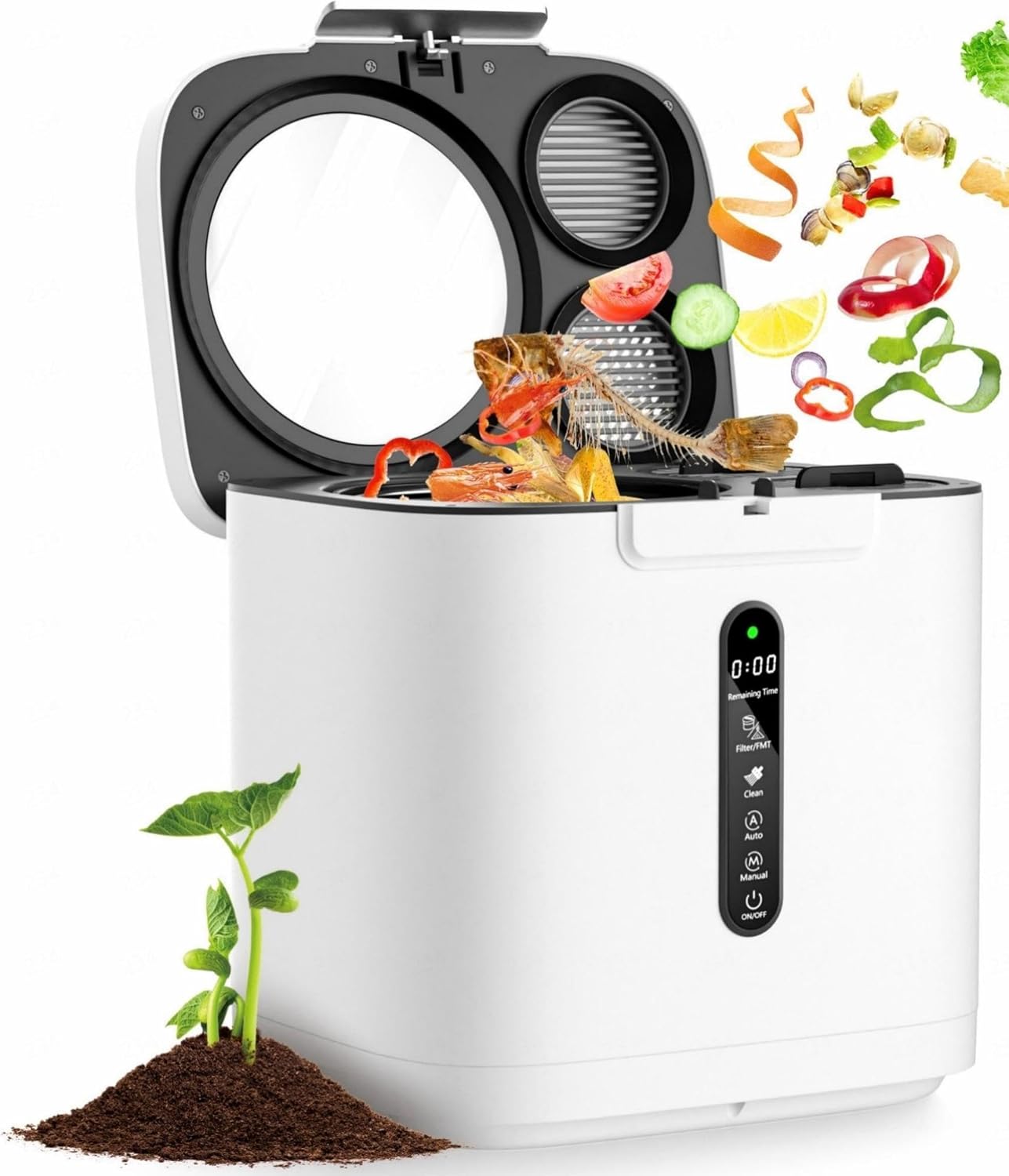
| Capacity | 4 liters |
|---|---|
| Material Type | Metal, Stainless Steel |
| Item Highlight | One-Touch Produces Dry Pre-Compost, LED Display, Odorless & Auto-Cleaning |
| Model Number | Fc-385w |
This Saluna 4L electric kitchen composter is designed for daily indoor use on a countertop to reduce food waste into a dry pre-compost product. It offers three programmable composting modes shown on an LED panel so you can set cycle time and monitor progress through the clear viewing lid without breaking the seal. Practical features include dual activated carbon filters for odor control, a removable stainless steel bucket that is dishwasher-safe, and a one-touch auto-cleaning rinse to simplify maintenance. The unit’s 4 liter capacity fits typical household scrap volumes for one to a few people but will require more frequent emptying in larger households. Because it concentrates material into a dry pre-compost rather than finished garden-ready compost, you will still need a backyard compost pile, worm bin, or municipal collection for final decomposition. The build appears aimed at durability with metal and stainless components, and the visible window and simple controls make it easy to integrate into a reliable kitchen routine.
Best for: A buyer who wants a dependable, low-fuss indoor system to reduce daily kitchen waste and prefers predictable, easy-to-use controls for routine composting.
Less Ideal for: Not well suited for households that need large-volume processing or gardeners who expect finished, soil-ready compost straight from the machine.
- Compact 4 L capacity suited to countertop placement and everyday kitchen scraps
- Three LED-controlled modes and visible lid let you monitor and customize cycles
- Dual activated carbon filters reduce kitchen odors during operation
- Removable stainless steel bucket is dishwasher-safe for easier cleaning
- One-touch auto-cleaning simplifies maintenance between uses
- 4 liter capacity requires frequent emptying for larger households or heavy cooking
- Produces dry pre-compost rather than finished compost, so further processing is needed
Verdict: Choose this compact electric composter if you want a reliable, low-maintenance countertop unit that turns daily scraps into dry pre-compost with straightforward controls and built-in odor control.
Epica Stainless Steel Countertop Compost Bin, 1.3 Gallon

| Capacity | 1.3 gallons |
|---|---|
| Material Type | Stainless Steel |
The Epica stainless steel compost bin is designed for daily kitchen use as a small, odor-controlled container for food scraps. It holds about 1.3 gallons, making it convenient to keep on a counter for several days of vegetable peels, coffee grounds, and other compostable scraps before transferring them to an outdoor pile or municipal collection. The stainless steel one-piece body resists rust and is easy to hand-wash, and the airtight lid plus activated charcoal filter significantly reduce smells. Filters are replaceable and typically last three to six months with regular use. Practical benefits include a durable finish that hides stains, a compact footprint for small kitchens, and simple maintenance routines that most users can follow. Important limitations are its small capacity, which means frequent emptying for larger households, and guidance to avoid composting meat, dairy, or diseased plants in this bin to prevent pests and bacteria. The product performs best as a countertop staging container rather than a primary long-term compost system.
Best for: Someone who wants a tidy, low-maintenance countertop solution to collect daily fruit and vegetable scraps before moving them to an outdoor compost or pickup service and who values odor control and durability.
Less Ideal for: Not well suited for families that produce large volumes of kitchen waste or for use as a primary composting system for meat and dairy disposal.
- Stainless steel construction resists rust and is easy to clean.
- Airtight lid combined with replaceable activated charcoal filter controls kitchen odors.
- Compact 1.3 gallon capacity fits easily on countertops in small kitchens.
- One-piece molded design reduces leak risk and simplifies washing.
- Small capacity requires frequent emptying for households that generate more scraps.
- Charcoal filters need periodic replacement or gentle rinsing to remain effective.
Verdict: Buy this if you want a compact, durable countertop bin that keeps kitchen scraps contained and largely odor-free before you move them to your main compost system.
Utopia Kitchen Countertop Compost Bin, 1.3 Gallon Stainless Steel

| Capacity | 4.92 liters |
|---|---|
| Material Type | Stainless Steel |
| Item Highlight | Odorless countertop compost bin with charcoal filter |
| Item Type Name | Kitchen Compost Bin for Kitchen Countertop – 1.3 |
This stainless steel countertop compost bin is designed for everyday kitchen use as a small, tidy container for food scraps until they move to an outdoor pile or municipal collection. It holds roughly 1.3 gallons, enough to collect a week of typical household fruit and vegetable peelings or coffee grounds for one to two people. The cylindrical stainless steel body looks neat on a counter and resists chips or cracks that plastic bins can show. A tight-fitting lid and replaceable charcoal filter reduce odors so you can keep the bin in the kitchen without noticeable smells for several days. Cleaning is straightforward: line with paper or rinse with mild soap as needed. The main limitations are capacity and active composting functions; this is a holding bin not a hot composter, so you still need to empty it regularly and manage moisture by draining liquids or using absorbent liners. If you need a larger or processing-capable unit this will not replace that role, but as a clean, low-maintenance countertop catcher it performs well.
Best for: Buyers who want a low-maintenance, odor-controlled way to collect daily kitchen scraps on the counter and prefer a durable, attractive container over hidden plastic buckets.
Less Ideal for: Households that generate large volumes of food waste or want a single device that actively processes compost rather than temporarily storing scraps.
- Stainless steel construction resists scratching and looks tidy on a countertop
- Charcoal filter and tight lid help control odors for several days
- Compact 1.3 gallon capacity fits small kitchens and does not take much prep-space
- Easy to clean by rinsing or lining with paper to absorb liquids
- Small capacity requires frequent emptying for larger households
- Does not accelerate decomposition or perform active composting
Verdict: A compact, durable countertop catcher with a charcoal filter that keeps kitchen scraps contained and largely odor-free for users who want simple, low-effort indoor compost storage.
Choosing the Right Indoor Compost Bin: Key Factors to Consider
Odor Control and Seal
Containing smells is the primary reason many people choose an indoor compost bin. A tight-sealing lid and internal gasket reduce fugitive odors, while carbon filters, charcoal pads, or other adsorption media capture volatile compounds before they reach the kitchen. Passive designs that combine a seal with a small venting system help avoid anaerobic pockets where strong odors develop.
Think about where you will keep the bin. A model with a replaceable filter can be refreshed periodically, while a completely sealed container may need more frequent emptying. Also consider how the lid locks and whether it will stay tightly closed when tipped or moved.
Size, Capacity, and Footprint
Indoor compost bins come in capacities from a few liters up to several gallons. Choosing the right size depends on how often you cook and whether you want to empty the bin daily, every few days, or once a week. A larger capacity reduces emptying frequency but takes more counter or cabinet space.
Measure the planned storage spot and allow clearance for opening the lid and lifting the container. Stackable or slim-profile designs can work in narrow spaces, while wider round bins might sit more stably on a solid countertop.
Ease of Emptying and Transfer
An indoor bin that is easy to empty encourages consistent use. Wide openings, removable inner buckets, and ergonomic handles make transferring scraps to an outdoor pile or municipal collection less messy. Some models include liners or compostable bags compatibility that can speed the transfer and reduce cleaning.
Also consider how the lid detaches and whether the inner container can be rinsed in a sink without splashing. Designs that minimize crevices and seams reduce stubborn residue and make routine washing straightforward.
Ventilation Design and Moisture Management
Proper airflow prevents anaerobic conditions and supports light drying of scraps, which minimizes smell and pests. Look for bins with designed vents and baffle systems that encourage passive circulation without releasing odors. Some indoor units use layered systems where a drying chamber or built-in tray separates wetter scraps from drier material.
Moisture control is also important because soggy leftovers decompose faster and smell worse. Models that allow draining or include absorbent inserts help keep the interior from becoming too wet. You should plan to add dry carbon-rich material or paper between wet scraps when needed.
Materials, Durability, and Ease of Cleaning
Indoor compost bins see frequent handling and exposure to acids and food residues, so durable materials matter. Stainless steel and thick, BPA-free plastics resist staining and odors better than thin, porous plastics. Smooth interior surfaces and removable components make cleaning faster and reduce long-term odor buildup.
Check whether seals, filters, and other wear parts are replaceable. A model that lets you access and clean the lid gasket, vents, and filter housing will perform better over time than one with permanently enclosed parts.
User Convenience Features
Small details can make daily composting much easier. Features like built-in carbon filter holders, removable inner buckets, pour spouts, or snap-lock lids speed routine tasks. A lightweight unit is easier to move to an outdoor compost pile or municipal bin on emptying day.
Consider whether the design works for your household routines. If you generate a lot of coffee grounds, for example, a bin with a wide opening helps. If you prefer low-maintenance setups, choose a model with a filter rather than one that requires frequent manual drying.
Best Places to Keep an Indoor Compost Bin
Choosing the right spot for an indoor compost bin reduces daily friction and helps control odor. Common locations are under the sink, on a counter near the prep area, tucked inside a lower cabinet, or on a balcony if weather and access allow. Under-sink placement hides the unit but needs enough clearance to open the lid and to carry the bin to an outdoor pile when full.
If you keep the bin on a countertop, pick a stable surface away from direct heat or sunlight, which can accelerate decomposition and odors. For cabinet storage, ensure the lid will not catch on the door and that the container is easy to lift out for emptying.
- Counter placement offers convenience for frequent cooking
- Under-sink keeps the bin hidden but needs easy removal
- Balcony or porch storage reduces indoor smells but requires weatherproofing
Managing Odors with Simple Habits
Even the best indoor bins benefit from simple habits that minimize smell. Layering food scraps with dry material like shredded paper, cardboard, or dried leaves reduces moisture and odor. Emptying the bin before it becomes overly full prevents anaerobic hot spots.
Rinse or wipe the interior regularly and replace or refresh carbon filters as recommended by the manufacturer. For short-term control, freezing very wet scraps like meat or fish in a small container until collection day can stop strong odors from developing indoors.
- Layer wet scraps with dry filler to reduce moisture
- Replace filters on a schedule and clean the interior
- Freeze high-odor items if immediate emptying is not possible
How to Transfer Indoor Scraps to Outdoor Compost
When your indoor bin is full, transfer the material to an outdoor bin, pile, or municipal collection receptacle. Use a removable inner bucket or a biodegradable liner to make the handoff cleaner. Hold the receiving container close and tip slowly to prevent spills.
If you have only raw kitchen scraps, bury them into the outdoor compost and add brown material to maintain a good carbon-to-nitrogen balance. For gardeners with limited outdoor space, consider community compost drop-off points.
- Use liners or removable buckets for tidy transfer
- Add dry brown material when moving scraps outdoors
- Tidy spilled bits immediately to avoid pests
Maintaining Filters and Replaceable Parts
Filters extend the useful life of an indoor compost bin but require periodic attention. Check filter housings for dust and residue, and replace carbon or charcoal pads according to frequency of use and manufacturer guidance. Some filters can be refreshed by brief airing, but most need replacement when saturated.
Keep spare gaskets or replacement pads on hand if you rely on a filter-heavy design. Regular checks of seals and vent openings prevent small failures from turning into larger odor problems.
- Inspect filters monthly in active kitchens
- Keep spare pads and gaskets available
- Clean vent passages to maintain passive airflow
Small Kitchen Composting Routines
Establishing a routine makes indoor composting predictable. Decide how often you will empty the bin and store a small outdoor transfer container nearby. If you cook daily, an every-2-to-3-day emptying schedule often balances convenience and odor control.
Label a spot for drying absorbent filler and keep a small scoop or tongs for transferring scraps. Consistency reduces smells and avoids letting the bin become an unpleasant chore.
- Empty every few days depending on scrap volume
- Store fillers and tools near the bin for quick access
- Adapt routine to seasonal changes in decomposition rate
How We Chose the Best Indoor Compost Bin
We focused on features that matter for indoor composting in small living spaces. Primary criteria included odor management, which covers filter systems, sealing lids, and passive airflow; capacity and footprint to ensure the unit fits typical counters, cupboards, or narrow balconies; ease of emptying and cleaning, since wet scraps and residue are common; materials and durability for regular kitchen use; and user convenience such as indicators, handles, or liners that simplify transfer to outdoor bins or pickup containers. We excluded large outdoor composters, insulated tumblers, and electrically powered continuous composters that are impractical for indoor counters or confined apartments. Items that lacked basic sealing or had poor build materials were also filtered out. The remaining selections scored well across the same concrete metrics so gardeners and urban composters can compare options on equal footing. Our scoring emphasized real-world daily use rather than lab-style decomposition speed testing.
FAQ
Can an indoor compost bin handle meat and dairy?
Meat and dairy decompose quickly and often produce strong odors and attract pests, so they are generally best avoided in small indoor bins. If you must dispose of them indoors, freeze those scraps until you can transfer them outdoors or use a tightly sealed unit with frequent emptying and a robust filter.
How often should I empty an indoor compost bin?
Frequency depends on household size and the bin capacity. Many households find emptying every two to four days keeps odors manageable. If your bin is small or you generate a lot of wet scraps, emptying daily may be necessary.
Do indoor compost bins require special liners or bags?
Some indoor units are compatible with compostable liners or small biodegradable bags which make transfer cleaner. Liners are optional but helpful for wet or sticky scraps. Avoid regular plastic bags that will not break down in a compost system if you plan to compost the contents.
Will a carbon filter eliminate all odors?
Carbon filters reduce many volatile compounds but rarely eliminate every smell on their own. Filters work best in combination with good sealing, frequent emptying, and moisture control. Replace filters when they become saturated to maintain effectiveness.
Can I use a kitchen bin as an indoor compost bin?
A general kitchen waste bin can be used in a pinch, but purpose-built compost bins have features that control moisture and odor better, such as vents, filter housings, and removable inner containers. If you repurpose a bin, add absorbent material and clean it frequently.
Final Verdict
Selecting an indoor compost bin is about balancing capacity, odor control, and practical daily use. Prioritize a model with good sealing and either effective passive ventilation or a replaceable filter if you compost indoors regularly. Match the bin size to how often you are willing to empty it and choose materials that are easy to clean. Tradeoffs are inevitable: larger bins reduce emptying frequency but take up more space, while smaller units require more attention but fit compact kitchens. Focus on the criteria discussed earlier and pick the combination of footprint, odor management, and ease of transfer that fits your routine.
