

Note: This article contains affiliate links. If you click on these links and make a purchase, I may earn a small commission at no extra cost to you. This helps support my research and content. Read my full affiliate disclosure here.
If you want finished compost faster, the right fast compost bin makes a big difference. Heat retention, airflow, and the ability to turn or tumble material influence how quickly microbes do their work, and those features behave differently in a backyard, balcony, or community garden. This guide covers our six top shortlisted fast compost bins and explains how we judged them. You will get clear information on the features that speed decomposition, practical setup and placement advice, and what to expect for maintenance and finished compost quality. Read on to see which designs fit your space and routine.
Top Picks at a Glance
| Best Overall The best all-around choice for most situations | Maygrove 53 Gallon Dual-Chamber Compost Tumbler with 360° Rotation |  |
| Best Quality Built to a higher standard if you want something more solid | Miracle-Gro Dual Chamber Compost Tumbler (2 × 18.5 gal) |  |
| Best Value The sweet spot between price and what you get | F2C 43‑Gallon Dual‑Chamber Rotating Compost Bin with Steel Frame |  |
| Best Budget The cheapest option that still gets the job done reliably | Saicool 43-Gallon Dual-Chamber Rotating Compost Tumbler with Sliding Door |  |
| Highest Rated A top-rated pick with lots of positive feedback | FCMP Outdoor IM2000 Tumbling Composter (22.5 gal) |  |
| Most Popular A crowd favorite that many people choose with confidence | VIVOSUN Outdoor Tumbling Composter, Dual-Chamber 43 Gallon |  |
Maygrove 53 Gallon Dual-Chamber Compost Tumbler with 360° Rotation

| Capacity | 53.01 gallons |
|---|---|
| Material Type | Polypropylene (PP) |
| Style | Cylindrical |
This Maygrove compost tumbler is built for gardeners who want faster, easier composting without constant manual turning. The drum rotates 360 degrees on a strong steel frame and includes built-in mixing bars and an ergonomic gear-assisted handle, so you simply spin the barrel to mix materials and accelerate decomposition. Dual chambers let you add fresh scraps to one side while the other side finishes, which supports near-continuous compost production and reduces the need to pause between batches. Adjustable air vents and a sliding-door design help control moisture and loading or harvesting, and the UV-resistant polypropylene drum with reinforced legs is intended to withstand outdoor conditions. Assembly is mostly snap-together with a few screws, so setup is quick for most users. Limitations are typical of compact tumblers: capacity is moderate for larger households or heavy landscapers, and plastic parts may eventually show wear in very hot or cold climates compared with all-metal units.
Best for: Gardeners who want quicker, low-effort compost for flower beds or vegetable plots and value continuous output without frequent manual turning.
Less Ideal for: People who need very large-volume composting or who prefer industrial-strength all-metal systems for extreme durability should consider other options.
- Dual-chamber design supports continuous composting by allowing loading on one side while the other cures
- 360° rotating drum with internal mixing bars and gear-assist handle for easy turning and faster breakdown
- Adjustable vents let you manage airflow and moisture to reduce odors and speed decomposition
- UV-resistant polypropylene drum with a steel frame and reinforced legs for outdoor durability
- Moderate total capacity may be insufficient for very large gardens or heavy organic waste producers
- Plastic construction could wear faster than all-metal alternatives in extreme climates
Verdict: A user-friendly dual-chamber tumbler that speeds up backyard composting with easy rotation and continuous operation.
Miracle-Gro Dual Chamber Compost Tumbler (2 × 18.5 gal)

| Capacity | 37 gallons |
|---|---|
| Material Type | Alloy Steel (frame) and UV-protected plastic (barrel) |
This dual-chamber Miracle-Gro tumbler is a user-friendly solution for gardeners who want a steady supply of finished compost without manual turning. Each chamber holds 18.5 gallons, so you can load one side while the other finishes curing; the barrel rotates on a galvanized steel frame for easy turning and faster aeration. The molded, UV-protected plastic and side-locking seals are designed to resist weather and help keep pests out, and the maker claims finished compost in roughly 4 to 6 weeks under good conditions. Typical use is adding balanced green and brown materials, rotating the tumbler every few days, then unlocking the sliding door to remove cured compost. Practical benefits include reduced physical labor compared with pile turning and a continuous workflow from dual chambers. Limitations to note are modest total capacity for very large gardens and reliance on correct moisture and feedstock balance to hit the faster decomposition times; very cold winters will slow processing. Assembly and placement on a level spot are important for smooth rotation.
Best for: Gardeners who value steady, low-effort compost production backed by a well-known brand and want the assurance of a proven dual-chamber system for regular use.
Less Ideal for: People needing very large-volume commercial composting or those who prefer an open windrow or in-ground hot compost system for maximum throughput.
- Dual-chamber design lets you add fresh material while another batch cures for continuous compost supply
- Rotating barrel on a galvanized steel frame makes aeration easy with minimal physical effort
- UV-protected plastic and tight side locks help resist weather and reduce pest access
- Produces finished compost relatively quickly when fed and moistened correctly
- 37-gallon combined capacity may be small for very large or heavy-production gardens
- Performance depends on proper moisture, material mix, and ambient temperature to reach claimed speed
Verdict: Choose this dual-chamber tumbler if you want a simple, low-labor way to produce a steady stream of finished garden compost with reliable pest protection.
F2C 43‑Gallon Dual‑Chamber Rotating Compost Bin with Steel Frame

| Capacity | 43 gallons |
|---|---|
| Material Type | PP and powder-coated steel |
This F2C 43‑gallon dual‑chamber tumbler is built to make backyard composting more efficient and less fussy. The two separate chambers let you keep finished compost on one side while adding fresh scraps to the other, so you do not need to wait to harvest usable material. The barrel has aeration holes and internal fins to break up clumps and introduce oxygen while the black exterior helps absorb heat to speed decomposition. Assembly is straightforward with included hardware and basic tools, and the powder‑coated steel frame plus interlocking PP panels provide decent stability when spinning. The sliding access doors make it simple to add or remove material without disassembling the barrel. Expect faster results than a stationary bin, but plan to turn the tumbler and monitor moisture for best performance. It is compact enough for typical yards but not suited for large-scale or heavy wet loads, and moving a full chamber requires effort despite the rotating design.
Best for: Home gardeners who want a compact, efficient system to speed backyard composting and prefer a practical setup that reduces downtime between batches.
Less Ideal for: People managing large quantities of yard waste or those who need a low‑effort, stationary hot compost system for commercial or very large‑scale beds.
- Dual chambers let you harvest finished compost while continuing to add new material
- Aeration holes and internal fins improve oxygen mixing and reduce clumping
- Powder‑coated steel frame with interlocking PP panels gives stable construction
- Sliding doors provide easy access for adding scraps and removing finished compost
- Rotating a full chamber can be physically demanding for some users
- Capacity (43 gallons) may be small for very large gardens or heavy organic waste streams
Verdict: Choose this dual‑chamber rotating tumbler if you want a space‑saving, faster backyard composter that lets you produce usable compost more continuously.
Saicool 43-Gallon Dual-Chamber Rotating Compost Tumbler with Sliding Door

| Capacity | 43 gallons |
|---|---|
| Material Type | PP, Steel |
This Saicool tumbler is a simple, budget-minded option for gardeners who want faster compost without continual turning by hand. The unit uses a dual-chamber drum that lets you load one side while the other matures, and the tumbling action improves aeration and mixing so kitchen scraps and yard waste break down more quickly than in a static bin. A sliding door and latch make adding and removing material straightforward, and the plastic drum with a steel frame and UV protection is intended to withstand outdoor conditions. At 43 gallons it handles a modest weekly volume for an average household and is best placed on level ground for easy rotation. Be aware it is a basic design without insulation or advanced airflow controls, so performance will vary with temperature and how well materials are balanced. For gardeners focused on getting usable compost sooner on a limited budget, this tumbler delivers practical, hands-on results.
Best for: Gardeners who want faster composting than a static bin but need an affordable, low-effort solution for household kitchen scraps and moderate yard waste.
Less Ideal for: Large-scale gardeners or those who need year-round rapid composting in cold climates should consider larger or insulated systems with forced aeration.
- Dual-chamber design allows continuous composting cycles without interrupting a curing batch
- Tumbling action improves aeration and speeds decomposition compared with stationary bins
- UV-protected plastic drum and steel frame increase outdoor durability
- Sliding door and secure latch make loading and removing compost quick and tidy
- No insulation or active airflow features, so cold-weather performance is limited
- 43-gallon capacity may be small for very large gardens or heavy weekly waste
Verdict: If you want quicker, hands-off compost on a budget, this dual-chamber 43-gallon tumbler gives continuous batches with minimal effort.
FCMP Outdoor IM2000 Tumbling Composter (22.5 gal)

| Capacity | 22.5 gallons |
|---|---|
| Material Type | Polypropylene (PP) |
| Model Number | IM2000 |
The FCMP Outdoor IM2000 is a compact tumbling composter that lets you mix kitchen scraps and yard trimmings without turning a pitchfork. Its single rotating chamber and deep fins give good aeration and make manual tumbling straightforward—turn the drum several times every few days to speed decomposition. The large door and removable access make loading and harvesting finished compost easy for beginners, and the body is made from UV-inhibited, post-consumer recycled polypropylene so it resists weathering and avoids rust. A galvanized steel frame adds structural support but the unit is light enough to move if needed. Because capacity is about 22.5 gallons, it is best for small households or gardeners who compost in batches rather than large-volume producers. Expect faster results in warm, active piles; cold or very wet climates will slow breakdown. Assembly and regular turning are required to get the two-week turnaround quoted under ideal conditions.
Best for: Best for pragmatic gardeners who want a low-fuss way to produce small, frequent batches of compost without manual digging and who value recycled materials and straightforward operation.
Less Ideal for: Not a good fit for gardeners who need to process large volumes of yard waste or want a passive, no-turn composting system.
- Easy tumbling design speeds mixing and improves aeration
- Large opening and removable door simplify loading and harvesting
- Made from 100% post-consumer recycled, UV-inhibited polypropylene for durability outdoors
- Galvanized steel frame provides sturdy support while keeping overall weight low
- Relatively small 22.5 gallon capacity not suited for large families or heavy yard waste producers
- Performance depends on consistent turning and warm conditions to achieve fastest compost times
Verdict: A compact, easy-to-use tumbling composter that delivers faster, well-aerated compost for small-scale gardeners who want efficient, repeatable results.
VIVOSUN Outdoor Tumbling Composter, Dual-Chamber 43 Gallon
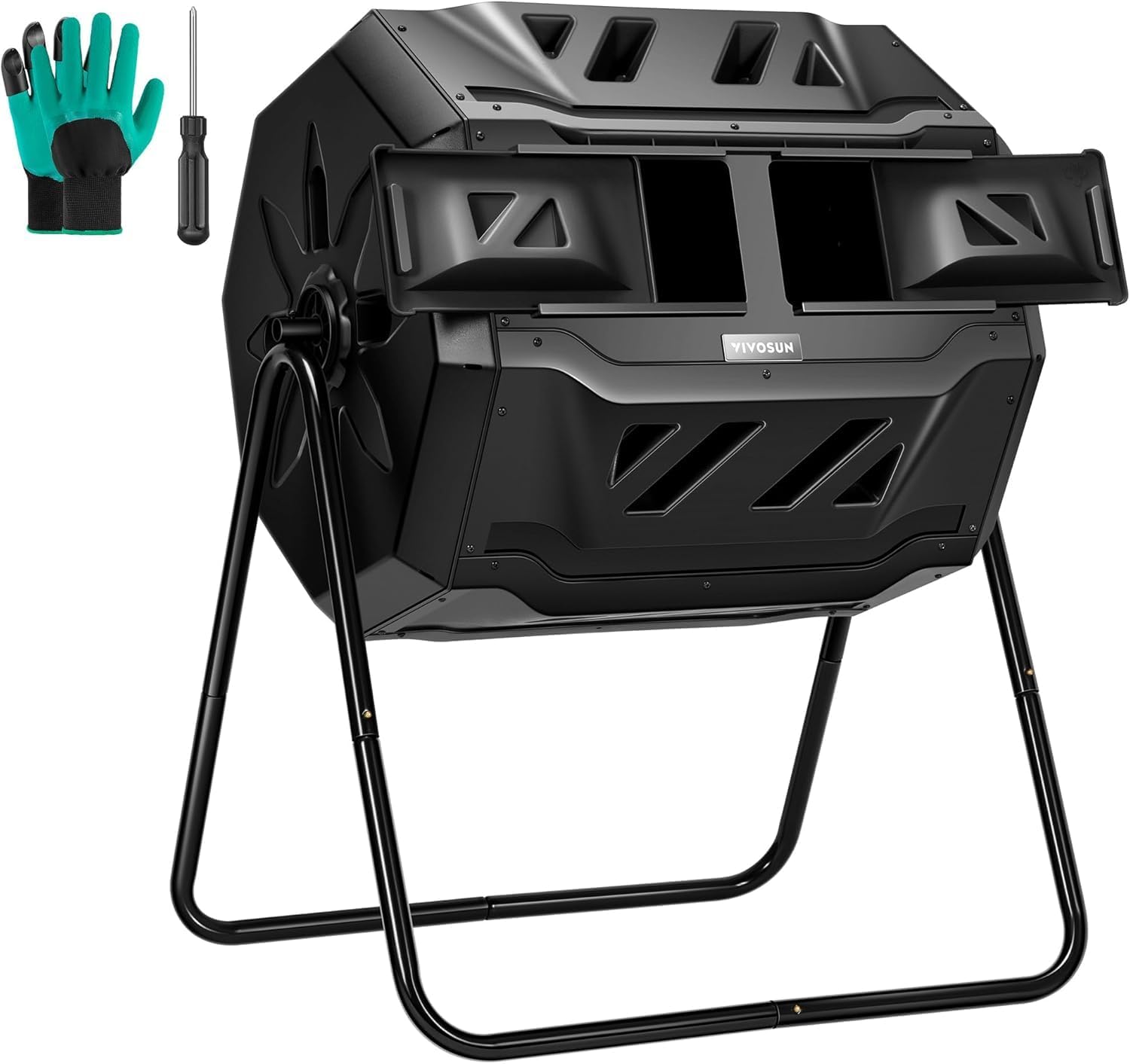
| Material Type | galvanized steel |
|---|---|
| Capacity | 43 gallons |
This VIVOSUN tumbling composter is a practical backyard unit built around two rotating chambers so you can add fresh waste to one side while the other finishes breaking down. The 360 degree tumbling design with deep internal fins makes turning the pile simple and helps break up clumps without digging. Ventilation slots around the drum promote airflow for aerobic decomposition, and the metal frame with a PP plastic barrel is designed to resist corrosion and outdoor weathering. It comes with waterproof garden gloves and small digging claws to make loading and aerating easier. At 43 gallons it is sized for a family garden or vegetable patch but is compact enough for a patio or small yard. Limitations to note are that it requires occasional manual turning to maintain activity and that the plastic drum means it will warm less in cold climates than insulated models, so composting speed will vary by season. Assembly and placement on a level spot are also important for smooth rotation.
Best for: Gardeners who want a hands-on, efficient system to produce regular batches of compost without digging a pile and who prioritize continuous output and easy turning.
Less Ideal for: People who need a completely hands-off hot composter or who compost only very large volumes; those in very cold climates seeking year-round rapid breakdown should consider insulated or electric options.
- Dual chambers let you load new material while another batch finishes, ensuring continuous compost production
- 360 degree tumbling with deep fins makes mixing and aeration easy without manual digging
- Galvanized steel frame and PP plastic barrel designed for outdoor durability and corrosion resistance
- Ventilation slots support aerobic breakdown for faster, less smelly composting
- Plastic drum offers less insulation than insulated or fully metal units, slowing composting in cold weather
- Requires manual turning and regular management to maintain heat and moisture for fast results
Verdict: If you want steady, manageable batches of compost with easy tumbling and continuous use, this dual-chamber VIVOSUN tumbler delivers practical, durable performance.
Choosing the Right Fast Compost Bin: Key Factors to Consider
Heat Retention and Insulation
How a bin traps and maintains heat determines whether it reaches thermophilic temperatures that speed microbial activity. Insulated walls, darker outer finishes, or compact shapes can raise internal temperature, but over-insulating without proper airflow can create anaerobic pockets.
Consider how your climate interacts with insulation. In cool, wet regions you need better heat retention to get fast breakdown, while in hot climates excessive insulation can dry material and slow decomposition. The bin's size relative to your waste stream matters because too-small volumes cool quickly and too-large volumes are hard to manage.
Airflow and Aeration
Oxygen supply drives aerobic decomposition, which is faster and less smelly than anaerobic breakdown. Look for designs with vents, perforated cores, or rotatable drums that maintain exchange without letting material fall out.
Placement of vents matters; low-level intake and higher exhaust help convective flow. Also check whether airflow openings are protected from rain to avoid waterlogging, which reduces oxygen and slows the process.
Turning Mechanism and Ease of Mixing
Regular turning redistributes moisture and oxygen and breaks up clumps so microbes work evenly. Tumblers, rotating cages, and removable inner cages simplify turning compared with static bins that require pitchfork work.
Evaluate how easily the mechanism operates when the bin is full. Smooth, balanced rotation reduces strain and encourages frequent turning, which directly speeds composting. Mechanisms that seize when wet or require awkward leverage hinder maintenance and slow results.
Access to Finished Compost
Quick access to finished material matters if you want to use compost regularly. Bottom-removal doors, sliding trays, and separate collection chambers let you harvest finished compost without dismantling the active pile.
Consider how much sifting you will do; fine textured compost often requires screening. A design that allows layering and staged curing speeds readiness for use while keeping fresh inputs separate.
Capacity and Footprint
A bin that is too small means frequent transfers or slower heating due to small mass. Too large a unit can be hard to turn and manage. Choose a capacity that matches your household green and brown waste output.
Also factor in physical footprint for a small yard or patio. Some fast systems use vertical stacking to save ground space while maintaining volume. Ensure there is clearance for turning, accessing doors, and routine maintenance.
Material Durability and Weather Resistance
Materials determine how long the bin will last under sun, rain, and freezing cycles. UV-stabilized plastics, powder-coated steel, and rot-resistant composites are preferable for outdoor use.
Fast composting stresses components through heat and repeated movement, so check for robust fasteners and rotors rated for wet conditions. Corrosion or brittle cracking will reduce airflow and turning performance over time.
Optimizing Location and Microclimate
Placement affects compost speed almost as much as the unit itself. Position the bin in a spot that gets some sun for part of the day to encourage internal heating, but avoid sites with full midday glare that can dry material out. A level, well-drained base prevents water pooling around the unit and reduces the chance of cold spots.
Keep the bin within reach of kitchen scraps and yard waste to make regular feeding easier. If you have a patio or balcony, choose a compact vertical or tumbler design and shield vents from direct rain while allowing airflow. For cold-season composting, consider insulating the base or locating the bin near a warm structure to preserve heat.
- Partial sun exposure boosts microbial activity without overdrying compost.
- Elevate or place on gravel to improve drainage and airflow under the unit.
- Leave enough clearance for turning mechanisms and door access.
Feeding Strategy for Faster Results
Particle size, moisture balance, and the carbon-to-nitrogen ratio are the practical levers gardeners control to speed decomposition. Chopping or shredding woody materials and green waste increases surface area and accelerates microbial colonization.
Aim for a texture similar to coarse soil and keep the pile as moist as a wrung-out sponge. Alternate layers of nitrogen-rich greens and carbon-rich browns to maintain balance. In fast systems use smaller, regular additions and turn more frequently to maintain heat and oxygen.
- Chop bulky materials before adding to reduce breakdown time.
- Monitor moisture with a simple squeeze test and add water or dry material as needed.
- Turn every few days in tumblers or at least once a week in static systems.
Managing Odors and Pests
Proper aeration, balanced feedstock, and prompt covering of food scraps minimize odors. Fast aerobic systems tend to be less smelly when operated correctly because heat and oxygen favor organisms that do not produce foul gases.
To deter rodents and flies, avoid leaving exposed food on top of the pile and use secure lids and fine-mesh vents. If pests are a recurring problem, consider adding a top layer of coarse carbon material or using designs with sealed chambers to block access.
- Keep meat and dairy out of home composts to reduce pests and odors.
- Cover fresh food scraps with a dry carbon layer to absorb moisture and smell.
- Secure vents with mesh to keep insects and rodents out while preserving airflow.
Seasonal Care and Continuous Operation
Composting behavior shifts with the seasons. In winter microbial activity slows, so maintaining heat becomes the priority. Insulating the bin, adding larger batches to increase mass, and concentrating turning sessions help preserve temperature.
In summer monitor moisture more frequently to prevent drying. A fast compost bin can run year-round with adjustments to feeding frequency, particle size, and turning rhythm. Staged or multi-chamber systems help maintain continuous output by letting one batch cure while another is active.
- Add extra material in fall to build a reserve for winter decomposition.
- Reduce turning in very hot, dry spells to avoid excessive drying.
- Use staged chambers if you need steady, continuous compost supply.
How We Chose the Best Fast Compost Bin
We focused on features that directly affect how quickly organic matter breaks down and how practical a system is for everyday garden use. Our selection filters prioritized proven thermophilic action, ventilation and aeration methods, and mechanisms that make mixing or tumbling straightforward. We also weighed durability in outdoor conditions and the unit's footprint for small yards or patios. Ease of maintenance and access to finished compost were key editorial screens to ensure realistic long-term use. Specifically, we evaluated heat retention and insulation strategies, the effectiveness and placement of vents or aeration ports, and whether turning mechanisms encourage rapid, even decomposition. Build materials and fasteners were assessed for resistance to moisture and UV exposure, and access design was judged on how easily gardeners can remove finished compost without disturbing active material. We excluded units that rely solely on chemical additives or that require specialized power sources. Items with poor access or unclear aeration were not considered. Our final picks reflect a balance of rapid breakdown, manageable maintenance, and durability for typical home garden conditions.
FAQ
How often should I turn a fast compost bin?
Often. Tumblers and actively managed fast bins benefit from turning every few days to a week to maintain heat and oxygen. Static bins can be turned less frequently but will compost more slowly.
What mix of materials speeds composting?
A balanced mix of greens (kitchen scraps, fresh grass clippings) and browns (shredded leaves, straw, cardboard) speeds decomposition. Aim for varied particle sizes and keep moisture similar to a wrung-out sponge.
Can I compost on a small patio or balcony?
Yes. Choose a compact tumbler or vertical fast system with secure vents and a contained footprint. Keep it stable, shield vents from rain, and avoid adding excessive wet food scraps that attract pests.
Will a fast compost bin smell more than a regular bin?
Not if managed correctly. Fast aerobic systems actually reduce odors because heat and oxygen favor non-odorous microbes. Odors usually indicate poor aeration, excess moisture, or inappropriate inputs.
How do I know when compost is finished?
Finished compost is dark, crumbly, and earthy-smelling with no recognizable food or yard waste. It will cool down and no longer produce heat when turned. If unsure, allow an extra curing period before use.
Can I compost meat or dairy in a fast bin?
Usually not recommended for home systems. Meat and dairy attract pests and can create anaerobic pockets that slow overall decomposition. If you choose to add them, use a sealed system and monitor closely for odors and pests.
Final Verdict
Fast compost bins accelerate the breakdown of organic waste when you pair the right design with an active management routine. Prioritize insulation and airflow, a reliable turning method, and easy access to finished material when selecting a system for a small yard or patio. Expect tradeoffs between capacity and ease of handling: larger volumes hold heat longer but require more effort to mix. Focus on matching bin size to how much green and brown material you produce, and adopt a feeding and turning schedule that preserves both moisture and oxygen. With those priorities in mind you can get finished compost faster and more consistently for garden use.
