

Note: This article contains affiliate links. If you click on these links and make a purchase, I may earn a small commission at no extra cost to you. This helps support my research and content. Read my full affiliate disclosure here.
A lush, uniformly green lawn starts with the right fertilizer and a plan that matches your grass type and climate. Choosing an appropriate fertilizer for green lawn affects more than color: it influences root depth, disease resistance, and water needs. This guide covers the top shortlisted fertilizers for green lawn situations and explains the practical tradeoffs you will face, from fast-acting nitrogen boosts to slower-release blends that support steady growth. Below we outline the evaluation factors used, summarize what matters in application, and present the top options gardeners commonly choose for a consistently green turf. Read on to match a fertilizer approach to your mowing, irrigation, and soil conditions.
Top Picks at a Glance
| Best Overall The best all-around choice for most situations | Scotts Turf Builder Lawn Food, 12.5 lb |  |
| Best Quality Built to a higher standard if you want something more solid | The Andersons Professional PGF Complete 16-4-8 Fertilizer with Humic (40 lb) |  |
| Best Value The sweet spot between price and what you get | Scotts Green Max Lawn Food (16.67 lb) |  |
| Best Budget The cheapest option that still gets the job done reliably | Jonathan Green Veri-Green Starter Fertilizer for Seeding & Sodding, 1,500 Sq Ft |  |
| Highest Rated A top-rated pick with lots of positive feedback | Scotts Green Max Lawn Food with Iron, 46.67 lb | 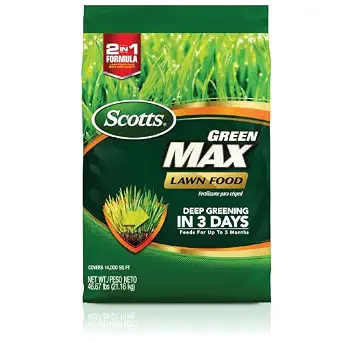 |
| Most Popular A crowd favorite that many people choose with confidence | Scotts Turf Builder WinterGuard Fall Lawn Food, 10 lb. |  |
Scotts Turf Builder Lawn Food, 12.5 lb

| Item Form | Powder |
|---|---|
| Specific Uses For Product | Lawn |
| Coverage | 5,000 sq. ft. |
| Mixing Ratio | 32:0:4 |
Scotts Turf Builder Lawn Food is a general-purpose granular fertilizer formulated for use on any grass type to thicken turf and improve root strength. You spread it with a broadcast or drop spreader (Scotts provides recommended settings) and can apply it to wet or dry lawns in spring, summer, or fall. The formula is pesticide-free and emphasizes building deeper roots so the lawn better absorbs water and nutrients, which helps turf resist stress over the season. One 12.5 lb bag covers about 5,000 sq. ft., making it a simple option for small to medium yards or spot treatments. Practical benefits include clear application guidance, compatibility with common spreaders, and the option to water in for faster greening. Limitations are that this single bag covers a modest area compared with larger homeowner bags and it does not include weed control or insect protection, so you may need additional products for comprehensive lawn care.
Best for: Buyers who want a reliable, easy-to-apply granular fertilizer to strengthen and green a small to medium lawn and prefer products with widespread user approval and clear instructions.
Less Ideal for: Homeowners needing one-step weed or pest control, or those with large properties who want a single bag to cover many thousands of square feet.
- Works on all common grass types so one product fits mixed lawns
- Builds stronger, deeper roots to improve water and nutrient uptake
- Clear spreader settings and can be applied to wet or dry turf for flexibility
- Pesticide-free formula suitable when you only want fertilization
- Covers only about 5,000 sq. ft. per bag, requiring multiple bags for larger yards
- Does not include weed or insect control so additional products may be needed
Verdict: A reliable, easy-to-use granular lawn food that builds stronger roots and is a solid choice for feeding small to medium lawns.
The Andersons Professional PGF Complete 16-4-8 Fertilizer with Humic (40 lb)

| N-P-K | 16-4-8 |
|---|---|
| Item Form | Granules |
| Specific Uses For Product | Lawn Care |
| Target Species | lawn grasses |
| Coverage | 40 |
This 40 lb bag of The Andersons Professional PGF Complete is a granular 16-4-8 lawn fertilizer designed to deliver both immediate and extended feeding for turf. It combines quick- and slow-release nitrogen so you get a mid-season green-up plus continued nutrition for up to eight weeks, while iron and micronutrients help deepen color. The super-fine particle size promotes even spread when applied with a broadcast or drop spreader and the included humic DG supports soil biology and nutrient uptake. Typical use is a spring application on established cool-season grasses like fescue, followed by watering to activate the granules. Practical benefits are consistent coverage, longer feeding intervals between applications, and visible color improvement. Important limitations are the strong safety warnings for eye and skin irritation and that the 16-4-8 ratio is a high-nitrogen formula best suited for growth and color rather than slow, low-nitrogen maintenance. It is not formulated for sale in certain states and requires careful handling and correct spreader settings to avoid overapplication.
Best for: Gardeners who prioritize strong, visible spring performance and want a product that delivers both immediate and sustained feeding for established fescue lawns.
Less Ideal for: People managing newly seeded turf, low-nitrogen maintenance programs, or those who prefer organic fertilizers should consider gentler or alternative products.
- Balanced quick- and slow-release nitrogen delivers immediate green-up plus up to eight weeks of feeding
- Includes iron, micronutrients, and humic DG to improve color and nutrient uptake
- Super-fine granules enable more even distribution with a spreader
- Large 40 lb bag covers significant lawn area between applications
- Causes skin, respiratory and serious eye irritation and requires protective handling
- High nitrogen ratio may be too strong for fine maintenance or newly seeded lawns
Verdict: Choose this product when you want a performance-focused spring fertilizer that gives fast green-up plus extended feeding for established fescue.
Scotts Green Max Lawn Food (16.67 lb)

| Item Form | Granules |
|---|---|
| Coverage | 5000 square feet |
| Specific Uses For Product | Lawn |
| Target Species | lawn grass |
Scotts Green Max Lawn Food is a granular, all-purpose lawn fertilizer formulated to deliver fast greening with a 2-in-1 feed plus 5% iron supplement. It is applied with a broadcast or drop spreader to any grass type and is recommended for routine spring, summer, or fall applications. Notable features include a guaranteed nonstaining formula when used as directed and settings provided for Scotts spreaders to help get an even application across the advertised 5,000 sq ft coverage. The iron content speeds visible greening in as little as three days and the granules are ready to water in for faster uptake. For a risk-averse homeowner growing fescue in spring, the product is straightforward to use and safe to re-enter the lawn immediately after application. Limitations are that proper spreader settings and sweeping up excess product are important to avoid runoff and that it is a general lawn food rather than a specialized product for nutrient-deficient soils, so a soil test is still useful for targeted corrections.
Best for: Homeowners who want a low-risk, easy-to-apply lawn food that produces quick green results on fescue lawns in spring and prefer established brand guidance for application.
Less Ideal for: Gardeners seeking a product to correct a specific nutrient imbalance or those who prefer liquid or organic-only fertilizing approaches.
- Includes 5% iron for faster, deeper greening visible in about three days
- Premeasured granular form covers up to 5,000 sq ft from one bag
- Manufacturer provides spreader settings to simplify even application
- Formulated not to stain concrete or driveways when used as directed
- Not a tailored corrective fertilizer for specific soil deficiencies
- Requires correct spreader settings and cleanup to prevent runoff
Verdict: A simple, fast-acting granular lawn food with added iron that reliably greens fescue lawns when applied with a spreader.
Jonathan Green Veri-Green Starter Fertilizer for Seeding & Sodding, 1,500 Sq Ft

| N-P-K ratio | 12-18-8 |
|---|---|
| Application method | Spreader |
| Form | Granules |
| Coverage | 1,500 sq ft |
| Included components | Grass Seed, Plant Fertilizer |
Jonathan Green Veri-Green Starter Fertilizer is a granular lawn starter designed to be applied the same day as seeding or sodding to help new grass establish quickly. It delivers a 12-18-8 N-P-K blend that emphasizes phosphorus for root development and includes humates and micronutrients to improve nutrient availability. Use it with a rotary, drop, or handheld spreader over the area being seeded; a 5 lb bag covers up to 1,500 sq ft and feeds seedlings for roughly two months. Practically, this product speeds germination, encourages deeper roots, and helps new grass withstand early stressors like temperature swings and light drought. Its granule form is easy to apply and safe for kids and pets to re-enter the lawn after treatment. The main limitations are coverage and longevity for larger projects since a single 5 lb bag suits only small yards or spot repairs, and it is specifically a starter fertilizer so additional feeding with a general lawn fertilizer will be needed later in the season.
Best for: Homeowners who need an affordable, purpose-built starter fertilizer for seeding, overseeding, or laying sod on small lawns or repair patches and who prioritize quick germination and strong root development.
Less Ideal for: People caring for large properties or seeking a season-long all-purpose fertilizer should consider larger coverage or multi-application products instead.
- High-phosphorus 12-18-8 formula targeted to promote seed germination and root growth
- Granular form works with rotary, drop, or handheld spreaders for even application
- Includes humates and micronutrients to improve nutrient uptake and early vigor
- Feeds new grass for up to two months, supporting initial establishment
- 5 lb bag only covers about 1,500 sq ft so multiple bags are needed for larger lawns
- Designed as a starter fertilizer so it does not replace regular seasonal feedings
Verdict: A cost-effective, phosphorus-rich starter fertilizer that speeds germination and builds strong roots for new or repaired lawns up to 1,500 sq ft.
Scotts Green Max Lawn Food with Iron, 46.67 lb

| Item Form | Granules |
|---|---|
| Target Species | Lawn Grass |
| Item Highlight | Lawn Fertilizer plus Iron Supplement |
Scotts Green Max Lawn Food is a granular, dual-action lawn fertilizer that combines balanced NPK nutrition with a 5% iron supplement to promote faster greening. It is applied with a broadcast or drop spreader and can be used in spring, summer, or fall on any grass type; Scotts provides spreader settings for consistent application. The iron content speeds up visible green color in about three days, and the formula is formulated not to stain concrete or driveways when used as directed. A single 46.67 lb bag covers up to 14,000 sq ft, making it practical for mid-to-large yards and routine seasonal treatments. Practical benefits include reliable, predictable results when you follow spreader settings and light watering after application, plus no required re-entry time for people or pets. Limitations are that it is a general-purpose granular fertilizer rather than a targeted treatment for specific nutrient deficiencies, and application requires a spreader and proper calibration to avoid uneven feeding.
Best for: Homeowners who prioritize dependable, fast visual greening across medium to large lawns and want a low-effort seasonal fertilizer that gives predictable results when applied as directed.
Less Ideal for: Gardeners seeking a corrective soil-specific program or slow-release nutrient management for lawns with known deficiencies should consider more targeted products or a soil test first.
- Includes 5% iron for faster visible greening within days
- Large coverage: one bag treats up to 14,000 sq ft
- Formulated not to stain concrete or driveways when used as directed
- Suitable for use on any grass type across spring, summer, or fall
- Not a specialty formula for correcting specific nutrient or soil pH issues
- Requires a spreader and correct settings for even application
Verdict: Choose this fertilizer if you want a reliable, fast-acting granular product that produces deep greening across a large lawn with minimal fuss.
Scotts Turf Builder WinterGuard Fall Lawn Food, 10 lb.

| Item Form | Granules |
|---|---|
| Specific Uses For Product | Lawn Fertilizer |
| Application Method | spread |
| Coverage | 4000 |
| Target Species | lawn grasses |
Scotts Turf Builder WinterGuard is a granular fall lawn food designed to build strong, deep roots and help turf recover from summer heat, drought, and regular wear. It is applied with a broadcast or drop spreader over a lawn in autumn and can be used on any grass type. The bag covers about 4,000 sq. ft., and the package directions include recommended spreader settings and note that watering-in is optional for fast results. In practice this product provides a straightforward, DIY-friendly way to add nutrients before winter; the granules are easy to spread and work with standard spreaders. Notable features are its all-grass compatibility and clear application guidance. Limitations are that it is a single-season bag sized for small to medium yards and it does not include weed or insect control functions found in some other Scotts formulas, so you may need additional products if those issues are a concern. For homeowners wanting a simple autumn boost to root strength, this is an effective, no-frills option.
Best for: Homeowners who want a simple, reliable fall fertilizer to strengthen roots and help lawns recover from summer stress without complicated application steps.
Less Ideal for: People managing large lawns who need wide-coverage bulk fertilizer or those who want combined weed or insect control in the same product.
- Formulated specifically for fall to build deep, winter-ready roots
- Works on all grass types so it fits mixed lawns
- Clear application instructions and spreader settings for easy DIY use
- Covers 4,000 sq. ft. from a single 10 lb. bag for small to medium yards
- No built-in weed or insect control so additional products may be needed
- Single 10 lb. bag may be small for larger properties
Verdict: Choose this bag if you want an easy-to-apply fall fertilizer that strengthens roots and helps your lawn recover before winter.
Choosing the Right Fertilizer for Green Lawn: Key Factors to Consider
Nutrient Ratio and Guaranteed Analysis
The fertilizer label shows the guaranteed analysis, usually as three numbers for nitrogen, phosphorus, and potassium. For a green lawn, nitrogen is the primary driver of leaf color and growth rate, but phosphorus and potassium influence root development and stress tolerance. Matching the N-P-K balance to your soil test avoids excess nutrients that can burn turf or run off into waterways.
Understanding the exact forms of nutrients matters too. Quick-release nitrogen gives a rapid green-up, while ammonium and urea forms behave differently in soil. Look for a clear guaranteed analysis so you can calculate application rates and avoid overfeeding.
Release Type and Feeding Schedule
Fertilizers come as quick-release, slow-release, or mixed formulations. Quick-release products produce a fast visible green-up but may require more frequent applications and carry a higher burn risk under drought. Slow-release or polymer-coated forms supply nitrogen gradually, supporting steady color and reducing the chance of flushes that attract pests or increase mowing frequency.
Consider your willingness and ability to apply multiple times per season. A homeowner who prefers two or three feedings will favor slow-release blends, while those aiming for immediate recovery after winter or a renovation may opt for a soluble boost followed by slow feeds.
Application Method and Ease
How a fertilizer is applied affects both coverage uniformity and waste. Granular products are commonly spread with broadcast or drop spreaders and require calibration for even results. Liquid fertilizers can be applied through hose-end sprayers or irrigation systems for quicker uptake but need different equipment and mixing steps.
Think about storage, dust, and cleanup as well. Granules are relatively simple to store and sweep, while liquids require safe containers and rinsing procedures. Choose a format that fits your tools and comfort level with spreader settings or mixing ratios.
Soil Type and Lawn Species Compatibility
Soil texture and grass species determine how nutrients move and how quickly turf responds. Sandy soils leach soluble nitrogen more readily, so slow-release forms or split applications reduce nutrient loss. Clay soils hold nutrients longer but can hold excess moisture, which affects root health and fertilizer timing.
Cool-season grasses and warm-season grasses have different peak growth periods and nutrient demands. Align fertilizer timing and formulation to your grass type to avoid feeding when the turf is dormant or stressed, which can lead to thatch or disease.
Environmental Impact and Timing
Responsible fertilizing reduces runoff and protects nearby waterways. Applying fertilizers before heavy rain increases leaching risk, especially with soluble nitrogen. Slow-release options and properly timed applications-after the turf has active growth and before dormancy-help minimize environmental impact.
Also consider local regulations and recommended buffer zones near storm drains. Using products with a lower water-soluble nitrogen fraction and following label directions for rate and timing are practical ways to limit nutrient loss.
Safety and Storage
Fertilizers are concentrated chemicals that require safe handling. Keep products in their original containers with labels intact and stored out of reach of children and pets. Spills of granular or liquid formulations should be cleaned promptly to prevent accidental ingestion by animals or runoff to planting beds.
Wear gloves and eye protection when handling concentrated forms, and rinse application equipment away from water sources. Clear storage and handling practices reduce risks and keep your lawn program running smoothly.
Timing Applications for Peak Green-Up
When to feed depends on grass type and local climate. For cool-season grasses, aim for early spring and early fall feedings that coincide with active root growth. Warm-season lawns benefit from late spring through mid-summer applications when the grass is actively growing.
Avoid heavy nitrogen applications during heat stress or drought. Instead, schedule lighter, more frequent feeds or choose slow-release formulations to maintain color without pushing excess top growth that the lawn cannot support.
- Match feeding windows to your grass type's growth cycle
- Avoid fertilizing before forecasted heavy rain
- Use lighter rates during dry, hot periods
Interpreting a Soil Test for Better Results
A soil test tells you existing nutrient levels and pH, which should guide fertilizer choice and lime or sulfur adjustments. Many lawns do not need extra phosphorus; a soil test will confirm whether that nutrient is required.
Apply fertilizers to correct specific deficiencies rather than following a generic schedule. This targeted approach prevents unnecessary nutrient buildup and delivers more predictable greening.
- Test every two to three years for stable lawns
- Adjust rates based on measured phosphorus and potassium
- Correct pH before major fertilizing for best nutrient uptake
Combining Fertilizer With Overseeding and Repair
When overseeding or patching thin spots, choose a fertilizer program that supports seedling establishment. Starter fertilizers higher in phosphorus can help roots develop, but only use them if a soil test indicates low phosphorus. Otherwise, use a balanced approach that encourages both seedlings and the established turf.
Timing matters: apply starter feeds at seeding and follow with a gentle slow-release program to avoid burning new grass and to support steady development.
- Use starter feeds when soil tests show low phosphorus
- Avoid high-nitrogen rushes immediately after seeding
- Water newly seeded areas gently to keep fertilizer near roots
Mowing and Watering Practices That Complement Feeding
Proper mowing height and consistent irrigation amplify fertilizer benefits. Taller mowing heights often encourage deeper roots and can improve drought resilience, making fertilizer inputs more effective. Mow regularly to remove no more than one-third of leaf height at a time to avoid stressing the turf after feeding.
Water deeply and infrequently to push nutrients into the root zone. Light, frequent watering after application should be limited to what the label recommends to move granules into soil without causing runoff.
- Set mower height to encourage deeper rooting
- Follow label watering instructions to incorporate fertilizer
- Avoid shallow, daily watering that keeps nutrients near the surface
Troubleshooting Excessive Growth or Burn
If fertilizer causes a too-rapid green-up, you may see increased thatch, more mowing, and vulnerability to insects and disease. Reduce future nitrogen rates, or switch to a slow-release product to smooth out growth. If burn occurs, flush the area with water according to label guidance to dilute concentrated salts and follow soil test recommendations before reapplying.
Regular observation after application helps catch problems early. Keep a record of application dates, rates, and results so you can adjust the program in subsequent seasons.
- Scale back nitrogen if turf grows excessively
- Flush burned areas gently when instructed
- Keep application records to track outcomes over seasons
How We Chose the Best Fertilizer for Green Lawn
We selected fertilizers for green lawn by focusing on specifications and real-garden performance characteristics that matter to turf health. Primary evaluation criteria included nutrient profile and release type to judge how quickly and evenly nitrogen and other macronutrients become available. Application practicality was assessed, covering spreader compatibility, granule size, and instructions for safe, even coverage. Residual effects and feeding schedule were considered to understand how often homeowners must apply and the risk of rapid flushes of growth. We also evaluated formulation suitability for common cool- and warm-season grasses and how products affect drought tolerance and disease pressure through balanced feeding. Environmental impact and leaching potential were part of the review, looking at slow-release versus soluble options. We excluded specialty blends intended only for ornamental beds, seed-start fertilizers, and products lacking clear guaranteed analysis. The final list favors fertilizers that combine clear labeling, predictable turf response, and manageable application for home lawn care.
FAQ
How often should I fertilize to keep a lawn green?
Frequency depends on the fertilizer type and grass species. Slow-release formulas usually need two to three applications per season, while quick-release products may be applied more often. Match timing to your grass growth cycle for best results.
Can I fertilize during a drought?
Fertilizing during drought increases stress risk. It is usually better to wait for active growth or after rainfall or irrigation has resumed. If you must feed, use low rates and slow-release products to avoid overwhelming the turf.
Will too much nitrogen make my lawn greener long term?
Excessive nitrogen can create a short-term deep green but leads to thatch, higher disease pressure, and weaker roots over time. Balanced, measured applications support sustainable greening rather than temporary color spikes.
Do I need phosphorus for a green lawn?
Phosphorus promotes root development but is not always necessary. A soil test will show whether your lawn requires phosphorus. Unnecessary phosphorus can accumulate and increase runoff risk, so test before adding it.
What is the best way to apply granular fertilizer evenly?
Use a calibrated spreader and overlap passes slightly to avoid striping. Test spreader settings on a small area and adjust before treating the entire lawn. Sweep any granules off hard surfaces back onto planted areas to prevent runoff.
How soon will I see color improvement after applying fertilizer?
Quick-release nitrogen can produce visible greening within days, while slow-release products may take several weeks for a steady improvement. Expect timing to vary with soil temperature, moisture, and turf health.
Final Verdict
Choose a fertilizer strategy that matches your grass type, soil test results, and willingness to apply on a schedule. Prioritize a clear nutrient analysis, an appropriate release type, and application methods you can execute consistently. Accept tradeoffs between immediate green-up and long-term turf health: fast-acting products give quick color but may require more care, while slow-release blends support steadier growth and lower environmental risk. Focus on timing, correct rates, and pairing fertilization with proper mowing and watering to get the best green lawn results with the least hassle.
