

Note: This article contains affiliate links. If you click on these links and make a purchase, I may earn a small commission at no extra cost to you. This helps support my research and content. Read my full affiliate disclosure here.
Growing a sago palm in a pot changes how it accesses nutrients. In containers the root zone is limited, potting mixes lose fertility faster, and water management affects nutrient availability. Choosing the right fertilizer for potted sago palm helps maintain lush, dark green fronds without forcing excessive top growth. This guide looks at six top options suited to container sago palms and explains how we judged them on nutrient balance, release behavior, and ease of use. Read on to find the feeding approach that fits your pot, watering routine, and desired maintenance level.
Top Picks at a Glance
| Best Overall The best all-around choice for most situations | Farmer's Secret Palm Tree Booster Liquid Fertilizer 4-15-12 (8 oz) |  |
| Best Quality Built to a higher standard if you want something more solid | PERFECT PALM Dual Action Palm Tree Fertilizer, 7 lb Pail with Measuring Scoop |  |
| Best Value The sweet spot between price and what you get | GARDENWISE 8-4-8 Palm Tree Granular Fertilizer (1 lb) |  |
| Best Budget The cheapest option that still gets the job done reliably | Jobe's Organics Fern & Palm Fertilizer Spikes (2 x 30-Pack) |  |
| Highest Rated A top-rated pick with lots of positive feedback | Moon Valley Nurseries Super Palm Juice Liquid Fertilizer, 1 Quart |  |
| Most Popular A crowd favorite that many people choose with confidence | Miracle-Gro Shake 'N Feed Palm Plant Food, 8 lb. |  |
Farmer's Secret Palm Tree Booster Liquid Fertilizer 4-15-12 (8 oz)

| Item Form | Liquid |
|---|---|
| Specific Uses For Product | Plant Growth |
| Target Species | Palm Trees |
| Mixing Ratio | 1 teaspoon per gallon |
| Liquid Volume | 8 fluid ounces |
This 8-ounce Farmer's Secret Palm Tree Booster is a highly concentrated liquid feed formulated specifically for palm trees, with a 4-15-12 N-P-K balance plus small amounts of iron and zinc. It is used by diluting 1 teaspoon per gallon for weekly soil or foliar applications and adjusting dose for young, mature, or container palms. The concentration means one small bottle produces many gallons of feed, which is convenient for repeated applications in an indoor setting where storage and shelf life matter. Notable features include a palm-targeted nutrient ratio, clear dosing guidance for seedlings, mature trees, and containers, and recommendation for application along the drip line to promote root uptake. Practical benefits are easy mixing, low coverage needs for indoor specimens, and trace micronutrients that help prevent common palm deficiencies. Important limitations are the small bottle size if you have multiple large indoor trees and the need to follow dilution carefully since the product is potent; the label also gives standard safety warnings and no precise dosing schedule beyond weekly guidance for general use.
Best for: Indoor growers who want a palm-specific, easy-to-mix concentrate that stretches across many feedings and is straightforward to apply to container palms.
Less Ideal for: Gardeners managing large outdoor palms or many trees who need bulk fertilizer or a slower-release granular product.
- Super-concentrated formula yields many gallons from one 8 oz bottle
- Formulated specifically for palm trees with added iron and zinc
- Simple dilution instructions for soil or foliar weekly feeding
- Recommended dosing adjustments for seedlings, mature trees, and containers
- Small unit volume may require frequent repurchase for multiple or large trees
- No detailed feeding calendar beyond general weekly guidance
Verdict: A compact, palm-focused concentrate that delivers targeted nutrients and stretches a little bottle into many feedings for indoor and container palms.
PERFECT PALM Dual Action Palm Tree Fertilizer, 7 lb Pail with Measuring Scoop

| Item Form | Granules |
|---|---|
| Application Method | Sprinkle |
| Specific Uses For Product | Palm Tree Health and Growth |
| Mixing Ratio | 7:14:40 |
Perfect Palm 7 lb is a granular, dual-action fertilizer designed specifically for palms and built around a spoon-feed application that is easy to use. You simply fill the included scoop, sprinkle the granules evenly within the root zone around the trunk and irrigate as normal; the mix contains quick-release and slow-release granules so some nutrients take effect immediately while others feed the tree over about six weeks. Notable features include a free measuring scoop and a resealable pail for tidy storage, a 7-14-40 NPK ratio that prioritizes potassium for stress resistance, and micronutrients such as iron and magnesium to support greening. The product is intended for repeated applications every six weeks and is sized to feed multiple small to medium palms per container. Limitations are that it is a palm-specific formula so it is not a balanced all-purpose fertilizer for non-palm ornamentals and the granular surface application requires even distribution and routine irrigation to dissolve evenly.
Best for: Buyers who prioritize measurable performance for Majesty palms and want a palm-specific program that delivers steady feeding and improved frond color with minimal mixing or calibration.
Less Ideal for: Gardeners seeking a multi-purpose fertilizer for lawns or non-palm ornamentals or those who prefer liquid or foliar feeding methods.
- Formulated specifically for palms with a 7-14-40 NPK that boosts potassium for improved stress tolerance
- Includes a measuring scoop and resealable pail for precise, tidy application
- Dual-action granules combine immediate and sustained nutrient release over roughly six weeks
- Contains micronutrients (iron, magnesium, manganese, zinc) to help correct deficiencies and improve frond color
- Designed for palms rather than as a general-purpose fertilizer for mixed plantings
- Requires even surface distribution and consistent irrigation to activate slow-release granules
Verdict: A purpose-built granular program for Majesty palms that delivers predictable, spoon-fed nutrition and improved frond color with minimal fuss.
GARDENWISE 8-4-8 Palm Tree Granular Fertilizer (1 lb)

| Item Form | Granules |
|---|---|
| Specific Uses For Product | indoor plant soil, palm tree fertilizer, tropical potting mix |
| Target Species | Palm tree |
| Liquid Volume | 0.5 quarts |
| Mixing Ratio | 8% nitrogen |
This granular 8-4-8 fertilizer is designed to support palm trees and other tropical container plants by supplying a balanced dose of nitrogen, phosphorus, and potassium with a quick-release nitrogen component. You apply it to potting soil or landscape beds as directed on the label, typically on a seasonal schedule to maintain steady growth and greener fronds. The product comes in a small, easy-to-handle bag intended for indoor potted palms and outdoor specimens, and its granular form makes it simple to mix into potting media or top-dress containers. Practical benefits include immediate nitrogen availability for a visible growth response and a formulation tailored to palm species that prefer that nutrient balance. Important limitations are the short-term nature of quick-release nitrogen, which means feeding frequency matters, and the product includes standard safety cautions for household use around children and pets. For sago palms in pots, follow conservative application rates since cycads have slower growth and can be sensitive to overfertilization.
Best for: Buyers who want a straightforward, easy-to-apply palm fertilizer to maintain healthy fronds on potted tropicals and who prefer visible results from periodic feedings.
Less Ideal for: Gardeners seeking a long-duration slow-release fertilizer or those managing large commercial plantings that need less frequent feeding should consider different formulations.
- Balanced 8-4-8 N-P-K ratio suited for palm and tropical plant nutrition
- Granular form that is easy to apply as a top-dress or to mix into potting soil
- Quick-release nitrogen gives a visible growth boost when palms need it
- Pack size and packaging are convenient for container gardeners and small landscapes
- Quick-release nitrogen provides short-term feeding and requires more frequent applications than slow-release formulas
- Not formulated specifically for cycads so users should apply cautiously to slow-growing sago palms
Verdict: A simple, easy-to-use 8-4-8 granular fertilizer that gives potted palms a quick nutrient boost when applied carefully.
Jobe's Organics Fern & Palm Fertilizer Spikes (2 x 30-Pack)

| Unit Count | 60 Count |
|---|---|
| Item Form | Sticks |
| Specific Uses For Product | Ferns and Palms |
| Mixing Ratio | 16:2:6 |
These Jobe's Organics fertilizer spikes are pre-measured, stick-style plant food made for ferns and palms and sold as two 30-count packs. You push the recommended number of spikes into potting mix around each potted plant, water once, and the spikes slowly release nutrients for roughly 60 days, which makes them convenient for routine feeding without measuring liquid feed. The formulation is high in nitrogen (16-2-6) which supports foliage growth typical of sago palms, and the sticks simplify application for busy or new plant owners. Practical benefits include tidy, low-mess application and consistent root-zone delivery that reduces the risk of overwatering or fertilizer burn when used per directions. Limitations are that the N-P-K ratio favors leafy growth over root or bloom development and you must reapply on schedule; spikes also give less control over precise dosing compared with granular or liquid options.
Best for: Best for budget-minded indoor gardeners who want a simple, low-maintenance feeding routine for potted sago palms and other foliage palms without mixing liquids.
Less Ideal for: Not a good fit for growers seeking balanced bloom or root-stimulating formulas or those who need fine control over nutrient ratios.
- Pre-measured sticks for low-mess, easy application
- Designed to deliver nutrients directly at the root zone over about 60 days
- High nitrogen formula supports healthy foliage growth
- Two 30-count packs provide supplies for multiple repottings or plants
- High N-P-K ratio is focused on foliage rather than root development or flowering
- Less precise dosing compared with liquid or granular fertilizers
Verdict: An inexpensive, no-fuss way to keep potted sago palms fed with steady, foliage-focused nutrition between repottings.
Moon Valley Nurseries Super Palm Juice Liquid Fertilizer, 1 Quart

| Item Form | Liquid |
|---|---|
| Specific Uses For Product | Palm Trees |
| Liquid Volume | 1 quarts |
| Mixing Ratio | 1:320 |
Super Palm Juice is a 1 quart liquid concentrate designed specifically for palm trees and other tropical plants, and it is easy to use for potted Sago palms. The product mixes at 1 ounce per 3 gallons of water (manufacturer directions) and is applied to the base of the plant monthly, which makes regular maintenance straightforward. Its formula lists 10% nitrogen and 11% phosphorus plus manganese and a suite of micronutrients such as iron, zinc, copper, boron and sulfur that palms need to maintain green fronds and steady trunk growth. As a concentrate, it reduces storage bulk compared with ready-to-use sprays and can treat multiple potted specimens when mixed correctly. Important practical notes are the need to follow safety directions when handling the concentrate and the risk of staining porous surfaces during application. For someone caring for potted Sago palms, this product provides a targeted nutrient mix and a predictable monthly schedule, but you must measure and dilute carefully to avoid overapplication on small containers.
Best for: Owners of potted Sago palms who prioritize a dependable, palm-specific fertilizer regimen and want a product that supports consistent monthly feeding and visible frond health.
Less Ideal for: Beginners who prefer ready-to-use sprays or those unwilling to mix measured dilutions and take basic safety precautions should consider simpler alternatives.
- Palm-specific nutrient profile including nitrogen, phosphorus and manganese to support frond color and trunk vigor
- Concentrated 1 quart format treats multiple potted palms when diluted, reducing frequent repurchase
- Simple monthly application schedule and clear mixing ratio for routine maintenance
- Liquid form is fast-acting and easy to apply to the root zone of potted specimens
- Concentrate requires careful measuring and dilution to avoid overfeeding small potted plants
- Contains staining ingredients that can mark concrete or porous surfaces if spilled
Verdict: A focused, palm-formulated liquid concentrate that gives reliable monthly feeding for potted Sago palms when mixed and applied correctly.
Miracle-Gro Shake 'N Feed Palm Plant Food, 8 lb.
| Item Form | Powder |
|---|---|
| Unit Count | 128 Ounce |
| Mixing Ratio | 8:2:12 |
| Target Species | palms, cycads and tropical plants |
| Item Type Name | Feeds up to 3 Months |
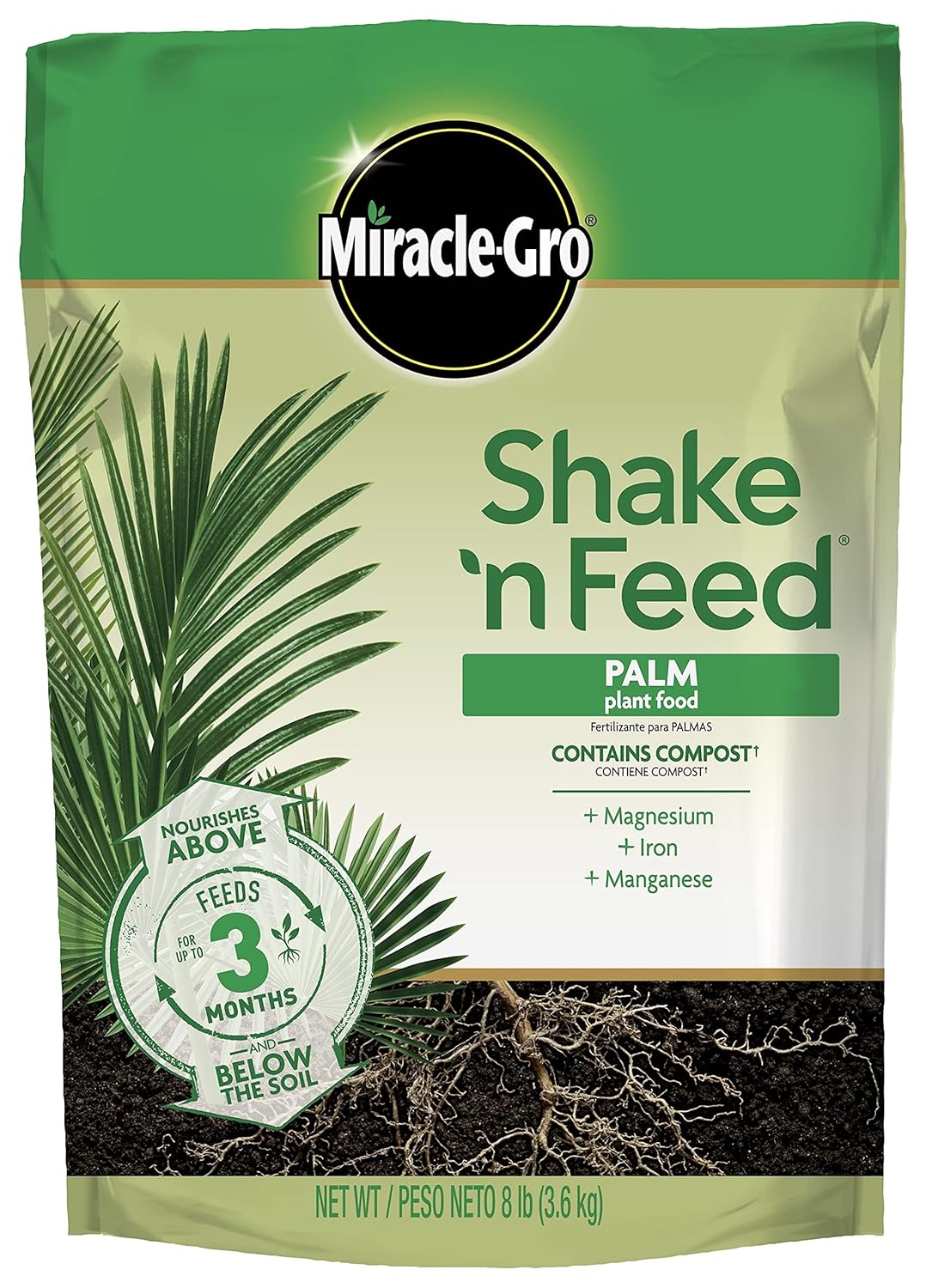
Miracle-Gro Shake 'N Feed Palm Plant Food is a granular, slow-release fertilizer made for palms, cycads, and tropical plants in containers or in the ground. You apply it by shaking the powder evenly onto soil under the fronds, working it into the top 1 to 3 inches, then watering to activate the nutrients. The 8-2-12 N-P-K ratio is supported by added magnesium, iron, and manganese to help green fronds and reduce yellowing, and the included compost supports microbial activity and root health. Practical benefits include multi-month feeding (up to three months) so you do not need to reapply frequently and suitability for both new plantings and established specimens. Limitations are that it is a general palm formula rather than a specialty foxtail-specific mix and the particulate form requires careful application to avoid contact with trunks or foliage. For gardeners who prioritize straightforward, low-effort feeding, this product provides a reliable, easy-to-follow routine but users wanting a tailored foxtail-only nutrient program may prefer a different formulation.
Best for: Buyers who want a dependable, low-maintenance palm fertilizer that is easy to apply and reduces how often you need to feed established palms and tropical containers.
Less Ideal for: Specialist growers seeking a species-specific foxtail palm nutrient program or those who prefer liquid feeds and precise dosing schedules.
- Slow-release formula feeds up to three months, reducing reapplication frequency
- Contains magnesium, iron, and manganese to help prevent yellowing and improve frond color
- Includes compost to support soil microbes and root health
- Works for both in-ground and container palms and tropical plants
- Not specifically formulated for foxtail palms, so it may not match exact species needs
Verdict: A straightforward, slow-release palm fertilizer that simplifies feeding for most gardeners who want reliable, low-effort results.
Choosing the Right Fertilizer for Potted Sago Palm: Key Factors to Consider
Nutrient Ratio and N-P-K Balance
The primary reason nutrient ratio matters is because sago palms favor steady, balanced feeding rather than high-nitrogen pushes that provoke soft growth. In a pot you want a fertilizer with moderate nitrogen paired with sufficient phosphorus for root support and potassium for overall plant health.
Look for formulations where nitrogen is present but not dominant, or choose a periodically applied feed schedule that limits nitrogen spikes. For container use, consider micronutrients such as magnesium and iron as well, because restricted root zones can develop deficiencies more quickly than garden beds.
Release Method and Feeding Frequency
How a fertilizer releases nutrients-slow-release granules, water-soluble concentrate, or organic compost tea-changes watering and maintenance demands. Slow-release products can provide months of steady nutrition from a single application, reducing the risk of overfeeding and salt buildup if you follow label rates.
Water-soluble feeds let you correct visible deficiencies quickly but require more frequent applications and careful dilution. Organic feeds often improve soil biology in the potting mix but release nutrients more slowly and variably, which can be an advantage for long-term soil health but less predictable if you need a rapid correction.
Salt Index and Root Safety in Containers
High-salt fertilizers can accumulate in potting media as water evaporates, increasing the risk of leaf tip burn and root desiccation. Because potted sago palms have limited soil volume, even moderate salt buildup can stress roots.
Choose fertilizers labeled safe for containers, flush pots periodically with clear water when drainage allows, and prefer lower-salt or controlled-release formulas if you water infrequently. Always follow container dosing rather than rates meant for in-ground plants.
Compatibility with Potting Mix and Drainage
Potting mixes vary in organic content and drainage. Fast-draining mixes need fertilizers that stay available between waterings, while moisture-retentive mixes are more prone to salt accumulation and prefer gentler feeds.
Match fertilizer type to your mix: slow-release granules work well in mixes that dry evenly, soluble feeds suit regularly watered pots, and organic amendments are best when you want to boost media structure and microbial life over time. Consider how often you repot and the pot size when choosing concentration and application schedule.
Micronutrient Content and Deficiency Correction
Sago palms can show yellowing or browning when lacking micronutrients like iron or magnesium. A fertilizer that includes trace elements can prevent common deficiency symptoms in containers where uptake is more limited.
If you see early signs of chlorosis, a targeted soluble micronutrient supplement can correct the issue quickly. Otherwise, choose a balanced feed that lists key micronutrients to reduce the chance of recurring problems.
Application Convenience and Safety
How easy a fertilizer is to apply affects whether you will feed consistently. Granules and timed-release capsules require fewer visits, which is helpful for busy gardeners, while liquid concentrates need measuring and mixing but allow quick corrections.
Also consider user safety and the risk of spills on patios or near pets. Clear dosing instructions and minimal dust or odor make a product easier to use around the home, and fewer required applications reduce the chance of accidental over-application.
When to Start a Feeding Program
Start feeding container sago palms once they are actively growing in spring and stop or reduce feeding in late fall when growth slows. For newly potted plants give a gentler schedule until roots settle into the new media.
If your sago palm is young or recently repotted, wait a few weeks before applying a concentrated feed so roots are not exposed to high nutrient levels immediately after repotting.
- Begin monthly or slow-release schedule in spring through summer
- Reduce or pause feeding during dormancy in cooler months
- Delay strong feeds for recently repotted specimens
How Pot Size Changes Feeding Needs
Smaller pots dilute nutrients faster because there is less media to hold reserves. A plant in a 6-inch pot will need gentler, more frequent feeding than one in a 12-inch pot. Larger containers buffer nutrient swings but can hide deficiencies until they are advanced.
When you up-pot, the fresh media provides a nutrient flush that reduces immediate feeding needs. Conversely, as roots fill a pot you may need to increase frequency or repot to restore available nutrients.
- Smaller pots: lower dose, more frequent feed
- Larger pots: slightly higher dose, less frequent feed
- Repotting often reduces need for supplemental fertilizer at first
Organic Vs Synthetic Approaches
Organic fertilizers feed soil life as well as the plant and tend to release nutrients gradually. They are forgiving in containers because they lower the risk of chemical burns, but they can be slower to correct visible deficiencies.
Synthetic or mineral formulas offer precise N-P-K ratios and predictable responses. They work well when you need to correct a deficiency fast or when you want tight control over nutrient inputs, but you must follow container-specific dosing to avoid salt buildup.
- Organics build long-term media health but release slowly
- Synthetics act fast and are easy to measure
- Combining approaches can balance immediate needs and soil improvement
Correcting Common Nutrient Symptoms
Yellowing between veins often indicates iron or magnesium issues, while uniform yellowing can point to nitrogen shortfall. Before changing your feeding program, check watering habits and soil pH because those often affect nutrient uptake.
A targeted water-soluble micronutrient or a foliar feed can correct leaf symptoms faster than a slow-release granular product. Use spot treatments for single plants and a routine balanced feed to prevent recurrence.
- Interveinal chlorosis: consider chelated iron or magnesium
- Pale overall foliage: check nitrogen and watering schedule
- Brown leaf tips: inspect for salt buildup or inconsistent watering
Seasonal Feeding Calendar for Container Sago Palms
In spring and summer maintain a steady schedule aligned with your fertilizer type: monthly for many slow-release products or every 2 to 4 weeks for diluted soluble feeds. Monitor new frond color and vigor to adjust intensity.
In autumn taper off feeding as temperatures cool and growth slows. During winter months keep plants on a minimal maintenance feed only if they remain actively growing indoors or in a warm greenhouse.
- Spring: begin regular feeding as new growth appears
- Summer: maintain steady schedule and watch for signs of overfeeding
- Fall and winter: reduce or stop feeding depending on growth
How We Chose the Best Fertilizer for Potted Sago Palm
We selected fertilizers using criteria that reflect the realities of container sago palm care. First, nutrient ratio mattered because sago palms need a balance that supports slow, steady leaf production and strong roots rather than flushes of weak growth. Second, delivery method was evaluated: slow-release granules, water-soluble formulas, and organic options all behave differently in pots and influence feeding frequency and leaching risk. Third, salt load and formulation concentration were considered since high-salt or high-concentration feeds can burn roots in confined pots. Fourth, ease of application and clarity of dosing instructions were important for consistent results across typical home watering routines. Fifth, compatibility with common potting mixes and container drainage patterns guided selection, because fertilizers that rely on frequent leaching are less suitable for poorly draining pots. We excluded formulations designed only for large landscaping or field use, products requiring specialized equipment, and any fertilizer whose label lacked clear container-specific dosing. The final shortlist emphasizes predictable nutrient delivery, safe salt levels for potted plants, and straightforward application for home gardeners.
FAQ
How often should I fertilize a sago palm in a pot?
It depends on the fertilizer type. Slow-release granules often need application once every 3 to 6 months, while water-soluble feeds are commonly applied every 2 to 4 weeks at a diluted rate. Adjust frequency based on pot size and visible plant response.
Can I use a general houseplant fertilizer for a potted sago palm?
Often you can, provided the product has a balanced ratio and instructions for container use. Avoid high-nitrogen blends meant to force rapid leaf growth, and check that micronutrients important to cycads are present or supplemented.
What are signs of fertilizer burn in container sago palms?
Leaf tip browning, scorched frond edges, and stalled growth can indicate salt accumulation or over-application. If you suspect burn, flush the pot with clear water if drainage allows and hold off on feeding until the plant recovers.
Should I worry about soil pH for container sago palms?
Yes. pH affects nutrient availability in the potting mix. Sago palms prefer slightly acidic to neutral mixes. If deficiencies appear despite feeding, test the media pH and adjust using appropriate amendments rather than increasing fertilizer concentration.
Are foliar feeds useful for potted sago palms?
Foliar sprays can quickly correct micronutrient deficiencies and are useful when root uptake is limited. They are a short-term correction rather than a replacement for a balanced soil feed, so combine foliar treatment with a regular feeding program as needed.
Final Verdict
For potted sago palms prioritize a fertilizer that delivers balanced nutrients without creating salt stress. Match release method to your watering habits and potting mix: slow-release options reduce maintenance, while soluble formulas give fast corrections. Pay attention to micronutrients and pot size when setting dose and frequency. Choose a feeding plan that fits your repotting schedule and tolerance for maintenance. Consistent, moderate feeding and occasional flushing when drainage allows will keep container sago palms healthy and minimize common nutrient problems.
