

Note: This article contains affiliate links. If you click on these links and make a purchase, I may earn a small commission at no extra cost to you. This helps support my research and content. Read my full affiliate disclosure here.
Growing table grapes requires a feeding plan that supports flowering, fruit set, and long-term vine vigor. The right fertilizer delivers the macronutrients and minor elements vines need at each growth stage without encouraging excessive vegetative growth that can reduce fruit quality. This guide presents six top fertilizer options shortlisted for table grapes, chosen for their nutrient profiles, ease of use, and suitability across common vineyard and backyard situations. Below we explain the practical factors that matter to grape growers, how each candidate was evaluated, and what to consider before you apply fertilizer in your vineyard or home garden.
Top Picks at a Glance
| Best Quality Built to a higher standard if you want something more solid | Soil Seed & Water Bacchus Organic Fertilizer for Grapevines |  |
| Best Value The sweet spot between price and what you get | Jobe's Organics Granular Fruit & Nut Fertilizer, 4 lb |  |
| Best Budget The cheapest option that still gets the job done reliably | Fairhaven Vitis-Max Grape Vine Fertilizer, 1 lb |  |
| Highest Rated A top-rated pick with lots of positive feedback | BRIRILINE Fruit, Berry & Vine Food 7-3-3, 64 fl oz |  |
| Most Popular A crowd favorite that many people choose with confidence | Miracle-Gro Water Soluble All Purpose Plant Food, 3 lb |  |
| Best Seller A high-volume bestseller chosen again and again | TPS Nutrients Grape Fertilizer Liquid Plant Food, 8 oz |  |
Soil Seed & Water Bacchus Organic Fertilizer for Grapevines

| Item Form | Granules |
|---|---|
| Specific Uses For Product | Vineyard Soil Enrichment |
| Application Method | Top-dress and mix into soil |
| Target Species | grapevines |
| Mixing Ratio | 1:4 |
Bacchus Blend is an organic, granulated soil amendment designed specifically for vineyards and grape production. It mixes dairy compost, worm castings and mineral supplements to build soil organic matter, improve water retention and feed vines through the root zone. Typical use is mixing one part Bacchus with four parts existing soil for new plantings or top-dressing established vines with a half-inch layer in early spring, then lightly incorporating and watering in. Notable features include an OMRI-listed organic formulation, an odorless granule form that is easy to spread, and clear application guidance for both home and commercial vineyards. Practical benefits are improved soil structure, increased microbial activity from compost and castings, and an easy way to deliver micronutrients like zinc and iron. Limitations are that it is a soil amendment rather than a complete granular NPK fertilizer so growers seeking rapid high-nitrogen responses may need to supplement, and recommended per-vine rates mean a single bag is modest for large plantings. Overall it is a good maintenance and soil-building product for grape growers focused on long-term vine health and fruit quality.
Best for: Grape growers who prioritize long-term soil health and fruit quality and who apply targeted organic amendments as part of a planned vineyard fertility program.
Less Ideal for: Growers who need fast-acting high-nitrogen feeding for rapid vegetative growth or those managing large commercial acreage who require bulk coverage from a single purchase.
- Formulated for grapevines with compost and worm castings to build soil biology
- OMRI-listed organic ingredients suitable for organic viticulture
- Clear instructions for new plantings and top-dressing established vines
- Granular, odorless form that is easy to spread and incorporate
- Not a balanced high-N fertilizer so may need supplemental nutrient sources for quick canopy pushes
- A single 9 lb unit is a limited coverage option for commercial-scale vineyards
Verdict: Choose Bacchus Blend if you want a certified organic soil-building amendment that improves vineyard soil biology and supports long-term grape quality.
Jobe's Organics Granular Fruit & Nut Fertilizer, 4 lb

| NPK | 3-5-5 |
|---|---|
| Target Species | Fruit and nut |
| Item Form | Granules |
| Unit Count | 64 Ounce |
| Specific Uses For Product | Plant Growth, Root Development, Seed Development, Soil Conditioning |
Jobe's Organics Granular Fruit & Nut Fertilizer is a small-bag, slow-release granular designed to feed the roots of fruit and nut trees, including pears. It supplies a balanced 3-5-5 NPK plus calcium, magnesium, and sulfur derived from organic sources such as feather meal and bone meal. Typical use is to broadcast or side-dress around the root zone every 4 to 8 weeks during the growing season; granules release nutrients gradually so you do not need frequent reapplication. Benefits include organic certification for use in organic gardens, straightforward measuring and application, and nutrients aimed at improving bloom and fruit set rather than quick leafy growth. Important limitations are the small 4 lb bag size, which means multiple bags will be needed for larger orchards, and the lower nitrogen ratio compared with general-purpose fertilizers if you want foliage-heavy growth. It is safe to use around people and pets when directions are followed, but users should avoid applying in windy conditions to prevent drift.
Best for: Home gardeners and small-plot fruit growers who prioritize organic inputs and want an easy-to-apply fertilizer to support fruit set and steady production in pear trees.
Less Ideal for: Commercial orchards or large properties that need bulk fertilizer or fast-acting high-nitrogen feed to drive rapid vegetative growth.
- OMRI listed organic formula suitable for certified organic gardens
- Balanced 3-5-5 NPK geared toward flowering and fruit production
- Slow-release granules that feed roots over weeks reducing application frequency
- Includes secondary nutrients like calcium and magnesium to support fruit quality
- 4 lb bag is small for multiple or mature trees
- Lower nitrogen percentage may be insufficient when rapid vegetative growth is desired
Verdict: A small, OMRI-listed granular fertilizer that reliably supports flowering and fruit production in pear trees for gardeners who prefer organic, slow-release nutrition.
Fairhaven Vitis-Max Grape Vine Fertilizer, 1 lb

| Item Form | Granules |
|---|---|
| Specific Uses For Product | Organic |
| Application Method | top dress |
| Target Species | grape |
| Unit Count | 16 Fluid Ounces |
Fairhaven Vitis-Max is a granular, controlled-release fertilizer made for grape culture and intended as a single-season top-dress. The resin-coated prills open when soil is wet and close when dry, which helps deliver steady nutrition without burning vines. The maker recommends about 2 ounces per vine and says one pound treats roughly eight vines, so a single 1 lb container covers a small planting or a few established vines. It is sold as an organic formulation with a full range of grape-targeted nutrients and is straightforward to apply to the soil surface or mixed into planting medium. Practical benefits include easy, infrequent feeding and reduced risk of overfertilizing compared with soluble feedings. Limitations are coverage and longevity for larger vineyards since the package is small and it is designed for one-season use; heavier-feeding vines or larger blocks will need more product or repeated purchases. For gardeners on a budget this product can be cost-effective for small plantings but will require calculating per-vine cost for larger needs.
Best for: Home gardeners with a few grapevines who want a simple, low-maintenance, organic seasonal feed and prioritize straightforward application over bulk coverage.
Less Ideal for: Owners of larger vineyards or those who need long-term bulk supply should consider larger-capacity or multi-season products to lower per-vine cost and reduce repeat purchases.
- Resin-coated granules provide controlled, moisture-triggered release to reduce burn risk
- Formulated specifically for grape vines rather than a generic fertilizer
- Simple top-dress application or mixing at planting makes it easy to use
- Organic labeled formulation for growers avoiding synthetic feeds
- Small 1 lb package only covers about eight vines so not efficient for larger plantings
- Single-season formulation means repeat purchases for multi-year feeding plans
Verdict: A small, grape-specific controlled-release fertilizer that delivers easy, low-risk seasonal feeding ideal for small home plantings.
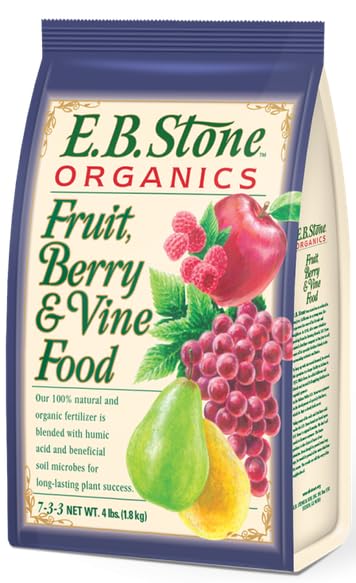
BRIRILINE Fruit, Berry & Vine Food 7-3-3, 64 fl oz
| Item Form | Granules |
|---|---|
| Specific Uses For Product | fruit trees, berries, and fruiting vines |
| Coverage | Organic |
| Liquid Volume | 64 fluid ounces |
| Mixing Ratio | 7:3:3 |
This organic 7-3-3 fertilizer is designed to supply steady, balanced nutrients to fruiting plants such as grapevines. Supplied as granules in a 64 fl oz container, it is applied by spreading around the root zone and watering in or mixing per the 7:3:3 directions, which makes it suitable for routine seasonal feedings. The blend emphasizes nitrogen for leafy growth while providing phosphate and potash to support flowering and fruit set, so it helps develop healthy canopies and promote crop production on grape vines. As an organic product it is appropriate for growers avoiding synthetic fertilizers, and the granular form is easy to store and measure for repeatable applications. Limitations are that nutrient analysis is modest compared with concentrated synthetic options and specific application rates are left to the label, so you may need to calculate amounts for mature vineyards or correct specific deficiencies with targeted amendments.
Best for: Home gardeners and small-scale growers who want a reliable organic feed to maintain healthy grapevines and improve fruit set through regular seasonal applications.
Less Ideal for: Commercial vineyard operators or growers needing rapid correction of specific nutrient deficiencies should consider higher‑analysis or targeted products instead.
- Organic formula suitable for growers avoiding synthetic fertilizers
- Balanced 7-3-3 N-P-K tailored for fruiting vines and berry crops
- Granular form that is easy to apply and store
- Supports leafy growth and fruit development with nitrogen, phosphate, and potash
- Lower nutrient concentrations than concentrated synthetic fertilizers so larger volumes may be required
- Label gives general directions but specific per-vine application rates are not detailed in the product data
Verdict: A dependable organic granular feed that provides balanced 7-3-3 nutrition to keep home grapevines healthy and productive.
Miracle-Gro Water Soluble All Purpose Plant Food, 3 lb

| Item Form | Powder |
|---|---|
| Application Method | Mix with water in a watering can |
| Fertilizer Analysis (N‑P‑K) | 24-8-16 |
| Unit Count | 48 Ounce |
| Coverage | Feeds approximately 1,200 sq. ft. |
Miracle‑Gro Water Soluble All Purpose Plant Food is a powdered NPK 24‑8‑16 formula that dissolves in water to give plants a quick nutrient boost. You mix measured scoops into a watering can and apply to the soil at the base of plants every 7–14 days for outdoor use or every 14 days for houseplants. Notable features include a high nitrogen content for leafy growth, compatibility with containers and in‑ground beds, and guidance for use with a Miracle‑Gro Garden Feeder for larger areas. In practical terms this is a fast‑acting feed that encourages bigger, greener foliage and works well in regular maintenance of perennials like hostas. Limitations are that it is a fast‑release fertilizer rather than a slow‑release option, so it requires regular reapplication and careful measuring to avoid overfeeding. Also, the 24‑8‑16 balance is geared toward vegetative growth, so it is not optimized if you want to prioritize flowering or bloom boosting.
Best for: Buyers who want a reliable, fast‑acting feed to maintain lush, leafy perennials and container plants and who value proven products with broad user endorsement.
Less Ideal for: Gardeners seeking a single, long‑lasting granular fertilizer or a bloom‑focused formula should consider alternative slow‑release or high‑phosphorus products.
- Water‑soluble powder mixes easily for quick uptake by roots
- High nitrogen formula promotes robust leafy growth ideal for shade plants
- Clear mixing and application instructions for both indoor and outdoor use
- Suitable for containers and in‑ground gardens and compatible with garden feeders
- Requires frequent applications so it is not a low‑maintenance, slow‑release option
- High nitrogen ratio is less suitable when the primary goal is more flowers than foliage
Verdict: A fast‑acting, water‑soluble fertilizer that reliably produces bigger, greener hosta leaves when used as directed.
TPS Nutrients Grape Fertilizer Liquid Plant Food, 8 oz

| Item Form | Liquid |
|---|---|
| Application Method | Soil drench |
| Target Species | Grapes |
| Liquid Volume | 8 fluid ounces |
This 8-ounce liquid grape fertilizer is a concentrated soil-drench designed to feed grape vines from root to fruit. It is typically mixed at the recommended ratio and applied as a soil drench around established vines, young table grape plants, or small vineyard blocks to encourage root strength, steady vegetative growth, and better cluster set. Notable features include a liquid formulation for quick availability to roots and a label focus on both vine vigor and fruit development, which makes it useful during active growth and pre-fruit set periods. Practical benefits are targeted nutrition for grapes, ease of application with a simple soil drench method, and suitability for backyard and small-scale vineyard use. Important limitations are the small 8 oz bottle size, which means frequent repurchasing or dilution when treating multiple plants, and the absence of detailed N-P-K numbers on the listing so you must follow label mixing guidance rather than tailoring precise macronutrient ratios. For gardeners who prefer a ready-to-use grape-specific feed, this is a convenient option, but larger plantings will need larger quantities or a different product for cost efficiency.
Best for: Gardeners who want a grape-specific, easy-to-apply liquid feed for a few vines or small hobby vineyard plots and who rely on product reputation and clear use instructions when choosing fertilizers.
Less Ideal for: Growers managing larger vineyards or many plants who need bulk quantities or exact macronutrient breakdowns should consider concentrated or bulk fertilizer options.
- Liquid formula provides nutrients that are quickly available to roots when applied as a soil drench
- Formulation and marketing targeted specifically to grapes, supporting vine vigor and cluster set
- Simple soil-drench application that fits routine watering schedules
- Suitable for both backyard vines and small vineyard plantings
- Small 8 oz bottle size may be impractical for treating multiple vines or larger plantings
- Product listing does not show explicit N-P-K values, limiting precise nutrient planning
Verdict: A convenient grape-focused liquid fertilizer that makes targeted feeding simple for backyard vines and small plantings.
Choosing the Right Fertilizer for Table Grapes: Key Factors to Consider
Nutrient Ratio and N-P-K Balance
Table grape vines need a fertilizer ratio that supports flowering and fruit development without pushing excessive leaf growth. Early in the season a slightly higher nitrogen feed helps shoot growth and bud development, but once fruit set begins you want a shift toward phosphorus and potassium to support blooms, berry development, and sugar accumulation.
Reading the guaranteed analysis on the label lets you match a product to each growth stage. Over-applying nitrogen during fruiting can produce excessive canopy and loose clusters, while too little potassium can reduce berry size and firmness. Choose products with a clear N-P-K ratio that corresponds to your vine's stage and soil test results.
Timing and Release Characteristics
How and when nutrients become available affects vine response and labor needs. Fast-release soluble fertilizers give rapid nutrient availability useful for correcting deficiencies or supporting a flush of growth, but they require more frequent applications and can raise salt levels in the root zone.
Controlled-release or slow-release formulations deliver nutrients over weeks or months, which reduces the number of applications and lowers leaching risk in sandy soils. Consider how often you want to apply fertilizer and whether your irrigation system or access to hand-feeding favors soluble feeds or granular controlled-release products.
Micronutrients and Secondary Elements
Beyond N-P-K, table grapes commonly need adequate calcium, magnesium, and iron along with trace elements like zinc, boron, and manganese. Deficiencies in these can show as poor fruit set, uneven ripening, or disorders like berry drop and reduced shelf life.
A fertilizer that includes key micronutrients or that is easily paired with targeted foliar sprays gives more flexibility when soil tests reveal specific shortages. However, indiscriminate addition of micronutrients can cause imbalances, so use them when soil or tissue tests indicate need.
Soil Type and pH Compatibility
Soil texture and pH influence nutrient availability and fertilizer selection. Acidic soils can lock up phosphorus and some micronutrients, while alkaline soils can limit availability of iron and manganese. Sandy soils leach soluble nutrients quickly and benefit from slow-release forms and more frequent but smaller nutrient doses.
Match fertilizers to your soil conditions and amend pH if necessary before relying on repeated nutrient additions. Knowing your soil type helps determine application rate and frequency to avoid waste and environmental loss.
Application Method and Labor
Think about whether you will broadcast granular fertilizer, band it under the vine row, apply through a drip system, or use foliar sprays. Each method has tradeoffs: broadcasting is simple but less precise, fertigation through drip lines offers even distribution with irrigation but requires a soluble formulation and compatible equipment, and foliar sprays are effective for quick correction of micronutrient deficiencies.
Choose a fertilizer form that fits your equipment and labor capacity. Ease of measuring and spreading, safety for workers, and compatibility with existing irrigation are practical considerations that affect the success of a feeding program.
Environmental Impact and Runoff Risk
Fertilizer management around fruiting vines should minimize nutrient runoff and groundwater contamination. High-salt, highly soluble products increase leaching risk, particularly on sloped sites or in sandy soils with heavy irrigation. Controlled-release options and split applications timed to vine uptake reduce environmental loss.
Consider buffer strips, careful irrigation scheduling, and local regulations when planning fertilization. Products with lower salt indices and clear application guidance help reduce the environmental footprint of a productive table grape planting.
Soil Testing and Interpreting Results
Start with a soil test to identify macro and micronutrient levels, organic matter percentage, and pH. Test results tell you which elements are deficient, which are sufficient, and whether pH adjustments are needed to make nutrients available to vines.
When reading a lab report, focus on extractable phosphorus and potassium numbers and on cation exchange capacity to understand how your soil holds nutrients. Use the recommendations to select a fertilizer ratio and to decide if lime or sulfur is needed to adjust pH before fertilizing.
- Sample at root depth and from representative locations across the planting.
- Repeat tests every 2 to 3 years to monitor trends, not just one-off fixes.
Fertilizer Timing Through the Growing Season
Split applications across the season match vine demands and reduce nutrient loss. Apply a maintenance dose at bud break to support shoot growth, then reduce nitrogen and supply phosphorus and potassium around bloom and fruit set to favor fruit development.
Late-season fertilization should be cautious; heavy nitrogen after harvest can delay vine hardening and increase winter injury risk in cooler climates. Tailor timing to your local climate and the phenology of the varieties you grow.
- Early season: support canopy development with moderate nitrogen.
- Bloom to fruit set: emphasize phosphorus and potassium.
- Post-harvest: avoid high nitrogen; focus on replenishing reserves if needed.
Using Foliar Feeds and Micronutrient Sprays
Foliar sprays can quickly correct micronutrient deficiencies detected by tissue tests or visual symptoms. Because leaves absorb some nutrients faster than roots can mine them from soil, foliar feeding is useful during critical windows like bloom and early berry set.
Limit foliar applications to recommended concentrations and avoid spraying during hot, sunny periods that can cause leaf burn. Foliar feeding complements soil fertilization but should not replace a balanced soil-based program.
- Use foliar sprays for zinc, iron, and boron corrections when needed.
- Follow label rates and timing to prevent phytotoxicity.
Organic Versus Synthetic Options
Organic fertilizers supply nutrients more slowly and can improve soil structure and microbial activity over time. They are often lower in available nitrogen and may require larger application volumes to match the immediate nutrient needs of a fruiting vine.
Synthetic fertilizers are concentrated and predictable, making them useful for precise corrective applications guided by soil tests. Many growers combine organic matter additions with targeted synthetic feeds to balance long-term soil health and short-term crop needs.
- Incorporate composts in the off-season to build organic matter.
- Use targeted synthetic feeds when quick correction of a deficiency is necessary.
Record-Keeping and Adjusting the Program
Keep a log of fertilization dates, products used, rates, and observed vine responses. Over seasons this record helps you refine timing and amounts to match yield and quality goals while avoiding over-application.
Combine records with periodic soil and tissue tests to confirm that your program maintains nutrient balance and to identify slow-developing deficiencies before they affect fruit quality.
- Note irrigation changes and weather patterns when evaluating fertilization outcomes.
- Adjust rates gradually and retest rather than making large, sudden changes.
How We Chose the Best Fertilizer for Table Grapes
We focused on fertilizers that suit the seasonal needs of table grape vines and practical application in garden and small-scale vineyard settings. Evaluation emphasized nutrient balance and timing because table grapes need different ratios for establishment, canopy management, and fruit development. We also judged ease of application across common methods gardeners use, including granular top-dress, soil incorporation, and soluble feeds for drip or foliar use. Other criteria included presence and proportion of secondary nutrients and micronutrients that influence berry color, firmness, and disease resistance; compatibility with soil pH and common soil types; and clear labeling that allows growers to match products to soil test results. Environmental impact and runoff risk were considered by preferring controlled-release or low-salt options where appropriate. We excluded specialty formulations meant only for ornamental grapes or non-fruiting varieties and products without transparent nutrient analysis. The final shortlist balances vine nutrition, application practicality, and long-term soil health.
FAQ
How much fertilizer do table grape vines need in the first year?
First-year vines typically need lighter feeding compared with established plants. Focus on building root development with modest nitrogen and organic matter; avoid heavy fertilization that encourages too much top growth. A soil test and conservative, staged applications are the best approach.
Can I apply the same fertilizer throughout the season?
Using the same product all season can work if it has a balanced release profile, but tailoring N-P-K ratios to growth stages usually yields better fruit quality. Many growers reduce nitrogen and increase potassium near fruit set to support berry development.
Are foliar sprays necessary for micronutrient deficiencies?
Foliar sprays are effective for quick correction of specific micronutrient shortages, especially during bloom or fruit set. They are a supplement to soil fertilization and are best used when tests or symptoms indicate a clear need.
When is the best time to apply fertilizer to minimize runoff?
Apply fertilizer during periods of moderate soil moisture and avoid imminently heavy rain events. Split applications and using controlled-release products reduce runoff risk. Coordinating applications with irrigation events helps ensure nutrients move into the root zone rather than off-site.
How do I correct a potassium deficiency in grapevines?
Address potassium shortages based on soil or tissue test results. Apply a potassium-focused fertilizer or amend with materials high in potash, timing applications before or at early fruit development. Improving soil organic matter also helps retain potassium in the root zone.
Final Verdict
Choose a fertilizer program for table grapes that reflects your soil test results, vine age, and seasonal goals. Prioritize the right nutrient ratios for each growth stage, include micronutrients only when indicated, and match application method and timing to your irrigation and labor capacity. Balance quick corrective feeds with longer-term soil-building practices. By focusing on nutrient balance, release type, and careful timing you can improve fruit size, flavor, and vine health while reducing waste and environmental impact.
