

Note: This article contains affiliate links. If you click on these links and make a purchase, I may earn a small commission at no extra cost to you. This helps support my research and content. Read my full affiliate disclosure here.
Tamarillo trees respond to feeding differently than many other fruiting shrubs and small trees. Choosing a fertilizer for tamarillos matters because the wrong NPK balance or an incompatible formulation can push leafy growth at the expense of flowers and fruit, or cause nutrient lockup in certain soils. This guide covers six top picks shortlisted for feeding tamarillo trees in garden beds, containers, and small orchards. We evaluate each option for nutrient balance, application ease, and soil compatibility so you can match a fertilizer to your site and fruiting goals. Read on for practical guidance on timing, application, and how to avoid common feeding mistakes.
Top Picks at a Glance
| Best Overall The best all-around choice for most situations | Alaska Fish Fertilizer for Plants, OMRI Listed 5-1-1 (Liquid) |  |
| Best Quality Built to a higher standard if you want something more solid | FoxFarm Big Bloom Liquid Plant Food, 16 fl oz |  |
| Best Value The sweet spot between price and what you get | Espoma Citrus-Tone Organic Fertilizer for Citrus, Avocado, Fruit & Nut Trees, 4 lb |  |
| Best Budget The cheapest option that still gets the job done reliably | Miracle-Gro Water Soluble Tomato Plant Food, 1.5 lb |  |
| Highest Rated A top-rated pick with lots of positive feedback | Miracle-Gro Water Soluble All Purpose Plant Food, 12.5 lb |  |
| Best Seller A high-volume bestseller chosen again and again | Miracle-Gro Shake 'N Feed Citrus, Avocado, Mango Plant Food, 4.5 lb |  |
Alaska Fish Fertilizer for Plants, OMRI Listed 5-1-1 (Liquid)

| Item Form | Liquid |
|---|---|
| Specific Uses For Product | Indoor, Outdoor |
| Application Method | Mix with water and apply to plants |
| Coverage | 1000 square feet |
| Mixing Ratio | 5:1:1 |
Alaska Fish Fertilizer is a concentrated liquid fish emulsion with a 5-1-1 NPK designed to feed vegetables, flowers, shrubs, trees and container plants without burning them. You mix the emulsion with water (manufacturer mixing ratio listed) and apply every few weeks during the growing season to supply steady nitrogen along with small amounts of phosphate and potash. It is OMRI listed, so it fits organic vegetable and edible gardens, and the fish-based nutrients also support soil microbes for improved soil biology. Practical benefits include easy mixing and application, broad suitability for indoor and outdoor use, and a formula that is gentle enough for seedlings and mature plants alike. Limitations are that its nutrient profile is skewed toward nitrogen so it is not a balanced replacement for fertilizers formulated for bloom or root development, and you will need to follow dilution instructions to avoid odor and overapplication. Coverage claims are broad, so heavier-feeding crops may need supplemental feeding or more frequent applications.
Best for: Gardeners who prioritize reliable plant growth and organic inputs and want a straightforward, repeatable liquid feed for vegetables, ornamentals, and containers.
Less Ideal for: Growers seeking a bloom-boosting or high-phosphorus formulation as a one-product solution should consider a specialized flowering fertilizer instead.
- OMRI listed for organic use
- Gentle 5-1-1 formula that feeds without burning seedlings or mature plants
- Liquid concentrate mixes with water for simple, controlled application
- Supports soil microbial activity in addition to supplying plant nutrients
- High relative nitrogen makes it less ideal as a sole fertilizer for flowering or fruiting stages
- Fish emulsion can produce noticeable odor during and after application
Verdict: A dependable, OMRI-listed liquid fish emulsion that delivers steady, plant-safe nitrogen feeding for organic vegetable and ornamental gardens.
FoxFarm Big Bloom Liquid Plant Food, 16 fl oz

| Item Form | Liquid |
|---|---|
| Specific Uses For Product | Organic |
| Application Method | watering can, sprayer, or drip system |
| Liquid Volume | 16 fluid ounces |
| Mixing Ratio | 4 |
Big Bloom is a concentrated liquid bloom fertilizer aimed at boosting flowers and fruit by supplying readily available organic nutrients. It mixes into water (manufacturer recommends 4 tablespoons per gallon) and can be applied with a watering can, sprayer, hose-end siphon, or through drip systems, so you can feed potted plants, beds, or containers without changing your routine. Notable features are its OMRI listing for organic use and the inclusion of bat guano and earthworm castings, which provide phosphorus and organic matter to encourage blooms and seed set. Because it is liquid and fast-acting, you can expect visible perk-up within a short time after feeding, and it is suitable for regular use at watering times to extend flowering. Limitations to consider are the small 16 fl oz size for larger gardens and the presence of phosphorus, which may be restricted in some locales and requires careful application to avoid runoff.
Best for: Gardeners focused on maximizing blooms and fruit who want an organic, fast-acting feed they can add to routine watering for container and bed-grown flowering plants.
Less Ideal for: Large-scale landscapers or very large perennial beds who need bulk fertilizer solutions or want to avoid phosphorus-based products due to local regulations.
- OMRI-listed organic formula with natural inputs like bat guano and earthworm castings
- Liquid concentrate allows fast nutrient uptake and flexible application methods
- Works with watering cans, sprayers, hose-end siphons, and drip systems for easy integration
- Small 16 fl oz bottle may require frequent repurchasing for larger flower beds
- Contains phosphorus so local restrictions on phosphorus fertilizers may apply
Verdict: Choose Big Bloom when you want an OMRI-listed, easy-to-apply liquid fertilizer that delivers fast organic nutrients to boost flowering and fruiting.
Espoma Citrus-Tone Organic Fertilizer for Citrus, Avocado, Fruit & Nut Trees, 4 lb

| Item Form | Granules |
|---|---|
| Specific Uses For Product | Gardening, Organic, Plant Food |
| Coverage | Medium |
| Target Species | Citrus, avocado, fruit and nut trees |
| Unit Count | 64 Ounce |
Espoma Citrus-Tone is a granular, ready-to-use organic fertilizer designed to feed fruiting trees by applying around the drip line and watering in. It delivers a 5-2-6 NPK analysis with added calcium and Espoma’s Bio-tone formulation, so it supports vegetative growth, bloom set and fruit development when used at recommended timings: late winter pre-bloom, spring post-bloom and fall. The granules make it easy to spread by hand around individual pomegranate or other fruit trees without mixing, and its organic inputs suit growers aiming to maintain soil biology while increasing nutrient availability. Practical benefits include targeted seasonal application, approval for organic production, and moderate coverage from a compact 4 lb bag that is easy to store. Limitations are that the bag covers a medium area only, so larger orchards will need more product, and specific mixing rates or per-tree application amounts are not printed in the available product guide, so you may need to consult manufacturer directions for exact dosing.
Best for: Gardeners who prioritize steady, organic performance for individual fruit trees and want a convenient granular fertilizer to support bloom and fruit development.
Less Ideal for: Growers managing large pomegranate plantings or commercial orchards who need bulk coverage and precise per-tree dosing from a high-volume product.
- Balanced 5-2-6 NPK with added calcium to support bloom and fruit set
- Organic formulation approved for organic gardening and soil biology
- Ready-to-use granules that are simple to apply around the drip line
- Recommended seasonal schedule (pre-bloom, post-bloom, fall) tailored for fruit trees
- 4 lb bag provides only medium coverage, requiring frequent repurchase for larger trees or multiple specimens
- Application rates and mixing ratios are not clearly listed in the available product details
Verdict: Choose this organic granular formula when you want a convenient, soil-friendly fertilizer that supports bloom and fruit set on individual pomegranate or other fruit trees.
Miracle-Gro Water Soluble Tomato Plant Food, 1.5 lb

| Item Form | Liquid |
|---|---|
| Application Method | Water Soluble |
| Target Species | Great for tomatoes and vegetables |
| Mixing Ratio | 18-18-21 |
Miracle-Gro Water Soluble Tomato Plant Food is a water-soluble fertilizer intended to boost vegetable growth by delivering nutrients quickly through a watering can or Miracle-Gro Garden Feeder. Its 18-18-21 mixing ratio supplies balanced nitrogen, phosphorus, and potassium so plants get a steady supply of the elements they need for leafy growth, flowering, and fruit set. Use it by mixing the recommended dose into a watering can for outdoor containers or in-ground beds and apply every 7 to 14 days during the growing season. The product works fast because it dissolves completely and can be applied directly to the root zone, which is useful for impatient gardeners trying to push tuber and foliage development in potatoes. On the downside it is a concentrated chemical fertilizer rather than an organic option and requires careful measuring to avoid overfeeding. Coverage notes from the brand indicate a small 1.5 lb package is meant to feed a modest area when used with the Garden Feeder, so larger plots will need multiple containers.
Best for: Ideal for gardeners on a budget who want a straightforward, fast-acting fertilizer to boost potato foliage and tuber development without complicated application methods.
Less Ideal for: Not the best choice for growers seeking organic or slow-release nutrition or for those managing large acreages who need bulk, long-lasting supplies.
- Water-soluble formula mixes easily for quick nutrient uptake
- Balanced NPK (18-18-21) supports foliage, flowers, and fruit development
- Designed for use with watering cans or the Miracle-Gro Garden Feeder for convenient application
- Feeds quickly when applied every 7 to 14 days during the growing season
- Concentrated synthetic formula, not an organic fertilizer
- 1.5 lb package is small for larger vegetable plots and will require frequent repurchasing
Verdict: A simple, fast-acting water-soluble fertilizer that gives budget-minded vegetable growers an easy way to boost potato growth and yields.
Miracle-Gro Water Soluble All Purpose Plant Food, 12.5 lb

| Item Form | Powder |
|---|---|
| Specific Uses For Product | Plant Food |
| Coverage | general purpose, suitable for various plants |
| Mixing Ratio | 1 tablespoon per gallon of water |
Miracle‑Gro Water Soluble All Purpose is a powder fertilizer designed to dissolve in water and deliver fast nutrients to indoor and outdoor plants. Gardeners mix the recommended scoop with a watering can or use a compatible garden feeder to apply directly to the soil around roots; the product gives routine feedings every 7 to 14 days outdoors or every 2 weeks for houseplants. Notable features include an NPK of 24‑8‑16 for strong vegetative growth, a quoted coverage of about 5,000 sq ft from a 12.5 lb container, and an included scoop with separate measuring ends for indoor and outdoor rates. In practice this means quick uptake for leafy growth and an easy, repeatable dosing routine for reliability across container and in‑ground Clusia specimens. Limitations are that it is a general‑purpose formula rather than a Clusia‑specific mix and frequent applications are required during the growing season, so you will need to follow the label closely to avoid overfeeding.
Best for: Buyers who want a dependable, easy‑to‑measure fertilizer to keep Clusia healthy with consistent, repeatable feedings and straightforward application routines.
Less Ideal for: Growers seeking a slow‑release or custom‑formulated Clusia fertilizer or those who prefer lower‑frequency, hands‑off feeding strategies.
- Fast‑acting water‑soluble formula for near‑instant nutrient availability
- Simple mixing ratios and included scoop make dosing consistent
- Large 12.5 lb container covers a lot of garden area for routine feedings
- Suitable for both container and in‑ground use so it works with potted Clusia and landscape plantings
- General all‑purpose NPK may not match specialized nutrient needs of Clusia at every growth stage
- Requires regular applications during the season rather than a slow‑release schedule
Verdict: A reliable, easy‑to‑mix water‑soluble fertilizer that delivers fast, consistent feedings for Clusia in both pots and landscape settings.
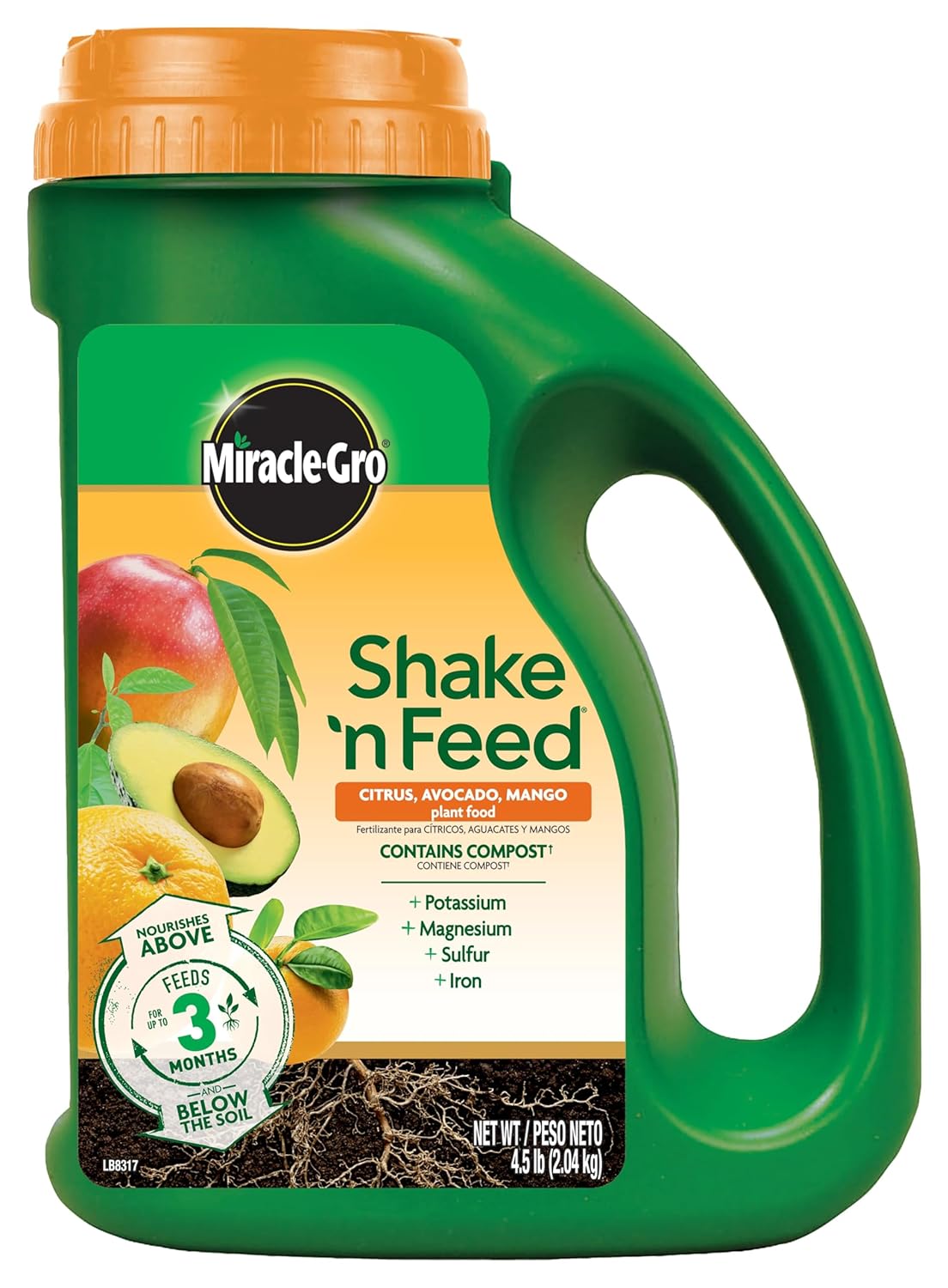
Miracle-Gro Shake 'N Feed Citrus, Avocado, Mango Plant Food, 4.5 lb
| Item Form | Granules |
|---|---|
| Application Method | Shake evenly onto soil |
| Target Species | citrus, avocado, mango |
| Mixing Ratio | 8-2-10 |
| Coverage | Medium |
This Shake 'N Feed formula is a granular, slow-release fertilizer made for citrus, avocado and mango trees in containers or in-ground. You shake the granules evenly onto the soil within the branch spread or mix into potting mix at planting, then water to start feeding; one application feeds plants for up to three months. The N-P-K listed (8-2-10) and added micronutrients such as potassium, magnesium, sulfur and iron help correct common deficiencies and support root development through microbes in the mix. It is practical for seasonal feeding and reduces the frequency of applications compared with quick-release fertilizers. Limitations include that it is a general fruit-tree feed rather than a lemon-specific formula and needs correct placement to avoid contact with trunks or foliage. For established trees you must follow label rates to avoid overfeeding and reapply every three months to maintain nutrition through the growing season.
Best for: Practical gardeners who want an easy, low-maintenance feeding schedule for lemon and other citrus trees and prefer a single product that works in pots and beds.
Less Ideal for: Growers who need a custom nutrient program based on soil tests or who want a fast-acting liquid feed for quick corrections should consider more targeted products.
- Slow-release formula provides up to 3 months of feeding per application
- Contains N-P-K 8-2-10 plus micronutrients to address common deficiencies
- Works for both container and in-ground citrus and other fruit trees
- Easy shake-and-feed application that reduces application frequency
- Not a lemon-specific formulation so may lack tailor-made ratios for particular soil tests
- Requires careful placement and incorporation to avoid trunk or foliage contact
Verdict: Use this to keep lemon trees consistently fed with a convenient, three-month slow-release granular fertilizer.
Choosing the Right Fertilizer for Tamarillos: Key Factors to Consider
NPK Ratio and Fruiting Response
The balance of nitrogen, phosphorus, and potassium directly shapes how a tamarillo allocates resources. Higher nitrogen encourages leafy growth while higher potassium supports flower development, fruit set, and fruit quality. Look for formulations that reduce nitrogen slightly once the initial vegetative flush is finished and boost potassium and phosphorus during flower initiation and fruit fill.
Consistent feeding over the season is often better than one heavy application. Slow-release granular products or timed liquid feeds help prevent the spikes and troughs in nutrient availability that can confuse a tamarillo's growth cycle.
Micronutrients and Soil Chemistry
Tamarillos benefit from micronutrients such as magnesium, calcium, iron, and zinc, especially when soils are marginal or when trees are container-grown. Calcium supports cell wall strength and reduces blossom end problems, while magnesium is vital for chlorophyll and steady photosynthesis.
Soil chemistry affects micronutrient availability. In alkaline soils some micronutrients can become unavailable, so choose a fertilizer or supplement that either contains chelated micronutrients or plan corrective amendments to adjust pH and nutrient availability.
Salt Index and Root Safety
Many concentrated fertilizers have a high salt index that can stress roots, especially in containers or poorly drained beds. Salt stress shows as browned leaf edges, wilting, or reduced vigor. For potted tamarillos, select low-salt or controlled-release formulations and flush growing media periodically to avoid buildup.
When applying granular fertilizers to in-ground trees, avoid placing granules directly against stems or roots. For container trees, reduce application rates and increase frequency rather than making large single applications.
Formulation and Application Method
Fertilizers come as soluble liquids, water-soluble powders, granular slow-release, and organic blends. Soluble feeds allow fast correction of deficiencies and are useful during active fruit set. Slow-release granules reduce the risk of overfeeding and save labor, while organic options add soil-building benefits but often supply nutrients more slowly.
Consider how often you want to feed and whether the tree is in a container or the ground. Containers typically need more frequent, lighter feeds; in-ground trees tolerate less frequent, larger applications.
Compatibility with Mulches and Soil Amendments
Mulches and organic matter influence nutrient release and soil moisture. Heavy mulches can slow fertilizer penetration to roots, while compost increases cation exchange capacity and can retain added nutrients. Some fertilizers pair well with organic mulches, while others require surface scratching in to improve uptake.
Plan feeding so it complements your mulching and compost regime. If you topdress with compost in spring, reduce synthetic fertilizer rates to avoid nutrient excess. For container-grown tamarillos, refresh potting mix periodically to prevent nutrient depletion.
Timing Relative to Growth Cycle
The tamarillo growth cycle has distinct phases: spring vegetative growth, flowering, fruit set, and fruit maturation. Fertilizer timing should align with those phases. Apply a balanced or slightly higher-nitrogen feed in early spring to support new shoots, then switch to a higher-phosphorus and potassium emphasis as buds form and during early fruit development.
Avoid heavy nitrogen late in the season where it can delay hardening and reduce winter resilience in cooler climates. Tailor the feeding schedule to your local season length and frost dates.
Feeding Tamarillos in Containers Vs In-Ground
Container-grown tamarillos need more frequent, precise feeding because pots limit the root zone and nutrient buffer. Water-soluble or low-salt liquid feeds applied every 2 to 4 weeks during the active season give better control and avoid salt buildup. Use a well-draining potting mix and flush the container occasionally to prevent soluble salt accumulation.
In-ground trees have a larger root volume and more stable soil chemistry, so they tolerate slower-release granular applications. Apply granules evenly under the canopy and lightly rake them into the topsoil, or broadcast in early spring with a follow-up feed at fruit set.
- Containers: lighter, more frequent liquid or water-soluble feeds
- In-ground: slow-release granules or granular applications twice a season
- Flush pots annually and refresh topsoil or compost for container trees
Timing Feedings for Flowering and Fruit Set
Aim for a two-stage feeding rhythm. Support early season shoot growth with a balanced feed, then pivot to a formula that supplies more potassium and phosphorus as flowers open and fruit begins to set. This shift helps the tree allocate resources to flowers and developing fruit rather than excessive leaf growth.
Avoid sudden changes in fertilizer concentration. Gradual adjustments and consistent scheduling reduce stress and help maintain a reliable crop across the season.
- Early season: balanced or slightly higher nitrogen
- Flowering to fruit set: boost phosphorus and potassium
- Late season: taper nitrogen to encourage fruit maturity
Soil Testing and pH Management
A simple soil test helps you choose the right fertilizer and any needed pH corrections. Tamarillos prefer slightly acidic to neutral soils where most nutrients are available. If soil pH is high, iron and manganese may be less available, and the tree can show deficiency symptoms despite adequate fertilizer.
Use test results to correct major nutrient shortfalls or to select formulations with chelated micronutrients. For container trees, also test the potting mix since media composition can differ greatly from native soil.
- Test pH and basic nutrients before major feeding changes
- Correct pH gradually with sulfur or lime based on test recommendations
- Retest every few years to track changes from amendments and mulching
Organic Vs Synthetic Options for Tamarillo Care
Organic fertilizers feed soil life while releasing nutrients more slowly. They improve structure and long-term fertility, which benefits tamarillos planted in beds with seasonal composting. However, organic feeds may not correct acute deficiencies quickly during flowering and fruit set.
Synthetic and controlled-release formulations give predictable NPK delivery and are useful when you need precise control of fruiting responses. Many gardeners combine both approaches: using organic matter to build soil while applying targeted synthetic or soluble feeds during critical growth phases.
- Use organic matter for long-term soil health
- Use soluble or controlled-release synthetics for predictable seasonal feeding
- Combine strategies to balance soil-building with short-term nutrient needs
Preventing Common Fertilizing Mistakes
Overfeeding is a common issue that causes lush foliage but poor fruiting, or burning in pots. Follow label rates, reduce doses for young trees and container-grown specimens, and prefer frequent lighter feeds over large single applications. Pay attention to signs of nutrient excess or deficiency and adjust accordingly.
Do not apply high-nitrogen feeds during late season. Also avoid surface-applied granules that sit against the trunk or main roots; spread inputs under the canopy and water in when appropriate to move nutrients into the root zone.
- Avoid high nitrogen after mid-season
- Use lower doses for containers and juvenile trees
- Water in granular fertilizers and avoid direct contact with stems
How We Chose the Best Fertilizer for Tamarillos
We shortlisted fertilizers that fit real-world tamarillo growing situations and excluded experimental or unproven blends. Selection focused on formulations and product characteristics that matter to gardeners growing tamarillos: reliable NPK ratios suitable for fruiting, presence of key micronutrients like magnesium and calcium, and formulations that play well with common soil types and container media. Our evaluation prioritized application practicality and predictability. We favored fertilizers available as granular, slow-release, or soluble formulations that allow controlled feeding through the growing season, and that have clear label guidance for fruit trees. Plant health indicators such as root friendliness and salt load were also weighed because tamarillos are sensitive to salt accumulation in pots. We excluded specialty blends that target unrelated crops or require complex greenhouse inputs. Final picks were judged on nutrient profile, ease of timing and measurement, compatibility with mulches and organic amendments, and the likelihood of producing balanced vegetative and reproductive growth in typical home garden settings.
FAQ
How often should I feed a tamarillo tree in a pot?
Usually every 2 to 4 weeks during the active growing season with a diluted liquid or water-soluble feed is appropriate. Frequency depends on the formulation and pot size; smaller pots need more frequent, lighter feeds.
Can I use a general fruit tree fertilizer on tamarillos?
Often a general fruit tree fertilizer is suitable if its NPK balance matches the tamarillo's needs. Check that it does not have excessive nitrogen during fruiting and that it supplies or allows for micronutrient supplementation if your soil is deficient.
What are signs of nutrient deficiency in tamarillos?
Yellowing between veins, poor flowering, stunted growth, and thin-looking fruit can indicate deficiencies. Specific patterns, such as interveinal chlorosis, suggest magnesium or iron shortages and warrant soil or tissue testing.
Should I change fertilizer when the tree is flowering?
Yes. Shift from a balanced or slightly nitrogen-favoring feed to one with relatively higher phosphorus and potassium as buds form and flowers open to support fruit set and development.
Is foliar feeding useful for tamarillos?
Foliar feeding can correct micronutrient shortages quickly but is not a substitute for root-zone fertility. Use it to address acute deficiencies, especially in container plants, and follow label instructions to avoid leaf burn.
How do I avoid salt buildup in containers?
Use low-salt or slow-release formulations, reduce application rates, and flush containers with clean water periodically. Repot with fresh mix every few years to refresh the root environment and prevent accumulated salts from affecting root function.
Final Verdict
Choose a fertilizer for tamarillos by matching the formulation to the tree's growth phase, planting situation, and soil chemistry. Prioritize a nutrient profile that supports flowering and fruit set rather than excessive vegetative growth, and consider micronutrient completeness and salt safety for containers. Plan a feeding rhythm that shifts from balanced early-season support to a potassium- and phosphorus-focused program at flowering. That approach, combined with soil testing and sensible application rates, helps you get reliable fruit while protecting root health and long-term soil fertility.
