

Note: This article contains affiliate links. If you click on these links and make a purchase, I may earn a small commission at no extra cost to you. This helps support my research and content. Read my full affiliate disclosure here.
Picking the right granular fertilizer for lawns shapes how quickly your turf greens up, how long the nutrition lasts, and how often you need to reapply. In real lawn care, the wrong formulation can mean weak growth, patchy color, or extra work during peak season. This guide focuses on granular options suited for lawns, distilling the most reliable picks into a shortlist you can trust. We evaluated products against nutrient balance, release profile, and ease of application so you can choose a granular fertilizer that matches your mowing schedule, soil needs, and seasonal goals. Below are our top selections and the criteria used to compare them.
Top Picks at a Glance
| Best Overall The best all-around choice for most situations | The Andersons Professional PGF Complete 16-4-8 Granular Lawn Fertilizer (covers 5,000 sq ft) |  |
| Best Quality Built to a higher standard if you want something more solid | The Andersons Professional PGF 16-0-8 Granular Lawn Fertilizer with Humic DG, 40 lb |  |
| Best Value The sweet spot between price and what you get | CountryMax Urea Fertilizer 46-0-0, 50 lb |  |
| Highest Rated A top-rated pick with lots of positive feedback | Espoma Turf‑Tone All Season Organic Lawn Food, 28 lb |  |
| Most Popular A crowd favorite that many people choose with confidence | Scotts Turf Builder Weed & Feed5 Granular Weed Killer + Fertilizer, 33.95 lb |  |
| Best Seller A high-volume bestseller chosen again and again | Scotts Turf Builder Lawn Food, 12.5 lb |  |
The Andersons Professional PGF Complete 16-4-8 Granular Lawn Fertilizer (covers 5,000 sq ft)

| Item Form | Granules |
|---|---|
| Specific Uses For Product | Soil Conditioning |
| Target Species | lawn grasses |
| Mixing Ratio | 4-1-2 ratio |
The Andersons Professional PGF Complete is a granular 16-4-8 lawn fertilizer designed for even coverage and sustained turf nutrition. It pairs quick-release nitrogen for an immediate green-up with slow-release forms that extend feeding up to eight weeks, and includes iron and several micronutrients to improve color and vigor. The product uses super-fine particles and Humic DG technology to promote soil contact and nutrient uptake; in practice that means easier spreading with fewer missed strips when you set your spreader and walk at a steady pace. Directions call for light watering after application to activate the DG particles. Practical benefits include multi-week feeding from a single application and added micronutrients that support recovery and color. Important limitations are the need to follow spreader settings and safety precautions when handling granular fertilizer and that this formulation is not sold in California. If you want a balanced, performance-focused granular fertilizer for standard cool- or warm-season lawns, this product delivers predictable results when applied correctly.
Best for: Homeowners who want a single, reliable granular fertilizer that produces steady green-up and prolonged feeding without frequent reapplications.
Less Ideal for: Do not choose this if you need a liquid feed, organic-only inputs, or live in regions where the product is restricted from sale.
- Balanced 16-4-8 N-P-K ratio for immediate and extended feeding
- Contains iron and micronutrients to improve turf color and health
- Super-fine granules and Humic DG technology for even distribution and quicker soil activation
- Feeds turf for up to eight weeks reducing application frequency
- Not available for sale in California
Verdict: A reliable, balanced granular fertilizer that delivers immediate color and multi-week feeding for homeowners seeking straightforward lawn care.
The Andersons Professional PGF 16-0-8 Granular Lawn Fertilizer with Humic DG, 40 lb

| Model Number | PGF 16-0-8 |
|---|---|
| Item Form | Granules |
| Specific Uses For Product | Lawns |
| Mixing Ratio | 1:4.5 |
The Andersons Professional PGF 16-0-8 is a lawn-specific granular fertilizer designed to deliver both immediate and extended nitrogen feeding. Applied with a broadcast spreader at the recommended 3.6 lb per 1,000 sq ft, it lays down fine particles for even coverage and steady results over 6 to 8 weeks. The formula is phosphorus-free and includes iron and micronutrients to help color and overall turf health, while Humic DG supports soil activity. The resealable 40 lb bag is convenient for storage and repeated applications during the season, and the product works across common lawn grasses with clear directions for reduced rates on centipede grass. Limitations are that it is not intended for use near waterways and cannot be sold in some states, and users must avoid application before heavy rain and clean spreaders after use. For gardeners focused on performance, this fertilizer streamlines regular feeding with a balance of quick green-up and longer-term nutrient availability.
Best for: Gardeners and lawn care enthusiasts who prioritize measurable turf performance and want a fertilizer that provides both quick green-up and sustained nutrition with predictable scheduling.
Less Ideal for: Small-scale gardeners or those who need an all-purpose fertilizer for beds and ornamentals should consider products formulated for mixed planting areas instead.
- Combination of quick- and slow-release nitrogen for immediate and extended feeding
- Super-fine granules promote even distribution and consistent coverage
- Includes iron, micronutrients, and Humic DG to support turf color and soil activity
- Resealable 40 lb bag for easier storage and repeated applications
- Not for sale in certain states and has restrictions for use near water or storm drains
- Requires careful application timing and spreader maintenance to avoid runoff or uneven results
Verdict: Choose this fertilizer if you want a lawn-focused, fast-plus-sustained feeding program that gives predictable green-up and ongoing nutrition.
CountryMax Urea Fertilizer 46-0-0, 50 lb

| N-P-K | 46-0-0 |
|---|---|
| Item Form | Granules |
| Application Method | broadcast and drop spreaders |
| Unit Count | 800 Ounce |
CountryMax Urea 46-0-0 is a concentrated granular fertilizer intended to rapidly correct nitrogen deficiency and produce quick green-up on lawns. You apply it with a broadcast or drop spreader over turf, gardens, or larger plantings; the uniform granules make coverage predictable and straightforward. The very high 46% nitrogen means it drives fast, visible top growth and deepens color when used during active growing periods, so it is useful for spring or summer feeding and for reviving pale turf. Because it is a straight urea product with no phosphorus or potassium, it is best paired with other fertilizers if you need balanced nutrition or soil-building benefits. Users should follow recommended rates to avoid excessive blade growth or burn in hot, dry conditions and consider watering after application to reduce volatilization. The 50 lb bag is economical for medium to large lawns or for multiple applications across the season.
Best for: Buyers who prioritize fast, cost-effective green-up and want a straightforward nitrogen boost for lawns and large planting areas; ideal for homeowners or managers optimizing turf color and growth with targeted feedings.
Less Ideal for: Gardeners seeking an all-in-one balanced fertilizer, soil-building organic amendments, or those with small ornamental beds where precise low-rate feeding is required should consider other products.
- Very high nitrogen content for rapid green-up and visible results
- Uniform granules that spread evenly with broadcast or drop spreaders
- Versatile for lawns, gardens, trees, shrubs and crops
- Large 50 lb bag provides economical coverage for medium to large areas
- Contains only nitrogen so it does not correct phosphorus or potassium deficiencies
- High nitrogen concentration can cause excessive top growth or burn if overapplied or used in heat stress conditions
Verdict: Choose this 50 lb high-nitrogen urea if you want the fastest, most economical way to drive lawn green-up and vigorous top growth.
Espoma Turf‑Tone All Season Organic Lawn Food, 28 lb

| Unit Count | 448 Ounce |
|---|---|
| Item Form | Granules |
| Application Method | Spread evenly on a dry, mowed lawn |
| Target Species | Lawn Grass |
Espoma Turf‑Tone is a 28 lb granular organic lawn food designed to feed lawns through spring, summer, and fall. You apply it with a drop or broadcast spreader to a dry, recently mowed lawn; one bag covers up to about 5,000 sq. ft. The formula uses slow‑release nitrogen (listed as 9‑0‑1) and Espoma’s Bio‑Tone microbial blend, which together promote steady greening and root health without the risk of chemical burn. Because it is made from organic inputs like feather meal and poultry manure, it releases nutrients more slowly than synthetic fertilizers, so results build over weeks rather than overnight. That slower action reduces leaching and can cut mowing frequency by encouraging sustained growth. The product is made in the USA and suits a range of cool and warm season grasses. The main limitation is the gentler, slower nutrient release compared with quick‑acting synthetics, so it is not the best choice when immediate color correction is needed or for rapid recovery after heavy stress.
Best for: Homeowners who prioritize consistent, low‑risk lawn care and prefer organic inputs to maintain long‑term soil health and steady greenup across seasons.
Less Ideal for: Users who need rapid color recovery or immediate greening after damage, or who require custom nutrient ratios for specific soil deficiencies.
- Slow‑release nitrogen for sustained feeding and lower burn risk
- Includes Bio‑Tone microbial formula to support root and soil health
- Organic ingredient base reduces risk of leaching and chemical runoff
- Easy to apply with standard spreaders and covers large lawns (up to ~5,000 sq. ft.)
- Slower visible results compared with synthetic quick‑release fertilizers
- Single NPK ratio (9‑0‑1) limits use when phosphorus or potassium corrections are needed
Verdict: Choose this if you want a reliable, organic slow‑release lawn fertilizer that builds lasting green color and soil health without burning.
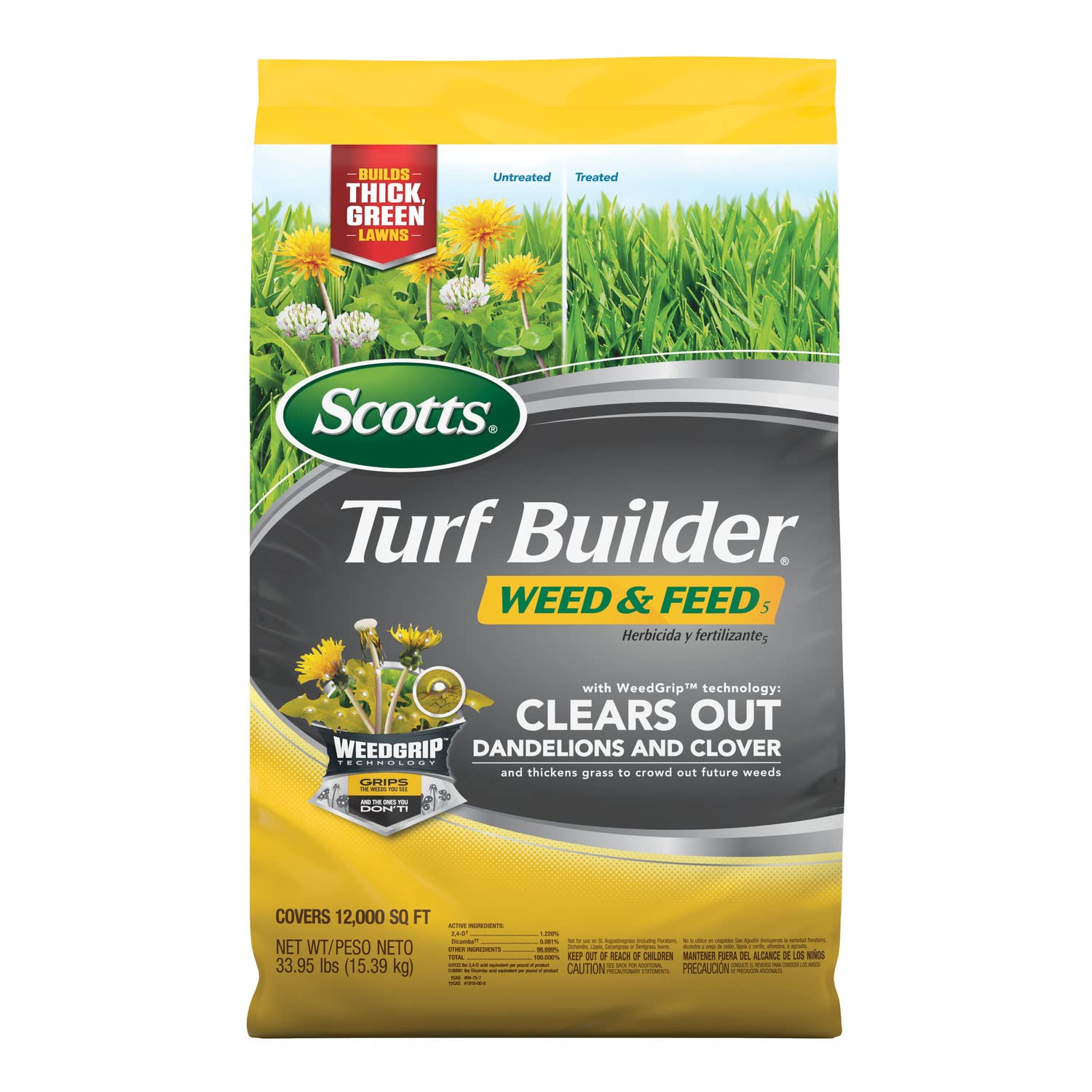
Scotts Turf Builder Weed & Feed5 Granular Weed Killer + Fertilizer, 33.95 lb
| Item Form | Granule |
|---|---|
| Coverage | 12000 square feet |
| Unit Count | 1 Count |
| Active Ingredients | 2.4-D and Dicamba |
Scotts Turf Builder Weed & Feed5 combines a selective herbicide with lawn fertilizer so you can kill common broadleaf weeds and feed grass in a single application. It is applied with a broadcast, drop, or handheld spreader to a wet lawn when daytime temperatures are between 60 and 90°F; one 33.95 lb. bag covers about 12,000 sq. ft. The formula uses WeedGrip technology and active ingredients 2,4-D and dicamba to target weeds such as dandelion and clover while the nitrogen and potassium content helps thicken grass over time. Practical benefits include fewer separate products and fewer application days during the growing season, and recommended spreader settings help achieve even coverage. Important limitations are crop restrictions and timing: do not use on St. Augustine, bentgrass, dichondra, carpetgrass, or when rain is expected within 24 hours, and follow the 24-hour no-watering rule to allow the granules to adhere. Because it contains synthetic herbicides, handle with care and keep people and pets off the treated area until dust settles.
Best for: Homeowners who want a practical, few-steps solution to reduce visible broadleaf weeds while feeding established cool- or warm-season lawns and who prefer following tested application guidance.
Less Ideal for: People managing sensitive turf species listed on the label or those seeking an organic or non-chemical weed control approach should consider alternatives.
- Combines weed control and fertilizer to reduce applications and simplify lawn care
- Large coverage per bag suitable for medium to large yards (up to 12,000 sq. ft.)
- Clear application guidance and spreader settings for even distribution
- Targets over 50 listed broadleaf weeds including dandelion and clover
- Contains synthetic herbicides that require safety precautions and application timing
- Not safe for several turf types such as St. Augustinegrass and creeping bentgrass
Verdict: If you want a single, proven granular product to both kill common broadleaf weeds and feed your lawn across a large area, this combines both functions effectively.
Scotts Turf Builder Lawn Food, 12.5 lb

| Item Form | Powder |
|---|---|
| Specific Uses For Product | Lawn |
| Coverage | 5,000 sq. ft. |
| Mixing Ratio | 32:0:4 |
Scotts Turf Builder Lawn Food is a ready-to-use granular fertilizer designed to thicken and green all grass types. You apply it with a broadcast or drop spreader following the package settings, and it can be used on wet or dry turf; light watering after application speeds visible greening. The formula focuses on feeding and root development rather than weed control or pesticides, so it helps lawns absorb water and nutrients and build deeper roots over time. The 12.5 pound bag covers roughly 5,000 square feet, making it a practical size for small to medium yards or spot treatments. Because it is a single-purpose lawn food, you may still need separate products for weed management or seasonal pest control. Also it requires careful sweeping of excess off hard surfaces and basic safety precautions like gloves and keeping it away from water bodies. For homeowners looking for a straightforward, proven fertilizer to maintain turf health, this is an easy-to-use option.
Best for: Homeowners who prioritize a low-risk, proven lawn-feeding product to maintain or improve turf health across seasons and who prefer simple, repeatable lawn care steps.
Less Ideal for: People who want an all-in-one weed and pest control solution or those managing very large properties who need higher coverage per bag.
- Formulated for all grass types so it works across mixed lawns
- Supports stronger roots and improved nutrient uptake
- Can be applied to wet or dry turf and activates faster if watered in
- Appropriate bag size for small to medium residential lawns (covers 5,000 sq. ft.)
- Does not include weed control or insect protection so additional products may be needed
- Requires a spreader and correct settings for even application
Verdict: A straightforward, reliable granular lawn food that strengthens roots and greens lawns, making it a safe go-to for everyday turf maintenance.
Choosing the Right Granular Fertilizer for Lawns: Key Factors to Consider
N-P-K Balance and Secondary Nutrients
The primary N-P-K numbers tell you what to expect from a granular fertilizer. Higher nitrogen promotes quick topgrowth and greening but can stress roots if overapplied. Phosphorus targets root development and is most relevant for new lawns or repair work. Potassium improves overall stress tolerance and wear resistance, which matters on high-traffic turf.
Secondary nutrients and micronutrients like iron, magnesium, and sulfur can correct common lawn deficiencies and affect color without increasing mowing frequency. For established lawns, choose a formula whose ratios match the season and your lawn goals. For spring green-up, formulas with higher nitrogen are appropriate. For late-season maintenance, a lower nitrogen, higher potassium blend helps strengthen turf for winter.
Release Profile and Timing
Granular fertilizers come in quick-release, slow-release, or a mixture of both. Quick-release formulas give rapid color but wear off faster and increase the risk of burn if not watered in properly. Slow-release granules deliver nutrients over weeks to months and reduce the frequency of applications and peak growth surges.
Consider your maintenance schedule and weather when choosing release type. If you mow frequently and need immediate color for a weekend, a product with a fast component helps. If you prefer low-effort maintenance, favor predominantly slow-release formulations to maintain steady growth and reduce risk of nutrient spikes.
Granule Size and Spreader Performance
Uniform granule size helps achieve an even spread and consistent nutrient distribution. Very fine granules can clog or behave unpredictably in some spreaders, while very coarse granules may not meter evenly at low application rates. Check that the product lists recommended spreader settings and that the granule shape is described for lawn use.
A fertilizer that lists spreader calibration guidance saves time and reduces overlap or missed strips. Also consider whether the granules resist dusting; dusty fertilizers can cause uneven application and waste product when wind is present during spreading.
Turf Safety and Application Windows
Even granular fertilizers that list low nitrogen content can injure grass if applied too heavily or during heat stress. Look for products that provide application rates by grass type and offer clear watering-in instructions. Timing matters: applying during cooler parts of the day and avoiding midsummer heat spikes lowers burn risk.
Also factor in mower height and recent cultural practices. Newly seeded areas need milder formulations or delayed feeding to prevent damage to seedlings. Products that specify safety for overseeding or new sod installation are preferable when renovating.
Coverage Area and Reapplication Frequency
Knowing how many square feet a bag covers at the recommended rate affects how much you buy and how often you reapply. Some granular fertilizers are concentrated and treat large areas with a single application, while others require repeat treatments for seasonal programs.
Match the coverage and longevity to your yard size and willingness to reapply. Long-lasting formulas reduce application labor but may provide slower visible results. Keep in mind that local soil fertility and rainfall patterns will change effective duration on your lawn.
When to Feed Your Lawn
Timing fertilizer applications to the lawn growth cycle produces better results than trying to force growth at the wrong time. Cool-season grasses benefit most from feeding in early spring and again in early fall, while warm-season grasses respond best when actively growing in late spring through summer.
Avoid heavy nitrogen applications during drought or extreme heat. Instead, choose lighter, slow-release feeds or wait for cooler conditions and adequate soil moisture. Water in applications when directions recommend to move nutrients into the root zone and reduce the chance of foliar scorch.
- Early spring: light feed to jumpstart growth
- Late spring/early summer: moderate feed if actively growing
- Late summer/early fall: feeding for root strength and winter prep
- Avoid heavy summer applications on cool-season turf
Applying Granular Fertilizer Evenly
Calibrate your spreader before applying any granular fertilizer. Use the product's recommended spreader setting as a starting point and test on a small area to confirm coverage. Walk at a steady pace and overlap passes slightly to avoid stripes.
For small yards or patch repairs, handheld or drop spreaders give more precision. For larger lawns, a broadcast spreader speeds the job but requires careful setup to avoid overapplication near walkways or foundations.
- Fill spreader on a paved surface to avoid spilling into soil
- Rake or sweep visible granules off hard surfaces to prevent runoff
- Water after application only if product instructs to avoid foliar burn
Managing Common Lawn Problems with Fertilizer
A granular fertilizer cannot fix all lawn issues, but choosing the right formula helps address common problems. For thin, patchy lawns, a product with moderate phosphorus and balanced nitrogen supports root recovery and tillering. For pale, yellowing turf, look for formulas that include iron or higher nitrogen for quick greening.
Resist the temptation to overapply fertilizer to correct pest or disease issues. Many problems stem from cultural care such as thatch, compaction, or improper mowing height rather than nutrient deficiency. Use fertilizer as one tool in a broader lawn care plan including aeration, dethatching, and watering adjustments.
- Pale color: consider iron-containing feeds or balanced N
- Patchy growth: focus on root-building formulas and overseed timing
- Wear areas: higher potassium helps tolerance to foot traffic
Environmental Considerations and Responsible Use
Apply fertilizers at labeled rates and avoid application before heavy rain to reduce runoff risk. Buffer zones near water bodies and careful timing during seasons with frequent storms help minimize nutrient loss to the environment.
Consider slow-release formulations to reduce nutrient pulses that can leach and to lower the number of annual applications. Testing your soil every few years informs whether you need fertilizer at all and which nutrients to prioritize.
- Check local fertilizer ordinances and seasonal restrictions
- Use drop spreaders near sensitive areas to limit drift
- Collect and clean up excess granules on pavement to prevent runoff
Storage and Handling Best Practices
Store granular fertilizer in a cool, dry place, sealed away from moisture to prevent caking and nutrient degradation. Keep bags off bare soil using pallets or shelving and away from children and pets.
When handling, wear gloves to avoid skin irritation and follow label safety directions. Dispose of empty bags per local regulations and never burn fertilizer-containing packaging.
- Keep product in original packaging with label intact
- Do not mix different fertilizers unless label permits
- Clean spreader after use to prevent cross-contamination
How We Chose the Best Granular Fertilizer for Lawns
We prioritized criteria that matter to gardeners applying granular fertilizer to turf rather than to ornamental beds. Nutrient balance was a top filter: we looked for formulations whose N-P-K ratios match common lawn goals such as greening, root development, or maintenance feeding. Release profile was essential; we favored products that clearly specify whether they release nutrients quickly, slowly, or on a mixed schedule so timing of greening and risk of burn are predictable. Application consistency and spreader compatibility were assessed to ensure even coverage and to reduce patching work after feeding. Solubility and turf safety were checked for burn potential and compatibility with typical watering and mowing practices. Longevity and coverage were reviewed to understand how many square feet a bag treats and how often reapplication is needed. We excluded specialty fertilizers formulated only for ornamentals, vegetable gardens, or indoor plants. Products lacking clear ingredient breakdowns, ambiguous release claims, or no guidance for spreading rates on lawns were removed. The final shortlist contains options that perform across these specific lawn-focused dimensions: nutrient ratio clarity, release timing, spreader-ready granule size, turf safety guidance, and predictable coverage.
FAQ
How often should I apply granular fertilizer to my lawn?
Frequency depends on the product's release profile and your lawn type. Fast-release formulas may need applications every 4 to 6 weeks during the growing season, while slow-release options can feed for 8 to 12 weeks. Base the schedule on manufacturer guidance and observed turf response.
Can I use granular fertilizer after overseeding?
It often depends on the label. Some granular fertilizers are safe for overseeding when applied at reduced rates, while others can harm seedlings. Use products that specify compatibility with seeding or wait until seedlings are established before applying full-strength feeds.
Will granular fertilizer burn my grass?
Granular fertilizers can burn turf if overapplied or left on blades without watering in, especially high-nitrogen quick-release types. Follow recommended rates, spread evenly, and water according to product instructions to minimize burn risk.
Is soil testing necessary before fertilizing?
Soil testing is recommended every few years to identify nutrient deficiencies and pH issues. Testing helps you choose a formula that supplies the nutrients your lawn actually needs rather than applying generic feeds that may not address the problem.
How do I choose the right spreader setting?
Start with the fertilizer's suggested setting for your spreader model, then test on a small strip and measure coverage. Adjust settings to match the recommended application rate per 1,000 square feet. Calibration reduces overlap and prevents under- or overapplication.
Final Verdict
Choosing the right granular fertilizer for lawns comes down to matching nutrient ratios and release profiles to your turf type, season, and maintenance habits. Prioritize clear N-P-K information, predictable release timing, and products with spreader guidance to avoid uneven feeding or burn. Balance coverage needs against how often you want to reapply and aim for responsible timing to reduce environmental impact. Use the evaluation criteria earlier in this guide to select a formula that fits your lawn goals. When you align fertilizer choice with soil test results and proper application technique, you will get more consistent greening, stronger roots, and less frequent corrective work.
