

Note: This article contains affiliate links. If you click on these links and make a purchase, I may earn a small commission at no extra cost to you. This helps support my research and content. Read my full affiliate disclosure here.
Choosing the right grass root growth fertilizer matters because shallow roots make lawns vulnerable to drought, disease, and wear. The right formula encourages deeper rooting, improves water uptake, and supports a thicker, more resilient turf that recovers faster from stress. This guide covers seven shortlisted options chosen specifically for encouraging root development in home lawns and small landscape areas. We evaluated each pick against practical gardener concerns like nutrient composition, ease of application, and safety for established turf. Read on to understand how these factors affect results and which fertilizer characteristics matter most for your lawn type and maintenance routine.
Top Picks at a Glance
| Best Overall The best all-around choice for most situations | Simple Lawn Solutions Growth Booster Liquid Fertilizer (32 oz) with Humic Acid, Hose-End Sprayer |  |
| Best Quality Built to a higher standard if you want something more solid | Lawn Synergy Starter Fertilizer 15-20-10 (25 lb) |  |
| Best Value The sweet spot between price and what you get | Scotts Green Max Lawn Food (covers 5,000 sq. ft.) |  |
| Best Budget The cheapest option that still gets the job done reliably | Greenview Starter Fertilizer 10-18-10, 8 lb bag |  |
| Highest Rated A top-rated pick with lots of positive feedback | Lawn Synergy Starter Fertilizer 15-20-10 (18 lb) for New Seed & Sod | |
| Most Popular A crowd favorite that many people choose with confidence | Scotts Turf Builder WinterGuard Fall Lawn Food, 10 lb. |  |
| Best Seller A high-volume bestseller chosen again and again | Scotts Turf Builder Lawn Food, 12.5 lb |  |
Simple Lawn Solutions Growth Booster Liquid Fertilizer (32 oz) with Humic Acid, Hose-End Sprayer
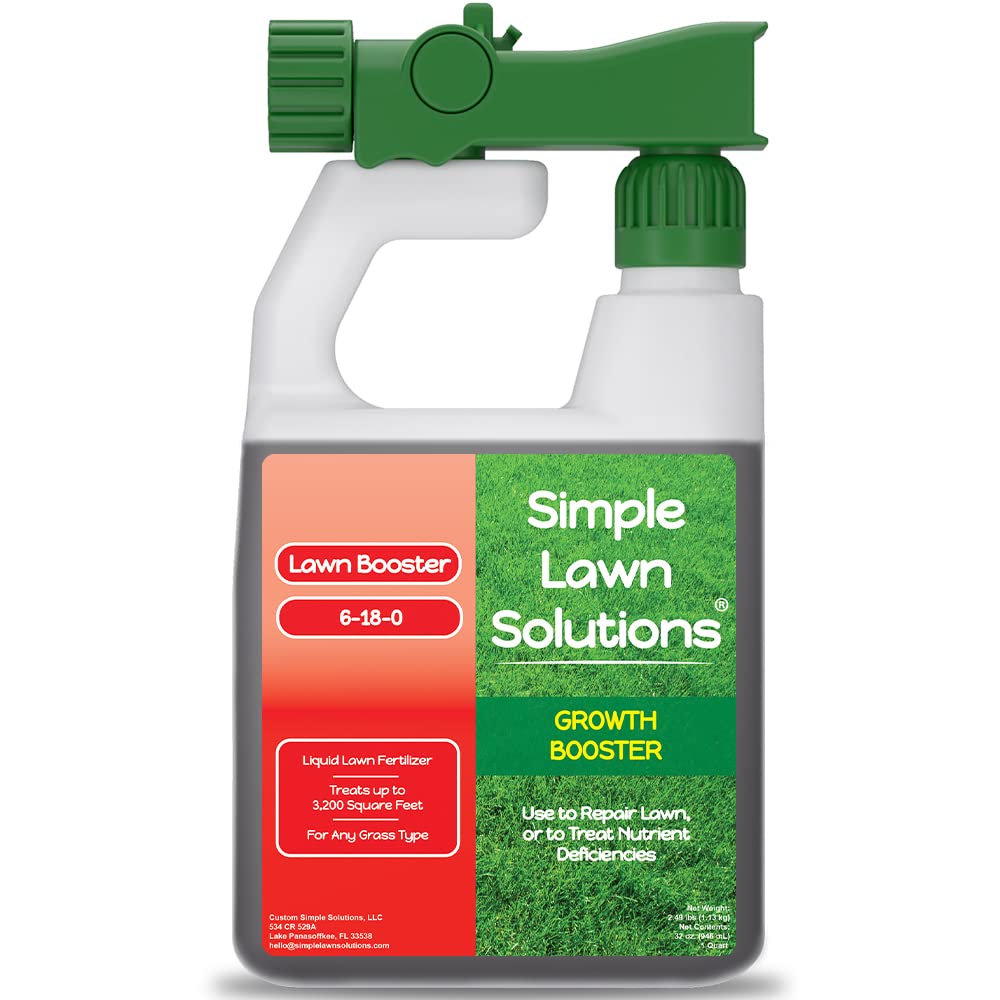
| Item Form | Liquid |
|---|---|
| Specific Uses For Product | Establishing lawn with sod or seed, Boosting vertical and lateral growth, Addressing phosphorus nutrient deficiencies |
| Application Method | Spray |
| Coverage | 3,200 square feet |
| Target Species | all grass types |
This ready-to-use growth booster is designed for establishing new lawns and encouraging faster vertical and lateral turf growth. It attaches to a hose-end sprayer and covers up to 3,200 square feet per bottle, so application is quick for medium-sized yards and for seeding or sodding jobs. The formula supplies nitrogen and a relatively high phosphorus percentage to promote seedling vigor and root development, while added humic acid helps improve nutrient availability in the soil. Practical benefits include easy hose connection, suitability for all common grass types, and a concentrate strength aimed at early-stage establishment. Limitations to note are that the product is focused on growth stimulation and phosphorus support rather than long-term balanced feeding, so it works best as a starter or boost rather than a standalone seasonal program. Users should follow the mixing directions carefully and pair this with a regular lawn food if longer-term fertility is needed.
Best for: Gardeners who want a simple, fast solution to establish new seed or sod and to accelerate early root and shoot growth without complex mixing or equipment.
Less Ideal for: Lawn owners seeking a full-season fertilizer program or those managing very large lawns where a concentrated bulk product and repeated coverage are needed.
- Ready-to-use hose-end sprayer for fast, even application over lawns
- High phosphorus content improves seedling vigor and root establishment
- Includes humic acid to enhance nutrient uptake and soil mineral availability
- Covers up to 3,200 square feet per bottle, suitable for medium yards
- Suitable for all common grass types and for both sod and seed
- Formulation is aimed at early growth and does not replace a complete seasonal fertilizer program
- Bottle volume may be small for larger properties requiring multiple applications
Verdict: A quick, hose-end starter booster that speeds root and seedling development for new lawns and repairs.
Lawn Synergy Starter Fertilizer 15-20-10 (25 lb)

| Item Form | Granules |
|---|---|
| Specific Uses For Product | Plant Growth, Root Development, Seed Development |
| Application Method | broadcast spreader |
| Coverage | 6,500 sq.ft. |
| Mixing Ratio | 15-20-10 |
This Lawn Synergy 15-20-10 starter fertilizer is made for establishing new lawns and improving early root growth when seeding or laying sod. It combines a high-phosphorus NPK ratio with a dual-source nitrogen system: XCU polymer/sulfur-coated slow-release granules for steady feeding up to about 10 weeks and ammonium sulfate for quick early color and response. The baged granules are applied with a broadcast or rotary spreader and lightly watered in to move nutrients into the root zone. Notable practical benefits include focused phosphorus to stimulate root formation, added micronutrients to reduce early stress, and a predictable release profile that reduces the need for repeat applications during establishment. Coverage is listed for large areas so a single 25 lb bag suits substantial lawns. Limitations are that application requires a spreader for even results and established lawns needing routine maintenance may prefer a balanced or lower-phosphorus feed; this product is specifically targeted at new seed or sod rather than regular feeding cycles.
Best for: Homeowners and landscapers focused on fast, reliable lawn establishment who prioritize strong root development and predictable early growth during seeding or sodding projects.
Less Ideal for: Gardeners seeking an all-purpose or seasonal maintenance fertilizer for established turf should consider a general-purpose or lower-phosphorus product instead.
- High 15-20-10 NPK with elevated phosphorus to encourage fast root development
- Dual-source nitrogen (XCU slow-release plus ammonium sulfate) for steady long and quick early nutrient availability
- Includes micronutrients to support stress tolerance and even early color
- Designed for broadcast spreader application with coverage suitable for large lawns
- Requires a spreader and light watering to be effective which adds a step versus liquid starters
- Formulated specifically for establishment so not ideal as an all-season maintenance fertilizer
Verdict: Choose this 15-20-10 starter if you want a performance-focused fertilizer that promotes rapid root establishment and steady early growth for new seed or fresh sod.
Scotts Green Max Lawn Food (covers 5,000 sq. ft.)

| Item Form | Granules |
|---|---|
| Coverage | 5000 square feet |
| Specific Uses For Product | Lawn |
| Target Species | lawn grass |
| Unit Count | 266.67 Ounce |
Scotts Green Max is a granular lawn food formulated to feed turf and speed visible greening using a 2-in-1 formula that includes 5% iron. It is intended for broadcast or drop spreader application and covers up to 5,000 square feet from a single 16.67 lb. bag. Typical use is to set a Scotts spreader to the recommended setting, walk at a steady pace, lightly water in, and reapply seasonally as directed. Notable features are the iron supplement for faster color response, a claim that granules are all nutrition with no filler, and a label guarantee that it will not stain hard surfaces when used correctly. Practical benefits include quick visible greening (the brand cites results in about three days), broad compatibility with any grass type, and simple cleanup instructions to minimize runoff. Important limitations are that it is a general lawn food rather than a specialized root-growth fertilizer so it focuses on top-growth greening rather than directed root-stimulating ingredients, and effective, even application depends on using a spreader and following specific settings. Users should follow label directions for timing and water management.
Best for: Homeowners who want an easy, fast way to improve lawn color and overall turf vigor across a medium-sized yard and who follow a seasonal feeding routine.
Less Ideal for: Gardeners seeking a fertilizer focused specifically on root development or a custom nutrient program for problem soils should consider products formulated for root growth or soil amendments.
- Includes 5% iron for faster, deeper greening
- Covers up to 5,000 sq. ft. from a single bag
- Granular format works with common broadcast or drop spreaders
- Claims minimal filler so each granule delivers nutrition
- Label includes clear spreader settings and simple cleanup guidance
- Formulated for rapid greening rather than targeted root stimulation
- Requires correct spreader settings and light watering for best results
Verdict: A simple, fast-acting granular lawn food with added iron that reliably boosts lawn greenness across a 5,000 sq. ft. area.
Greenview Starter Fertilizer 10-18-10, 8 lb bag

| NPK | 10-18-10 |
|---|---|
| Form | Granules |
| Application method | Broadcast or drop spreader |
| Coverage | 2,500 sq. ft. |
Greenview Starter Fertilizer is designed for establishing new lawns and repairing bare spots by supplying nutrients seedlings need to develop roots and germinate successfully. It is applied once at seeding using a broadcast or drop spreader, lightly raked into the topsoil, then seeded on top. The 10-18-10 formula emphasizes phosphorus to support root and seed development while providing a mix of immediate and time-release nitrogen for up to eight weeks of feeding. Practical benefits include clear application instructions, coverage of about 2,500 sq. ft. from a single 8 lb bag, and a granular form that spreads evenly with common spreaders. Limitations are that it is intended for one-time use at planting rather than regular maintenance and that it should not be hand spread. Also it does not replace follow-up lawn care like proper watering, mowing, or future maintenance fertilizations once grass is established.
Best for: Homeowners establishing or reseeding lawns who want a purpose-built starter fertilizer that promotes root development and supports seedlings through the first weeks of growth.
Less Ideal for: Gardeners who need a regular maintenance feed or a product for established lawns should choose an all-purpose or slow-release lawn fertilizer instead.
- High phosphorus 10-18-10 formula targeted for seed germination and root development
- Provides both immediate and time-release nitrogen for continued feeding up to eight weeks
- Granular form works with broadcast or drop spreaders for even coverage
- Covers approximately 2,500 sq. ft. per 8 lb bag, suitable for small to medium new lawn areas
- Formulated for one-time use at seeding and not intended for regular maintenance
- Not safe to hand spread and requires a spreader for proper application
Verdict: Choose this starter fertilizer when you need a focused, high-phosphorus feed to help new grass seed and seedlings establish strong roots.
Lawn Synergy Starter Fertilizer 15-20-10 (18 lb) for New Seed & Sod
| Mixing Ratio | 15:20:10 |
|---|---|
| Item Form | Granules |
| Specific Uses For Product | Plant Growth, Root Development, Seed Development |
| Coverage | Up to 4,500 sq.ft. |
This Lawn Synergy starter fertilizer is built for establishing new grass from seed or fresh sod, combining a 15-20-10 NPK ratio with a blend of slow-release XCU nitrogen, ammonium sulfate, and micronutrients. It is typically applied with a broadcast or rotary spreader at the recommended rate before or after seeding and lightly watered in; the XCU coating provides steady nutrient release for up to about 10 weeks while ammonium sulfate supplies quick early response and color. Practical benefits include a high-phosphorus formula that encourages strong root development, clean prills that feed evenly through spreaders, and included micros that help young turf handle establishment stress. As a professional-grade product, it requires protective handling and careful following of application rates to avoid overfeeding. The coverage claims make it suitable for mid-size lawns, but users who need very frequent feeding or prefer purely organic inputs will find this synthetic starter less appropriate.
Best for: Buyers who prioritize predictable, professional-strength performance for establishing new lawns or overseeding and want a starter fertilizer that delivers steady nutrient release and reliable root development.
Less Ideal for: Gardeners committed to organic programs or those needing a general-purpose maintenance fertilizer for established lawns should consider alternative products.
- High-phosphorus 15-20-10 formula targeted for root development and seedling establishment
- XCU slow-release nitrogen provides steady feeding for up to about 10 weeks
- Mix of slow and fast nitrogen sources gives both early green-up and sustained growth
- Clean, uniform granules spread evenly through broadcast or rotary spreaders
- Includes micronutrients to support stress tolerance and even color in young turf
- Synthetic formulation may not suit gardeners seeking organic-only options
- Requires careful PPE and handling because it is professional-grade
- Not intended for frequent routine feeding once lawn is established
Verdict: Choose this starter fertilizer when you want a dependable, pro-grade product that promotes fast germination and strong root establishment for new seed or sod.
Scotts Turf Builder WinterGuard Fall Lawn Food, 10 lb.

| Item Form | Granules |
|---|---|
| Specific Uses For Product | Lawn Fertilizer |
| Application Method | spread |
| Coverage | 4000 |
| Target Species | lawn grasses |
Scotts Turf Builder WinterGuard Fall Lawn Food is a granular fertilizer formulated for autumn application to strengthen root systems and help turf recover from summer heat, drought, and heavy use. It is applied with a broadcast or drop spreader over the lawn in fall and can be used on any grass type; one 10 lb. bag covers about 4,000 sq. ft. Notable features include a spreadable granule form that works on wet or dry grass and straightforward spreader settings listed on the label for DIY homeowners. In practice the product delivers a nutrient boost that helps grasses build deeper roots for better winter resilience and improved green-up next spring. The formula does not require immediate watering in, though a light irrigation speeds activation. Limitations are typical for single-application bag sizes — coverage is modest for larger yards and users will need to follow spreader calibration closely to avoid uneven application. The product is primarily a root-strengthening fall feed rather than a year-round program or weed control treatment.
Best for: Homeowners who prioritize proven seasonal lawn care and want a straightforward fall feed to strengthen roots and improve spring recovery, and who prefer products with wide user adoption and clear application guidance.
Less Ideal for: People looking for an all-in-one weed control and fertilizing solution or those managing very large lawns who need bulk coverage from a single purchase.
- Specifically formulated for fall to encourage deeper, stronger grass roots
- Works on any grass type and can be applied to wet or dry turf
- Clear spreader settings and simple application for DIY homeowners
- One 10 lb. bag covers approximately 4,000 sq. ft., suitable for small to medium lawns
- 10 lb. bag provides limited coverage for larger yards, requiring multiple bags
- Not a combined weed-and-feed formula so weeds are not addressed by this product
Verdict: Choose this fall lawn food when your priority is building deep, winter-ready grass roots with an easy, DIY application.
Scotts Turf Builder Lawn Food, 12.5 lb

| Item Form | Powder |
|---|---|
| Specific Uses For Product | Lawn |
| Coverage | 5,000 sq. ft. |
| Target Species | grass |
| Mixing Ratio | 32:0:4 |
Scotts Turf Builder Lawn Food is a granular fertilizer designed for routine lawn feeding to thicken turf and strengthen root systems. It is applied with a broadcast or drop spreader and can be used on wet or dry lawns in spring, summer, or fall. The formulation is pesticide-free and intended to improve a lawn's ability to absorb water and nutrients by promoting deeper roots and denser top growth. One 12.5 pound bag covers about 5,000 square feet and Scotts provides recommended spreader settings for consistent application. In practice this product works well as a low-effort maintenance feed that complements regular mowing and watering. Expect gradual green-up and better drought resilience over successive applications rather than an immediate dramatic change. Limits to consider are that it is a general lawn food rather than a targeted root stimulator with specialized micronutrients, and correct spreading is important to avoid uneven results. For homeowners who want a dependable, easy-to-use feed to support stronger roots, this is a sensible choice.
Best for: Homeowners who prioritize predictable, low-risk lawn care and want an easy, routine fertilizer to gradually build root strength and overall turf health.
Less Ideal for: Gardeners seeking an intensive, fast-acting root stimulator or a product tailored to specific nutrient deficiencies should consider more specialized root-building formulations.
- Promotes stronger, deeper roots and thicker turf across all common grass types
- Can be applied to wet or dry lawns and includes spreader settings for consistent coverage
- Covers approximately 5,000 sq. ft. per 12.5 lb bag for routine maintenance
- Pesticide-free formula suitable for regular seasonal feeding
- General-purpose formula without specialized root-targeting micronutrients
- Requires a spreader and correct settings to achieve even application
Verdict: A reliable, easy-to-use lawn food for homeowners who want steady improvement in root strength and turf density without specialized products.
Choosing the Right Grass Root Growth Fertilizer: Key Factors to Consider
Nutrient Balance Favoring Roots
A fertilizer meant to boost root growth should provide a nutrient profile that encourages belowground development. Moderate phosphorus and potassium levels, relative to nitrogen, support root initiation and carbohydrate storage in root tissues. Excessive nitrogen drives leaf growth at the expense of roots, so you want a formula that shifts the plant's resource allocation downward.
Look for clearly stated N-P-K ratios and sources of each element. Phosphorus as bone-fide phosphate and potassium as soluble potash are useful for root activity. Slow-release nitrogen can help maintain balanced growth without forcing excessive shoot elongation, which otherwise increases the plant's water demand and stresses roots.
Root Stimulants and Soil Biologics
Many modern root-focused fertilizers include biostimulants such as seaweed extracts, humic substances, amino acids, or beneficial microbes. These ingredients do not replace essential nutrients but can increase root branching, improve nutrient uptake, and enhance soil structure around the root zone. Mycorrhizal inoculants, where appropriate, help fine roots explore more soil volume for water and nutrients.
Consider whether your lawn will actually benefit from added biologics. Established, healthy turf in fertile soils may see smaller gains than newly seeded or compacted lawns. Also note that biological products are often sensitive to storage and application conditions, so follow label guidance to preserve their effectiveness.
Application Method and Timing
How you apply the fertilizer affects how roots respond. Granular products spread with a broadcast or drop spreader and release nutrients slowly, which is convenient for large areas. Water-soluble or liquid options deliver nutrients quickly and can be applied through hose-end sprayers or irrigation systems for faster uptake.
Timing is crucial. Apply root-focused fertilizers when grasses are actively growing and can move carbohydrates to roots. For cool-season lawns, early spring or late summer into fall is often best. For warm-season grasses, late spring through summer when roots are expanding is ideal. Avoid applying high-phosphorus products when the grass is dormant or under severe drought stress, as uptake will be limited.
Soil Type and pH Influence
Soil texture and pH govern nutrient availability and root penetration. Sandy soils drain quickly and may need more frequent, lighter applications to keep nutrients in the root zone. Clay soils hold nutrients but can limit root penetration if compacted, so managing compaction and choosing a formulation with humates or organic matter can help.
Test soil pH before committing to a fertilizer. Phosphorus availability declines in very acidic or very alkaline soils, so root-targeted products may be less effective unless pH is adjusted. Addressing pH and structure alongside fertilization gives roots the environment they need to grow deeply.
Turf Variety and Growth Habit
Different grass species respond differently to fertilization. Cool-season grasses typically build roots in cooler parts of the year and may benefit most from applications timed for late summer and fall. Warm-season grasses push root growth in warm months and need nutrient programs that support that seasonal pattern.
Know your turf type and follow recommendations for that species. A product that works well on one grass may not produce the same results on another, especially if the nutrient ratios or biostimulants are not matched to the growth cycle of your lawn.
Environmental and Safety Considerations
Fertilizer misapplication can lead to runoff, nutrient leaching, and damage to non-target plants or water bodies. Choose products with clear application rates and timing to reduce environmental risk. Slow-release formulas and incorporation of organic carriers can lower the chance of rapid nutrient loss.
Observe buffer zones near waterways, follow local regulations on phosphorus use if applicable, and avoid overapplication that can burn turf. Proper calibration of spreaders or sprayers and adherence to label instructions protect both your lawn and the surrounding environment.
When Root-Focused Fertilizer Is Worth Using
Root-targeted fertilizer is particularly useful when you need deeper rooting for drought resilience, when establishing new turf, or when renovating thin or compacted lawns. If your grass shows shallow rooting, slow recovery after wear, or poor drought resilience, a product that encourages root development can change how the turf uses water and nutrients.
Conversely, regularly fed, vigorous lawns in fertile soils may not see dramatic benefits. Use root-focused products as part of a broader program that includes aeration, proper mowing, and irrigation adjustments to get the best results.
- Good for new seeding and sodding to speed establishment
- Helpful after aeration or topdressing to encourage new root penetration
- Useful before drought-prone seasons to build root reserves
Application Tips for Best Root Response
Apply fertilizer when the grass is actively growing so photosynthates are available to support root growth. Light irrigation after application helps move soluble nutrients into the root zone without creating runoff. For granular products, calibrate your spreader and overlap passes carefully to avoid stripes.
Split applications can be more effective than a single heavy dose. Smaller, repeated applications keep nutrients available in the root zone and reduce the risk of burn. Always follow label rates and adjust timing based on local weather and grass type.
- Water in lightly after application to move nutrients down
- Use split applications for longer-lasting root stimulation
- Avoid fertilizing during heat waves or drought stress
Combining Fertilizer With Cultural Practices
Fertilizer is most effective when combined with practices that improve soil conditions. Core aeration reduces compaction and allows roots to penetrate more easily. Following aeration with a root-growth fertilizer helps newly opened soil accept nutrients and encourages roots to explore the loosened profile.
Topdressing with a thin layer of compost along with an appropriate fertilizer can improve organic matter and water-holding capacity, supporting deeper roots over time. Mowing at the correct height and maintaining consistent but moderate irrigation also shift the plant's allocation toward stronger root systems.
- Aerate before applying root-focused products on compacted lawns
- Topdress with compost to improve soil texture and nutrient retention
- Maintain correct mowing height to support root energy storage
Signs Your Lawn Is Responding
Visible signs of improved rooting include better drought tolerance, quicker recovery from traffic, and more uniform green-up after growth periods. You may not see roots directly without digging, but the turf's function-water uptake, resistance to wilting, and ability to thicken-gives practical feedback.
Allow several weeks to a few months for root changes to translate into aboveground improvements depending on product type and season. Evaluate results across a growing season rather than expecting immediate topgrowth changes.
- Reduced wilting between irrigations
- Faster repair of worn patches
- Denser turf canopy over time
Safe Storage and Handling
Store fertilizers in a cool, dry place away from children and pets. Keep granular products in sealed containers to prevent moisture clumping and preserve even spreading. Liquid and biological products often have shorter shelf lives and may require refrigeration or use within a certain period after opening.
Label instructions usually include safety guidance for mixing and application. Use personal protective equipment as recommended, and clean equipment after use to avoid cross-contamination with other garden chemicals.
- Keep materials dry and sealed
- Follow label storage life recommendations for biologicals
- Clean spreaders and sprayers after each use
How We Chose the Best Grass Root Growth Fertilizer
We prioritized products formulated to stimulate root elongation and root mass rather than just topgrowth. Evaluation focused on measurable, garden-relevant dimensions: active nutrient ratios that favor root development, presence and concentration of root-stimulating compounds such as phosphorus and potassium in appropriate forms, and whether the product includes beneficial biostimulants or mycorrhizal inoculants that aid root establishment. Application practicality was another filter. We looked for fertilizers with clear application windows, manageable spreading or spraying requirements, and instructions that fit typical homeowner schedules. Safety and turf compatibility were assessed by checking recommended rates for common cool-season and warm-season grasses and whether the product minimizes burn risk when applied correctly. We excluded products aimed solely at fast green-up or high nitrogen topgrowth, granular blends with undisclosed ratios, and options intended only for new sod installation. The final list emphasizes reliable root-focused formulations, usable application methods, and formulations that align with common lawn maintenance practices.
FAQ
How soon will I see deeper roots after applying a root-focused fertilizer?
Root growth is gradual. You may notice improved drought tolerance and recovery in a few weeks, but measurable root depth increases often take months and are influenced by season, soil, and turf type.
Can I use root growth fertilizer on newly sodded or seeded lawns?
Yes. Products designed for root establishment can help young turf develop a strong root system. Choose formulations and application rates appropriate for seedlings or new sod and follow seeding or sodding guidance.
Is phosphorus always necessary for root development?
Phosphorus supports root initiation and energy transfer, but availability depends on soil pH and existing soil phosphorus. A soil test helps determine if additional phosphorus is needed rather than applying it by default.
Will a root-focused fertilizer prevent drought stress entirely?
No. Deeper roots improve drought resilience but do not replace proper irrigation, soil management, and species selection. Combine fertilization with cultural practices like mulching, aeration, and adjusted watering schedules for best results.
Are biological additives like mycorrhizae worth using on lawns?
They can be beneficial in disturbed or poor soils and for new installations. Results vary with soil conditions and product quality, so consider them as part of an integrated program rather than a cure-all.
How often should I apply a root-targeted fertilizer?
Frequency depends on the product form and its release profile. Slow-release granular products often require fewer applications per season, while soluble or liquid treatments may be applied more frequently in smaller doses. Follow label intervals and align timing with active root growth periods.
Final Verdict
Prioritize a fertilizer that supports root development through an appropriate nutrient balance, included root stimulants if beneficial, and an application method you will use consistently. Pair products with cultural practices such as aeration, correct mowing, and soil amendment to maximize root response. Focus on matching product timing to your turf species and soil conditions. By weighing nutrient composition, application ease, and turf safety, you can select a root-focused program that produces deeper, more resilient lawn roots over the season.
