

Note: This article contains affiliate links. If you click on these links and make a purchase, I may earn a small commission at no extra cost to you. This helps support my research and content. Read my full affiliate disclosure here.
If you have gullies, bare slopes, or exposed soil after construction, the right ground cover can stop runoff, build organic matter, and protect roots from washing away. Choosing the best ground cover for soil erosion matters because plants are doing heavy lifting: their stems slow water, leaves protect topsoil from raindrop impact, and roots bind soil layers together. This guide profiles seven shortlisted ground covers chosen for real-world erosion control across slopes, banks, and disturbed sites. We evaluated each pick on coverage speed, root structure, durability under runoff, and maintenance needs so you can match a planting to your site conditions.
Top Picks at a Glance
| Best Overall The best all-around choice for most situations | Sandbaggy Coir Erosion Control Mat (4 ft x 80 ft Roll) |  |
| Best Quality Built to a higher standard if you want something more solid | Super Geotextile 6 oz Non-Woven Geotextile Fabric, 3 x 50 ft |  |
| Best Value The sweet spot between price and what you get | GRASSCLUB 3ft x 300ft Heavy-Duty Weed Barrier Landscape Fabric |  |
| Best Budget The cheapest option that still gets the job done reliably | Groweco Heavy-Duty Weed Barrier Landscape Fabric, 1.4 ft x 50 ft |  |
| Highest Rated A top-rated pick with lots of positive feedback | ExploreHorizon 6 ft x 300 ft Heavy-Duty Weed Barrier Landscape Fabric (3.24 oz) |  |
| Most Popular A crowd favorite that many people choose with confidence | GardenMate 6 x 33 ft Weed Control Fabric, 100 g/m² UV-Stabilized Polypropylene |  |
| Best Seller A high-volume bestseller chosen again and again | Pterying Weed Barrier Landscape Fabric, 2.6ft x 100ft |  |
Sandbaggy Coir Erosion Control Mat (4 ft x 80 ft Roll)

| Material Type | Coir, Jute |
|---|---|
| Size | 4 ft by 80 ft Roll Size or 320 sq ft |
| Item Thickness | 0.5 inches |
| Other Special Features of the Product | Biodegradable |
| Water Resistance Level | Waterproof |
This Sandbaggy coir mat uses dense coconut fiber bound with jute backing to hold soil, reduce runoff, and protect seeded slopes while vegetation establishes. It is installed by rolling the mat over the prepared slope, securing it with staples or pins, and anchoring the edges so the fibers trap sediment and retain moisture for seed germination. Notable features are its biodegradable natural-fiber construction and substantially longer service life than straw options, with the manufacturer stating roughly 2 to 5 years of functional erosion control on steep or wet sites. Practical benefits include good moisture retention to aid germination, minimal environmental impact as the mat decomposes, and coverage that makes it suitable for restoring riverbanks, oceanfronts, and hillsides. Important limitations are that natural coir will eventually break down so long-term permanent stabilization will require vegetation or structural measures, and installation on very rocky or irregular ground may need trimming and extra fasteners for secure anchoring.
Best for: Buyers who want an environmentally friendly, medium-term erosion-control solution for restoring slopes, streambanks, or coastal edges and who plan to establish vegetation rather than install permanent hardscape. Ideal for homeowners, land managers, or conservation projects seeking balance between durability and ecological impact.
Less Ideal for: Not the best choice for projects needing permanent, non-biodegradable armoring or for tiny urban container gardens and finished lawns where aesthetics of a natural fiber roll are undesirable.
- Made from dense coir and jute for effective soil retention and moisture buffering
- Biodegradable so it supports vegetation establishment and leaves no synthetic residue
- Rated to last multiple years, offering longer durability than straw blankets
- Large roll coverage reduces seams and speeds installation on medium to large erosion sites
- Natural fibers decompose over time so it is not a permanent hard armor solution
- Requires mechanical anchoring and careful edging on very steep or rocky terrain to stay secure
Verdict: Choose this coir mat when you need a long-lasting, eco-friendly erosion-control cover that stabilizes soil while native vegetation establishes.
Super Geotextile 6 oz Non-Woven Geotextile Fabric, 3 x 50 ft
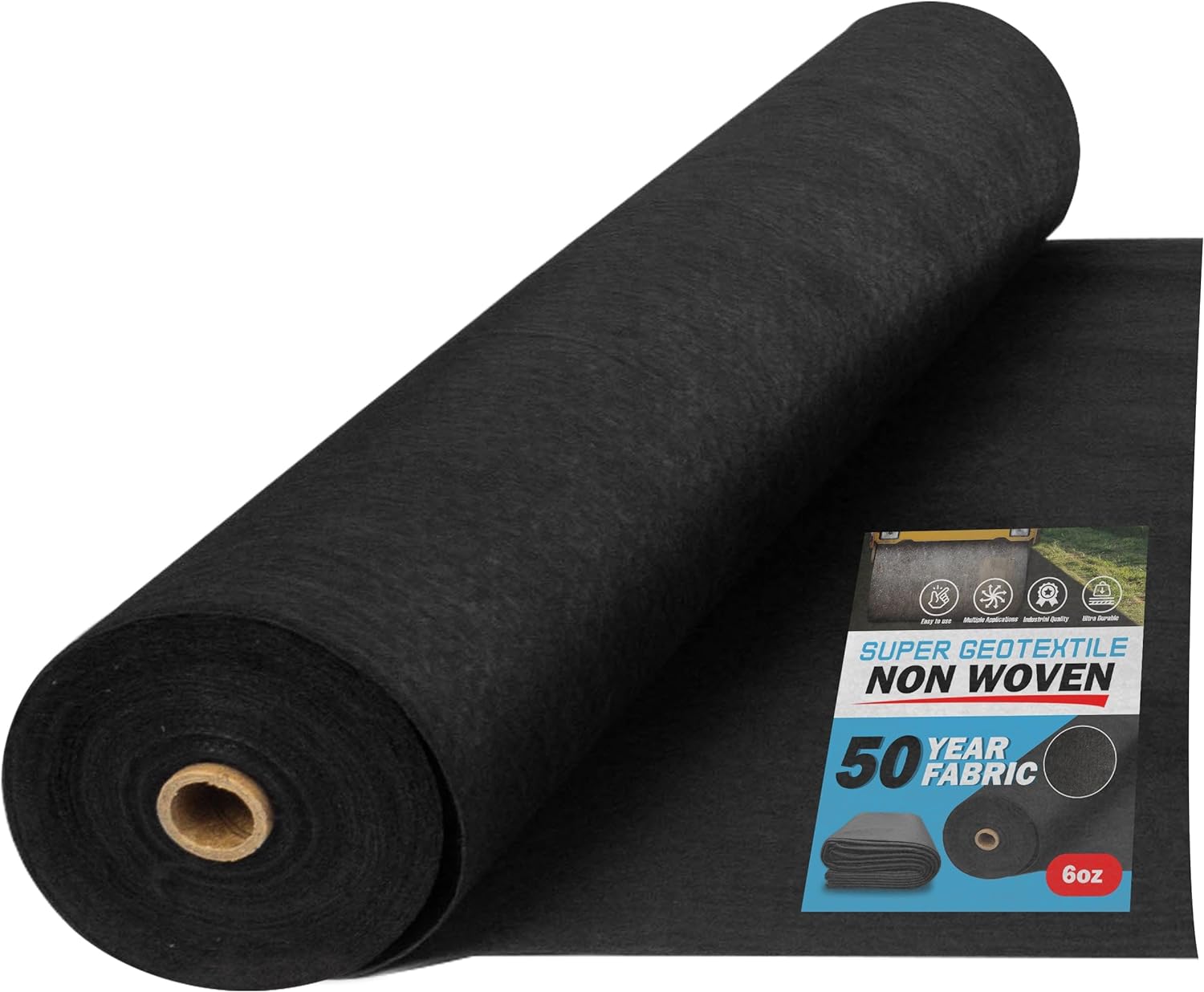
| Weight | 6 ounce |
|---|---|
| Type | Non-woven geotextile |
| Applications | Erosion control, drainage, underlayment, landscaping |
| UV/rot resistance | Yes |
This 6 ounce non-woven geotextile from Super Geotextile is built for heavy-duty soil stabilization and erosion-control work. Installed as a single-piece underlayment or filter layer, it separates soil from aggregate, promotes drainage for French drains and riprap, and reduces washout on slopes and retaining walls. Notable features include its higher fabric weight for tensile strength, UV and rot resistance for extended outdoor life, and availability in long cut lengths to minimize seams. In practice it speeds installation because larger rolls cut down on joins and makes for a more consistent filtration layer beneath gravel, soil, or pond liners. Practical limitations are that it is a fabric only so it must be paired with proper drainage aggregate, stakes or staples for secure fastening, and correct overlap/seam technique on steep sites; it does not replace structural erosion measures like toe-anchors or hard armoring. For performance-focused erosion control this fabric provides a durable, low-maintenance filter layer that holds up under heavy use when installed correctly.
Best for: Gardeners, contractors, and property owners who need a durable, long-lasting fabric to control soil erosion and build reliable drainage solutions on slopes, beds, or pond sites.
Less Ideal for: People looking for a standalone structural solution or a decorative groundcover; those projects requiring immediate hard armoring or vegetation-based erosion control should consider other options.
- 6 oz heavy-weight construction for greater tensile strength and durability
- UV and rot resistant for extended outdoor lifespan
- Available in long single-piece cuts to reduce seams and speed installation
- Functions as an effective filter layer for drainage applications like French drains and riprap
- Fabric must be used with appropriate aggregate, fasteners, and proper installation technique to perform as intended
Verdict: Choose this heavy 6 oz non-woven geotextile when you need a robust, long-lasting filter layer for serious erosion control and drainage projects.
GRASSCLUB 3ft x 300ft Heavy-Duty Weed Barrier Landscape Fabric

| Material | Woven polypropylene (PP) |
|---|---|
| Coverage | 900 sq ft |
| Tensile strength | 400 LBS |
| Fabric weight | 3.2 oz |
This GRASSCLUB woven weed barrier is a practical, heavy-duty landscaping fabric intended to block weeds while letting water and air pass through. Sold as a 3 ft by 300 ft roll (900 sq ft), it is typically laid under mulch, gravel, or artificial turf and cut to fit beds, pathways, and driveways. The 3.2 oz high-density PP material and listed 400 lb tensile strength mean it holds up under stone or light vehicle traffic and helps reduce soil erosion and rutting when used as underlayment. Its permeability lets irrigation and rain drain without washing soil away, which supports plant health and soil stability. Installation is straightforward with landscape staples or pins, and the roll format reduces seams for large areas. Limitations to note are that woven PP is not biodegradable and can be harder to remove later than lighter fabrics, and over time weeds may emerge at cut edges or through accumulations of organic material on top. For practical erosion control and long-lasting weed suppression in gardens, beds, and gravel driveways this fabric is well suited.
Best for: Buyers who prioritize a durable, long-lasting solution to control weeds and stabilize soil across larger beds, paths, or gravel driveways and who plan installations that benefit from a single large roll.
Less Ideal for: People seeking a temporary or fully biodegradable groundcover solution or those who expect frequent replanting and need an easily removable fabric.
- Heavy woven polypropylene construction resists tearing and supports up to 400 lb tensile strength
- Good water and air permeability preserves drainage and soil moisture
- Large 900 sq ft roll reduces seams when covering bigger erosion-prone areas
- Durable enough to support gravel or stones for driveway and pathway stabilization
- Non-biodegradable polypropylene that will remain in the soil long-term
- Can be difficult to remove once covered with mulch or gravel
Verdict: A robust, high-tensile woven fabric that reliably suppresses weeds and stabilizes soil for long-term erosion control across large areas.
Groweco Heavy-Duty Weed Barrier Landscape Fabric, 1.4 ft x 50 ft

| Material | Polypropylene (PP) |
|---|---|
| Weight | 3.2 OZ |
| Available widths | 1.4FT, 2.8FT, 6FT, 15FT |
| Available lengths | 50FT, 100FT |
| Intended use | Landscape weed barrier, underlayment for artificial grass |
The Groweco heavy-duty weed barrier is a woven polypropylene landscape fabric intended as a low-maintenance ground cover under mulch, gravel, artificial turf, or around planting beds. It comes with printed alignment lines to make straight cuts and installation easier and is sold in multiple widths and lengths to suit small garden runs or longer pathways. The fabric’s 3.2 oz weight gives it noticeable tear resistance for routine foot traffic and tool use, while its woven construction still permits water and air to reach the soil so plants do not suffocate. In practice it reduces weed germination by blocking light to seeds and simplifies mulching jobs, speeding up maintenance. Limitations are that it must be trimmed around plants and anchored properly to avoid movement, and it will eventually degrade under heavy UV exposure so it is better for mulched or covered applications than exposed decorative beds. For a budget-focused ground cover solution this fabric balances durability and breathability for many common garden uses.
Best for: Gardeners who need an inexpensive, practical ground cover to reduce weeding and speed up maintenance in beds, paths, or under artificial turf. Good for homeowners prioritizing straightforward installation and low upfront cost.
Less Ideal for: Those seeking a permanent, fully UV-stable solution for exposed driveways or decorative beds should consider heavier geotextiles or hard landscaping alternatives.
- Woven polypropylene construction blocks weed germination while allowing water and air through
- Printed green guide lines simplify alignment and cutting during installation
- 3.2 oz weight gives improved tear resistance for routine garden use
- Versatile for use under mulch, gravel, artificial turf, walkways and vegetable beds
- Will eventually degrade with prolonged UV exposure if left uncovered
- Requires edging or staples and trimming around existing plants during installation
Verdict: A cost-conscious, heavy-duty woven fabric that reliably blocks weeds while letting water and air through, making it a practical choice for everyday garden ground cover.
ExploreHorizon 6 ft x 300 ft Heavy-Duty Weed Barrier Landscape Fabric (3.24 oz)

| Material | Woven polypropylene |
|---|---|
| Weight | 3.24 oz per yd² |
| Coverage | 6 ft x 300 ft (1800 sq ft) |
This 6 x 300 ft woven polypropylene landscape fabric is built for large erosion-control and weed-suppression projects. The 3.24 oz material is described as tear-resistant and weatherproof, so it can be rolled out across slopes, flower beds, driveways, or other vulnerable ground to limit weed germination and help hold soil in place. The fabric is permeable, which lets water and air reach the soil beneath and helps avoid surface puddling while conserving soil moisture. Installation is straightforward: clear the area, lay the fabric with the textured side down, cut plant holes as needed, and secure with staples before covering with mulch or stone. Because it comes in a single 6 by 300 ft roll, it covers a large footprint without seams for many yards of work. The main trade-offs are handling a heavy long roll during installation and the need to cut openings for existing plants, which can add time on complex beds. It is not a permanent fix for severe erosion where engineered solutions are required, but it is a practical, durable option for stabilizing soil and reducing weed pressure on slopes and large landscapes.
Best for: Gardeners and landscapers who need a dependable, long-running ground cover to stabilize soil and suppress weeds over large areas and slopes and who prioritize durability and predictable performance.
Less Ideal for: People seeking a temporary or decorative-only solution for small container beds or those who need engineered erosion control for severe washouts or unstable soils.
- Large single-roll coverage (6 x 300 ft) reduces seams and installation joins
- Woven polypropylene construction offers tear resistance and weatherproofing for multi-season use
- Permeable design lets water and air pass to prevent puddling and retain soil moisture
- Suitable for erosion control on slopes and for use under mulch or decorative stone
- Roll is heavy and bulky to handle alone during layout and fastening
- Not a substitute for structural erosion control where engineered materials or contouring are required
Verdict: Choose this durable, high-coverage polypropylene fabric when you need a reliable, permeable ground cover to reduce erosion and suppress weeds across large landscape areas.
GardenMate 6 x 33 ft Weed Control Fabric, 100 g/m² UV-Stabilized Polypropylene

| Material Type | Polypropylene (PP) |
|---|---|
| Fabric Weight | 100 grams_per_square_meter |
| Item Thickness | 100 mils |
| Unit Count | 215.28 Square Feet |
This GardenMate woven landscape fabric is a straightforward heavy-duty weed barrier for garden beds, paths, and under mulch. Made from UV-stabilized polypropylene at about 100 g/m², it is tear resistant and intended for long-term outdoor use; the weave is breathable so water, air and nutrients reach the soil while light is blocked to suppress weed growth. Typical use is laying the fabric over prepared soil, overlapping edges by at least 10 cm and securing with pins or anchors before covering with mulch, gravel or soil. Notable features are the advertised UV protection and a weight that balances durability with easy cutting using household scissors. Because it is not fully waterproof, it will still allow drainage and is suitable under paving or in raised beds. Limitations are that visible seams must be properly overlapped to prevent weeds at joins and it will not stop deep-rooted perennial weeds without additional mechanical control. For buyers concerned about longevity and proven results, this product presents a practical, low-maintenance weed suppression option when installed correctly.
Best for: Gardeners who prioritize proven, low-maintenance weed suppression and want a durable, UV-stabilized fabric they can install under mulch, gravel, or paving.
Less Ideal for: People seeking a completely impermeable membrane for pond liners or projects that require a waterproof barrier should consider a different product.
- UV-stabilized polypropylene resists sunlight degradation for longer outdoor life
- Breathable weave allows water and air to reach soil while blocking light to suppress weeds
- Heavy woven construction (100 g/m²) offers good tear resistance and durability
- Easy to cut and shape with household scissors for custom beds and paths
- Not water resistant when a fully impermeable barrier is required
- Seams need careful overlap and securing to prevent weeds emerging at joins
Verdict: Choose this UV-stabilized, heavy woven polypropylene fabric if you want a durable, breathable weed barrier for long-term garden beds and paths.
Pterying Weed Barrier Landscape Fabric, 2.6ft x 100ft

| Material | Woven polypropylene |
|---|---|
| Weight | 2 oz per square yard |
| Permeability | Water- and air-permeable |
| Intended uses | Garden beds, gravel underlayment, pathways |
This woven polypropylene landscape fabric is intended as a durable, general-purpose weed barrier for flower beds, vegetable gardens, pathways, and under gravel. It blocks sunlight to prevent weed seed germination while remaining water- and air-permeable so irrigation reaches roots and the soil can breathe. Installation is straightforward: roll out, use the green alignment stripes for spacing, cut planting Xs, and secure edges with staples or U-pins; the manufacturer recommends taping cut lines to reduce fraying. At 2 to 2.4 ounces per square yard this is a midweight option that balances tear resistance with ease of handling, so it will support gravel underlayment and light driveway use but is not the heaviest commercial grade. The fabric is advertised as UV-stabilized for extended outdoor life and safe for use around edibles because it is polypropylene and non-leaching. Expect reliable weed suppression when seams are overlapped and edges are well anchored, but very aggressive perennial roots or weeds may eventually find weak points if not paired with proper edging and maintenance.
Best for: Buyers who want a reliable, easy-to-install weed barrier for beds, vegetable gardens, and light landscape underlayment and who prioritize predictable, low-risk performance over specialty heavy-duty options.
Less Ideal for: People needing the toughest commercial-grade fabric for heavy vehicle driveways or sites with persistent deep-rooted weeds should consider heavier-weight geotextiles or mechanical methods instead.
- Woven polypropylene construction blocks light while allowing water and air to pass
- Green alignment stripes simplify planting layout and spacing
- Midweight fabric with tear resistance suitable for garden beds and gravel underlayment
- UV-stabilized and described as non-leaching, making it safe for vegetable gardens
- Not the heaviest commercial grade so very aggressive roots or heavy vehicle traffic may require a heavier option
- Landscape staples or pins are sold separately and needed for reliable edge security
Verdict: A dependable midweight woven weed barrier that balances durability and breathability for low-risk garden and landscape projects.
Choosing the Right Ground Cover for Soil Erosion: Key Factors to Consider
Rooting Habit and Soil Binding
How roots develop determines whether a ground cover merely masks soil or actually binds it. Plants with fibrous, dense root mats or deep, anchoring roots hold soil particles together and resist pullout during heavy runoff. Consider both lateral root spread to tie surface layers and vertical root depth to connect surface soils to more stable subsoil.
On sloped sites, look for species that produce interlocking roots and resist surface sloughing. Shallow-rooted plants may still be useful on gentle slopes or as temporary cover, but long-term erosion control generally needs species that grow a durable belowground network.
Speed of Establishment and Coverage
Fast-establishing ground covers reduce the window when soil is exposed and vulnerable. Coverage rate is about how quickly stems and leaves create a continuous canopy that breaks raindrop impact and slows surface flow. Rapid lateral spread from stolons or dense seeding can close gaps before rills form.
Seeds, plugs, or mats each have different timelines and establishment risks. Seeded covers can be economical but may need mulching and protection until germination; plugs and matting give quicker surface protection but cost more and may require better initial moisture management.
Tolerance to Moisture Extremes
Sites prone to erosion often see both wet and dry stress: saturated soils during storms and drought between events. A ground cover that tolerates periodic inundation without root rot and also survives dry spells will maintain continuous protection. Species adapted to your site's typical moisture regime prevent seasonal dieback that would expose soil.
On banks with concentrated flow, choose covers that resist scouring and can regrow from surviving root crowns after short-term flooding.
Soil and Sun Compatibility
Match plant choices to local soil texture and sunlight. Coarse, sandy soils drain quickly and favor plants with deep anchoring roots, while heavy clays need species that tolerate poor drainage and can penetrate compacted layers. Many ground covers perform differently in full sun versus heavy shade; planting a sun-adapted cover in a shaded ravine results in thin, ineffective protection.
Soil pH and fertility affect establishment speed. Some covers thrive in poor, rocky soils and build organic matter over time, making them ideal for disturbed or low-input sites.
Maintenance Needs and Longevity
Erosion-control plantings should be durable with low long-term maintenance. Consider whether the cover requires frequent mowing, pruning, or replanting after winters. Perennial covers that self-renew reduce upkeep and costs over time, but some may need annual maintenance to prevent thatch or to control aggressive spread.
Also evaluate how easily gaps can be repaired. A planting that tolerates spot reseeding or plug replacements can be maintained without full reinstallation if localized erosion occurs.
Matching Ground Cover to Slope Severity and Drainage
Assess slope angle and where water concentrates before choosing plants. Gentle slopes with sheet flow can be stabilized with low-growing mats that spread quickly. Steeper banks or gullies need covers with stronger root anchoring and possibly layered plantings that include deeper-rooting perennials.
Pay attention to drainage patterns. Intermittent channels that concentrate flow will require tougher, denser covers or temporary erosion control measures during establishment. In many cases combining a fast annual nurse cover with a slower, deeper-rooted perennial gives both immediate protection and long-term stability.
- Gentle slopes: prioritize coverage rate and low maintenance
- Steep banks: prioritize rooting strength and soil binding
- Areas with concentrated flow: look for scouring tolerance and regenerative growth
Establishment Strategies for Reliable Cover
Establishing ground cover successfully often requires more than planting. Prepare a firm seedbed, control competing weeds, and stabilize the surface with mulch or erosion-control fabric where runoff is strong. Keep young plants consistently moist during the first weeks so roots can penetrate and hold soil.
Consider staged approaches: use quick-establishing annuals or temporary blankets to protect soil while perennial ground covers become established. In high-risk sites, combine mechanical measures like wattles or coir logs with plantings until the vegetation can handle flows on its own.
- Use mulch or biodegradable mats on exposed soil to protect seed until established
- Plant during cool, moist seasons for higher germination and lower stress
- Control weeds aggressively in the first year to reduce competition
Managing Cover on Different Soil Types
Soil texture and compaction change how plants establish and how water moves. Sandy soils drain fast and may need species with good drought tolerance and deep roots. Clay soils hold water and can remain saturated; choose covers that tolerate poor aeration and resist root rot.
Amending soil with organic matter can improve establishment but avoid heavy tilling on slopes which can increase erosion risk. On thin or rocky soils, select hardy covers that spread over the surface and build organic layers gradually.
- Sandy soils: prioritize drought tolerance and deep-rooting species
- Clay soils: choose covers that tolerate wet feet and compacted profiles
- Rocky or poor soils: use hardy, low-input species that build biomass over time
Seasonal Care and Repair After Storms
Monitor plantings after major rain events. Look for bare patches, rills, or exposed roots and repair promptly with plugs, seed, or temporary mulching. Early intervention prevents small problems from turning into larger erosion features.
Seasonal care also includes controlling thatch and removing woody debris that can redirect flow. In climates with freezing winters, expect some dieback and plan for spring reseeding or plug replacement in high-use areas.
- Inspect after heavy storms and repair small failures quickly
- Plan for spring remediation when perennial covers wake from dormancy
- Use temporary measures where flow intensity exceeds plant tolerance
Environmental and Regulatory Considerations
Some sites are subject to local regulations about allowable vegetation, especially near waterways. Avoid species that are restricted or considered invasive in your region. Native species are often preferred by regulators and provide better ecological fit and wildlife benefits.
Consider how ground cover choices affect habitat, pollinators, and long-term soil health. Choosing plants that improve soil structure and support local ecology reduces future maintenance and aligns with conservation-minded practices.
- Check local rules for plantings near streams or wetlands
- Favor noninvasive native species where possible
- Consider pollinator-friendly covers if habitat value matters
How We Chose the Best Ground Cover for Soil Erosion
We focused on attributes that directly affect a plant's ability to prevent and repair soil loss. Selection criteria emphasized proven erosion-control traits rather than ornamental features. Primary filters included rooting habit and depth, lateral spread and establishment speed, tolerance to site stresses such as drought or periodic inundation, and ability to form a protective surface canopy. We also considered maintenance intensity, winter hardiness for temperate sites, and ecological fit with common site soils and sun exposure. Excluded items were plants known to be invasive in many regions or species that only provide seasonal cover without lasting root reinforcement. We filtered out choices that require heavy site engineering or tree-planting timelines to be effective. The result is a list of ground covers that establish quickly, create consistent surface protection, and develop root systems that meaningfully stabilize soil on slopes, banks, and disturbed patches.
FAQ
How long does it take for ground cover to prevent erosion?
It depends on the species and establishment method. Fast-spreading annuals or matting can provide surface protection within weeks, while perennial covers that build strong root networks usually take a full growing season to offer reliable soil binding.
Can I use seed on steep slopes?
You can, but seeded slopes often need additional protection such as mulch, erosion-control blankets, or temporary wattles to prevent seed washout. Seeding during a cool, moist season improves success and reduces the chance of runoff removing seed.
Are there thin-soil or rocky-site options for erosion control?
Yes. Several hardy ground covers tolerate shallow or rocky soils and slowly build organic matter to improve stability. These species typically focus on surface spread and low nutrient requirements rather than deep rooting into intact soil profiles.
Will ground cover stop concentrated runoff channels?
Ground cover alone usually cannot handle high-velocity concentrated flow. Those channels often need engineered interventions or rock-lined swales coupled with vegetation. After flow is reduced, dense plantings can stabilize banks and prevent further incision.
How do I repair a ground cover after it washes out?
Repair small areas with plugs or reseeding and protect them with mulch or temporary fabric until roots re-establish. For larger failures, assess the cause-such as redirected flow or poor drainage-and address that before replanting to avoid repeat loss.
Final Verdict
Prioritize root system behavior and coverage speed when choosing ground cover for soil erosion. Fast surface closure reduces immediate loss, while durable root networks provide long-term stability. Balance site realities-slope, soil type, moisture regime, and maintenance capacity-when selecting and establishing cover. A staged approach that combines quick temporary protection with slower-establishing perennial covers often delivers the best outcome. Focus on plants that match your site and on simple establishment practices to ensure reliable erosion control over time.
