

Note: This article contains affiliate links. If you click on these links and make a purchase, I may earn a small commission at no extra cost to you. This helps support my research and content. Read my full affiliate disclosure here.
Choosing the right grow light for a 5×5 grow tent changes how evenly plants develop, how much heat you manage, and how much electricity you use. In a compact 5×5 footprint you need predictable light distribution across the canopy, controllable intensity for different growth stages, and a unit that will not overload your ventilation or circuit. This guide covers six shortlisted grow lights suited to 5×5 grow tent setups. Each pick was chosen for usable canopy coverage, energy performance, and thermal behavior. Below we explain what mattered in selection and what traits will affect performance in your tent before you review the individual options.
Top Picks at a Glance
| Best Overall The best all-around choice for most situations | FARMLITE 420W Dimmable LED Grow Light Bar for 5×5 Grow Tent |  |
| Best Quality Built to a higher standard if you want something more solid | AC Infinity IONFRAME EVO10 1000W Samsung EVO Bar LED Grow Light (5×5) |  |
| Best Value The sweet spot between price and what you get | BAYLABS 720W Full Spectrum LED Grow Light with Interchangeable Bars |  |
| Best Budget The cheapest option that still gets the job done reliably | Sonlipo SPF4000 PRO 400W Full Spectrum LED Grow Light with Dimmer, Timer and Sunrise/Sunset |  |
| Most Popular A crowd favorite that many people choose with confidence | MARS HYDRO FC-6500 730W Foldable LED Grow Light (Full Spectrum) |  |
| Best Seller A high-volume bestseller chosen again and again | AGLEX 600W Full Spectrum LED Grow Light — Dimmable, Daisy-Chain, Bar Style for 5x5ft |  |
FARMLITE 420W Dimmable LED Grow Light Bar for 5×5 Grow Tent

| Light Source Type | LED |
|---|---|
| Wattage | 420 watts |
| Mounting Type | Hanging Mount |
| Light Source Special Features | dimmable |
| Material Type | Aluminum |
This FARMLITE 420W LED grow light is built as a hanging full-spectrum bar aimed at covering a 5×5 grow tent. It provides 0 to 100% dimming via onboard controls or an external 0-10V controller and supports master/slave daisy-chaining so multiple fixtures can be synced for larger setups. The aluminum bar design helps passively dissipate heat without fans, and IP65-rated components reduce worry about occasional water exposure. Typical use is suspended above the canopy at the recommended height, dimming lower for seedlings and increasing intensity for flowering. Practical benefits include flexible control, clean thermal management with no fan noise, and the ability to expand easily by linking many units. Important limitations are that the listing emphasizes wattage rather than measured PPFD or efficiency numbers, so growers wanting exact light output or energy-per-photon data may need to consult lab tests; the fixture is also relatively large and requires compatible hanging space and power infrastructure. For budget buyers this model offers many pro-level controls, but those who prioritize documented light output metrics should compare technical measurements before deciding.
Best for: Growers outfitting a single 5×5 tent who need a controllable, expandable LED solution that balances features with a budget-conscious purchase approach.
Less Ideal for: Growers who require published lab-verified light output numbers or those managing very small micro setups where a compact panel would be preferable.
- 420W full-spectrum output with 0-100% dimming for different growth stages
- Daisy-chain master/slave and 0-10V external control for synchronized multi-fixture setups
- Aluminum bar construction provides passive heat dissipation and operates without a noisy fan
- IP65-rated components and spray-glued diodes reduce risk from occasional watering
- No manufacturer PPFD, PAR or efficacy figures provided for precise performance comparisons
- Relatively large fixture that requires sufficient hanging space and compatible power setup
Verdict: A feature-rich, dimmable 420W LED bar that gives budget-minded growers a controllable, expandable option for a 5×5 grow tent.
AC Infinity IONFRAME EVO10 1000W Samsung EVO Bar LED Grow Light (5×5)

| Wattage | 1000 watts |
|---|---|
| Light Source Type | LED |
| Light Source Special Features | dimmable, schedule controls, WiFi app control, sunrise/sunset dimming |
| Light Output Maximum | 4000 lumens |
| Material Type | Aluminum |
The IONFRAME EVO10 is a high‑output bar-style LED designed for full-cycle cultivation in a 5×5 tent. It uses Samsung LM301H EVO diodes with a reported PPE of 3.14 µmol/J and a dense diode array to deliver strong PPFD and deep canopy penetration for both veg and flower. The fixture offers 10 brightness levels, sunrise/sunset dimming, daily scheduling and WiFi app compatibility for remote control when paired with AC Infinity’s controller. Physically it is a slim aluminum fixture with a removable passive-cooled driver and supports daisy-chaining for larger installs. In practice this means easy light scheduling, tight canopy coverage, and reduced hotspots at high intensities, but it is large and heavy compared with consumer lights and draws full 1000W power under high output. Buyers should plan for adequate electrical capacity and heat management in the grow room. Overall it is a performance-focused solution that delivers commercial-grade light distribution and programmability for serious 5×5 tent growers.
Best for: Growers who prioritize maximum light output and precise scheduling in a 5×5 tent and want commercial-grade spectrum and control to push yields.
Less Ideal for: Casual hobbyists, very small grows, or setups without dedicated electrical capacity and ventilation should consider lower-wattage, lighter fixtures.
- High-efficiency Samsung LM301H EVO diodes for strong PPFD and canopy penetration
- Programmable features including 10 brightness levels, sunrise/sunset dimming, and daily scheduling
- Removable passive-cooled LED driver and aluminum body for reliable thermal management
- Daisy-chain support for expanding multiple fixtures and simplified wiring
- Large physical size and substantial weight make installation and tent fitment more demanding
- 1000W power draw requires proper electrical setup and additional heat management
Verdict: If you need commercial-level output and advanced scheduling in a 5×5 tent, the IONFRAME EVO10 delivers the light intensity and programmability to maximize yields.
BAYLABS 720W Full Spectrum LED Grow Light with Interchangeable Bars

| Light Source Wattage | 720 watts |
|---|---|
| Light Source Type | Light Emitting Diode |
| Light Source Special Features | Dual Dimming, Daisy Chain Compatible |
| Beam Angle | 120 degrees |
| Material Type | Aluminum |
This BAYLABS 720W LED is built for serious 5×5 tent growers who want high photon output with flexible control. The fixture delivers a reported 1944 μmol/s PPF at about 2.7 μmol/J using a full spectrum (3000K/5000K plus 660nm and 730nm), so it supplies strong photosynthetic light for seeding through flowering. Its modular, plug‑and‑play center bars let you replace or upgrade individual bars without swapping the whole unit, which keeps maintenance costs down and allows spectrum customization over time. Passive, fanless cooling keeps operation quiet and reduces moving‑part failures, while dual dimming (manual knob plus 0‑10V) and daisy‑chain support make it easy to fine tune intensity and link multiple fixtures for larger setups. Practical limitations are size and installation needs for a 5×5 area and the initial power draw typical of a 720W unit; you should plan rigging height and electrical supply accordingly. Overall the light is aimed at growers who want professional output and long‑term serviceability rather than an ultra‑compact or low‑power option.
Best for: Growers outfitting a single 4×4–5×5 tent who prioritize high light output, precise dimming control, and a fixture that is serviceable and upgradeable over time.
Less Ideal for: Casual hobbyists with very small spaces or those who need a low‑power, plug‑and‑play lamp for a single seedling tray should consider smaller, lower‑draw options.
- Very high PPF and efficiency (2.7 μmol/J) for strong photosynthetic performance
- Interchangeable center bars allow easy replacement or spectrum upgrades without replacing the whole fixture
- Fanless passive cooling for quiet, low‑maintenance operation
- Dual dimming (manual and 0‑10V) plus daisy‑chain support for scalable, precise control
- 720W power draw requires appropriate electrical provisioning and increases operational cost compared with lower‑watt fixtures
Verdict: If you need professional‑level, even coverage for a 5×5 grow tent with upgradeable bars and quiet, low‑maintenance operation, this 720W BAYLABS fixture is a strong choice.
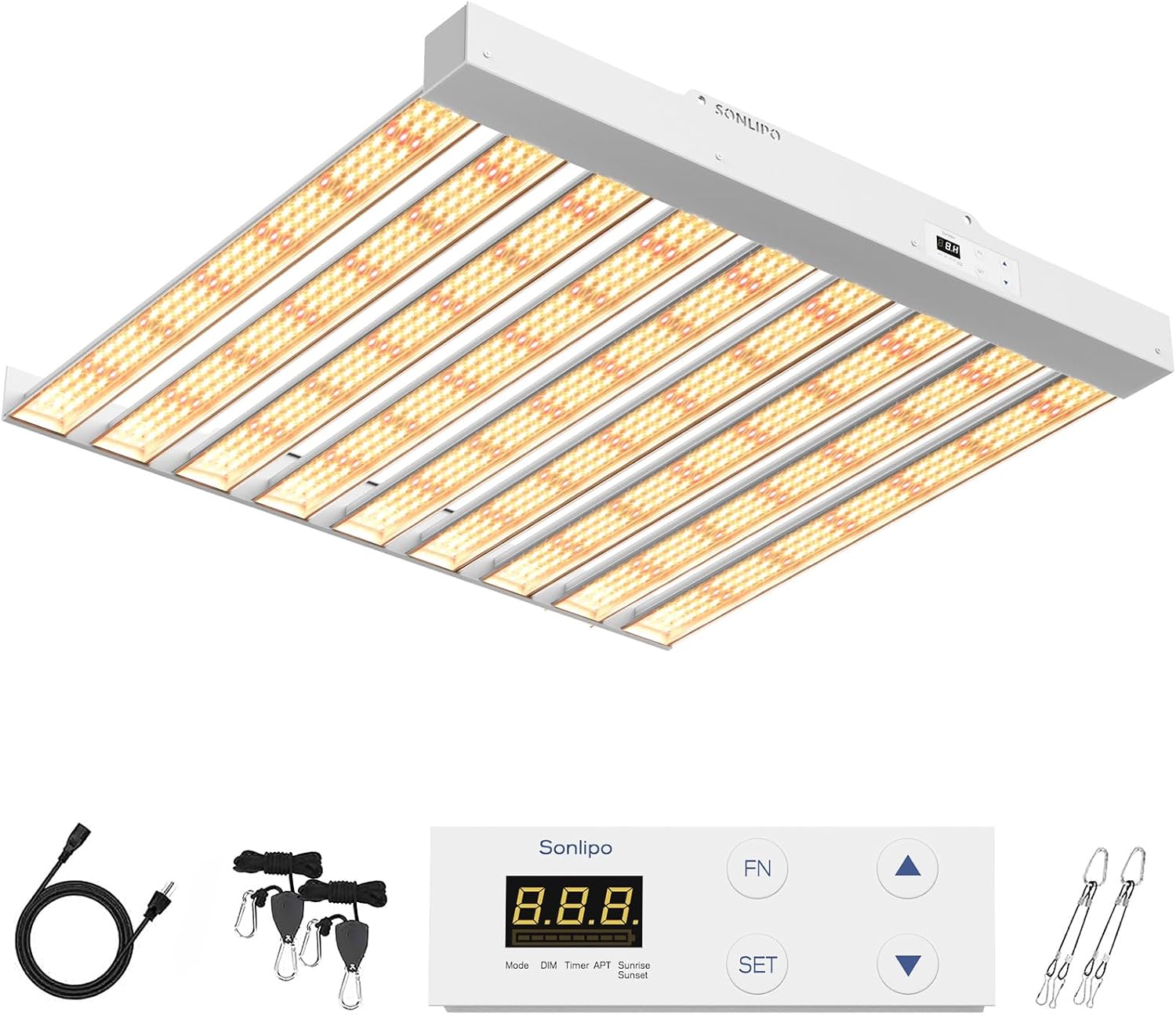
Sonlipo SPF4000 PRO 400W Full Spectrum LED Grow Light with Dimmer, Timer and Sunrise/Sunset
| Wattage | 400W |
|---|---|
| Coverage | Up to 5×5 ft |
| PPFD | Up to 1768 μmol/m²·s |
| LED count | 1963 SAM LM281+ LEDs |
The Sonlipo SPF4000 PRO is a plug-and-play 400W LED grow light aimed at growers using a 4×4 to 5×5 tent who want an all-in-one fixture. It offers three selectable spectrum modes for seedling, vegetative and flowering stages and includes a dimmer and programmable timer so you can tailor intensity and daily schedules. The unit claims high PPFD (up to 1768 μmol/m²·s) from 1963 SAM LM281+ LEDs and is intended to replace a 600W HPS while using less power. Notable practical features are the built-in wiring for cleaner installation, a reflective lampshade to concentrate output, and a quiet aluminum housing with quantum-style heat dissipation. The sunrise and sunset ramping is useful for easing plants into light cycles rather than abrupt on/off changes. Expect strong light penetration for canopy work and flexible scheduling, but at 400W it will still draw significant electricity compared with lower-power fixtures and may be larger and heavier than basic panels, so hanging and cooling should be planned accordingly.
Best for: Growers outfitting a 4×4 to 5×5 tent who want a single fixture that covers all growth stages with programmable timing and strong light output while keeping installation simple.
Less Ideal for: Casual hobbyists who need a very low-power or compact light for a small shelf or micro-greens setup should consider smaller panels instead.
- Full-spectrum modes (Veg, V&B, Bloom) let you match light to each growth stage
- Built-in timer and dimmer plus sunrise/sunset ramping for programmable daily cycles
- High claimed PPFD and large LED count for strong canopy penetration
- Integrated wiring and reflective lampshade simplify setup and increase light delivery
- 400W power draw is substantial compared with lower-watt budget fixtures
- Large fixture may require robust hanging and space for heat dispersion
Verdict: A powerful, programmable 400W full-spectrum fixture built to run a 5×5 tent with stage-specific modes and sunrise/sunset scheduling.
MARS HYDRO FC-6500 730W Foldable LED Grow Light (Full Spectrum)

| Light Source Type | LED |
|---|---|
| Voltage | 110 volts |
| Light Source Wattage | 730 watts |
| Light Source Special Features | Dimmable, Daisy-chain function, Remote control compatibility |
| Specification Met | ETL, DLC |
The MARS HYDRO FC-6500 is a bar-style LED panel built to deliver high light output for a 5×5 ft grow tent. It uses Bridgelux diodes with targeted Osram red chips to raise PAR where flowering counts most, and its 2.9 μmol/J efficiency means strong light without extreme electricity waste for this power class. The fixture folds flat for storage and hangs easily in tents; aluminum construction and the bar layout help keep heat down compared with sealed fixtures. Built-in dimming, daisy-chain capability and app/remote compatibility make scheduling and fine tuning simple for routine tent runs. Important limitations are its high nominal wattage and size, which require proper ventilation and a compatible hang height to avoid light burn and heat buildup. Also this is a dedicated indoor grow light with no bundled climate controller, so buyers should plan on a separate fan or controller for tight tents.
Best for: Buyers who want a reliable, high-output light for a 5×5 tent and prefer plug-and-play features with smart dimming and app control to simplify routine grows.
Less Ideal for: Casual hobbyists with very small tents, strict low-power limits, or growers who need an all-in-one tent climate system rather than a standalone light.
- Designed for 5×5 ft coverage with high PAR output using Bridgelux and Osram diodes
- Foldable bar design for easier installation, storage, and improved heat dissipation
- Dimmable, daisy-chain and app/remote control support for scheduling and fine tuning
- Aluminum construction and bar layout that help reduce operating temperature compared with enclosed fixtures
- High 730W power draw means you must plan ventilation and electrical load
- No integrated climate control or accessories included, so extra equipment is required
Verdict: A powerful, app-compatible 730W fixture optimized to give dependable 5×5 tent performance with easy dimming and installation.
AGLEX 600W Full Spectrum LED Grow Light — Dimmable, Daisy-Chain, Bar Style for 5x5ft

| Power consumption | 600W |
|---|---|
| Coverage | 5×5 ft |
| LED count | 2040 SMD LEDs |
| PPFD | 1442 μmol/㎡/s |
| Voltage | AC110-277V |
The AGLEX 600W full-spectrum LED grow light is built for a 5×5 foot grow tent and combines broad-spectrum LEDs with dimming and daisy-chain control for multi-unit setups. It delivers a mix of warm and cool white plus blue, red, IR and UV wavelengths to support seedling, vegetative and flowering stages. The fixture uses SMD LEDs across multiple bars to produce a reported PPFD suitable for close-quarters cultivation while consuming about 600W, which the listing compares favorably to higher-draw HPS/MH systems. Dimming from 0 to 100% lets you dial intensity for different growth phases and the daisy-chain feature allows a single controller to run multiple lights, useful if you scale beyond one tent. Practical benefits include lower electrical draw than equivalent HID setups and flexibility for clones through flowering. Expect a sizeable fixture and the need to manage heat and mounting in a tent environment; the product description repeats some claims and does not list detailed fan or thermal specs, so confirm placement and ventilation for long runs. For buyers who want straightforward full-spectrum output and potential for multi-unit control, this unit is a solid option.
Best for: Growers who want a ready-to-use full-spectrum fixture sized for a single 5×5 tent and value energy efficiency plus the option to expand to multiple lights.
Less Ideal for: People who need compact, low-profile lights for very small spaces or growers who require fully specified professional-grade thermal data before deployment.
- Full spectrum including blue, red, IR and UV to support all growth stages
- Dimmable 0–100% to tailor light intensity for seedlings through flowering
- Daisy-chain capability for controlling multiple units from one power source
- High LED count and claimed PPFD that aims to match higher-wattage HPS/MH output while using less power
- Listing lacks detailed thermal management and fan specifications for continuous commercial use
- Large fixture requires careful mounting and tent ventilation planning
Verdict: A powerful, energy-efficient full-spectrum fixture that suits a 5×5 grow tent and lets you scale with daisy-chained units.
Choosing the Right Grow Light for 5X5 Grow Tent: Key Factors to Consider
Light Footprint and Hanging Height
A grow light's stated area is only useful if it matches the canopy distance you will use. In a 5×5 grow tent you usually hang fixtures 12 to 30 inches above the canopy depending on power and spectrum. The effective footprint changes with height: a high-power fixture close to the canopy gives a small, intense hotspot, while the same fixture raised higher spreads light more evenly but with lower intensity. Consider how much vertical space you have inside the tent including hangers and any oscillating fan. If your tent will host taller plants or multi-tier growth, prioritize a fixture that maintains usable PPFD across a wider area at the heights you plan to use.
Photosynthetic Photon Flux Density (PPFD) and Uniformity
PPFD measures how many photons useful for photosynthesis hit the canopy each second and is the most direct indicator of a light's ability to drive growth. For a 5×5 grow tent you need both adequate average PPFD and consistent distribution so that edges do not go light-starved while the center is oversaturated. Look for published PPFD maps or lab measurements that show values across a 5×5 grid at realistic hanging distances. Uniformity matters for canopy management: large swings in PPFD force constant repositioning of plants and can lower overall yield because parts of the crop are underlit.
Energy Use and Electricity Efficiency
Energy efficiency is the ratio of usable light produced to electricity consumed and directly affects operating cost. In a small tent, high-efficiency fixtures lower monthly power bills and reduce the waste heat you must remove. Consider the spectrum-adjusted efficacy (micromoles per joule) rather than raw wattage, since two fixtures rated for the same watts can produce very different useful light. Also account for dimming capabilities that let you reduce power draw during vegetative stages or when supplemental light from other sources is available.
Heat Output and Thermal Management
Heat control is critical inside a 5×5 grow tent where ventilation capacity is limited. Excessive fixture heat raises canopy temperature, increases humidity, and forces stronger extraction or cooling strategies. Fixtures with efficient drivers, passive or active cooling, and lower waste heat are easier to integrate. Also consider how the light's physical design affects airflow-bulky housings can block circulating air and create hotspots. Good thermal management reduces stress on plants and keeps odor and moisture under control.
Spectrum and Control Features
Different light spectra influence plant morphology, flowering, and secondary metabolite production. Fixtures that offer selectable spectrums or full-spectrum output give you flexibility for both veg and bloom stages. Control features like dimmers, separate veg/flower channels, or programmable schedules make it simpler to tune intensity and spectrum without moving the fixture. These controls can improve plant quality and extend fixture life by avoiding constant full-power operation.
Durability, Safety, and Ease of Maintenance
A grow light must withstand humid tent conditions and occasional splashes. Durable housings, sealed electronics, and reliable mounting points reduce long-term hassles. Electrical safety features such as grounded plugs, certified drivers, and protection against voltage spikes matter for home setups. Ease of cleaning and servicing-such as accessible drivers or modular LED boards-makes routine maintenance simpler and keeps light output consistent over time.
Sizing Your Light to Plant Load
Match light output to how densely you plant and what stage the crop is in. Heavily flowered, high-yield crops demand higher average PPFD than clones or vegetative trays. In a 5×5 tent, quantify the canopy area you will use and plan for the highest light needs in bloom when calculating fixture count or wattage equivalents.
If you intend to run multiple smaller fixtures versus one large bar or panel, consider overlap. Multiple fixtures can improve uniformity and create redundancy so one failed unit does not ruin the whole crop. Single high-power fixtures simplify hanging and wiring but require careful placement to avoid hotspots.
- Estimate peak PPFD needs for bloom and size accordingly.
- Account for fixture spacing and overlap if using multiple units.
- Plan hanging points to allow even coverage and airflow.
Managing Heat and Ventilation
Tie your lighting plan to the tent's ventilation capacity. More light generally means more heat; adjust fan and filter sizes to remove that heat without causing excessive negative pressure. Use temperature probes at canopy level to track conditions rather than relying on air temperature near the tent ceiling.
Consider using dimming schedules or lower power during the hottest part of the day to reduce stress on the exhaust system. Passive-cooled fixtures often run cooler to the touch but still radiate heat into the canopy zone; active-cooled models can move heat away from the light source more effectively.
- Measure canopy-level temperature after lights have run for a few hours.
- Select exhaust and intake capacity to maintain target temps under peak load.
- Use programmable controllers to reduce light output on hot days.
Light Maintenance and Longevity
LED arrays degrade slowly over time. Plan for eventual light depreciation and check whether a fixture's manufacturer or documentation provides L70 or similar ratings. Regular dusting and occasional gentle cleaning of lenses or covers maintain output and PPFD uniformity.
Ease of service matters: fixtures with replaceable driver modules or modular boards simplify repairs and extend usable life. Also verify expected warranty coverage and what it covers in terms of LED failure versus driver issues.
- Schedule regular cleaning to avoid dust buildup on diodes or lenses.
- Track hours of operation to estimate long-term depreciation.
- Prefer modular designs if you want easier future servicing.
Control Strategies for Different Growth Stages
Adjusting light intensity and spectrum between vegetative and flowering stages reduces stress and energy waste. Lower intensities with a bluer spectrum encourage compact vegetative growth, while higher intensities with a red-rich spectrum support flower development. Fixtures with separate channels make these transitions straightforward.
Timers and light controllers keep photoperiods consistent. For multi-rack or mixed-height setups within the same 5×5 tent, use light movers, adjustable hangers, or zoned dimming to account for plants at different elevations.
- Use separate veg/flower channels where available for quick spectrum shifts.
- Implement timers to maintain strict photoperiods for flowering plants.
- Consider light movers or adjustable ratchets for uneven canopy heights.
Integrated Power and Safety Considerations
Check the tent's electrical circuit capacity before adding multiple fixtures or additional devices like inline fans and controllers. Overloaded circuits cause tripped breakers and can be hazardous. Use power strips with surge protection and route cables to avoid moist areas.
Mount lights securely to rated hangers and ensure any modifications do not compromise safety. If your fixture has exposed electronics, avoid locations where condensate or overspray could reach components.
- Calculate total circuit draw including lights, fans, and pumps.
- Use grounded outlets and appropriate gauge extension cords if necessary.
- Keep electronics off the tent floor to reduce water exposure risk.
How We Chose the Best Grow Light for 5X5 Grow Tent
We focused on practical, measurable attributes that matter in a 5×5 grow tent. Primary evaluation criteria included effective canopy footprint at typical hanging heights, photosynthetic photon flux density (PPFD) consistency across a 5×5 area, and energy consumption relative to delivered light output. Thermal management was prioritized because excess heat in a small tent forces extra ventilation and can stress plants. Dimming or spectrum control options were included as a criterion because the ability to dial intensity for veg versus flower helps plant quality and reduces wasted energy. Build durability and electrical safety rounded out the assessment to account for long-term use in humid indoor environments. We excluded lights that were clearly undersized for a 5×5 footprint or intended only for micro or single-plant racks. Cheap, untested fixtures with no measurable output data or lacking basic safety certifications were not considered. The shortlisted units represent a balance of usable light distribution, controllability, thermal behavior, and energy efficiency for hobby to serious home growers using a 5×5 grow tent.
FAQ
How many micromoles do I need in a 5×5 grow tent for flowering plants?
Flowering plants usually benefit from higher PPFD levels than vegetative plants. For dense flower canopies in a 5×5 tent, aim for average PPFD ranges that match the crop's intensity needs. Exact micromole targets vary by species and cultivar, so use published PPFD maps and target the higher end for heavy bloom stages.
Can I use one large fixture or should I use multiple smaller lights in a 5×5 tent?
Both approaches work. One large fixture simplifies hanging and wiring but requires careful placement to avoid hotspots. Multiple smaller fixtures improve uniformity, allow zoning, and offer redundancy if one unit fails. Choose based on available hanging points, canopy layout, and your tolerance for redundancy.
Will an efficient LED eliminate the need for an exhaust fan in a small tent?
No. Even efficient LEDs produce waste heat and create humidity that needs to be managed. Proper ventilation is still essential to control temperature and humidity, though a more efficient fixture reduces the size and power requirement of the exhaust system.
How high should I hang a grow light over a 5×5 canopy?
Hanging height depends on fixture power and design. Typical ranges for LEDs in a 5×5 setup fall between 12 and 30 inches above the canopy. Use manufacturer PPFD data when available and start higher while monitoring plant response and PPFD to avoid light stress.
Does spectrum really matter for indoor tent grows?
Yes. Spectrum influences plant shape, leaf thickness, and flowering behavior. Full-spectrum fixtures or those with adjustable channels let you tailor light to each growth stage. The degree of impact depends on the crop and how precisely you want to control morphology and secondary metabolites.
How do I maintain consistent light across a multi-level canopy?
Use multiple fixtures spaced to overlap their footprints, adjustable hangers to lower lights over taller plants, or zoned dimming to boost underlit areas. Reflective tent interiors help, but direct overlap and correct hanging heights are more reliable for uniform PPFD.
Final Verdict
For a 5×5 grow tent the right light balances usable canopy coverage, stable PPFD, and manageable heat. Prioritize fixtures that provide published PPFD maps for a 5×5 footprint, have efficient drivers to reduce electricity use and heat, and offer control over intensity and spectrum for different growth stages. Expect tradeoffs: higher output means more ventilation needs, while multiple fixtures improve uniformity at the cost of more mounts and wiring. Decide first on the canopy density and peak PPFD you need, then match fixtures that deliver that output with the least thermal and electrical compromise. With those priorities in hand you can choose confidently from the shortlisted options.
