

Note: This article contains affiliate links. If you click on these links and make a purchase, I may earn a small commission at no extra cost to you. This helps support my research and content. Read my full affiliate disclosure here.
Aloe vera responds best to bright, steady light without high heat or wide spectrum spikes that can stress its thick, water-storing leaves. If you keep aloe in a window-poor spot, a purpose-built grow light helps maintain compact habit, prevent etiolation, and support occasional flowering. This guide looks at six top grow lights for aloe vera across common indoor setups, from small pots on a windowsill to grouped succulents on a shelf. The shortlist focuses on practical features gardeners notice in daily use. We evaluate spectral output, heat control, mounting flexibility, and energy efficiency so you can pick a light that fits your space and care routine. Read on for the criteria we used and factors to weigh before you buy.
Top Picks at a Glance
| Best Overall The best all-around choice for most situations | Garpsen Adjustable LED Grow Light with Telescopic Pole and Timer |  |
| Best Quality Built to a higher standard if you want something more solid | VIVOSUN LumaLight 100W LED Full Spectrum Grow Light |  |
| Best Value The sweet spot between price and what you get | LEOTER 4-Head LED Grow Light with Full Spectrum, Timer and 10-Level Dimming |  |
| Highest Rated A top-rated pick with lots of positive feedback | Hemonee 5-Head LED Grow Light with Adjustable Tripod Stand |  |
| Most Popular A crowd favorite that many people choose with confidence | GooingTop HY-021 6000K Full-Spectrum Clip Grow Light |  |
| Best Seller A high-volume bestseller chosen again and again | Briignite A19 Full Spectrum LED Grow Light Bulb (2-Pack) |  |
Garpsen Adjustable LED Grow Light with Telescopic Pole and Timer

| Light Source Type | LED |
|---|---|
| Number of Light Sources | 80 |
| Additional Features | Adjustable Height, Dimmable, Full Spectrum, Timer |
| Switch Type | Dimmer |
| Power Source | Corded Electric |
This Garpsen grow light is designed to give potted indoor plants a flexible, full-spectrum light source. It combines 80 LEDs with selectable color modes (3000K, 5000K, 6500K plus added 660nm red), five brightness levels and a 6/12/16 hour timer so you can match light intensity and duration to different growth stages. The lamp mounts on a sturdy telescoping pole that extends up to 65 inches and includes a 360° gooseneck for precise aiming, making it easy to position light over succulents or taller specimens without modifying the plant setup. Controls are dimmable and simple to use, and the aluminum housing with a translucent ring shade helps dissipate heat while improving light transmission. Practical limits are that it is a single-head pole lamp rather than a wide-panel, so coverage for large multi-pot setups is limited and it requires a planter-mounted insertion for floor use. The unit is corded and not waterproof, so keep it inside and away from wet environments.
Best for: A balanced indoor gardener who wants a versatile, easy-to-adjust lamp for one or a few potted plants and values automatic scheduling and flexible positioning.
Less Ideal for: Those wanting to light a long seedling tray, multiple-shelf propagation racks, or outdoor setups should consider wider-panel fixtures or waterproof models instead.
- Full-spectrum LED array with added 660nm red to support multiple growth stages
- Telescoping pole and 360° gooseneck for precise height and angle adjustment
- Built-in timer (6/12/16H) and five dimming levels for automated, adaptable light schedules
- Aluminum housing and translucent shade improve heat dissipation and light transmission
- Single-head design limits lateral coverage for multiple plants or wide arrangements
- Not waterproof so unsuitable for humid or outdoor use
Verdict: A versatile, adjustable full-spectrum pole grow light that automates daily schedules and lets you fine-tune intensity and angle for healthy indoor aloe and other potted plants.
VIVOSUN LumaLight 100W LED Full Spectrum Grow Light

| Wattage | 100 watts |
|---|---|
| Light Source Type | LED |
| Number of Light Sources | 336 |
| Is Waterproof | True |
| Control Method | Remote |
The VIVOSUN LumaLight 100W is a compact full-spectrum LED grow light intended for indoor gardens and patios. It uses a mix of white, blue, red and far-red diodes to support all growth stages from seedlings through flowering, and the array is arranged to deliver uniform intensity across the canopy. Typical use is hanging above a small grow area with the included rope hangers and adjusting intensity via the four-level dimming knob or remote/mobile control when paired with VIVOSUN accessories. Notable features include IP65 water and dust resistance for high-humidity setups, a low-heat design for closer placement to plants, and Bluetooth/remote control compatibility for easier scheduling. Practical benefits are even coverage for several small plants, lower heat stress, and long expected LED life. Limitations are its 100W power level, which is best for small tents or a few plants rather than larger grow rooms, and some advanced scheduling requires the separate GrowHub controller for full smart automation.
Best for: A practical home grower who wants a reliable, compact full-spectrum light for seedlings through flowering and values even coverage and low heat in a small tent or patio setup.
Less Ideal for: Large-scale growers or those outfitting multi-shelf systems who need higher wattage fixtures or broader coverage should consider more powerful models.
- Full-spectrum diode mix (white, blue, red, far-red) suitable for all growth stages
- Dimmable four-level control plus Bluetooth/remote connectivity for convenient intensity adjustments
- IP65 waterproof and dustproof rating allows use in humid or misted environments
- Low-heat design with aluminum body for efficient thermal management and longer LED life
- At 100 watts it is intended for small tents or modest plant counts and not optimized for larger grows
- Advanced smart scheduling requires purchasing the GrowHub controller separately
Verdict: A dependable, compact full-spectrum LED grow light that delivers even coverage and low heat for small indoor grows.
LEOTER 4-Head LED Grow Light with Full Spectrum, Timer and 10-Level Dimming

| Light Source Type | LED |
|---|---|
| Number of Light Sources | 80 |
| Wattage | 80 watts |
| Control Method | Remote |
| Mounting Type | Clip On |
The LEOTER 4-head grow light is a USB-powered, clip-on lamp built for indoor plant care that combines full-spectrum and targeted red/blue diodes to support seedlings, vegetative growth and flowering. It uses 80 LEDs arranged across four adjustable heads on flexible goosenecks so you can position light over individual large plants or groupings. Notable features are three spectral modes (red+blue, warm/full spectrum, and combined), a circular memory timer with 3/9/12-hour presets, and ten brightness levels for fine control over intensity. The strong metal clip and flexible necks make it simple to aim light at tall foliage without permanent installation. Practical benefits include reduced need for supplemental natural light, convenient daily scheduling for busy users, and a compact footprint that suits shelves or plant stands. Important limitations are that the unit is described as a clip/desk lamp rather than a wide-panel fixture, so coverage for very large single specimens may require placing heads close to foliage or using multiple units, and the timer resets if unplugged so it needs occasional reprogramming after power loss.
Best for: Buyers who want a controllable, space-efficient grow light to supplement indoor sun for larger houseplants and prefer a proven, feature-rich unit with preset timers and adjustable heads.
Less Ideal for: Growers who need single-fixture coverage for floor-to-ceiling specimens or large multi-plant setups should consider full-size panel fixtures or multiple units instead.
- Full spectrum plus red and blue LEDs (80 total) to support all growth stages
- Ten dimming levels for precise intensity control
- Three timer presets with memory function for hands-off daily scheduling
- Adjustable 4-head design and flexible goosenecks for targeted placement
- Strong metal clip allows mounting on shelves, desks, or plant stands
- Designed as a clip-on lamp so single-unit coverage is limited for very large plants
- Timer settings must be reset after the light is unplugged
Verdict: A versatile, adjustable clip-on grow light that gives busy indoor gardeners precise control over spectrum, intensity and scheduling to boost large plant growth in compact spaces.
Hemonee 5-Head LED Grow Light with Adjustable Tripod Stand

| Heads | 5 |
|---|---|
| Height range | 15 to 63 inches |
| Spectral modes | Red+Blue, White, Combined |
| Brightness levels | 10 levels (10%–100%) |
| Timer | 4/8/12 hour auto on/off |
This Hemonee five-head LED grow light is designed to give steady, customizable light to small indoor plant collections like aloe vera. The telescoping tripod raises from about 15 to 63 inches while each of the five flexible gooseneck heads rotates 360 degrees so you can aim light where plants need it most. It offers three spectrum presets (red+blue, white, or combined) and ten brightness levels from 10 to 100 percent, which helps match the lower light needs of succulents through active growth phases. A built-in timer and two controllers (inline and RF remote) let you set 4/8/12 hour cycles and control each head independently for automated, consistent schedules. The unit uses an aluminum shell and aviation-grade heat sink for better heat dissipation, which supports longer run times without overheating. Limitations to note are that light output and spectral detail are not given as numerical PAR or PPF values, so precise intensity for demanding growers is unknown, and the tripod design takes up floor space compared with clamp or hanging fixtures.
Best for: Buyers who prioritize a dependable, hands-off grow solution for low-maintenance succulents and houseplants and want easy scheduling and directional control without frequent adjustment.
Less Ideal for: Growers who need quantified light output for high-intensity or scientific cultivation or those wanting a compact hanging fixture for tight spaces.
- Adjustable tripod and 360° gooseneck heads allow precise targeting of individual plants
- Three spectral modes and 10 brightness settings to match aloe vera light needs through growth stages
- Timer plus inline and RF remote control enable reliable automated schedules
- Aluminum shell with aviation-grade heat sink improves heat dissipation for continuous use
- No published PAR or PPF values to quantify actual usable light for photosynthesis
- Tripod footprint may be bulky for very small planting areas
Verdict: If you want a reliable, easy-to-schedule grow light that directs adjustable full-spectrum illumination to individual aloe vera plants, this five-head tripod unit is a practical choice.
GooingTop HY-021 6000K Full-Spectrum Clip Grow Light
| Power Source | Corded Electric |
|---|---|
| Color Temperature | 6000 Kelvin |
| Light Output Maximum | 2500 lumens |
| Light Source Special Features | Dimmable |
| Number of Light Sources | 84 |
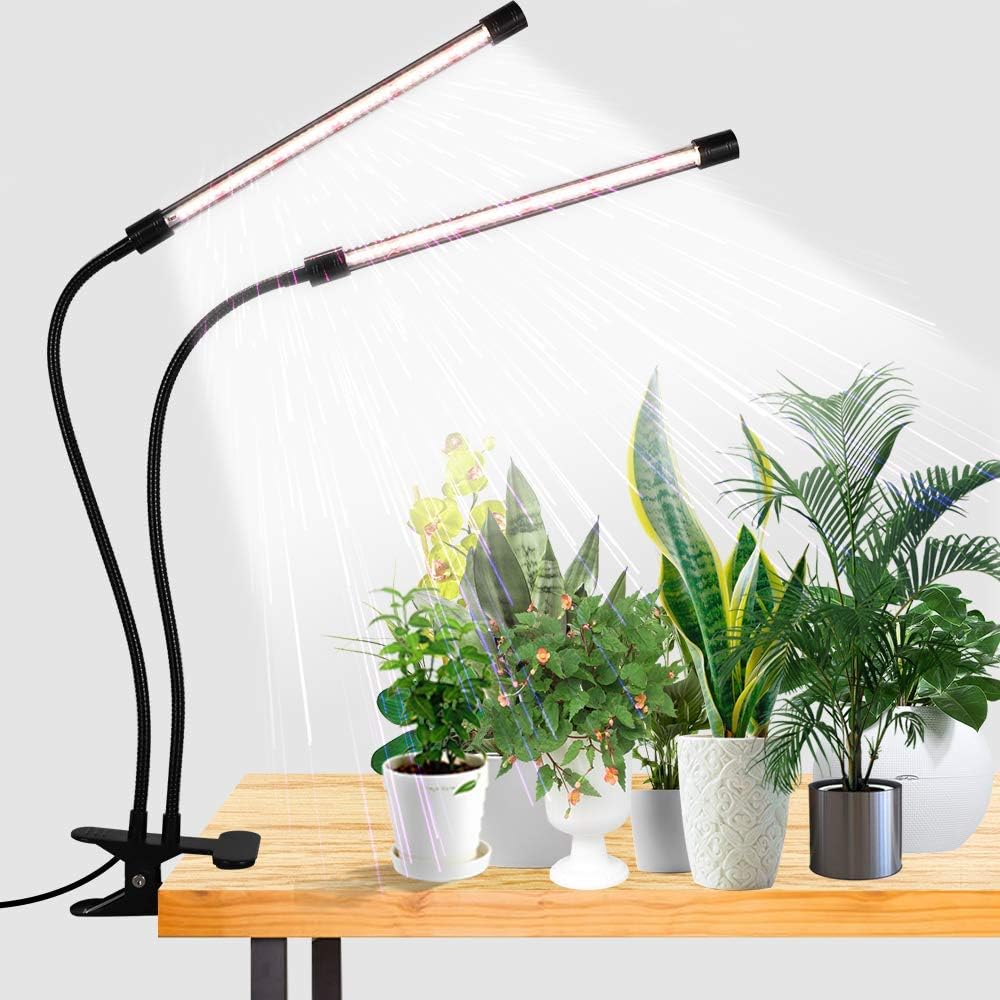
This GooingTop HY-021 is a compact clip-on grow light built for small houseplants, seedlings and shelf gardens. It uses 84 LEDs (white plus deep red) to deliver a 6000K full-spectrum output intended to mimic midday sun, with a high color-rendering output that also makes it pleasant as a reading lamp. Two flexible gooseneck heads and a strong clamp let you aim light precisely over pots and seed trays, while the attached remote provides 50%/100% dim levels and repeating timers at 4, 8 or 12 hours for hands-off scheduling. Practical benefits include low power draw (listed as roughly 10 W LED draw), a claimed 1 to 2 square meter coverage for seedlings, and an included timer that simplifies day/night cycles. Limitations are its design for small setups rather than large grow racks and the clip mounting limits placement compared with freestanding fixtures. The unit also relies on the corded remote instead of a smartphone app and the lifespan claim is typical of LEDs but not independently verifiable from the listing.
Best for: Buyers who want a simple, low-power, plug-and-play grow light to boost seedlings and a few houseplants on a desk or shelf and who value an easy-to-use timer and adjustable brightness.
Less Ideal for: Growers planning multi-shelf installations, larger vegetable grows, or who need networked or app-based control should consider larger bar lights or fixtures designed for commercial racks.
- Full-spectrum 6000K output with added 660 nm red LEDs to support vegetative growth and flowering
- Attached remote with dimming (50%/100%) and repeat timer settings (4/8/12 hours) for easy scheduling
- Flexible dual goosenecks and strong clamp enable precise positioning over small pots and seed trays
- High reported color rendering for comfortable viewing and accurate plant color assessment
- Low electrical draw around 10 W while covering small growing areas
- Clip-mount design and stated 1–2 m² coverage make it better suited to individual plants or small trays rather than large multi-shelf setups
- No smart app or wireless control option; remote is cord-attached which limits placement flexibility
Verdict: A compact, easy-to-use clip grow light that delivers full-spectrum light and convenient timer/dim controls for small indoor plant setups.
Briignite A19 Full Spectrum LED Grow Light Bulb (2-Pack)

| Light Type | LED |
|---|---|
| Additional Features | Full Spectrum |
| Bulb Base | E26 |
| Light Output Maximum | 1000 lumens |
| Light Source Operating Life | 30000 hours |
These Briignite A19 grow bulbs are full-spectrum LED replacements that screw into any standard E26 fixture to give indoor plants consistent, natural-looking light. Each bulb outputs about 1000 lumens at roughly 11 to 12 watts, so they act like a 60 to 100 watt incandescent while using far less energy, which is handy for running multiple bulbs on a budget. The 3500–4000K warm daylight color and high CRI make foliage colors appear normal rather than the purple hue of some grow lights, so they work well in living spaces and plant shelves. Built-in features include app control and push-button options and an advertised 25,000 to 30,000 hour operating life. Limitations to note are modest reported PPF compared with purpose-built high‑output grow fixtures and the 180 degree beam, which is better for general room lighting than targeted canopy penetration for dense or tall plants. For small collections, seed starting, or supplementing light in low-light rooms these bulbs are an economical, easy-to-install choice.
Best for: Houseplant owners who need an affordable, plug-and-play light to supplement natural light for a few pots, seedlings, or a small indoor garden while keeping energy costs low.
Less Ideal for: Growers aiming to flower large or dense canopy crops or outfitting multi-tiered grow racks will want higher‑PPF, purpose-built fixtures instead.
- Full spectrum output that looks like natural white light and preserves true foliage color
- Low power draw (around 11–12W) with 1000 lumens brightness for energy-efficient continuous use
- Standard E26 base fits common fixtures for tool-free installation
- High CRI of 90 helps accurate color rendering in living spaces
- Beam angle and lumen-focused design give less concentrated PAR/PPF than dedicated high‑output grow fixtures
- App and push-button controls are basic compared with advanced programmable controllers
Verdict: A low-cost, easy-to-install full-spectrum LED bulb that gives natural-looking light and energy savings for small indoor plant collections.
Choosing the Right Grow Light for Aloe Vera: Key Factors to Consider
Light Spectrum and Color Temperature
Aloe vera benefits from a balanced spectrum that leans toward blue light for compact, stocky growth and includes enough red to support occasional flowering. Look for fixtures that specify full-spectrum output or list both blue and red peak wavelengths. Color temperature figures can help: 4000K to 6500K often provides the cooler, daylight-like light aloe prefers during its active growth.
Spectrum matters because windowless indoor lighting that is too warm or overwhelmingly red can cause stretching or soft tissue. Fixtures that offer spectrum control or are marketed as full spectrum give you the best chance of matching natural daylight characteristics for healthy succulent structure.
Heat Output and Thermal Safety
Succulents store water in leaves and are sensitive to sustained surface heat. A grow light with poor heat dissipation or concentrated hot spots can lead to leaf scorch, discoloration, or accelerated dehydration. Choose fixtures with passive cooling, heat sinks, or low-heat diodes and avoid lamps that require the plant to sit very close to the emitter unless they include protective diffusion.
Consider how long you plan to run the light each day. Longer photoperiods increase cumulative heat exposure, so a fixture with lower surface temperature or good airflow is safer for small pots and plastic containers.
Adjustable Intensity and Timers
Aloe vera needs bright light but not constant maximum intensity. Dimming capability or multi-intensity modes lets you start seedlings or shaded plants at lower light, then increase exposure as they acclimate. Built-in timers or compatibility with plug timers make it easy to provide consistent daily hours without manual intervention.
Having fine control over intensity also helps when moving a lamp closer for winter light or farther away during summer. This flexibility reduces the risk of overexposure and supports gradual acclimation, which prevents shock and sunburn.
Coverage Area and Mounting Options
Aloe plants are often grown singly or in small groupings. A fixture should match your planting layout, offering focused coverage for a single pot or a wider spread if you keep multiple succulents together. Adjustable goosenecks, hanging kits, or stand attachments let you position light at the correct distance and angle for even illumination.
Think about shelf depth, ceiling height, and whether you need a clip-style lamp for a windowsill or a freestanding panel for a plant cart. A fixture that is too wide will waste light; one that is too narrow will create shaded areas that encourage uneven growth.
Energy Use and Daily Operating Cost
Grow lights often run several hours per day, so power draw matters for long-term household energy use. LED fixtures typically offer higher lumen-per-watt efficiency and lower heat output than older lamp types. Compare wattage relative to the coverage area to gauge overall efficiency.
Lower energy use also translates to cooler operation, which is important for succulents. Look for clear wattage ratings and output specifications so you can estimate running costs, especially if you plan extended photoperiods in winter.
How Much Light Does Aloe Vera Need
Aloe vera evolved in bright, open habitats and does best with several hours of bright light each day. Indoors that often means 10 to 14 hours of supplemental light during shorter daylight months. Aim for steady, diffuse illumination rather than short bursts of intense light to mimic daylength and prevent etiolation.
Measure the area where you will place the pot. A single small aloe on a windowsill may need only a small clip lamp or a narrow panel, while a shelf of mixed succulents requires broader coverage and adjustable mounting to keep light even across several pots.
- Short photoperiods lead to stretching; increase daily hours, not intensity, to prevent etiolation.
- Maintain a consistent schedule with timers to support steady growth.
- Use distance and dimming to avoid leaf scorch when increasing light.
Placement and Distance Guidelines
Distance between lamp and plant determines effective intensity. For many LED panels and strips, 8 to 24 inches is a practical range depending on output. Closer placement gives stronger light but raises heat risk. Start farther away and move closer over several days while watching leaf response.
Position the light so it hits the top and upper sides of the rosette. Side-only illumination creates uneven growth. If using a directional lamp, rotate the plant periodically to keep leaves balanced.
- Begin with a conservative distance and increase gradually.
- Avoid placing lights directly against plastic pots without airflow.
- Rotate plants weekly if the fixture cannot provide even coverage.
Routine Care When Using Supplemental Light
Supplemental light changes daily water and feeding needs. Plants receiving more light will use more moisture. Adjust your watering schedule to soil dryness rather than calendar days. Check soil moisture with a finger or probe before watering to avoid overwatering, which is a common issue with succulents under grow lights.
Keep an eye on leaf color and spacing. Pale, elongated leaves suggest insufficient light, while brown patches or shriveling can indicate heat stress or too-frequent watering. Reduce intensity or move the light back if you see signs of stress.
- Water based on soil dryness; increase drainage if plants stay wet longer.
- Watch for signs of too much or too little light and adapt placement.
- Clean fixtures periodically to maintain output and reduce hot spots.
Using Timers and Seasonal Adjustments
A regular daily photoperiod helps aloe stay in a predictable growth cycle. Use a timer to mimic longer days in spring and summer and shorten hours in winter. Many growers reduce supplemental light in late autumn to encourage a mild dormancy and prevent weak, leggy growth.
Adjust intensity with seasons as well. In winter, increase hours rather than cranking intensity to prevent heat-related damage. During bright seasons, move lights farther away or reduce run time to complement natural daylight.
- Set timers for consistent start and stop times each day.
- Increase photoperiod gradually into spring and decrease into autumn.
- Use lower intensity but longer hours in winter for steady growth.
Common Mistakes to Avoid
Overcrowding plants under a single narrow fixture leads to shaded, stretched individuals. Match the light width to the number of pots, or provide separate fixtures for clustered arrangements. Avoid assuming higher power equals better results; incorrect spectrum or poor heat management causes more problems than inadequate wattage.
Another common error is leaving new plants too close to a bright LED immediately. Harden plants to stronger light over several days to prevent leaf scorch. Finally, neglecting fixture orientation and airflow increases dust buildup and heat, which reduces performance and risks plant health.
- Do not place plants directly on top of hot fixtures.
- Avoid rapid jumps in light intensity without a transition period.
- Keep fixtures clean and allow some airflow around the lamp.
How We Chose the Best Grow Light for Aloe Vera
We evaluated lights that suit the needs of potted aloe vera and other small succulents by focusing on measurable, gardener-relevant attributes. Key filters included spectral quality, because aloe benefits from a strong blue-to-red balance for compact growth; heat output, since excess warmth damages succulent tissue; and adjustable intensity so you can tailor light to plant size and distance. We also considered physical fit for indoor use, including mounting or stand options, coverage area for single or multiple pots, and overall energy efficiency for extended daily use. Durability and ease of cleaning were included because many growers run lights for months at a time and need fixtures that tolerate dust and occasional humidity. We excluded high-output greenhouse fixtures designed for large-scale production and lights that lack reliable spectrum or dimming control. The final picks passed a balance of spectral suitability, safe thermal behavior, adaptable mounting, and practical power consumption.
FAQ
How many hours of artificial light does an indoor aloe vera need daily?
Aloe vera commonly does well with 10 to 14 hours of supplemental light during short daylight months. Adjust by monitoring leaf firmness and color; increase hours if plants stretch, decrease if leaves show heat stress.
Can I use a standard LED household bulb for aloe vera?
Standard LEDs can provide light but often lack the balanced spectrum succulents need. Look for bulbs or fixtures labeled full-spectrum or those listing blue and red outputs for better plant structure and health.
Will grow lights make aloe vera grow faster than natural window light?
Grow lights can maintain steady growth when natural light is insufficient, but speed depends on spectrum, intensity, and photoperiod. Properly tuned supplemental light encourages compact, healthy growth rather than simply faster elongation.
How close should a grow light be to an adult aloe plant?
Typical LED fixtures work well 8 to 24 inches from the leaf tips depending on output. Start at the far end of that range and move closer gradually while watching for discoloration or leaf curling.
Do I need to worry about heat from modern LED grow lights?
Many LEDs run cool, but some high-output fixtures still produce significant heat. Check for heat sinks or passive cooling and avoid placing plants directly against warm housings. Monitor leaves for scorch as an early sign of thermal stress.
Final Verdict
For indoor aloe vera, prioritize a fixture with a balanced spectrum, low surface heat, and adjustable intensity. Coverage and mounting flexibility matter more than raw wattage for single pots or small groupings, and energy efficiency reduces operating heat and cost. Balance these tradeoffs based on your space: choose narrow, focused lights for single plants and wider, adjustable panels for multiple pots. With the right light and consistent schedule, you can maintain compact, healthy aloe with minimal fuss.
