

Note: This article contains affiliate links. If you click on these links and make a purchase, I may earn a small commission at no extra cost to you. This helps support my research and content. Read my full affiliate disclosure here.
If you start vegetable seedlings indoors, the right grow light changes timing, vigor, and transplant success. Seedlings raised under weak or uneven light become leggy, stressed, or slow to develop true leaves, which makes them harder to harden off and set in the garden. This guide covers seven shortlisted grow lights for starting vegetable seedlings and explains how they perform in real seed-starting setups such as trays, flats, and small racks. We evaluate spectrum, adjustable mounting and clearance, heat behavior, and energy use so you can pick a fixture that fits your space and growing goals. Read on for practical guidance before the product list.
Top Picks at a Glance
| Best Overall The best all-around choice for most situations | VIPARSPECTRA P700 70W Dimmable Full Spectrum LED Grow Light |  |
| Best Quality Built to a higher standard if you want something more solid | VIVOSUN LumaLight 100W LED Full Spectrum Grow Light |  |
| Best Value The sweet spot between price and what you get | EWPJDK 84‑LED Clip Gooseneck Full Spectrum Grow Light with Timer |  |
| Best Budget The cheapest option that still gets the job done reliably | bseah Full Spectrum LED Grow Light for Indoor Plants (2-Tube, 10W) |  |
| Highest Rated A top-rated pick with lots of positive feedback | Barrina TX36 2ft LED Grow Light (4-pack) with Mechanical Timer |  |
| Most Popular A crowd favorite that many people choose with confidence | GooingTop HY-021 6000K Full-Spectrum Clip Grow Light |  |
| Best Seller A high-volume bestseller chosen again and again | Barrina T5 1ft LED Grow Lights, 5000K Full Spectrum — 4-Pack |  |
VIPARSPECTRA P700 70W Dimmable Full Spectrum LED Grow Light

| Light Output Maximum | 11000 lumens |
|---|---|
| Light Source Wattage | 70 watts |
| Mounting Type | Hanging Mount |
| Light Source Special Features | Dimmable |
| Number of Light Sources | 216 |
The VIPARSPECTRA P700 is a 70W full spectrum LED grow light built for seed starting and vegetative stages. It uses 216 diodes and a tuned mix of red and white LEDs to deliver high PAR output (advertised 11,000 lumens) across a small footprint roughly suited to a 2×2 ft veg area. The light is fanless and relies on large aluminum heat sinks to keep running temperatures low while the included 4-level dimmer lets you dial intensity for seedlings, clones, or mature veg. Setup is simple with hanging mount hardware included and the unit draws about 0.65 A at 120V so it runs far cooler and uses far less power than a comparable 150W HPS/MH system. For compact tents, shelves, or single-cabinet grows it offers a good balance of light output, spectrum, and efficiency. Limitations are its small coverage area and modest absolute wattage compared with larger fixtures, so gardeners with bigger canopies will want a higher-output model or multiple units.
Best for: Growers who want an efficient, low-heat fixture to run a single tent, shelf, or cabinet and who prioritize electricity savings and adjustable output for seedlings and veg.
Less Ideal for: Commercial growers or hobbyists running multi-plant canopies or larger tents who need wider coverage and higher total light output.
- Full spectrum diode layout optimized for seedlings and vegetative growth
- Low power draw (70W) with high reported lumen/PAR output for energy efficiency
- Fanless design with aluminum heat sinks for quiet, low-heat operation
- Integrated 4-level dimmer for easy intensity adjustment
- Coverage geared to a small 2×2 ft veg area so not ideal for larger grows
- Absolute wattage and diode count are modest compared with larger commercial fixtures
Verdict: A compact, energy-efficient full spectrum LED that delivers strong veg-stage light and adjustable intensity for small tents and cabinets.
VIVOSUN LumaLight 100W LED Full Spectrum Grow Light

| Wattage | 100 watts |
|---|---|
| Light Source Type | LED |
| Number of Light Sources | 336 |
| Is Waterproof | True |
| Control Method | Remote |
The VIVOSUN LumaLight 100W is a compact full-spectrum LED grow light intended for indoor gardens and patios. It uses a mix of white, blue, red and far-red diodes to support all growth stages from seedlings through flowering, and the array is arranged to deliver uniform intensity across the canopy. Typical use is hanging above a small grow area with the included rope hangers and adjusting intensity via the four-level dimming knob or remote/mobile control when paired with VIVOSUN accessories. Notable features include IP65 water and dust resistance for high-humidity setups, a low-heat design for closer placement to plants, and Bluetooth/remote control compatibility for easier scheduling. Practical benefits are even coverage for several small plants, lower heat stress, and long expected LED life. Limitations are its 100W power level, which is best for small tents or a few plants rather than larger grow rooms, and some advanced scheduling requires the separate GrowHub controller for full smart automation.
Best for: A practical home grower who wants a reliable, compact full-spectrum light for seedlings through flowering and values even coverage and low heat in a small tent or patio setup.
Less Ideal for: Large-scale growers or those outfitting multi-shelf systems who need higher wattage fixtures or broader coverage should consider more powerful models.
- Full-spectrum diode mix (white, blue, red, far-red) suitable for all growth stages
- Dimmable four-level control plus Bluetooth/remote connectivity for convenient intensity adjustments
- IP65 waterproof and dustproof rating allows use in humid or misted environments
- Low-heat design with aluminum body for efficient thermal management and longer LED life
- At 100 watts it is intended for small tents or modest plant counts and not optimized for larger grows
- Advanced smart scheduling requires purchasing the GrowHub controller separately
Verdict: A dependable, compact full-spectrum LED grow light that delivers even coverage and low heat for small indoor grows.
EWPJDK 84‑LED Clip Gooseneck Full Spectrum Grow Light with Timer

| Number of Light Sources | 84 |
|---|---|
| Wattage | 10 watts |
| Voltage | 5 volts_of_direct_current |
| Connectivity Technology | USB |
| Controller Type | Push Button, Timer Function |
This compact EWPJDK clip grow light is aimed at boosting light for desktop and small indoor plants. It plugs into USB power, clamps to shelves or desks with a strong padded clip and uses a flexible gooseneck so you can aim the 84 LEDs over seedlings, succulents or potted herbs. The lamp offers three spectra—white, red, and combined—and ten dimming steps, so you can match intensity to seedling, vegetative or flowering stages. A built‑in cycle memory timer (3/9/12 hours) automates daily schedules, which is handy if you forget to switch lights. At about 10 watts the light is low power and runs cool, making it safe for close placement to foliage. Limits to expect are the small coverage area and modest power, so it will not replace larger fixtures for multiple plants or wide trays. Also it is not water resistant so it should be kept away from humid setups and wet benches. For single pots, propagation trays and desk gardening it is a practical, easy to position option.
Best for: Gardeners who want a low‑effort, energy‑efficient solution for single pots, seedlings or a small windowsill and who value an easy to position, set‑and‑forget light.
Less Ideal for: Growers planning to light multiple plants, large trays, or a grow tent should choose a higher‑output panel or multiple fixtures instead.
- Flexible gooseneck and strong padded clamp make it easy to position and secure on desks or shelves
- Three light modes and 10 dim levels let you tailor spectrum and intensity to growth stages
- Built‑in memory timer with 3/9/12 hour cycles automates daily light schedules
- Low 10 watt draw and USB power keep energy use and heat minimal for close placement
- Small footprint and limited output mean it only covers a few small pots or seedlings
- Not water resistant so it cannot be used in humid or wet greenhouse benches
Verdict: A compact, low‑power clip grow light with adjustable spectrum and a memory timer that makes automated care simple for single pots and small seedlings.
bseah Full Spectrum LED Grow Light for Indoor Plants (2-Tube, 10W)

| Wattage | 10 watts |
|---|---|
| Power Source | DC 5V (USB) |
| Number of Light Sources | 2 |
| Control Method | Remote |
This bseah grow light is a tabletop LED lamp designed to help seedlings and young plants get steady light when natural sun is insufficient. It plugs into USB power and uses two tubes of yellow and white full-spectrum LEDs to support germination, vegetative growth, and flowering stages. The flexible metal gooseneck and non-slip base make it easy to position over a tray of seeds or a few small pots, while the remote and on-device controls offer three mode presets plus 10 dimming levels so you can lower intensity for delicate seedlings or boost it for heavier growth. The built-in 3/9/12 hour timer with memory simplifies daily schedules. Practical benefits include long LED life expectancy and a lightweight, desktop setup that fits on a windowsill or seed-starting bench. Limitations are the low 10 watt total output and single light head which mean coverage is limited to a small area and taller seedlings may need the lamp repositioned as they grow. For starting seeds you may need multiple units or supplemental light for larger trays.
Best for: Buyers who want an inexpensive, compact lamp to start small batches of seeds or care for a few seedlings on a windowsill and prefer a simple plug-and-play setup.
Less Ideal for: Gardeners who need to light large seed trays, multiple flats, or quickly grow taller seedlings should look for higher-output fixtures or expand with additional units.
- Full spectrum LED output suitable for seed germination through early growth
- Adjustable gooseneck and non-slip base for precise positioning over seedlings
- Ten dim levels and three mode presets let you tailor light intensity for stages
- Auto 3/9/12 hour timer with memory simplifies daily on/off scheduling
- USB power lets it run from common adapters, power banks, or a computer
- Only 10 watts and two tubes limit coverage to a small seed tray or a few pots
- Not waterproof so it must be kept away from wet benches or high-humidity setups
Verdict: A budget-friendly, easy-to-use USB grow lamp that works well for starting small batches of seeds and supporting early seedling growth.
Barrina TX36 2ft LED Grow Light (4-pack) with Mechanical Timer

| Power Source | AC |
|---|---|
| Wattage | 36 watts (per fixture) / 144W (kit) |
| Light Source | LED |
| Brightness | 2900 lm (per fixture) |
The Barrina TX36 kit bundles four 2 ft LED fixtures that deliver a full red and blue spectrum intended for seed starting and early vegetable growth. Each fixture draws 36 W (144 W total) and includes 156 LEDs per lamp for high PPFD aimed at efficient photosynthesis at close distances. Typical use is hanging or surface-mounted above seed trays or small grow tents; the aluminum housing helps with heat dissipation during continuous runs. The mechanical 24-hour timer is simple and reliable for repeatable light cycles without a smart controller, and the lights are linkable so you can chain multiple fixtures to cover longer benches. Practical benefits include strong germination and compact footprint for windowsills or shelves, plus included hanging hardware and individual on/off switches. Limitations are that the control is limited to the mechanical timer only so you cannot program complex schedules or dimming, the lights are not water resistant so they need placement away from direct moisture, and the 2 ft length is best for small setups rather than large commercial benches.
Best for: Gardeners who want a dependable, low-fuss lighting solution to start vegetable seedlings indoors and prefer simple mechanical scheduling over smart controls.
Less Ideal for: Growers who need precise dimming, customizable multi-day light programs, or waterproof fixtures for humid or splash-prone environments.
- Full red and blue full-spectrum LEDs optimized for seed starting and vegetative growth
- Linkable design and included hanging hardware make it easy to cover multiple trays or a long shelf
- Mechanical 24-hour timer provides simple reliable on/off scheduling without extra electronics
- Aluminum housing for better heat dissipation during extended runtimes
- No dimming or advanced programmable schedules beyond the mechanical timer
- Not water resistant so it must be kept away from wet work areas or open irrigation
Verdict: A dependable, linkable LED kit with a simple mechanical timer that reliably handles seed-starting and small-scale vegetable propagation.
GooingTop HY-021 6000K Full-Spectrum Clip Grow Light
| Power Source | Corded Electric |
|---|---|
| Color Temperature | 6000 Kelvin |
| Light Output Maximum | 2500 lumens |
| Light Source Special Features | Dimmable |
| Number of Light Sources | 84 |
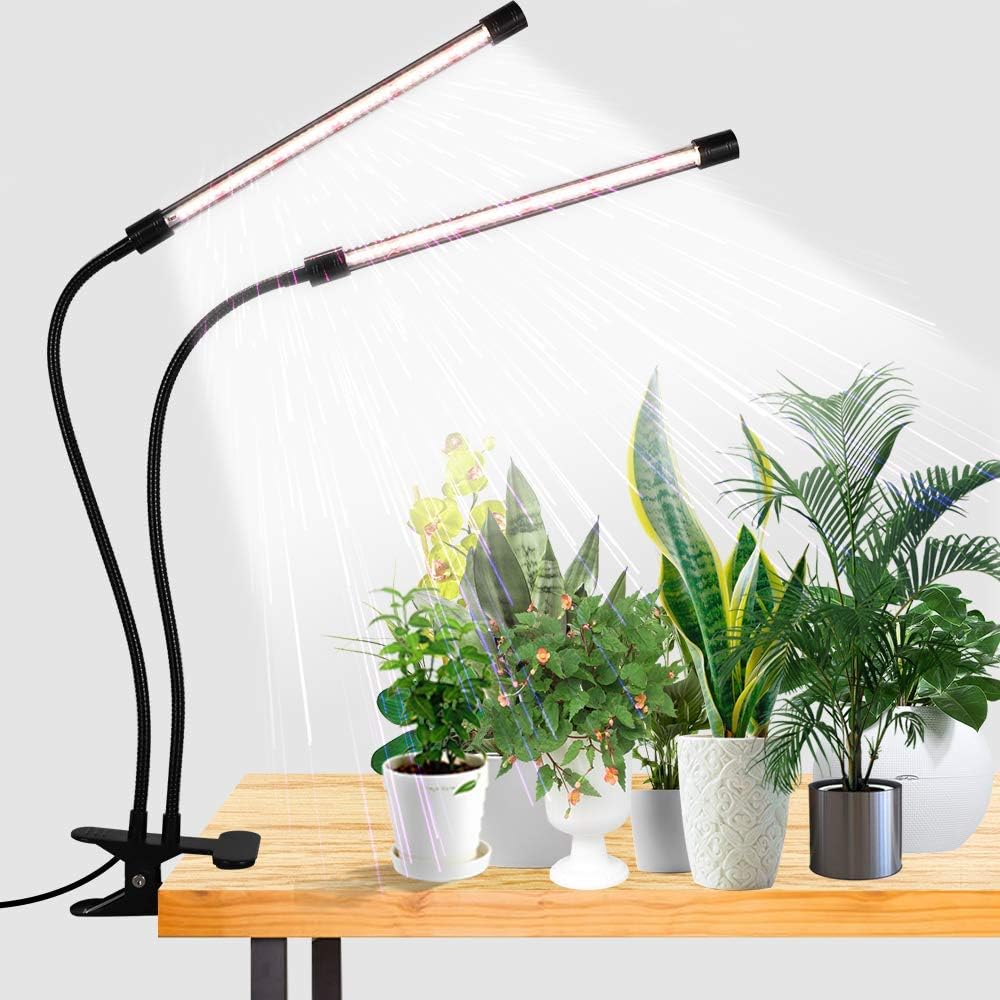
This GooingTop HY-021 is a compact clip-on grow light built for small houseplants, seedlings and shelf gardens. It uses 84 LEDs (white plus deep red) to deliver a 6000K full-spectrum output intended to mimic midday sun, with a high color-rendering output that also makes it pleasant as a reading lamp. Two flexible gooseneck heads and a strong clamp let you aim light precisely over pots and seed trays, while the attached remote provides 50%/100% dim levels and repeating timers at 4, 8 or 12 hours for hands-off scheduling. Practical benefits include low power draw (listed as roughly 10 W LED draw), a claimed 1 to 2 square meter coverage for seedlings, and an included timer that simplifies day/night cycles. Limitations are its design for small setups rather than large grow racks and the clip mounting limits placement compared with freestanding fixtures. The unit also relies on the corded remote instead of a smartphone app and the lifespan claim is typical of LEDs but not independently verifiable from the listing.
Best for: Buyers who want a simple, low-power, plug-and-play grow light to boost seedlings and a few houseplants on a desk or shelf and who value an easy-to-use timer and adjustable brightness.
Less Ideal for: Growers planning multi-shelf installations, larger vegetable grows, or who need networked or app-based control should consider larger bar lights or fixtures designed for commercial racks.
- Full-spectrum 6000K output with added 660 nm red LEDs to support vegetative growth and flowering
- Attached remote with dimming (50%/100%) and repeat timer settings (4/8/12 hours) for easy scheduling
- Flexible dual goosenecks and strong clamp enable precise positioning over small pots and seed trays
- High reported color rendering for comfortable viewing and accurate plant color assessment
- Low electrical draw around 10 W while covering small growing areas
- Clip-mount design and stated 1–2 m² coverage make it better suited to individual plants or small trays rather than large multi-shelf setups
- No smart app or wireless control option; remote is cord-attached which limits placement flexibility
Verdict: A compact, easy-to-use clip grow light that delivers full-spectrum light and convenient timer/dim controls for small indoor plant setups.
Barrina T5 1ft LED Grow Lights, 5000K Full Spectrum — 4-Pack

| Wattage | 5W |
|---|---|
| Color temperature | 5000K |
| Linkable | Link up to 16 lights |
| Control | Separate on/off switches |
The Barrina T5 1ft grow light 4-pack provides straightforward, energy-efficient supplemental lighting for seedlings, vegetative plants, and flowering houseplants. Each slim fixture produces a 5000K full spectrum output at 5W and includes an on/off switch so you can control lights individually or run them together. The lights are plug-and-play and come with power cords, connector cables, clips, double-sided tape, and cable ties for quick installation on shelves, racks, or small indoor shelving units. Because fixtures link up to 16 units, you can scale a multi-shelf setup without extra wiring. Practical benefits include low power draw, compact footprint that fits tight spaces, and a high PPFD-focused output that supports photosynthesis. Limitations are that these are short 1-foot fixtures intended for close-proximity use rather than lighting large rooms, the mounting relies on adhesive and clips rather than a heavy-duty mounting system, and they are not magnetic, which reduces some placement options. For growers who want an easy, modular lighting solution for small indoor setups, these deliver reliable light for everyday use.
Best for: Buyers who want a compact, energy-efficient grow-light system to brighten shelves or small indoor racks and who value easy installation and scalable setups.
Less Ideal for: Growers who need to light large rooms, tall plants, or wide benches should choose longer or higher-output fixtures instead.
- Full-spectrum 5000K output suitable for seedlings through flowering
- Individual on/off switches for each fixture allow flexible light scheduling
- Linkable design supports up to 16 lights for easy expansion
- Low power consumption (5W per 1ft fixture) reduces energy use
- Includes basic installation kit (power cords, connectors, clips, tape, cable ties)
- Short 1ft length limits coverage area per fixture
- Mounting depends on adhesive and clips rather than more secure hardware
- Not magnetic, reducing placement options on metal surfaces
Verdict: A compact, low-energy, and linkable 1ft grow light kit ideal for efficiently lighting shelves and small indoor plant setups.
Choosing the Right Grow Light for Starting Vegetable Seedlings: Key Factors to Consider
Spectral Output and Intensity
Seedlings respond differently to blue and red wavelengths. Blue-rich spectra encourage short, stocky growth and strong leaf development while some red light supports stem strength and early photosynthesis. Fixtures labeled full-spectrum that include a strong blue component are usually best for the seedling stage.
Intensity matters because weak light causes stems to stretch as seedlings reach for light. Too little intensity yields leggy plants with thin stems that can collapse once transplanted. Choose a light that provides moderate intensity close to seedlings with the option to raise the fixture as plants grow.
Fixture Height and Adjustability
Seedlings need lights positioned fairly close to their tops – often 2 to 8 inches depending on intensity – and that distance must be adjustable as seedlings grow. Fixtures with simple height adjustment, adjustable hangers, or built-in telescoping stands make it easy to maintain optimal distance without scorching foliage.
Good adjustability also allows you to move the light higher for heat-sensitive species or lower when you need more intensity. Look for fixtures with clear guidance on recommended mounting heights for seedlings and simple mechanisms for raising or lowering the unit.
Coverage Area and Uniformity
A single flat or multiple seedling trays should receive even light so every cell germinates and grows at the same rate. Narrow beam fixtures create hotspots and shaded edges that lead to uneven stands. Consider the footprint of the light at typical mounting heights and match it to your tray or rack dimensions.
Uniform coverage reduces the need to rotate trays or reposition seedlings manually and supports consistent transplant timing across a batch. For wider setups, plan for multiple fixtures or an array that overlaps slightly to eliminate dark zones.
Heat Output and Ventilation
Seedlings tolerate only modest heat; excessive warming from a fixture can dry media, stress roots, and push plants into unwanted growth phases. LED fixtures generally run cooler than older fluorescent or HID options, but some high-output LEDs still produce notable heat at the heat sink.
Assess how the fixture dissipates heat and whether you need additional ventilation or distance to avoid heat buildup. Lower heat output also makes it safer to place lights closer to seedlings for better intensity control.
Energy Use and Run-Time Controls
Indoor seed starting often requires 12 to 16 hours of light per day for multiple weeks. Energy-efficient fixtures keep operating costs reasonable and reduce greenhouse or indoor heat load. Look for fixtures with known wattages and lumen output so you can estimate running costs.
Integrated timers or compatibility with plug-in timers simplifies daily schedules and reduces manual intervention. Dimming options let you dial intensity for germination versus later true-leaf stages, extending the fixture's usefulness.
Ease of Setup and Durability
You will likely set up and break down grow lights multiple seasons, so simple assembly and robust construction matter. Fixtures with straightforward hanging hardware, clear mounting instructions, and corrosion-resistant materials last longer in humid seed-starting environments.
Durability also includes water resistance around trays and the ability to clean the fixture without damaging optics. A well-built light saves time and avoids mid-season failures that can set back an entire batch of seedlings.
How Light Schedule Affects Seedling Development
Most vegetable seedlings do well with 12 to 16 hours of light per day. Shorter photoperiods slow growth and can delay the development of sturdy true leaves, while excessively long schedules offer diminishing returns and can stress plants or increase energy use.
Using a timer keeps schedules consistent and prevents stretch caused by uneven daily light. Adjust the photoperiod slightly by species; cool-season crops often need slightly less intense light than warm-season transplants that thrive under brighter, longer schedules.
- Start with 14 to 16 hours for fast-growing warm-season crops.
- Reduce to 12 to 14 hours for cool-season vegetables to avoid overreaction.
- Use a dark period of at least 8 hours so seedlings can rest and develop stronger stems.
Setting Up a Small Seed-Starting Bench
Plan the bench so trays are centered under the fixture footprint. Measure the tray dimensions and match them to the light coverage at the mounting height you expect to use. Leave room for airflow around trays to reduce humidity pockets and damping-off risk.
Mount lights on adjustable hangers or an overhead rail so you can lower the fixture as seedlings grow. Keep a small hand tool or ruler at the bench to check clearance and avoid accidental contact with foliage.
- Allow 2 to 4 inches of clearance for very low-intensity fixtures.
- For higher-intensity LEDs, start at 6 to 8 inches and lower gradually.
- Use reflective walls or light-colored surfaces to boost uniformity without adding more fixtures.
Managing Heat and Humidity Near Seedlings
Heat can dry the potting mix and stress tiny roots. Monitor soil temperature and surface moisture closely in the first week of germination. If a fixture radiates noticeable heat, raise it a few inches or add a fan to keep air moving without chilling seedlings.
Humidity domes help germination but increase fungal risk if left too long. Remove domes as soon as the first true leaves appear and maintain moderate humidity with good ventilation rather than constant enclosure.
- Check trays daily for surface drying or condensation.
- If a fixture causes hot spots, redistribute trays or increase mounting height.
- Use a small oscillating fan on low to strengthen stems and improve air exchange.
Scaling Up From a Single Tray to Multiple Racks
As you expand, think in terms of light modules and overlap. Multiple fixtures can be spaced so their coverage zones overlap slightly, eliminating gaps while avoiding intense hotspots. Standardize mounting height across racks to simplify schedule and maintenance.
Energy and ventilation needs increase with scale. Track cumulative wattage and plan for adequate airflow to prevent heat build-up when many fixtures run in the same room.
- Stagger start dates to spread transplant workload.
- Group seedlings by species and light requirement for simpler management.
- Consider fixtures with daisy-chain power or integrated controls to reduce cord clutter.
Common Mistakes When Using Grow Lights for Seedlings
Keeping lights too high and expecting seedlings to compensate is a frequent error that produces weak, leggy plants. Conversely, placing high-output fixtures too close can cause bleaching or heat stress. Start conservative and adjust based on plant response.
Relying solely on light labels without checking coverage at working heights can lead to uneven stands. Use a simple grid test with seedling flats to evaluate light spread before sowing many seeds.
- Do not ignore duration: inconsistent daily schedules cause stretch.
- Avoid leaving humidity domes on past the first true leaves.
- Do not assume all full-spectrum claims mean the same spectral balance.
How We Chose the Best Grow Light for Starting Vegetable Seedlings
We prioritized features that matter when starting vegetable seedlings indoors. Key evaluation criteria included spectral output and intensity for early leaf development, fixture height and adjustability to prevent legginess, and uniform coverage to support even germination across flats. Heat management and the ability to run for long photoperiods without overheating were assessed to protect delicate seedlings. Energy efficiency and control options such as timers or dimming were considered because many growers run lights for 12 to 16 hours daily. We also looked at build quality and ease of setup since beginners and hobbyists need simple, reliable fixtures. We excluded specialized high-intensity fixtures intended for mature canopy stages and grow systems designed exclusively for flowering. Fixtures that could not deliver a usable spectrum for seedlings or lacked basic mounting and adjustability features were not shortlisted. The final list focuses on practical, seed-starting-ready grow lights that balance light quality, control, heat behavior, and energy use.
FAQ
How far should a grow light be from vegetable seedlings?
Distance depends on fixture intensity. Many seed-starting LEDs work at 2 to 8 inches above seedlings, while higher-output units are safer at 6 to 12 inches. Start farther away and lower the light gradually while watching for stretch or leaf scorch.
What color spectrum is best for starting vegetable seedlings?
A spectrum with a healthy blue component promotes compact, sturdy seedlings. Full-spectrum lights that include blue and some red are suitable because blue supports leaf development and short stems during the seedling stage.
How long each day should seedlings be under a grow light?
Most vegetable seedlings perform best with 12 to 16 hours of light daily. Use a timer to maintain consistency, and provide at least 8 hours of darkness so plants can complete metabolic rest cycles.
Will a grow light heat up my indoor seed-starting area?
All fixtures produce some heat, but LEDs generally emit less than traditional HID or some fluorescent fixtures. Heat buildup depends on fixture design, room ventilation, and how many units run together. Monitor surface and air temperature and add ventilation if needed.
Can I use one light for mixed trays of different vegetables?
You can, but grouping by similar light needs simplifies management. Fast-growing, light-hungry warm-season crops may outcompete cool-season varieties if they share a single fixture and schedule.
Are timers and dimmers important for seed starting?
Yes. Timers ensure consistent photoperiods which prevents stretch, and dimmers let you tailor intensity for germination versus later true-leaf stages. These controls reduce manual intervention and improve outcomes.
Final Verdict
When choosing a grow light for starting vegetable seedlings, prioritize spectrum, adjustability, and uniform coverage. Spectral balance and the ability to position the fixture close to seedlings determine whether plants stay compact and healthy. Energy use, heat behavior, and control features influence practical daily management and long-term convenience. Balance the tradeoffs: a slightly higher initial cost for better spectrum and controls often saves time and reduces crop failures. Focus on how the fixture fits your bench size, how easy it is to adjust as seedlings grow, and whether it runs cool enough for close placement. With those priorities, you can pick a grow light that supports robust, transplant-ready seedlings.
