

Note: This article contains affiliate links. If you click on these links and make a purchase, I may earn a small commission at no extra cost to you. This helps support my research and content. Read my full affiliate disclosure here.
Variegated houseplants need a different light approach than solid-green species. Too little light and the pale sections fade; too intense or the wrong spectrum and the leaves scorch or revert to plain green. Choosing the right grow light for variegated plants matters because these cultivars rely on balanced, consistent illumination to keep their unique patterns and avoid stress. This guide covers seven shortlisted grow lights chosen for how they handle spectrum tuning, intensity control, and heat management. We explain the practical tradeoffs and evaluation criteria so you can match a light to your plant collection and growing conditions before checking the product details below.
Top Picks at a Glance
| Best Overall The best all-around choice for most situations | GLOWRIUM G2 Floor Grow Light with Adjustable Stand | 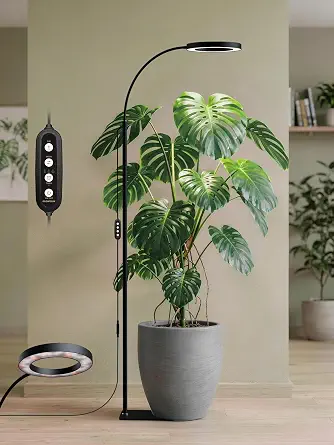 |
| Best Quality Built to a higher standard if you want something more solid | VIPARSPECTRA P700 70W Dimmable Full Spectrum LED Grow Light |  |
| Best Value The sweet spot between price and what you get | LEOTER 4-Head LED Grow Light with Full Spectrum, Timer and 10-Level Dimming |  |
| Best Budget The cheapest option that still gets the job done reliably | Briignite A19 Full Spectrum LED Grow Light Bulb (2-Pack) |  |
| Highest Rated A top-rated pick with lots of positive feedback | Hemonee 5-Head Adjustable LED Grow Light with Tripod Stand |  |
| Most Popular A crowd favorite that many people choose with confidence | GooingTop HY-021 6000K Full-Spectrum Clip Grow Light |  |
| Best Seller A high-volume bestseller chosen again and again | Barrina T5 1 ft LED Grow Light, 5000K Full Spectrum (4-pack) |  |
GLOWRIUM G2 Floor Grow Light with Adjustable Stand

| Light Source Type | LED |
|---|---|
| Additional Features | Adjustable Height, Dimmable, Flexible, Full Spectrum, Timer |
| Wattage | 20 watts |
| Number of Light Sources | 66 |
| Controller Type | Remote Control |
The GLOWRIUM G2 is a floor-style grow lamp designed to give large indoor plants reliable supplemental light without complicated installation. It uses 66 full-spectrum LEDs in a 20W fixture mounted on a three-section aluminum stand so you can raise the lamp to match a Monstera's canopy as it grows. Controls include stepless 10 to 100% dimming across six levels, a 3/9/12-hour auto timer, and a remote plus in-line push-button operation for quick adjustments. Practical features such as a wide base, anti-slip design, 13-foot power cord, and good heat dissipation make it easy to position near living-room plants and keep running safely for long periods. The lamp offers three light modes that combine warm, cool, and red spectrums to support rooting, vegetative growth, and flowering stages. Limitations are that it is meant for indoor use only and has a freestanding footprint, so it takes floor space and is less suitable for very small apartments or for growers who need wall- or ceiling-mounted fixtures.
Best for: Houseplant owners who want a straightforward, durable lamp to give a growing Monstera reliable, adjustable supplemental light without fussing with mounts or complex setups.
Less Ideal for: People with very limited floor space, those who need ceiling- or wall-mounted lighting, or growers who require IP-rated fixtures for humid rooms.
- Adjustable three-section stand lets you raise the light to match Monstera height and changing canopy needs
- Full-spectrum LED array with warm, cool, and red modes supports all growth stages
- Stepless 10–100% dimming and 3/9/12-hour timer add automation and precise intensity control
- Aluminum construction improves heat dissipation for longer runtime and durability
- Long 13-foot power cord and stable anti-slip base make placement flexible and secure
- Freestanding design requires floor space and may not fit very tight or high-shelf setups
- Specified as indoor use only so it is not suitable for humid outdoor or unprotected patio placements
Verdict: A practical, easy-to-use floor grow light that gives Monsteras adjustable full-spectrum illumination as they grow.
VIPARSPECTRA P700 70W Dimmable Full Spectrum LED Grow Light

| Light Output Maximum | 11000 lumens |
|---|---|
| Light Source Wattage | 70 watts |
| Mounting Type | Hanging Mount |
| Light Source Special Features | Dimmable |
| Number of Light Sources | 216 |
The VIPARSPECTRA P700 is a 70W full spectrum LED grow light built for seed starting and vegetative stages. It uses 216 diodes and a tuned mix of red and white LEDs to deliver high PAR output (advertised 11,000 lumens) across a small footprint roughly suited to a 2×2 ft veg area. The light is fanless and relies on large aluminum heat sinks to keep running temperatures low while the included 4-level dimmer lets you dial intensity for seedlings, clones, or mature veg. Setup is simple with hanging mount hardware included and the unit draws about 0.65 A at 120V so it runs far cooler and uses far less power than a comparable 150W HPS/MH system. For compact tents, shelves, or single-cabinet grows it offers a good balance of light output, spectrum, and efficiency. Limitations are its small coverage area and modest absolute wattage compared with larger fixtures, so gardeners with bigger canopies will want a higher-output model or multiple units.
Best for: Growers who want an efficient, low-heat fixture to run a single tent, shelf, or cabinet and who prioritize electricity savings and adjustable output for seedlings and veg.
Less Ideal for: Commercial growers or hobbyists running multi-plant canopies or larger tents who need wider coverage and higher total light output.
- Full spectrum diode layout optimized for seedlings and vegetative growth
- Low power draw (70W) with high reported lumen/PAR output for energy efficiency
- Fanless design with aluminum heat sinks for quiet, low-heat operation
- Integrated 4-level dimmer for easy intensity adjustment
- Coverage geared to a small 2×2 ft veg area so not ideal for larger grows
- Absolute wattage and diode count are modest compared with larger commercial fixtures
Verdict: A compact, energy-efficient full spectrum LED that delivers strong veg-stage light and adjustable intensity for small tents and cabinets.
LEOTER 4-Head LED Grow Light with Full Spectrum, Timer and 10-Level Dimming

| Light Source Type | LED |
|---|---|
| Number of Light Sources | 80 |
| Wattage | 80 watts |
| Control Method | Remote |
| Mounting Type | Clip On |
The LEOTER 4-head grow light is a USB-powered, clip-on lamp built for indoor plant care that combines full-spectrum and targeted red/blue diodes to support seedlings, vegetative growth and flowering. It uses 80 LEDs arranged across four adjustable heads on flexible goosenecks so you can position light over individual large plants or groupings. Notable features are three spectral modes (red+blue, warm/full spectrum, and combined), a circular memory timer with 3/9/12-hour presets, and ten brightness levels for fine control over intensity. The strong metal clip and flexible necks make it simple to aim light at tall foliage without permanent installation. Practical benefits include reduced need for supplemental natural light, convenient daily scheduling for busy users, and a compact footprint that suits shelves or plant stands. Important limitations are that the unit is described as a clip/desk lamp rather than a wide-panel fixture, so coverage for very large single specimens may require placing heads close to foliage or using multiple units, and the timer resets if unplugged so it needs occasional reprogramming after power loss.
Best for: Buyers who want a controllable, space-efficient grow light to supplement indoor sun for larger houseplants and prefer a proven, feature-rich unit with preset timers and adjustable heads.
Less Ideal for: Growers who need single-fixture coverage for floor-to-ceiling specimens or large multi-plant setups should consider full-size panel fixtures or multiple units instead.
- Full spectrum plus red and blue LEDs (80 total) to support all growth stages
- Ten dimming levels for precise intensity control
- Three timer presets with memory function for hands-off daily scheduling
- Adjustable 4-head design and flexible goosenecks for targeted placement
- Strong metal clip allows mounting on shelves, desks, or plant stands
- Designed as a clip-on lamp so single-unit coverage is limited for very large plants
- Timer settings must be reset after the light is unplugged
Verdict: A versatile, adjustable clip-on grow light that gives busy indoor gardeners precise control over spectrum, intensity and scheduling to boost large plant growth in compact spaces.
Briignite A19 Full Spectrum LED Grow Light Bulb (2-Pack)

| Light Type | LED |
|---|---|
| Additional Features | Full Spectrum |
| Bulb Base | E26 |
| Light Output Maximum | 1000 lumens |
| Light Source Operating Life | 30000 hours |
These Briignite A19 grow bulbs are full-spectrum LED replacements that screw into any standard E26 fixture to give indoor plants consistent, natural-looking light. Each bulb outputs about 1000 lumens at roughly 11 to 12 watts, so they act like a 60 to 100 watt incandescent while using far less energy, which is handy for running multiple bulbs on a budget. The 3500–4000K warm daylight color and high CRI make foliage colors appear normal rather than the purple hue of some grow lights, so they work well in living spaces and plant shelves. Built-in features include app control and push-button options and an advertised 25,000 to 30,000 hour operating life. Limitations to note are modest reported PPF compared with purpose-built high‑output grow fixtures and the 180 degree beam, which is better for general room lighting than targeted canopy penetration for dense or tall plants. For small collections, seed starting, or supplementing light in low-light rooms these bulbs are an economical, easy-to-install choice.
Best for: Houseplant owners who need an affordable, plug-and-play light to supplement natural light for a few pots, seedlings, or a small indoor garden while keeping energy costs low.
Less Ideal for: Growers aiming to flower large or dense canopy crops or outfitting multi-tiered grow racks will want higher‑PPF, purpose-built fixtures instead.
- Full spectrum output that looks like natural white light and preserves true foliage color
- Low power draw (around 11–12W) with 1000 lumens brightness for energy-efficient continuous use
- Standard E26 base fits common fixtures for tool-free installation
- High CRI of 90 helps accurate color rendering in living spaces
- Beam angle and lumen-focused design give less concentrated PAR/PPF than dedicated high‑output grow fixtures
- App and push-button controls are basic compared with advanced programmable controllers
Verdict: A low-cost, easy-to-install full-spectrum LED bulb that gives natural-looking light and energy savings for small indoor plant collections.
Hemonee 5-Head Adjustable LED Grow Light with Tripod Stand

| Adjustable height | 15 to 63 inches |
|---|---|
| Light modes | Red+Blue, White, White+Red+Blue |
| Brightness levels | 10 levels (10%–100%) |
| Timer options | 4/8/12 hours |
This Hemonee five-head LED grow light is built for steady everyday use with a tripod stand that extends from 15 to 63 inches and flexible goosenecks that rotate 360 degrees, so you can position each head directly over variegated plants without fuss. It offers three spectral modes (Red+Blue, White, and White+Red+Blue) and 10 brightness levels from 10 to 100 percent, letting you dial in gentle light for delicate variegation or stronger output for growth. Each head can be operated independently and the unit includes an inline controller plus an RF remote with timer presets for 4/8/12-hour cycles, which makes hands-off, consistent schedules easy. The aluminum shell and aviation-grade heat sink help keep the LEDs cool during long runs. Practical downsides are that the stand setup is basic rather than heavy-duty and the lamp is freestanding so it may take more floor space than a hanging fixture; it also does not list exact PPFD values, so users who need precise light measurements will need a meter. For growers focused on reliable, adjustable lighting for color-sensitive plants this is a convenient, user-friendly option.
Best for: Growers who prioritize dependable, set-and-forget lighting and need precise head-level positioning to protect variegation while providing consistent supplemental light.
Less Ideal for: Growers seeking high‑precision, measurable light output for professional propagation or those who need a compact hanging solution for limited floor space.
- Five independent LED heads with 360 degree goosenecks for precise placement over individual plants
- Three spectral modes and 10 brightness levels to match light needs at different growth stages
- Includes RF remote and inline controller with 4/8/12 hour timers for consistent automated schedules
- Aluminum shell and aviation-grade heat sink for improved heat dissipation during extended use
- No published PPFD or lux numbers for exact light intensity measurements
- Tripod stand is basic and may be less stable than heavier, commercial-grade mounts
Verdict: A versatile, easy-to-use multi-head grow light that delivers reliable, adjustable schedules and spot placement for preserving variegated foliage.
GooingTop HY-021 6000K Full-Spectrum Clip Grow Light
| Power Source | Corded Electric |
|---|---|
| Color Temperature | 6000 Kelvin |
| Light Output Maximum | 2500 lumens |
| Light Source Special Features | Dimmable |
| Number of Light Sources | 84 |
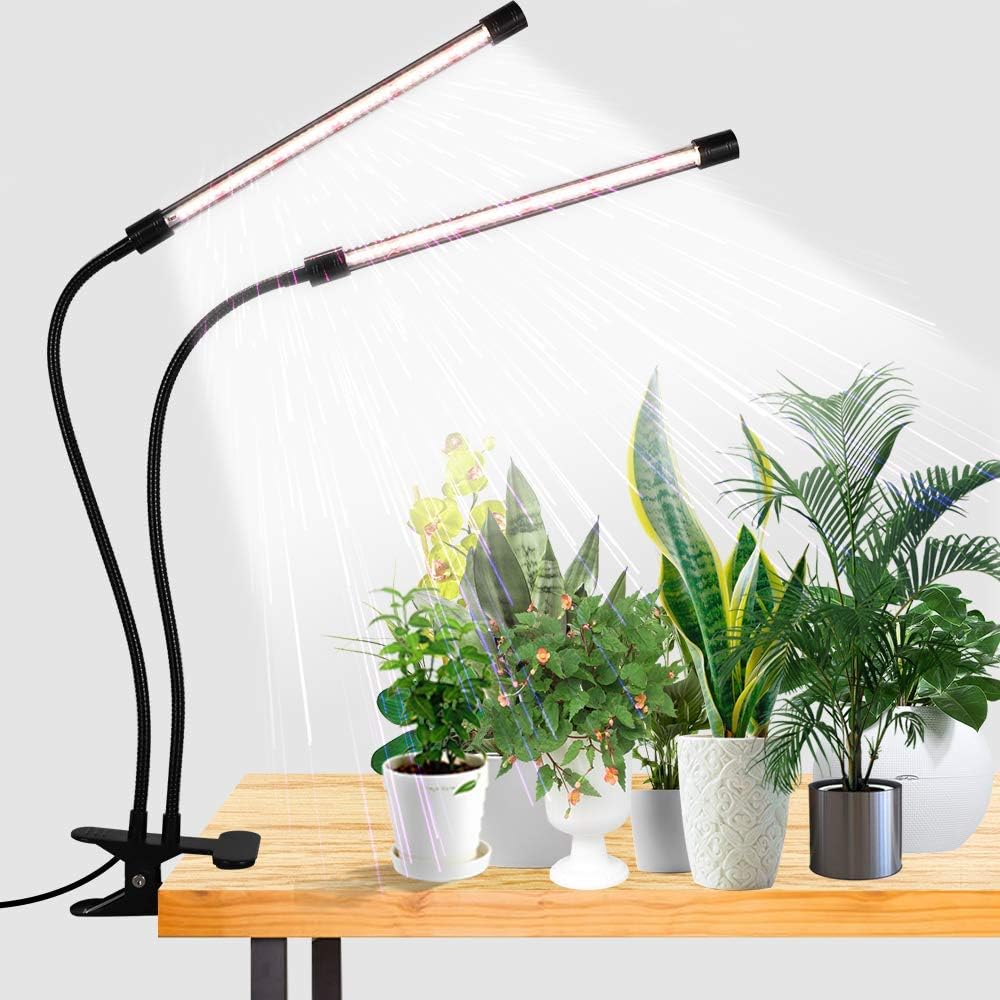
This GooingTop HY-021 is a compact clip-on grow light built for small houseplants, seedlings and shelf gardens. It uses 84 LEDs (white plus deep red) to deliver a 6000K full-spectrum output intended to mimic midday sun, with a high color-rendering output that also makes it pleasant as a reading lamp. Two flexible gooseneck heads and a strong clamp let you aim light precisely over pots and seed trays, while the attached remote provides 50%/100% dim levels and repeating timers at 4, 8 or 12 hours for hands-off scheduling. Practical benefits include low power draw (listed as roughly 10 W LED draw), a claimed 1 to 2 square meter coverage for seedlings, and an included timer that simplifies day/night cycles. Limitations are its design for small setups rather than large grow racks and the clip mounting limits placement compared with freestanding fixtures. The unit also relies on the corded remote instead of a smartphone app and the lifespan claim is typical of LEDs but not independently verifiable from the listing.
Best for: Buyers who want a simple, low-power, plug-and-play grow light to boost seedlings and a few houseplants on a desk or shelf and who value an easy-to-use timer and adjustable brightness.
Less Ideal for: Growers planning multi-shelf installations, larger vegetable grows, or who need networked or app-based control should consider larger bar lights or fixtures designed for commercial racks.
- Full-spectrum 6000K output with added 660 nm red LEDs to support vegetative growth and flowering
- Attached remote with dimming (50%/100%) and repeat timer settings (4/8/12 hours) for easy scheduling
- Flexible dual goosenecks and strong clamp enable precise positioning over small pots and seed trays
- High reported color rendering for comfortable viewing and accurate plant color assessment
- Low electrical draw around 10 W while covering small growing areas
- Clip-mount design and stated 1–2 m² coverage make it better suited to individual plants or small trays rather than large multi-shelf setups
- No smart app or wireless control option; remote is cord-attached which limits placement flexibility
Verdict: A compact, easy-to-use clip grow light that delivers full-spectrum light and convenient timer/dim controls for small indoor plant setups.
Barrina T5 1 ft LED Grow Light, 5000K Full Spectrum (4-pack)

| Wattage | 5W per fixture |
|---|---|
| Color temperature | 5000K Full Spectrum |
| Linkable | Link up to 16 lights |
| Control | Separate on/off switch per fixture |
| Included accessories | Power cords, connecting cords, clips, double-sided tape |
The Barrina T5 1 ft LED grow light kit supplies full-spectrum 5000K light in a compact, linkable T5 form that is useful for starting and growing tomato seedlings under artificial light. Each 1 ft fixture draws 5W and has its own on/off switch so you can run a single tube or multiple fixtures to match light needs. The set includes power cords, connecting cords, clips, double-sided tape and cable ties for quick plug-and-play installation and you can chain up to 16 lights in series to light multiple trays or shelf levels. Practical benefits for seedlings are even, high-PPFD output from an efficient LED array and the ability to tailor coverage by switching fixtures on or off. Limitations are that the small 1 ft form gives narrow coverage per tube so larger seed flats or full-width racks will need many fixtures, and the product is non-magnetic so mounting options depend on the included clips or your own hardware. Overall this kit is a straightforward, budget-friendly choice for growers who want controllable, linkable light for early-stage tomato plants.
Best for: Growers who want a compact, energy-efficient, controllable lighting solution for starting and growing tomato seedlings on shelves or seed trays.
Less Ideal for: People needing single wide-coverage fixtures for large benches or commercial-scale propagation should consider longer tubes or high-output panels instead.
- Full-spectrum 5000K output suitable for seedlings and vegetative growth
- Separately controllable fixtures let you run only the number of tubes needed
- Linkable design supports chaining up to 16 lights for multi-shelf setups
- Includes mounting clips, power and connecting cords for quick plug-and-play setup
- Small 1 ft length provides limited coverage per fixture so more units are needed for larger trays
Verdict: A compact, linkable full-spectrum T5 kit that gives efficient, controllable light ideal for raising healthy tomato seedlings on shelves and seed trays.
Choosing the Right Grow Light for Variegated Plants: Key Factors to Consider
Spectrum and Color Balance
Variegated plants benefit from a light spectrum that supports chlorophyll production without overwhelming the lower-pigmented tissue. A balanced full spectrum or adjustable bands allows you to increase blue for compact growth or add red for flowering without washing out pale leaf margins. In practice, look for spectral output graphs or tunable channels so you can dial in the mix for different species and growth phases.
Spectrum matters because variegated leaves often contain less chlorophyll in pale areas. Those sections need sufficient usable photons to photosynthesize without being pushed into stress by excess energy in wavelengths they cannot process efficiently. Being able to shift the spectrum over time also helps prevent reversion, where plants produce more green tissue to compensate for poor light quality.
Intensity Range and Control
Light intensity, measured as PPFD at the canopy, determines whether variegated tissue receives enough energy to sustain its lighter pigment. Variegated cultivars frequently prefer moderate PPFD compared with robust green-leaved species. Dimmable fixtures or lights with multiple output modes let you set a lower baseline for pale varieties while providing short boosts when needed for active growth.
Practical control is important because placement distance and fixture height change PPFD dramatically. A fixture with several wattage or dimming settings reduces the need to constantly reposition plants and helps you fine-tune exposure to avoid bleaching or etiolation.
Heat Output and Thermal Management
Delicate variegated leaves are more susceptible to heat stress and edge burn than tougher green foliage. Lights that run cool or spread heat well across a panel reduce the chance of hotspots that scorch pale tissue. Look for models with good heat sinks, low surface temperatures, or integrated fans if you are using the light close to leaves.
Consider thermal performance in relation to mounting: fixtures inside small terrariums or close to shelving have reduced air circulation, so choose lights specified for low surface temperature or that include temperature monitoring. Lower heat also lets you keep lights closer for even coverage without risking damage.
Coverage Pattern and Mounting Options
Variegated plants are often displayed in groupings, on narrow shelves, or in hanging baskets, so the light's coverage footprint and mounting flexibility affect how evenly each plant receives illumination. A narrow spotlight can create hot and cold zones that stress leaves; a wide, even spread from panels or bars reduces contrast and supports uniform variegation retention.
Adjustable hanging kits, clip mounts, or rail attachments make it easier to position the fixture at optimal height and angle. Consider fixtures that allow tilting or modular placement for mixed collections with differing leaf orientations.
Dimming, Timers, and Photoperiod Control
Consistent photoperiods and the ability to reduce intensity gradually are particularly useful for variegated plants that need a stable light regimen to maintain patterned foliage. Built-in timers and smooth dimming help mimic natural dawn and dusk transitions, which can reduce shock from sudden on/off cycles and limit stress-induced reversion.
Programmable features also let you vary daylength seasonally without manual intervention, important if you move plants between windows and supplemental light. Fine-grained dimming is preferable to a basic on/off because small adjustments can produce noticeably different outcomes for pale tissue.
Energy Use and Long-Term Reliability
Because many growers run supplemental lights for long daily periods, energy efficiency affects ongoing cost and environmental footprint. Fixtures with high efficacy deliver more usable light per watt and typically produce less waste heat, both advantages for variegated specimens. A longer rated lifespan and consistent lumen maintenance reduce the need for frequent replacement and help preserve stable light conditions over months or years.
Durability of components like drivers and connectors also matters. A well-built fixture with reliable electronics minimizes flicker and output drift, both of which can stress sensitive plants over time.
Matching Light to Variegation Types
Variegation comes in many forms from marginal white edges to mottled patches and sectoral patterns. Plants with very pale or predominantly white areas need gentler, more diffuse light because those tissues have minimal chlorophyll. Conversely, variegated plants with large green sectors can tolerate slightly higher PPFD but still benefit from spectrum control to avoid overgrowth of the green areas.
Assess the proportion of pale tissue before choosing a fixture. If most leaves are heavily variegated, prioritize tunable, lower-intensity panels and place the light a little closer to the canopy for even coverage. If green sectors dominate, you can lean toward stronger output with more control features.
- High-white variegation: prefer diffuse, lower-intensity light
- Mottled variegation: balanced spectrum with gentle increases
- Sectoral variegation: watch for uneven exposure across the plant
Using Distance and Diffusion to Prevent Bleaching
Distance from the fixture to foliage is one of the simplest tools to manage intensity. Increasing distance lowers PPFD rapidly, which is useful when you only have a higher-output fixture. However, increased distance can reduce uniformity, so combine distance changes with diffusers or reflectors to maintain even light.
Diffusers and frosted covers soften harsh points of light and spread photons more evenly. For shelves or grouped plants, a diffuser can prevent a single hotspot that burns leaf margins while delivering enough usable light for variegated tissues.
- Start with the manufacturer-recommended height and adjust in small increments
- Use diffusion when placing lights close to sensitive leaves
- Measure light with a simple meter if possible to confirm PPFD
Integrating Supplemental Light with Window Light
Natural light from windows often varies day to day and seasonally. Supplemental grow lights work best when they complement rather than replace window light. Use artificial light to even out daily totals and to boost morning or evening light when variegated plants need steady exposure.
Place lights to fill shaded areas or to provide longer photoperiods during short winter days. Avoid doubling high-blue output when your window receives intense midday sun, as that can push leaves into excessive light stress.
- Balance natural and artificial spectra for smoother color retention
- Shift supplemental timing seasonally to match daylight length
- Observe plants after small adjustments to avoid sudden stress
Routine Checks and Adjustments
Variegated plants respond visibly to small changes in light. Inspect new growth for signs of bleaching, reversion to green, or edge burn during the first few weeks after installing a new fixture. Make one adjustment at a time and allow at least a week to see the effect.
Keep a simple log of light settings, distance, and plant responses. That record helps you identify which combinations preserve variegation best across different seasons and locations in your home.
- Look for pale-new-leaf failure to harden as a sign of too little usable light
- Watch for crisp brown edges that indicate heat or localized burn
- Adjust timers gradually to avoid photoperiod shock
Fixtures That Work in Small and Confined Spaces
Many variegated plants live on shelves, in terrariums, or on windowsills with limited clearance. Low-profile bars and slim panels designed for tight spaces provide even coverage without adding heat or bulk. Choose fixtures with low surface temperature ratings for enclosed environments and those that offer clip or rail mounts to maximize flexibility.
Ventilation matters in confined spaces. If you are using a light inside an enclosed display, select fixtures with passive cooling and low wattage to avoid raising interior temperatures and humidity beyond safe levels for variegated foliage.
- Select low-profile fixtures for tight shelf spacing
- Prefer passive cooling for low-noise enclosed displays
- Use mounting hardware that lets you angle light for even spread
How We Chose the Best Grow Light for Variegated Plants
We prioritized features that directly affect how variegated foliage responds to supplemental lighting. Spectrum control was a top filter because the ratio of blue to red and the presence of far-red or full-spectrum output influences pigment retention and leaf development. Intensity adjustability was required so delicate pale tissue can be given lower PPFD while nearby green tissue receives enough light. Heat management was an exclusionary criterion; high surface temperatures or poor airflow can cause tissue burn on variegated leaves, so models that rely on passive, poorly dissipated heat were deprioritized. We also evaluated build and mounting flexibility since many variegated plants are grown on shelves, in terrariums, or under hanging fixtures and need adaptable mounting or dimming. Energy efficiency and longevity were considered to reflect real-world running costs and consistent output across a season. Finally, we excluded lights that only offer single-spectrum, high-intensity output without dimming or spectrum control, because those do not suit the nuanced needs of variegated cultivars. The scoring aligned to measurable specs like spectral output curves, adjustable PPFD range, surface temperature under load, mounting options, and rated lifespan.
FAQ
How bright should a grow light be for variegated plants?
It depends on the amount of pale tissue and the species. Many variegated houseplants do well at moderate PPFD levels rather than maximum output. Start low and increase intensity gradually, watching new growth for signs of stress or reversion.
Can I use a normal grow light designed for vegetables on variegated houseplants?
Often those lights are higher intensity and tuned for flowering, which can be too strong for delicate variegated leaves. If you use such a fixture, rely on dimming, increased distance, or diffusion to reduce intensity and adjust spectrum if possible.
Will stronger light prevent variegation from fading?
Stronger light can help maintain variegation in some species, but excess intensity can bleach or burn pale tissue. Improving usable light through better spectrum and even distribution is usually safer than simply increasing wattage.
How close can a grow light be to variegated leaves?
That depends on the fixture's heat output and beam pattern. Low-heat LED panels can be placed closer than high-intensity spots. Monitor leaf temperature and watch for edge browning to determine safe distance.
Is a full-spectrum light necessary for variegated plants?
Full-spectrum or tunable fixtures are beneficial because they let you adjust the ratio of blue and red light for different growth stages. A fixed single-spectrum light may work for some species but offers less flexibility to protect pale tissue.
How important are timers and dimmers for variegated collections?
Timers and smooth dimming are very helpful. They maintain consistent photoperiods and allow incremental intensity changes, which reduces stress and helps preserve patterned foliage over time.
Final Verdict
Prioritize lights that offer spectrum control, smooth dimming, and low heat if you want to preserve variegation. Coverage and mounting flexibility determine how evenly delicate leaves receive usable photons, while energy efficiency and a reliable driver ensure stable output over time. Balance intensity with diffusion and distance rather than assuming higher wattage is better. Focus on fixtures that let you tune spectrum and PPFD to the needs of your specific variegated cultivars, and you will minimize reversion and leaf damage while keeping patterns bright.
