

Note: This article contains affiliate links. If you click on these links and make a purchase, I may earn a small commission at no extra cost to you. This helps support my research and content. Read my full affiliate disclosure here.
If you plan to run a six-plant setup indoors, picking the right grow tent matters for canopy shape, airflow, and ease of routine care. A tent that fits six plants comfortably keeps lights at the right distance, lets ventilation circulate evenly, and gives you enough workspace for watering, pruning, and training. This guide covers a short list of top grow tents for 6 plants, chosen for practical features gardeners use every day. We evaluated usable floor and canopy area, ventilation options, access and maintenance features, and durability so you can choose a tent that suits your space and workflow.
Top Picks at a Glance
| Best Overall The best all-around choice for most situations | VIVOSUN P558 PRO 5×5 Grow Tent (60x60x80) — Heavy-Duty Mylar-Lined |  |
| Best Value The sweet spot between price and what you get | Spider Farmer 4×4 Grow Tent (48 x 48 x 80) |  |
| Best Budget The cheapest option that still gets the job done reliably | zazzy 4×4 Grow Tent 48 x 48 x 78 with 600D Mylar Interior |  |
| Highest Rated A top-rated pick with lots of positive feedback | AC Infinity CLOUDLAB 866 5×5 Advance Grow Tent |  |
| Most Popular A crowd favorite that many people choose with confidence | VIVOSUN S448 4×4 Grow Tent (48" x 48" x 80") |  |
| Best Seller A high-volume bestseller chosen again and again | VIVOSUN S848 4×8 Grow Tent (96 x 48 x 80 inches) — High Reflective Mylar |  |
VIVOSUN P558 PRO 5×5 Grow Tent (60x60x80) — Heavy-Duty Mylar-Lined

| Frame Material | Alloy Steel |
|---|---|
| Inner Material | Polyethylene Terephthalate (PET) |
| Outer Material | Oxford Fabric |
| Capacity | 400 pounds |
The VIVOSUN P558 PRO 5×5 grow tent is designed as a durable, lightproof chamber for indoor cultivation of multiple plants. Its three-layer 2000D Oxford canvas with plant-safe PE and 100% reflective mylar maximizes light efficiency and prevents leaks while the robust 22mm alloy steel poles and included high-CFM support bars keep the frame steady under load. The tent comes with a floor tray, four hanging bars, cable-management ports, a large observation window, and smooth SBS zippers that make daily access and monitoring straightforward. In practice this tent suits a six- to eight-plant setup in 5-gallon containers when you need reliable light control and scope for mounting lights, filters, and trellis gear. The built-in support kit reduces flex when using powerful inline fans, but buyers should plan ventilation and electrical layout because fans, filters, and lights are not included. Assembly is typical for pro-style tents and requires a bit of time to position the thicker poles and accessories. For someone wanting a stable, light-tight 5×5 that scales to a full multi-plant system, this model is a solid all-round choice.
Best for: Growers who want a durable, light-tight 5×5 that can reliably support a multi-plant setup and heavier equipment, and who value build quality and organized cable management.
Less Ideal for: Casual hobbyists seeking a minimal, ready-to-run system with included lights and fans or buyers who need a very small footprint grow space.
- Thick 2000D fabric with 100% reflective mylar for strong light control and efficiency
- Reinforced φ22mm alloy steel poles and extra hanging bars for stable mounting of lights and trellis
- High-CFM support kit included to minimize tent flex when using powerful fans
- Large observation window and smooth SBS zippers for easy monitoring and access
- Multiple cable-management ports and an exterior pocket to keep accessories tidy
- Ventilation, lighting, and filtration components are not included so additional purchases are needed
- Heavier-duty materials and thicker poles make assembly slightly more time-consuming
Verdict: A sturdy, pro-style 5×5 tent that prioritizes light control and structural support for multi-plant indoor grows.
Spider Farmer 4×4 Grow Tent (48 x 48 x 80)
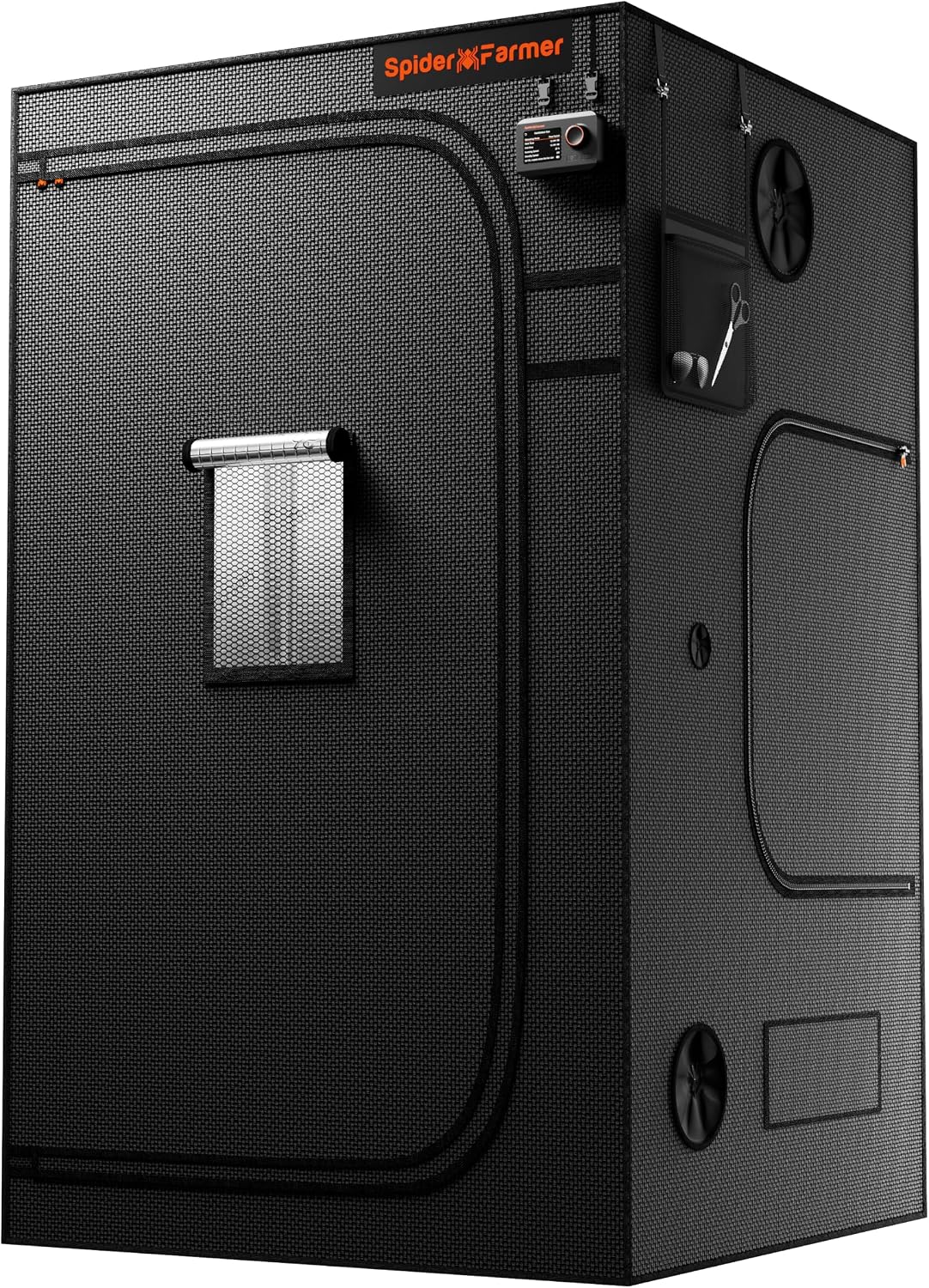
| Unit Count | 16 Square Feet |
|---|---|
| Inner Material | mylar |
| Outer Material | 1680D Oxford cloth and reflective mylar |
| Frame Material | Metal |
| Weight Capacity Maximum | 150 pounds |
This Spider Farmer 4×4 grow tent creates a controlled, lightproof space for indoor gardening and is sized for a 4×4 setup. It uses thick 1680D Oxford canvas and reflective mylar to minimize light leaks and maximize usable light, and heavy steel poles with reinforced adapters support substantial hanging loads so larger LED fixtures and carbon filters can be installed without sagging. The tent includes practical features for organized builds: multiple cable pass-throughs, a dedicated controller hook and cable lanyard, an enlarged observation window, removable waterproof floor tray, and a tool bag for accessories. Setup is tool-free and straightforward, and the observation window plus zipper configurations make monitoring and access convenient. Expect a reliably dark, insulated environment well suited to multi-light grows, but note the tent’s robust materials and metal frame make it less portable than lightweight pop-up options and the interior space is fixed to the 4×4 footprint so larger commercial layouts will need bigger tents or modular expansion.
Best for: Gardeners who want a durable, no-nonsense grow environment that supports heavier lights and tidy cable management for a reliable 4×4 indoor grow setup.
Less Ideal for: People needing a highly portable or very large commercial grow space should consider lighter pop-up tents for mobility or larger modular systems for scale.
- High-density 1680D Oxford canvas and diamond mylar interior for strong lightproofing and reflectivity
- Reinforced steel frame rated to support heavy lights and filters without collapsing
- Multiple cable passthroughs and controller hooks for tidy smart-gear integration
- Removable waterproof floor tray and tool bag simplify maintenance and organization
- Heavier, more rigid construction reduces portability compared with lightweight tents
- Fixed 4×4 interior area may be limiting for larger or multi-tier commercial setups
Verdict: Buy this tent if you want a rugged, lightproof 4×4 grow space built to support heavy lights and organized smart-gear setups.
zazzy 4×4 Grow Tent 48 x 48 x 78 with 600D Mylar Interior

| Chamber Volume | 104 cubic feet |
|---|---|
| Frame Material | Metal |
| Inner Material | Metal |
| Outer Material | Canvas |
This 4×4 zazzy grow tent is a budget-friendly enclosure for indoor gardening that creates a lightproof, reflective environment for up to about six small to medium plants. It uses tear-resistant 600D canvas, heavy-duty zippers, metal poles and reinforced PA corner connectors to form a stable frame that is tool-free to assemble. The interior is lined with near-100% reflective mylar to boost light efficiency and retain heat, and multiple ducting vents and a mesh-covered rectangle window let you add fans and filters while keeping insects out. A removable floor tray simplifies cleaning and catchment of run-off. The tent is practical for growers who need a compact, no-frills space to run lights, a filter and modest ventilation; expect solid light containment but limited premium features such as built-in observation windows or advanced porting options. Overall it balances durability and reflective performance at an economical level, though users wanting heavier-duty commercial fittings or larger access panels may look elsewhere.
Best for: Growers on a tight budget who need a reliable, compact tent to run lights and basic ventilation for a multi-plant setup and prefer straightforward, tool-free assembly.
Less Ideal for: Experienced growers who require advanced access panels, integrated monitoring ports, or heavy commercial-grade fittings for large or highly automated grows.
- 600D canvas and double stitching for tear resistance and light blocking
- 98% reflective mylar interior to improve light use efficiency
- Sturdy metal pole frame with reinforced connectors for stable assembly
- Multiple vents and a ducting window with mesh for easy fan and filter installation
- Removable floor tray makes cleaning and runoff management simple
- No built-in observation window despite some listings mentioning one
- Porting and access options are basic compared with higher-end tents
Verdict: A practical, economical 4×4 grow tent that maximizes light reflectivity and stable support for a six-plant indoor setup.
AC Infinity CLOUDLAB 866 5×5 Advance Grow Tent

| Frame Material | Alloy Steel |
|---|---|
| Inner Material | Mylar |
| Item Highlight | Largest Zipper Window, 2000D Mylar Canvas, 1" Poles |
| Weight Capacity Maximum | 150 pounds |
The AC Infinity CLOUDLAB 866 is built for growers who want a dependable, long-lasting 5×5 grow environment for up to six plants in 5-gallon pots. It uses 1-inch alloy steel poles and thick 2000D canvas with lab-tested mylar that maximizes light reflectivity, which helps even light distribution and improves lamp efficiency. Practical touches include large zipper viewing windows, SBS zippers, extra hanging bars, multiple duct ports for ventilation and climate gear, and a stain-resistant catch tray for easy maintenance. The tent also offers a controller mounting plate with a lightproof cable passthrough so environmental controllers and inline fans integrate cleanly. Assembly and placement are straightforward but the tent is substantial and may need two people to position and secure. There are no built-in electrical components, so you will need to plan for fans, filters, lights, and a controller separately. If you prioritize a robust frame, high-reflectivity interior, and thoughtful cable and duct management, this tent is a reliable foundation for a multi-plant grow room.
Best for: Growers who prioritize a durable, well-engineered tent that integrates cleanly with environmental controllers and separate ventilation and lighting systems for a reliable six-plant setup.
Less Ideal for: Casual hobbyists looking for an all-in-one kit or a very lightweight temporary shelter should consider simpler, smaller, or bundled options instead.
- Reinforced 1" alloy steel poles for strong structural support
- 2000D canvas with lab-tested mylar for very high light reflectivity
- Multiple duct ports and extra hanging bars for flexible ventilation and equipment setup
- Large zipper window and SBS zippers for convenient access and monitoring
- Controller mount with lightproof cable passthrough for tidy integration of environmental controls
- No integrated lighting, fans, or filters included so additional equipment is required
- Large and heavy when assembled, which can make initial setup and placement more difficult
Verdict: Buy this tent if you need a rugged, high-reflectivity 5×5 grow tent that integrates neatly with external controllers and ventilation for a reliable six-plant grow.
VIVOSUN S448 4×4 Grow Tent (48" x 48" x 80")

| Tent size | 48" x 48" x 80" |
|---|---|
| Inner material | Polyethylene Terephthalate (PET) |
| Outer material | Oxford Fabric |
| Frame material | Metal |
| Light source wattage | 400 watts |
The VIVOSUN S448 is a 4×4 grow tent designed to give hobby and small-scale growers a durable, lightproof environment for indoor plants. It uses a high-reflectivity mylar interior to diffuse light and reduce hotspots, plus upgraded heavy-duty zippers and a thick 1680D oxford outer fabric for long-term use. The metal frame and reinforced connectors hold hanging bars for lights and other equipment, while multiple duct ports and cable openings make it straightforward to add fans, filters, humidifiers or controllers. A removable mylar floor tray simplifies cleaning and the observation window lets you check plants without breaking the seal. Setup is intended to be quick with clear instructions and smooth-gliding doors for easy access. Expect a solid, workmanlike tent that supports multimedia grow systems, but be aware it is a dedicated grow environment so you will need to add lighting, ventilation and environmental controls separately to run a complete setup.
Best for: Buyers who value proven construction and clear social proof and want a reliable, long-lasting 4×4 tent to build a complete indoor grow system with separate lights and ventilation.
Less Ideal for: Casual plant owners who want a plug-and-play all-in-one kit or those with very limited indoor space should consider smaller integrated kits instead.
- 100% reflective mylar interior to improve light distribution and reduce hotspots
- Sturdy all-metal frame and reinforced connectors that support hanging lights and equipment
- Thick 1680D oxford fabric and heavy-duty zippers for durability and lightproofing
- Multiple duct ports and cable openings for easy integration of ventilation and climate-control gear
- Removable waterproof floor tray and observation window for easier maintenance and monitoring
- Does not include lighting, fans, or filtration so you must purchase a complete system separately
- Relatively large footprint requires dedicated indoor space and clearance for airflow
Verdict: A well-built, reflective 4×4 tent that gives risk-conscious growers a durable, serviceable base to assemble a reliable indoor grow system.
VIVOSUN S848 4×8 Grow Tent (96 x 48 x 80 inches) — High Reflective Mylar

| Frame Material | Metal |
|---|---|
| Inner Material | Polyethylene Terephthalate (PET) |
| Outer Material | Oxford Fabric, PE |
| Weight Capacity Maximum | 100 pounds |
| Chamber Volume | 6.04 cubic_meters |
The VIVOSUN S848 is a 4×8 grow tent built for hobbyists who want a reliable, light-controlled environment for multiple plants. It uses a hexagon-pattern reflective Mylar interior to diffuse light more evenly across the canopy, which helps reduce hotspots and improve overall light efficiency. The tent’s heavy-duty Oxford fabric, reinforced PE layer, and metal frame connectors give it a robust feel and make it suitable for hanging grow lights and other equipment. Multiple duct ports, cable openings, and bottom vents make it straightforward to add an inline fan, filter, humidifier, or other climate control gear, and the transparent viewing window lets you inspect plants without breaking the seal. Assembly is tool-free and relatively quick thanks to reinforced corner connectors. Limitations are its footprint and weight capacity relative to very large commercial setups and that full performance depends on adding compatible ventilation and lighting components which are sold separately.
Best for: A cautious grower who wants a durable, easy-to-seal tent for a multi-plant indoor setup and values even light distribution and flexible ventilation options.
Less Ideal for: People who need a compact single-plant solution or those looking for an all-in-one kit with included lights and filtration.
- 100% reflective hexagon-pattern Mylar interior for improved light diffusion
- Heavy-duty 1680D Oxford fabric and reinforced PE layers for durability and light blocking
- Sturdy all-metal frame and top bars support hanging lights and equipment
- Multiple duct ports and cable openings for easy integration of ventilation and climate gear
- Transparent viewing window and removable mesh covers for quick checks and easier cleaning
- Requires separate purchase of fans, filters, and lights for a complete grow system
- Relatively large footprint that may not suit very small indoor spaces
Verdict: A robust, well-ventilated 4×8 tent that gives cautious growers a reliable, light-efficient environment for multiple plants when paired with separate climate and lighting gear.
Choosing the Right Grow Tent for 6 Plants: Key Factors to Consider
Usable Floor and Canopy Area
For a six-plant layout you need to think about actual usable floor area and how plants will fill that space as they grow. Raw footprint numbers do not always reflect internal obstructions such as corner poles, support straps, or preinstalled dividers. Compare net interior length and width and imagine your preferred plant spacing method whether pots, fabric pots, or a low-stress training grid.
Canopy area matters because it determines how many lights you need and at what height. A tent with a slightly larger footprint can let you stagger plants or run larger pots for longer veg cycles, while a tight footprint forces more aggressive training and more frequent topping.
Ventilation Configuration
Good ventilation prevents heat pockets and moves CO2-rich air across the canopy. Look at the size, number, and placement of duct ports, intake panels, and passive vents. Ports placed near the top and midline let you run an exhaust fan and inline filter efficiently without strapping ducts awkwardly through the interior.
Also consider how easy it is to mount fans or ducting. Some tents include reinforced ports or removable panels that simplify routing. For a six-plant arrangement you will likely need a fan that can move a moderate volume of air; the tent should accommodate duct runs without sharp bends that reduce airflow.
Interior Height and Training Space
Height determines your flexibility with light types, reflector styles, and plant training. Taller tents let you use more aggressive training techniques and accommodate larger lights at a safe distance from the canopy. If you plan to run a dense six-plant canopy or let plants flower for a long period before harvest, extra headroom reduces the need for frequent defoliation or height management.
Also consider internal hanging points and channels for support rigs. Strong, well-placed anchor points make it easier to hang lights, linears, and trellis nets without interfering with plant movement.
Light Reflection and Containment
Effective interior reflectivity ensures that light is reused rather than lost to the tent walls. A high-quality reflective liner spreads light more evenly across the canopy and reduces hot spots directly under fixtures. Equally important is how well the tent blocks light leaks; stray light at the seams or zipper can create stress and disrupt light cycles for flowering plants.
Inspect zipper construction, seam sealing, and corner overlaps when assessing containment. Even small, consistent leaks can affect timed light cycles and encourage stretching.
Access, Cleaning, and Maintenance
Daily access impacts how often you inspect and maintain plants. Wide doors, observation windows with removable covers, and removable floor trays reduce strain when watering, pruning, or checking for pests. A tent that opens awkwardly or has tiny ports makes routine tasks cumbersome and increases the chance of accidental damage to the canopy.
Consider how easy it is to clean the interior liner and remove soil or spilled nutrient solution. Removable pans and washable liners save time and reduce the chance of mold build-up in damp corners.
Planning Your Six-Plant Layout
Start by deciding whether you want a square grid, staggered arrangement, or staggered rows. Square grids maximize even light coverage while staggered layouts can help with airflow and access. Sketch the tent interior and mark positions for lights, fan, filter, and each pot so you know where cords and ducting will run.
Account for pot diameter and whether you will use saucers or trays. Allow a little extra space for plant spread during flowering; it is easier to restrain small gaps than to create new space later.
- Measure pots and add 2 to 4 inches clearance per plant for airflow.
- Place the exhaust near the top corner to draw heat out efficiently.
- Reserve a small clear path for daily access and maintenance.
Ventilation Setup Tips for Even Airflow
Position the exhaust fan at or near the top of the tent and use an intake low on the opposite side to create a consistent airflow pattern across the canopy. Avoid routing intake and exhaust too close together because that can short-circuit airflow.
Use ducting with gentle curves and minimize the number of bends. If your layout forces a tight bend, increase fan capacity slightly to maintain the same effective airflow.
- Aim for passive intake where possible to reduce the number of duct runs.
- Use an oscillating clip fan inside the tent to break up microclimates among plants.
Lighting Considerations for a Six-Plant Canopy
Lighting strategy depends on canopy density and desired yield. For compact canopies one large center fixture can work, but more uniform coverage often comes from multiple smaller fixtures or a horizontally distributed bar. Match fixture height to the internal tent height and your training method to avoid light burn or excessive stretching.
Consider adjustable hanging systems so you can raise or lower fixtures as plants change size. Also account for the extra heat load from lights when calculating fan size and filter placement.
- Place lights to cover the canopy evenly and avoid dark corners.
- Choose hanging hardware rated for the weight of your fixtures.
Flooring, Drainage, and Humidity Control
A removable waterproof floor tray makes cleaning spills easier and helps protect flooring outside the tent. Good drainage prevents standing water that encourages mold and pests. If you plan on frequent heavy watering, choose a tent with a raised lip and a drain port.
Humidity management becomes more important with six plants that transpire heavily. Ensure your tent has room for a dehumidifier or that your household HVAC can handle the extra moisture during peak transpiration.
- Use a hygrometer inside the tent for accurate humidity readings.
- Run lights and fans on timers to stabilize daily temperature and humidity cycles.
Assembly and Durable Construction
Ease of assembly matters if you move tents between locations or set up and tear down seasonally. Look for tents with clear pole fittings and a stable frame that resists sagging under the weight of lights and ducting. Reinforced corners and thicker fabric liners improve long-term durability.
Check for sturdy zipper designs and robust stitching at stress points. These small construction details influence how the tent performs after months of use.
- Test zippers and ports during assembly to make sure they align properly.
- Plan for spare hanging straps and small repair patches for long-term maintenance.
How We Chose the Best Grow Tent for 6 Plants
We shortlisted tents using criteria that reflect how a six-plant setup behaves in real indoor gardens. Usable canopy area and interior height were prioritized to ensure plants can be trained without crowding. Ventilation capability and duct port placement were weighed heavily because even airflow prevents hot spots and supports healthy transpiration. Build quality and material thickness were used to assess light containment and long-term durability under repeated setup and tear-down. Access features such as door style, observation windows, and removable floor trays were considered for routine maintenance and pest checks. Ease of assembly and footprint flexibility were included to help gardeners match tents to tight rooms, closets, or basements. We excluded tents intended only for seedlings or micro-propagation, as well as ultra-large commercial enclosures that exceed a typical home six-plant layout. The final picks emphasize real-world dimensions, ventilation practicality, and user-friendly access rather than marketing claims.
FAQ
What tent size is best for six medium-sized pots?
It usually depends on your pot diameter and training method, but a tent that gives roughly 3 by 3 feet of usable canopy per two plants often works for six plants in a 3×2 grid. Allow extra room if you plan larger pots or extended flowering cycles.
How much ventilation do I need for a tent housing six plants?
You want an exhaust that can exchange the tent air several times per minute when lights are on. The exact fan size depends on tent volume and light heat output. Also account for static pressure from carbon filters and ducting when choosing fan capacity.
Can I run a six-plant setup in a shorter tent?
Yes, but shorter tents limit training options and may force lower light placement or more frequent pruning. If you plan aggressive training or large flower stretch, choose a taller tent to reduce management time.
How do I prevent light leaks from upsetting light cycles?
Inspect zippers, seams, and observation windows for gaps and use overlapping flaps where possible. Maintain dark periods by sealing any small openings and minimizing door openings during the dark cycle.
Is it better to use one large light or multiple smaller fixtures?
Multiple fixtures often give more even coverage across a six-plant canopy, while a single large light can be simpler to install. The right choice depends on tent dimensions and how evenly the fixture distributes usable light.
Final Verdict
When choosing a grow tent for six plants, prioritize usable canopy area, ventilation placement, and interior height over headline dimensions. These factors determine how easily you can train plants, manage heat and humidity, and access the canopy for routine care. Expect tradeoffs between compact footprints and usable vertical space; pick the configuration that matches your training method and room constraints so you spend less time rearranging and more time tending plants.
