

Note: This article contains affiliate links. If you click on these links and make a purchase, I may earn a small commission at no extra cost to you. This helps support my research and content. Read my full affiliate disclosure here.
Weeds growing between pavers, in cracks, and along edges can quickly make a driveway look neglected and create tripping hazards. Choosing the right herbicide for driveways matters because these products behave differently on hard surfaces than in soil: some provide rapid knockdown but little lasting control, while others penetrate roots or leave residual activity that prevents regrowth. This guide covers seven shortlisted herbicides suited for driveways and similar hardscape areas. We focus on how each product performs on common driveway surfaces, how long control lasts, and what safety or surface-staining risks to expect. Read on for the criteria we used to select picks and practical advice for applying herbicide safely and effectively.
Top Picks at a Glance
| Best Overall The best all-around choice for most situations | Roundup QuickPro Herbicide Powder (108.8 oz) |  |
| Best Quality Built to a higher standard if you want something more solid | RM43 Total Vegetation Control 43% Glyphosate Plus Weed Preventer, 2.5-Gallon |  |
| Best Value The sweet spot between price and what you get | Hi-Yield Super Concentrate Killzall Weed & Grass Killer, 32 oz |  |
| Best Budget The cheapest option that still gets the job done reliably | Pulverize Weed & Grass Killer, Ready-to-Use 1 Gallon (Messinas) |  |
| Highest Rated A top-rated pick with lots of positive feedback | Agrisel SpeedPro XT Quart Herbicide |  |
| Most Popular A crowd favorite that many people choose with confidence | Spectracide Weed & Grass Killer Concentrate, 1 Gallon |  |
| Best Seller A high-volume bestseller chosen again and again | Roundup Weed & Grass Killer4 with Pump 'N Go 2 Sprayer, 1.33 gal |  |
Roundup QuickPro Herbicide Powder (108.8 oz)

| Item Form | Powder |
|---|---|
| Coverage | Non-selective broad spectrum coverage |
| Active Ingredients | Glyphosate; Diquat |
| Unit Count | 108.8 Ounce |
| Liquid Volume | 1 gallons |
Roundup QuickPro is a concentrated powder herbicide designed to be mixed with water and applied through standard sprayers for rapid control of unwanted vegetation. It combines glyphosate for systemic, lasting control with diquat for quicker leaf uptake, so you can see visible browning in as little as 24 hours and the spray becomes rainfast in about an hour. Typical use is mixing 1.5 ounces per gallon of water, treating driveways, fence lines, and other areas where nonselective weed kill is acceptable while protecting desirable plants from drift. The powder format yields a lot of product in one unit and is convenient for users who prefer to mix exact doses when treating larger areas. Important limitations include the nonselective nature of the formula, which means careful application and shielding of desirable plants are required, and the product contains glyphosate, which some buyers may want to avoid. Follow label safety directions to protect people, pets, and non‑target plants.
Best for: Buyers who prioritize a reliable, fast‑acting solution for removing unwanted grass and weeds from nonplanting areas and who value predictable, professional‑style results.
Less Ideal for: Gardeners wanting selective lawn treatments, organic-only approaches, or those who need to treat areas near sensitive plants or pollinator habitat should consider alternatives.
- Fast visible control due to combined glyphosate and diquat action
- Concentrated powder mixes to treat large areas with controlled dosing
- Rainfast in about one hour so treatments hold up through brief showers
- Works systemically for control of many annual and perennial weeds
- Nonselective formula can damage desirable plants if not carefully applied
- Contains glyphosate which some gardeners may prefer to avoid
Verdict: Choose Roundup QuickPro when you need a dependable, fast‑acting nonselective herbicide that delivers visible control quickly and holds up through light rain.
RM43 Total Vegetation Control 43% Glyphosate Plus Weed Preventer, 2.5-Gallon
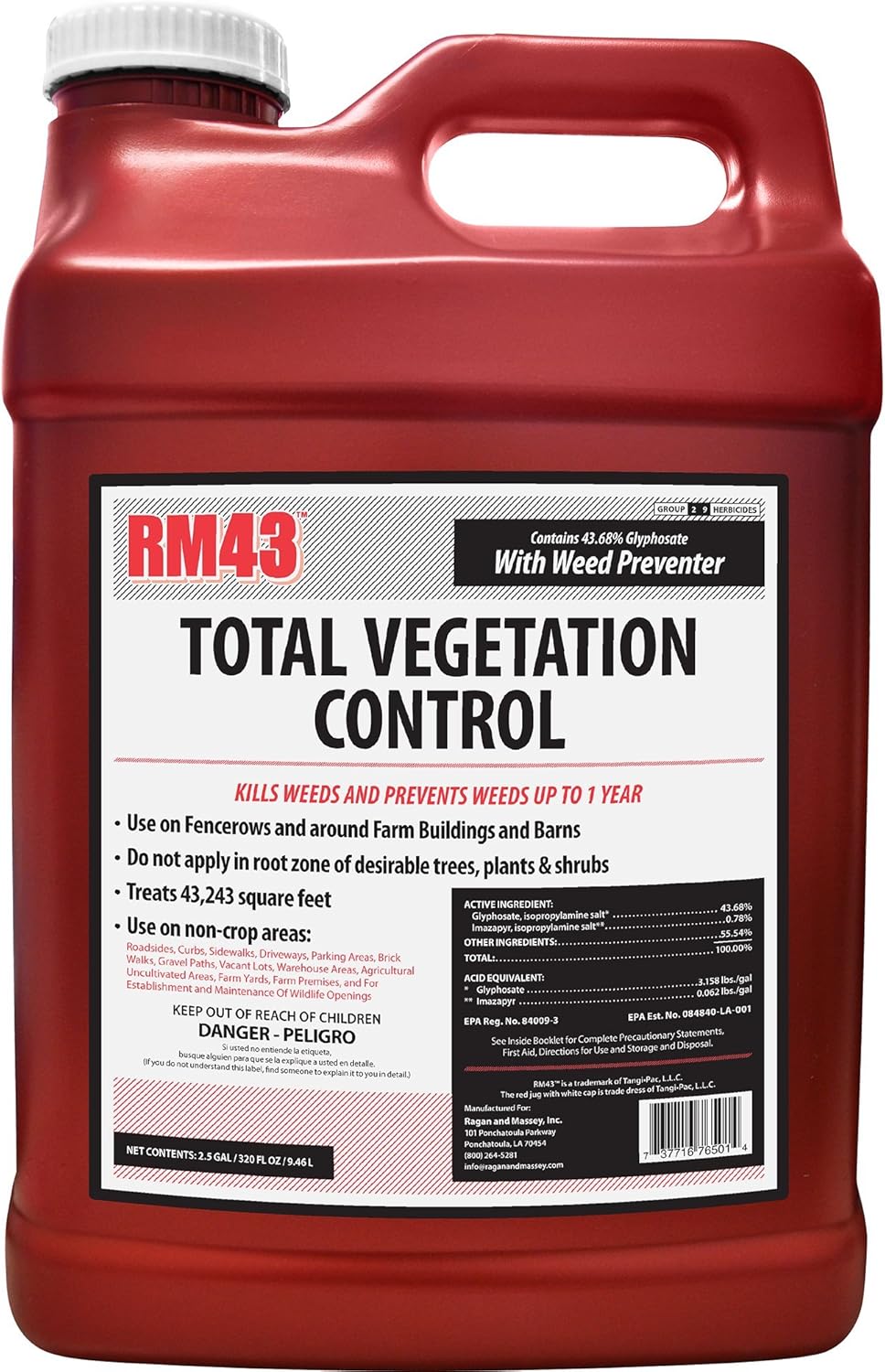
| Unit Count | 320 Fluid Ounces |
|---|---|
| Liquid Volume | 320 fluid ounces |
| Coverage | 243 243 square feet |
| Active Ingredients | Glyphosate isopropylamine salt, Imazapyr isopropylamine salt |
RM43 Total Vegetation Control is a concentrated 2.5‑gallon herbicide intended for killing existing growth and preventing regrowth for up to a year on areas where no vegetation is desired. You mix it into spray solution and apply to hardscape edges, gravel driveways, fence rows, and around buildings as either spot treatments or blanket applications on bare ground. The formula pairs glyphosate and imazapyr with a surfactant so it kills grasses, broadleaf weeds, vines, brush and some woody growth and becomes rainfast in about two hours. Practical benefits for driveway use include long residual control that reduces repeat spraying and a large coverage rate that treats many square feet from one container. Important limitations are that it is for non‑crop areas only and will damage desirable plants if sprayed over roots or drift occurs, and the active ingredient blend makes it persistent so care is required where you may later want vegetation to return. Follow label directions for mixing, application timing and safety precautions when using near soil that will be planted later.
Best for: Gardeners, property owners, and maintenance crews who prioritize strong, long‑lasting weed eradication on gravel driveways and other non‑crop hardscape areas and want to minimize repeat applications.
Less Ideal for: Homeowners planning to replant treated areas soon or those needing selective weed control near desirable plants should choose a less persistent or more targeted product.
- Combination of glyphosate and imazapyr for both knockdown and long residual control
- Concentrated 2.5‑gallon container covers large areas without frequent refills
- Rainfast in about two hours so light rain soon after application is less likely to reduce effectiveness
- Suitable for total vegetation control on gravel driveways, fence rows and other non‑crop areas
- Persistent active ingredients that can prevent desirable vegetation from reestablishing for an extended period
- Not safe for use where desirable plant roots may be exposed or where drift could contact nearby plants
Verdict: Choose RM43 when you need a single, heavy‑duty application that delivers broad spectrum kill and up to a year of weed prevention on gravel driveways and other non‑crop surfaces.
Hi-Yield Super Concentrate Killzall Weed & Grass Killer, 32 oz

| Unit Count | 32 Fluid Ounces |
|---|---|
| Coverage | 6400 square_feet |
| Item Form | Liquid |
| Active Ingredients | surfactant |
Hi-Yield Super Concentrate Killzall is a liquid glyphosate concentrate designed for nonselective weed control on hardscapes such as gravel driveways, paths, and patios. You mix the concentrate with water in a sprayer and apply it directly to unwanted grasses, broadleaf weeds, and woody brush; the double-surfactant formula helps the solution stick and dry on foliage for quicker uptake. A single 32-ounce bottle is rated to cover up to 6,400 square feet, so it is practical for treating large driveway areas without frequent reorders. The product is labeled for tougher weeds and stump treatment when used at higher rates, but it is not for use on lawns or desirable plants and requires basic spraying equipment. Important considerations include following the safety directions closely to avoid drift or runoff into water, wearing protective gear during handling, and accepting that this is a nonselective herbicide so it will damage any vegetation it contacts. For driveway weed control it delivers concentrated, economical coverage but demands careful application and sensible protective precautions.
Best for: Buyers who want an economical, high‑strength concentrate to clear and maintain gravel driveways and other hardscape areas and who are comfortable mixing and spraying a professional‑grade herbicide.
Less Ideal for: Homeowners who prefer nonchemical or selective spot treatments, or those unwilling to use protective gear and follow strict application and safety directions.
- High-concentration glyphosate formula kills weeds and grasses to the root for long-lasting control
- Double-surfactant mix adheres and dries on foliage for faster uptake
- Large coverage from one 32 oz bottle up to 6,400 sq ft reduces the need for frequent purchases
- Label includes stronger application rates for tough weeds, brush, and stump treatment
- Nonselective herbicide that will kill any plants it contacts, so careful targeting is required
- Requires a sprayer accessory and personal protective equipment for safe application
Verdict: A concentrated, high‑coverage glyphosate solution that makes clearing and maintaining weeds in gravel driveways efficient for buyers who want a powerful, economical option.
Pulverize Weed & Grass Killer, Ready-to-Use 1 Gallon (Messinas)

| Unit Count | 128 Fluid Ounces |
|---|---|
| Item Form | Spray |
| Liquid Volume | 1 gallons |
| Active Ingredients | Maleic hydrazide |
| Coverage | Up to 250 sq.ft. (Gallon Ready to Use) |
This ready-to-use Pulverize Weed & Grass Killer is designed for homeowners who need a fast, no-mix solution for weeds on patios, driveways, and garden edges. You spray directly onto foliage and the formula begins drying weeds within hours, making it useful for spot treatments and clearing hardscape cracks. The product is non-selective so it will kill any plant it contacts, and the label highlights control of common annual weeds, moss, algae, and lichens. The formula is described as made from naturally derived ingredients and approved for organic gardening, which reduces concerns about heavy synthetic chemicals and makes it easier to use around family areas once treated surfaces have dried. Important trade-offs are that it will damage desirable plants if oversprayed and that repeat applications every 2 to 3 weeks are recommended for new growth; rain within a few hours can require reapplication. For small to medium problem areas this gallon size gives broad coverage without mixing, but users should follow safety directions to avoid skin or eye contact.
Best for: Homeowners who need an affordable, easy-to-use herbicide for spot-treating driveways, patios, and edges and who prioritize friendlier, naturally derived ingredients around pets.
Less Ideal for: Gardeners wanting a selective lawn-safe product to preserve turf or those who need a systemic, long-term single-application control for deep perennial roots.
- Ready-to-use spray requires no measuring or mixing
- Fast-acting formula shows visible weed dieback within hours
- Naturally derived active ingredient intended for pet- and family-friendlier use once dry
- Effective on a broad range of annual weeds plus moss, algae, and lichens
- Non-selective formula will kill desirable plants if contacted
- May require repeat applications every 2–3 weeks for new growth
Verdict: A convenient, pet-friendlier ready-to-use herbicide for quickly clearing weeds and hardscape growth without mixing.
Agrisel SpeedPro XT Quart Herbicide

| Unit Count | 32 Fluid Ounces |
|---|---|
| Item Form | Liquid |
| Coverage | Non-selective broad spectrum coverage |
| Included Components | SpeedPro XT Herbicide |
Agrisel SpeedPro XT is a concentrated, non-selective liquid herbicide built for hard-surface and industrial weed control where long-term suppression is the priority. It combines a contact ingredient for quick visible wilting with systemic and residual actives that move into roots and give up to about three months of re-growth protection. Typical use is spot or directed spraying on driveways, sidewalks, patios, gravel and mulched edges with a shielded sprayer to avoid desirable plants. The label recommends keeping pets away until treated areas are dry and reapplying persistent patches. Practical benefits include fast visible results in 2 to 4 days, broad-spectrum control of grasses and broadleaf weeds, and residual suppression that reduces repeat treatments. Limitations to expect are the need for careful application to avoid non-target plants, and that it is for non-crop/paved and industrial sites rather than for use around desirable garden plants. Users should read and follow label directions for safe storage, pet safety, and reapplication intervals.
Best for: Homeowners or property managers who need dependable, long-lasting weed control on paved surfaces and prefer a product that combines quick knockdown with residual suppression.
Less Ideal for: Gardeners seeking a selective or landscape-safe option for planted beds or turf should choose a different product formulated for those uses.
- Fast visible activity within 2–4 days due to a contact ingredient
- Systemic and residual components provide up to about three months of regrowth suppression
- Designed for non-crop hard surfaces so it is suitable for driveways, patios, sidewalks and paved edges
- Label guidance supports directed applications with shielded sprayers to protect desirable plants
- Non-selective formula can damage any desirable plants it contacts, requiring careful, targeted application
- Not intended for use in garden beds or around desirable vegetation
Verdict: Choose SpeedPro XT when you want fast knockdown plus multi-month residual control for weeds on driveways and other hard surfaces.
Spectracide Weed & Grass Killer Concentrate, 1 Gallon

| Unit Count | 128 Fluid Ounces |
|---|---|
| Coverage | Non-selective broad spectrum coverage |
| Item Form | Liquid |
Spectracide Weed & Grass Killer Concentrate is a liquid, nonselective herbicide intended for spot treatments where you need to remove unwanted weeds and grasses down to the root. You mix the concentrate with water in a tank sprayer and apply to fully cover target leaves; the formula is rainproof after about 15 minutes and can show visible dieback in as little as three hours. Practical benefits include a long coverage yield from the one-gallon bottle and the ability to replant in treated areas after a day, which is useful for renovating small hardscape edges, beds and fence lines. Important features are the fast rainfast action, root-killing activity and clear label directions for application rates (7 fl oz per gallon covers about 300 sq ft). Limitations are that it is nonselective so you must shield desirable plants from drift and it is meant for spot or targeted use rather than blanket lawn treatment, and it requires a sprayer and careful handling to avoid accidental damage.
Best for: Gardeners who want a fast, reliable concentrate for targeted weed removal around hardscape, beds, and fence lines and who are comfortable mixing and applying herbicides carefully.
Less Ideal for: Those who need selective lawn weed control, prefer ready-to-use products, or who lack a sprayer and prefer minimal chemical handling.
- Concentrate stretches one gallon into many treatments, making it cost-effective for spot work
- Rainproof in about 15 minutes so light showers soon after application do not ruin results
- Kills weeds and grasses down to the root for longer-lasting control
- Visible results in as little as three hours and treated areas can be replanted after one day
- Nonselective formula will damage desirable plants if sprayed or drifted onto them
- Requires mixing and a tank sprayer rather than ready-to-use convenience
Verdict: A practical, fast-acting concentrate for targeted weed and grass removal when you need quick, root-killing results around hardscape and beds.
Roundup Weed & Grass Killer4 with Pump 'N Go 2 Sprayer, 1.33 gal

| Unit Count | 170 Fluid Ounces |
|---|---|
| Item Form | Spray |
| Coverage | 300 Square_Feet |
| Active Ingredients | Triclopyr, Triethylamine Salt, Fluazifop-P-Butyl, Diquat Dibromide |
This Roundup Weed & Grass Killer4 comes in a 1.33 gallon container with an integrated Pump 'N Go 2 sprayer that lets you apply a continuous stream for up to 10 minutes without mixing. It is formulated to kill a wide range of broadleaf weeds and grasses down to the root and advertises visible browning in hours and rainproof protection in about 30 minutes, so treated areas can be replanted in 1 to 30 days depending on instructions. The extendable wand improves accuracy for edging around flower beds, foundations, and hard surfaces so you can target unwanted plants without bending over. Practical benefits include straightforward one-hand spraying, coverage suitable for small- to medium-scale cleanup, and a clear safety section that emphasizes protective clothing and keeping people and pets away until the spray dries. Important limitations are that it is a chemical herbicide with active ingredients buyers should review for toxicity and environmental impact, and it requires careful application to avoid drift onto desirable plants. The sprayer is convenient but adds weight as you carry and handle the full container.
Best for: Gardeners who want a ready-to-use, targeted herbicide to quickly clear weeds around beds and hardscapes and who prioritize easy application and fast visible results guided by other buyers' experience.
Less Ideal for: Organic gardeners or those who prefer nonchemical methods should look for mechanical or organic alternatives, and users who need very large-area broadcast control may prefer concentrate products or professional services.
- Built-in Pump 'N Go 2 sprayer with extendable wand for up to 10 minutes of continuous spray
- Produces visible results in hours and becomes rainproof in about 30 minutes
- Designed for use around flower beds, hardscapes, mulch and foundations for targeted spot treatment
- Covers a useful area from a single bottle suitable for small to medium beds
- Contains synthetic active ingredients that require careful handling and distancing of people and pets until dry
- Risk of harming nearby desirable plants if not applied precisely
Verdict: If you want a convenient, ready-to-use sprayer that gives fast, targeted weed control around garden beds and hardscapes, this package is a practical pick.
Choosing the Right Herbicide for Driveways: Key Factors to Consider
Mode of Action and Root Control
Different herbicides kill weeds in different ways, and that affects whether regrowth comes back quickly. Some chemistries burn down top growth quickly but leave root systems intact, which is common with contact herbicides. Other products have systemic action that moves into roots and crowns, giving a better chance of permanent control for perennials and deeply rooted weeds.
Understanding mode of action helps you pick a product matched to the dominant weeds in your driveway. For annual grasses and shallow-rooted broadleaves, a fast-contact product can give a clean appearance quickly. For dandelions, clover, or other perennials, a systemic option that translocates to roots is generally more effective at reducing regrowth.
Residual Activity and Re-emergence
Residual products leave an active barrier in cracks and on surfaces that can suppress new seedlings for weeks to months. This can reduce how often you need to re-treat but increases the need for caution around desirable plants and in areas with runoff.
If your driveway sees frequent seed rain or you have nearby weedy borders, a longer residual period can be valuable. Conversely, if you need to avoid lingering activity due to adjacent lawns or recently planted beds, shorter-residual or non-residual options are preferable.
Surface Compatibility and Staining Risk
Driveway surfaces vary from poured concrete to asphalt, pavers, and gravel, and herbicides can interact differently with each surface. Some formulations can leave visible residues, darken asphalt, or cause temporary discoloration on concrete and certain pavers.
Inspect a small, inconspicuous area before broad application when stain risk matters, and follow label dilution guidance. Consider whether you need a formulation designed for hardscapes or a water-based product that rinses off easily to reduce aesthetic impacts.
Application Method and Access to Cracks
Effective driveway treatment depends as much on delivery as on chemistry. Narrow crack applicators, foaming formulations, or foam markers help keep product where it is needed, reducing waste and drift. Handheld sprayers with adjustable nozzles are common, but pour-and-sweep granular or brush-on gels can be useful for tight joints.
Think about how much prep you will do before application, such as sweeping, spot-treating versus blanket spraying, and whether you need equipment that reaches into edges and tight seams without overspray.
Safety, Runoff, and Nearby Plants
Herbicide use on hard surfaces can increase the chance of runoff into storm drains or adjacent plantings, so label directions about dilution, buffer distances, and rinsing are important. Some active ingredients are more mobile in water and require stricter safeguards to avoid harming nearby vegetation or contaminating water.
Wear recommended personal protective equipment, avoid treating before heavy rain, and plan containment where runoff could travel to desirable beds. Homeowners should also consider pet and child access post-application and follow label re-entry intervals.
Speed of Visible Results and Re-treatment Frequency
Some gardeners prioritize rapid visual cleanup while others prefer slow-acting but longer-lasting control. Contact herbicides produce visible browning within days, which is helpful before tackling a maintenance task. Systemic or residual options may take longer to show full effect but reduce how often you treat the same area.
Balance how soon you need the driveway to look tidy against the time you are willing to wait for a lower long-term workload. Also factor in seasonal timing, because cooler conditions slow herbicide uptake and may require later re-treatment.
Preparing the Driveway Before Treatment
Begin by clearing loose debris, leaves, and soil from cracks so the herbicide contacts live plant tissue and not mulch or dust. Mechanical removal with a wire brush or a pressure washer can reduce the amount of living material and improve product contact for better results.
On compacted or heavily shaded driveways where moss or algae is present, treat visible growth first and allow it to die and dry before sweeping out residues. Good surface prep minimizes product waste and reduces the chance of staining from dead plant material resting on the pavement.
- Sweep and blow out cracks before application
- Mark utilities and avoid runoff paths into drains
- Test any new formulation on an inconspicuous spot if surface appearance matters
Timing Treatments for Best Results
Warm, actively growing conditions are the best time to treat most weeds because plant metabolic activity increases uptake and translocation of systemic herbicides. For cool-season weeds, spring and early fall treatments are often most effective. Avoid applying before heavy rain to prevent wash-off and before hot, dry spells that reduce plant uptake.
For perennials, allow several weeks after treatment to evaluate root kill. Repeat applications timed to coincide with fresh growth can improve control of persistent species.
- Treat on a dry day with at least 24 hours without rain
- Target actively growing weeds rather than dormant periods
- Follow label guidance for seasonal timing and re-treatment intervals
Spot Treatment Versus Blanket Application
Spot treating cracks and edges concentrates product where weeds are present and reduces chemical use. For driveways with extensive seedbeds in joints, a targeted blanket application may be more time efficient but requires extra care to limit overspray on adjacent beds and lawns.
Use low-pressure sprayers and narrow nozzles for spot work. For very narrow cracks, consider gel or granular options designed to stay in place rather than broadcast liquid sprays.
- Use a targeted nozzle for crack lines
- Reserve blanket sprays for heavily infested surfaces with proper containment
- Consider non-spray formats for vertical or uneven joints
Cleaning Up After Application
After the recommended dwell time, some products can be rinsed from the hard surface to reduce residue; others should be left to dry and bind per label instructions. Remove dead plant material and sweep it away to prevent staining and seed redistribution.
Store leftover product safely and clean equipment according to label directions to avoid contamination. When pressure washing treated areas, check label guidance on timing to avoid removing desirable residual activity.
- Sweep dead weeds promptly to prevent staining
- Rinse or leave product on surface only as allowed by the label
- Dispose of rinse water in accordance with local regulations
Integrated Driveway Weed Management
Herbicides are one tool in a broader strategy. Regular mechanical maintenance such as joint sanding, sealants, and timely mechanical weeding reduces dependence on chemicals. Filling joints with polymeric sand or compacted gravel decreases seed lodging and helps reduce weed pressure over time.
Combine preventive measures with selective herbicide use for persistent patches. Periodic monitoring and prompt spot treatments will keep a driveway tidy with lower chemical inputs.
- Use joint materials that deter seeds
- Pull or wire-brush seedlings before they set seed
- Rotate methods between mechanical and chemical for long-term control
How We Chose the Best Herbicide for Driveways
We prioritized products that address the specific challenges of herbicide use on driveways and other hard surfaces. Evaluation focused on real gardener concerns: mode of action and root kill, residual activity and re-emergence rates, compatibility with concrete and paving, ease of application on tight cracks and edges, and handling or safety features for homeowner use. Laboratory-only claims were not taken at face value; we favored products with consistent, practical performance reports for common driveway weeds like grasses, dandelions, clover, and moss. We excluded formulations intended solely for turf, ornamental beds, or non-hardscape agricultural use, along with products requiring commercial application licenses when homeowner alternatives were available. For safety and environmental filters we considered label instructions for runoff risk and proximity to desirable plants. Product age and reformulation history were considered to avoid outdated chemistries that no longer reflect current labeling.
FAQ
Can I use a lawn herbicide on driveway weeds?
Often lawn herbicides are formulated for soil and turf situations and may not be appropriate for hard surfaces. Check the label: some products are labeled for spot treatments on non-cropland or hardscapes, while others are not recommended due to runoff or staining risk.
Will a driveway herbicide damage concrete or pavers?
Some formulations can cause temporary darkening or residue on porous surfaces, but most label instructions include guidance to minimize staining. Testing a small area first and following dilution instructions reduces risk.
How long before it is safe for pets or people to walk on treated areas?
Safety intervals vary by product and exposure. Many homeowner formulations allow re-entry once the spray has dried, but always read the label for specific re-entry intervals and any additional precautions for pets.
What is the best time of year to treat perennial weeds in cracks?
Treat during active growth, typically in spring or early fall, when plants are moving sugars to roots and systemic herbicides are most effective. Avoid very hot or drought-stressed periods when uptake is reduced.
Can I pressure wash my driveway after applying herbicide?
Pressure washing can remove surface residues and any residual activity. Follow label guidance on how long to wait before washing and whether rinsing is permitted, since washing too soon can reduce control or move chemicals offsite.
Are natural or vinegar-based options effective on driveway weeds?
Acid-based contact options can brown foliage quickly and are useful for small annuals, but they often do not kill deep roots and may require frequent re-treatments. They can also be harsher on some surfaces and require careful handling.
Final Verdict
Choose a driveway herbicide based on the weeds you are facing, the surface you need to protect, and how long you want control to last. If perennial, deeply rooted weeds are the main problem, prioritize systemic options that reach roots. If you mainly need quick cleanup of annual seedlings, contact or short-residual treatments will produce fast visible results. Balance effectiveness with surface compatibility and safety. Combine targeted herbicide use with mechanical maintenance and joint repairs to reduce long-term dependence on chemicals. With the right mix of product choice and application technique, you can keep driveways tidy while minimizing repeat work and unintended impacts.
