

Note: This article contains affiliate links. If you click on these links and make a purchase, I may earn a small commission at no extra cost to you. This helps support my research and content. Read my full affiliate disclosure here.
Nutsedge can overrun lawns, garden beds, and container plantings if you do not address it early. Choosing the right herbicide for nutsedge matters because this weed grows from tubers and can survive routine mowing and shallow cultivation. The products we shortlisted are the most appropriate options for the specific challenge of nutsedge control in turf and ornamental areas. This guide summarizes why each type of herbicide is useful, how we evaluated efficacy and turf safety, and what to expect during treatment windows. Read on to understand the tradeoffs and pick the approach that fits your site and maintenance plan.
Top Picks at a Glance
| Best Overall The best all-around choice for most situations | Sedgehammer Nutsedge Herbicide, 1.33 oz (Granule Packet) |  |
| Best Quality Built to a higher standard if you want something more solid | Nufarm Certainty Turf Herbicide, 1.25 oz |  |
| Best Value The sweet spot between price and what you get | Atticus Empero Q-Pak Nutsedge Killer (2-Pack) |  |
| Best Budget The cheapest option that still gets the job done reliably | Spectracide Weed Stop for Lawns Plus Crabgrass Killer Concentrate, 32 oz |  |
| Highest Rated A top-rated pick with lots of positive feedback | Basagran Herbicide 2.5 Gallon (Bentazon 44%) |  |
| Most Popular A crowd favorite that many people choose with confidence | Ortho Nutsedge Killer for Lawns Ready-To-Spray, 32 fl. oz. |  |
| Best Seller A high-volume bestseller chosen again and again | SEDGEHAMMER Plus Turf Herbicide Nutsedge Killer, 2-Pack |  |
Sedgehammer Nutsedge Herbicide, 1.33 oz (Granule Packet)

| Unit Count | 1.33 Ounce |
|---|---|
| Item Form | Granule |
| Coverage | 1,000 sq ft |
| Active Ingredients | Halosulfuron-methyl |
Sedgehammer is a concentrated granular formulation that you mix into water to make a spray for targeting nutsedge in lawns. It is used post-emergence on actively growing nutsedge and works by translocating to tubers and nutlets, so treated plants yellow within 10 to 14 days and die back fully in about 3 to 4 weeks. A single 1.33 ounce packet makes roughly 40 gallons of spray and covers about 1,000 square feet per gallon, which makes it economical for treating medium to large areas. The product includes a measuring scoop and requires adding a non-ionic surfactant for best uptake; the label warns not to store mixed spray and to keep people and pets off the area until dry. Labeled for many common turfgrass species, Sedgehammer is selective on established lawns when used as directed, but it is a herbicide so care is needed around desirable plants and in sensitive turf types. Expect to reapply on larger or persistent infestations and follow timing and rain-free windows for best results.
Best for: Homeowners or landscape stewards who need a focused, professional-strength solution for nutsedge across medium to large lawns and value a low-use-rate concentrate that treats below-ground tubers.
Less Ideal for: Those who want an immediate visible kill or a ready-to-use product for small spot treatments should consider simpler formulations; avoid for golf putting greens and very sensitive plantings.
- Concentrated packet mixes into about 40 gallons of spray, covering large areas efficiently
- Targets nutsedge down to tubers and nutlets for longer-term control
- Includes measuring scoop for accurate mixing and label directions for application
- Selective on many established turfgrasses when used according to label
- Mixed spray degrades within 24 hours and cannot be stored
- Requires addition of a non-ionic surfactant and careful timing to be effective
Verdict: A concentrated, turf-safe option for homeowners and pros who need effective, long-lasting control of nutsedge across larger lawns.
Nufarm Certainty Turf Herbicide, 1.25 oz

| Unit Count | 1.25 Ounce |
|---|---|
| Item Form | Liquid |
| Coverage | 0.75-2.0 acres |
| Active Ingredients | Herbicide, surfactant |
Certainty Turf Herbicide is a concentrated, selective post-emergent product designed for professional-strength control of tough grassy weeds in turf. It is typically mixed and applied as a broadcast or spot treatment and is intended for warm-season and cool-season turf depending on label rates. The formula contains 75% sulfosulfuron and is recommended with a non-ionic surfactant for dependable nutsedge and kyllinga control; coverage per 1.25 fl oz unit is listed at roughly 0.75 to 2.0 acres depending on the rate used. That makes the bottle effective for multiple spot treatments or small acreage use. Practical benefits include targeted control of yellow and purple nutsedge and good activity on other undesirable grasses and some broadleaves without disturbing established turf when used as directed. Important limitations are the need to follow label directions closely for timing and rate, the requirement to add a surfactant for certain pests, and that it is a chemical control best used by someone comfortable mixing and applying herbicides safely.
Best for: Best for home gardeners or turf managers who need a performance-oriented chemical solution for persistent nutsedge and other grassy weeds and who are comfortable mixing and applying professional-strength herbicides.
Less Ideal for: Not suited for users who prefer non-chemical or organic control methods or who lack experience handling concentrated herbicides and following label safety and application instructions.
- Contains 75% sulfosulfuron for strong activity against nutsedge and kyllinga
- Selective formula for use in managed warm- and cool-season turf
- Low use rate yields 0.75–2.0 acres of coverage per unit, suitable for multiple applications
- Works with a non-ionic surfactant to improve nutsedge control in broadcast or spot treatments
- Requires careful mixing, surfactant addition, and strict adherence to label directions
- Not a one-size-fits-all solution for all weed species and turf situations
Verdict: Choose this product when you need a high-performance, selective chemical that reliably targets nutsedge and other tough grassy weeds in managed turf.
Atticus Empero Q-Pak Nutsedge Killer (2-Pack)

| Item Form | Water Dispersible Granular |
|---|---|
| Coverage | 2000 |
| Active Ingredients | Halosulfuron-methyl |
| Number of Packs | 2 |
Empero Q-Pak is a selective nutsedge herbicide sold as pre-measured water-dispersible packets that mix with a sprayer to treat patches of yellow and purple nutsedge and Kyllinga. You mix one rapid-dissolve packet per gallon of water, spray actively growing weeds and the active halosulfuron-methyl moves into the plant to reach tubers for a root-level kill. It is labeled for use on a wide range of warm- and cool-season turf and many non-crop sites so it can be applied on residential lawns, golf turf, sports fields, and ornamental areas without broad damage to desirable grasses. Practical advantages include the convenience of pre-measured packets with built-in surfactant, rainfastness after four hours, and guidance on application timing and reapplication intervals. Limitations are that it is not for newly seeded or stressed lawns, may require repeat treatments for large infestations, and you must allow weeks for full plant decline rather than instant visible results.
Best for: Homeowners and groundskeepers who want a no-fuss, targeted solution to remove nutsedge from established lawns and landscape beds with minimal mixing error and limited impact on desirable turf.
Less Ideal for: People seeding new turf, those needing instant visible results, or users seeking a non-selective quick-kill herbicide for mixed weed outbreaks.
- Pre-measured rapid-dissolve packets with built-in surfactant for easy, no-guess mixing
- Selective action on yellow and purple nutsedge and Kyllinga while being safe on many established turfgrasses
- Active ingredient (halosulfuron-methyl) translocates to tubers for root-level control
- Rainfast after four hours which reduces reapplication after light showers
- Not safe for newly seeded or drought-stressed lawns
- May need repeat applications and several weeks to see complete dieback for larger infestations
Verdict: A convenient, pre-measured selective nutsedge treatment that reaches tubers for effective control while minimizing mixing mistakes.
Spectracide Weed Stop for Lawns Plus Crabgrass Killer Concentrate, 32 oz
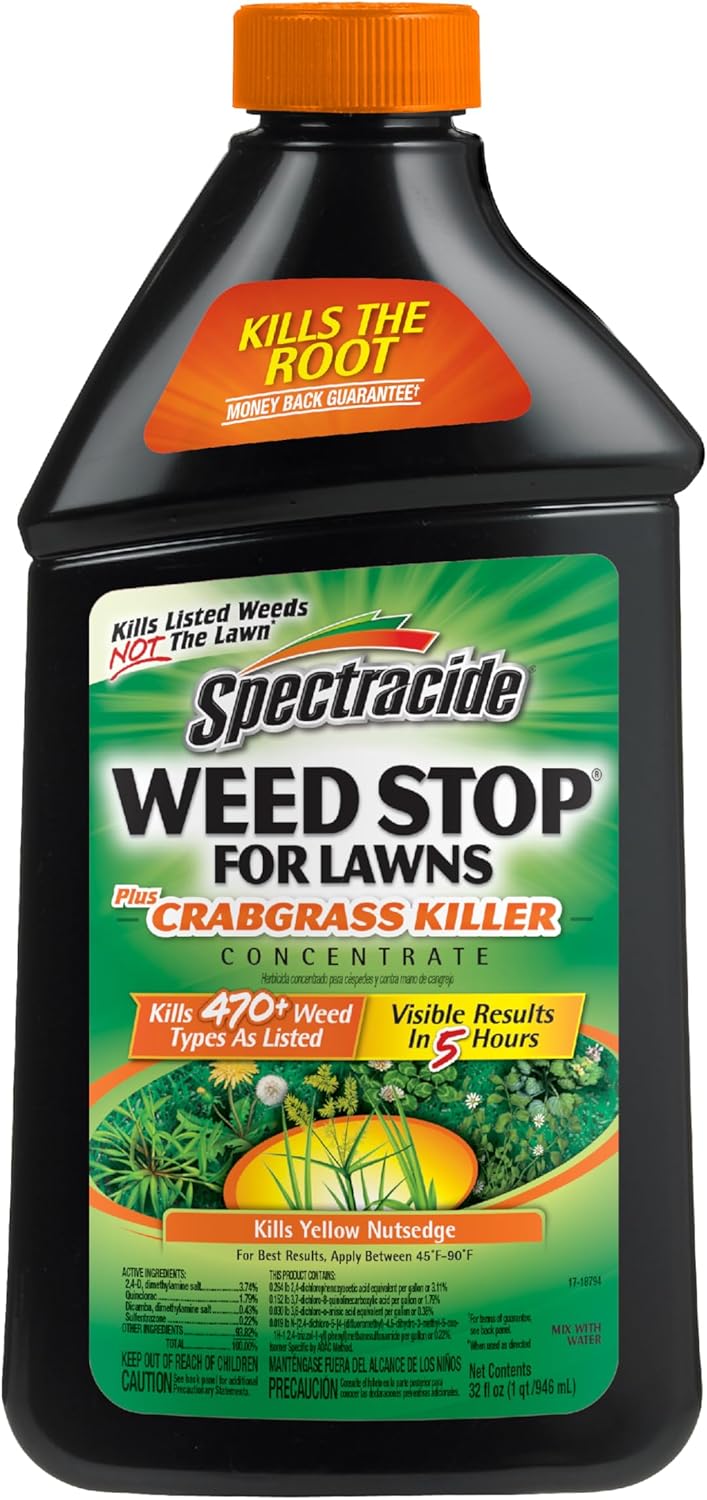
| Unit Count | 32 Ounce |
|---|---|
| Coverage | 5000 square_feet |
| Item Form | Liquid |
| Kills | 470+ listed weeds |
Spectracide Weed Stop Plus Crabgrass Killer is a ready-to-dilute concentrate designed to target grassy and broadleaf weeds across a typical yard. Mix and apply with a sprayer and the formula kills by contact down to the root with visible dieback in about 5 hours and becomes rainfast in roughly 3 hours. The 32 ounce bottle covers up to 5,000 square feet, making it a practical choice for treating whole lawns. Directions note best performance between 45 and 90 degrees daytime temperature and caution against treating Bermudagrass in very hot conditions to avoid temporary discoloration. Practical benefits include fast visible results, broad-spectrum control that includes dandelion and clover, and the convenience of a concentrated product that stretches across a larger area than ready-to-use sprays. Important limitations are the temperature restrictions for safe application, the need to let treated areas dry before people or pets return, and observing reseeding intervals after treatment. For routine crabgrass control on established lawns, this concentrate balances effectiveness and coverage for cost-conscious buyers.
Best for: Buyers who want an economical, concentrated treatment to control crabgrass and a wide range of weeds across a whole lawn and who are comfortable mixing and applying a spray product.
Less Ideal for: People with newly seeded lawns, very small patch treatments who prefer ready-to-use bottles, or those who cannot avoid applying during hotter daytime temperatures.
- Concentrated formula treats up to 5,000 sq ft from a 32 oz bottle
- Kills over 470 listed broadleaf and grassy weeds including crabgrass
- Visible results in about 5 hours and becomes rainfast in approximately 3 hours
- Designed to kill weeds down to the root when used as directed
- Must follow temperature limits to avoid lawn injury, particularly on Bermudagrass
- Requires mixing and a separate sprayer rather than being ready-to-use
Verdict: A budget-friendly concentrate that delivers fast, broad-spectrum crabgrass and weed control for established lawns while covering a large area per bottle.
Basagran Herbicide 2.5 Gallon (Bentazon 44%)

| Active Ingredients | Bentazon 44.0% |
|---|---|
| Item Form | Liquid |
| Liquid Volume | 2.5 gallons |
| Coverage | 1000 square feet |
Basagran is a commercial-strength, post-emergent herbicide formulated with 44% bentazon and supplied as a 2.5 gallon liquid jug for treating nutsedge and broadleaf weeds. It is applied diluted with water according to the label to treat actively growing weeds, with stated coverage of about 1000 square feet per full jug when mixed as directed. As a contact herbicide, it works best on young, actively growing yellow nutsedge and broadleaf species and is commonly used in turf, ornamentals, corn and soybeans where labeled. The practical benefits are straightforward: a high-concentration active ingredient for reliable control when used at correct rates, a large container suited to multiple treatments, and familiarity for growers who need a proven bentazon product. Limitations to note are that it is contact-only so repeat applications or follow-up cultural control may be needed for heavy infestations, and careful adherence to label directions is required for safety and crop tolerance. Users should plan applications for the right growth stage and follow all safety and use instructions on the label.
Best for: Buyers who prioritize consistent, proven chemical control of nutsedge and broadleaf weeds in turf or labeled crops and who follow label directions and safe application practices.
Less Ideal for: Casual gardeners looking for an all-in-one, low-risk solution or those unwilling to follow pesticide label restrictions should consider gentler or non-chemical options instead.
- High 44% bentazon concentration for effective post-emergent control of yellow nutsedge and many broadleaf weeds
- Large 2.5 gallon jug suitable for multiple treatments or larger areas
- Designed for turf, ornamentals and labeled crops so it fits common agricultural and lawn use cases
- Contact mode of action, so it performs best on actively growing weeds and may require repeat applications for complete control
- Requires strict adherence to label directions for safety and correct crop use
Verdict: Choose this concentrated bentazon formulation when you need a reliable, professional-strength post-emergent option for controlling yellow nutsedge and broadleaf weeds.
Ortho Nutsedge Killer for Lawns Ready-To-Spray, 32 fl. oz.

| Unit Count | 32 Fluid Ounces |
|---|---|
| Coverage | 5000 square_feets |
| Item Form | Spray |
| Active Ingredients | Sulfentrazone |
Ortho Nutsedge Killer for Lawns is a hose-end ready-to-spray herbicide designed to target nutsedge, kyllinga and a long list of other sedge and broadleaf weeds while leaving established turfgrass intact. You connect your garden hose to the built-in sprayer, flip the thumb activation on and apply evenly over the affected area; a 32 fl. oz. bottle treats up to about 5,000 sq. ft. The active ingredient is sulfentrazone, which is effective on stubborn sedges and several broadleaf weeds such as spurge, dandelion and plantain. Practical benefits include the convenience of a no-mix hose applicator, clear directions for common lawn grasses and coverage suitable for medium lawns. Important limitations are that it must not be used on newly planted or sodded turf, and it should not be sprayed on ornamentals, flowers or vegetables; treated areas must stay off-limits to children and pets until dry and application in windy conditions is discouraged. For homeowners who prefer an easy hose-end solution, this product simplifies spot and area treatments for spurge and similar weeds.
Best for: Homeowners who want a convenient, low-effort spray to control nutsedge and spurge in established lawns and who prioritize products with clear label directions and documented performance.
Less Ideal for: Gardeners establishing new turf, those who need a herbicide for ornamentals or edible beds, and users wanting a granular or non-chemical option for spurge control.
- Ready-to-spray hose-end applicator for simple, no-mix application
- Active ingredient sulfentrazone targets nutsedge, kyllinga and many broadleaf weeds including spurge
- Covers up to 5,000 sq. ft. from one 32 fl. oz. bottle
- Label lists both cool- and warm-season turfgrasses where product is safe to use
- Not safe for newly planted, plugged or sodded turf or for use on ornamentals, flowers or vegetable beds
- Requires keeping children and pets off treated areas until sprays have dried
Verdict: A convenient hose-end sulfentrazone formula that makes targeting nutsedge and spurge in established lawns quick and easy.
SEDGEHAMMER Plus Turf Herbicide Nutsedge Killer, 2-Pack

| Item Form | Powder |
|---|---|
| Coverage | 1000 square_feet |
| Unit Count | 1 Ounce |
| Number of Packs | 2 |
| Active Ingredients | Herbicide |
Sedgehammer Plus is a selective post-emergent herbicide sold as pre-measured powder packets that you mix into water and spray on actively growing nutsedge and other small broadleaf and sedge weeds. One 13.5 g packet already contains a non-ionic surfactant and is mixed into one gallon of water to treat about 1,000 square feet, so applications are simple and measured. It works systemically, moving into tubers and nutlets so you can see yellowing within 10 to 14 days and fuller control in a few weeks. The label lists compatibility with many common turfgrasses and gives clear timing guidance such as not mowing two days before and after treatment and avoiding rain within four hours. Practical strengths are convenience of single-dose packets, built-in surfactant, and selective activity that reduces risk to established turf when used as directed. Limitations are that it targets specific weeds rather than acting as a broad-spectrum lawn spray and requires careful timing, repeat applications for heavy infestations, and adherence to safety directions about pets, children, and not storing mixed solution.
Best for: Buyers who want a reliable, easy-to-mix product that controls nutsedge without harming common turfgrasses and who prefer clear, measured applications and conservative lawn care practices.
Less Ideal for: People seeking a single product to kill a wide range of weed types across non-turf areas or those who prefer granular or extended-release formats for very large properties.
- Pre-measured packets with built-in surfactant for easy, accurate mixing
- Systemic action that reaches tubers and nutlets for longer-lasting nutsedge control
- Selective formulation labeled for many common turfgrasses to lower risk to lawn
- Covers approximately 1,000 sq ft per packet, simplifying coverage planning
- Targets nutsedge and a limited list of weeds rather than providing broad-spectrum weed control
- Mixed solution should be used immediately and not stored, requiring planning around application windows
- May require repeat treatments for heavy or established infestations
Verdict: If you want a straightforward, selective nutsedge treatment with single-use packets and built-in surfactant, Sedgehammer Plus is a practical, low-risk choice.
Choosing the Right Herbicide for Nutsedge: Key Factors to Consider
Active Ingredient and Mode of Action
Different active ingredients target nutsedge through distinct physiological pathways, and the mode of action determines how and when the herbicide will work. Some act on cell division or lipid synthesis and require uptake through green foliage, so they are most effective on actively growing nutsedge. Others have translocation characteristics that can reach underground tubers when applied at the right growth stage.
Understanding the active ingredient also helps you rotate chemistries across seasons to reduce the risk of resistance. Check the label for the primary active, any synergists, and whether tank mixes are recommended or restricted. This affects both efficacy and long-term management strategy.
Labeled Uses and Turf Safety
Labels list the turfgrass species, ornamental plants, and site types where a product is permitted and indicate any restrictions or precautions. Turf safety varies by grass type; a herbicide safe on warm-season grasses may injure cool-season lawns, and vice versa. Pay attention to timing restrictions that limit applications during heat stress or dormancy, as stressed turf is more susceptible to damage.
Also check buffer zones, re-entry intervals, and whether the label permits use around ornamentals or in landscaped beds. Choosing a product labeled for your specific lawn or planting types reduces the chance of unintended injury.
Application Timing and Growth Stage
Nutsedge responds differently to treatments depending on growth stage. Many herbicides are most effective when nutsedge is actively growing, typically in warmer months when plants are producing green shoots and taking up foliar-applied chemistry. Treating too early or when plants are dormant will reduce uptake and control.
Repeat applications are sometimes necessary to reach tubers that sprout after initial treatment. Follow label windows for retreatment and consider integrating cultural practices like improved drainage and mowing height adjustments to reduce reinfestation pressure.
Residual Activity and Re-treatment Interval
Some herbicides offer residual soil activity that suppresses new nutsedge shoots for weeks to months, while others rely mainly on contact and require follow-up sprays. Residual control can reduce labor and the number of treatments, but higher persistence may limit planting options and could affect desirable seedlings or nearby ornamentals.
Review re-treatment intervals and how long you must avoid planting sensitive species. For beds where you plan to establish new plants, choose a chemistry with a short residual or be prepared to follow label specified planting waits.
Application Method and Equipment
Herbicides come as concentrates, ready-to-use mixes, or granular forms, and each has different mixing and application needs. Backpack or pump sprayers are common for spot treatments in lawns, while hose-end or granular spreaders can be useful for larger areas. Some formulations require nonionic surfactants or crop oil concentrates to improve uptake.
Equipment calibration and spray coverage matter: underdosing reduces effectiveness, while overapplication increases the risk of turf injury and environmental runoff. Consider what gear you have and choose a formulation that fits your comfort level with measuring and applying chemicals.
When to Treat Nutsedge
Treat nutsedge when shoots are actively growing and visibly green. Active uptake through foliage is critical for many post-emergent herbicides, so applications during warm, non-stressed conditions will give the best results.
Avoid treating during drought stress or during extreme heat if the label warns against it. For persistent infestations, plan follow-up applications based on label intervals and monitor for new shoots after initial control.
- Target treatments in late spring through mid-summer when nutsedge is most active
- Wait for adequate soil moisture but avoid applications during heavy rain forecasts
- Scout regularly and spot-treat new emergence to limit tuber replenishment
Cultural Practices to Reduce Nutsedge Pressure
Herbicides are most effective when combined with cultural tactics that reduce the environment nutsedge prefers. Improve drainage in wet areas where nutsedge thrives, adjust irrigation timing to avoid persistent surface moisture, and raise mowing heights where appropriate to encourage dense turf competition.
Mulching beds and pulling isolated clumps before they set more tubers can slow spread. Over time, healthier, competitive turf and less favorable soil moisture conditions decrease the frequency of chemical interventions.
- Correct drainage issues and reduce surface saturation
- Maintain recommended mowing height to strengthen turf competition
- Use mulch in beds to suppress new shoots and limit light reaching tubers
Spot Treatment Vs. Broadcast Applications
Spot treating visible nutsedge reduces chemical use and lowers risk to desirable plants, but broadcast applications can be appropriate for widespread infestations. Decide based on infestation size, proximity to sensitive species, and whether you need residual protection over a larger area.
When spot treating, apply carefully to avoid overspray on ornamentals. For broadcast sprays, calibrate equipment and follow label rates for uniform coverage and effective control.
- Spot treat small patches to save product and limit exposure
- Broadcast for large or diffuse infestations following label directions
- Use physical barriers or shielded spraying near sensitive ornamentals
Safety, Storage, and Environmental Considerations
Follow label instructions for personal protective equipment, mixing, and disposal. Store concentrates out of reach of children and pets in original containers and keep away from extreme temperatures.
Be mindful of runoff and avoid applying before heavy rain. Some active ingredients have restrictions near water bodies or on slopes; check label buffer requirements and local regulations to protect pollinators and aquatic life.
- Wear appropriate gloves, eye protection, and clothing when mixing and applying
- Do not apply before heavy rain or in windy conditions that increase drift
- Respect label buffer zones near water and sensitive vegetation
How We Chose the Best Herbicide for Nutsedge
We focused on products and formulas designed to control nutsedge and similar yellow or purple nutsedges rather than general broadleaf or grass-only herbicides. Evaluation prioritized how reliably a product reduces nutsedge density in established turf or beds, and whether it does so without causing unacceptable injury to desirable grass or ornamentals. Key criteria included documented nutsedge efficacy across application timings and growth stages, labeled turf and ornamental safety, required application rates and re-treatment intervals, and mode of action to help avoid resistance from repeated single-mode use. We also considered formulation type and ease of mixing for typical homeowner equipment, plus active ingredient persistence and any special adjuvant needs. We excluded general-purpose weed killers with no specific efficacy data for nutsedge, products intended only for agricultural row crops, and specialty chemistries not labeled for common lawn or ornamental use. The resulting list emphasizes options that match real gardener needs: predictable nutsedge control, compatibility with common turf species, and clear application guidance.
FAQ
How long before I see results after applying a nutsedge herbicide?
Results often appear within 7 to 21 days as treated shoots yellow and die, but full control of underground tubers can take multiple weeks and occasional follow-up applications. Timing depends on active ingredient, growth stage at application, and environmental conditions.
Can I mix a nutsedge herbicide with other lawn sprays?
Mixing depends on label instructions and compatibility. Some herbicides are designed to tank-mix with fertilizer or broad-spectrum products, while others list specific incompatibilities. Always run a jar test or follow manufacturer guidance and avoid unlisted combinations near sensitive plants.
Will a nutsedge herbicide harm my ornamental plantings?
Potential harm depends on the product label and proximity. Some formulas are labeled safe for many ornamentals when used as directed, but overspray or drift can injure non-target plants. Use spot treatments, shielding, or choose products labeled for use around ornamentals to reduce risk.
Is repeated application necessary to control nutsedge?
Often yes. Because nutsedge reproduces from underground tubers, a single application may not eliminate future sprouts. Labels usually provide safe re-treatment intervals and recommend follow-up sprays to address shoots that emerge after initial control.
Can cultural changes reduce reliance on herbicides for nutsedge?
Yes. Improving drainage, reducing surface moisture, maintaining healthy turf, and mulching beds all make conditions less favorable for nutsedge. Cultural practices combined with targeted herbicide use reduce the frequency and quantity of chemical applications needed.
Final Verdict
Choose a nutsedge control plan that matches your site and tolerance for re-treatment. Prioritize products labeled for nutsedge with proven efficacy, then match the label to your turf or ornamental species to avoid injury. Balance residual needs against planting plans and use cultural practices to lower long-term pressure. A thoughtful approach that considers active ingredient, timing, and equipment will produce more reliable results than repeated random applications. Focus on the factors discussed here to pick the safest and most effective strategy for your lawn or beds.
