

Note: This article contains affiliate links. If you click on these links and make a purchase, I may earn a small commission at no extra cost to you. This helps support my research and content. Read my full affiliate disclosure here.
If you spend weekend hours preparing beds or reclaiming overgrown patches, the right homeowner garden tiller saves time and reduces back strain. A tiller that matches the size of your garden and the soil type you work with will make a noticeable difference in how quickly you can plant and how well seedlings establish. This guide covers seven top picks geared toward homeowners, shortlisted for real backyard use. We focus on how each design performs in compact plots and typical yard soils, and we evaluate power delivery, handling, durability, and maintenance needs. Read on to find a tiller that fits your garden layout and physical comfort level.
Top Picks at a Glance
| Best Overall The best all-around choice for most situations | Sun Joe TJ603E 16-Inch Corded Electric Garden Tiller & Cultivator |  |
| Best Quality Built to a higher standard if you want something more solid | Poulan Pro 18" Rear Tine Tiller with 212cc Gas Engine |  |
| Best Value The sweet spot between price and what you get | SOARFLY Cordless Tiller Cultivator with 2×4.0Ah Batteries |  |
| Best Budget The cheapest option that still gets the job done reliably | Muylux 20V Cordless Tiller Cultivator with 2 x 2.0Ah Batteries |  |
| Highest Rated A top-rated pick with lots of positive feedback | Sun Joe Corded Electric Garden Tiller & Cultivator TJ604E |  |
| Most Popular A crowd favorite that many people choose with confidence | BILT HARD 14-inch Corded Electric Tiller Cultivator, 10 Amp |  |
| Best Seller A high-volume bestseller chosen again and again | HEINPRO Cordless Garden Tiller Cultivator (Compatible with DEWALT 20V MAX) |  |
Sun Joe TJ603E 16-Inch Corded Electric Garden Tiller & Cultivator

| Power Source | Corded Electric |
|---|---|
| Motor | 12 Amp |
| Tilling Width | 16 Inch |
| Tine Material | Steel |
The Sun Joe TJ603E is a compact corded tiller and cultivator built to break up soil and prepare garden beds quickly. It uses a 12-amp electric motor to power six angled steel tines that cultivate a 16-inch swath and reach about 8 inches deep, making it a good choice for turning small to medium vegetable plots, flower beds, and prepping new planting rows. The folding handle and three-position wheel adjustment make it easy to set working depth and transport or store in a garage. Being electric, it runs cleaner and quieter than gas models and requires little maintenance beyond keeping tines clean. Practical limitations are the corded power source, which restricts reach without an extension, and the unit is intended for lighter soils and moderate workloads rather than heavy, compacted ground or commercial-scale tilling. For gardeners who want reliable, low-maintenance performance for routine bed preparation, this machine delivers straightforward, efficient results.
Best for: Gardens where routine bed preparation and moderate digging are the priority; ideal for homeowners who want a low-maintenance, reliable electric tool to prep vegetable plots and flower beds quickly.
Less Ideal for: Large acreage, professional landscapers, or anyone who needs to break up dense, compacted clay or heavy turf should consider a more powerful gas or heavy-duty tiller instead.
- Decent 12-amp motor for consistent power during typical home gardening tasks
- Six angled steel tines for effective soil turnover and durability
- 16-inch tilling width covers beds efficiently for quicker passes
- Folding handle and adjustable wheel positions for easier transport and storage
- Electric operation reduces maintenance and eliminates gas fumes and oil
- Corded design limits working range without an outdoor extension cord
- Not intended for very hard, compacted soils or commercial-scale tilling
Verdict: A practical, low-maintenance electric tiller that delivers dependable performance for routine garden bed preparation.
Poulan Pro 18" Rear Tine Tiller with 212cc Gas Engine
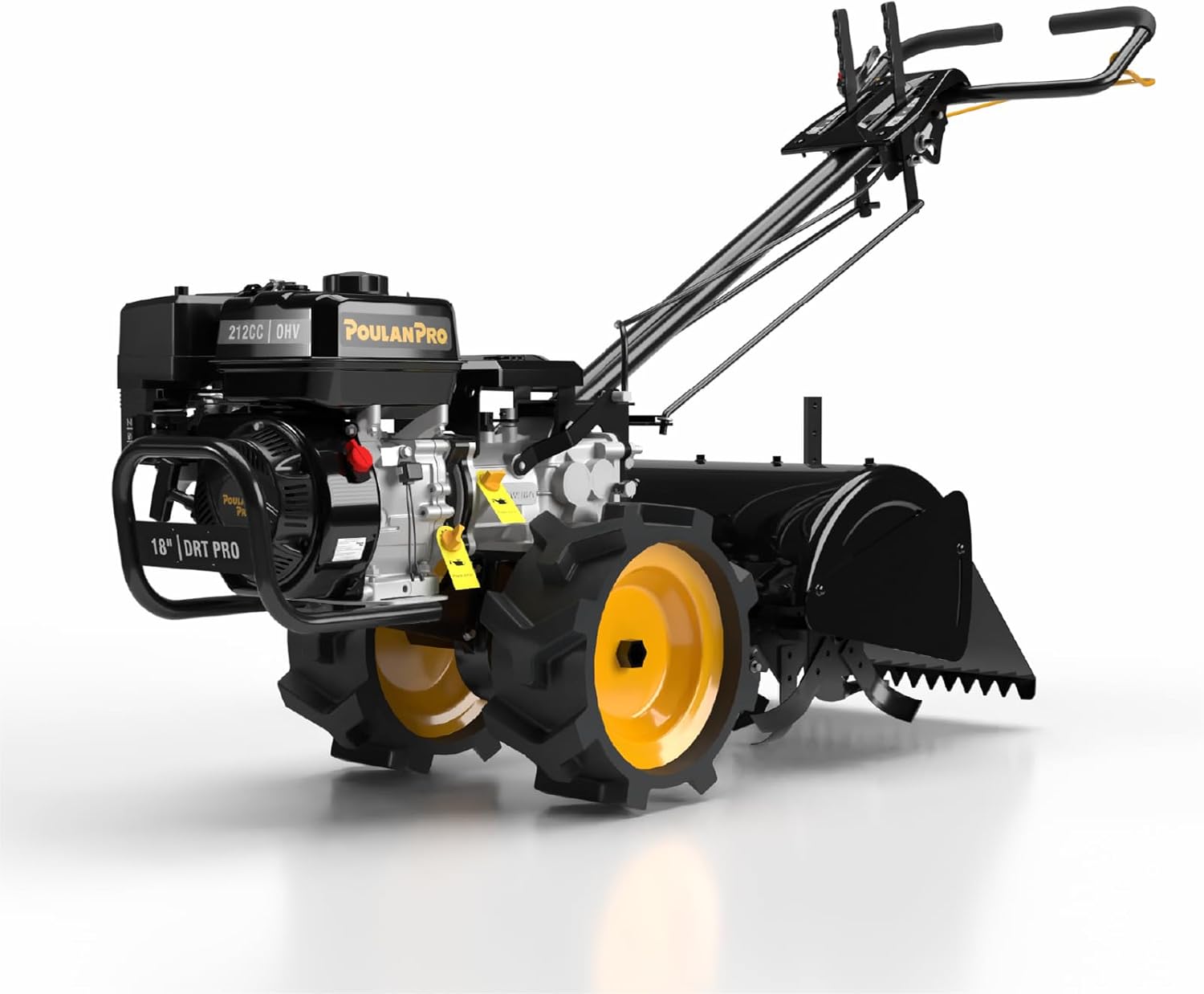
| Engine | 212cc 4-cycle |
|---|---|
| Tilling width | 18" |
| Tilling depth | 4"-10" |
| Tines | 16 steel dual-rotation |
| Transmission | Full gear-driven |
The Poulan Pro 18-inch rear tine tiller is built for repetitive, demanding soil work where reliability matters. Its 212cc 4-cycle gas engine pairs with a full gear-driven transmission rather than belts, which reduces routine adjustments and delivers steady power when breaking hard or compacted ground. The unit uses 16 steel tines with dual-direction rotation and three speeds (two forward, one reverse) so you can control progress and back out without fighting the machine. Flat-free tires and a dual-grip handlebar make maneuvering and pivoting along beds more controlled and low maintenance. Practical benefits include consistent performance in vegetable plots, flower beds, and small acreage prep, plus fewer service headaches thanks to the gear drive. Important limitations are that it is a gas machine so it needs fueling and periodic engine upkeep, and its weight and size make it less suited for very small or raised beds where a compact tool would be easier to handle.
Best for: Gardeners and small-scale growers who prioritize a low-maintenance, workhorse tiller that consistently handles heavy or compacted soil for regular bed preparation.
Less Ideal for: Urban gardeners with very small plots, raised beds, or those who prefer electric or hand tools for lighter, infrequent tilling tasks.
- Full gear-driven transmission reduces belt maintenance and delivers consistent torque
- Powerful 212cc 4-cycle engine handles compacted soil and larger plots
- Dual-rotation 16-tine setup with multiple speeds improves control when tilling and reversing
- Flat-free tires provide long-term durability and stable traction without inflation concerns
- Gas engine requires regular fueling, oil changes, and winter storage care
- Physical size and weight limit ease of use in very small or raised garden beds
Verdict: Choose this tiller when you need a robust, low-maintenance gas tiller that consistently tackles compacted soil on vegetable plots and small farms.
SOARFLY Cordless Tiller Cultivator with 2×4.0Ah Batteries

| Unit Count | 2 Count |
|---|---|
| Material Type | Alloy Steel, Plastic |
| Power Source | Battery Powered |
| Operation Mode | Electric |
This SOARFLY cordless tiller is built for small gardens, raised beds, and flower plots where maneuverability and ease matter more than industrial power. It runs on two included 4.0Ah lithium batteries and drives 48 steel tines at a stated 360 RPM to loosen soil, remove weeds, and aerate moderately compacted ground. Adjustable handle height and an auxiliary grip make it simple to steer in tight rows and reduce operator fatigue during longer sessions. Because it is cordless and relatively lightweight, it is easy to carry between beds and safe to use where extension cords would be impractical. The machine performs best in normal garden soil and slightly moist clay when started shallow and increased gradually; very hard, rock-filled, or deeply compacted ground will slow progress and may require multiple passes or a heavier gas unit. Safety features include a two-step start with a safety lock to prevent accidental engagement. For gardeners who want a fuss-free, portable cultivator for prepping planting areas and spot weeding, this model is a practical, user-friendly option.
Best for: Home gardeners with small plots, raised beds, or tight planting rows who prioritize a lightweight, cordless tool that is easy to maneuver and reduces physical strain.
Less Ideal for: Large acreage owners or users who need to break up deep, heavily compacted or rock-strewn soil should consider a heavier gas-powered tiller instead.
- Comes with two 4.0Ah batteries for extended runtime and quick battery swaps
- 48 steel tines provide effective soil loosening for small beds and raised planters
- Adjustable height and auxiliary handle improve comfort and control during use
- Cordless design makes it highly portable and usable where power outlets are unavailable
- Not powerful enough for very hard, rocky, or deeply compacted soil compared with gas tillers
- 360 RPM and lightweight build mean slower progress on large areas
Verdict: A portable, easy-to-use cordless cultivator ideal for prepping and maintaining small gardens and raised beds with minimal hassle.
Muylux 20V Cordless Tiller Cultivator with 2 x 2.0Ah Batteries

| Power Source | Battery Powered |
|---|---|
| Operation Mode | Electric |
| Material Type | Alloy Steel |
| Number of Items | 2 |
The Muylux 20V cordless tiller is a compact electric cultivator built for light-duty garden tasks like prepping planting beds, aerating turf edges, and breaking up shallow compacted soil. It uses two steel tines that rotate up to 240 RPM and are rated to loosen soil about 4 inches deep, which makes quick work of small plots and tight spaces where a full-size tiller would be unwieldy. The included pair of 2.0Ah 20V batteries lets you swap packs to keep working without long interruptions, and the cordless design improves maneuverability around raised beds and landscaping. Its lightweight, ergonomic handle reduces user fatigue for shorter sessions. Expect this to perform well for routine cultivation and small vegetable patches, but it is not intended for deep digging or heavy clay and will struggle on very compacted ground or large acreage. Durable alloy-steel tines and simple electric controls keep maintenance low, though run time depends on battery capacity and the unit is best suited to frequent short jobs rather than extended commercial work.
Best for: Buyers who want an affordable, easy-to-use cordless tool for prepping small vegetable beds, container gardens, or flower borders and prefer portability over heavy-duty power.
Less Ideal for: Do not choose this if you need a machine for deep tilling, extensive acreage, or frequent heavy-duty landscaping tasks.
- Cordless battery operation improves maneuverability in small gardens and tight spots.
- Two included 20V batteries allow quick swapping to extend working time for short tasks.
- Steel tines rated to loosen soil up to 4 inches deep for efficient bed preparation.
- Lightweight ergonomic design reduces user fatigue during routine cultivation.
- Not designed for deep tilling or heavy clay soils where a larger gas or heavy-duty electric tiller is needed.
- 2.0Ah batteries provide limited run time for larger areas and may require frequent recharging or replacements.
Verdict: A budget-friendly cordless cultivator that delivers convenient, lightweight soil prep for small gardens and tight spaces.
Sun Joe Corded Electric Garden Tiller & Cultivator TJ604E

| Power Source | Corded Electric |
|---|---|
| Motor | 13.5-Amp |
| Tilling Width | Up to 16 inches |
| Tilling Depth | Up to 8 inches |
The Sun Joe TJ604E is a compact corded electric tiller built to prepare small garden plots and flower beds without the fuss of gas maintenance. It runs on a 13.5-amp motor that tills a 16-inch-wide swath up to 8 inches deep, using six angled alloy steel tines that resist rust and handle light to medium soil. The folding handle and three-position wheel adjustment make it easy to store and to control working depth across different soil types. As an electric machine it delivers quieter, cleaner operation and continuous power as long as you have an outlet nearby, which simplifies upkeep compared with small gas tillers. Limitations include dependence on a cord for power, which restricts range and requires care to avoid tangling, and it is best suited for softened or loamy soils rather than heavy clay or rocky ground where a more powerful gas model would perform better.
Best for: Gardeners who want a low-maintenance, easy-to-use cultivator for preparing and refreshing small vegetable beds, flower borders, or starter plots and who prioritize simplicity and reliable electric power.
Less Ideal for: Large-acreage gardeners or those who regularly work compacted clay or rocky ground should consider a heavier gas-powered tiller or professional equipment instead.
- 13.5-amp motor provides steady power for small to medium garden beds
- Six angled alloy steel tines designed to resist rust and cultivate effectively
- Folding handle and compact footprint for easy storage and transport
- Three-position wheel adjustment for better control of tilling depth
- Corded electric design means quieter operation and low maintenance
- Corded power limits working range and requires attention to avoid the cord
- Not intended for very heavy clay, large roots, or rocky conditions
Verdict: If you need a simple, low-maintenance electric tiller to quickly prepare and maintain small gardens, the Sun Joe TJ604E delivers reliable power and easy storage.
BILT HARD 14-inch Corded Electric Tiller Cultivator, 10 Amp

| Power Source | Corded Electric |
|---|---|
| Working Width | 14" |
| Working Depth | 8.7" |
| Tines | 4 rust-resistant steel blades |
The BILT HARD 14-inch corded electric tiller is built for small vegetable patches, flowerbeds, and light soil prep where maneuverability matters more than heavy-duty power. Its 10 amp AC motor turns four rust-resistant steel tines to till a 14-inch swath to roughly 8.7 inches deep, making short work of breaking up topsoil, mixing in compost, and removing shallow weeds. The unit is compact and light enough for one person to handle and the two-position wheels plus foldable H-handle make transport and storage straightforward. Safety features include a lock button to reduce accidental starts. Practical limitations are its corded power and modest tine setup, which mean it is best for looser soil and smaller plots rather than compacted ground or deep, rocky beds. Expect quicker work on established garden soil and lighter prep tasks but consider a larger electric or gas tiller for heavy duty turning or large acreage.
Best for: Gardeners with small to medium raised beds or flower borders who want an easy-to-handle, low-maintenance tiller for routine soil prep and compost mixing.
Less Ideal for: People preparing large plots, hard-packed ground, or stony soils should look at more powerful gas or larger electric tillers built for heavy-duty turning.
- Lightweight and foldable handle for easy transport and compact storage
- Four rust-resistant steel tines that slice and mix soil for small beds
- Two-position wheels simplify moving between work and transport modes
- Safety lock button reduces risk of accidental activation
- Corded power limits range and requires an appropriately rated extension cable
- Modest tine configuration and 10 Amp motor are not ideal for very hard or rocky soil
Verdict: A compact, easy-to-use electric tiller that handles routine prep of small garden beds quickly and with minimal storage footprint.
HEINPRO Cordless Garden Tiller Cultivator (Compatible with DEWALT 20V MAX)

| Power Source | Battery Powered (Battery and Charger not Included) |
|---|---|
| Working Width | 9In tilling width |
| Tilling Depth | 7In depth |
| Blades | 4 hardened steel blades |
| Speed | 360 RPM |
This HEINPRO cordless tiller is a compact electric cultivator aimed at quick soil prep in small plots and raised beds. It uses DEWALT 20V MAX-compatible batteries so you can borrow power from an existing tool collection, and an integrated battery gauge shows runtime at a glance. The unit turns soil with four hardened steel blades at about 360 RPM across a 9-inch working width and up to 7-inch depth, making light plowing, aerating, mixing compost, and weeding straightforward. The tiller is easy to assemble with a three-section pole and quick-release collar and has an adjustable auxiliary handle and non-slip soft grip for better control. Safety is addressed with a dual-switch system to prevent accidental starts. Limitations include modest power and a narrow working width that make it unsuitable for heavy sod, dense grass, or large acreage, and the battery and charger are not supplied. For small vegetable plots and tight garden spaces it is a practical, low-maintenance alternative to gas tillers.
Best for: Buyers who want a simple, low-maintenance electric tiller for small vegetable plots, raised beds, or flower borders and who prioritize safety and ease of use over maximum power.
Less Ideal for: People needing a heavy-duty tiller for large gardens, commercial use, or for removing established turf should consider a larger gas or higher‑power electric model.
- Cordless design compatible with DEWALT 20V MAX batteries for convenient shared power
- Lightweight and ergonomic with adjustable handle and soft grip for reduced user fatigue
- Four hardened steel blades provide efficient soil mixing, aeration, and light plowing
- Dual safety switch reduces accidental starts and improves user safety
- Quick three-section assembly and compact storage for tight sheds and garages
- Not intended for heavy sod or dense grass where blades can tangle
- Battery and charger are not included so runtime depends on separate purchase or existing batteries
- Narrow 9-inch width and modest RPM limit efficiency on larger areas
Verdict: A lightweight, safe cordless tiller that makes quick soil prep in small beds easy using DEWALT 20V MAX batteries.
Choosing the Right Homeowner Garden Tiller: Key Factors to Consider
Engine or Motor Power
Engine or motor power determines how effectively a tiller can break into compacted soil and mix in amendments. For most homeowners, moderate horsepower is sufficient for loamy or amended garden beds, while higher torque helps with clay, sod, or previously untilled ground. Electric models often deliver immediate torque and low maintenance, but gas units generally provide more sustained power for heavier tasks.
Consider how much raw power you need based on the toughest patch you expect to work. A small plot of raised beds usually needs less power than reclaiming a backyard lawn. Overpowered machines can be harder to control in tight spaces, so balance power against handling.
Tine Configuration and Width
Tine layout and cutting width affect how many passes you need, the size of furrows created, and how the machine moves through roots and debris. Narrower tines and a slimmer working width are better for tight rows and between beds, while wider tine arrays speed up preparation for larger plots. The direction tines rotate and whether they are reversible also influence soil mixing and forward traction.
Think about the typical bed width and how close you work to established plants. Interchangeable or shielded tine setups can extend usefulness across tasks from light cultivation to full-depth tilling.
Maneuverability and Handling
How a tiller steers, its wheel placement, handle ergonomics, and overall weight determine how easily you can control it in a home garden. Lighter units are easier to transport and position, but they may not provide the traction needed in heavy soils. Counterintuitively, slightly heavier tillers with well-placed wheels and good handle leverage can feel easier to guide because they track straight and resist kickback.
Assess garden access points, gate widths, and storage space when choosing a tiller. Foldable or adjustable handles make transport and storage simpler for homeowners with limited shed room.
Starting Reliability and Routine Maintenance
If a tiller is hard to start or fussy to maintain, you are less likely to use it promptly during planting windows. Easy-start engines, simple electric controls, or belt-driven systems with accessible adjustments reduce time spent troubleshooting. Also consider maintenance intervals for spark plugs, air filters, lubrication points, and tine inspections.
Homeowners benefit from machines with clear access to wear items and straightforward tuning procedures. Fewer maintenance steps lower the chance of downtime during critical planting periods.
Durability of Wear Components
Tines, transmission gears, and tine-shaft bearings take the most abuse. Robust materials and replaceable wear parts lengthen a tiller's useful life. Look for simple guard designs that prevent stones and roots from bending tines and for sealed gearboxes or straightforward lubrication points that cut down on corrosion and wear.
Durability matters more if you plan to till frequently or work gritty, rocky soils. For occasional light use, moderate-grade components can be acceptable but expect faster wear.
Electric Vs Gas Options for Home Gardens
Electric tillers suit many homeowners because they are quiet, low-maintenance, and easier to start. Corded electric models are best for smaller beds close to an outlet, while battery-powered units add portability without gasoline maintenance. Battery runtime and torque are the main tradeoffs to check for heavier soils.
Gas tillers provide consistent power and are better for reclaiming lawn or working deep compacted soil. They require more maintenance and tend to be louder, but their sustained torque makes quicker work of tough patches.
- Electric: low maintenance, quieter, limited by cord or battery life
- Gas: higher sustained power, more maintenance, better for deep tilling
Preparing Your Plot Before Tilling
Remove large roots, rocks, and persistent weeds before running a tiller. Scanning the area and pulling or pruning problem material prevents excessive wear and reduces the risk of damaging tines. For very thick sod, cut into strips or use a sod cutter first so the tiller can handle smaller sections.
Mark permanent planting areas and avoid tilling where you intend to leave established shrubs. If the soil is very wet, wait until it is slightly drier; tilling wet clay can create tight clods that are hard to break down later.
- Pull out large debris and stakes
- Cut or section heavy sod before tilling
- Avoid working overly wet soil to prevent compaction
Depth Control and Layering Amendments
Controlling till depth helps you incorporate compost and amendments at the right level for root development. For seed beds, a shallow pass followed by a finer rake pass creates a smooth, friable surface. For planting root vegetables, till deeper to loosen the subsoil and remove impediments.
Work amendments in stages. Mix bulky organic matter with a first pass at shallow depth, then till deeper on a second pass to integrate materials more thoroughly. This staged approach prevents burying light compost too deep and helps maintain soil structure.
- Shallow pass for seedbeds
- Deeper pass for root crops and new beds
- Staged amendment mixing for even incorporation
Safe Operation and Operator Comfort
Wear eye protection and sturdy footwear to guard against thrown debris. Keep hands and feet away from rotating tines, and never make adjustments while the engine or motor is running. Familiarize yourself with shutoff controls and emergency stop procedures before starting.
To reduce strain, choose a tiller with adjustable handle height and good vibration damping. Take regular short breaks during long sessions and consider using a shoulder strap or helper for moving heavier machines around your yard.
- Use PPE and keep clear of tines
- Adjust handles for posture and reach
- Know shutoff controls and safe handling procedures
Storing and Winterizing Your Tiller
Prepare a tiller for storage by cleaning soil from tines and removing plant residue. For gas units, follow manufacturer guidance on fuel stabilization or draining fuel to prevent carburetor issues. Lubricate moving parts and inspect for worn tines or loose fasteners before putting the machine away.
Store in a dry, covered location to prevent corrosion and battery degradation. Investing a little time in proper winterizing reduces startup trouble in the next season and extends the unit's usable life.
- Clean tines and remove debris
- Stabilize or drain fuel for gas models
- Store in a dry, sheltered spot
How We Chose the Best Homeowner Garden Tiller
We shortlisted Homeowner Garden Tillers by focusing on practical, gardener-facing criteria that predict real-world performance in small to medium yards. Selection began with machines designed for homeowner-scale plots rather than commercial implements. We excluded heavy-duty agricultural tillers and purely ornamental tools that cannot break compacted suburban soils. Key evaluation criteria included engine or motor power and torque for breaking through compact or clay soils, tine configuration and width for coverage without excessive passes, handling and maneuverability for narrow beds and around obstacles, and ease of starting and routine maintenance because homeowners often handle upkeep themselves. Durability of key components and availability of common replacement parts were also considered to ensure a reasonable service life under regular backyard use. Finally, vibration and operator comfort were assessed to reflect how long you can work without fatigue.
FAQ
How deep should I till a new vegetable bed?
For most vegetable beds, a two-step approach works well: a shallow initial pass of 3 to 4 inches to mix amendments, followed by a deeper pass of 6 to 8 inches if you need to loosen compacted subsoil. Depth depends on crop root depth and soil condition.
Can I use a homeowner tiller on clay soil?
Yes, many homeowner tillers can handle clay if they have good torque and sturdy tines. Work clay when it is slightly moist, not saturated, and consider multiple, shallower passes rather than one deep cut to avoid creating hard clods.
Is an electric tiller powerful enough for raised beds?
Electric tillers are often ideal for raised beds because they are lighter and easier to maneuver in tight spaces. Battery models provide good convenience, but check that torque and battery runtime match the depth and length of your beds.
How often should I service the tines and gearbox?
Inspect tines before each season and after heavy jobs, replacing bent or badly worn tines as needed. Gearboxes and drivetrain components typically need lubrication or inspection annually, or sooner if you use the tiller frequently in gritty soils.
Will tilling bring weed seeds to the surface?
Tilling can expose dormant weed seeds and bring them to the surface where they germinate. To reduce weeds, remove persistent roots first, work in pre-plant mulch, and follow up with a fine rake and shallow cultivation to manage seedlings.
Final Verdict
Choose a Homeowner Garden Tiller that matches the toughest soil task you expect and the layout of your garden. Prioritize the right balance of power and maneuverability so you can work efficiently in narrow beds without overexertion. Remember that tine configuration, starting reliability, and the durability of wear parts will determine how useful the machine is season after season. Focus on the evaluation factors discussed here to pick a tiller that makes bed preparation faster, safer, and more consistent.
